Sanjha Morcha

CAPTAIN WITH THE GENERAL

Punjab chief minister Capt Amarinder Singh called on army chief Gen Bipin Rawat on Thursday. Amarinder presented a set of six military history books authored by him to the General.


Homage to Indian WW1 heroes 44 soldiers sacrificed their lives protecting Israel’s Haifa city from Ottoman TurksHomage to Indian WW1 heroes 44 soldiers sacrificed their lives protecting Israel’s Haifa city from Ottoman Turks

Prime Minister Narendra Modi greets the Indian contingent of the United Nations Interim Force in Lebanon during a visit to the Indian Army Cemetery of the World War-I in the Israeli coastal city of Haifa. AFP

Simran Sodhi

Tribune News Service

New Delhi, July 6

Prime Minister Narendra Modi today paid homage to the Indian soldiers whose bravery was instrumental in securing the liberation of Haifa as he wrapped up his historic three-day Israel visit. The PM, accompanied by his Israeli counterpart Benjamin Netanyahu, visited the Indian cemetery in Haifa and laid a wreath to honour the Indian soldiers. “This is the final resting place for 44 of the Indian soldiers who sacrificed their lives during World War I to liberate the city,” Modi said before visiting the site.(Follow The Tribune on Facebook; and Twitter @thetribunechd)Forty-four Indian soldiers were killed protecting Haifa from the Ottoman Turks in World War I. Major Dalpat Singh (MC) is known as the ‘Hero of Haifa’ for his critical role in the liberation of the city. He was awarded a military cross for his bravery.The Haifa war was fought on September 22-23 in 1918. The Indian Army celebrates September 23 as Haifa Day every year. Later in the day, PM Modi and Netanyahu attended the first meeting of India-Israel CEOs forum in Tel Aviv. As many as 12 strategic pacts envisaging investments worth $4.3 billion were signed between Indian and Israeli companies at the first meeting of CEO forum in Tel Aviv today, according to information released by the Federation of Indian Chambers of Commerce and Industry (FICCI). “The forum identified and stressed on the need to realise opportunities in focus sectors identified during the first meeting of CEOs forum. There was a consensus that the current trade volume amounting to just over $ 4 billion has the potential to reach $20 billion in the next five years. To realise this goal, the forum underlined key recommendations to two heads of states,” FICCI said in its statement. After wrapping his rather successful visit, the PM left for the German city of Hamburg where world leaders have gathered to attend the G20 Summit.  Previous ImageNext Image Prime Minister Narendra Modi lays a wreath at the Indian cemetery in Haifa, Israel, on Thursday. Forty-four Indian soldiers laid down their lives during the liberation of Haifa in 1918. The PM also unveiled a plaque commemorating Major Dalpat Singh, known as the “Hero of Haifa”, for his critical role in defeating the Ottoman Empire forces. PTI Simran Sodhi Tribune News Service New Delhi, July 6 Prime Minister Narendra Modi today paid homage to the Indian soldiers whose bravery was instrumental in securing the liberation of Haifa as he wrapped up his historic three-day Israel visit.  The PM, accompanied by his Israeli counterpart Benjamin Netanyahu, visited the Indian cemetery in Haifa and laid a wreath to honour the Indian soldiers.  “This is the final resting place for 44 of the Indian soldiers who sacrificed their lives during World War I to liberate the city,” Modi said before visiting the site. (Follow The Tribune on Facebook; and Twitter @thetribunechd) Forty-four Indian soldiers were killed protecting Haifa from the Ottoman Turks in World War I. Major Dalpat Singh (MC) is known as the ‘Hero of Haifa’ for his critical role in the liberation of the city. He was awarded a military cross for his bravery. The Haifa war was fought on September 22-23 in 1918. The Indian Army celebrates September 23 as Haifa Day every year.  Later in the day, PM Modi and Netanyahu attended the first meeting of India-Israel CEOs forum in Tel Aviv. As many as 12 strategic pacts envisaging investments worth $4.3 billion were signed between Indian and Israeli companies at the first meeting of CEO forum in Tel Aviv today, according to information released by the Federation of Indian Chambers of Commerce and Industry (FICCI).  “The forum identified and stressed on the need to realise opportunities in focus sectors identified during the first meeting of CEOs forum. There was a consensus that the current trade volume amounting to just over $ 4 billion has the potential to reach $20 billion in the next five years. To realise this goal, the forum underlined key recommendations to two heads of states,” FICCI said in its statement.  After wrapping his rather successful visit, the PM left for the German city of Hamburg where world leaders have gathered to attend the G20 Summit.

PM pays tribute to Indian

VISIT ENDS On his last day in Israel, Modi visits cemetery of 44 soldiers who laid down their lives to liberate Haifa city

From page 01 TEL AVIV: Prime Minister Narendra Modi on Thursday visited the Indian cemetery in the Israeli city of Haifa and paid homage to Indian soldiers who laid down their lives during the World War 1 while protecting the city from the powerful forces of the Ottoman Empire.

AP PHOTOPM Narendra Modi lays a wreath during a memorial ceremony at the World War I Indian Army cemetery in Haifa on Thursday.Modi visited the cemetery on the last day of his visit to Israel.

“This is the final resting place for 44 of the Indian soldiers who sacrificed their lives during World War I to liberate the city,” Modi had said before visiting the site.

The Indian Army commemorates September 23 every year as Haifa Day to pay its respects to the two brave Indian Cavalry Regiments that helped liberate the city following a dashing cavalry action by the 15th Imperial Service Cavalry Brigade.

“I am deeply honoured to stand here today to salute the valiant soldiers, who laid down their lives for the liberation of Haifa during the First World War,” the Prime Minister wrote in the visitors’ book.

He also wrote that next year, the centenary of the Battle of Haifa would present another opportunity to mark the enduring bond between India and Israel. In the autumn of 1918, the Indian Brigade was a part of the Allied Forces sweeping northwards through Palestine in what is seen as the last great cavalry campaign in history.

Captain Aman Singh Bahadur and Dafadar Jor Singh were awarded the Indian Order of Merit (IOM) and Captain Anop Singh and 2nd Lt Sagat Singh were awarded the Military Cross (MC) as recognition for their bravery in this battle.

Major Dalpat Singh (MC) is known in the annals of history as the ‘Hero of Haifa’ for his critical role in the Liberation of the city. He was awarded a military cross for his bravery.

In 2012, the municipality of Haifa decided to immortalise the sacrifices made by Indian soldiers, many of whom are buried in the cemetery here, by including the stories of their valiant efforts in school curricula.

The municipality also decided to organise a ceremony every year to commemorate the role of the Indian Army in liberating the city from Turks after almost 402 years.

LEADERS LAUNCH INNOVATION BRIDGE

Modi, along with his Israeli counterpart Benjamin Netanyahu, on Thursday launched an India-Israel Innovation Bridge designed to link start-up companies and innovators of the two countries. The bridge is aimed at benefitting Israeli companies and India in areas like agricultural technology, water technology and digital healthcare.

While India has 157.35 million hectares of agricultural land, there are over 500 Israeli agricultural technology companies.

Similarly, while India is the largest user of ground water, Israel is the largest investor in water technology.

There will be over 600 million people seeking affordable healthcare by 2018. Israel, with over 385 companies in the digital health sector, can provide a solution.

MODI MEETS INDIAN STUDENTS IN ISRAEL

PM Modi on Thursday also met a group of Indian students pursuing higher education in Israel.

“It was great to meet Indian students studying in Israel,” Modi said in a tweet.

The meeting, which took place at Dan Hotel, was the last programme scheduled during the PM’s historic three-day visit to the Jewish nation.

Addressing the Indian diaspora here at an event also attended by Netanyahu, Modi on Wednesday said almost 600 students from India are studying in different subjects in Israel and some of them are present here. “My young colleagues, you are like the bridge of technology and innovation between India and Israel. My friend Netanyahu and I believe …. that science, innovation and technology will be the main base for the future relations between India and Israel. That is why whatever you are learning here, will help strengthen India,” he had said.


DG, Defence Estates, meets Governor

Srinagar, July 5

Jojneswar Sharma, Director General, Defence Estates (DGDE), called on Governor NN Vohra at Raj Bhawan.Sharma briefed the Governor about certain issues relating to acquisition of land, resettlement and rehabilitation of displaced persons and hiring and requisitioning of lands and buildings by the DGDE.The Governor stressed the vital importance of establishing a system for efficient management of defence land which ensures its optimum utilisation and a dynamic approach for unwanted pockets of such land being returned to the state.The Governor referred to several long-pending cases and recalled negative consequences being suffered on account of defence land in Jammu not having been returned to the University of Jammu for more than a decade. — TNS


Pay

The Union Cabinet chaired by the Prime Minister Shri Narendra Modi approved the recommendations of the 7thCPC on allowances with some modifications. The revised rates of the allowances shall come into effect from 1st July, 2017and shall affect more than 48 lakh central government employees.

While approving the recommendations of the 7thCPC on 29th June, 2016, the Cabinet had decided to set up the Committee on Allowances (CoA) in view of substantial changes in the existing provisions and a number of representations received. The modifications are based on suggestions made by the CoA in its Report submitted to Finance Minister on 27thApril, 2017 and the Empowered Committee of Secretaries set up to screen the recommendations of 7thCPC.

7th CPC recommendations on Allowances

The 7th CPC had adopted a three-pronged approach in examining a total of 197 allowances which involved an assessment of the need for continuation of each allowance, appropriateness of the set of people covered by the allowance and rationalisation which involved clubbing of allowances with similar objectives. Based on the examination on these lines, the 7th CPC recommended that 53 allowances be abolished and 37 be subsumed in an existing or a newly proposed allowance.

For most of the allowances that were retained, the 7th CPC recommended a raise commensurate with inflation as reflected in the rates of Dearness Allowance (DA). Accordingly, fully DA-indexed allowances such as Transport Allowance were not given any raise. Allowances not indexed to DA were raised by a factor of 2.25 and the partially indexed ones by a factor of 1.5. The quantum of allowances paid as a percentage of pay was rationalised by a factor of 0.8.

A new paradigm has been evolved to administer the allowances linked to risk and hardship. The myriad allowances, their categories and sub–categories pertaining to  civilians employees, CAPF and defence personnel have been fitted into a table called the Risk and Hardship Matrix (R&H Matrix). The Matrix has nine cells denoting varying degrees of risk and hardship with one extra cell at the top named as RH – Max to include Siachen Allowance. Multiple rates applicable to individual allowances will be replaced by two slab rates for every cell of the R&H Matrix.

Modifications approved by the Cabinet

The modifications approved today were finalised by the E-CoS based on the recommendations of the CoA. The CoA had undertaken extensive stakeholder consultations before finalising its recommendations. It had interacted with Joint Consultative Machinery (Staff side) and representatives from various staff associations. Most of the modifications are on account of continuing requirement of some of the existing arrangements, administrative exigencies and to further the rationalization of the allowances structure.

Financial Implications

The modifications approved by the Government in the recommendations of the 7th CPC on allowances will lead to a modest increase of ₹1448.23 crore per annum over the projections made by the 7th CPC. The 7th CPC, in its Report, had projected the additional financial implication on allowances at ₹29,300 crore per annum. The combined additional financial implication on account of the 7th CPC recommendations along with the modifications approved by the Cabinet is estimated at ₹30748.23 crore per annum.

Highlights of Cabinet approval on Allowances

1.        Number of allowances recommended to be abolished and subsumed:

Government has decided not to abolish 12 of the 53 allowances which were recommended to be abolished by the 7th CPC. The decision to retain these allowances has been taken keeping in view the specific functional requirements of Railways, Posts and Scientific Departments such as Space and Atomic Energy. It has also been decided that 3 of the 37 allowances recommended to be subsumed by the 7th CPC will continue as separate identities. This has been done on account of the unique nature of these allowances. The rates of these allowances have also been enhanced as per the formula adopted by the 7th CPC. This will benefit over one lakh employees belonging to specific categories in Railways, Posts, Defence and Scientific Departments.

2.        House Rent Allowance

HRA is currently paid @ 30% for X (population of 50 lakh & above), 20% for Y (5 to 50 lakh) and 10% for Z (below 5 lakh) category of cities. 7th CPC has recommended reduction in the existing rates to 24% for X, 16% for Y and 8% for Z category of cities. As the HRA at the reduced rates may not be sufficient for employees falling in lower pay bracket, it has been decided that HRA shall not be less than ₹5400, ₹3600 and ₹1800 for X, Y and Z category of cities respectively. This floor rate has been calculated @ 30%, 20% and 10% of the minimum pay of ₹18000.This will benefit more than 7.5 lakh employees belonging to Levels 1 to 3.

7th CPC had also recommended that HRA rates will be revised upwards in two phases to 27%, 18% and 9% when DA crosses 50% and to 30%, 20% and 10% when DA crosses 100%. Keeping in view the current inflation trends, the Government has decided that these rates will be revised upwards when DA crosses 25% and 50% respectively. This will benefit all employees who do not reside in government accommodation and get HRA.

3.        Siachen Allowance

7th CPC had placed Siachen Allowance in the RH-Max cell of the R&H Matrix with two slabs of ₹21,000 and ₹31,500. Recognizing the extreme nature of risk and hardship faced by officers / PBORs on continuous basis in Siachen, the Government has decided to further enhance the rates of Siachen Allowance which will now go up from the existing rate from ₹14,000 to ₹30,000 per month for Jawans & JCOs (Level 8 and below) and from ₹21,000 to ₹42,500 per month for Officers (Level 9 and above). With this enhancement, Siachen Allowance will become more than twice the existing rates. It will benefit all the soldiers and officers of Indian Army who are posted in Siachen.

4.        Dress Allowance

At present, various types of allowances are paid for provisioning and maintenance of uniforms/outfits such as Washing Allowance, Uniform Allowance, Kit Maintenance Allowance, Outfit Allowance etc. These have been rationalised and subsumed in newly proposed Dress Allowance to be paid annually in four slabs @ ₹5000, ₹10,000, ₹15,000 and ₹20,000 per annum for various category of employees. This allowance will continue to be paid to Nurses on a monthly basis in view of high maintenance and hygiene requirements. Government has decided to pay higher rate of Dress Allowance to SPG personnel keeping in view the existing rates of Uniform Allowance paid to them (which is higher than the rates recommended by the 7th CPC) as also their specific requirements. The rates for specific clothing for different categories of employees will be governed separately.

5.        Tough Location Allowance

Some allowances based on geographical location such as Special Compensatory (Remote Locality) Allowance (SCRLA), Sunderban Allowance & Tribal Area Allowance have been subsumed in Tough Location Allowance. The areas under TLA have been classified into three categories and the rates will be governed as per different cells of R&H Matrix and will be in the range of ₹1000 – ₹5300 per month. The 7th CPC had recommended that TLA will not be admissible with Special Duty Allowance (SDA) payable in North-East, Ladakh and the Islands. Government has decided that employees will be given the option to avail of the benefit of SCRLA at pre-revised rates along with SDA at revised rates.

6.                     Recommendations in respect of some important allowances paid to all employees:

(i)                  Rate of Children Education Allowance (CEA) has been increased from ₹1500 per month / child (max. 2) to ₹2250 per month / child (max.2). Hostel Subsidy will also go up from ₹4500 per month to ₹6750 per month.

(ii)                Existing rates of Special Allowance for Child Care for Women with Disabilities has been doubled from ₹1500 per month to ₹3000 per month.

(iii)          Higher Qualification Incentive for Civilians has been increased from ₹2000 – ₹10000 (Grant) to ₹10000 – ₹30000 (Grant).

7.        Recommendations in respect of some important allowances paid to         Uniformed Services: Defence, CAPFs, Police, Indian Coast Guard and    Security Agencies

                    i.                        The 7th CPC has recommended abolition of Ration Money Allowance (RMA) and free ration to Defence officers posted in peace areas. It has been decided that Ration Money Allowance will continue to be paid to them and directly credited to their account. It will benefit 43000 Defence officers.

                  ii.                        Technical Allowance (Tier – I & II) are paid to Defence officers belonging to technical branches @₹3000 per month and ₹4500 per month. 7th CPC has recommended that Technical Allowance (Tier – II) be merged with Higher Qualification Incentive for Defence personnel. In view of the specific requirements of Defence Forces for the Defence personnel to keep pace with changing Defence requirements and technologies, the  Government has decided not to discontinue Technical Allowance. The list of courses for these allowances will be reviewed to remain in sync with the latest technical advancements in Defence.

                iii.                        The facility of one additional free railway warrant (Leave Travel Concession) presently granted to personnel of Defence Forces serving in  field/high altitude/CI Ops shall also be extended to all personnels of CAPFs and the Indian Coast Guard.

                iv.                        Rates of High Altitude Allowance granted to Defence Forces and CAPF personnel will be governed by the R&H Matrix. The rates will go up from  ₹810 – ₹16800 per month to ₹2700 – ₹25000 per month.

                  v.                        Field Area Allowances are granted to Indian Army, Air Force & CAPF personnel. The rates of Field Area Allowances (Modified Field, Field & Highly Active)  will be governed by the R&H Matrix. The rates will go up from ₹1200 – ₹12600 per month to ₹6000 – ₹16900 per month. Classification of field areas for this allowance will be done by Ministry of Defence for Defence personnel and by Ministry of Home Affairs for CAPFs.

                vi.                        The rates of Counter Insurgency Ops (CI Ops) Allowance, granted to Defence and CAPFs while deployed in counter – insurgency operations will be governed by the R&H Matrix. The rates will go up from  ₹3000 – ₹11700 per month to ₹6000 – ₹16900 per month.

              vii.                        Rates of MARCOS and Chariot Allowance granted to marine commandos of Indian Navy will be governed by the R&H Matrix. The rates will go up from ₹10500 – ₹15750 per month to ₹17300 – ₹25000 per month.

            viii.                        Rates of Sea Going Allowancegranted to personnel of Indian Navy will be governed by the R&H Matrix. The twelve hour conditionality for determining the eligibility of Sea Going Allowance has been reduced to four hours. The rates will go up from ₹3000 – ₹7800 per month to ₹6000 – ₹10500 per month.

                ix.                        Rates of Commando Battalion for Resolute Action (COBRA) Allowancegranted to CRPF personnel deployed in Naxal hit areas will be governed by the R&H Matrix. The rates will go up from ₹8400 – ₹16800 per month to ₹17300 – ₹25000 per month.

                  x.                        Rates of Flying Allowance granted to flying branch and technical officers of Defence Forces will be governed by the R&H Matrix. The rates will go up from ₹10500 – ₹15750 per month to ₹17300 – ₹25000 per month. It has been extended mutatis mutandis to BSF Air Wing also.

                xi.                        Rates of Higher Qualification Incentive for Defence Personnel have been increased from ₹9000 – ₹30000 (Grant) to ₹10000 – ₹30000 (Grant).

              xii.                       Aeronautical Allowance, presently paid to personnel of Indian Navy, has been extended to Indian Coast Guard. The rate of this allowance has been increased from₹300 per month to ₹450 per month.

            xiii.                        Rates of Test Pilot and Flight Test Engineer Allowancewill be governed by the R&H Matrix. The rates will go up from  ₹1500 / ₹3000 per month to ₹4100 / ₹5300 per month.

            xiv.                        Rates of Territorial Army Allowance have been increased from ₹175 – ₹450 per month to₹1000 – ₹2000 per month.

              xv.                        Ceilings of Deputation (Duty) Allowance for Defence Personnel have been increased from ₹2000 – ₹4500 per month to ₹4500 – ₹9000 per month.

            xvi.                        Rates of Detachment Allowance have been increased ₹165 – ₹780 per day to ₹405 – ₹1170 per day.

          xvii.                        Rates of Para Jump Instructor Allowance have been increased from ₹2700/3600 per monthto ₹6000 / 10500 per month.

        xviii.                        Special Incident / Investigation / Security Allowancehas  been rationalized. Rates for Special Protection Group (SPG) have been revised to 55% and 27.5% of Basic Pay for operational and non – operational duties respectively.

8.         Recommendations in respect of some important allowances paid to Indian Railways

              i.                              Rates of Additional Allowance have been increased from ₹500 / 1000 per month to ₹1125 / 2250 per month. This has also been extended to Loco Pilot Goods and Senior Passenger Guards also @₹750 per month.

                  ii.                        In view of strenuous nature of the job, new Allowance namely Special Train Controller’s Allowance @5000 per month for Train Controllers of Railways has been introduced.

9.        Recommendations in respect of some important allowances paid to Nurses & Ministerial Staffs of Hospital

                 i.                        Existing rate of Nursing Allowance has been increased from ₹4800per month to ₹7200per month.

               ii.                        Rate of Operation Theatre Allowance has been increased from ₹360per month to ₹540 per month.

                iii.                        Rates of Hospital Patient Care Allowance / Patient Care Allowance have been increased from ₹2070 – ₹2100 per month to ₹4100 – ₹5300 per month. 7th CPC recommendations modified to the extent that it will be granted to Ministerial staff also.

10.       Recommendations in respect of some important allowances paid to        Pensioners


Rate of Fixed Medical Allowance (FMA) for Pensioners has been increased from ₹500 per month to ₹1000 per month. This will benefit more than 5 lakh central government pensioners not availing CGHS facilities.

                    i.                        The rate of Constant Attendance Allowance granted on 100% disablement has been increased from ₹4500 per month to ₹6750 per month.

11.       Allowances to Scientific Departments

              i.                              The recommendations of 7th CPC to abolish Launch Campaign Allowance and Space Technology Allowance has not been accepted. In order to incentivize the supporting employees in Space and Atomic Energy sector, the rate of Launch Campaign and Space Technology Allowance has been increased from ₹7500 per annum to ₹11250 per annum.Professional Update Allowance for non-gazetted employees of Department of Atomic Energy will also continue to be paid at the enhanced rate of ₹11250 per annum.

                  ii.                     The 7th CPC had placed Antarctica Allowance, paid to the Scientists and other members undertaking the expedition to Antarctica under the Indian Antarctic programme, in the RH-Max Cell of the R&H Matrix. The rates of the RH-Max Cell recommended by the 7th CPC were less than the existing rates of Antarctica Allowance which is currently paid on per day basis. Considering the specific nature of these expeditions and to provide appropriate increase in rates, Government has decided to keep Antarctica Allowance out of the R&H Matrix and the allowance will continue to be paid on per day basis as per existing practice. The Rates of Antarctica Allowance will go up from ₹1125 per day (Summers) and ₹1688 per day (Winters) to ₹1500 per day (Summers) and ₹2000 per day (Winters).

12.                  Allowances paid to D/o Posts

                    i.                        The recommendations of 7th CPC to abolish Cycle Allowance, granted     mainly to Postmen and trackmen in Railways, has not been accepted. Keeping in view the specific requirement of this allowance for postmen in Department of Posts and trackmen in Railways, the cycle allowance is retained and the rates have been doubled from ₹90 per month to ₹180 per month. This will benefit more than 22,200 employees.


India Reminds China of Astana Consensus to End Dispute Over Doklam

New Delhi: Even as NSA Ajit Doval engages with his BRICS counterparts in Beijing, New Delhi once again tried to convey to China that it was looking at resolving the stand-off in Doklam through diplomacy.

Ministry of External Affairs spokesperson Gopal Baglay elaborated on Sushma Swaraj’s reply to the Rajya Sabha on the issue, saying that a resolution should be sought based on the Astana consensus.The Astana consensus states that “differences between India and China should be addressed in a manner that they don’t become disputes”, Baglay said.Despite repeated questions though the spokesperson did not divulge information on whether Doval will speak to his Chinese counterpart State Councillor Yang Jeichi in Beijing separately over the current stand-off near Sikkim. Doval will be calling on Chinese President Xi Jinping as will the other BRICS security advisors.Baglay also pointed out that the Astana consensus which was reached between Jinping and Prime Minister Narendra Modi on the margins of the SCO summit earlier this year stresses on the significance of the relations between the two countries for regional and global stability.Replying to a question in the Lok Sabha on Wednesday, MoS, External Affairs, VK Singh had stated “Government of India is also engaged with the Government of the People’s Republic of China through the diplomatic channels to maintain peace and tranquility… and is committed to finding an amicable resolution acceptable to concerned countries.”


After the attack on the Amarnath Yatra: Why Meghnad Desai is both right and wrong on Kashmir BY Lt Gen Ata Husnain (Retd)

Men of letters have outstanding world views, but sometimes their views on the situation in the Valley are coloured by lack of practical appreciation of the ground reality. This could certainly be said of Meghnad Desai, thinker and analyst of no mean proportion, who has argued in a newspaper column recently “Kashmir needs patience to get right. A harder military approach will be urged. That has been tried since 1989. Time has come to try something different”.

He is entirely right in the broad concept he has outlined. No strategy can be static and no proxy conflict of this kind can ever be defeated by military means. I disagree, however, that India’s approach to the proxy conflict has so far only been militaristic or through the security prism and not from the angle of winning the support of the people. A brief recap is appropriate.

1994 and 1996 were political high water marks with the Joint Resolution of Parliament and the first elections after 1989, respectively. 1997 was the humanitarian landmark with the adoption of Operation Sadbhavana and the Supreme Court’s issue of guidelines to the army on operations under AFSPA.

2002 saw the adoption of the healing touch policy of the late Mufti Mohammad Sayeed in conjunction with Prime Minister Atal Bihari Vajpayee’s philosophical and humanitarian approach. 26/11 saw the re-adoption of a hard line by Pakistan, leading to the paralysis in the streets till 2010. 2011-13 saw the conscious calibration of the balance of hard and soft power through the Hearts Doctrine which created hope and attempted restoration of dignity to the conflict stricken people, incidentally by the army itself; a situation not politically exploited.

There was nothing militaristic about 2014-16 either; it was a situation of political uncertainty. No doubt violence increased, but not so dangerously until July 8, 2016, when Burhan Wani was killed and the current impasse came to be.

The recent attack on the Amarnath Yatra after 15 years of peace may actually prove to be another landmark in the history of J&K since 1989, demanding a pragmatic look at balance of hard and soft power. Some observations about the attack and its aftermath are pertinent. First, it could have been much worse, only providence saved the day although loss of even a single yatri to violence is unacceptable.

Second, the response within Kashmir and the rest of India seems different to what might have been expected. They must have been a major disappointment for proxy war sponsors across the LoC, who wish to create mayhem within India’s tenuous social fabric. The Valley did not witness any support from the people for this heinous act despite the commonly professed notion of hatred towards Indians and other faiths.

Third, the aftermath was sensitively handled by chief minister Mehbooba Mufti with her timely visit to victims and the injured; her statements were soothing and appropriate. The PM also stepped in as also the home minister, but with nothing jingoistic. The political opposition made a conscious effort at consensus, up to a point.

Lastly and most interestingly, growing impatience in the rest of India with the turbulent situation in the Valley and the broad tendency to be accusatory against a community did not translate into anything as negative as could have been.

Meghnad Desai is both right and wrong. While much more needs to be done to get the people back to the track of belief in themselves and India, the military’s role cannot be diminished. Success of soft power initiatives ultimately lies in the ability of the military to stave off the physical threats. The last time India diluted military presence without overseeing genuine peace, that space was occupied by terror groups.

We cannot afford it this time, after having learnt our lesson for the umpteenth time. That is the lesson from, for example, the Northern Ireland conflict. The Good Friday agreement could only be enabled in 1997 because the British army continued to hold the periphery even as economics, high quality governance and talking with the people began in earnest. That is ultimately what brought about a significant victory for the people and for the government.


मोबाइल छीना तो जवान ने धर्मशाला के मेजर को मारी गोली

धर्मशाला ( जीसी पठानिया/ निस) : 

मेजर शिखर थापा का पत्नी और माता-पिता के साथ फाइल चित्र।

जम्मू-कश्मीर में नियंत्रण रेखा के पास उड़ी सेक्टर में एक सैन्य चौकी में ड्यूटी के दौरान एक जवान ने मेजर शिखर थापा (29) को गोली मार दी, जिससे उनकी मौके पर ही मौत हो गयी। तैनात मेजर शिखर थापा धर्मशाला के दाड़ी गांव के रहने वाले थे। बताया जा रहा है कि मेजर थापा ने मंगलवार शाम जांच के दौरान एक जवान को संवेदशील क्षेत्र में ड्यूटी के दौरान मोबाइल फोन पर व्यस्त पाया। उन्होंने जवान को डांटते हुए उसका फोन छीना, जिससे वह नीचे गिरकर टूट गया। गुस्से में जवान ने मेजर थापा पर पीछे से गोलियां दाग दीं।  शिखर थापा 2011 में सेना में लेफ्टिनेंट भर्ती हुए थे। वे 71-आर्मर्ड रेजिमेंट में थे, वर्तमान में 8वीं राष्ट्रीय राइफल्स में तैनात थे। उनके परिवार में पत्नी सुविधा थापा और 3 माह का बेटा है। उनके पिता अरविंद कुमार ने बताया कि शिखर आखिरी बार बेटे के जन्म के समय छुट्टी पर घर आये थे। तब वे अपने नये मकान की सजावट में लगे रहे। लेकिन, उन्हें इस मकान में रहना नसीब नहीं हुआ। सोमवार रात ही उन्होंने  पत्नी सुविधा से फोन पर बात की थी और नये मकान पर चर्चा की थी। उनकी पार्थिव देह बुधवार को उनके पैतृक गांव दाड़ी लाई जाएगी।

Scolded for using mobile, jawan shoots Major dead

NEW DELHI: Angry over being ticked off for using cellphone on duty, an army jawan posted in Jammu and Kashmir’s Uri sector on Tuesday pumped five bullets into a major, killing him on the spot.

HT PHOTOMajor Shikhar Thapa with his parents in 2011 when he was commissioned into the army.

Major Shikhar Thapa belonged to 71 Armoured Regiment but was attached to 8 Rashtriya Rifles, the army’s elite counter-insurgency unit deployed in Uri, close to the Line of Control, an army spokesperson said, confirming the fratricidal killing.

Hindustan Times has learnt that Thapa pulled up Naik Kathi Resan and told him he would be reported to the commanding officer for using mobile phone while on duty in a sensitive area.

The phone was damaged while being confiscated, which led to an argument after which Resan, who is from 19 Madras, shot the officer with his AK-47 rifle at around 12.15am.

The army and police were investigating the incident, the spokesperson said.

Fratricidal killings have occurred in the past as well among security forces in Jammu and Kashmir.

Some of the reasons cited for such incidents are long periods of separation from families, working under constant stress and lack of recreational facilities for the troopers.


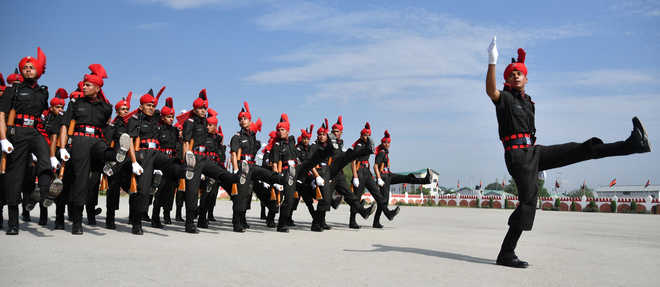
251 youths from state inducted into Army

Tribune News Service

Srinagar, July 15

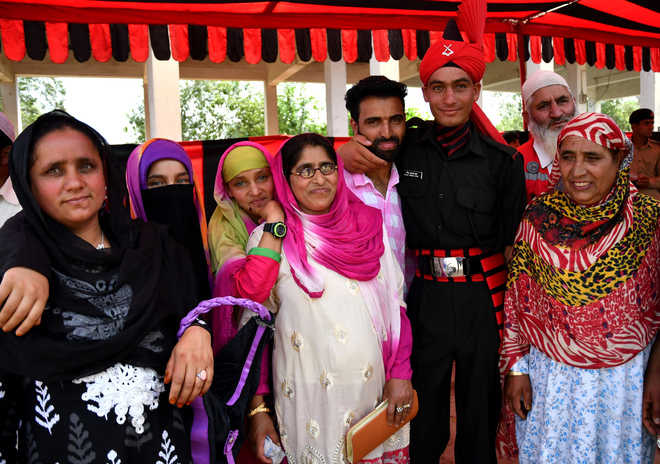
Fifty Kashmiris were among 251 youths from J&K who were inducted into Army’s Jammu and Kashmir Light Infantry (JAKLI) Regiment at a colourful passing out parade today.The parade was reviewed by Lt Gen JS Sandhu, General Officer Commanding, Chinar Corps, and was attended by over 1,500 parents and relatives of the young soldiers along with a number of civil and military dignitaries.The GOC, Chinar Corps, congratulated the young soldiers for their immaculate parade and impressed upon selfless service towards the nation.He praised their contribution towards encouraging more youth from J&K to come forward to join the security forces and also highlighted the vital role played by their parents in motivating their wards to join this noble profession.The young soldiers who distinguished themselves in varied facets of training were also felicitated by Lt General Sandhu.Recruit Rohit Singh of Jammu district received the Sher-e-Kashmir Sword of Honour and Triveni Singh Medal for being adjudged “Overall Best Recruit” and Recruit Randheer Singh of Kathua district bagged the Chewang Rinchen Medal for being “Best in Firing,” an Army spokesman said.Later talking to reporters, Lt General Sandhu said the interest and enthusiasm to join the Army was still very high among Kashmirs despite the killing of young Army officer Lt Ummar Fayaz.“We have not seen change. The interest and enthusiasm to join the Army is still very high. Youngsters in thousands are participating in recruitment rallies. The enthusiasm among people to get better livelihood opportunities has not diminished. When a youth reaches the age of 17 or 18 years, he has to make his life. Whatever opportunities he gets ready for that,” he said.


Two soldiers killed in Pakistan firing at LoC

Two soldiers killed in Pakistan firing at LoC
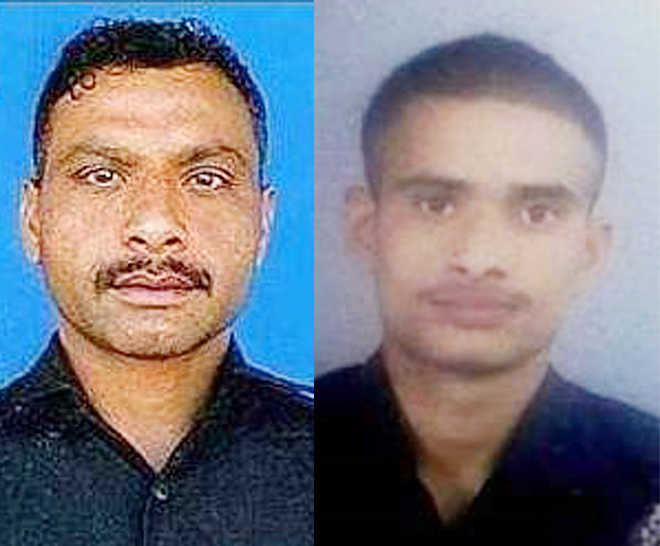
Two Army personnel Ranjit Singh (L) and Satish Bhagat, both from Jammu, lost their lives. ANI

Srinagar, July 12

Two Army jawans were killed today as Pakistani troops violated the ceasefire in the Keran sector of Line of Control (LoC) in north Kashmir, an Army official said here. In central Kashmir’s Budgam district, three Hizbul Mujahideen militants were killed in an encounter with security forces.(Follow The Tribune on Facebook; and Twitter @thetribunechd)The soldiers from the Jammu and Kashmir Rifles were killed in Furkiya area of Chowkibal sector. They have been identified as Ranjit Singh and Satish Bhagat, both from Jammu.Furkiya area has been a known route used by militants infiltrating into the Kashmir Valley from Pakistan.

Meanwhile, three militants have been gunned down in central Kashmir. The slain militants have been identified as Aaqib Gul of Gooripora, Javaid Ahmad Shiekh of Beerwah and Sajid Ahmad Gilkar of Malaratta in old city.

On specific intelligence inputs about the presence of militants in the central Kashmir’s Budgam, security forces had launched a cordon and search operation in Redbugh area last evening .The search operation turned into an encounter as the search party of the security forces was fired upon by the militants.The operation was halted for the night but the security forces maintained the cordon of the area to stop the militants from escaping.The gunfight resumed this morning.”Three militants were killed this morning in the encounter and some weapons and ammunition were recovered from the spot,” a police official said. — Agencies


Airfares to drop sharply as govt enforces new tariff

Passengers likely to pay reduced fares while travelling out of Delhi

NEWDELHI: Airfares are set to drop along with aircraft landing and parking fees in a potential boon to both passengers and airlines.

Aviation regulator Directorate General of Civil Aviation (DGCA), in an order on Friday, slashed the user development fee for passengers on both domestic and international flights originating in Delhi with immediate effect.

Passengers will be charged only ₹10 as a user development fee (UDF) for domestic flights like Delhi-Mumbai, from as much as ₹578 previously.

For a Delhi-New York international flight, this will drop from as much as ₹1,335 per ticket to ₹45, the DGCA said in its order, which was reviewed by Mint.

Until now, both departing and arriving passengers had to pay the UDF. Now, only those departing from Delhi airport will have to pay the fee.

Airlines will save on aircraft landing and parking fees, which are being nearly halved.

A Delhi-Mumbai flight for the next fortnight is currently selling for a base price of ₹2,100. This could be cut to ₹1,600 if the airlines pass on the benefits to consumers.

“This is a welcome move that will benefit passengers flying out of Delhi,” said Ajay Singh, chairman and managing director of SpiceJet.

Air India, Jet Airways, IndiGo, Vistara, and GoAir did not respond to emails seeking a comment.

“It is a big relief, fares will fall,” said an airline executive, who did not wish to be named.

The new tariffs have been pending implementation for a few years, because the Delhi airport operator had gone to the courts against proposed tariff revisions.

Air India challenged this in the Supreme Court, which on July 3 vacated a stay granted by the Delhi high court, allowing the revised tariffs to kick in.

GMR Infrastructure Ltd-led Delhi Delhi International Airport Limited (DIAL) told the Bombay Stock Exchange on Friday that it will pursue the matter with an appellate tribunal.

The Supreme Court, it said, “has also directed the appellate tribunal to decide the tariff appeals filed by DIAL expeditiously, preferably within two months from the date of the order of the Hon’ble Supreme Court. DIAL will engage constructively with the regulator to endeavour a balanced implementation and will work expeditiously with the appellate tribunal to reach a fair and positive outcome in the two months directed by the Hon’ble Supreme Court.”

Delhi airport earns about ₹350 crore every month from these airport charges currently.

An analyst welcomed the move to lower the UDF, which has been imposed to allow airport operators to recover their investments.

“Its a good thing if someone is saying ‘let’s get on with it’. Let the consumers benefit. Otherwise, what happens is that a passenger of today is paying for a passenger of tomorrow for no reason, just because the airport operator wants a better cash flow and keeps fighting for better ones,” said Amrit Pandurangi, former head of the infrastructure practice at Deloitte Touche Tohmatsu India Llp.

Consumer body Air Passengers Association of India (APAI) said all the money already collected by Delhi airport because of delayed implementation of the new tariff should be returned to passengers as well as airlines immediately.

“This is a very good move,” said APAI chief Sudhakar Reddy. “APAI wants removal of ADF (airport development fee) and substantial reduction in UDF and landing, parking charges as recommended by AERA and refund of all amounts collected illegally by DIAL.”