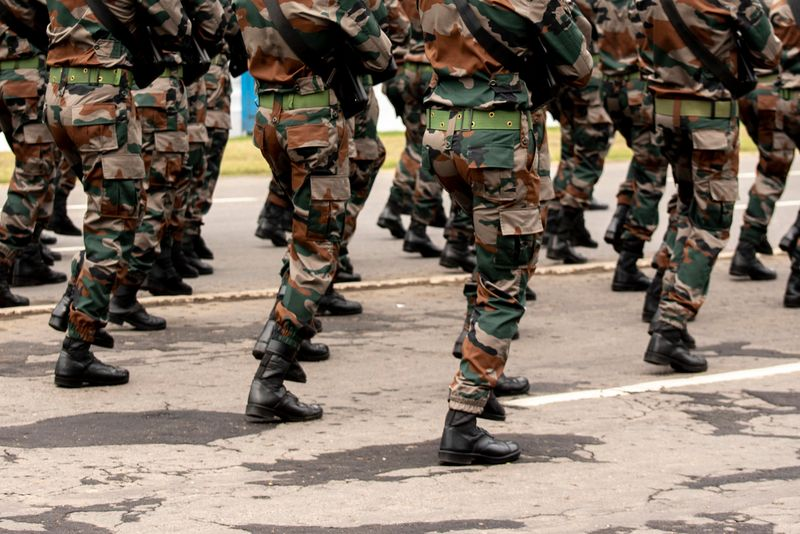
200th Gunners Day: Ludhiana’s close-knit community of Army veterans set to revisit times when guns roared
















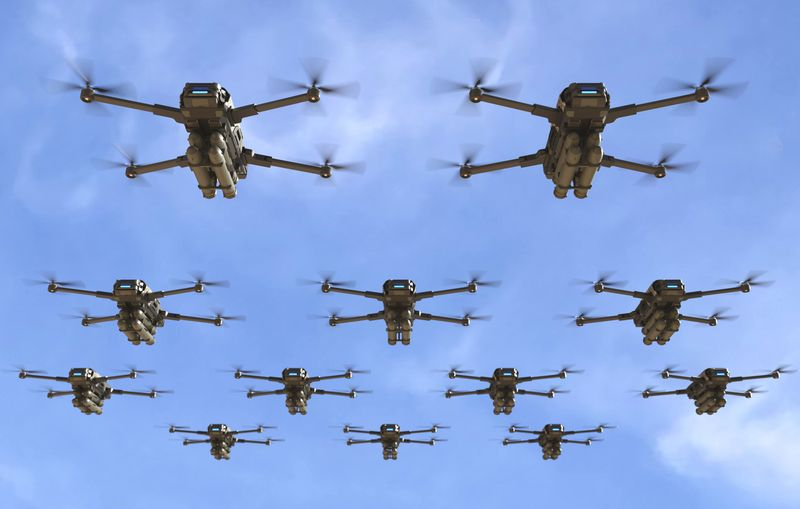
The Army is constructing multi-tier anti-drone steel mesh screens to protect sensitive buildings in field areas from attacks by drones and unmanned aerial systems (UAS), which are being used increasingly across the battlefield.
A total of 863 drone intrusions along the India-Pakistan border were reported in 2025-26, including 854 incidents in Punjab and Rajasthan, according to the Ministry of Defence (MoD). During this period, 237 drones were brought down, including five carrying war-like stores, 72 carrying narcotics and 161 without any payload.
“These activities signify greater attempts by the adversary to employ drones for various nefarious activities like reconnaissance and smuggling of arms, ammunition and narcotics along the International Border, especially in Punjab,” the MoD’s annual report for 2025-26 states.
The screens, measuring about 37 m in length and 20 m in width, will comprise three adequately spaced layers of different types of steel mesh designed for staged interception, energy dissipation and progressive arrest of incoming aerial objects, according to a request for information issued by the Army on September 25. These defences will initially be installed at several locations in the Western Sector.
The outer layer will incorporate camouflage and concealment features to minimise visual and thermal signatures from aerial and ground observation. This will be achieved by blending exposed structures with the natural terrain and using non-reflective coatings and multi-spectral camouflage paint.
The Army is already using steel meshes and synthetic nets to provide overhead protection to frontline equipment, bunkers, observation posts, artillery guns and vehicles, including tanks. Some of these anti-drone measures for vehicles were also displayed during this year’s Republic Day Parade in New Delhi.
The use of metal meshes to counter drones first gained prominence during the Russia-Ukraine war, when advancing Russian tanks were spotted with such protective structures mounted on them.
Drones emerged as a key component of that conflict, which escalated in February 2022. Three years later, the Indian subcontinent witnessed extensive use of drones and counter-drone systems during Operation Sindoor in May 2025, marking a significant shift in the conduct of military operations and underscoring the growing emphasis on non-contact warfare.
The operation saw large-scale tri-service deployment of drones and missiles for precision strikes deep inside Pakistan, rather than manpower-intensive formations being massed along the border and troops engaging each other directly. The armed forces also neutralised hundreds of enemy drones and missiles launched across the western frontier through an integrated air-defence shield.
With automated systems and AI-enabled platforms becoming integral to modern warfare, the armed forces, through in-house projects and collaboration with the industry, have accelerated the development and induction of indigenous drones and counter-drone systems. They are also putting in place a vast training infrastructure to produce technologically enabled soldiers.
A core committee has been constituted to take decisions on the induction, proliferation and deployment of UAS and counter-UAS equipment in the Army and to coordinate all related aspects.
As many as 30 types of UAS and loitering munitions, covering 80 variants across five categories — surveillance, strike, air defence, special roles and logistics — have been identified for deployment in different operational scenarios and terrain conditions. In addition, several existing air-defence weapons have been modified to detect and destroy small drones as part of the broader air-defence network.

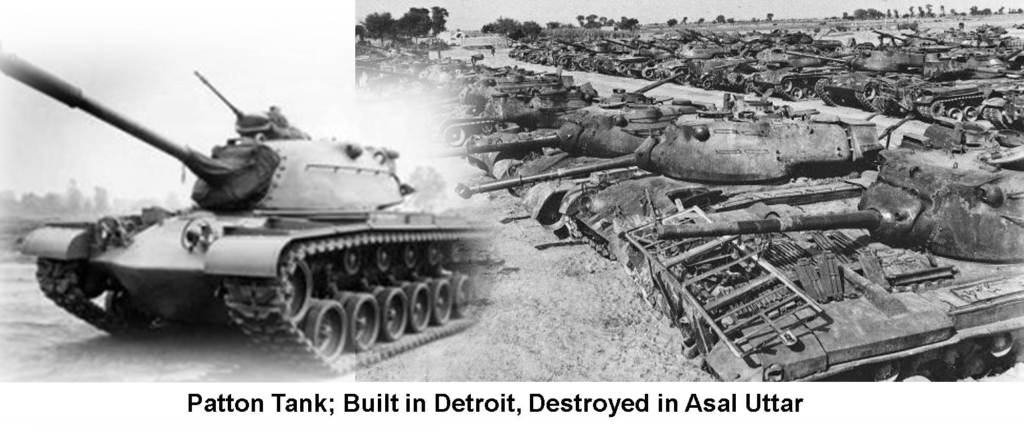
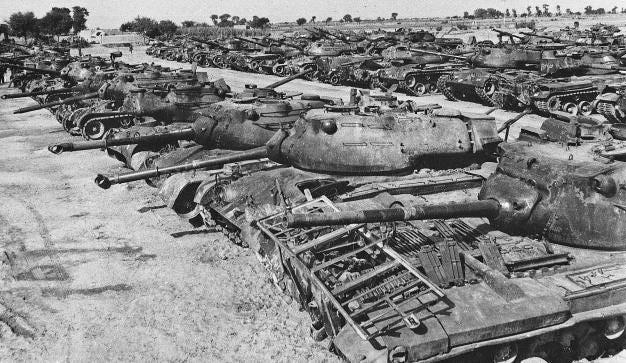
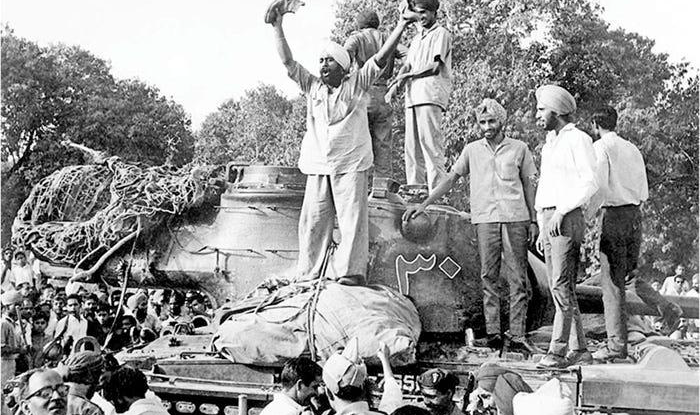
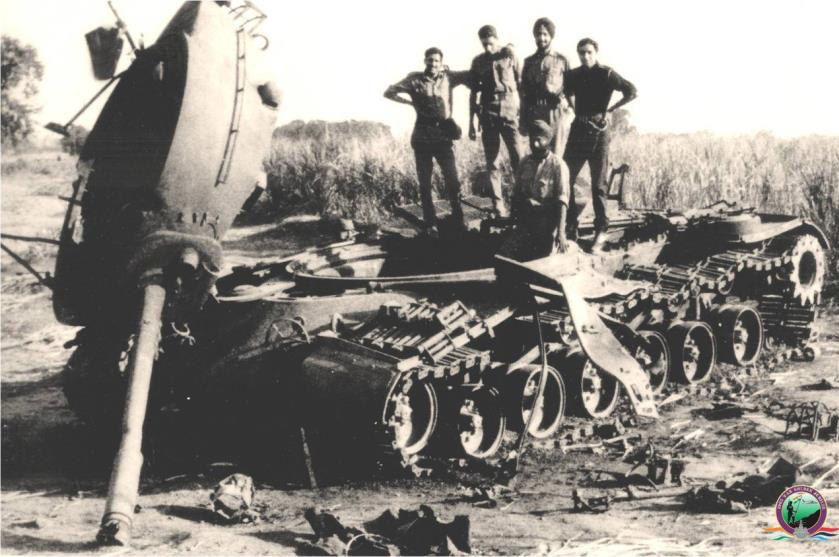
In the battle lasting 8 to 10 Sep, the pride of Pakistan’s army, their Armoured Division was humbled by the Indian Army. Pakistan lost 97 tanks including 72 Pattons. Indian losses were comparatively negligible.
On 6 Sep, Indian 4 Mountain Division comprising 7 & 62 Mountain Brigades and 9 (DECCAN) Horse – was tasked to capture Kasur. Contesting 4 Mountain Division was Pakistan’s 11 Infantry Division with three Infantry Brigades. After initial gains, 4 Division was forced to withdraw and take defences at Asal Uttar on 7 Sep. Pak 1 Armoured Division launched a counter offensive on 8 Sep. Pak Attack Plan: Two Infantry Brigades of 11 Infantry Division with 5 Armoured Brigade to establish a bridgehead in area Mastgarh-Bhura Kohna, advance on Khem Karan-Bhikhiwind axis to protect the flank and also isolate 7 Infantry Division located at Firozpur. 1 Armoured Division to break out with:
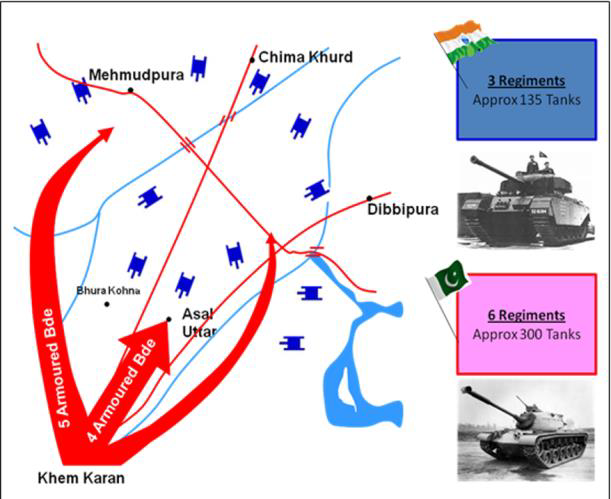
3 Armoured Brigade – two Armoured Regiments and a Mechanised Infantry Battalion in APCs head Northeast and capture Jandiala Guru, cutting off Amritsar. • 4 Armoured Brigade – two Armoured Regiments and a Mechanised Battalion to advance along Kasur-Khem Karan – Valtoha – Nabipur axis – secure Harike bridge over the Beas and advance towards the GT Road to capture the Beas Bridges (Both Rail and Road) astride the GT road thereby cutting off the Indian 11 Corps from rest of India. Pak 1st Armoured Division was equipped with modern American M 47 & M 48 Patton tanks and M113 Armoured Personal Carriers (APCs). Pakistan had Six Tank Regiments with approx 300 Tanks. India had Three Regiments with approx 135 Tanks. Patton Tank had a 90 MM Main Gun implying heavier rounds and longer range than Indian Tanks with smaller gun of 75 MM. The Patton Tanks had a thicker armour plate and superior fire control systems. 4 Mountain Division was supported by 2 Independent Armoured Brigade. General Gurbaksh Singh General Officer Commanding 4 Mountain Division directed his Artillery to unleash heavy fire on the enemy, slowing them down. Pak 1 Armoured Division was unable to breach the Indian defences despite its overwhelming superiority.
4 Mountain Division was supported by 2 Independent Armoured Brigade. General Gurbaksh Singh General Officer Commanding 4 Mountain Division directed his Artillery to unleash heavy fire on the enemy, slowing them down. Pak 1 Armoured Division was unable to breach the Indian defences despite its overwhelming superiority. Terrain as a Force Multiplier – flat agricultural fields, primarily sugarcane cultivation. During the battle, India strategically flooded these fields, creating swampy conditions that immobilized Pak tanks. 4 Division’s defence at Asal Uttar was prepared like a horseshoe, which allowed them to effectively trap and counter the enemy forces.
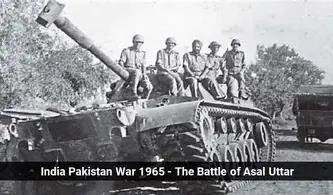
9 (DECCAN) HORSE less a squadron deployed to deal with Pakistani tank assaults. The third squadron was protecting artillery gun areas in the depth. 2 (Independent) Armoured Brigade – • 3 CAVALRY deployed behind, covering area ChimaDibbipura. • 8 CAVALRY, deployed on the flanks forming a horseshoe to ambush Pakistani tanks. On 8 Sep, Pakistan carried out Recce in Force with a Combat Group consisting of two squadrons of Chaffee (light) tanks, a squadron of Pattons and some Mechanised Infantry.
The squadron of Deccan Horse concealed in tall sugar cane waited. A fierce tank battle ensued, and the enemy withdrew with 11 tanks lost; struck down with sniper like precision. Minor skirmishes continued and the day long enemy armour assaults along with infantry had no worthwhile success. The attack continued during the night and at least five assaults were beaten back by the valiant 18 RAJPUTANA Rifles supported by very accurate Artillery fire including guns firing in ‘direct fire’ role.
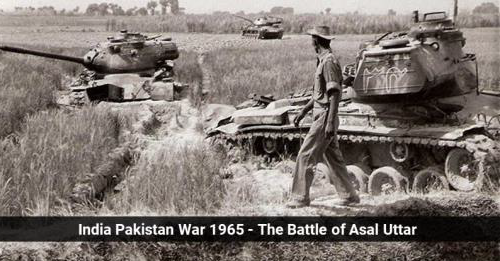
At this stage, 2 (Independent) Armoured Brigade was ordered to deal with Paki tanks trying to bypass the defended sector by making out-flanking movements. Indian tanks were cleverly sited behind tall sugarcane so that the Pak tanks could not see them till it was too late. Pak 4th and 5th Armoured Brigades made at least five, attacks between them. At the very first, 5th Brigade overran Khem Karan. Subsequently, every attack was defeated by the Indian Army with aplomb. The commanders were brilliant. They flooded the terrain, channelised the tanks to killing areas using guile and tactical brilliance. The well-trained Indian tank crews were superior in manoeuvre and gunnery and defeated a superior enemy tank due to their high standards of training and individual skills. Additionally, the Infantry Regiments played a key role, utilizing antitank weaponry and sharp shooting skills. On 9 Sep, Pak Air Force and Artillery tried to soften the targets followed by tank assaults. They achieved no success, and it was expected that having failed to overrun the defended sector, Pakistan would make a final effort to break out by making outflanking thrusts.
On 10 Sep, CQMH Abdul Hamid of 4 GRENADIERS armed with a jeep-mounted recoilless gun, displayed extraordinary courage by taking out several Pakistani Patton tanks, one after another. He refused to retreat even under heavy enemy fire. He was killed in action. and posthumously awarded the Param Vir Chakra, India’s highest military honour. By mid-day, the Pakistani Combat Group which was attacking 4 GRENADIERs was also trying to make a northern outflanking movement. A squadron of 3 CAVALRY lay in wait. As the Pakistani tanks appeared, they were hit by well camouflaged tanks which took the Pakistani combat group by complete surprise. The tanks of Deccan Horse also fired on Pakistan’s tanks from the flank as they were heading east. The Pakistani combat group was pulverized by this sledge and hammer beating.
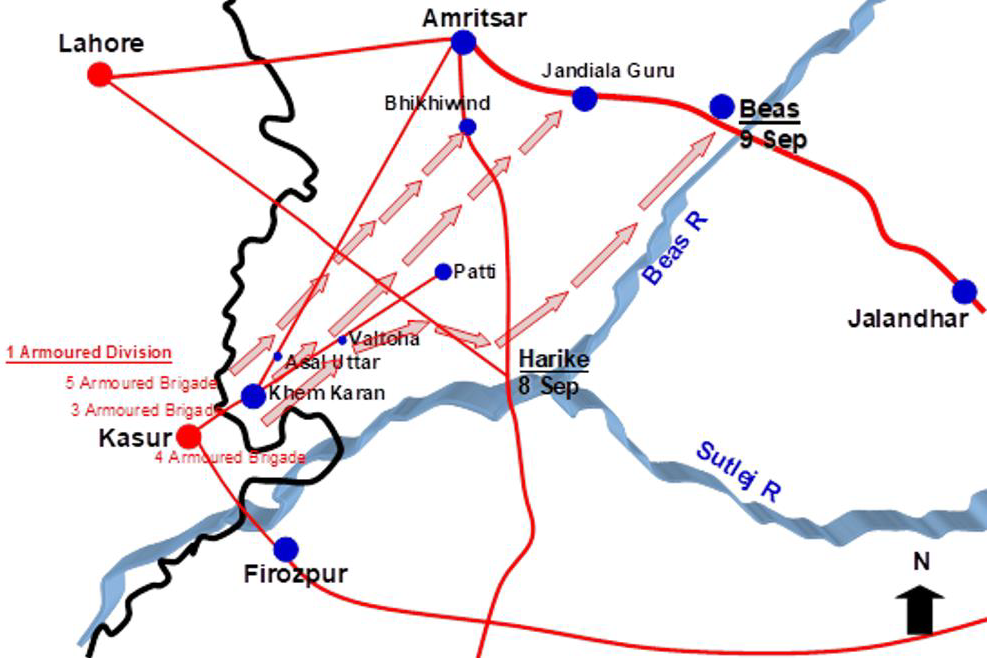
Foiled in the northern hook, Major General Nasir the Pakistani Divisional Commander tried a wider southern out-flanking move and sent 4 Armoured Brigade with 4 Cavalry in lead with a Mechanised Infantry Battalion following. The Centurion tanks of 3 CAVALRY were ready and waiting. The Shermans of Deccan Horse also fired upon from the northern side. Some areas had been cleverly flooded. The Pakistanis were channelized into the mouth of a semi-circle with Indian tanks firing from three directions. It was an ideal trap and to complement this, the divisional artillery was ready to bring down maximum concentration of fire into this area. A better part of Pak 4 Cavalry Regiment was shot to pieces in a boldly planned and executed ambush. Major General Nasir, watching the battle from his helicopter was disappointed. He came down and moved forward on Khem Karan – Bhikhiwind road to push his troops into a last-ditch effort. He spoke to the Brigade Commander and the CO 4 Cavalry to bash on regardless.
His radio signals were intercepted and at 6 PM, Nasir and his reconnaissance group came under heavy artillery fire in which Brigadier Shammi, the Artillery Brigade Commander of the Pak Armoured Division was killed and General Nasir wounded.
With that it was curtains for the Pakistani offensive.
In the battle lasting 8 to 10 Sep, the pride of Pakistan’s army, their Armoured Division was humbled by the Indian Army. Pakistan lost 97 tanks including 72 Pattons. Indian losses were comparatively negligible.
Lieutenant Colonel AS Vaidya, CO of Deccan Horse was awarded the Maha Vir Chakra and so were Major General Garbaksh Singh, Brigadier Theogaraj and Lieutenant Colonel Salim Calib, CO of 3 CAVALRY. 2 (I) Armoured Brigade had defeated a superior but clumsy opponent in the largest tank battle fought since the World War II.
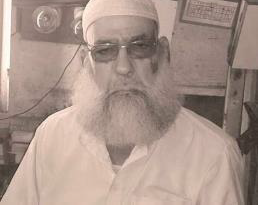

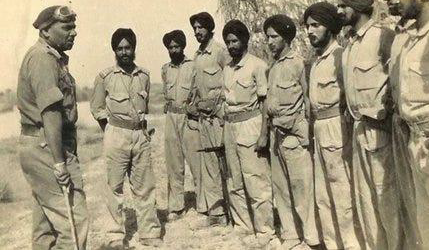
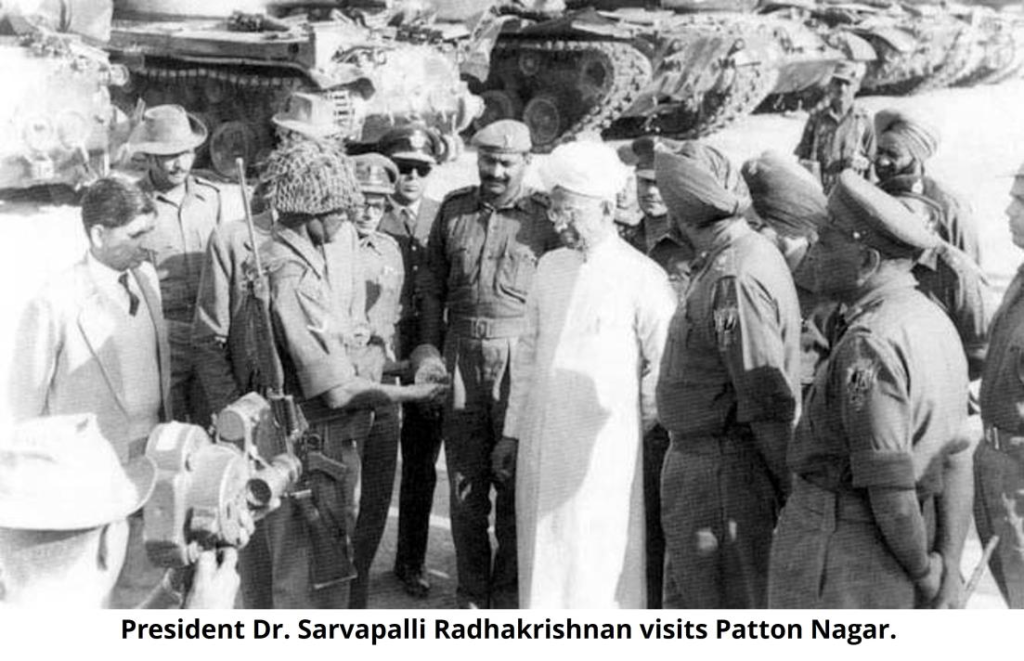
Brig T.K. Theograj, Commander 2 (I) Armoured Brigade speaking to the tank crews.


Sale of fifth generation stealth jet, the Sukhoi-57, to India will be on the agenda when Russian President Vladimir Putin and Prime Minister Narendra Modi hold their bilateral meeting on Friday.
Kremlin Spokesperson Dmitry Peskov, while taking questions from Indian journalists at an online media briefing on Tuesday, was asked about the Sukhoi-57 and he responded: “The issue of selling those machines to India is on the agenda.”
The Indian side is wanting transfer of technology for production locally and this is a question for additional discussions that are also under way, Peskov said at the briefing which was hosted by Russian state-run news outlet Sputnik.
Explaining the issue of technology transfer, Peskov said: “Every country wants to keep the new technology to itself. But given the advanced strategic partnership with India, we will discuss the possibilities, should they be available, of sharing those technologies with our Indian partners.”
The Sukhoi-57 is a fifth-generation jet. The US and its NATO allies use the F-35 while China has a fifth-gen jet J35 and is now providing the same to Pakistan.
Also, India and Russia are looking to discuss widening of defence cooperation, including tweaking of jointly produced missiles to provide them an edge globally, said Peskov as he spoke about the bilateral talks to be held on the sidelines of the BRICS leaders’ summit in New Delhi on September 12 and 13.
Peskov mentioned how the two countries are jointly producing missiles like the Brahmos and are looking to improve upon them to make them even better.
On India seeking greater number of S-400 air defence missiles, the Kremlin spokesperson said, “Several matters will be discussed.”
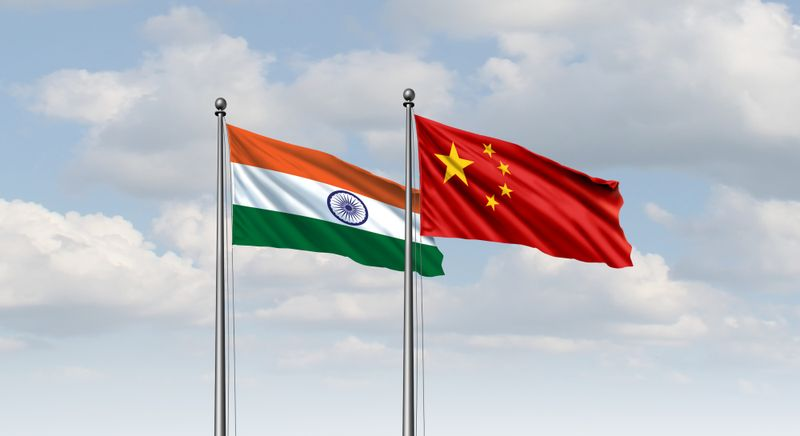
Senior military commanders of India and China have conducted two ‘flag meetings’ in as many days along the Line of Actual Control (LAC) — the de facto boundary between the two countries — in Arunachal Pradesh.
The first meeting took place on Sunday (September 6) between Corps Commander-level officials at the Border Personnel Meeting point at Wacha, north of Kibithoo in Anjaw district of the state. The meeting was first reported by The Tribune in its September 7 edition.
Ministry of External Affairs (MEA) spokesperson Randhir Jaiswal said the second meeting took place a day later, on Monday, on the Chinese side of the LAC. “It was conducted at Damai on the Chinese side on 7 September 2026,” Jaiswal said at a briefing in New Delhi on Tuesday.
As per protocol, the MEA and its Chinese counterparts refer to these as ‘senior highest military commander-level’ flag meetings.
The nomenclature ‘flag meetings’ is used when commanders discuss operational issues related to maintaining peace and tranquillity in border areas. The Indian Army’s 3 Corps Commander, Lt Gen Girish Kalia, represented India. The 3 Corps is tasked with guarding a major portion of the 1,140-km LAC in the state.
Sources said the meetings along the LAC took place within a month of a misunderstanding between the two militaries near Taksing in the Upper Subansiri district of the state. Taksing is under the command of the Indian Army’s 3 Corps. Sources said the Indian Army has taken a firm stance in dealing with the position taken by Chinese troops in the area where these issues are ongoing.
Last month, while responding to questions on the ‘military situation’ along the LAC in Arunachal Pradesh, Jaiswal said the issues were ‘most serious’ and that developments along the state’s border would ‘reflect’ on the larger bilateral ties.
India and China have differing perceptions of the Line of Actual Control in their respective territories, and at times this leads to issues on the ground.
Meanwhile, Jaiswal said the meetings were pursuant to the understandings reached between the Special Representatives of India and China in August 2025 and August 2026, and subsequent discussions at meetings of the Working Mechanism for Consultation and Coordination (WMCC) held in Beijing and New Delhi in May and August 2026, respectively.
The Special Representatives of India and China — National Security Advisor Ajit Doval and China’s Foreign Minister Wang Yi — met in Beijing on August 25 and agreed to continue efforts towards a ‘political settlement’ of the disputed boundary between the two countries, in order to address the long-term interests of both sides.
The meetings between the military commanders took place just days before Chinese President Xi Jinping’s expected visit to India for the BRICS Leaders’ Summit on September 12–13.
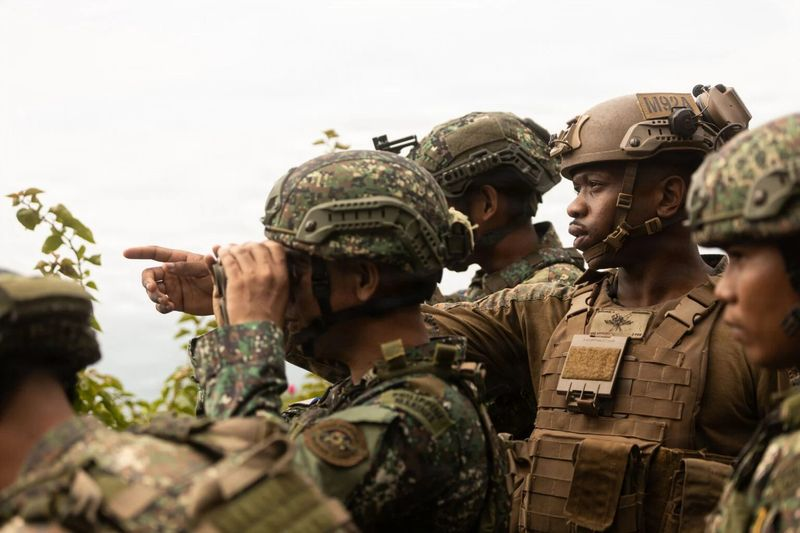
Geopolitics often throws up unusual paradoxes, and one has just emerged in the Indo-Pacific. The navies and marine forces of the US and the Philippines have trained together to defend the Southeast Asian nation’s coastal waters by simulating the use of the BrahMos anti-ship missile.
The BrahMos is a supersonic anti-ship missile jointly developed by India’s Defence Research and Development Organisation (DRDO) and Russia’s NPO Mashinostroyeniya. The Philippines procured the missile from India under a $375-million deal signed in 2022.
“US and Philippine Marines are training to defend against maritime strike rehearsals that simulate the use of recently acquired BrahMos anti-ship missiles,” USNI News reported. USNI News is published by the United States Naval Institute, an independent organisation founded in 1873.
The exercise is significant because it involves the integration of a Russian-origin missile system into efforts aimed at countering potential threats in the disputed waters of the South China Sea. It also highlights the unusual situation of US forces training alongside a partner military operating a weapon system jointly developed with Russia and supplied by India.
In an era marked by sanctions on Russia, US legislative restrictions on Russian military equipment and Washington’s efforts to reduce allied dependence on Moscow’s defence industry, the scenario unfolded last month at a remote outpost in northern Luzon in the Philippines.
Luzon faces the Scarborough Shoal, a disputed maritime feature claimed by both Manila and Beijing.
The Pentagon released images of the drills, showing personnel from both countries training to establish a “kill chain” using notional drones and ground-based anti-ship missiles against simulated maritime targets. The US-Philippine training was conducted as part of an exercise called the Archipelagic Coastal Defence Continuum.
The drill comes amid China’s increasingly assertive posture in the South China Sea. One component of the exercise involved Philippine Air Force Hermes drones tracking a surface action group in support of a simulated BrahMos missile strike.
The simulated targets included two Type 052D guided-missile destroyers, a Type 054A frigate and a Type 901 fast combat support ship. These classes of vessels are currently in service with the Chinese People’s Liberation Army Navy and frequently operate in the South China Sea.
Such warships have been involved in several incidents near Scarborough Shoal in recent months.
The exercise is also helping Philippine missile batteries develop the procedures and tactics required to operate the Indian-made BrahMos. Capable of travelling at nearly three times the speed of sound and carrying a 400-pound warhead, the shore-based BrahMos significantly enhances the Philippines’ coastal defence capabilities.
Capt MacKenzie Margroum, spokesperson for Marine Rotational Force-Southeast Asia, was quoted by USNI News as saying: “Training gives insight into how our Philippine counterparts approach maritime defence within the unique geography and operating environment.”
The bilateral effort forms part of Washington’s broader strategy to strengthen the alliance’s long-range strike capabilities against potential adversarial naval forces operating near Philippine waters. The two countries have increasingly focused their joint exercises on coastal defence and maritime security.
COTT Bessent, the US Treasury Secretary, laid out three maxims in a recent speech: “The nation that cannot produce what it needs is not truly secure. The nation that depends on its adversaries for critical inputs is not truly sovereign. And the nation that reduces its economics to consumption is not truly prosperous.”
Bessent’s context is a world that his country, more than any other, has worked to create — in which, as Thucydides wrote, the strong do what they can, and the weak suffer what they must. Where alliances can be disregarded, friendships become irrelevant and markets subject to unexpected disruptions.
The phrase that characterises this new world is weaponised interdependence. Such weaponisation comes more easily to those in control of the main nodes of the global economy, giving them coercive power. One could even think of panopticon situations (the usual example being a single guard in a circular prison who can watch all the inmates). Think of the SWIFT interbank communication system. Equally, they could offer choke points for coercive use. Choke points can also be points of vulnerability — think submarine cables which, if cut, could cripple an adversary for a while.
For a middle power like India, such a world is more complex and offers many new challenges, and only imperfect answers or solutions. In the spirit of atmanirbharta, can India hope to ensure its security and sovereignty by producing all that it needs — as Bessent asked? Think of the major weapons platforms and technologies that are currently imported. Or not rely on others for critical inputs — something that even the major powers don’t attempt? Most obviously, what price strategic autonomy when 90 per cent of the country’s oil and half its gas needs are imported? And what price sovereignty in the face of penal tariffs and arbitrary trade sanctions?
It is obvious that the goals in such a world have to be not just economic efficiency and competitiveness but also finding ways to minimise vulnerability — without paying too great a price through higher costs that localisation often imposes. Hence the current attempts at domestic chip manufacture and the setting up of data centres. Yet interdependence is written into the scenario and must be dealt with.
The asymmetric conflicts in Ukraine and Iran pose their own urgent questions for the economy. Hundreds of missiles and drones (offensive and defensive) have been fired in a day, for days on end, in both theatres. Can India hope to develop such a supply capability, given its limited manufacturing base, or (as a more sensible alternative) turn civilian industrial units to military use in short order? And how well is the country positioned in the context of wars that will henceforth be fought in the cyber-physical world?
Sensible policies can always provide answers. India could become an electro-state, for instance, by copying China’s example to reduce oil dependence and multiply storage capacity in order to insulate against supply shocks. China can store more than four months’ oil requirements, whereas India’s strategic reserves are for barely 10 days. When availability can trump price in a critical agricultural input like fertiliser, sensible policy can serve to boost the domestic production of an item that does not after all involve rocket science.
India has always been wary of international dependencies. Especially in defence, space and atomic energy, it has sought from the beginning to build national capabilities and be self-reliant. There are some impressive success stories to show for this in the defence arena: the nuclear-powered submarines, for instance (though Russian help has been critical). And the multi-pronged missile programme. A layered air defence system that showed its mettle during Operation Sindoor. Mobile howitzers for the artillery have been developed by the Armaments R&D Establishment in partnership with Kalyani and Tata. Some aspects of electronic warfare capability constitute another success story.
The risk is that overreach can result in failure, or unaffordable delays (which, in defence, is the same thing). Overreach explains why many attempts at self-reliance in defence have failed, such that the country is the world’s second largest importer of armaments (after Ukraine). Major weapons platforms that the country needs are still being imported — those on the current list being Rafales, submarines and long-endurance drones. And imported weapons tend to be far more expensive than indigenous substitutes, when these are developed.
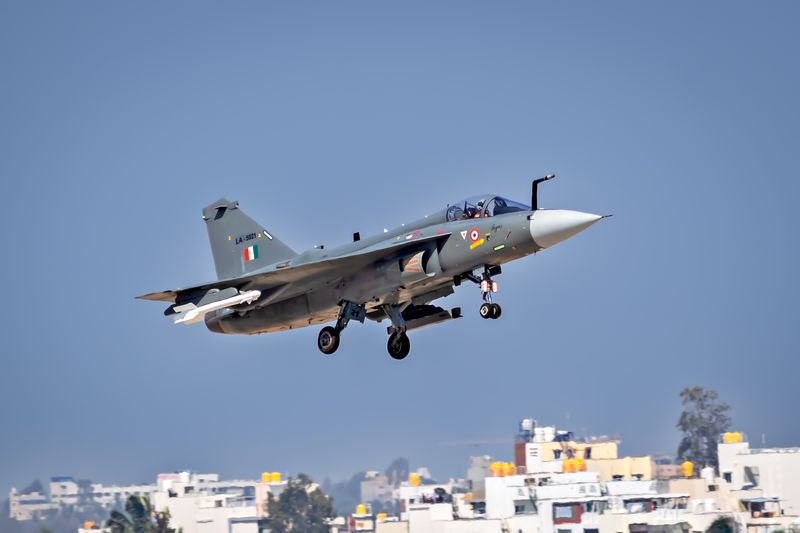
Moreover, the world sends periodic reminders about supply vulnerabilities. The gas turbine engines that have powered the Navy’s main fighting ships have traditionally come from Ukraine, now consumed by war; fortunately, Bharat Heavy Electricals has been producing gas turbines for the frontline warships. But the supply of the S-400 air defence systems has been interrupted by Russian preoccupations. And Hindustan Aeronautics Limited can’t turn out the 180 Tejas fighters that the Air Force desperately needs because (among other things) the engines have to come from General Electric, which has delayed production because (again, inter alia) a South Korean supplier of components has gone out of business.
Ambition is as ambition does. The import dependence is because too many plans, goals and targets have come unstuck. The dependence on General Electric engines for Tejas is because the domestically developed Kaveri engine didn’t measure up. The Army’s demanding specifications for an infantry rifle (such as interchangeable barrels that use bullets with different sizes!) proved too complicated to deliver, resulting in large-scale imports.
The NavIC (Navigation with Indian Constellation) satellite-based system that was to be a regional substitute for the US GPS (Global Positioning System) is non-functional because of a shortage of operational satellites and the failure of an atomic clock. This has underlined the need for an indigenous system, more than a quarter century after Kargil 1999.
The critical need is for realism on what the country can sensibly do on its own (and deliver at cost and within deadline), while being a part of international consortia where it can’t. As an example of the latter, would India have been better placed if it had stayed as a partner in Russia’s Su-57 stealth fighter programme, especially now that China has developed its own stealth fighter, the J-20?
This is the first of a 2-part series
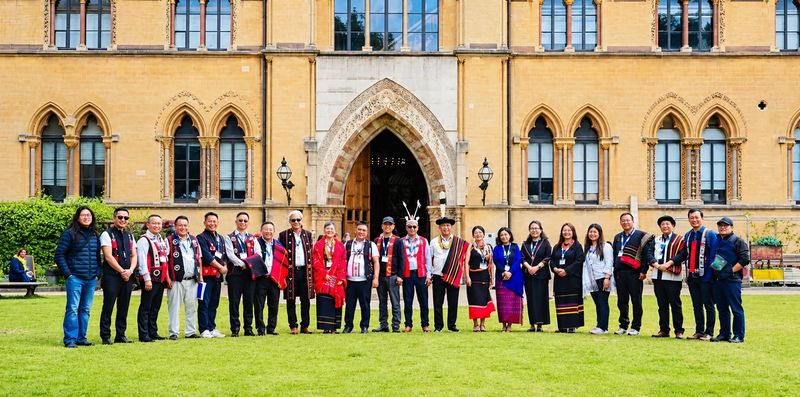
Thirty-nine Naga ancestral skulls, some taken more than a century ago during British colonial rule, are to be brought home from Oxford to Nagaland, in what Naga organisations describe as a moment of healing, unity and the return of memory.
The University of Oxford formally approved the return of 39 of the 40 ancestral remains claimed by the Forum for Naga Reconciliation (FNR) last July. The remaining set of remains was excluded because its provenance could not be clearly established as Naga.
Pitt Rivers Museum’s Belgian director, Laura Van Broekhoven, told Agence France-Presse (AFP) that the remains “have been away from their homeland for far too long”. The museum told AFP that it was “working closely” with the Naga community to agree on a date for the handover ceremony.
In a separate statement to Euronews, Van Broekhoven described the process as “humbling” and said she felt honoured to have worked towards returning the 39 Naga ancestors.
The FNR and other Naga organisations, in a statement sent to AFP welcoming the Oxford decision, said: “Repatriation, for the Nagas, is not simply about bones and ancestral remains finding their way back to the land but importantly about memory returning to where it belongs.”
The decision brings to a remarkable point of closure a process that began in 2020, when Van Broekhoven approached the FNR about the possibility of repatriating the remains.
A date for the handover ceremony has not yet been set. The Pitt Rivers Museum is working with Naga representatives on arrangements for the return.
In June 2025, a 23-member Naga delegation travelled to Oxford and came face to face with ancestral remains held in the Pitt Rivers Museum.
They were shown skulls, tufts of hair, fingernails, long bones and the partial remains of a child.
Some delegates wept. Others prayed in Naga languages.
For the museum, the remains had been accessioned as part of a collection. For the visitors, they were ancestors.
“This was not a museum visit,” one delegate said afterwards. “This was a reckoning — with the dead, with our history, and with ourselves.”
Dr Phyobemo Ngully, a psychiatrist from Kohima who was among the delegates, explained the spiritual significance of the visit. “If we don’t bring them home, our ancestral spirits will be restless,” he said.
On the final day of the visit, the delegates addressed their ancestors directly: “We are here now to reclaim you.”
More than a year later, Oxford has agreed to let them do precisely that.
The formal claim for the 40 remains was submitted to Oxford this year by the FNR, which had been authorised by Naga tribal councils to act on their behalf. Oxford’s own gazette subsequently recorded that the visitors of the Pitt Rivers Museum recommended the return of 39 of the 40 remains.
The historical background is disturbing.
The Tribune has seen correspondence written by British colonial administrator James Philip Mills in 1923 in which he described his intention to “loot” the Naga village of Yungya “to the advantage of the PR” — the Pitt Rivers Museum.
“I should like to fire on it,” Mills wrote. “The men deserve bullets.”
In subsequent correspondence, Mills confirmed that he had shipped a severed human head from Yungya via Calcutta.
Another colonial administrator, JH Hutton, an anthropologist as well as a District Commissioner, was also associated with the collection of Naga human remains and objects. The Pitt Rivers Museum itself says Hutton and Mills brought most of its Naga human remains into the collection between roughly 1910 and 1940, and acknowledges that remains and objects were frequently confiscated during punitive military expeditions rather than freely given.
The distinction between colonial collecting and Naga memory could hardly be sharper.
The museum speaks of human remains and collections. The Naga organisations speak of ancestors, memory, dignity and belonging.
For the Naga organisations, the immediate priority is not the return of artefacts. It is the return of their dead.
The current restitution concerns the 39 Naga ancestors approved for return by Oxford.
The repatriation effort is being coordinated by the FNR and the Recover, Restore and Decolonise (RRaD) research initiative, working with Naga tribal bodies, church leaders and communities. In June 2025, Naga tribal Hoho leaders, elders and FNR-RRaD members travelled to the Pitt Rivers Museum to see and bear witness to the ancestral remains.
The Naga delegation subsequently issued the Naga Oxford Declaration on Repatriation, calling for the remains to be reclaimed and returned to their homeland.
The proposed burial in Nagaland is intended to provide a dignified resting place and, according to Naga representatives, to symbolise the unity of the Naga people. A burial site has been identified and discussions are underway with the Nagaland Government over its allocation.
The Oxford decision is part of a wider international movement challenging the presence of human remains and cultural objects acquired by Western institutions during the colonial era.
But the Naga case has a particular resonance because it involves not merely the return of disputed objects but the return of people.
At Oxford last year, the Naga delegation ended its declaration with a blessing: “May your homecoming bring peace and harmony to our land.”
The words, written when the journey home was still uncertain, now have a different meaning.
The journey has been approved. What remains is to bring them home.
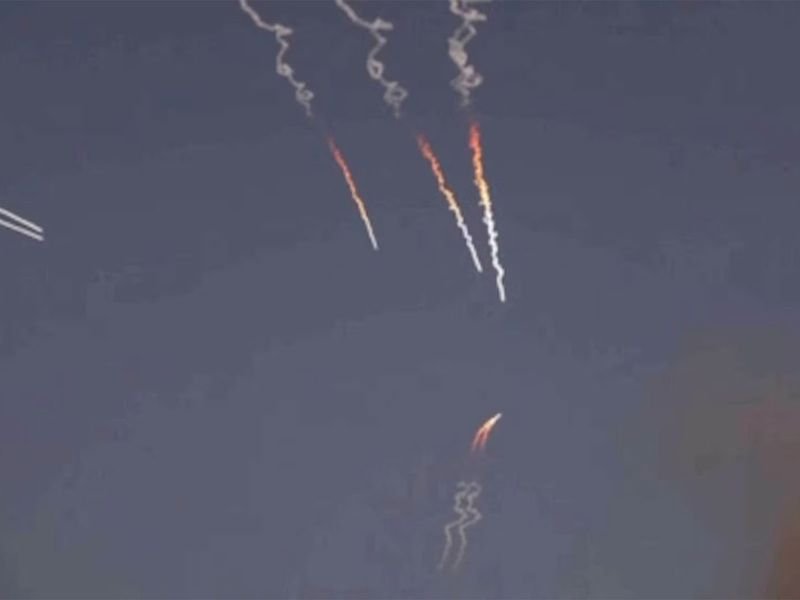
Multiple explosions were heard across Iranian coastal regions, including Qeshm Island as well as Sirik and Minab counties.
According to state broadcaster Islamic Republic of Iran Broadcasting (IRIB), the sounds of several explosions were reported along the coastal areas of Sirik and Minab County.
Addressing the incidents, the Hormozgan Governorate stated that the origin of the sounds heard in Qeshm was determined to be coming from the sea.
Citing Saudi media, IRNA added that at least two strong explosions were heard in the area.
This comes as US President Donald Trump asserted on Wednesday (local time) that the war with Iran will end “immediately” after the upcoming US midterm elections, accusing Tehran of holding out in hopes that a change in political power in Washington will allow it to pursue a nuclear weapon.
Speaking to reporters before departing for a Republican midterm convention in Dallas, Texas, Trump argued that Tehran is attempting to influence American voters to secure a more lenient administration in Washington.
“I think the war will end immediately after the election…They’re desperate to try and affect the election so that we could get a nice, weak group of people in there and leave them alone and let them have their nuclear weapon,” Trump said.
Asked directly why he believes the fighting will cease so rapidly after the vote, Trump reiterated that Tehran is running out of options.
“Because they can’t hold out any longer. They’re desperate to try and affect the election, so that we can get a nice weak group of people in there and leave them alone and let them have their nuclear weapon. All they want is a nuclear weapon, and if they had a nuclear weapon, the whole world is in deep trouble,” he stated.
When pressed on whether he expected diplomatic talks to resume or the military campaign to be restarted, Trump signalled that Washington is in no rush to negotiate, asserting that recent operations have severely weakened the Iranian state.
He added that any ultimate diplomatic resolution would extend far beyond conventional nuclear agreements.
On the other hand, Iranian Foreign Ministry Spokesperson Esmail Baghaei on Thursday rejected accusations made by US Secretary of State Marco Rubio that Yemen’s Houthis operate as a proxy for Tehran, stating that the group acts independently and takes orders from no one.
In a post on X, Baghaei accused Washington of driving regional instability through its military presence and hegemonistic policies, emphasising that lasting peace in Yemen requires an end to external intervention.
“Marco Rubio’s lies cannot replace facts. Ansarallah is an independent Yemeni actor that makes its own decisions; it takes orders from no one and acts as nobody’s proxy,” Baghaei said.
Directing criticism toward US policy in the Middle East, Baghaei urged Washington to withdraw its military involvement if it seeks genuine stability in the region.
“The roots of instability in the region lie in US military interventions and hegemonic policies. If Washington genuinely wanted peace, it would take one simple step: end its malign and destabilising interventions in our region,” he stated






























