



Sanjha Morcha

What’s New

Click the heading to open detailed news

Current Events :

web counter

Print Media Reproduced Defence Related News

Heron, Searcher, Sea Guardian, SWITCH — the many UAVs that make up India’s drone arsenal

Drones
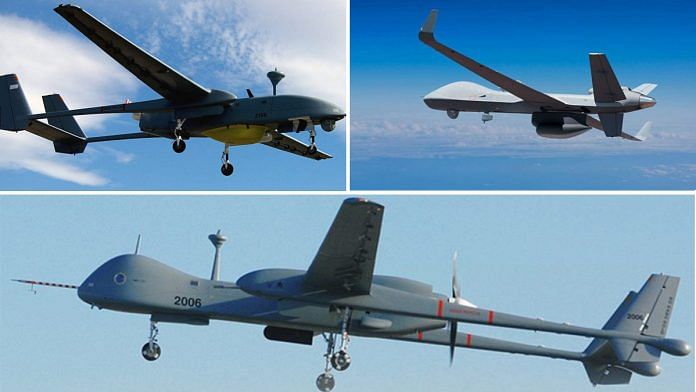
Heron 1, Heron TP, & Sea Guardian drone | Photo: Commons/iai.co.il/General Atomics

Text Size: A- A+

New Delhi: India is currently pursuing multiple Unmanned Aerial Vehicles (UAVs) or drones programme in an attempt to arm its three services — Army, Navy and the Air Force — with weapons that would play a critical role in future wars.

These UAVs are not just meant for long range surveillance but also for carrying out precision strikes from standoff distances and for Kamikaze operations.

Among the several drone programmes that the Indian military is pursuing, one of them is Project Cheetah.

Project Cheetah, which is divided into two separate programmes, aims to upgrade and arm India’s Heron drones, with the assistance of Israel, the manufacturer.

As reported by ThePrint earlier this week, the Indian Air Force (IAF) has “completed cost negotiations” and the project has “entered final stages of

Another programme that India is pursuing is the procurement of 30 MQ-9 Reaper or Predator B drones, which will be a tri-service initiative.

ThePrint takes a look at the various UAVs that are part of India’s unmanned aerial squadrons and possible future acquisitions.

Heron

Developed by the Israel Aerospace Industries (IAI), the Heron, also known as Machatz-1, is a Medium Altitude Long Endurance (MALE) UAV.

In November 2005, India had reportedly signed a $220 million (approximately Rs 1,630 crore) deal with IAI to procure 50 Herons. According to Defense Industry Daily, the deal was said to have been near completion in 2004, but was postponed due to Lok Sabha elections that year.

The Daily also said that India had previously used 12 Heron-1 UAVs in its search and rescue operations following the December 2004 tsunami, and their performance in those operations played a part in sealing the deal for India and IAI.

In 2006 and 2011, the Indian Navy ordered Heron UAVs for squadrons set up in Kochi and Gujarat respectively.

In all, there are about 90 Herons in service with the country.

Heron II

One big lacuna in the Herons in use with India is that they are not equipped for satellite navigation, which helps in better range and wider coverage.

Following tensions at the Line of Actual Control (LAC) with China since May last year, the Army ordered on lease four latest generation of Herons, known as the Heron II.

While initially it was believed that the Army was leasing Heron TP, a variant of the Heron, sources in the defence and security establishment confirmed it was actually Heron II.

The Heron TP is 14-metre long with a wingspan of 26 metres and endurance of up to 30 hours, while its beyond line-of-sight range and altitude capabilities are the same as the Heron.

The Israelis also offered Heron TP to India for possible procurement.


Also read: Soft kill or hard kill, there’s no foolproof system to counter drones. India needs R&D


Searcher

Also developed by IAI, the Searcher was first deployed in 1992, but it was the Searcher Mk II, introduced in 1998, that India procured after 2000.

Described by Israeli Weapons, an online database on the history, development and usage of arms by the Israeli Defence Forces and companies, as a “multi mission tactical UAV system”, the Searcher Mk II is 5.85-metre long with a wingspan of 8.55 metres, and endurance of up to 18 hours. Its range is listed as 300 km while altitude capabilities are at 20,000 feet.

In 2002, the IAF’s use of the Searcher Mk II caught the eye of Pakistani media when the Pakistani Air Force reportedly shot down an Indian UAV near Kasur, along the Line of Control (LoC).

Alongside the Heron UAVs, the Indian Navy also uses Searcher Mk II. However, currently, the biggest user of the Searcher is the Army.

Sea Guardian

Developed by the American firm General Atomics Aeronautical Systems (GA-ASI), the MQ-9B Sea Guardian is a variant of the MQ-9 Predator B, which is described by the United States Air Force as a “remotely piloted aircraft” instead of the widely-used UAV.

Unlike the Heron, the Sea Guardian comes under the High Altitude Long Endurance (HALE) UAVs. It is 11.7-metre long with a wingspan of 24 metres and a maximum endurance of 40 hours. Its range is listed as over 5,500 nautical miles, or over 10,000 km, while altitude capabilities are at 40,000 feet.

Indian Navy inducted two Sea Guardian drones on lease last year in order to expand on surveillance activities over the Indian Ocean Region.

SWITCH UAV

Developed by Navi Mumbai-based firm ideaForge Technology, the SWITCH UAV is termed as a “first of its kind” Vertical Take-Off and Landing (VTOL) aircraft and fixed wing hybrid UAV.

In January this year, the Army awarded a $20 million deal (approximately Rs 148 crore) to ideaForge, for an undisclosed number of the advanced version of SWITCH tactical drones.

These specialised systems are made to operate in high altitude areas like Ladakh, for use by infantry soldiers and special forces.

While the Army ordered an upgraded version, the standard man portable SWITCH weighs 6.5 kg and is capable of vertical take-off, conventional flight with an endurance of two hours.

It can carry out surveillance up to 15 km from altitudes of 4,000 metres. It has a maximum operating altitude of 1,000 metres and has a wind resistance up to 10.8 knots or 20 km per hour.


Also read: Nano, micro, small: The different drone types in India & if Jammu-like strike can be averted


Quadcopters

The infantry battalions of the Army use multiple varieties of quadcopters.

These drones are manufactured by the Defence Research and Development Organisation (DRDO) and also by private firms.

These drones are used for tactical surveillance by soldiers during anti-terrorism operations and patrolling for a much deeper situation awareness.

Costing no more than a few thousand rupees, these kind of drones are extensively used by the forces along the LoC and in Jammu and Kashmir.

Harpy and Harop

The IAF uses two kind of kamikaze drones — Harpy and the upgraded Harops — both procured from Israel.

The Harpy is an all-weather day/night ‘Fire and Forget’ autonomous weapon system that is used to take out enemy radars and, hence, disables their air defence systems. It can also be used to take out other targets as well.

This is launched from a ground vehicle behind the battle zone.

It has a communication range of 200 km and an endurance of nine hours precision of less than 1 metre with a 16kg warhead.

The Harop is a loitering missile (LM) which serves as an Electro-Optically guided attack weapon.

The Harop can be used for taking out a number of targets, including moving vehicles.

(Edited by Neha Mahajan)


Also read: Army to procure anti-drone systems as India scales up defences against new threats


India & China finally disengage in Gogra, temporary structures removed, ‘buffer zone made’

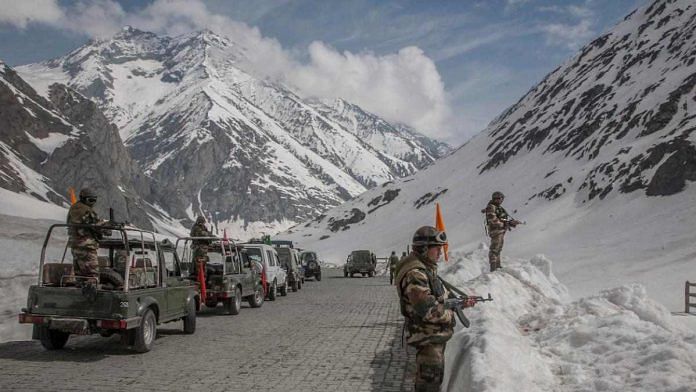
File image of Indian soldiers in Ladakh | By special arrangement

File image of Indian soldiers in Ladakh | Representational image | By special arrangement

New Delhi: India and China have completed troop disengagement from the Gogra area of eastern Ladakh, after 15 months of a “sensitive face-off”, the Army announced Friday.

The disengagement process, which includes removal of all temporary structures and other allied infrastructure by both sides, and restoration of landform to “pre-stand-off period”, was carried out over two days, that is 4 and 5 August, the Army said in a statement.

“As per the agreement, both sides have ceased forward deployments in this area in a phased, coordinated and verified manner… The troops of both sides are now in their respective permanent bases,” the Army added.

The development comes days after the 12th round of corps-commander-level talks between India and China, which were held on 31 July at the Chushul-Moldo meeting point on the Chinese side of the Line of Actual Control (LAC). 

Sources in the defence and security establishment told ThePrint that as part of the disengagement process, which was first initiated in the area in 2020 but not completed by China, a buffer zone has been created. No patrolling will take place in the area in the foreseeable future, by either India or China, they said.

The disengagement, the sources added, involved a “platoon-plus strength” (a platoon roughly comprises 25 soldiers) on both sides.

“The disengagement process was initiated last year too. However, China did not complete the entire process and kept a platoon-plus strength of soldiers, which they have now withdrawn after the fresh agreement at corps commander level,” a source said.


Also Read: 5 maps that tell you all you want to know about India vs China in Ladakh


‘On equal footing’

Sources said the disengagement was the outcome of a “step-by-step” process, which involved a lot of “patience and perseverance”.

One source added that “being on an equal footing helps”, alluding to India’s refusal to back down in the face of Chinese aggression since May last year.

In its statement, the Army said “both sides agreed on disengagement in the area of Gogra”, adding that it was an outcome of the corps commander meeting.

“The troops in this area have been in a face-off situation since May last year,” the Army said.

This agreement ensures that the LAC in this area will be strictly observed and respected by both sides, and that there is no unilateral change in status quo, it added.

“With this, one more sensitive area of face-off has been resolved. Both sides have expressed commitment to take the talks forward and resolve the remaining issues along the LAC in the western sector,” the statement said.

The Indian Army, it added, along with the ITBP (Indo-Tibetan Border Police), is totally committed to ensure the sovereignty of the nation and maintain peace and tranquillity along the LAC in the western sector.

Next focus point

India and China had been locked in a stand-off at the LAC since April-May last year — a stand-off that also resulted in a clash at Galwan Valley that killed 20 Indian soldiers. Efforts have been underway at multiple levels since last year to resolve the tensions.

While Gogra disengagement has been finalised now, disengagement has also been completed at two other points of friction, Pangong Tso and Galwan Valley, since last year.

The corps commander talks held last month were the shortest-ever, but were described as successful, and forward movement was expected.

Sources said the next focus of India-China talks will be the Hot Springs area, which is Patrolling Point 17A.

The Hot Springs area, they added, is also doable and there is “not much difference” in the opinions put forward by both sides.

The remaining friction points — like Depsang Plains and Demchok — will take time.

(Edited by Sunanda Ranjan)


Also Read: What does the future of India-China ties look like? 8 experts speak


The importance of being Bhoop Singh

He’s your average soldier, who bends his back to demands of an exacting profession. He’s lived in swamps, roasted in deserts, eaten dust, frozen his marrow in Siachen

The importance of being Bhoop Singh

Photo for representational purpose only

Lt Col AK Ahlawat

Mercury is used to measure the behaviour of temperature and Bhoop Singh that of your average soldier. What would Bhoop Singh do when faced with such and such a situation? Is this new equipment Bhoop Singh proof? How many calories’ diet will Bhoop Singh require in this terrain? How will Bhoop Singh relay the message of appearance of Halley’s comet to his battalion?

Bhoop Singh is the ideal, or not-so-ideal, average soldier of our Army. Kipling created soldiers like privates Learoyd, Mulvaney and Ortheris. George MacDonald Fraser gave us private McAuslan. It is debatable as to who introduced Bhoop Singh into the lexicon, but certainly the phenomenon needed introducing.

Once I gave a lift to some jawans in my old Maruti 800. When they disembarked, all of them banged shut the doors with such might that the little car nearly overturned. That is your average Bhoop Singh way of doing things. You need everything to be four times multiplied by the ordinary.

In the vein of Kipling’s ‘The Three Musketeers’, Bhoop Singh is the representation of admiration one feels for our average soldier. He is not perfect, not overly educated or overly faux cultured. He is a farming man, a tiller of our ancient earth distinguished by dialect characteristics. Till a few years ago, he would wear his uniform threadbare and get his boot soles patched up by the unit cobbler with pieces cut from airplane tyres. He would self-dye his faded uniform darkest green to make it last and last. He respects and supports the traditions of his regiment. He is thrifty to the depths of parsimony and saves most of his pay which he money orders home. He has a wife, a father and mother and a buffalo to support. His family makes homemade ghee for him to take along after leave. They melt it and fill it in 2-litre Coca-Cola bottles for ease of carriage. He pays bounced-up fees to send his children to ersatz English medium schools that are cropping up fast.

He is part of his company and battalion teams in sports. It’s expected of him and he does not shun the team’s honour. More often than not, he ends up with an injury during his Army career that plagues the rest of his days upon earth but he laughs it off and treats it as a scar of honour.

He is the unwearying boot that carries his country’s arms and stands guard to its Constitution, civilisation and national values, bends his back to the demands of an exacting profession.

Slow talking, infinitely patient and delayed to anger, he spends his life in unknown and remote arenas of conflict, never seen or visited by his countrymen. He is not admitted to the outer doormats of any powerful offices. His profession keeps him away from smalltime fads of preening and self-shining. His duty is to keep his legs strong, aim unwavering, heart staunch and mind sagacious. He has to guard against the insidious call of getting drunk after a hard day’s hill bashing more than required, thereby spoiling his chances of an additional stripe.

This is our Bhoop Singh, your average soldier. He has lived in swamps, roasted in deserts, eaten dust and sand, frozen his marrow in Siachen. He is scarred, resourceful and old shod in soldiering. As George Orwell said, “People sleep peaceably in their beds at night only because rough men stand ready to do violence on their behalf.”


Punjab announces Rs 1 crore each for men’s hockey team players from state

SGPC to award Rs 5 lakh to participants from Punjab, Rs 1 crore to team

Tribune News Service

Chandigarh, August 5

Punjab Sports Minister Rana Gurmeet Sodhi announced a cash award of Rs 1 crore each for the players from the state in the Indian men’s hockey team.

India won the bronze medal after a thrilling 5-4 victory over Germany at the Tokyo Games on Thursday, giving the country its first Olympic hockey medal in more than forty years.

Germany took an early lead in the goal-rich match through a second-minute goal by Timur Oruz, and posed a threat to eight-time Olympic hockey champions India in the first quarter.

After Simranjeet Singh equalised with a backhand shot for India, Germany kept their cool, scoring two goals to take a 3-1 lead in the second quarter.

But India pulled level late in that quarter thanks to goals by Hardik Singh and Harmanpreet Singh, making it 3-3 at the halftime break.

India then took a 5-3 lead after Rupinder Pal Singh notched in a penalty stroke and Simranjeet Singh scored his second of the match not long into the second half.

Germany came back a goal but was unable to force the equaliser, even after taking out its goalie to bring in an extra field player late in the game.

India’s bronze was its first Olympic hockey medal since winning gold at the 1980 Moscow Games.

SGPC announces Rs 1 crores award for team, Rs 5 lakh to participants from Punjab

Shiromani Gurudwara Prabandhak Committee (SGPC) President Bibi Jagir Kaur has announced to award Rs 1 crore to the Indian hockey team. She said the SGPC will also award Rs 5 lakh each to all players of Punjab who are participating in Olympic.

She said the team will soon pay obeisance at Harmandir Sahib when they will be presented the award.


Rajiv Gandhi Khel Ratna Award renamed after hockey great Dhyan Chand

‘Hope PM will announce changing the name of Narendra Modi Stadium and Arun Jaitley stadium after legendary sportspersons’, says Congress

Rajiv Gandhi Khel Ratna Award renamed after hockey great Dhyan Chand

Tribune News Service

New Delhi, August 6

India’s highest sporting honour, Rajiv Gandhi Khel Ratna Award was on Friday renamed Major Dhyan Chand Khel Ratna Award with Prime Minister Narendra Modi making the announcement on Twitter.

“Major Dhyan Chand was among India’s foremost sportspersons who brought honour and pride for India. It is fitting that our nation’s highest sporting honour will be named after him,” he said.

The BJP leaders termed the move as token of gratitude to India’s hockey legend and sportspersons who had brought glory to the country.

Congress leader Randeep Surjewala also welcomed the renaming but said, “Now that a new beginning has been made, we hope the PM will announce changing the name of Narendra Modi Stadium and Arun Jaitley stadium after legendary sportspersons.”

Surjewala said, “We hope Modi ji should not have used his myopic political motives to drag the name of a celebrated player like Major Dhyan Chand.”


India building warships to hunt down subs close to its shores

India building warships to hunt down subs close to its shores

Indian Navy Ship (INS) Tabar. File photo

Ajay Banerjee

Tribune News Service

New Delhi, August 7

India is adding to its ability to hunt down submarines, especially in shallow waters, or in areas closer to the coast. All along the western coast, there are vast areas of shallow waters. Several of the refineries, crude-oil moorings, strategic oil storage reserves and key ports are on the west coast.

Yesterday, the project to make eight Anti-Submarine Warfare Shallow Water Craft (ASW-SWC) kicked off at the Garden Reach Shipbuilders and Engineers (GRSE), Kolkata. The keel of the first such warship was ‘laid virtually’ by Vice Chief of the Indian Navy Vice Admiral SN Ghormade.

Project to make 8 Shallow Water Craft

  • The project to make eight Anti-Submarine Warfare Shallow Water Craft (ASW-SWC) vessels kicked off at the Garden Reach Shipbuilders
  • and Engineers, Kolkata.
  • These ASW- SWC are designed for a speed of 25 knots and are capable of full-scale underwater surveillance of coastal waters and coordinated operations with aircraft.
  • The vessels will be able to destroy underwater targets. The ASW Shallow Water Craft have underwater sensors.

Guarding waters: 16 warships, 13k crore cost
Four vessels in use: INS Abhay, Ajay, Akshay, Agray

The ‘keel laying’ is a major milestone activity in the shipbuilding process and indicates the amalgamation of various blocks towards construction of a ship. The project at the GRSE, a company owned by the Ministry of Defence, is in collaboration with private Larsen and Toubro (L&T). This is the second part of the project, the other one of making eight similar warships is being done at Cochin Shipyard Limited, Kochi. The first steel cutting at the shipyard in Kerala was done in December last year. The project to make these 16 warships is close to Rs 13,000 crore. At present, the Indian Navy uses four vessels — INS Abhay, Ajay, Akshay and Agray — for scouting submarines in shallow waters. These are more than 30 years old and are customised variants of the Russian Pauk-class corvettes.

Besides these specialised shallow water sub-hunters, the Navy has a brand new fleet of submarine hunting warships called the ‘Kamorta class’ that ventures to high seas. In the air, specialised aircraft called the Boeing P8I keep an eye on submarines and carry anti-submarine missiles, the Harpoon. The Navy has 10 such surveillance planes. India has also contracted for 24 specialised submarine hunting helicopters from US company Lockheed Martin, to replace three-decade old Russian Kamov-28 copters.


Manish Tewari | Does India need theatre commands?

The combatant command President selects needs to have served in at least one joint responsibility role in a senior command position

Since India’s military reform process will be equally intricate, protracted, and even complicated with competing and conflicting demands, claims, issues, and even turf battles that would have to be reconciled, the legislature needs to play a far more pro-active role. Representational Image. (AFP)  Since India’s military reform process will be equally intricate, protracted, and even complicated with competing and conflicting demands, claims, issues, and even turf battles that would have to be reconciled, the legislature needs to play a far more pro-active role. Representational Image. (AFP)
Manish Tewari
MP ANANDPUR SAHOB(Pb)
A lawyer and a former Union minister. The views expressed are personal. Twitter handle @manishtewari

There has been quite a bit of commentary in the public space about the proposed reorganisation of the Armed Forces into theatre commands. A large number of retired defence officers, including former chiefs of both the Air Force and the Navy, have written profound opinion pieces expressing apprehensions and reservations about the process and the fact that it is being rushed through rather impulsively.

Let us first understand what is being attempted. On December 24, 2019, the government announced the creation of a chief of defence staff and a new department of military affairs (DMA) in the ministry of defence. This was followed by the appointment of the outgoing Army Chief General Bipin Rawat as the first CDS on December 31, 2019. This new paradigm brought into sharp relief the question of the proposed institution of Theatre Commands for the Indian Armed Forces.

The fundamental concept underpinning the Theatre Commands paradigm is achieving jointness. Jointness means the synergy and synchronisation of different branches of the fighting arms into one cohesive and integrated organisation.

The idea is neither new nor novel. Over three dozen countries in the world have evolved and adopted a combined services template for their militaries. Major powers like the United States, Russia, China and even the United Kingdom from where we have inherited our military ethos are all tasked on this jointness archetype now.

In the US, prior to 1986, each service had its own chief. The service chiefs together stood constituted as Joint Chiefs of Staff. Its elected chairperson reported to the defence secretary. The defence secretary, in turn, was accountable to the President.

This arrangement was analogous to India before the appointment of the chairman of Joint Chiefs of Staff in the US as the principal military advisor the President, National Security Council, Homeland Security Council, and the defence secretary post the implementation of the Gold Water-Nichols Act of 1986. He assists the President and the defence secretary, both civilians, in giving strategic direction to the Armed Forces. He proffers advice with regard to force structures and budgetary practices. When rendering counsel he is obligated by law to confabulate with the service chiefs who act as secondary military advisors.

This Act promulgated in 1986 transformed both the character and configuration of the US defence forces. The important thing to mark is that the reorganisation came through legislation and not via an executive fiat.

The Act provided the latitude for both joint and single service commands. It ordained that a unified combatant command means a military command that comprises personnel from two or more military realms. The command hierarchy of a unified or specified combatant command travels from the President downwards to the secretary of defence, and from there, directly to the theatre or the combatant commander. The President only selects an officer to lead a combatant command, if the officer concerned has diverse experience and has served in at least one joint responsibility role in a senior command position.

Democratic nations must be extremely vigilant about excess centralisation of authority in any one defence official. The US arrangement guarantees this by mandating the chain of operational command runs from the President to the defence secretary — a cabinet-level position in the US and then directly to the theatre commander. The chairperson of the joint chiefs of staff, therefore, has no operational command authority.

Even in the United Kingdom, a new epoch for the British Armed Forces is emerging. On March 22, 2021, the government officially released its Integrated Review of Security, Defence, Development and Foreign Policy. It delineates the government’s visualisation of the UK’s role in the world over the next decade and thus provides a clear roadmap to the Armed Forces in terms of what the policy priorities of the state are over the medium term.

Thus whatever operational concepts the defence establishment wants to evolve need to be clearly fine pointed to cater to the tactical, diplomatic and foreign policy priorities of the United Kingdom’s civilian government. What is noteworthy is that defence reform is a part of a larger strategic horizon and not merely an act of internal reorganisation.

That is why in India, across the board, strategic experts, specialists and researchers have been arguing for transparency and openness on the specificities of the proposed theatre commands in India. Even among the services, the opinion seems to be split. It is not a mere coincidence that retired Air Force and Navy officers are forcefully arguing against theatre commands. Even the proxy views of these two services are being aired in the public space and social media suggesting that there is trouble in paradise.

The fundamental decision that must be taken even now is that, if we are to head in the direction of theatre commands, this transition must be carried out through legislation like in the United States and not by mere executive instructions of the department of military affairs in the ministry of defence.

Moreover, politicians who understand India’s strategic imperatives, especially the two-front challenges, that India confronts must pro-actively guide this transition.
They need to be assisted by a foreign policy and strategic affairs professionals who never lose sight of the big picture. A generic bureaucracy where an officer serves in the department of animal husbandry one day, department of cooperation the next day, and the ministry of defence the third day will never measure up to the task of guiding the defence forces through the single biggest transformative change attempted by them ever since their inception. Neither should this task be left to the CDS and a bunch of military officers to superintend this makeover as just another internal reorganisation process unique to the Armed Forces being implemented in a strategic vacuum.

When this osmosis of the defence establishment played itself out in the US politicians, defence professionals, strategic thinkers, foreign policy practitioners, and, most vitally, the media absorbed themselves in five years of knowledgeable and cogent public discussions before the US Congress finally passed the Goldwater-Nichols Defence Reorganisation Act of 1986.

Since India’s military reform process will be equally intricate, protracted, and even complicated with competing and conflicting demands, claims, issues, and even turf battles that would have to be reconciled, the legislature needs to play a far more pro-active role. It must seriously apply itself to the establishment of a Dedicated Standing Committee of Parliament staffed with military advisers and other professionals to independently monitor this transition very minutely.


No consensus yet on structure of theatre commands, discussions, tweaks to continue

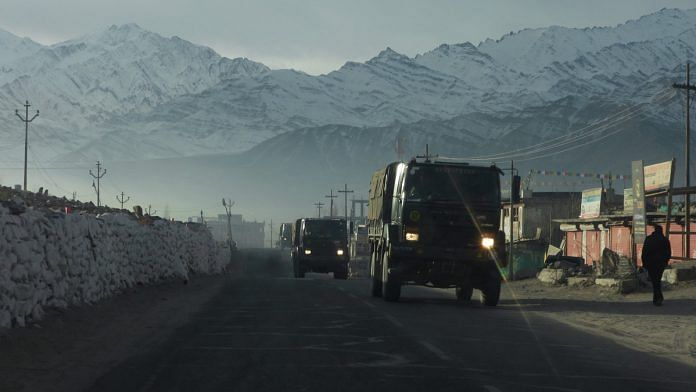
Representational image of an Indian Army convoy moving through Ladakh | Photo: ANI

New Delhi: The three Services — Army, Navy and Air Force — are jointly working to reach a consensus on the exact structure of the theatre commands, a concept that the Modi government is firm on and will be the biggest defence reform that the forces will see.

Government sources as well as those in the defence and security establishment told ThePrint that more discussions will take place among various stakeholders in the coming weeks, and all issues will be thoroughly brainstormed.

It is expected that Prime Minister Narendra Modi, during his Independence Day address, could announce the government’s decision to adopt theaterisation as a concept.

Sources explained that if an announcement is made, the raising will start and will continue for a year. In this period, existing commanders will assume the role of theatre commanders. Formal appointment of theatre commanders will be done only after a period of one year and operationalisation will be done by 2023.

Theterisation, which seeks to unite the 17 individual Commands of the three Services into four or five joint structures, will not only lead to a joint warfare approach but will also result in cutting down of manpower and joint acquisition that will be cost-effective in the long run, sources said.

Also on the cards are joint training and new Command and Structure that will see the operation role of Service Chiefs being reduced in the coming years.

The Chief of Defence Staff (CDS) will eventually become the operational ocmmander once the process is stabilised.


Also read: Joint military command is the future but India can’t rush into it


Support to any act of terrorism is crime against humanity, Rajnath Singh says at SCO meet

Defence Minister Rajnath Singh attend conclave of Shanghai Cooperation Organisation (SCO), in Dushanbe, on 28 July 2021 | Twitter | @rajnathsingh

Text Size: A- A+

New Delhi: Terrorism is the most serious threat to international peace and security and support to any acts of terror is a crime against humanity, Defence Minister Rajnath Singh said on Wednesday at a conclave of the Shanghai Cooperation Organisation (SCO) in Dushanbe.

He reaffirmed India’s resolve to fight terrorism in all its forms and manifestations and said peace and prosperity cannot coexist with terrorism, in remarks seen as directed at Pakistan.

“Peace and prosperity cannot coexist with terrorism. Terrorism is the most serious threat to international peace and security,” Singh said in presence of defence ministers of China, Russia and other member countries of the SCO.

“Any act of terror and support to such acts, including cross border terrorism, committed by whomsoever, wherever and for whatever motives, is a crime against humanity. India reaffirms its resolve to fight terrorism in all its forms and manifestations,” he said.

Singh said India accords high priority to the “consolidation of trust” in the security domain within the SCO as well as strengthening ties with partners of the grouping bilaterally on the basis of equality, mutual respect and understanding.

“The challenge today is not just one of concepts and norms, but equally of their sincere practice. The leading voices of the world must be examples in every way,” he said without elaborating.

He said India is committed in its resolve to work within the SCO framework for helping create and maintain a peaceful, secure and stable region.

“India also reiterates readiness to partner with fellow SCO Member States to develop joint institutional capacities that respect individual national sensitivities and yet generate a spirit of cooperation to create contact and connectivity between people, societies and nations,” he said.

Singh said the geo-strategic location of India makes it both a “Eurasian land power” as well as a stakeholder in the Indo-Pacific.

“Our intent and aspirations are therefore focused towards prosperity and development of the entire region. We affirm this intent through our national policy of Security and Growth for All in the Region, commonly known by the acronym ‘SAGAR’,” he said.

“Security and stability are most essential components to create conducive environment for growth and economic development of the region and our respective nations,” he added.

Singh said the SCO nations together encompass nearly half the human population and it covers approximately three-fifths of the Eurasian continent in terms of geographical expanse.

“We, therefore, have collective stakes to create a safe, secure and stable region that can contribute towards progress and improvement of human development indices of our people and the generations which will follow,” he said.

“It is in the same spirit India helps people of Afghanistan, which is facing violence and devastation over decades. So far India completed 500 projects in Afghanistan and continuing with some more with total development aid of US dollar 3 billion,” he added.

The SCO, seen as a counterweight to NATO, is an eight-member economic and security bloc and has emerged as one of the largest transregional international organisations.

India and Pakistan became its permanent members in 2017.

The SCO was founded at a summit in Shanghai in 2001 by the presidents of Russia, China, the Kyrgyz Republic, Kazakhstan, Tajikistan and Uzbekistan.

India has shown keen interest in deepening its security-related cooperation with the SCO and its Regional Anti-Terrorism Structure (RATS), which specifically deals with issues relating to security and defence.

India was made an observer at the SCO in 2005 and has generally participated in the ministerial-level meetings of the grouping, which focus mainly on security and economic cooperation in the Eurasian region.


Also read: Rajnath to focus on regional peace at SCO, meet with Chinese defence minister not ruled out