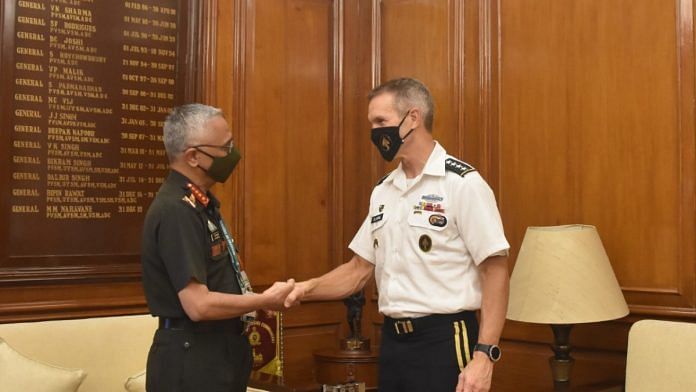
General Richard D. Clarke, Commander US Special Operations Command called on Army Chief General MM Naravane, on 29 July 2021 | Twitter | @adgpi
Text Size: A- A+
New Delhi: Army Chief General MM Naravane held talks with Commander of US Special Operations Command General Richard D Clarke on Thursday, focussing on various key aspects of bilateral defence and security cooperation.
General Clarke is on a three-day visit to India.
“General Richard D. Clarke, Commander United States Special Operations Command #USSOCOM called on General MM Naravane #COAS and discussed issues of mutual interest,” the Army said in a tweet.
Officials said various dimensions of bilateral defence cooperation, including ways to further deepen it, figured in the talks.
Before meeting General Naravane, the US official laid a wreath at the National War Memorial.
“The visit will enhance defence cooperation and military ties between the two nations,” the Army said.
Separately, General Naravane also held a telephonic conversation with Lieutenant General Charalampos Lalousis, Chief of Hellenic Army General Staff, focussing on defence cooperation between India and Greece.
The Indo-US defence ties have been on an upswing in the last few years.
In October last year, India and the United States sealed the Basic Exchange and Cooperation Agreement (BECA) to further boost the bilateral defence ties. The pact provides for sharing of high-end military technology, logistics and geospatial maps between the two countries.
The firming up of the BECA came two years after the two countries signed another pact called COMCASA (Communications Compatibility and Security Agreement) that provides for interoperability between the two militaries and the sale of high-end technology by the US to India.
In June 2016, the US designated India as a “Major Defence Partner”, intending to elevate defence trade and technology sharing with the country to a level commensurate with that of its closest allies and partners.
The two countries had also inked the Logistics Exchange Memorandum of Agreement (LEMOA) in 2016 that allows their militaries to use each other’s bases for repair and replenishment of supplies as well as provides for deeper cooperation.
Royal background, contemporaries in service and friends outside the military, both Sawai Bhawani Singh & Sukhjit Singh were awarded MVC
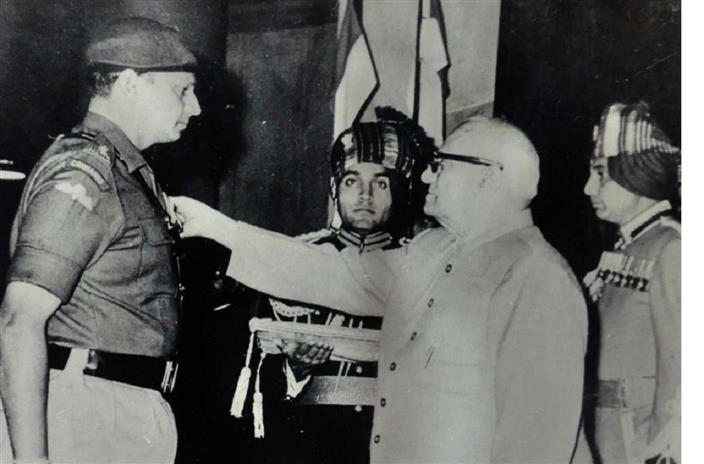
Brig (then Lt Col) Sawai Bhawani Singh being presented the Maha Vir Chakra by President VV Giri.
Sujan Dutta
So much champagne flowed to celebrate his birth, as myth and legend have it, that they nicknamed him “Bubbles”. Myth and legend competed through his stellar military career and continued the contest beyond it.
It was not a Champagne Run, though, that got ‘Brigadier His Highness Saramad-i-Rajahai Hindustan Raj Rajendra Shri Maharajadhiraj Sawai Bhawani Singh Bahadur’ a Maha Vir Chakra when he was a Lieutenant Colonel in 1971.
Brig Sukhjit Singh
For, the last of the ‘Maharajas’ — before Prime Minister Indira Gandhi abolished the privy purse for the rulers of the erstwhile princely states earlier that year — was lionised for having led raid after raid at the head of 10 Paras (commandos).
Later to be known as the 10 Para Special Forces (‘Desert Scorpions’), the battalion was the tip of the spear that pierced deep into enemy territory in Pakistan’s Sindh through the Thar desert, in territory that was once partly under the House of Kacchawaha (the Jaipur royals).
Myth and legend are somewhat conditioned by the quality of record-keeping about the deeds of the feted ‘Desert Scorpions’. The citation by the Ministry of Defence reads:
“On the night of December 5 (1971), Lt Colonel Sawai Bhawani Singh, who was commanding a battalion of the Parachute Regiment (commandos), led his men deep into the enemy territory and for four days and nights, with complete disregard for his personal safety, made skillful and relentless raids on the strongly held posts at Chachro and Virawah.”
There were two companies he was leading — Alpha and Charlie. After zooming through the night over sandy desert dunes and vales in Jongas, the companies scared the enemy first with the cacophony they caused. Then, Alpha company partly surrounded a wing of the Pakistani Rangers’ fortified post at Chachro, some 70 km from the border, while Charlie company raided it. They took prisoners.
Then the commandos headed for Virawah. Action repeated itself with the element of hand-to-hand fighting added. In “gingering up the enemy”, Bhawani Singh’s boys killed 17 Pakistani soldiers in the surgical strikes with light machine guns mounted on their jeeps.
Then they raided Nagarparkar, another defended Pakistani position, before returning to base. At the base, they were given yet another task — to blow up an ammo dump in Islamkot that they duly proceeded to do. All of them returned from all the raids. There was no Indian casualty.
In the blitzkrieg that was said to have been modelled after a British SAS raid behind German lines in Libya during World War II, there was a dissonance between a certain ‘A’ and a certain ‘B’, ‘A’ being for the anecdotal and ‘B’ for the battle action report.
In ‘A’, Lt Col Bhawani Singh has also narrated that after crossing into Pakistani territory, somehow the local Khemkhanis (Rajput Muslims) had learnt that their Maharaja was in the vicinity. They wanted to reverentially bow to him, in an account by his friend Brigadier Sukhjit Singh, with cries of ‘Khama Ghani Maharaj’. The villagers, according to Sukhjit Singh, were “demonstrating that borders have never severed generational ties of fealty”.
B: the battle action reports as well as the citations of 10 Para SF during 1971 are non-existent, according to the MoD. The response to a Right to Information query said, “The relevant record of citations has been destroyed as per policy in vogue.” (Reported by The Print in 2019).
At last count, 36 Pakistani soldiers were killed by the Paras and 22 others were taken prisoner.https://8450f44027c5f3ef4c52a066ba732bb8.safeframe.googlesyndication.com/safeframe/1-0-38/html/container.html
“The name ‘Bubbles’ is in a way a misnomer for the frivolity it implies,” Sukhjit Singh wrote evocatively after his friend’s death in April 2011. “He was not an indolent prince of leisure but an exemplar tour de force, who brought gravitas to each and every one of his roles and responsibilities. At the same time, it should be conceded that his effervescent personality gave ample grounds for this to be a well-suited ‘pet name’. Military punctilio, ceremonial exactitude and elegance, all came naturally to him.”
Sukhjit Singh was/is a prince himself, from the House of Kapurthala. His fondest memory is of rides with his grandfather, the Maharaja of Kapurthala, “in a zebra-driven chariot in the zoological gardens of the palace”, according to an interview to The Tribune.
Sukhjit Singh, also of the armoured corps’ Scinde Horse (14 Horse), was its Commanding Officer as a Lieutenant Colonel in the Shakargarh sector, the bulge that threatened the Pathankot-Jammu national highway linking to Srinagar.
His exploits with his men on the then modern T-55 tanks are part of military lore to this day. The Scinde Horse was the first to have got the tanks imported from Soviet Russia in 1966.
He was leading the charge from the south of bulge, in skirmishes leading to the epic Battle of Basantar.
“On December 10, 1971, his regiment was deployed west of Naina Kot when the enemy launched an armoured attack in strength under cover of intense artillery and heavy mortar fire,” his citation noted.
Despite the flak from the Pakistani forces, Sukhjit Singh manoevred his machines, leading his columns from the open cupola of his own tank, sometimes with his dust goggles raised to the forehead to see better through binoculars so that he could direct volleys from his men most effectively.
The next day, on December 11 again, he personally outflanked the enemy to close in on them despite its medium artillery and mortar fire. The Pakistanis lost eight tanks, Shermans and Pattons. The intention was to capture the enemy tanks. One Pakistani officer, two junior commissioned officers and two other ranks were taken prisoner at Malakpur.
He was already a veteran of armoured warfare, having distinguished himself in the Dera Baba Nanak sector in the 1965 operations.
An excerpt from The Tribune (March 19, 2021) quoting him reads: “The 1971 war was raging. I was Lieut Col at that time. My troops managed to round up Pakistani soldiers. Among them was a tall, smart guy with whom I began talking just to cull more information. As our conversation was on, he told me, ‘I have one last wish.’ I replied, ‘What makes you think that we are going to kill you?’ During further inquiry, we got to know that he is the son of Sikandar Hayat Khan, a former premier of Punjab. He was among those who were set free. Much later, I met the family as well.”
After 26 years in the Army and the decoration, the man who led that charge and is said to have influenced the Punjab Chief Minister, Capt Amarinder Singh (of the Patiala royals), to join the Army, has also had long legal tussles, including one when he was posted in the military operations directorate.
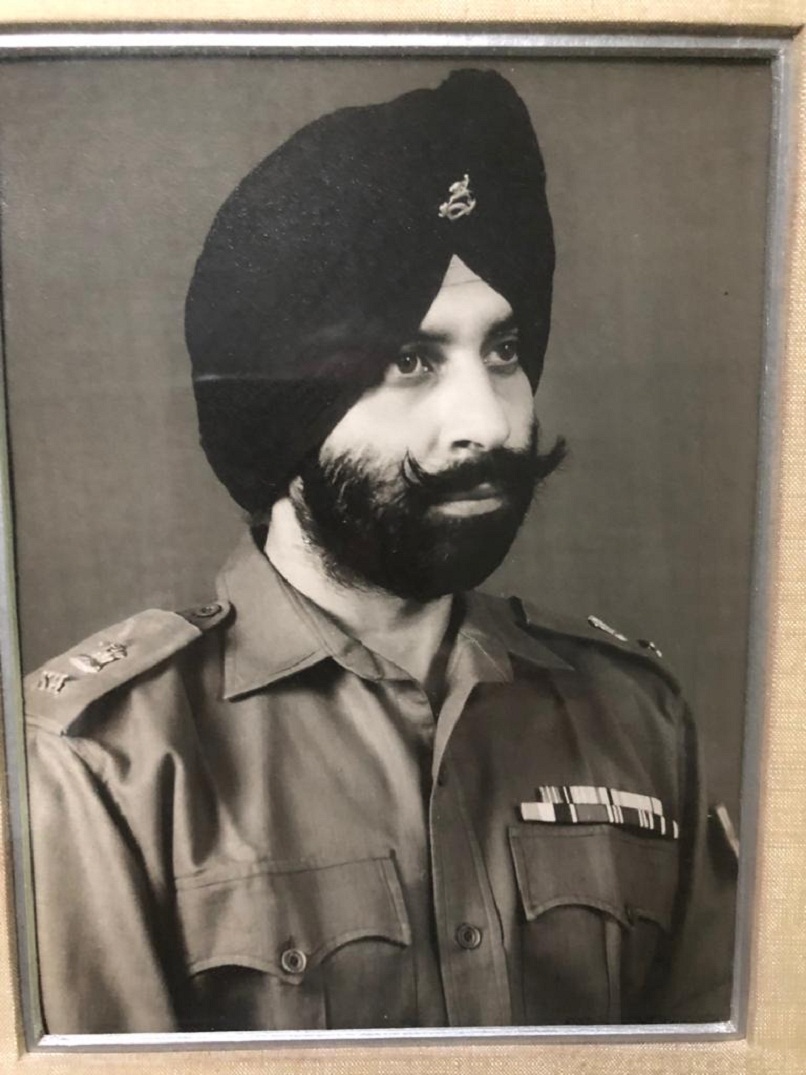
Sawai Bhawani Singh and Sukhjit Singh were not only contemporaries in service, they were friends outside the military. Bhawani Singh was schooled at Seshbagh in Srinagar, Doon and Harrows. He was commissioned into the 3rd Cavalry in 1951 before moving to the President’s Bodyguard and then to the 10 Paras. He was recalled to service to be conferred the rank of Brigadier post-retirement and before being sent on diplomatic assignments.
Sukhjit Singh was also educated at The Doon School before training at the Indian Military Academy.
Having cleared the interview for the National Defence Academy, all that remained was the medical test before I could adorn the military uniform. There is many a slip between the cup and the lip; a problem was detected in my eyes and I was referred for a review. The next day, as we sat in the waiting hall, I heard my name being called out. Before I could gather my medical documents and move in, another candidate walked up briskly to the doctor for his check-up. We had the same name though his ‘chest number’ (numerical identity given to all candidates), was senior to mine. Perhaps it was his turn, so I thought.
The doctor spent considerable time examining his eyes, but couldn’t find the problem mentioned in the medical papers. He then enquired if there was someone else by the same name, to which I answered in the affirmative. He lambasted me for not being attentive that led to wasting of his precious time on a wrong person instead. There was laughter in the hall and I too managed to grin. The doctor was visibly agitated; it was no coincidence that I was rejected ‘temporarily’ on medical grounds. I had to undergo the agony of a medical re-examination four weeks later before being declared ‘fit for combat’.
As luck would have it, both of us namesakes were allotted the same battalion in the academy. While dealing with a multitude of cadets, matching names to faces was a big enough challenge for instructors; two identical names, both ‘turbaned gentry’, further added to the confusion.
As if this was not enough, both of us joined the regiment of artillery and went for ‘Young Officers’ course soon after commissioning. One day in the middle of the course, my senior subaltern came over looking for me. He had been sent by our commanding officer to enquire about my wellbeing. Presumably, a report had been sent to the regiment of my having gone missing from the course. Those were the days of no cell phones and telegrams which at times caused confusion.
While he was relieved seeing me enjoying my weekend drink in the mess, I was perplexed as to why the commanding officer was so concerned about my health. He had a hearty laugh when he learnt that it was the ‘other one’ who had been declared ‘absent without leave’, as per the Army parlance. Perhaps the dispatcher, in his exuberance, sent the signal to the regiment about the first namesake he saw on the list, little realising that the ‘same spellings’ figured again further down in the nominal roll of officers.
‘What’s in a name? That which we call a rose by any other name would smell as sweet,’ said Shakespeare in Romeo and Juliet. Well, there is a lot of scope for ‘comedy of errors’, I would have answered. Now, when I colloquially write my name as ‘EchPee’, there is a compelling reason behind it.
Saluting the Kirti Chakra awardee, and the braveheart’s wife — Veer Nari Manjit Kaur, who picked herself up after the huge loss and ensured the best for their children
Representational photo
Brig SPS Dhaliwal (Retd)
Baghelawala is a small village in Moga district of Punjab located off the Moga-Ferozepur road. As you enter the village, you are greeted by the imposing memorial of the late Lance Havaldar Zora Singh, Kirti Chakra, of 1 Sikh Light Infantry, opposite of which is the senior secondary school, again named after this gallant soldier.
On October 15, 1970, in this village was born Zora Singh, appropriately named by his parents as he would prove to be a “Brave Lion” later in life. Having completed his schooling, this boy, who was passionate about joining the Army, was recruited in the Sikh Light Infantry Regiment on December 3, 1987.
A veteran of Op Pawan in Sri Lanka, he moved with his battalion to J&K’s Krishna Ghatti sector in January 2001. A month later, information was received at our headquarters of the presence of an infiltrated group of militants in the thickly wooded forest area of Khanetar in Poonch district. The task to search for and eliminate this group was given to the Ghatak Platoon and a patrol party of B Company of 1 Sikh LI and a Ghatak Platoon of 4 Grenadiers under their Adjutant, who volunteered for the operation. He briefed them and they set about the search from two opposite directions. Three days of toil in the area gave no results. The troops were running low on rations and were fatigued, but continued the search on the fourth day.
Lance Havaldar Zora Singh, with the patrol party of B Company of 1 Sikh LI, was in the lead when he saw some suspicious movement next to a dhok (an abandoned hut). As he approached the hut, Zora Singh spotted a lookout militant sitting outside and he immediately opened fire. He dropped the lookout and charged at the dhok, wanting to catch the rest of the party by surprise. However, the militants rushed out with all guns blazing. In the exchange of fire, L Hav Zora Singh received a burst of AK-47 in his stomach. Despite being wounded, he pressed on, dragging himself forward. He eliminated two fleeing militants before he himself collapsed having received a direct shot to his head. It was this unprecedented act of courage and devotion to duty that paved the way for the remaining party managing to eliminate three more militants. The two, who had escaped, fell into the ambush of 4 Grenadiers and were subsequently eliminated.
L Hav Zora Singh displayed a high standard of leadership and indomitable courage and made the supreme sacrifice for the success of the task assigned to his paltan. For this unparalleled courage and devotion to duty, he was awarded the Kirti Chakra (the second highest award for bravery in peacetime, after the Ashoka Chakra). The award was received by his wife Manjit Kaur from President Dr APJ Abdul Kalam.
Manjit Kaur was totally shattered. Zora Singh had left behind a daughter, seven years old, and two sons, aged four and a year-and-a-half. With the support of his battalion, the village and the civil administration, this young widow set about dauntlessly bringing up and educating her children. An epitome of fortitude herself, the Veer Nari picked up a job as a Class IV employee in the village school, named after her late husband.
Today, after 20 years of hard work and toil, she is proud of her achievements. Her daughter, having completed her Masters, has migrated to Europe, her elder son has moved to Australia on a work permit and her youngest son has recently completed his Bachelors in Commerce from Moga. A feat even the late braveheart would be very proud of.
There are many more like Manjit Kaur in our country who are re-writing their destiny in a similar manner as their brave husbands gave their today for our tomorrow.
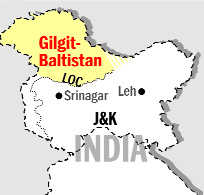
Pak authorities finalise law to award provisional provincial status to Gilgit-Baltistan: Report
India has clearly conveyed to Pakistan that the entire Jammu and Kashmir and Ladakh, including the areas of Gilgit and Baltistan, are integral part of the country
India maintains the Government of Pakistan or its judiciary has no locus standi on territories illegally and forcibly occupied by it. File
Islamabad, August 1
Pakistani authorities have finalised a law to award provisional provincial status to strategically located Gilgit-Baltistan, a media report said on Sunday.
India has clearly conveyed to Pakistan that the entire union territories of Jammu and Kashmir and Ladakh, including the areas of Gilgit and Baltistan, are an integral part of the country by virtue of its fully legal and irrevocable accession.
India maintains the Government of Pakistan or its judiciary has no locus standi on territories illegally and forcibly occupied by it.
Dawn newspaper reported that under the proposed law by the Ministry of Law and Justice, the Supreme Appellate Court (SAC) of Gilgit-Baltistan may be abolished and the region’s election commission is likely to be merged with the Election Commission of Pakistan (ECP).
Sources in the law ministry told the newspaper that the draft of the bill titled ‘26th Constitutional Amendment Bill’ had been prepared and submitted to Prime Minister Imran Khan.
In the first week of July, the prime minister had assigned the task of preparing the law to federal Law Minister Barrister Farogh Naseem.
According to the sources, the draft bill has been prepared after careful reading of the Constitution of Pakistan, international laws, the United Nations’ resolutions especially those related to a plebiscite on Kashmir, comparative constitutional laws and local legislation.
The stakeholders, including the governments of Gilgit-Baltistan and Pakistan-occupied Kashmir, had been consulted on the proposed constitutional amendment, the report quoted sources as saying.
The proposed law suggests that due to sensitivity attached to the region, it could be given provisional provincial status by amending Article 1 of the Constitution that related to the provinces and territories, the sources said.
They added that a set of amendments would be introduced to give the region representation in Parliament, besides the establishment of the provincial assembly in the territory.
The sources are confident that the constitutional amendment is in accordance with the international practice of merger of territories and it will not adversely affect the Kashmir cause in any manner, the report said.
The Pakistan government and the Opposition had reportedly discussed the move prior to last year’s meeting of the political leadership with the Pakistan Army chief.
According to an Opposition leader, Gilgit-Baltistan has acquired great significance in the region due to the China-Pakistan Economic Corridor (CPEC) that is now a “jugular vein” for the country.
The CPEC, which connects Gwadar Port in Pakistan’s Balochistan with China’s Xinjiang province, is the flagship project of Beijing’s ambitious multi-billion-dollar Belt and Road Initiative (BRI).
India has protested to China over the CPEC as it is being laid through Pakistan-occupied Kashmir. PTI
A top Pakistani terrorist, Ismal Alvi, alias Abu Saifullah, alias Lamboo, was among two Jaish-e-Mohammed militants killed by security forces in an encounter in J&K’s Pulwama district today, said police officials.
Probably the biggest strike this yr: Officials
Ismal Alvi: An IED expert, he was from the family of JeM chief Masood Azhar; had trained Pulwama suicide bomber Adil Dar, say sources
Sameer Dar: He too was involved in the Pulwama attack. Of the 19 accused in the attack, eight have so far been killed, said the J&K DGP
Belonging to JeM chief Masood Azhar’s family, Lamboo was allegedly involved in the planning of the 2019 attack on a CRPF convoy in Pulwama that had left its 40 personnel dead. A resident of Pakistan’s Punjab province, he was believed to have been the JeM operational commander (alongside Rauf Asgar) in southern Kashmir, the hotbed of militancy. The second terrorist has been identified as Sameer Dar. An A-category terrorist, he was named in the Pulwama attack chargesheet.
A suicide bomber, Adil Dar, had rammed an explosive-laden vehicle into the CRPF convoy on February 14, 2019, on the Srinagar-Jammu national highway in Pulwama.
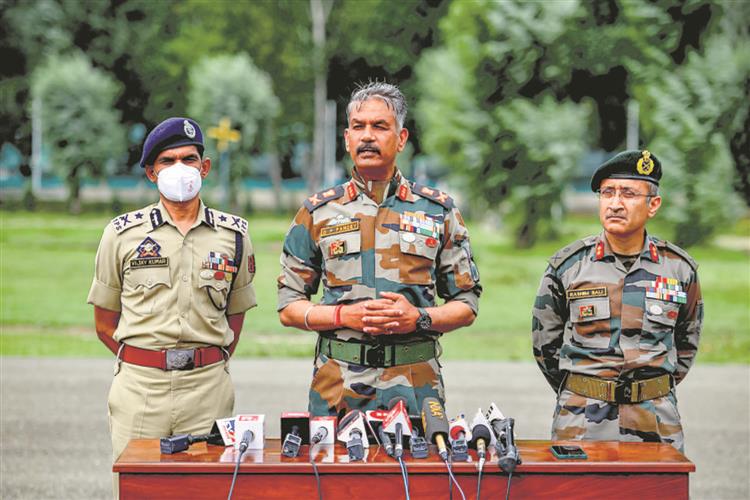
Lt Gen DP Pandey, General Officer Commanding of Chinar Corps, is reported to have said that Lamboo was one of the masterminds for having trained a local, Adil, who blew himself up in the IED attack. — TNS
China seizes maps showing Arunachal as part of India
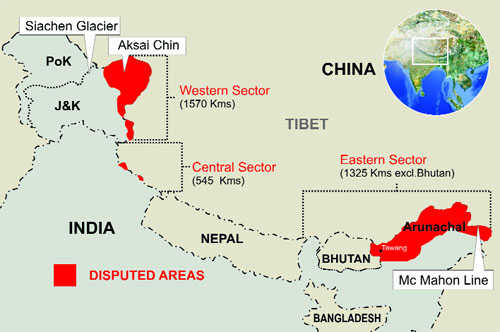
Customs officials in China have seized a large consignment of world maps, meant for export, for showing Arunachal Pradesh as part of India, the official media reported on Friday.
China claims the northeastern Indian state of Arunachal Pradesh as part of South Tibet, which is firmly rejected by India. India says Arunachal Pradesh is its integral and inalienable part. The maps were wrapped in about 300 export consignments. — PTI
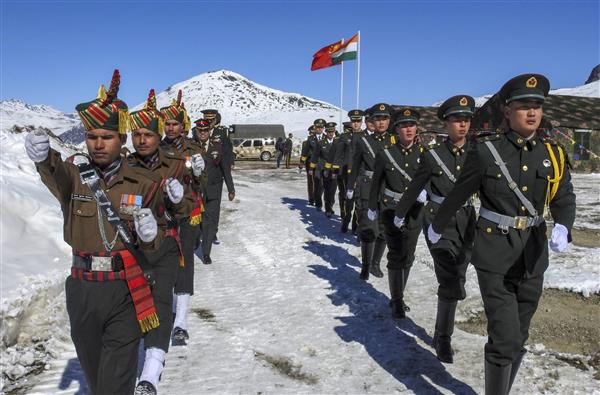
Ladakh row: India presses for early disengagement in Hot Springs, Gogra during military talks with China
12th round of military talks last for around nine hours; no official comment on the outcome of the meeting that took place at the Moldo border point on the Chinese side of LAC
Photo for representation only. PTI
New Delhi, July 31
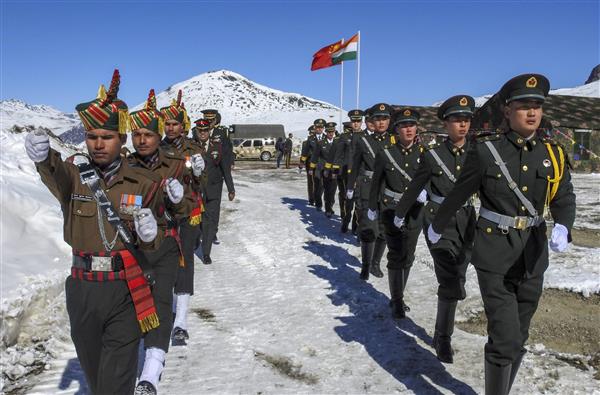
India on Saturday pressed for an early disengagement of troops and weapons in Hot Springs, Gogra and other remaining friction points in eastern Ladakh during the 12th round of military talks with China that lasted for around nine hours, sources in the security establishment said.
Both sides held detailed deliberation and the talks were comprehensive, they said without elaborating further.
There was no official comment on the outcome of the meeting that took place at the Moldo border point on the Chinese side of the Line of Actual Control (LAC) in eastern Ladakh amid expectations of a breakthrough in the disengagement process in Gogra and Hot Springs.
It is learnt that both sides discussed “specific details to cool tempers in the remaining friction points including moving ahead with the disengagement process and agreed to jointly maintain stability on the ground”.
The talks started at 10.30 am and ended at 7.30 pm, sources said.
The Indian side forcefully pressed for early resolution of the standoff and particularly insisted on expeditious disengagement in Hot Springs and Gogra, a source said.
Ahead of the talks, sources said India was hopeful of a positive outcome on the disengagement process.
India has been insisting that the resolution of the outstanding issues, including at Depsang, Hot Springs and Gogra, is essential for the overall ties between the two countries.
The latest round of talks took place after a gap of more than three and a half months. The 11th round of military dialogue had taken place on April 9 at the Chushul border point on the Indian side of the LAC and it lasted for around 13 hours.
The 12th round of military talks took place over two weeks after External Affairs Minister S Jaishankar firmly conveyed to his Chinese counterpart Wang Yi that the prolongation of the existing situation in eastern Ladakh was visibly impacting the bilateral ties in a “negative manner”.
The two foreign ministers had held a one-hour bilateral meeting on the sidelines of a conclave of the Shanghai Cooperation Organisation (SCO) in Tajik capital city Dushanbe on July 14.
In the meeting, Jaishankar had told Wang that any unilateral change in the status quo along the LAC was “not acceptable” to India and that the overall ties can only develop after full restoration of peace and tranquillity in eastern Ladakh.
In the last round of military talks, both sides discussed ways to take forward the disengagement process in Hot Springs, Gogra and Depsang with a larger aim to bring down tensions in the region. However, there was no forward movement in the disengagement process.https://4cdf56fc6d7d8a21f498d43bcb12f202.safeframe.googlesyndication.com/safeframe/1-0-38/html/container.html
The Indian delegation at Saturday’s talks was led by Lt Gen PGK Menon, the Commander of the Leh-based 14 Corps.
The border standoff between the Indian and Chinese militaries erupted in May last year following a violent clash in the Pangong lake areas and both sides gradually enhanced their deployment by rushing in tens of thousands of soldiers as well as heavy weaponry.
As a result of a series of military and diplomatic talks, the two sides completed the withdrawal of troops and weapons from the North and South banks of Pangong lake in February in line with an agreement on disengagement.
Each side currently has around 50,000 to 60,000 troops along the LAC in the sensitive sector. PTI
10-hour talks at Moldo as India, China discuss pullback of troops
Senior Indian and Chinese military commanders could possibly arrive at a consensus of some sort for a pullback of troops at the identified friction points along the 832-km Line of Actual Control (LAC) in eastern Ladakh.
The agreed upon agenda for the Lt Gen-level talks, which began at 10 am and lasted around 10 hours, included disengagement and de-escalation of troops, weapons and equipment from Gogra and Hot Springs, the two flashpoints along the LAC. The Chinese were learnt to be unwilling to discuss troop build-up in Depsang plains, said an official.
Round 12 of Army talks
It was the 12th round of military talks since June 6 last year
Come 2 weeks after S Jaishankar met his Chinese counterpart
EAM told China that LAC tension was ‘negatively’ impacting ties
Any unilateral change in status quo was ‘unacceptable’, he had said
Organised at the Moldo garrison of the People’s Liberation Army (PLA) of China, it was the 12th round of senior military level talks between the two sides since June 6 last year. Moldo faces Chushul on the Indian side.
A formal announcement of the outcome, if any, was expected after the Indian side returned to its base and the decision was conveyed to the Ministry of External Affairs (MEA). The MEA is the coordinator of the Working Mechanism for Consultation and Coordination (WMCC) on India-China border affairs. The WMCC is a group comprising representatives of the foreign ministries and the militaries of the two sides.
Lt Gen PGK Menon, 14 Corps Commander, led the talks from the Indian side. Once Lt Gen Menon along with his team returned to Chushul from Moldo, he was expected to head back to his headquarters at Leh, a 4-hour journey in normal weather conditions.
The 12th round of military talks took place over two weeks after External Affairs Minister S Jaishankar firmly conveyed to his Chinese counterpart Wang Yi that the prolongation of the existing situation in eastern Ladakh was visibly impacting the bilateral ties in a “negative manner”.
The two foreign ministers had held a one-hour bilateral meeting on the sidelines of a conclave of the Shanghai Cooperation Organisation (SCO) in Tajik capital city Dushanbe on July 14.
In the meeting, Jaishankar had told Wang that any unilateral change in the status quo along the Line of Actual Control was “not acceptable” to India and that the overall ties could only develop after full restoration of peace and tranquillity in eastern Ladakh.
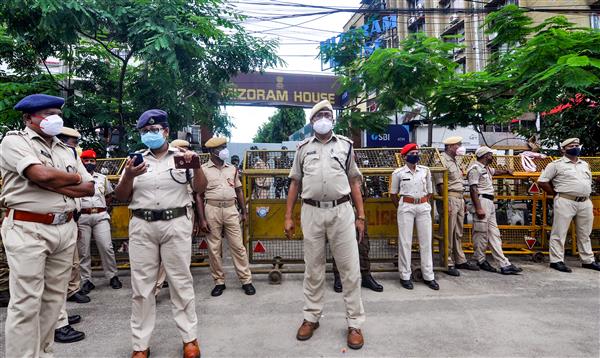
Assam security personnel stand vigil outside the Mizoram House in Guwahati. PTI
Tribune News Service New Delhi, July 31
Assam and Nagaland have inked a pact to “move back” their security personnel from the current location to their base camps in a bid to reduce tension at the border, Chief Minister Himanta Biswa Sarma said.
Border conflict: Several clashes since 1965
The border dispute between Assam and Nagaland began soon after Nagaland became a state in 1963
The Nagaland State Act of 1962 had defined the state’s borders according to a 1925 notification
Nagaland, however, did not accept border delineation
Several major clashes have taken place on the inter-state border since 1965
In a Twitter Post, the Assam Chief Minister said, “the two states have agreed to move back their security personnel from the current location to their base camps in a bid to reduce tension at the border.”
“In a major breakthrough towards de-escalating tensions at Assam-Nagaland border, the two Chief Secretaries have arrived at an understanding to immediately withdraw states’ forces from border locations to their respective base camps,” Sarma said.
The joint statement, a copy of which was also pasted on Twitter by Sarma, read: “Both sides agreed that in order to maintain peace and tranquility in the areas around Ao Senden village and Vikuto Village, as known in Nagaland and in Assam they are known as Jankhona Nala/Nagajankha respectively, urgent and effective steps are required for defusing the standoff between the security forces of Nagaland and Assam.”
State Stalwarts
DEFENCE MINISTER
Minister Rajnath Singh
ALL HUMANS ARE ONE CREATED BY GOD
HINDUS,MUSLIMS,SIKHS.ISAI SAB HAI BHAI BHAI
CHIEF PATRON ALL INDIA SANJHA MORCHA
LT GEN JASBIR SINGH DHALIWAL, DOGRA
SENIOR PATRON ALL INDIA SANJHA MORCHA
MAJOR GEN HARVIJAY SINGH, SENA MEDAL ,corps of signals
.
.
PATRON ALL INDIA SANJHA MORCHA
MAJ GEN RAMINDER GURAYA ,MADRAS REGIMENT
sanjhamorcha303@gmail.com
PRESIDENT SOUTH ALL INDIA SANJHA MORCHA
COL SS RAJAN BOMBAY SAPPERS,
PRESIDENT UTTARAKHAND ALL INDIA SANJHA MORCHA
COL B M THAPA ,BENGAL SAPPERSS
PRESIDENT HARAYANA STATE CUM COORDINATOR ESM
BRIG DALJIT THUKRAL ,BENGAL SAPPERS
PRESIDENT TRICITY
COL B S BRAR (BHUPI BRAR)
PRESIDENT CHANDIGARH ZONE
COL SHANJIT SINGH BHULLAR
.
.
PRESIDENT PANCHKULA ZONE AND ZIRAKPUR
COL SWARAN SINGH
INDIAN DEFENCE FORCES
DEFENCE FORCES INTEGRATED LOGO
INDIAN AIR FORCE
Air Officer C-in-C WESTERN AIR COMMAND
AIR MSHL S PRABHAKARAN AVSM VM
AOC-IN-C, EASTERN AIR COMMAND
Air Marshal Inderpal Singh Walia
AOC-in-C SOUTH WESTERN AIR COMMAND
Air Marshal Vikram Singh
AOC-IN-C, SOUTHERN AIR COMMAND
Air Marshal J.Chalapati
AOC-IN-C TRAINING COMMAND
AIR MARSHAL SK GHOTIA VSM
AOC-IN-C MAINTENANCE COMMAND
Air Marshal Jagdish Chandra
Flag Officer Commanding in Chief, Western Naval Command
ice Admiral R Hari Kumar, PVSM, AVSM, VSM
Flag Officer Commanding in Chief, Eastern Naval Command
Vice Admiral Sanjay Bhalla, AVSM, NM
Flag Officer Commanding in Chief, Southern Naval Command