Maintaining passes and roads and tracks in the vicinity of the border is the responsibility of the BRO that was established in May 1960
Photo for representational purpose only. PTI file
Vijay Mohan
Tribune News Service
Chandigarh, August 9
To commemorate 75 years of Independence, Border Roads Organisation (BRO) will unfurl the National Flag at 75 highest passes in India on August 15, besides undertaking several other activities.
The Himalayan range that spreads across India’s northern frontier has the highest passes and motorable roads in the world, the highest being the Kalindi Pass in Uttarakhand at an altitude of 19,521 feet.
Earlier this month, the BRO completed the black-topping of the world’s highest motorable roads that passes over the 19,300-foot-high Umling La Pass in south-easten Ladakh connecting the town of Demchok in the vicinity of the Line of Actual Control.
The mountain passes and roads are of immense strategic importance and some of them are approachable only on foot or horseback, though the Indian Army has successfully driven tanks over a few of them. Many of the passes that lie close to the border with China are off limits to civilian visitors.
Till Umling La was opened to vehicles, the 17,582-foot-high Khardung La in Ladakh, also a popular tourist destination, was said to be the highest motorable pass in the world. Other passes that lie above 18,000 feet include Gyong La (Siachen, Muling la (Uttarakhand), Sia La (Siachen), Marsimik La (Ladakh), Mana Pass and Sin La (both in Uttarakhand).
Maintaining passes and roads and tracks in the vicinity of the border is the responsibility of the BRO that was established in May 1960. Functioning under the Ministry of Defence, its operations spread across 19 states and three union territories as well as neighbouring countries such as Afghanistan, Bhutan, Myanmar, Tajikistan and Sri Lanka.
Besides those in the Himalayas, many of which are well known and popular with tourists and adventurers, there are other passes in the country that lie at much lower elevations, including those in the Western Ghats and Nilgiris in peninsular India
Other activities by the BRO in various parts of the country to commemorate the Independence Day this year include 75 medical camps, plantation drives at 75 locations and 75 school samvad to motivate children through interactions and lectures.
In addition, gallantry award recipients and war heroes are also being felicitated, a defence spokesperson said. Two such events were organised in Uttarakhand and Sikkim earlier this week
The 100-ft-high National Flag at Gulmarg in Baramulla. PTI
Srinagar, August 10
The Army on Tuesday dedicated to the nation a 100-foot tall National Flag at the famous ski-resort of Gulmarg as part of the celebrations of 75 years of Independence. Lieutenant General YK Joshi, Commander, Northern Command, presided over the ceremony, Srinagar-based Defence PRO Colonel Emron Musavi said.
Col Emron Musavi, Defence PRO
Tourist attraction
The flag adds to the tourist attraction of the town.
The flag adds to the tourist attraction of the location, he said. During the ceremony, the Commander said the flag was a tribute to the countless Kashmiris, who made “the ultimate sacrifice” while safeguarding the nation’s integrity.
Colonel Musavi said Joshi also honoured the next of kin of soldiers who had made sacrifice in the service to the nation. — PTI
Punjab CM pats men’s hockey team for regaining India’s lost glory in hockey
Promotes Indian hockey team captain Manpreet Singh as SP in Punjab Police
The chief minister along with Punjab Governor VP Singh Badnore also transferred the cash prize money online in the accounts of the Olympic medallists and participants. Tribune photo
Tribune News Service Chandigarh, August 12
Punjab Chief Minister Amarinder Singh on Thursday announced that the state government would soon work out modalities for providing jobs to the medallists and asked the state chief secretary to examine the matter on the top priority before taking a final decision.
In his address on the occasion to honour the Olympic medallists and participants of Tokyo Olympics-2020 with cash prize of Rs 28.36 crore here at a glittering ceremony in Punjab Bhawan this evening who brought laurels to the country especially the state, the chief minister said Punjab has rewritten the history in the sporting annals of the country.
The chief minister along with Punjab Governor VP Singh Badnore also transferred the cash prize money online in the accounts of the Olympic medallists and participants.https://bb3788e2584deeb0a012df48be5af23f.safeframe.googlesyndication.com/safeframe/1-0-38/html/container.html
As a token of respect and gratitude, the women hockey players presented a hockey stick to the chief minister with signatures of its entire team members.
Complimenting the stellar performance of the men’s hockey team in clinching the bronze medal after a gap of 41 years in Tokyo Olympics, the Punjab chief minister termed it as a beginning towards revival of India’s lost glory in hockey.
In recognition of the stupendous performance of state players in Tokyo Olympics, Capt Amarinder Singh announced to name the schools and approach roads leading to their native villages after the names of the players. He also asked PWD and School Education Minister Vijay Inder Singla to identify such schools and roads so as to give due honour to the players who made every Punjabi proud.
On the occasion, the chief minister promoted the men’s hockey team captain Manpreet Singh as Superintendent of Police from DSP in Punjab Police.https://bb3788e2584deeb0a012df48be5af23f.safeframe.googlesyndication.com/safeframe/1-0-38/html/container.html
Reiterating his government’s commitment to provide the state-of-the-art infrastructure to the players so as to enable them to further excel in world class tournaments, the chief minister said that ‘The Maharaja Bhupinder Singh Punjab Sports University, Patiala’ would be instrumental in showcasing the rare talent of sportspersons from Punjab on global map.
He also asked the sports minister to chalk out a blueprint for developing ultra-modern stadiums for different sports in consultation with the players and their coaches so that they could practice in a professional manner as per world class standards and assured that there would be no dearth of funds for this purpose..
While making a special mention of hockey legend Balbir Singh Senior and iconic athlete Milkha Singh, he said nobody would have been happier than these two stalwarts at this rare achievement, had they been alive today.
He said the state government would also honour gold medal winner javelin thrower Neeraj Chopra the first ever Indian athlete to achieve the unique accomplishment, having roots in Punjab, who could not make it to attend this function.https://bb3788e2584deeb0a012df48be5af23f.safeframe.googlesyndication.com/safeframe/1-0-38/html/container.html
Pointing out further, the chief minister said that the historic win in men’s hockey and indomitable spirit displayed by women’s hockey team and athlete Kamalpreet Kaur would ever inspire the budding players to further achieve the new heights of glory in national as well as international tournaments.
He also highly lauded the participation of Punjab players in boxing, shooting and athletics.
In his address, Punjab governor appreciated the spirit of these players to join the police force and also made an offer to the willing players for joining the Chandigarh Police.
He said that the talent pool in sports must come from the villages and well-equipped sports academies are required in our rural areas where the energies of the youth can be channelized towards sports.
Govt accommodation meant for serving officials, not retirees as benevolence: SC
Top court sets aside an order of Punjab and Haryana High Court, says direction to allow a retired public servant to retain such premises for an indefinite period is distribution of state largesse without any policy.
Photo for representation. — iStock
New Delhi, August 12
Government accommodation is meant for serving officials and not retirees as a “benevolence” and distribution of largesse, the Supreme Court has said while setting aside an order of the Punjab and Haryana High Court allowing a retired public servant to retain such premises.
Right to shelter does not mean right to government accommodation, the apex court said, observing that direction to allow a retired public servant to retain such premises for an indefinite period is distribution of state largesse without any policy.
While allowing the appeal filed by the Centre, a bench of justices Hemant Gupta and A S Bopanna set aside the high court order and directed the retired Intelligence Bureau officer, a Kashmiri migrant, to hand over vacant physical possession of the premises on or before October 31, 2021.
The bench also directed the Centre to submit a report of action taken against retired public servants, who are in government accommodation post their retirement by virtue of orders of the high courts, by November 15, 2021.
The officer, who was transferred to Faridabad where he was allotted a government accommodation, had attained the age of superannuation from service on October 31, 2006.
“The right to shelter does not mean right to government accommodation. The government accommodation is meant for serving officers and officials and not to the retirees as a benevolence and distribution of largesse,” the bench said in its judgement passed last week.
The top court was hearing a plea against the July 2011 order of a division bench of the high court which had dismissed a petition against its single judge order.https://65ae3afaba79bd4cf4ce766896be283d.safeframe.googlesyndication.com/safeframe/1-0-38/html/container.html
The single judge had said it was not possible for the retired officer to return to his own state due to which the order of eviction shall be kept in abeyance. The high court had also said the authorities were at liberty to provide alternative accommodation to him on nominal licence fee in Faridabad.
The officer had earlier given representation to the concerned authority to allow him to retain the government accommodation and he was allowed to retain the house for another one year.
Later, he submitted another representation in June 2007 to allow him to retain the house allotted to him on a nominal licence fee till the circumstances prevailing in Jammu and Kashmir improve and the government makes it possible for him to return to his native place.
He was served with a notice under the Public Premises (Eviction of Unauthorised Occupant) Act, 1971 and later, an order for eviction was passed but it was stayed by a district court in Delhi.
When an objection was raised about territorial jurisdiction of Delhi court, he withdrew his appeal and filed it in Faridabad court which dismissed it in August 2009. Later, the matter reached the high court.
In its verdict, the apex court referred to several judgements delivered earlier and said it was held that government accommodation is only meant for in-service officers and not for the retirees or those who have demitted office.
“The compassion howsoever genuine does not give a right to a retired person from continuing to occupy a government accommodation,” it said.
It noted that according to a policy framed by the government, a displaced person is to be lodged in a transit accommodation and if it is not available, then cash compensation is to be provided.
“There is no policy of the central government or the state government to provide accommodation to displaced persons on account of terrorism in the state of Jammu and Kashmir,” it said. “The hardship faced by them does not lead to a corresponding duty of the state to provide them alternative government accommodation.”
It noted that a section of society, more so retired public servants who have earned pension and drawn retirement benefits, cannot be said to be in such condition where the government should provide government accommodation for an unlimited period.
“A section of the migrants cannot be treated as preferential citizens to give them the right to shelter at the cost of millions of other citizens who do not have a roof over their heads,” it said.
The bench said right of shelter to a displaced person is satisfied when accommodation had been provided in the transit accommodation.
The bench said in terms of the policy, which was considered in an earlier verdict of the apex court, Kashmiri migrants are entitled to transit accommodation and if transit accommodation could not be provided then money for residence and expenses.
It said the retired officer in the matter and such persons are not from the poorest section of migrants and have worked in the higher echelons of the bureaucracy.
“To say that they are enforcing their right to shelter only till such time the conditions are conducive for their safe return is wholly illusory. No one is sure that at what point of time the condition will be conducive to the satisfaction of the migrants. Such benevolence and preferential right to section of the citizens is unfair to the serving officers,” it said.
It set aside the high court’s order and restored the writ petition challenging the order under the Public Premises (Eviction of Unauthorised Occupant) Act, 1971. PTI
Good morning , friends!.. ..I feel elated to share with you all this proud moment of the stupendous achievement by Neeraj, my Regimental boy!.. he was picked up by our regiment, Rajputana Rifles( Raj Rif) in 2016 as Direct Hav in Sports quota. Col Dinesh Alagh was his mentor initially at our Raj Rif Regt Centre, Delhi but soon realised his potential & recommended his further training at Germany n since past 5 years has been training in GERMANY only!. He has not been to even his unit 4 Raj Rif, which is there with me in Udaipur , but purely due to his dedication , focussed approach n hard wk, he has performed consistently well over the past 5 years n reached this stage today!…Incidentally, he also holds the World Record with a throw of 88.67 m.. Congratulations to us all Indians, the Indian Army n Rajputana Rifles!.History is created- by the Indian Army yet again ! Unfortunate that his mentor, Col Dinesh passed away a few weeks back n could not see the end result !. Veer Bhogya Vasundhara !🎉🥂🍾🎼💃💐
Neeraj Chopra ends India’s 100-yr wait for track & field medal in Olympics
Indias Neeraj Chopra reacts as he competes in the final of the mens javelin throw event at the 2020 Summer Olympics, in Tokyo.
Karam Prakash
Tribune News Service
Patiala, August 7
Neeraj Chopra (23) knew he’d thrown big — the javelin left his hand, the momentum carried him close to the final line and he swivelled and turned his back to the flying spear. He knew it was going far. He simply raised his arms in triumph. He had got a big one — 87.58 metres. That was the gold standard. It was only the second of his six throws of the night. No one came close to beating him.
The son of a Panipat farmer and an alumnus of Chandigarh’s DAV College, Chopra remained calm through the next half-an-hour as spear after spear flew in the Tokyo night. He vented out his joy with a massive roar, only when his closest competitor, Jakub Vadlejch of the Czech Republic, who had hit 86.67 in his fifth attempt, finished with a foul on his sixth and final throw. Gold in his pocket, Chopra threw the spear for the one final time in Tokyo — a creditable 84.24 metres.
Chopra’s gold is India’s second individual gold in the Olympic Games after Abhinav Bindra’s shooting gold at Beijing in 2008. Chopra’s gold feels doubly burnished as it comes in an event that requires the highest levels of athleticism, power and agility.
India came close to a medal in track and field only twice before — when Milkha Singh finished fourth in 400m at the Rome Olympics in 1960, and when PT Usha fell a hundredth of a second short of bronze in the 440m hurdles at Los Angeles in 1984. In 100 years of trying, since India first participated in the Olympic Games in 1920, Chopra’s is the country’s first-ever medal in athletics.
“This is our first Olympic medal for a very long time, and in athletics it is the first time we have gold, so it’s a proud moment for me and my country,” Chopra, a Subedar in the Indian Army, said later. “In the qualification round, I threw very well. So I knew I could do better in the final. I didn’t know it would be gold, but I am very happy.”
Chopra has always focused on big events. Before he left for training and competitions in the run-up to the Tokyo Olympics, Chopra said he had given up on a lot of things to focus on the biggest multi-sports event of the world. “One has to make sacrifices to achieve something big in life,” he had said at the National Institute of Sport here before leaving for the Games.
Parveer Singh, athletics coach, said: “Neeraj had already competed with the best throwers in the world before participating in the Olympics. The majority of his best performances have come at big events. He’s mentally a strong kid.” Chopra is made for big events. He was just 18 when, in his first big multi-sports competition, the South Asian Games, he won gold with a throw of 82.23m. A few months later, he became the Under-20 world champion in Poland with a massive throw of 86.48m, then India’s national record. Two years later, he won gold medals at the Commonwealth and Asian Games — the first Indian athlete two win gold at these two events in the same year since Milkha Singh in 1958.
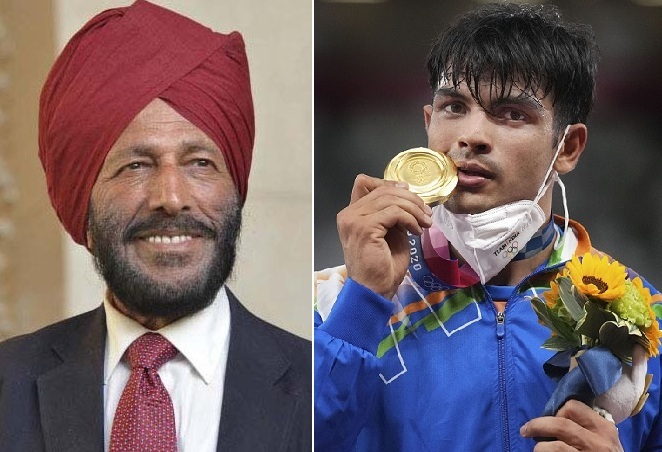
Less than two months ago, Milkha Singh died, and his wish of seeing an Indian athlete win an Olympics medal remained unfulfilled. But Chopra’s gold would be a shot in the arm for the Indian athletics community.
Dedicates win to late Milkha Singh
Second Indian to win individual gold medal in Olympics after Abhinav Bindra (2008)
India surpasses previous best haul of 6 medals in 2012 Games
The 23-year-old son of a farmer from Panipat was confidence personified in the final
Neeraj Chopra dedicates gold to Milkha Singh, fulfils his wish of Olympic medal in track and field events::Fauji to Fauji
Jeev Milkha Singh thanked Olympic gold medallist javelin thrower Neeraj Chopra after he dedicated his gold to legendary Milkha Singh
Milkha Singh and Neeraj Chopra with gold medal. — File/PTI photo
Gaurav Kanthwal
Tribune News Service
Chandigarh, August 7
Legendary Milkha Singh’s famous wish of seeing India win an Olympic medal in track and field event could not be fulfilled in his lifetime, but javelin thrower Neeraj Chopra, who won the gold medal with a throw of 87.58m at the Tokyo Olympics, has done it barely two months after the death of the Flying Sikh on June 18, 2021.
Jeev Milkha Singh thanked Olympic gold medallist javelin thrower Neeraj Chopra after he dedicated his gold to legendary Milkha Singh.
Milkha Singh’s constant refrain in his lifetime was that he wished to see India winning Olympics gold in track and field events before he breathed his last.
Jeev said, “Dad from above is crying in joy. His dream has come true. Proud moment for India. I salute him for his determination and hard work. God bless him.”
The Flying Sikh came close to win an Olympic medal in the 1960 Games only to finish 4th in the final of men’s 400m.
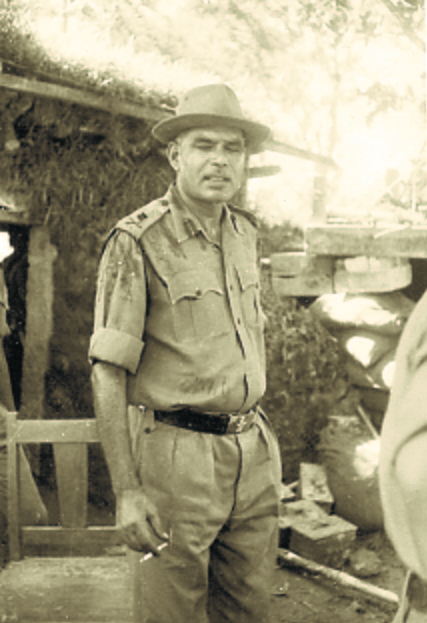
Some people are born to lead, but even these born warrior leaders must learn professionalism in modern warfare before they can successfully lead men in battle. Sagat was one such man. He joined the Bikaner State Forces as an other rank and within a short time was promoted as an officer in Sardul Light Infantry (now 19 Rajput) just before it moved to Iraq for war. By the time the unit had returned to India, after four years, he had been nominated to attend the Staff College at Quetta. What qualities made this man, who was more comfortable speaking in the vernacular, achieve these heights?
Dhaka had been surrounded in one of the swiftest and greatest feats of arms in less than 16 days. Lt Gen Sagat’s vision, which he kept close to his chest, saw him use all resources innovatively, not giving up on his aim and relentlessly pursuing, bypassing and defeating the enemy
Sagat had this constant yearning to learn and achieve. He always volunteered for any professional course allotted to the battalion. Such was his ability that he was made to do the Staff Course at Haifa; maybe the only Indian officer to be nominated to do two staff courses. Sagat commanded two battalions of 3rd Gorkha Rifles and was serving in Army HQ as a Colonel, when the COAS picked him up in an unprecedented step to command 50 Para Brigade. A normal infantry officer never got such an appointment. Sagat did his jumps quickly and got down to training his brigade when he was asked to move to Belgaum for the liberation of Goa.
The Para Brigade was allotted the subsidiary axis in the north from Sawantwadi, while the main body, consisting of 17 Infantry Division, moved from Belgaum, across the Sahyadris, from East to West, into Goa. Sagat had no bridging equipment but had four main rivers to cross in his advance. The Army Commander (later COAS), Lt Gen JN Choudhury, had little expectation of the Para Brigade achieving anything much, but Sagat bet Brig DK Palit, the Director of Military Operation, that he would be in Panjim first. The stakes were a drink at the Mandovi Hotel bar.
On the face of it, Sagat had little chance of making it first, pitted against the resources of a division. On top of that, he had only two Para battalions and was allotted an under-equipped and under-trained 2 Sikh LI only at their concentration area in Belgaum. Sagat was a hard task master and did his best to get the battalion into shape.
The advance commenced on December 18. The Para Brigade would move directly south and link up with 17 Infantry Division at Pillem, while 2 Sikh LI, with an armoured squadron, was to move on a parallel axis to Mapuca, which was opposite Panjim and separated by the Mandovi river. It was the intention of the Division Commander to enter the Portuguese capital with his Division. Sagat had this great quality of not breathing down his subordinates’ necks and he allowed the Para battalions to use their heads while he spent time with 2 Sikh LI, encouraging them to accelerate their advance. The Paras crossed three rivers through ad hoc means and kept on advancing till nightfall, when Sagat called a halt as 17 Infantry Division had still not linked up. By then, straining at the leash, 1 Para had captured Ponda, an objective of the Division, and 2 Para was on the road to Panjim.
50 Para Brigade had ringed the capital from three directions. 17 Infantry Division was still out of communication when the Army Commander decided that night to allow 50 Para Brigade to recommence its advance. That was enough. 2 Sikh LI, emboldened as never before, crossed the Mandovi in the morning and entered Panjim, while 1 Para made a dash and captured the seat of government. Brig Palit flew down to Goa and paid for the drink with Sagat.
Sagat’s grand achievement catapulted him as a cynosure. He had this unique ability of understanding a situation more rapidly than anyone else and then acting on it decisively. For him, the fog of war dispersed more rapidly. He would remain cool and calculating despite the fluidity of the battle. He was anything but orthodox and imbued his command with his confidence, daring and courage and allowed them their initiative.
After his NDC Course, Sagat was posted as the Brigadier General Staff at HQ 11 Corps. Just before the war, he was posted as the Division Commander of 17 Mountain Division, deployed on the Sikkim Watershed.
In those days, troops deployed on the Watershed acted as a trip wire against any Chinese ingress and carried out delay and warning up to the main defences which were in depth. Sagat realised that giving up the Watershed would entail a most difficult operation to re-occupy it. It would also enable the enemy to roll down more easily towards Gangtok. He gave orders that the Watershed would not be given up and set about shoring up its defences. He was soon put to the test as the Chinese started pushing the defences in solidarity with Pakistan. Sagat’s orders were firm. Troops will hold on regardless. The neighbouring formation, as per orders, gave up Jelep La and deployed main defences in the depth. Since then the Chinese hold Jelep La and India has not been able to recover it. Despite instructions, Sagat denied the Watershed and that’s why we continue to hold Nathu La and Chola.
Bent on preventing the continuous Chinese pinpricks at Nathu La, Sagat decided to lay a fence on the Watershed. He took his superiors on board and a single strand of barbed wire was laid on August 18, 1967, despite physical interference and intimidation by the Chinese. The fence was being turned into a formidable obstacle. On September 11, as work commenced, without warning the Chinese opened devastating small arms fire. There were heavy casualties and Sagat asked for permission to open artillery fire. As it was not forthcoming, he gave the orders nevertheless. Our domination of the Watershed enabled the observation posts to look deep into Chinese territory. Heavy casualties were caused, and it took some time for them to recover.
Shortly after the situation stabilised, Sagat was posted as General Officer Commanding, 101 Area, with responsibility to counter the insurgency in Mizoram. Counter-insurgency operations multiplied with small teams to the fore. Junior officers were allowed to exercise initiative and take responsibility for operations. Sagat carried out a parallel initiative in the resettlement of villages as well as winning the hearts and minds of people. By the time he got posted out, Sagat had ensured that the back of insurgency had been broken.
Sagat was posted as General Officer Commanding, 4 Corps, in December 1970 and was awarded a Padma Bhushan on January 26. Meanwhile, East Pakistan was in turmoil. There was no alternative but to exercise the military option. This could only be done, on account of climate and terrain constraints, in December. Sagat got to know of the role he was to play in July 1971. Operational Instructions were issued in August. He moved to Tripura in September. He was allocated the counter-insurgency formations of 8 and 57 Mountain Division and was also allotted his reserve, 23 Mountain Division. Several ad hoc forces were created, prominent among them being K Force, which was to play a prominent role in the advance to Chittagong. To create administrative maintenance areas in a short time for such a large force under the most hostile circumstances was a major achievement.
The initial task required 4 Corps to advance up to the Meghna river line, capture Chittagong, if possible, and contain Sylhet. Sagat was not satisfied with his tasking. Dhaka was the lynchpin of the Theatre Offensive, but it was not mentioned anywhere as an objective. Sagat had little time to train his units in conventional operations, but carefully monitored their activities. Before the offensive, there were three brigade-level operations. Not satisfied with some of the performances, Sagat was brutal in telling his commanders and troops that he would not accept foot dragging.
The Corps offensive started by the end of November, which required the initial crust of the enemy defences to be pierced. The most savage fighting was opposite Agartala, where 57 Mountain Division was tasked to capture Akhaura. It was a slogging match lasting five days and Sagat set the tone by venturing ahead of the forward troops in a helicopter and then landing amongst them to encourage them on. He allowed no rest as the enemy front started crumbling.
The habit he established initially set the tone of the campaign. His formations were spread over a large geographical area. The Northern Sector was where the offensive was being carried out by 8 Mountain Division towards Sylhet. The North-Central Sector was with 57 Mountain Division as it advanced from Agartala. The South-Central Sector was under 23 Mountain Division as it advanced towards the river port of Chandpur and the Southern Sector was under the ad hoc K Force, which was tasked to head south towards Chittagong.
Every day Sagat would range over his entire frontage in an Allouette helicopter of the Air Force (subsequently, he started using an Air OP flight helicopter piloted by Maj, later Lt Gen, GS Sihota). He would take flight at the crack of dawn, mostly as per an itinerary chalked out late the previous night. He would visit the formations, sometimes flying ahead of the forward troops, and land amongst them, constantly encouraging them while giving them critical information of the enemy. There were times when he would change focus seeing the progress of the offensive. He would land back at the Corps HQ, sometimes after last light, and then after a quick wash, would head for the Operations Room. Thereafter, he and the senior staff would go to the A Mess, where he would issue orders for the next day, setting his staff in a tizzy. At times, the complete plan would change. For Sagat, written instructions were only pieces of paper.
The first major change occurred when he allowed 23 Mountain Division to infiltrate between the enemy defences rather than hit them head-on. The second was when the first heliborne operation of the Indian Army was carried out on a shoestring. After reconnaissance by Group Captain Chandan Singh, on the night of December 7, 4/5 GR with a company of 9 Guards was landed near the Surma bridges at Sylhet. The Mi4 was an old war horse and had seen its best days, but it and the pilots performed marvellously. Instead of contesting the landing, the Pakistani units hemmed themselves in, waiting to be overwhelmed.
December 6 was also the day when Sagat carried out drastic changes to his plan. 57 Mountain Division, which had been tasked to head for the Meghna on an axis north of Maynamati, was ordered to continue its advance ahead of Akhaura towards Brahmanbaria. Taking 61 Brigade under his command, Sagat ordered it to head for Daudkhandi on the Meghna, while shedding two battalions to contain and attack the enemy defences on Lalmai Heights. 8 Mountain Division was asked to get a brigade ready for a heliborne operation on Dhaka. Sagat was a battle opportunist par excellence.
Suspecting what Sagat had in mind, the Army Commander rang him on December 7 and told him firmly not to attempt a crossing of the Meghna. This led to an acrimonious argument, resulting in Aurora visiting him on December 8, where Sagat managed to convince him to go ahead with his plans.
December 9 was an extraordinary day even for Sagat. He flew to Daudkhandi on the Meghna and found it to be vacated. Then he flew south along the river to Chandpur, where he found no enemy, so he flew rear wards, landed in front of the leading battalion and the armoured squadron, picked up their commanding officers, showed them Chandpur from the air, dropped them back and told them to go hell for leather. He flew to Daudkhandi and landed in front of the leading company commander and told him to rush for the river and commandeer all boats. Thereafter, he flew to Agartala, picked up the Air Force squadron commanders to fly along the Meghna to do a recce of likely landing sites. While returning, he saw explosions near the only bridge at Ashuganj and flew over it. A machine gun opened fire, injuring the pilot and grazing the General. He returned to Agartala, had the pilot evacuated, commandeered another helicopter, flew to Brahmanbaria where he saw the preparations for the famous ‘Meghna Air Bridge’ going on. He met Lt Col (later Lt Gen) Himmeth Singh, CO of 4 Guards, and others involved in the heliborne operation being planned over the Meghna and returned to the Corps HQ late in the evening, where he allowed his injury to be treated.
4 Guards with other troops was flown over the Meghna at night. Other units took river crafts across. The squadron of 63 Cavalry, under Maj Shamsher Mehta, which was right in the forefront of the advance, swam across. By the time Dhaka surrendered, it had been encircled from three sides. From the East, across Daudkhandi and from the NE and north. Brigades had successfully crossed the Meghna and carried on advancing, while the Pakistan brigade in opposition, with the GOC of their 14 Division, was successfully contained at Bhairab Bazaar.
Dhaka had been surrounded in one of the swiftest and greatest feats of arms in less than 16 days. Sagat’s vision, which he kept close to his chest, saw him use all resources innovatively, not giving up on his aim and relentlessly pursuing, bypassing and defeating the enemy. He was ruthless in the pursuit of this vision but ensured his troops and commanders were imbued with it. His personal courage, stamina and far-sightedness have never been matched in the annals of the Indian Army, which covered itself in glory.
— The writer was then ADC
to Lt Gen Sagat Singh
Jharkhand announces Rs 50 lakh each for state players in women’s hockey team::
Indian players take selfies as they celebrate their victory against Australia during womens field hockey quarterfinal match at the 2020 Summer Olympics, in Tokyo. — Reuters
Ranchi, August 7
The Jharkhand government has announced a cash award of Rs 50 lakh each for the players hailing from the state who were part of the women’s hockey team which finished fourth in the Tokyo Olympics.
Chief Minister Hemant Soren said that the Indian women’s hockey team could not win a bronze medal in the Tokyo Olympics, but the way all the girls played against the last Olympic gold medallist Great Britain in the bronze medal match was commendable.
“I salute the entire Indian women’s hockey team. The daughters of Jharkhand and my sisters made a wonderful contribution to the performance of the Indian women’s team,” he said.
The Jharkhand government had announced before the start of the Olympics that Rs 2 crore each would be given to the players of the state for winning gold, one crore for winning silver and Rs 50 lakh for winning bronze.
The Indian women’s team could not win the battle for bronze but for the better performance of players from Jharkhand, the government decided to modify its earlier decision and give Rs 50 lakh to all the players from the state included on the women’s hockey team and convert everyone’s ancestral house into a pucca house.
“There is an incomparable contribution of every player, coach and all the support staff in taking the Indian women’s team to this point. I and the whole of Jharkhand express my gratitude from the bottom of my heart and congratulations on the excellent performance and best wishes for the future,” the CM said.
He said that recently the government has provided jobs to sportspersons who have won medals at the international level and this will continue. — IANS
Scrap L1 concept for procurement, need revolution in bureaucratic affairs, Army chief says
At a seminar by the United Services Institution, Army chief Gen. M.M. Naravane speaks out against procedural lacunae in defence procurement, emphasises need for more agile processes.
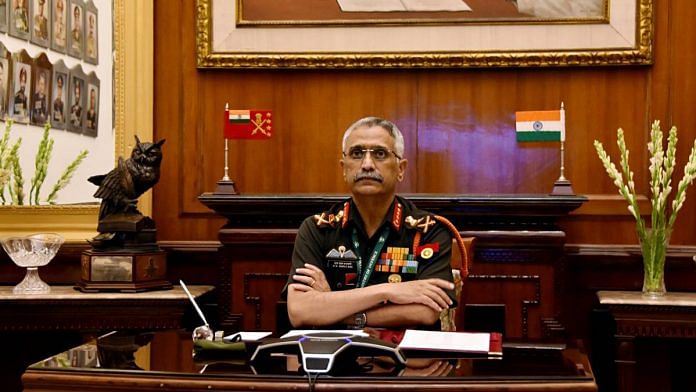
File photo of Army chief General M.M. Naravane | ANIText Size: A- A+
New Delhi: Army chief General M.M. Naravane Tuesday called for a “revolution in bureaucratic affairs” and spoke out against procedural lacunae in the defence procurement process because of what he called the ‘Zero Error Syndrome’.
Speaking at a seminar organised by the United Services Institution, the Army chief also called for a rethink of the L1 vendor concept altogether.
Under this system, the lowest bidder, known as L1, wins the contract.
The Army chief underlined that the force has brought about major structural changes by aligning both the revenue and capital routes of procurement under the Deputy Chief of Army Staff (Capability Development and Sustenance).
“This alone is not enough. Our procurement process unfortunately has not kept pace with the requirements of time. Many procedural lacunae have crept into the acquisition process due to the overbearing nature of our rules and regulations, leading to a ‘Zero Error Syndrome’,” he said.
The Zero Error Syndrome, as he sees it, is the bureaucratic web of checks and balances, in place to ensure zero error, that in turn results in a slower pace of functioning.
Speaking on the topic ‘Transformation Imperatives for the Indian Army in the coming decades’, the Army chief said the needs of the information era warfare “cannot be hamstrung by the procedures of the Industrial Age”.
“The need of the hour is to have a metamorphosis here too, perhaps even doing away with the concept of the L1 vendor altogether. For real transformation to take place, we require a revolution in bureaucratic affairs.”
Gen. Naravane added that the dual requirement of fast-tracking modernisation, and simultaneously promoting self-reliance, are indeed challenging objectives for a developing nation such as India.
Considering the quick pace of defence modernisation being undertaken by our adversaries, we cannot afford to lag behind, he further said.
The Army chief said wars today, more than ever before, require a ‘whole of nation’ effort.
The transformation of the Indian Army, and indeed of the armed forces, needs to be ‘resource informed’, he underlined.
India cannot hope to fight and win the next war with legacy structures evolved from the past, he added. Our force structures must be agile, flexible, modular and networked and they should reflect the realities and challenges of the contemporary battlefield, he said.
What the armed forces have achieved so far is merely jointness for the industrial era, he noted, saying India needs to transit rapidly to full scale integration for digital era combat as well as greater interoperability.
“It is hard enough to be joint, the difficulties in interoperability will be many times greater,” he said.




























































 Chopra’s gold is India’s second individual gold in the Olympic Games after Abhinav Bindra’s shooting gold at Beijing in 2008. Chopra’s gold feels doubly burnished as it comes in an event that requires the highest levels of athleticism, power and agility.