









Sanjha Morcha

What’s New

Click the heading to open detailed news

Current Events :

web counter

Print Media Reproduced Defence Related News

APP GOVT PROVED TO BE ANTI-FAUJI BY scraping ‘Guardians of Governance’ scheme

The scheme was launched in the year 2017 by the Punjab government with the objective of monitoring schemes of few departments at the grass root level in an efficient and effective manner.Since it was a flagship programme of Captain Amarinder Singh government to hire ex-servicemen to monitor government programme, with a false accusation that GOG had unsatisfactory performance of previous years in monitoring the assigned schemes of few departments, the Cabinet also decided to do away with the Guardians of Governance Scheme in the state but Bhagwant Mann ready to pay grants for the dead soldiers to the tune of one crore

Mr Tewari MP Anandpur Sahib Only Minister who came fwd in support of GOG at this hour when APP anti fauji Govt dismissed GOG scheme as the Sectaries did not project GOG achievement of 4 yrs to CM and also did not allow the GOG officer incharge Brig HV Singh to meet CM after his first meeting for small brief and role of GOG and CM Bhagwant Mann has asked him to send him the data but the IAS officers and welfare Minister Fauja Singh declined .

The GOG were trained ie The ex-servicemen hired in the inaugural phase were given a five-day training at the Punjab government-run Mahatma Gandhi State Institute of Public Administration. Soon after taking office in March 2017, Chief Minister Amarinder Singh set up a new department called Guardians of Governance reporting directly to him. The department comprises entirely of ex-servicemen. “This will be a group of ex-servicemen from panchayats to blocks to districts, right up to the chief minister. They will report about the implementation of welfare schemes through mobile application .in order to eradicate the misuse of funds,” Amarinder Singh described the scheme as “brain, eyes, and ears” of the government.

The GOG a disciplined force who never cared itself working for the Govt and public took risks and openly assisted people during Covid time .It was the IAS ,BDOs,SHOs, MLAs, Arthiyas <mandi board who were stopped from corruptions of any type even village sarpaches for atta Dal and old ager pension scheme ,they could not manipulated with false claims,

Mr Tewari MP Anandpur Sahib Only Minister who came fwd in support of GOG

Army’s 100-yr-old bond with Jalandhar

Army's 100-yr-old bond with Jalandhar

As the oldest Army unit in Jalandhar turned 100 recently, Tribune correspondent Deepkamal Kaur and lensman Sarabjit Singh trace its glorious years through visuals.

On the 16th of August, one of the oldest units of the Army in Jalandhar turned 100. Jalandhar Terriers, as the 112th Infantry Battalion (Territorial Army) Dogra is fondly called, was established in Jalandhar on August 16, 1922, during the British era and has just completed a centenary of its raising.

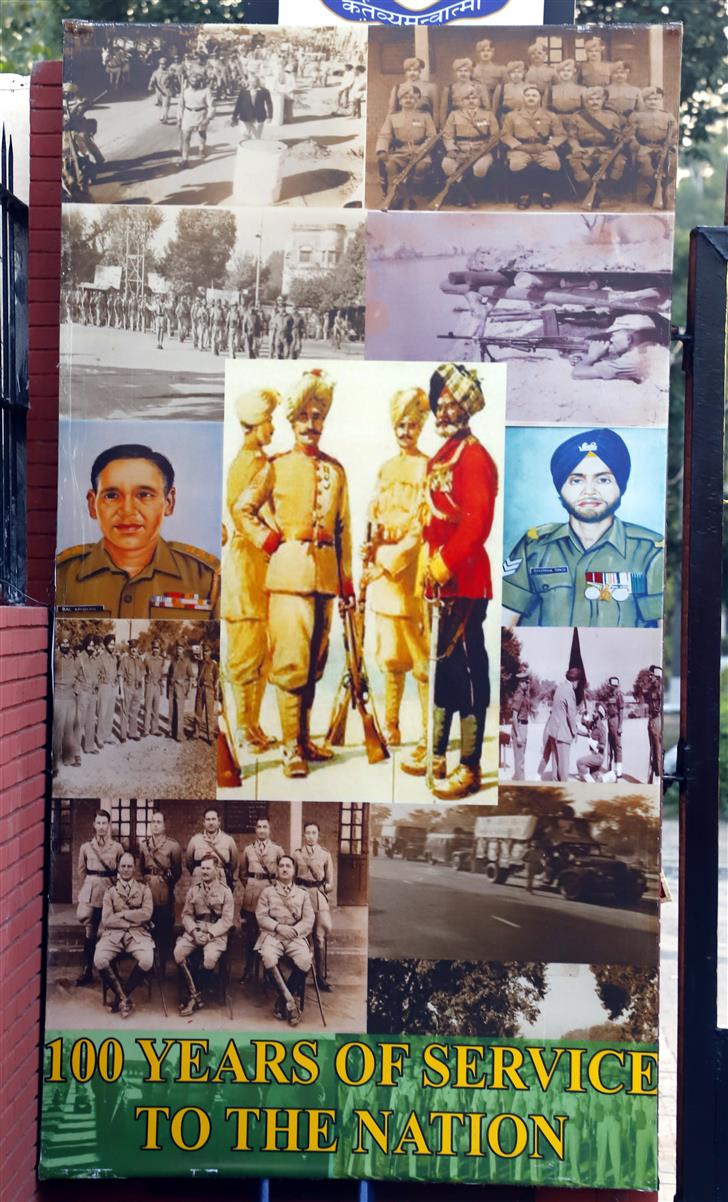
Old pictures of 112th Infantry Battalion (Territorial Army) Dogra on a wall at the entrance of the unit in Jalandhar Cantonment.

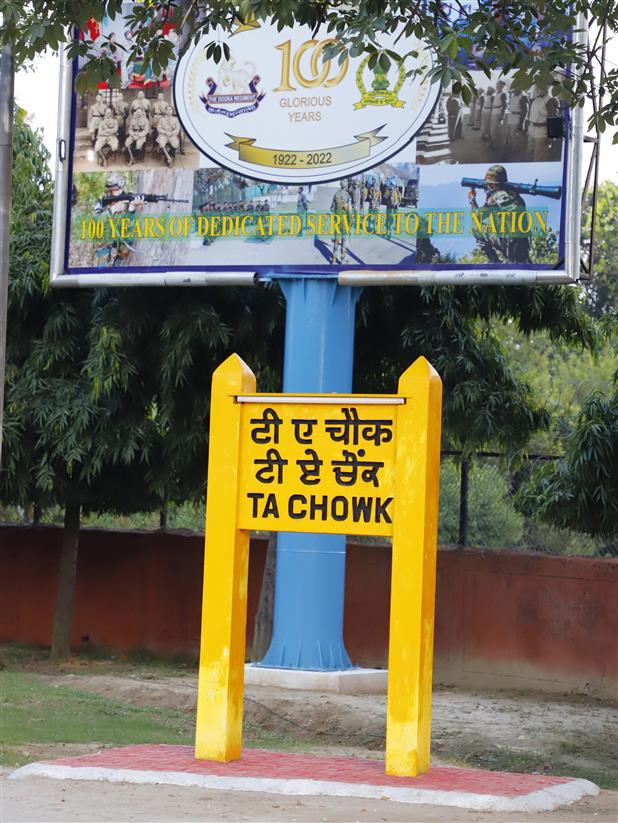
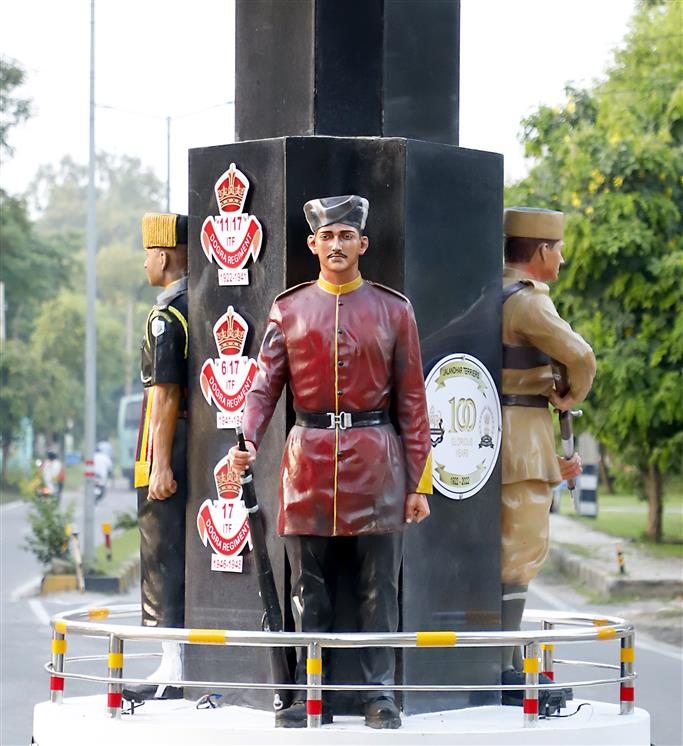
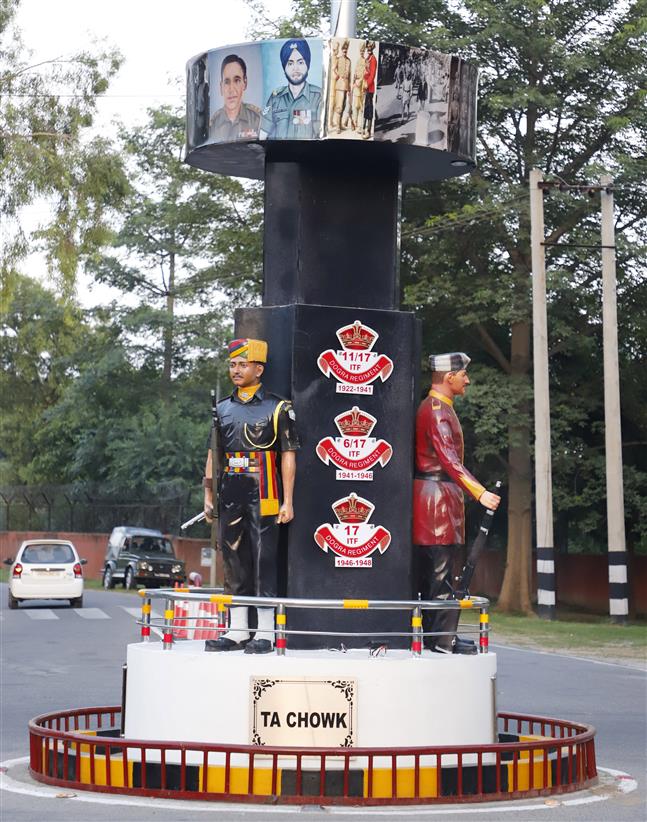
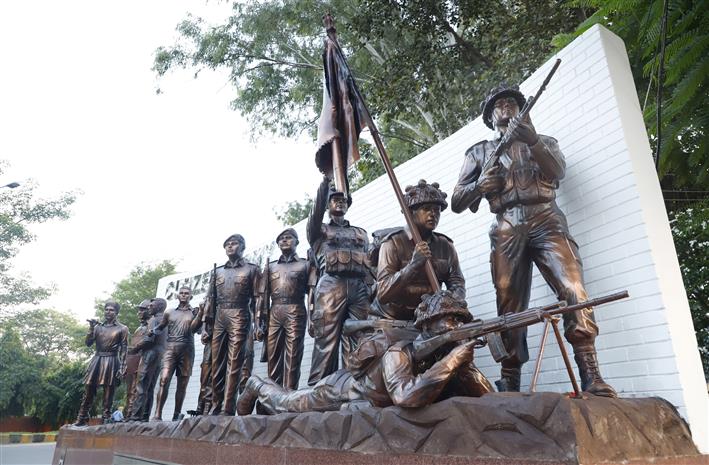
As a commemoration of the event, an intersection in Jalandhar Cantonment falling near the unit and abutting Nalwa Road has been named as Territorial Army Chowk (TA Chowk for short). Various murals, artistic and informative structures about the 100-year-old unit have been installed at this roundabout which has now emerged a selfie points for the people from across Jalandhar.

An intersection on the Nalwa Road in Jalandhar Cantt that was named TA Chowk during the centenary celebrations of the unit.

The inauguration of TA Chowk was done by General Officer Commanding-In-Chief, Southern Command, Lt Gen JS Nain, who is also the Colonel of the Dogra Regiment and Dogra Scouts. The GOC-in-C had tea with the troops. To mark the occasion, a Special Sainik Sammelan and veterans lunch was also organised at Vajra Sainik Institute for which 148 ex-servicemen from various parts of Punjab, Himachal Pradesh, Jammu and Kashmir and Haryana participated. They recounted old times and stories as they celebrated the landmark event.

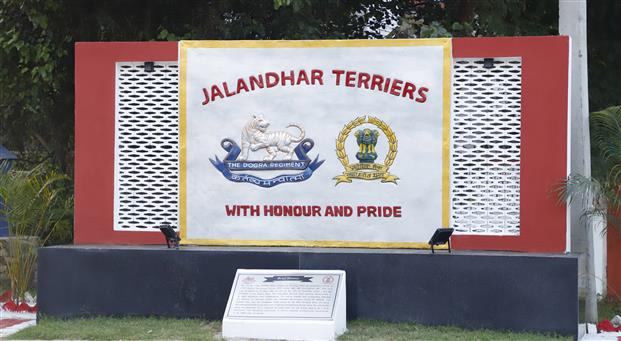
A structure at the TA Chowk in Jalandhar Cantonment.

Rich legacy

The unit was raised at Jalandhar Cantt on August 16, 1922, as 11/17 Indian Territorial Force (ITF) under Maj WB Cunnigham MC. The unit was re-raised as 6/17 ITF in 1941 and as 17 ITF in 1946. It was again re-christened on August 22, 1949 as 112 Infantry Battalion (TA) and got affiliated with the Dogra Regiment. The unit has participated in big operations of the Army since Independence. It is credited with defending the Halwara and Adampur airfields from the Pakistani paratroopers during Op Riddle. It has also had three Sena Medal awardees — Capt Bal Krishan, Lance Havildar Dhana Singh and Lance Naik Ranjeet Singh. The battalion has also won the Chief of Army Staff trophy for the Best Territorial Army unit thrice. Over the years, it has galvanised as a seasoned operation-ready outfit and proven itself to be a force multiplier.

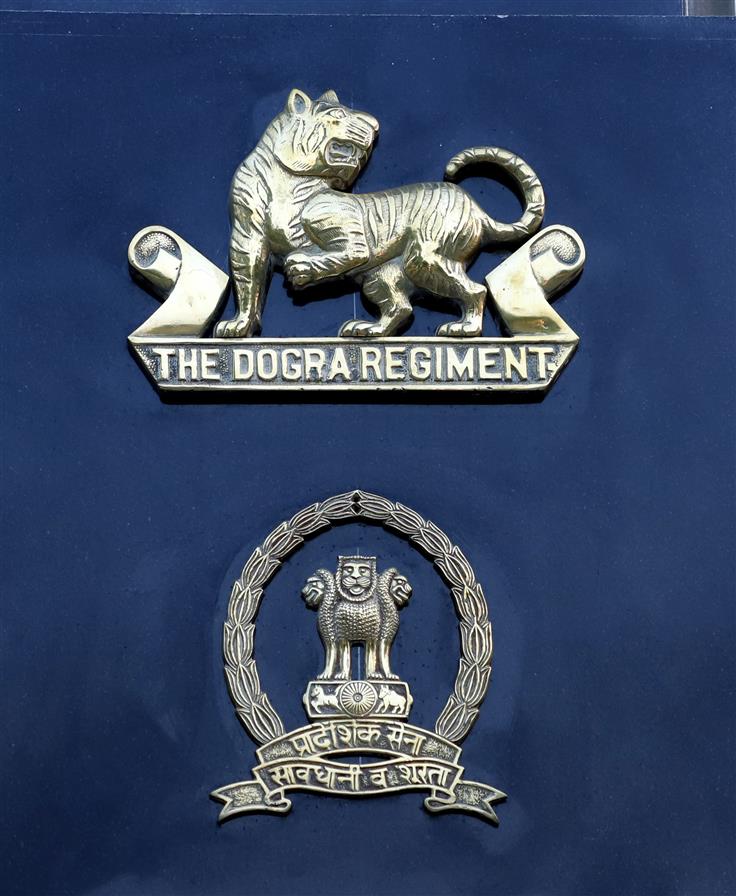
Insignias of the Dogra Regiment and Territorial Army at the TA Chowk.
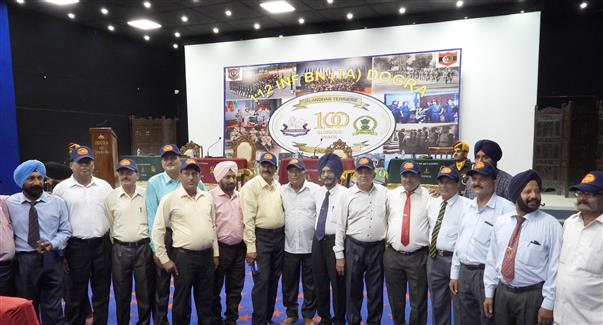
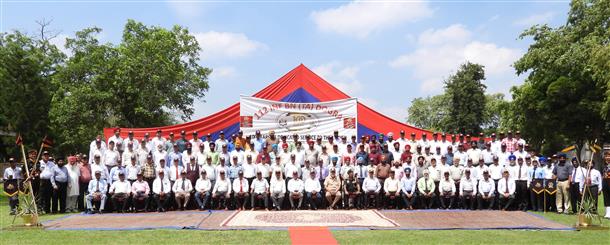
Officers associated with the unit of the 112th Infantry Battalion (Territorial Army) Dogra at the centenary function held in Jalandhar Cantt.
Insignias of the Dogra Regiment and Territorial Army.
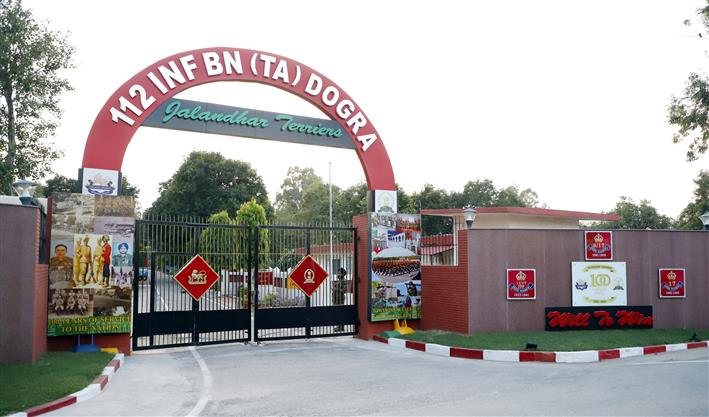
The gate of the unit of the 112th Infantry Battalion (TA) Dogra.
A group picture of officers associated with the unit of the 112th Infantry Battalion (Territorial Army) Dogra clicked at the centenary function held in Jalandhar Cantonment.
A small roundabout structure installed at the TA Chowk tomark the 100th anniversary of the 112th Infantry Battalion.


Colonial burden

Army on the right track to remove Raj remnants

Colonial burden

The celebrations to mark 75 years of Independence are witnessing all-out efforts by the Union government to weed out traces of the country’s colonial past and showcase/rediscover its cultural heritage. Early this month, Prime Minister Narendra Modi, while unveiling a naval ensign which draws inspiration from Maratha king Chhatrapati Shivaji, proclaimed that the nation had ‘taken off a burden of slavery’. Less than a week later, following the inauguration of Kartavya Path, he declared that Kingsway or Rajpath, a ‘symbol of slavery’, had been consigned to history. The symbolism of these steps — initiated by a country which has overtaken its former ruler Britain to become the world’s fifth largest economy — is not lost on anyone. Now, the Army has set the ball rolling for doing away with colonial practices as well as names of units and regiments.

According to the Army, some of the legacy practices which require a review include customs and traditions from the colonial era; military uniforms and accoutrements; regulations, laws, rules and policies of colonial origin; and English names of some units, buildings, roads, parks etc. The initiative has stirred up a hornets’ nest, with a section of retired defence officers fearing an erasure of the Army’s colonial heritage. Undoubtedly, the British shaped the Indian Army on the bedrock of a regimental system and marshalled its forces to fight for the Empire in the First and Second World Wars. However, India’s glorious martial tradition predates the Raj, as shown by legendary warriors of the Sikh and Maratha empires. Due recognition of this legacy is direly needed.

l

Well-considered removal of remnants of its colonial past is a logical step for a nation that is carving a niche for itself as a pace-setter in the international arena. The Army, which is in the midst of a modernisation drive, has a central role to play in making a clean break with antiquated customs. Clinging on to moth-eaten practices reeks of a slavish mentality. Shedding the colonial burden, at long last, in the military domain is vital to bolster national pride and honour.


4th arrest, Army man held from Arunachal: DGP

4th arrest, Army man held from Arunachal: DGP

Mohali, September 24

The Punjab Police on Saturday arrested an Army man posted in Arunachal Pradesh in the Chandigarh University video clip case, said Director General of Police (DGP) Gaurav Yadav.

The accused has been identified as Sanjeev Singh of Jammu who is suspected to be blackmailing the accused girl student. Yadav said based on forensic and digital evidence, the Mohali police was dispatched to Arunachal Pradesh to arrest Sanjeev.

He said that he was arrested from Sela Pass in ArunachalPradesh with the support of the Arunachal Pradesh Police, Assam Police and Army authorities.

The Mohali police have obtained a two-day transit remand of Sanjeev from the court of Chief Judicial Magistrate (CJM) Bomdila to produce him before the Magistrate in Mohali, he added.

The accused is allegedly the person who was calling up and sending messages to the accused girl to click more photos and videos. As of now, he is the main accused.

His phones and other devices have been seized and will be sent for forensic analysis. The Army said it helped the police to arrest the accused. The Army practices zero tolerance towards such acts,


Russia calls for mobilisation

After setbacks, Putin repeats threat of nuclear warfare

Russia calls for mobilisation

Seven months after Russia invaded Ukraine, President Vladimir Putin on Wednesday ordered Russia’s first mobilisation since World War II. He also resolved to use nuclear weapons in the conflict in order to ‘protect’ his country and people. ‘If the territorial integrity of our country is threatened, we will without doubt use all available means to protect Russia and our people… This is not a bluff,’ Putin said. The threat to escalate the conflict, with the mobilisation of some 3 lakh additional troops, came after Russia suffered several military setbacks in the recent weeks — the Ukrainians claim to have retaken 3,500 square miles of land, including the cities of Izyum and Kupiansk, important supply hubs for Russian forces.

Reports from European capitals show that Putin’s threat is being treated as a bluff made by a desperate dictator — diplomats from various countries have reiterated the determination to arm and finance Ukraine’s resistance. Unfortunately, western analysts and diplomats are unsympathetic to Russia’s genuine security concerns: NATO has added 14 new members since the German reunification in 1990, even though western leaders had, on several occasions in the early 1990s, verbally assured the Russians about the limits of NATO’s eastward expansion — without giving written guarantees. While Putin can’t be absolved of blame in the devastation of Ukraine, those western hawks who worked for aggressive containment of Russia in the last three decades also bear moral responsibility for this unfolding tragedy.


Girl Students leaving Chandigarh university Graruha :

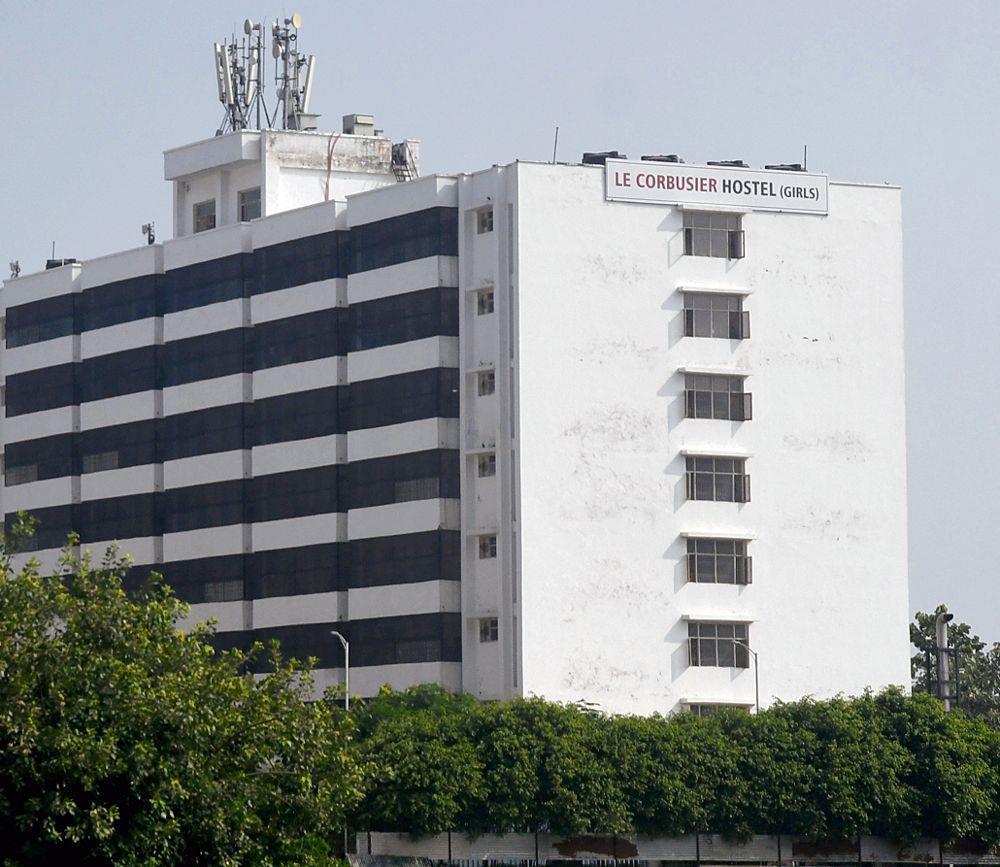
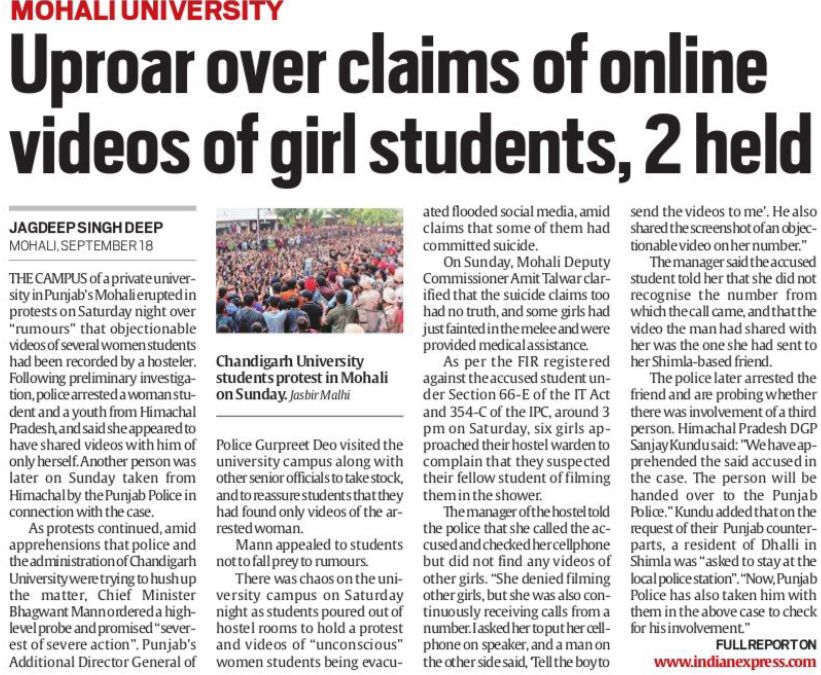
Parents of Girl students staying in hostels are vacating the hostel and taking away their daughter on the on the pretext they are no more safe in hostel. From reliable sources it has come to knowledge that Vice Chancellor Mr Bawa is pleading parents with folded hands to the parents but the chancellor Satnam Singh Sandu without whose approval nothing moves has gone into hiding mode along with Director Sohi. All the newspapers in English,hindi and Punjabi are carrying the news thus has become National News . Satnam SIngh Sandu who belives in giving comfort Zone to Students in luch break time and after the classes wher students keep sitting in Lawns when the entire college admin and teaching stqafff has lef6t except security which also belongs to the university .VC is being made the esca[pe coat Some clips as under


Indo-Bangla ties

Relations between India and its immediate neighbour Bangladesh have been time-tested and strong. India presided over the birth of the new nation in 1971 and have enjoyed close and cordial relations ever since. The Prime Minister Sheikh Hasina’s ongoing four-day state visit to India will highlight these ties once again and further cement relations between two neighbours. During the visit, the two sides are likely to ink at least seven bilateral agreements in areas like water management, railway and science and technology. Issues related to security cooperation, investment, enhanced trade relations, power and energy sector cooperation, water sharing of common rivers, water resources management, border management, and combating drug smuggling and human trafficking are likely to get priority during the talks between two sides. This is Hasina’s first visit to India since 2019. Her delegation comprises Foreign Minister Momen, Commerce Minister Tipu Munshi, Railways Minister Md Nurul Islam Sujan, Liberation War Minister A. K. M. Mozammel Haq and Mashiur A. K. M. Rahman, the economic affairs advisor to the Prime Minister. The visit will further strengthen the multifaceted relationship between the two countries based on strong historical and cultural ties and mutual trust and understanding, according to the Indian Ministry of External Affairs. India and Bangladesh signed an interim water sharing agreement for Kushiyara river, the first such pact since the signing of the Ganga water treaty in 1996. Sheikh Hasina noted that India and Bangladesh share 54 rivers and sought early conclusion of the Teesta water sharing agreement, which has been hanging fire for more than a decade due to opposition from West Bengal Chief Minister Mamata Banerjee. India and Bangladesh signed a memorandum of understanding on sharing of waters of Kushiyara river, a pact that will benefit people residing in southern Assam and the Sylhet division of Bangladesh. Prime Minister Narendra Modi noted that the important agreement on sharing water of the Kushiyara river will benefit southern Assam in India and Sylhet region in Bangladesh. Modi said there were 54 rivers that pass through the Indo-Bangladesh border, and have been linked to the livelihood of the people of the two countries for centuries. These rivers, folk tales about them, folk songs, have also been witness to our shared cultural heritage. Hasina shared the sentiments expressed by Modi and also stressed on the need to have watersharing agreements for other rivers as well. She said the two countries have resolved many issues in the spirit of friendship and cooperation. It is hoped that all outstanding issues, including Teesta water sharing agreement, will be concluded as an early date. Modi and Hasina had a fruitful conversation on enhancing cooperation in relation to flood mitigation. India has been sharing flood-related data with Bangladesh on a real-time basis. The period of data sharing has also been extended. Hasina was accorded a ceremonial reception at the forecourt of the Rashtrapati Bhawan where Modi extended a warm welcome to her. She said the two nations were also working to develop stronger economic ties to fulfill the basic needs of the people of the two countries. Hasina told her Indian counterpart that her main aim is to develop the economy and fulfill the basic needs of our people. With friendship you can solve any problem. So we always do that. After the bilateral talks, Modi hosted a one-on-one lunch for the visiting dignitary at the Hyderabad House here. India and Bangladesh had signed the Ganga water treaty in 1996 for sharing waters of the mighty river for a period of 30 years. The treaty was signed by the then prime minister H D Deve Gowda and Hasina. SPIRITUAL WORLD


Defence Minister Rajnath Singh meets Mongolia’s
top leadership to boost bilateral strategic ties

ULAANBAATAR, SEPTEMBER 6 Rajnath Singh, the first Indian Defence Minister to visit Mongolia, met the top leadership of this country here on Tuesday and decided to fully implement the bilateral strategic partnership based on mutual trust, common interests, shared values of democracy and the rule of law. Singh also inaugurated the Cyber Security Training Centre built with India’s assistance at the National Defence University in Ulaanbaatar and laid the foundation stone of the India-Mongolia Friendship School, to be constructed with Indian assistance. On the first day of engagements here, Singh held bilateral talks with his Mongolian counterpart Lt Gen Saikhanbayar Gursed and also called on President Ukhnaagiin Khurelsukh and Chairman of State Great Khural (Parliament) G Zandanshatar.