Centre is yet to give its approval As the euphoria over the commissioning of the indigenous aircraft carrier INS Vikrant ebbs, the time may be right to announce another aircraft carrier, taking their number to three in the naval fleet. New Delhi: As the euphoria over the commissioning of the indigenous aircraft carrier INS Vikrant ebbs, the time may be right to announce another aircraft carrier, taking their number to three in the naval fleet. Besides the new INS Vikrant, the 44,500-tonne carrier INS Vikramaditya procured from Russia is already in service. Strategic circles were expecting an announcement today at the commissioning of the Vikrant as the Navy has been pushing for the third carrier, expected to be a 65,000-tonne warship. The Centre is yet to give its approval. Any delay in re-employing the hard-earned skill of making a carrier could be a missed opportunity. Navy Vice Chief Vice Admiral SN Ghormade, at a press conference last week, said: “The Navy’s plan has catered for a third aircraft carrier.” An indigenous ecosystem has been created by building the Vikrant. The stage is now well set to take the next step forward to indigenously build the next aircraft carrier to ensure the expertise gained is utilised to the maximum, Admiral Ghormade had said. After having built the Vikrant – the biggest warship made by India ever — Madhu Nair, Chairman and Managing Director of Cochin Shipyard Limited, told The Tribune the “build time” for the next carrier could be cut down significantly. “Once a go-ahead is given for the next carrier, we can make it in eight years or so,” said Nair. “A new dock is coming up, it will be capable of handling 70,000-ton ships,” he added. It took 13 years to make the Vikrant — from the keel-laying in February 2009 to its commissioning. Also, India is racing to match China in naval strength. China has two operational aircraft carriers – the Liaoning and Shandong. In July it launched another one, Fujian, expected to be commissioned in 2025. Other Asian countries are also racing to enhance sea power. The Japanese have the JS Izumo, which can fly fighter jets. It’s adding JS Kaga. South Korea has a plan to launch by 2030 a large-deck amphibious warfare ship. The need for a third carrier also arises as these ships have lengthy maintenance schedules. The cycle of maintenance can lead to the absence of a carrier for two years. The INS Vikramaditya refit began in the beginning of 2021 and still continues. So if India has three carriers, one each can be deployed on the western and eastern flank while the third goes for a refit. ‘13 Years To Build Vikrant, 8 Years For Next’ Having built Vikrant, Cochin Shipyard chief Madhu Nair said next carrier can be built in significantly lesser time “After getting the go-ahead, we can make it in 8 years or so,” he said. It took 13 years to make INS Vikrant
HOW THE WAR IN UKRAINE HAS FORCED INDIA TO STEP UP ITS DEFENCE INDIGENISATION PROGRAM
he IAF’s light combat aircraft, the TEJAS, at an Air Show Faced with a shortage of spares from Russia and Ukraine, defence minister Rajnath Singh has okayed domestic procurement of 780 critical military components and sub-systems As a solution to the Indian military’s requirement for spares amidst the protracted Russia-Ukraine war, the Narendra Modi government is turning towards the domestic industry to meet the supply gaps. Defence minister Rajnath Singh has given the go-ahead for domestic procurement of 780 critical components and sub-systems used in fighter jets, helicopters, transport planes, armoured tanks and submarines. This means all this military hardware will come under a phased import ban between December 2023 and December 2028. The new Positive Indigenisation List includes critical spares and sub-systems for India’s frontline fighter jet Sukhoi-30, Jaguar, TEJAS and Dornier-228 planes. Some spares for the Indian Navy’s operational Kilo-class submarines as well as equipment for the Indian Army’s T-90 and Arjun tanks are also part of the list. With this list, the government aims to further reduce imports by DPSUs (defence public sector undertakings). India is the world’s second biggest importer of arms, accounting for 9.2 per cent of the total global arms imports. Next comes Saudi Arabia. There has, however, been a push by the Modi government for self-reliance in defence. About 80 per cent of the country’s domestic defence industry is owned by the government. The ministry of defence (MoD) has set a target of Rs 1.75 lakh crore worth of indigenous defence production by 2025, including exports to the tune of Rs 35,000 crore. DPSUs will have to play a major role in achieving this goal. The MoD says the new Positive Indigenisation List is in continuation of two such lists for sub-systems, assemblies and components issued in December 2021 and March 2022. The first two lists together contain 2,500 items that are already indigenised and 458 which will be indigenised within the given timelines. Indigenous development of these sub-systems and components will give a boost to the DPSUs and reduce dependence on imports. The war in Ukraine has adversely impacted several upcoming projects of the Indian military. India uses more than 70 Russian military platforms. More than 80 per cent of the products made by India’s ordnance factories are Russian-based and the units continue to depend on Russia for critical spares. A majority of fighter jets of the Indian Air Force (IAF) are Russian, including the 272 Su-30MKIs and over 100 MiG-21 ’Bison’. The IAF also operates the Russian-made Mi-17 and Mi-8 helicopters. Military observers say the Russia-Ukraine conflict has cast a shadow on critical defence equipment supplies from both nations. Besides new purchases, existing platforms of the Indian military—fighter planes, air defence missiles, artillery guns, tanks—are heavily dependent on Russia and Ukraine for critical spares. The impact is showing on key projects, such as the upgrade of IAF’s Antonov AN-32 fleet, supply of critical R-27 air-to-air missiles for Sukhoi Su-30MKI and MiG-29, upgrades of existing artillery and air defence systems, and sourcing of engines for four guided-missile frigates of the navy.
Chief of Navy Staff Admiral R Hari Kumar handing over a model of INS Vikrant To PM Modi New Delhi: India, with the induction of its first Indigenous Aircraft Carrier, ‘ INS Vikrant’ is set to contain China’s iniquitous intentions to control the Indo-Pacific region. As preparations for India’s third aircraft carrier have already been set in motion, it is a clear message to China and Pakistan of its nefarious design in keeping with the theme of being a ‘Combat Ready, Credible and Cohesive force’ in the Indian Ocean Region. On September 2, India got its first Indigenous Aircraft Carrier, ‘ INS Vikrant’. Prime Minister Narendra Modi commissioned the aircraft carrier at the Cochin Shipyard in Kerala. A CNN report claimed the aircraft carrier had put India into “an elite league of the world’s naval powers,” and an AFP article hailed it as “a milestone in government efforts to counter China’s growing military assertiveness in the region”. The INS Vikrant is a force multiplier that will be a ‘game-changer’ in the current regional maritime security dynamics as the IAC will boost India’s maritime defence capabilities with the in-service carrier INS Vikramaditya. It is well-known that China, which has been demonstrating an increasingly aggressive posture along the land boundary with India, is also attempting to get a foothold in the Indian Ocean, which is increasingly becoming a stage of rivalry between India and China. Towards this, China has already acquired a naval outpost in Djibouti and invested in developing the Gwadar port in Pakistan. The Chinese Navy will use these basing facilities to support its ships. Recently, China also launched its third aircraft carrier, Fujian, and is rapidly building two more aircraft carriers, including its fleet of destroyers and frigates. The vessel – with a flight deck that is approximately 320m long and almost 80m wide according to satellite imagery estimates – is referred to as a Type 003 carrier. India and China were recently at odds over the docking of a Chinese ”spy ship” in Sri Lanka’s Hambantota port for a seven-day replenishment, which India had vehemently opposed due to security concerns. Sri Lanka initially requested a delay in the ship’s arrival over India’s objections, but eventually, it got approved following “extensive consultations at a high level.” These developments are a cause for concern in the Indian security establishment. While India has become a preferred security provider for its littoral countries, it cannot be the case with China for the nations in the Southeast Asia region. China’s contentions in the IOR are to protect its sea lines of communication through the Straits of Malacca and the Hormuz Straits. The Hormuz Straits account for 40 per cent of China’s oil imports, and the Straits of Malacca accounts for 82 per cent of China’s oil imports, popularly known as the ‘Hormuz-Malacca Dilemma’, and that is the reason why China is attempting to encircling India by building a string of naval bases to surround India’s neighbours and various neighbouring island states. The String of Pearls is a network of Chinese military and commercial bases from the Chinese mainland to Port Sudan in the Horn of Africa. This network passes through crucial maritime choke points that include the Strait of Malacca, Strait of Hormuz, Strait of Mandeb, Gwadar Port in Pakistan, and Hambantota Port in Sri Lanka. China has long wanted to control the Indo-Pacific region, which is essential for its security and commercial shipping. The String of Pearls is one such initiative by China in this direction. But with the induction of INS Vikrant, India is now well poised to contain China’s String of Pearls. Notably, INS Vikrant is “the largest ship ever built in the maritime history of India” and can operate a fleet of 30 aircraft, including fighter jets and multi-role helicopters. It is designed with a high degree of automation for machinery operations, ship navigation, and survivability. Designed by the Indian Navy’s in-house Warship Design Bureau (WDB) and built by Cochin Shipyard Limited, a Public Sector Shipyard under the Ministry of Ports, Shipping and Waterways, Vikrant has been built with state-of-the-art automation features and is the largest ship ever built in the maritime history of India. Prime Minister Narendra Modi said, “INS Vikrant is not just a warship. This is a testament to the hard work, talent, influence, and commitment of 21st century of India”. With the commissioning of ‘Vikrant’, India has joined a select group of nations such as the US, the UK, Russia, China, and France with the niche capability to design and build an aircraft carrier indigenously. He further added that the carrier has filled the nation with “new confidence” and declared India had taken one more step toward becoming a developed nation. Defence Minister Rajnath Singh said the commissioning of Vikrant demonstrates that India is “fully capable of meeting the collective security needs of the region” and that India’s navy is ready to respond to any crisis. INS Vikrant, built at the cost of around Rs 20,000 crore, successfully completed its fourth and final phase of the sea trials last month. With the construction of ‘Vikrant’, India has joined a select group of nations having the niche capability to indigenously design and build an aircraft carrier. At a top speed of about 28 knots and an endurance of 7,500 nautical miles, the IAC can readily be deployed to an area of potential threat. The 262-meter-long and 62-meter-tall aircraft carrier can carry 1,600 sailors and displaces about 43,000 tons of water will bolster its navy capabilities amid growing concerns over the Chinese regime’s assertiveness in the region. The ship has over 2,300 compartments, designed for a crew of around 1,700 people, including specialised cabins to accommodate women officers. Vikrant has a top speed of around 28 knots and a cruising speed of 18 knots with an endurance of about 7,500 nautical miles. The aircraft carrier is 262 metres long, 62 metres wide and it has a height of 59 metres. Its keel was laid in 2009. The commissioning of India’s first indigenous aircraft carrier is a momentous occasion during the ‘Amritkaal of India’s 75 years of independence and signifies the country’s confidence and prowess. This indigenous aircraft carrier is proof of the country’s technical acumen and engineering skills. This demonstration of India’s self-sufficiency to produce an aircraft carrier warship will reinforce the country’s defence indigenization programs and ‘Make in India’ campaign.
CAN INDIA DEFEAT CHINA AND PAKISTAN’S AIR-TO-AIR MISSILES?
As India continues to make strides in air-to-air missile technology, Pakistan and China should know that they will see a dominant BVR missile in New Delhi’s arsenal soon by Girish Linganna In June, India took an important step toward self-reliance by placing an order for the Astra Mk-1 beyond visual range (BVR) missile. BVR missiles can engage targets beyond a pilot’s visual range, which is typically about thirty-seven kilometers. The Astra MK-1 has a range of 100 kilometers and a ceiling of twenty kilometers. It has satisfied all the consumers who intend to integrate them into their aircraft, including the Indian HAL Tejas multirole fighter. However, will this new capability give India an edge over Pakistan and China? A Tall Order Pakistan’s F-16 fighter jets are armed with U.S. AIM-120 advanced medium-range air-to-air missiles (AMRAAM). It is a fire-and-forget active transmit-receive radar guidance weapon with a range of over 100 kilometers capable of traveling at Mach 4 speed. In retaliation to the 2019 Balakot airstrike, Pakistan launched Operation Swift Retort where it fired the AIM-120 AMRAAM at six locations in Jammu and Kashmir. China’s sights are set on matching U.S. air dominance and their innovations are primarily motivated to achieve comparable, if not superior, aerial warfighting capabilities against the United States. It created the PL-15 missile, an active radar-homing BVR weapon with a 300-kilometer range capable of reaching Mach 4.5. For reference, missiles that can achieve speeds of Mach 5 and above qualify as hypersonic. To counter such advanced adversaries, it is not enough for India to demonstrate indigenization. There must be a fighting chance with the proper defence forces. Comparing military capabilities to each other in isolation is often moot because real combat involves a variety of factors, such as other equipment and tactics. When Chinese aircraft penetrate Taiwanese airspace, they do not rely solely on their speed and manoeuvrability but also on electronic measures to render Taiwanese radars useless. If one combines a suite of electronic warfare with BVR missiles, the target is a sitting duck. India’s Response To Pakistan And China The Astra missiles were first tested in 2003 as part of the Integrated Guided Missile Development Programme (IGMDP). Astra MK-1 is an advanced BVR missile that can be launched agnostic to the target’s relative position. It includes advanced electronic countermeasures (ECM), which improve its target tracking capability even in an environment with electronic jammers. It can engage multiple targets and now sports an indigenous RF seeker-based active radar instead of semi-active radar. The pilot has the option of using “Lock on before Launch” (LOBL) or “Lock on after Launch” (LOAL), allowing the fighter jet to shoot and scoot. It is meant to engage an enemy that fights back. Hence, while most aircraft use up to 9 G forces to out manoeuvre missiles, the Astra Mk-1 uses 30 Gs to ensure the endgame objective of an engagement. The all-weather missile has a range of 100 kilometers and travels at a near hypersonic speed of Mach 4.5. Although its fifteen-kilogram warhead is smaller than the eighteen and twenty-kilogram warheads of the AIM-120 and PL-15, respectively, it has a demonstrated ability to score a direct hit from maximum range. Potency Potential Recent news reports indicate that the Astra MK-2 and MK-3 models are set to be tested in 2023 and 2024, respectively. The Mk-2 variant is said to be an incremental upgrade of the Astra MK-1 with a 160-kilometer range. It will also have a dual-pulse solid-fuel rocket motor used by the industry standard, Meteor missile, to achieve greater operational range. The Astra Mk-3 is being developed along with Russia and will most likely have the new Solid Fuel Ducted Ramjet (SDFR) for a range of 350 kilometers. The Astra Mk-3 will afford India a credible response to the Chinese PL-15 and other world-class BVR missiles. The SDFR was tested in 2019 and 2021 and it is used in the Meteor BVR air-to-air missile (AAM) to boost energy before engagement. This continuous thrust gives it the largest No-Escape Zone at sixty kilometers. The American AIM-120 uses a rocket motor that achieves its kinetic peak first before bleeding energy as it progresses toward its target. This is also the case with the Astra Mk-1. However, both the MK-2 and MK-3 will have an SDFR to ensure maximum kinetic energy is sustained after launch. This will ensure that the target is unable to escape the missile within a certain distance. The AIM-120 has a smaller No-Escape Zone than the PL-15, comparable to the Meteor missile. As India continues to make strides in missile technology, Pakistan and China should know that they will see a dominant BVR missile in New Delhi’s arsenal soon. Girish Linganna is a Defence & Aerospace analyst and is the Director of ADD Engineering Components (India) Pvt Ltd, a subsidiary of ADD Engineering GmbH
DEVELOPMENT OF SCALED-UP VERSION OF UTTAM AESA RADAR FOR SUKHOI SU-30MKI HAS BEGUN: REPORT
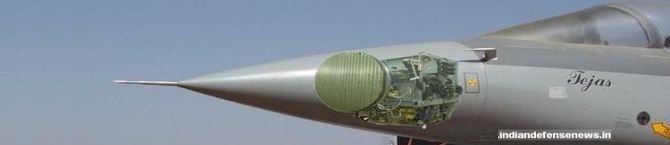
The Defence Research & Development Organization (DRDO) formally completed transfer of technology for the production of the Uttam active electronically scanned array (AESA) radar to Hindustan Aeronautics Limited (HAL) in the presence of the senior leadership of the Indian Air Force (IAF). The Uttam, developed by DRDO’s Electronics and Radar Development Establishment (LRDE), Bangalore, will equip the IAF’s TEJAS MK-1A fighters that will begin to enter service from 2024. This development has taken place subsequent to the successful completion of the Uttam’s airborne test program, Delhi Defence Review has reported. The indigenous Uttam AESA has been fully flight-tested for all air to air, air to ground, weather & terrain avoidance/following modes. Following the successful completion of the baseline Uttam project, fire control radars (FCRs) derived from it are being progressed for the TEJAS MK-1A, TEJAS MK-2 and Advanced Medium Combat Aircraft Aircraft (AMCA) as a combined ‘mission mode’ programme given the commonality between them the report stated. On the initiative of the IAF’s senior leadership, the development of a scaled-up version of the Uttam to equip the Su-30MKI fighter fleet has also begun. The IAF, pleased with the development and performance of the Uttam, will depute some Su-30MKI units for the development, integration, flight-testing and certification of said radar. Development of this scaled-up Uttam derivative i.e. for the Su-30 MKI will require 36-48 months, with flight testing estimated to begin after 24 months. Airborne testing is an extremely rigorous process that entails a variety of check points even if the same components are flying in other radar units on different aircraft the report further added.
n a major move, the Union Government has decided to rename Rajpath and Central Vista lawns stretching from the Rashtrapati Bhavan to India Gate here as “Kartavya Path”
In a major move, the Union Government has decided to rename Rajpath and Central Vista lawns stretching from the Rashtrapati Bhavan to India Gate here as “Kartavya Path”. Sources said the New Delhi Municipal Corporation (NDMC) has convened a meeting on September 7 to deliberate on the matter.
PM Narendra Modi in his Independence Day speech stressed the abolition of symbols that reflect the colonial mindset. He also stressed the importance of everyone fulfilling their duties in the 25 years leading to 2047 when India would be celebrating 100 years of Independence.
Indian Navy Commander Sureshwar Dhari ‘Willy’ Sinha (retd), (88) who turned into a regarded environmentalist post his stint in the Navy, died in New Delhi on Sunday.
Commissioned in the Navy in January 1954 and trained in the UK, he was the first fleet electronic warfare officer of the Navy. Part of the commissioning crew of the Petya anti-submarine ships acquired from the former USSR, he was the Commanding Officer of INS Kadmatt.
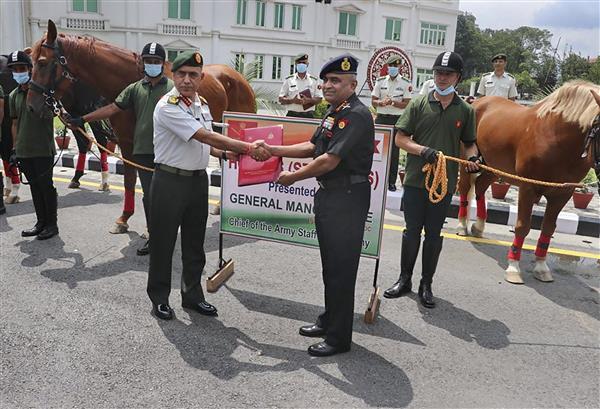
Army Chief Gen Manoj Pande with his Nepalese counterpart Gen PR Sharma in Kathmandu.
Kathmandu, September 5
Nepal President Bidya Devi Bhandari conferred the title of Honorary General of the Nepali Army to the Indian Army chief, Gen Manoj Pande, at a special ceremony here on Monday, continuing the seven-decade-old tradition reflecting the close ties between the two countries.
General Pande was also presented a sword and scroll during the ceremony held at the President’s official residence, Shital Niwas, in Kathmandu.
Following the ceremony, General Pande called on the President of Nepal. Earlier, Gen Pande laid a wreath and paid homage at Bir Smarak (martyrs’ memorial) at Kathmandu. Thereafter, he visited the Nepali Army headquarters where he was accorded a ceremonial guard of honour.
General Pande also handed over various non-lethal military items to Nepalese counterpart Gen PR Sharma.
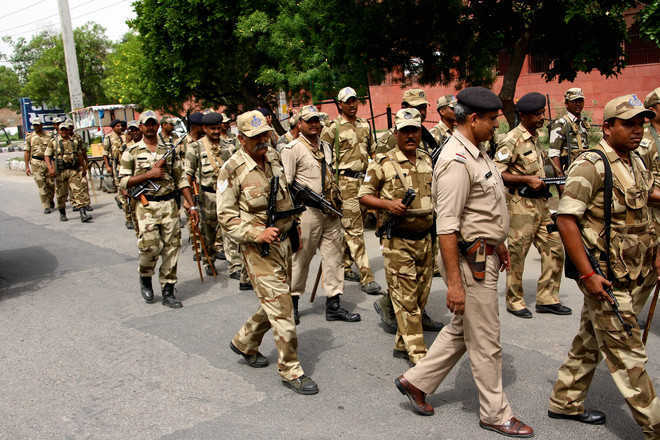
The government has provided Central Industrial Security Force (CISF) cover to the Rashtriya Swayamsevak Sangh’s (RSS) offices in the national capital, officials said today. The officials said the main Keshav Kunj office located at Jhandewalan and its camp office at Udasin Ashram, Pahar Ganj, had been brought under the CISF cover beginning September 1.
The personnel would be deployed at the entry and exit of the two buildings and guards would be posted at all vantage points to secure the campus. The security cover to the RSS premises was sanctioned by the Union Ministry of Home Affairs (MHA) based on inputs shared by central intelligence agencies, the officials said. The RSS is considered the ideological fountainhead of the ruling BJP at the Centre. RSS chief Mohan Bhagwat is already a ‘Z plus’ category protectee. The CISF also secures the Nagpur office of the organisation.
As the RSS chief also worked from the Delhi offices and the re-development of the Keshav Kunj facility was nearing completion, it was prudent to secure these premises as well, they said.
Bangladesh to confer Mujib Scholarship to descendants of Indian soldiers killed, injured in 1971 war
The award is named after Bangabandhu Sheikh Mujibur Rahman, Hasina’s father
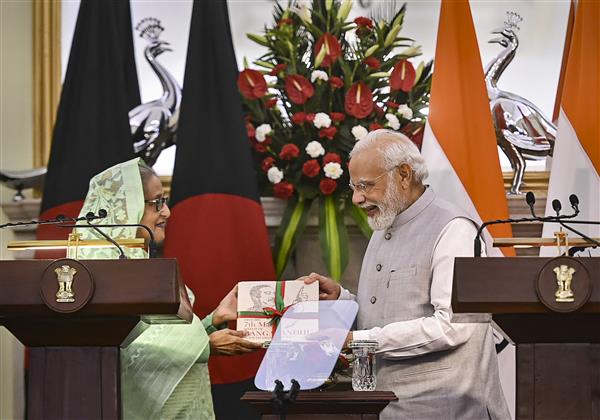
Prime Minister Narendra Modi with his Bangladeshi counterpart Sheikh Hasina during the release of a joint statement after their meeting, at Hyderabad House in New Delhi, Tuesday, Sept. 6, 2022. PTI
New Delhi, September 6
Prime Minister of Bangladesh Sheikh Hasina announced the Mujib Scholarship on Tuesday for the direct descendants of the Indian soldiers killed or grievously injured in the 1971 Bangladesh Liberation War.
The awards will be conferred on Wednesday, she said.
The award is named after Bangabandhu Sheikh Mujibur Rahman, Hasina’s father.
According to reports, a total of 200 family members of Indian Army personnel will receive the scholarship.
“We are grateful for the valuable support from the government and the people of India in the great war of liberation of Bangladesh in 1971, which was a watershed moment in our bilateral relations….
“Tomorrow, I will confer the Mujib Scholarship to the direct descendants of the soldiers or officers of the defence forces of India who were martyred or gravely wounded during the Bangladesh Liberation War,” Hasina said.
As many as 1,984 Indian Army personnel were killed in the war, according to the Bangladeshi government.
The Hasina government had earlier honoured other Indian supporters of the freedom movement of Bangladesh, including writers and politicians. In the past, Hasina had also proposed to confer similar honours to those soldiers who laid down their lives to liberate the country.
India and Bangladesh signed seven agreements after talks between Modi and Hasina, including one on sharing the water of the Kushiyara River, which is expected to benefit the regions of southern Assam and Sylhet in Bangladesh.
Hasina, who is on a four-day visit to India, also oversaw the signing of a memorandum of understanding (MoU) between the Prasar Bharti and Bangladesh Television (BTV) on cooperation in broadcasting.
State Stalwarts
DEFENCE MINISTER
Minister Rajnath Singh
ALL HUMANS ARE ONE CREATED BY GOD
HINDUS,MUSLIMS,SIKHS.ISAI SAB HAI BHAI BHAI
CHIEF PATRON ALL INDIA SANJHA MORCHA
LT GEN JASBIR SINGH DHALIWAL, DOGRA
SENIOR PATRON ALL INDIA SANJHA MORCHA
MAJOR GEN HARVIJAY SINGH, SENA MEDAL ,corps of signals
.
.
PATRON ALL INDIA SANJHA MORCHA
MAJ GEN RAMINDER GURAYA ,MADRAS REGIMENT
sanjhamorcha303@gmail.com
PRESIDENT SOUTH ALL INDIA SANJHA MORCHA
COL SS RAJAN BOMBAY SAPPERS,
PRESIDENT UTTARAKHAND ALL INDIA SANJHA MORCHA
COL B M THAPA ,BENGAL SAPPERSS
PRESIDENT HARAYANA STATE CUM COORDINATOR ESM
BRIG DALJIT THUKRAL ,BENGAL SAPPERS
PRESIDENT TRICITY
COL B S BRAR (BHUPI BRAR)
PRESIDENT CHANDIGARH ZONE
COL SHANJIT SINGH BHULLAR
.
.
PRESIDENT PANCHKULA ZONE AND ZIRAKPUR
COL SWARAN SINGH
INDIAN DEFENCE FORCES
DEFENCE FORCES INTEGRATED LOGO
INDIAN AIR FORCE
Air Officer C-in-C WESTERN AIR COMMAND
AIR MSHL S PRABHAKARAN AVSM VM
AOC-IN-C, EASTERN AIR COMMAND
Air Marshal Inderpal Singh Walia
AOC-in-C SOUTH WESTERN AIR COMMAND
Air Marshal Vikram Singh
AOC-IN-C, SOUTHERN AIR COMMAND
Air Marshal J.Chalapati
AOC-IN-C TRAINING COMMAND
AIR MARSHAL SK GHOTIA VSM
AOC-IN-C MAINTENANCE COMMAND
Air Marshal Jagdish Chandra
Flag Officer Commanding in Chief, Western Naval Command
ice Admiral R Hari Kumar, PVSM, AVSM, VSM
Flag Officer Commanding in Chief, Eastern Naval Command
Vice Admiral Sanjay Bhalla, AVSM, NM
Flag Officer Commanding in Chief, Southern Naval Command