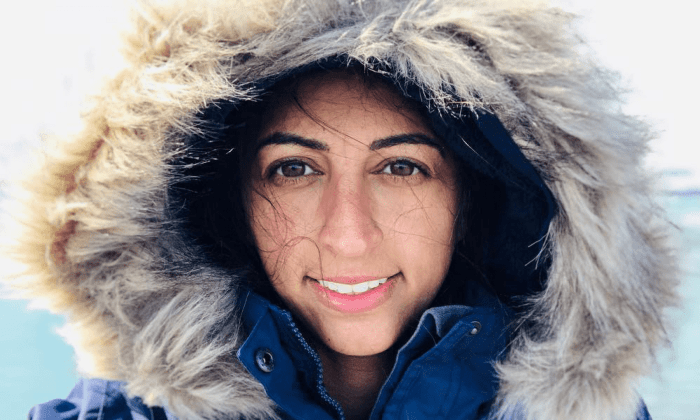
Indian-origin British Sikh Army officer Preet Chandi, who made history by trekking to the South Pole, is now going for a record-breaking 1,100 miles trek across Antarctica — solo and unaided! Captain Chandi, also known as “Polar Preet”, became the first woman of colour in January this year to complete a solo and unsupported 700-mile trip to the South Pole in just 40 days, five days ahead of her finishing schedule.
The 33-year-old will pull all her kit and supplies on a sledge (pulk), weighing around 120kg (19 stone) at the start of her epic journey in November, while battling temperatures of -50c and wind speeds of up to 60mph.
Army physio Captain Preet Chandi aims to be the first woman to cross Antarctica solo and unsupported.
‘Polar’ Preet’s 1,100-mile trek will last up to 75 days.
“I expect the journey to take approximately 75 days. Having done 700 miles to the South Pole, I know I can do 1,100 miles,” Chandi, a physiotherapist with the British Army, said.
Chandi, the British Army website reported, will make slower progress at the beginning because of the extra weight of her pulk, a type of sledge pulled by a person and used to carry equipment and supplies. Her pulk will include ice screws, an ice axe, crevasse equipment and crampons which are only needed for the last part.
From the South Pole to the base of the glacier is around 655 km. Of this, about 140 km is on the glacier which climbs from around 763m to 2,931m.
“I don’t know what the ground or the weather will be like. If there’s lots of heavy snowfall it will slow me down. I need to hit the South Pole by a certain point to give me enough time to go down and navigate the glacier,” Chandi said.
Chandi is the third fastest female solo skier for the expedition behind Johanna Davidson of Sweden and Britain’s Hannah McKeand. She is also the first person to reach the South Pole on foot in two years, the Guardian reported.
“The British Army is extremely proud to have such a remarkable ambassador. Captain Chandi embodies the qualities we seek of all who serve – courage, commitment, and the want to be the best we can be,” said Lieutenant General Sharon Nesmith, Deputy Chief of the General Staff, British Army.
“Inspiration for all, especially young girls, to push personal limits and achieve incredible feats,” British MP Tanmanjeet Singh Dhesi tweeted.
Antarctica is the coldest, highest, driest and windiest continent on Earth and nobody lives there permanently.
When Chandi reached the South Pole earlier this year, she had said in her blog post: “I don’t want to just break the glass ceiling, I want to smash it into a million pieces”
AFWWA sets Guinness World Records for largest display of knitted woollen caps
Air Force Wives Welfare Association (AFWWA) on Saturday set a Guinness World Records by displaying 41,541 knitted woollen caps here.
Nearly 3,000 women, all AFWWA members from all over the country, knitted more than 40,000 woollen caps over a period of nearly three months starting July 15 as part of the association’s ‘Knittathon’ drive.
The event was organised at the Indian Air Force (IAF) Auditorium here.
“The record is amazing and it is for the display of the highest number of knitted woolen caps. This is a first-of-its kind category,” Rishi Nath, an adjudicator at the Guinness World Record told PTI.
The colourful caps made of Vardhaman wool were put on display in the verdant lawns of the auditorium campus. They were arranged to form ‘KNITTATHON 2022’ and ‘41,541’ on the ground.
“These caps were hand-knitted by nearly 3,000 members of AFWWA as part of our special drive ‘Knittathon’ which started on July 15 and culminated on October 15. The caps will be distributed to extremely needy people ahead of the winter,” AFWWA president Neeta Chaudhari said.
The event was held to mark the 52nd anniversary of AFWWA.
“A total of 41,541 caps have been knitted by our members from across the country. This will boost their confidence and this achievement is a step forward to make them ‘atmanirbhar’,” she said.
Union Minister for Women and Child Development Smriti Irani was the chief guest at the event.
In her address, she hailed the women for their achievement earned through “precision-based participation”
Earlier in the day, Defence Minister Rajnath Singh visited the auditorium campus and congratulated AFWWA for the achievement.
MASSIVE PROTESTS ERUPT ACROSS IN PAK’S SWAT VALLEY AGAINST WAVE OF TERRORISM
Khyber Pakhtunkhwa: The residents of Swat and Shangla returned to the streets against the wave of terrorism on Thursday and reminded the Pakistan government to do more against the spate of terrorism in the scenic valley. They demanded authorities to clamp down on elements ruining the peace in the area, reported Dawn. The protest was organised by a local organisation, Swat Qaumi Jirga, while elders, youth, and children from different parts of Charbagh tehsil took part in the demonstration, carrying placards inscribed with slogans seeking the restoration of peace in the valley. Chanting slogans and holding placards, they voiced their grievances as terrorism has seemingly made a return to the region. Notably, on Monday, terrorists opened fire on a school van, killing the driver and injuring two children. During their protest last week at Matta Chowk in the Khwazakhela tehsil of Swat, the protesters had warned that they might take up arms to tackle terrorists if the authorities failed to play their due role, reported Dawn. It was the eighth protest today by the locals since the resurfacing of the terror activities in the month of August. The most recent protest was on Tuesday, after a school van in Charbagh came under gunfire, leaving the driver dead and two children injured. The incident triggered protests in several parts of Khyber Pakhtunkhwa, with thousands taking to the streets to show their resolve against terror, reported Dawn. The protest eventually ended after 40 hours after negotiations with the administration. The protesters had been demanding the arrest of the culprits behind the attack and warned of marching to Islamabad if authorities failed to meet their demands within 24 hours. Adviser to Prime Minister on Political and Public Affairs, Amir Muqam, also turned up at the protest to express solidarity with the demonstrators, reported Dawn. The speakers were of the view that their demonstrations will continue until the elimination of the last terrorist from the valley. In his remarks, Muqam said, “The PML-N will never compromise on peace in Swat.” A speaker said that the people of Swat have “woken up” and are entirely aware of right and wrong and bad and good. Another speaker, Mukhtiar Yousafzai, said the locals have decided they would not breathe freely until terrorism was completely eliminated from Swat, reported Dawn. “Gone are the days when the people of Swat were made to suffer through an organised pattern of terrorism. This time, we have resolved to eradicate this menace once and for all,” said Yousafzai in his address. Earlier in September, a bomb blast took the life of a peace committee member and seven others, leading citizens to take to the streets in protest.
India, China hold talks, agree to resolve remaining LAC issues
India and China on Friday held the 25th meeting of the Working Mechanism for Consultation & Coordination on India-China Border Affairs (WMCC) and reviewed the situation along the Line of Actual Control (LAC) in the western sector.
The two sides agreed to continue discussions through diplomatic and military channels to resolve the remaining issues along the LAC at the earliest so as to create conditions for the restoration of normalcy in bilateral relations. To achieve the objective in accordance with the existing bilateral agreements and protocols, both sides agreed to hold the next (17th) round of senior commanders’ meeting at an early date, stated an MEA press release.
Recalling the developments since the last meeting of the WMCC in May, they welcomed the disengagement in the area of Gogra-Hot Springs (PP-15) that was carried out in a phased, coordinated and verified manner between September 8 and 12.
The two sides noted these steps reflected the understandings between External Affairs Minister S Jaishankar and Chinese Foreign Minister Wang Yi, including at their recent meeting in Bali in July. The Indian delegation was led by the Joint Secretary (East Asia) from the Ministry of External Affairs. The Director General of the Boundary & Oceanic Department of the Chinese Ministry of Foreign Affairs led the Chinese delegation
Next meeting soon
Both sides to continue talks through diplomatic and military channels
Aim to resolve remaining issues along LAC at earliest for restoration of normalcy
Agree to hold next round of senior commanders’ meeting at an early date
In a significant development, India on Friday announced its ability to launch a nuclear-tipped missile from a submarine while it is under the water.
In a statement, the Ministry of Defence said, “INS Arihant carried out a successful launch of a submarine launched ballistic missile (SLBM) on October 14.”
INS Arihant, a nuclear-powered and nuclear missile-carrying submarine, is part of the super-secret indigenous programme to have three such vessels. The submarine was launched at sea in 2009 and became operational later.
The test was carried out using a missile without a nuclear warhead, which can be fitted at any stage. It is estimated that the tests of an SLBM from a submarine had been carried out previously, but a formal announcement was made today following validation of all parameters and possibly after testing missiles that travel to varying ranges
Sources said Sagarika (750-km range) and K-4 (3,500 km) were the two options. The details of the missile have not been declared. In the past, India tested missiles from underwater by using a watertight submerged cannister to mimic a submarine.
The MoD today said, “The missile was tested to a predetermined range and impacted the target area in the Bay of Bengal with very high accuracy. All operational and technological parameters of the weapon system have been validated.”
It said a “robust, survivable and assured retaliatory” capability was in sync with the country’s policy to have “credible minimum deterrence that underpins its no first use” commitment.
India joins top nations
India became first country outside five permanent members of UNSC — US, UK, Russia, China and France — to have ability to launch a nuclear-tipped missile from a submarine
Pakistan ‘one of the most dangerous nations in the world’, says Biden with reference to nukes
In perhaps the most candid statement made against it, US President Joe Biden described Pakistan as “one of the most dangerous nations” in the world with holds “nuclear weapons without any cohesion.” The US President made these remarks at a Democratic Congressional Campaign Committee Reception in Los Angeles (California), during which he berated both China and Russia.
The remarks on Pakistan were made while Biden was talking about US foreign policy with regard to China and Vladimir Putin’s Russia. Biden concluded by saying he considered Pakistan to be the most dangerous country in the world.
“This is a guy (Xi Jinping) who understands what he wants but has an enormous, enormous array of problems. How do we handle that? How do we handle that relative to what’s going on in Russia? And what I think is maybe one of the most dangerous nations in the world: Pakistan. Nuclear weapons without any cohesion,” said Biden, as quoted in a White House press release of his remarks at the Democratic party event.
Biden’s remarks could be seen as a setback to the Shehbaz Sharif government’s bid to improve ties with the US. At the event, Biden said there were enormous opportunities for the US to change the dynamic in the second quarter of the 21st century.https://c3efed9d70c9f88f0c8a217ec3feaec4.safeframe.googlesyndication.com/safeframe/1-0-38/html/container.html
“So, folks, there’s a lot going on. A lot going on. But there’s also enormous opportunities for the United States to change the dynamic in the second quarter of the 21st century,” the US president said.
These comments come two days after the release of the US’ National Security Strategy. The 48-page document makes no reference to Pakistan.
On Wednesday, the Biden administration released the Congress mandated key policy document, underlining the threat posed to the US by both China and Russia.
The National Security Strategy states that China and Russia who earlier this year announced a “no-limits partnership” are increasingly aligned with each other but the challenges they pose are distinct.
“We will prioritise maintaining an enduring competitive edge over the PRC while constraining a still profoundly dangerous Russia,” it adds.
The policy document contends that competition with China is most pronounced in the Indo-Pacific, but it is also increasingly global.
The US Security Strategy highlighted that the next ten years will be a decisive decade of competition with China.
On the Russia-Ukraine conflict, the document says Moscow’s “imperialist foreign policy” culminated “in a full-scale invasion of Ukraine in an attempt to topple its government and bring it under Russian control.”
you are polluting minds of young generation of this country: SC slams Ekta Kapoor for featured several objectionable scenes related to a soldier’s wife
The Supreme Court Friday came down heavily on producer Ekta Kapoor over “objectionable content” in her web series ‘XXX’, saying she was polluting the minds of the young generation of this country.
The top court was hearing a plea filed by Kapoor challenging the arrest warrants issued against her for allegedly insulting soldiers and hurting the sentiments of their families in the web series aired on her OTT platform ALTBalaji
“Something has to be done. You are polluting the minds of the young generation of this country. It is available to all. OTT (Over The Top) content is available to all. What kind of choice are you providing to the people?….on the contrary you are polluting the minds of youngsters,” a bench of Justices Ajay Rastogi and C T Ravikumar said.
The court made the observation after senior advocate Mukul Rohatgi, appearing for Kapoor, submitted that a petition has been filed before the Patna high court but there is no hope the matter will be listed for hearing soon.
He said the top court had earlier granted protection to Kapoor in a similar matter.
Rohatgi said the content is subscription based and that there is freedom of choice in this country.
The court, which stopped short of imposing costs, then wondered what kind of choice is being given to people.
“Everytime you travel to this court….we don’t appreciate this. We will put a cost on you for filing such a petition. Mr Rohatgi please convey this to your client. Just because you can afford and hire the services of good lawyers….this court is not for those who have voices.
“This court works for those who don’t have voices…if these people who have all kinds of facilities, if they cannot get justice then think of the situation of this common man. We have seen the order and we have our reservations,” the bench observed.
The top court kept the matter pending and suggested a local lawyer may be put to work to know about the status of hearing in the high court.
A trial court in Bihar’s Begusarai had issued the warrant on a complaint lodged by Shambhu Kumar, an ex-serviceman.
Kumar, in his complaint of 2020, alleged series ‘XXX’ (Season-2) featured several objectionable scenes related to a soldier’s wife
Chandigarh University video ‘leak’: Army man had ‘sent’ girl’s videos to her kin
The Forensic Science Laboratory (FSL) report of the mobile phone conversations between the Chandigarh University girl suspect and Army man runs into around 8,000 pages, sources have said.
SIT member Rupinder Kaur Bhatti said: “It runs into thousands of pages but it has a lot of gibberish data, which is not related to the case. We will be concluding the case shortly,” she said.
Sources said the girl suspect and Sanjiv Singh got acquainted through the social media, and might have met in person as well.
The forensic report has reportedly established that Sanjiv had sent objectionable videos and photographs of the girl to her father and aunt. The cops confirmed this but remained tight-lipped on whether the videos were pornographic or not.
The police are yet to recover another mobile phone of Sanjiv, a resident of Samba, from his earlier place of posting. The third suspect, Sunny Mehta, became friends with the CU girl during her college days as she used to stop by at his bakery shop.
It has also come to light Sunny, a class IX passout and a bakery worker, was avoiding the girl, an MBA-I student, for the past one-and-a-half years although they had been friends for around one year in the past.
Later, differences cropped up between the two and their conversations were restricted. “They were on talking terms off and on,” confirmed the cops. The police are still rummaging through the pile of FSL report to make sure relevant facts are not missed in the investigation.
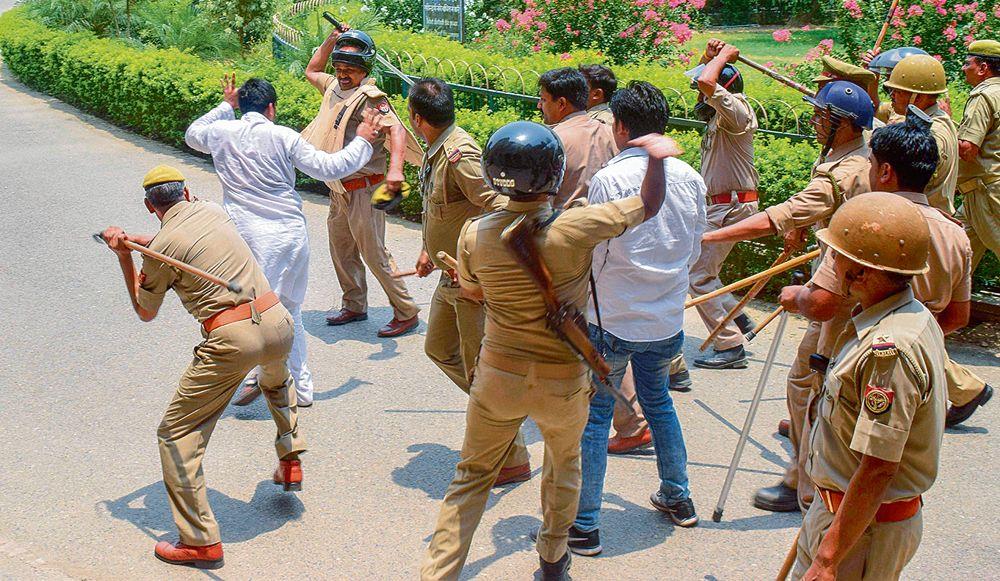
Four young men caught for pelting stones on the pandal under which garba had been organised were flogged by a police inspector in Kheda district of Gujarat. The flogging was carried out in full public view and it was captured live on video. Was that legal? Of course not. Third-degree torture, as practised within the confines of a police precinct, and fake encounters where criminals are dealt with are also illegal, but such practices have the approval of many citizens and, hence, continue with impunity.
The political class should be made aware of the dangers involved in allowing the police to run amok.
The inspector, who carried out the summary punishment, was confident that he had the consent, tacit or spoken, of his superiors. I would go a step further and say that even the political bosses were knowingly complicit. After the use of bulldozer in Yogi’s UP, that instrument of destruction and of revenge has been used in other BJP-ruled states too. The infection has spread. The police in those states are sure that they will be supported if they adopt extra-judicial methods to ensure quick ‘justice’.
Why is this unconventional and uncivilised method of dispensing justice admired by the people, mainly the middle class? The haves lean on the State’s authority to live their lives in peace and comfort. When the judicial process system becomes slack in ensuring the safety of life and property, pressure is built on the police to adopt shortcuts to achieve a modicum of law and order. When there is a ground-swell of public adulation for policemen who are adept in such shortcuts, politicians, who closely follow trends in public perception, cling on to these straws to ensure their own hold on power. Even though those who support these methods belong largely to the haves, the politicians do take note because it is this class that dictates public perception.
A digression at this stage is necessary. Ever since communal politics has assumed prime importance in our land, the minority community has found itself at the receiving end of the police lathi. This development has, to some extent, enthused the have-nots of the majority community and they, too, have joined the ranks of those who exult when ‘criminals’ are disciplined. The flogging of the stone pelters would have been welcomed by all elements of the majority, both haves and have-nots. The police are encouraged in this new role of judge and executioner because of the overwhelming support of the majority community.
The only corrective step that can be advocated to combat this descent into police criminality is to put the criminal justice system back on track. The entire process has to be addressed — beginning with the registration of crimes, proper and timely investigation, quick prosecution of the culprits, daily hearings in murder and serious crime trials, as used to be the practice when I was a student of law in the late 1940s.
The practice of seeking adjournments at the drop of a hat should be discouraged by the judiciary. At present, it has degenerated into routine. Superior courts have specified the number of adjournments that can be permitted, but these directions are honoured only in their breach. For instance, there is a case of murder registered against Sachin Vaze, the cop who was collecting money from bar owners in Mumbai at the instance of his political boss or departmental superior, either of them, or more likely, both of them in cahoots with each other! The trial has not even begun despite the crime having been reported nearly two decades ago.
The Minister for Justice in the Modi government is a go-getter. He should spearhead this project. To begin with, he needs to get the higher judiciary and the police leaders, as well as the Bar chiefs and Directors of Prosecution in each state to sit together and thrash out the doable correctives, like adjournments, before discussing increased manpower in the judiciary, the prosecuting agency and the police investigation segment. Rijiju is a capable minister. If he puts his heart into the project, it can, and will, succeed.
At present the police, especially in BJP-ruled states, and particularly in UP, seem sure of political backing for adopting shortcuts. The political class should be made aware of the dangers involved in allowing the police to run amok in this fashion. Police officers who have been given such unlawful liberties will soon become a menace to society, as has been proved in Mumbai. The stark example of permitting a Sachin Vaze such licence has resulted in him being accused of murdering in cold blood his own friend who had lent his vehicle to plant explosives outside Mukesh Ambani’s residence!
In territories unaffected by terrorism, there is no excuse for letting loose criminals in uniform. Terrorists do not recognise the law and its legally mandated representatives like the police, prosecutors and judges. Terrorists do not bribe politicians or policemen. They just pump bullets into them. In terrorist-affected areas only those armed with guns matter. Others, including political leaders, bureaucrats and judges, besides the citizenry, are all at their mercy. The police becomes the only possible saviour, but that proposition requires a lid to be kept on irresponsible personnel at different levels.
Terrorists captured from within the Golden Temple by KPS Gill after Operation Black Thunder II had surrendered in full view of global television audiences. KTS Tulsi, the prosecutor, had promised their conviction. Not one was convicted! Any judge trying them would necessarily weigh the risk to his own life, and also to that of his male progeny. (Khalistani terrorists were reputed to concentrate only on males.)h
The rules applicable to the handling of terrorism-based crime may need to be tweaked but there is no justification to allow the police in Gujarat or UP to become a law unto themselves. It may be difficult to give anything but token punishment to the inspector who ‘flogged’ the pelters. (TV video shots show that he did the flogging ‘rather gently’.) It is his departmental superior and the political boss of the district who need to be re-educated on the nature of the danger involved.
Army assault dog ‘Zoom’, who helped eliminate militants, dies
NewDelhi, October 13 Army’s assault dog ‘Zoom’, who sustained gunshot wounds earlier this week while battling terrorists in Jammu and Kashmir’s Anantnag district, succumbed to injuries on Thursday, said officials from the Srinagar-based 15 Corps. The two-year-old Belgian Shepherd, also known as Malinois, was active in the service for the last eight months. The canine was known to be ferocious, committed and highly trained to locate and bring down terrorists. The officials said Zoom was under treatment at the Advance Field Veterinary Hospital in Srinagar, but succumbed around noon. “Zoom’s condition was improving and the canine was responding well to the treatment. The dog looked fine till noon after which it suddenly started gasping and soon collapsed,” the officials said. It was on October 10 that security forces had launched a cordon and search operation in Tangpawa following inputs about the presence of terrorists. As was the norm, Zoom was tasked to clear the house where the terrorists were hiding. “Zoom identified and attacked the terrorists, but received two gunshots…. The canine kept on fighting and performing its task, which resulted in the killing of two Lashkar terrorists,” the officials said. The terrorists had taken refuge in the house of a civilian. Zoom was trained to retrieve the weapons from terrorists hiding in buildings. The dog is learnt to have approached the target stealthily and pounced upon the terrorists. “Zoom was fired upon by the terrorists in hiding, injuring it seriously. However, the dog was successful in destabilising the terrorists, who were then effectively neutralised through precision fire,” the Army had said on the day of the operation. On June 30, another Army dog, Axel, had died in a counter-terrorism operation in Kashmir. Like Zoom, the twoyear-old Axel, also a Belgian
State Stalwarts
DEFENCE MINISTER
Minister Rajnath Singh
ALL HUMANS ARE ONE CREATED BY GOD
HINDUS,MUSLIMS,SIKHS.ISAI SAB HAI BHAI BHAI
CHIEF PATRON ALL INDIA SANJHA MORCHA
LT GEN JASBIR SINGH DHALIWAL, DOGRA
SENIOR PATRON ALL INDIA SANJHA MORCHA
MAJOR GEN HARVIJAY SINGH, SENA MEDAL ,corps of signals
.
.
PATRON ALL INDIA SANJHA MORCHA
MAJ GEN RAMINDER GURAYA ,MADRAS REGIMENT
sanjhamorcha303@gmail.com
PRESIDENT SOUTH ALL INDIA SANJHA MORCHA
COL SS RAJAN BOMBAY SAPPERS,
PRESIDENT UTTARAKHAND ALL INDIA SANJHA MORCHA
COL B M THAPA ,BENGAL SAPPERSS
PRESIDENT HARAYANA STATE CUM COORDINATOR ESM
BRIG DALJIT THUKRAL ,BENGAL SAPPERS
PRESIDENT TRICITY
COL B S BRAR (BHUPI BRAR)
PRESIDENT CHANDIGARH ZONE
COL SHANJIT SINGH BHULLAR
.
.
PRESIDENT PANCHKULA ZONE AND ZIRAKPUR
COL SWARAN SINGH
INDIAN DEFENCE FORCES
DEFENCE FORCES INTEGRATED LOGO
INDIAN AIR FORCE
Air Officer C-in-C WESTERN AIR COMMAND
AIR MSHL S PRABHAKARAN AVSM VM
AOC-IN-C, EASTERN AIR COMMAND
Air Marshal Inderpal Singh Walia
AOC-in-C SOUTH WESTERN AIR COMMAND
Air Marshal Vikram Singh
AOC-IN-C, SOUTHERN AIR COMMAND
Air Marshal J.Chalapati
AOC-IN-C TRAINING COMMAND
AIR MARSHAL SK GHOTIA VSM
AOC-IN-C MAINTENANCE COMMAND
Air Marshal Jagdish Chandra
Flag Officer Commanding in Chief, Western Naval Command
ice Admiral R Hari Kumar, PVSM, AVSM, VSM
Flag Officer Commanding in Chief, Eastern Naval Command
Vice Admiral Sanjay Bhalla, AVSM, NM
Flag Officer Commanding in Chief, Southern Naval Command