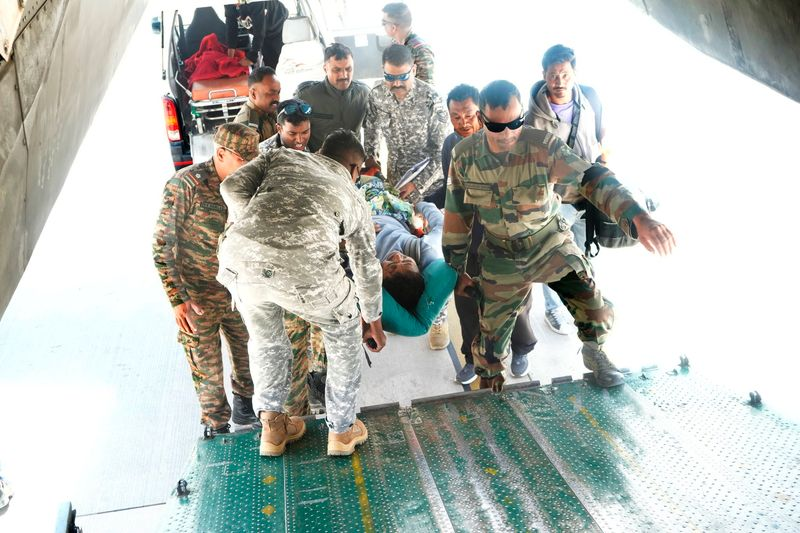
Five critically ill patients, including three personnel of the Indian Army, have been airlifted from Ladakh to Chandigarh for advanced medical care, the IAF said on Monday.
In a post on X, the Western Air Command (WAC) of the Indian Air Force also said 143 lives have been saved through casualty evacuation operations in the Ladakh sector alone during 2026.
The WAC shared details about the critical medical evacuation mission undertaken from Ladakh, despite challenging high-altitude terrain and inclement weather conditions.
“The Indian Air Force successfully undertook a critical Medical Evacuation (MEDEVAC) mission from Ladakh, airlifting five Dangerous Ill Listed (DIL) patients for advanced medical care at Chandigarh. The patients comprised three Indian Army personnel with one dependent and one Ladakhi civilian,” it posted.
The IAF also shared some images of the medical evacuation mission.
“Despite the challenging high-altitude terrain and inclement climatic conditions, IAF C-17 and AN-32 aircraft ensured their swift, safe and timely evacuation. The mission underscores the IAF’s unwavering commitment to preserving life and providing hope in emergencies. #IndianAirForce – Every Life Matters, Every Call Answered #143 lives have been saved through CASEVAC operations in the Ladakh Sector alone during 2026,” it added.
A Dangerously Ill List (DIL) patient — a medical classification — refers to individuals whose condition is critical, unstable, and carries a high probability of imminent deterioration or death, according to the National Institutes of Health website.
The Indian Air Force successfully undertook a critical Medical Evacuation (MEDEVAC) mission from Ladakh, airlifting five Dangerous Ill Listed (DIL) patients for advanced medical care at Chandigarh.The patients comprised three Indian Army… pic.twitter.com/SYYyAVfCHu
— Western Air Command, IAF (@hqwaciaf) June 8, 2026
Army opens fire at Pakistani drone along LoC in J-K’s Poonch
Security forces launched a search operation early Tuesday to ascertain whether the drone had carried out any airdropping during its flight
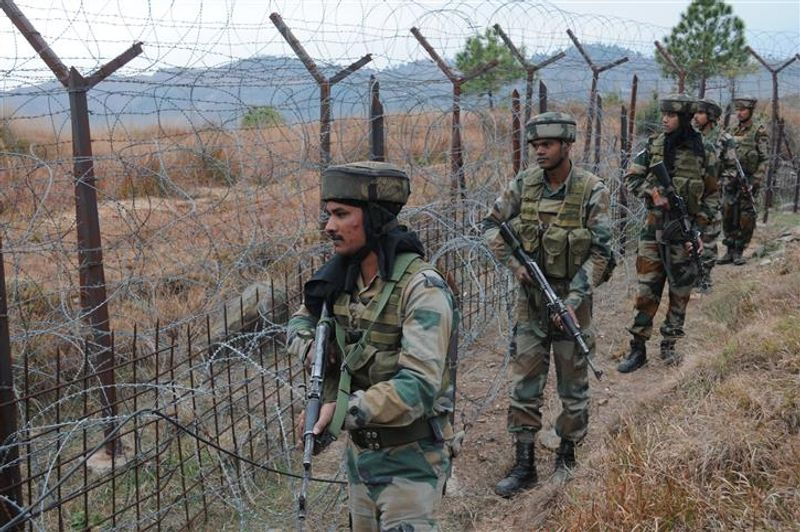
Army troops opened fire at a Pakistani drone after it intruded into Indian territory in Jammu and Kashmir’s Poonch district, but it returned to Pakistan-occupied Kashmir (PoK) after briefly hovering over some forward Indian posts, officials said on Tuesday.
The drone was spotted over some forward Indian posts in the Balakote area of the Mendhar sector late Monday night, the officials said.
They said Indian Army troops fired around nine rounds at the drone, but failed to hit the target as it was flying at a considerable height.
Security forces launched a search operation early Tuesday to ascertain whether the drone had carried out any airdropping during its flight over the area.
The operation continued for several hours, with security personnel conducting an extensive search of the area. However, nothing suspicious was found on the ground, the officials said
Juxtaposition of J&K and Ukraine war in Pak-EU statement strikes a jarring note
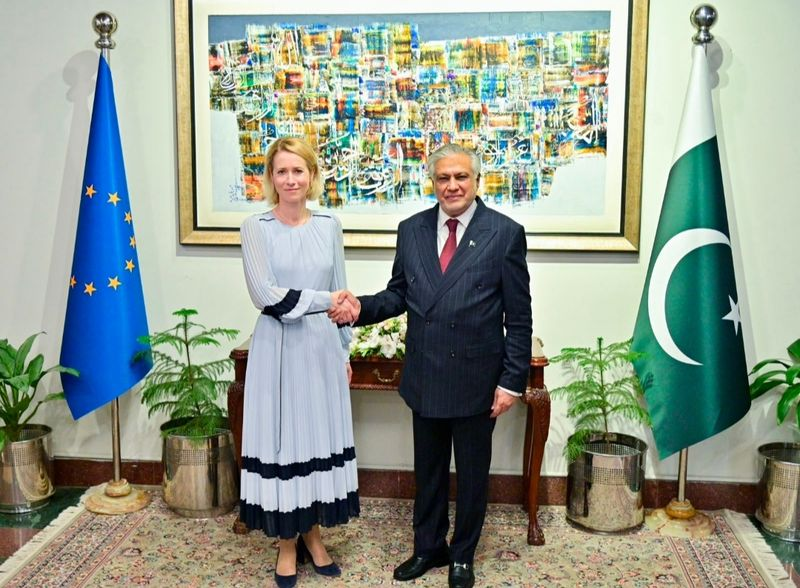
UST when Indian policymakers thought that India-EU ties were on an upward trajectory, they received a rude shock. Standing beside Pakistan’s Foreign Minister Ishaq Dar in Islamabad on June 1, EU’s High Representative for Foreign Affairs and Security Policy, Kaja Kallas, said: “Pakistan is a major regional power and an important partner for the European Union”.
Praising Pakistan’s mediation between the US and Iran, she said: “Your diplomatic efforts have helped to prevent a return to full-blown war on several occasions, and these efforts are much recognised and appreciated across Europe”. This would have been music to Pakistani ears and jarring to some circles in Delhi, for there has been no change in Pakistan’s reliance on terrorism to keep India on the defensive.
Paragraph 11 of the EU-Pakistan joint statement, which came out after Kallas’ discussions with Dar was unprecedented and offensive. It stated: “The Pakistan side briefed on the issue of Jammu and Kashmir. The EU side briefed on Russia’s war on Ukraine. Both sides expressed support for the peaceful resolution of conflicts through dialogue and diplomacy in accordance with the principles of the UN Charter.”
Prima facie, these lines are innocuous, but it is the juxtaposition of J&K and the Ukraine war that gave them an entirely different complexion. The skilled and professional EU diplomats who negotiated the joint statement would have known that putting J&K and the Ukraine war in the same paragraph would be unacceptable to India. Moreover, by joining the two issues through a sentence containing homilies on “dialogue and diplomacy” and invoking the UN Charter, they only added insult to injury. If the diplomats had slipped, why did Kallas do so too?
Kallas was Estonia’s Prime Minister for three years and has held her present office since December 2024; hence, she does not lack experience. The inescapable conclusion, therefore, is that the EU deliberately agreed to a formulation which the Pakistanis may have proposed. In accepting it, the EU showed complete disregard for Indian sensitivities.
Lest some readers think that this writer is getting carried away by unimportant minutiae of diplomatese, a peep into the arcane world of diplomatic drafting is called for. Diplomats endeavour to find common formulations for joint statements. When they fail and one side insists that unless its views are recorded it will not agree even to a mention of a matter of surpassing importance to the other, unilateral statements are framed. They indicate that the other side has merely heard the view of the other. However, in recording these formulations, it is ensured that no link can be drawn between the unilateral comments. These inevitably come about if they are included in a single paragraph.
At present, it was naturally essential for the EU to mention the Ukraine war in a joint statement. In turn, the Pakistanis would have demanded the inclusion of their viewpoint on J&K. Even while accepting such a compromise, the EU should have insisted that J&K and Ukraine be mentioned in separate paragraphs. And, while diplomacy was being urged for J&K, the EU should have called for the right conditions being created by the cessation of cross-border violent extremism. The EU did not do so.
Responding to a question on the reference to J&K in the joint statement, the Ministry of External Affairs (MEA) spokesperson said on June 2: “We categorically reject such unwarranted references in the joint press communique on matters internal to India. The Union Territories of Jammu and Kashmir and Ladakh are integral and inalienable parts of India. Those who have no locus standi on such matters should desist from making any comment on them”. This was a routine and weak response to an unprecedented and unjustified paragraph in the joint statement. Why did the MEA not even mention the EU, let alone strongly condemn it?
Is it because the Modi government did not want the focus to be on its embarrassment? It had done the EU the high honour of inviting Ursula von der Leyen, President of the European Commission, and Antonio Costa, President of the European Council, as Chief Guests for this year’s Republic Day. During the visit, the India-EU Free Trade Agreement was signed; the EU itself acknowledged that the pact accorded “a significant competitive advantage in key industrial and agri-food sectors”.
Prime Minister Narendra Modi’s discussions with EU leaders laid the groundwork for an extensive and comprehensive partnership in the security sector and other domains. The leaders’ statement noted: “Enhance cooperation to counter terrorism, in all its forms and manifestations including cross-border terrorism…” The term “cross-border terrorism” in such statements indirectly refers to, at a minimum, the infrastructure of terror in Pakistan.
In March this year, External Affairs Minister S Jaishankar visited Brussels. His host was Kaja Kallas, though he also interacted with other senior EU leaders. According to a MEA readout, the visit was “reflective of India’s sustained high-level engagement with the European Union.” It went on to say: “India-EU relations have entered a phase of renewed strategic momentum…” Some strange momentum, indeed, if the EU shows a lack of basic sensitivity to India’s significant concerns, as shown during Kallas’ visit to Islamabad.
It is a fact that Pakistan’s stock has risen in the world because of its mediation efforts between the US and Iran. Recently, in his reply to an Indian journalist’s question on China-Pak ties, Russian President Vladimir Putin denied that Pakistan was under China’s full control. He went on to say: “Pakistan is a large country and it has multifaceted ties with different countries.”
These assessments of Pakistan should not bother Indian policymakers, but it should worry them when the EU (or, in future, others) makes unwarranted, even if indirect, comparisons of India’s concerns with other global matters. That is where India has to call the EU out — not through smart one-liners but logic backed by action. And perhaps Jaishankar could sweeten his interaction with his EU counterpart with Kaja (oops, that should be Kaju) Katli!
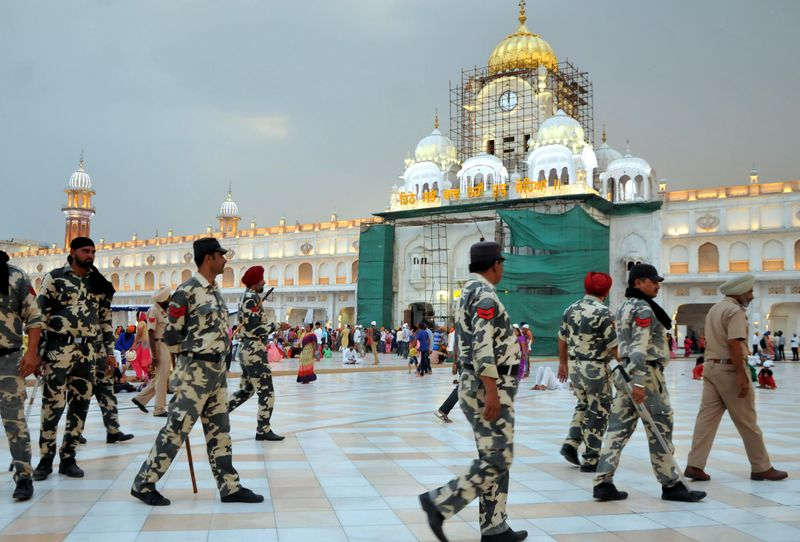
It has been 42 years since the Army marched into the Golden Temple in 1984. What was the objective of the Army action?
The devout view it as a premeditated sacrilegious assault on their holiest of holy shrines while the government of the day described it as an operation to clear the sacred space of the armed radicals who had usurped the temple, laid siege and posed a challenge to the legitimacy of the constitutionally established polity.
But with time and better understanding of the events, there is a near unanimity that the operation was avoidable, ill-planned and terribly executed. It left deep psychological scars, resulted in the destruction of the seat of Miri Piri, Akal Takht, and the death of nearly 1,000 persons, including Army men. And this unanimity of opinion includes a long list of army generals, including two former Army Chiefs, Gen VK Singh and Gen VN Sharma, who have gone public against Operation Bluestar.
The operation that was launched to eliminate violence, in fact, sowed the seeds of an ethno-religious struggle and unleashed unmitigated violence that was far worse than what it had aimed to end. Foreign powers exploited our internal situation. Weapons and drugs seeped in from the highly porous border and confirmation of this has come from a Pakistani scholar. Prof Ilyas Chattha, in his book, ‘ The Punjab Borderland, Mobility, Materiality and Militancy, 1947-1987’, has exposed the role played by his country in fuelling militancy in Punjab.
The ethno-national movement fizzled out long ago, but there are lessons to be learnt. The foremost lesson pertains to how we deal with religious plurality, political divergence, regional aspirations and uprisings. Regional assertions have to mingle with national objectives just as the nation must acknowledge the divergence of identities and aspirations in a country as large as ours.
This requires not a military approach to problems but conflict resolution through dialogue. Bluestar is a classic instance of the failure to parley, even though 26 meetings were held between Dharam Yudh Morcha leaders and the Central government, the last being on May 29, 1984 with four Union ministers in Delhi. They responded positively to the demands, not knowing that the Chief of Army Staff, Gen AS Vaidya, had already been mandated a few days earlier that troops be moved to Amritsar. The result was catastrophic.
The irony is that these very demands of the Morcha were accepted a year later, in July 1985, with the signing of the Rajiv-Longowal accord. But, by then, the moderate Longowal and his ilk had ceased to be relevant. The command of the struggle had passed on to gun-wielding militants. The spirit of shaheedi swept the Panth.
To make it worse, the Central government ducked the accord — the PM who had signed the covenant discarded it. Political imperatives prevailed over the need for conflict resolution. The pending demands continue to agitate the state.
Could militancy re-emerge in the state? It is highly unlikely. However, microscopic remnants of secessionists sitting abroad continue to fund and direct criminal activities, operating through organised criminal gangs. It is a nexus of drugs and weapon smugglers, who often operate under the ideological garb of separatism.
The consequence of this is a deteriorating law and order situation, with cases of extortions, IED or grenade blasts, killings and frequent email threats of bomb scares at public places. Forces from across the border are using drones to drop weapons and drugs to destabilise the region.
However, the recent killings of three policemen in two separate incidents in the border districts are alarming, suggestive of what is called a consternation strategy, which terrorists apply to produce a chilling effect to demoralise the symbols of state authority. They randomly pick up targets with the objective to make the state appear ineffective.
The administrative system runs on vakar — honour and credibility — as distinct from mere electoral legitimacy and terrorists seek to challenge its authority to bring its image down. This strategy was resorted to in Punjab in the 1980s by militants when many policemen, officials and journalists were targeted. A similar strategy was employed by Naxalites in West Bengal in the 1970s.
The ever-lingering religion-related issues, the acrimonious tu-tu-main-main politics, agrarian unrest leading to roadblocks and demonstrations and economic slowdown that pushed up unemployment were the contributing factors that led to decades of violence. These fault lines exist in varying degrees even today.
The beadbi or sacrilege issue is a highly sensitive one and cases have lingered since 2015, keeping the sentiments on a boil. The cases need a logical conclusion. The well-intended 2026 Amendment to the Jaagat Jot Sri Guru Granth Sahib Satkar Act has caused an unintended conflict between religious bodies and the state. The issue needs to be resolved keeping in view the Sikh sentiments, Article 26 (b) that confers the right to manage affairs related to religion by communities and by ascertaining the opinion of all stakeholders.
Efforts should be made to reduce societal and religious conflicts. Emotive issues are exploited by militants, criminals and vested interests. The historical and cultural milieu of a militarised Punjab makes us vulnerable to resorting to violence. Let me recall what Lord Dalhousie said on the annexation of Punjab: “There never will be peace in Punjab, as long as its people are allowed to retain the means and the opportunity of making war.”
Punjabis have never missed an opportunity to challenge state authority, whether it was the Mughal empire or the British or after Independence, our own. Punjab will remain peaceful and people will prosper only so long as the state is effective and the administration is perceived as just, delivering good governance.
The writer was Deputy Commissioner, Amritsar, during Operation Bluestar
US Army Apache helicopter crashes near Strait of Hormuz amid tensions over Iran conflict
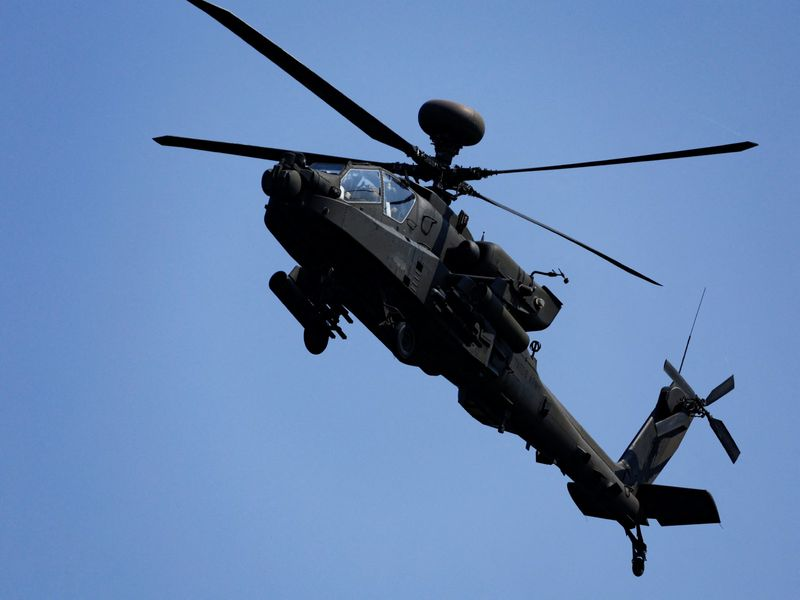
A US Army Apache attack helicopter crashed near the Strait of Hormuz, with President Donald Trump saying the two crew members on board were “fine” after the incident involving the strategic waterway, which remains under a chokehold by Iran.
What caused the crash remained unclear Tuesday morning in the Middle East, which was still reeling after Iran and Israel exchanged fire the previous day in the biggest blow yet to the straining ceasefire in the Iran war. Iranian state media, relying on foreign reporting, acknowledged the crash without elaborating.
Since the US and Israel began striking Iran on February 28, the war has shaken the global economy, driven up energy prices around the world and made many basics, including food, more expensive. Officials have been unable to turn the April ceasefire into a deal to permanently end the conflict.
Trump, speaking to journalists at John F Kennedy International Airport in New York after watching the NBA Finals on Monday night, acknowledged the crash.
“The pilots are fine. Yeah,” Trump said. “Nobody injured. We are going to issue a report tomorrow. But the pilots are fine.”
The New York Times first reported that a US Army Apache attack helicopter went down near the strait in unclear circumstances. The US military’s Central Command and the Defence Department did not immediately respond to requests for comment from The Associated Press.
Apache helicopters have been a key asset for the American military as it enforces a blockade on Iranian crude oil shipments and tankers, seeking to pressure Tehran into reaching a deal. The helicopters also have been used by the United Arab Emirates to shoot down Iranian drones during the Iran war.
Trump insists an Iran deal is coming
Trump also expressed renewed optimism over negotiations with Iran.
“We have a good chance” of signing a deal in “two or three days,” Trump said. But he didn’t provide any details on why there was reason for new optimism.
“We’re very close to having a very, very good, strong, powerful deal,” the President said. “If we go and bomb – which we could do very easily if we want, and we spend another two or three weeks bombing – they’ll have nothing left whatsoever. But you won’t have the strait open for months.”
He added: “If we do the bombing, you know, a lot of people are going to be killed. Who wants to do that? I don’t.”
Mediators, led predominantly by Pakistan, have been trying to weeks to get a deal across the line. However, both Iran and the US have taken hard-line positions.
The US wants to see Iran give up its stockpile of highly enriched uranium, which is believed still to be entombed in the country after American airstrikes in the 12-day war in 2025. But Iran is refusing that and demanding relief from sanctions. It also wants the release of frozen assets even before a final agreement is in place, something rejected by Trump.
Indian Army’s Major Prabhat Mishra wins 2 awards at US Army’s advanced training course
No-1 SSB for GC decl today are as under :-
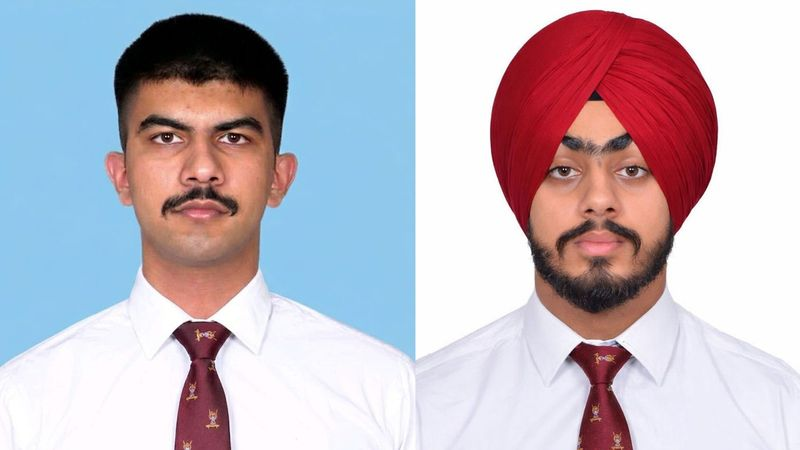
Two Mohali cadets secure AIR 2 and 6 in AFCAT, also clear CDS
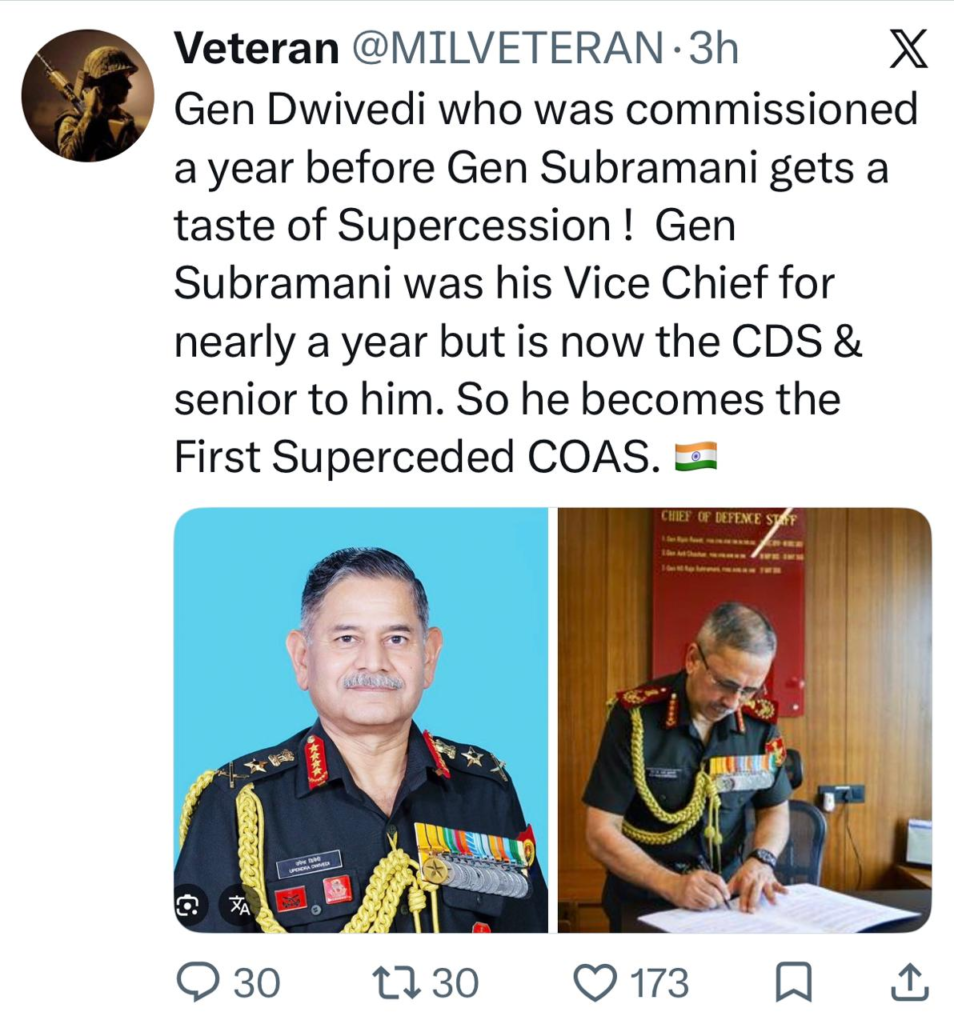
Junior made CDS and senior become junior :
Canada has turned into an Indian colony’: Toronto festival video sparks online debate
Army conveys ‘displeasure’ to Captain a day after proposal at passing-out parade
Motive not essential for conviction: AFT upholds life sentence
Explainer: Cracking the NDA: What it takes, what it means, and what comes next
The perimeter of Viksit Bharat
Delhi inferno: Muslim trader’s mattresses, quilts become lifesavers: he says everyone is same, whether Hindu or Muslim. We all are Hindustani. It was my duty to help our brothers, whether he is Hindu or Muslim.”
Military jargon cripples serious thinking
Gender inequality: Can’t exclude married daughters from definition of ‘family’, rules SC
Fourth S-400 squadron arrives in India; fifth expected by year-end
Indian killed as Iran targets Kuwait after fresh strikes by US
US trade body announces new 12.5% tariff on India, Govt says proposed tax not final
Indian Army’s Major Prabhat Mishra wins 2 awards at US Army’s advanced training course
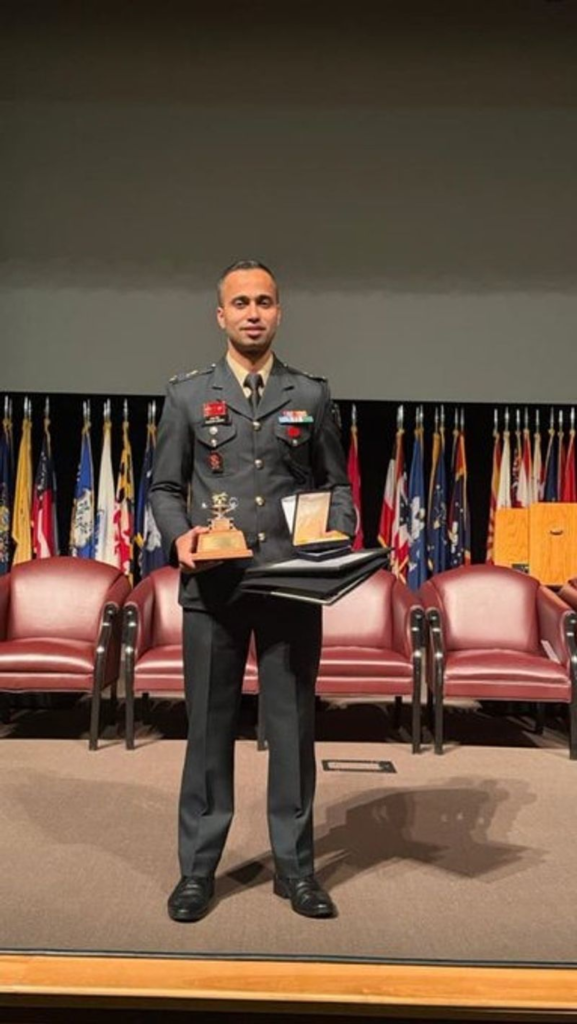
An Indian Army major has won two academic awards at a prestigious US Army leadership programme that included 951 officers from the US and partner nations at Fort Leavenworth, Kansas.
Major Prabhat Mishra of India received the Birrer-Brookes Award for Outstanding Master of Military Arts and Science Thesis and the General Douglas MacArthur Military Leadership Writing Award during the graduation ceremony of the US Army Command and General Staff College’s Command and General Staff Officer Course (CGSOC).
The awards were presented as 951 graduates completed the 10-month programme designed to prepare mid-career officers for senior leadership and staff responsibilities.
The graduating class included 120 international military students from 92 countries.
This year’s class experienced a reformed and modernised curriculum that reflected the rapid technological and tactical advancements dictated by the current operational environment, a US Army statement said.
Among other international officers Major Aleksander Granberg of Norway received the General Dwight D. Eisenhower Award and the Arter-Doniphan Award, and Lieutenant Colonel Taleh S F H H Alrashid of Kuwait received the Major General Hans Schlup Award.
Lt. Gen. Jim Isenhower, Commanding General, US Army Combined Arms Command and Fort Leavenworth, explained to the class that their responsibility as graduates of CGSOC is to be the conductor of the track, prepared by the academic rigour they conquered over the last 10 months.
International military education at Fort Leavenworth began in 1894. Since then, more than 8,700 International Military Students from nearly 170 countries have attended classes alongside their US counterparts.
US Army Command and General Staff College’s mission is to educate field grade officers to be agile, innovative, and adaptive leaders in increasingly complex and uncertain environments.
A day after two women cadets from Mai Bhago Armed Forces Preparatory Institute made history by topping national defence merit lists, cadets from its sister institute in Mohali have achieved a similar feat.
Two cadets from the 10th course of Maharaja Ranjit Singh Armed Forces Preparatory Institute, Mohali, have secured All India Ranks 2 and 6 in Air Force Common Admission Test II. Both have also cleared the Combined Defence Services (CDS) examination, marking an unprecedented dual success for the state within 24 hours.
Sukhraj Singh Heera, son of a government school teacher from Rupnagar district, secured AIR 2 in AFCAT. Cadet Jasnoor Singh of Pathankot secured AIR 6.
In the CDS merit list, Jasnoor Singh ranked first in the Air Force category, while Sukhraj Singh Heera ranked fourth in the Army category — a rare instance of cadets from the same institute ranking in the top five of two separate national defence exams simultaneously.
Both cadets have already been selected for CDS courses beginning later this month. Punjab Employment Generation, Skill Development and Training Minister Aman Arora congratulated the cadets, saying Sukhraj and Jasnoor had “made the entire state proud”. He added that the state government is committed to strengthening both MRSAFPI and Mai Bhago AFPI so that more youth from ordinary backgrounds can get commissioned in the armed forces. “The state government’s aim is jobs for youth and a uniform for those who dream of serving the nation,” he said.
MRSAFPI Director Major General Ajay H Chauhan, VSM (Retd.), praised the achievement and noted that around 24 cadets from the institute are set to receive joining letters for courses beginning shortly at training academies across the country — reflecting the strong pipeline the institute has built.
These results, following Mai Bhago AFPI’s AIR 1 in the Air Force Academy exam and AIR 18 in the NDA exam announced on Monday, complete a remarkable 24-hour sweep for Punjab’s state-run defence preparatory institutes, with cadets from both placing in the top ranks of four national defence exams over two consecutive days.
The Chief of Defence Staff (CDS) is a four-star officer of equal rank to the Chief of Army Staff (COAS). While the CDS acts as the “first among equals” and the principal military advisor to the Defence Minister, the COAS retains operational command over the Indian Army and is not subordinate to the CDS. [1, 2, 3, 4, 5]
However, in terms of commissioning seniority and official protocol, the COAS can be junior to the CDS. [1]
Key Differences and Dynamics
Rank & Status: Both the CDS and the COAS hold the rank of full General (4-star rank), sitting 12th in the Indian Order of Precedence. [1, 2, 3, 4]
Command vs. Integration: The COAS has direct command of the Army. The CDS does not exercise military command over the Service Chiefs, but rather promotes tri-service synergy, oversees the Department of Military Affairs (DMA), and drives military theaterization. [1, 2, 3, 4]
Protocol & Precedence: In defense protocol, the CDS serves as the Permanent Chairman of the Chiefs of Staff Committee (COSC), giving the office ceremonial and functional seniority over the Service Chiefs in official meetings and state functions. [1, 2]
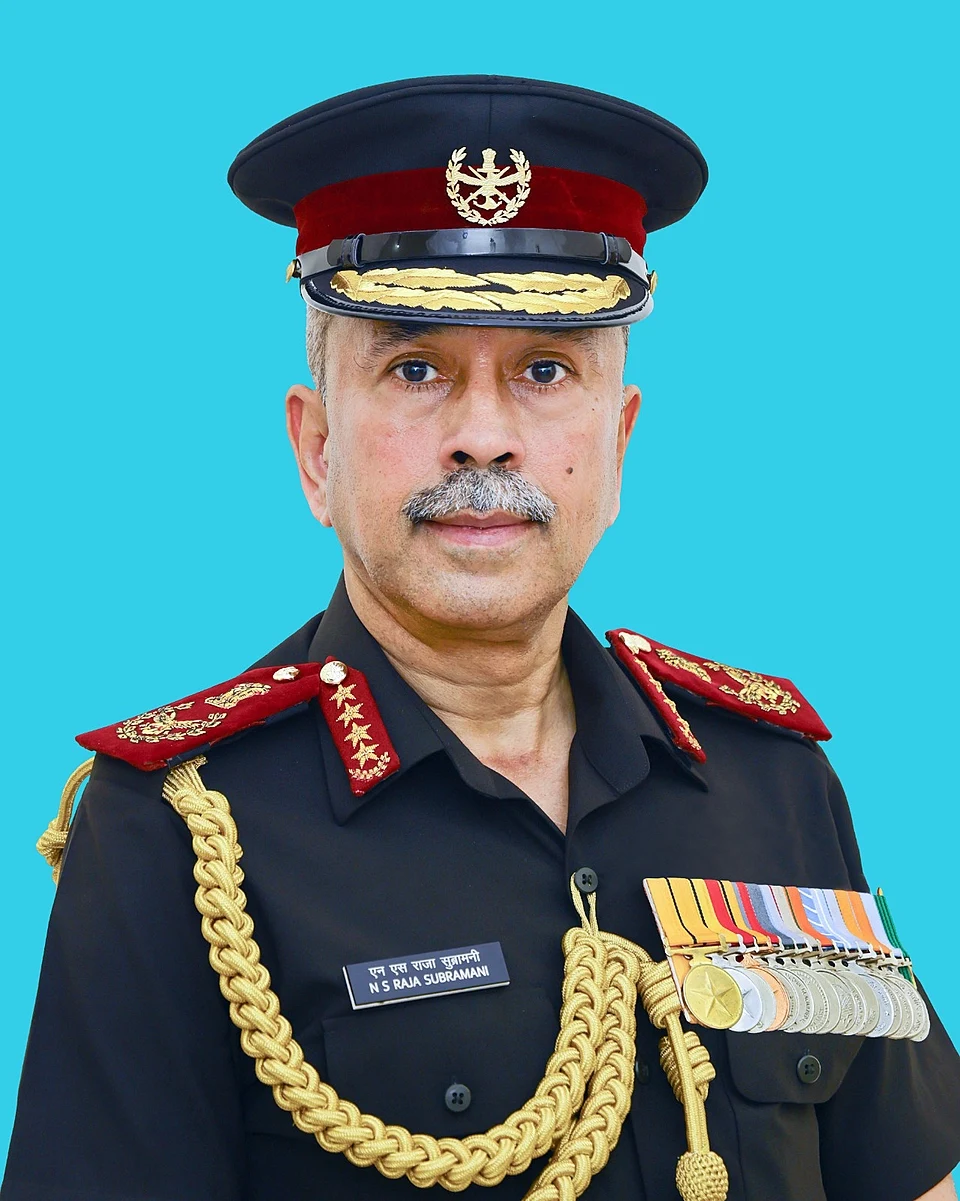
Recent Precedents: Seniority in these appointments is not strictly based on years of service. For instance, following his appointment as the 3rd Chief of Defence Staff, General N.S. Raja Subramani became senior in protocol to the serving Army Chief, General Upendra Dwivedi, despite having served under General Dwivedi as the Vice Chief of the Army Staff previous
State Stalwarts
DEFENCE MINISTER
Minister Rajnath Singh
ALL HUMANS ARE ONE CREATED BY GOD
HINDUS,MUSLIMS,SIKHS.ISAI SAB HAI BHAI BHAI
CHIEF PATRON ALL INDIA SANJHA MORCHA
LT GEN JASBIR SINGH DHALIWAL, DOGRA
SENIOR PATRON ALL INDIA SANJHA MORCHA
MAJOR GEN HARVIJAY SINGH, SENA MEDAL ,corps of signals
.
.
PATRON ALL INDIA SANJHA MORCHA
MAJ GEN RAMINDER GURAYA ,MADRAS REGIMENT
sanjhamorcha303@gmail.com
PRESIDENT SOUTH ALL INDIA SANJHA MORCHA
COL SS RAJAN BOMBAY SAPPERS,
PRESIDENT UTTARAKHAND ALL INDIA SANJHA MORCHA
COL B M THAPA ,BENGAL SAPPERSS
PRESIDENT HARAYANA STATE CUM COORDINATOR ESM
BRIG DALJIT THUKRAL ,BENGAL SAPPERS
PRESIDENT TRICITY
COL B S BRAR (BHUPI BRAR)
PRESIDENT CHANDIGARH ZONE
COL SHANJIT SINGH BHULLAR
.
.
PRESIDENT PANCHKULA ZONE AND ZIRAKPUR
COL SWARAN SINGH
INDIAN DEFENCE FORCES
DEFENCE FORCES INTEGRATED LOGO
INDIAN AIR FORCE
Air Officer C-in-C WESTERN AIR COMMAND
AIR MSHL S PRABHAKARAN AVSM VM
AOC-IN-C, EASTERN AIR COMMAND
Air Marshal Inderpal Singh Walia
AOC-in-C SOUTH WESTERN AIR COMMAND
Air Marshal Vikram Singh
AOC-IN-C, SOUTHERN AIR COMMAND
Air Marshal J.Chalapati
AOC-IN-C TRAINING COMMAND
AIR MARSHAL SK GHOTIA VSM
AOC-IN-C MAINTENANCE COMMAND
Air Marshal Jagdish Chandra
Flag Officer Commanding in Chief, Western Naval Command
ice Admiral R Hari Kumar, PVSM, AVSM, VSM
Flag Officer Commanding in Chief, Eastern Naval Command
Vice Admiral Sanjay Bhalla, AVSM, NM
Flag Officer Commanding in Chief, Southern Naval Command