









n a significant academic-defence collaboration, the Remount Veterinary Corps (RVC) Centre and College, Army, Meerut Cantonment, had recently invited Randhir Singh, scientist at Guru Angad Dev Veterinary and Animal Sciences University, Ludhiana, to deliver an expert lecture on “Early Prediction of Military Working Dog Success: Integrating Wearables, Behaviour and Biomarkers”.
Singh provided an insightful and futuristic overview of emerging evaluation tools for military working dogs. His talk covered behavioural scoring systems, activity-monitoring sensors, hormonal stress markers, cytokine profiling and predictive disease analytics powered by machine learning. The presentation, which highlighted the potential of early-life assessment, received exceptional engagement and appreciation from RVC officers.
Emphasizing proactive health screening, Singh discussed the importance of early detection of pancreatitis, renal diseases, hip dysplasia and osteoarthritis. He underscored how scientific monitoring could extend working lifespans, improve training efficiency and enhance the mission readiness of canine soldiers.
He delivered a detailed lecture on dialysis indications, designing an effective workflow, and real-time decision-making in critical care.
India, Russia reorient defence ties towards co-development, co-production
PM Narendra Modi with Russian President Vladimir Putin . PTI
Six-decade-old India-Russia military ties were today “re-oriented” to make co-development and co-production of advanced technology the new benchmark for promoting ‘Make in India’.
A joint statement, released after Prime Minister Narendra Modi and Russian President Vladimir Putin concluded their annual summit here, said “responding to India’s quest for self-reliance, the partnership is reorienting to joint research and development, co-development and co-production of advanced defence technology and systems”.
The shift towards “co-development” and “co-production” marks a paradigm change for several future platforms such as next-generation fighter jets, aero-engines, marine engines, radars and missiles that the Indian armed forces may require. Russia currently holds advanced technologies, including the S-400 air defence system and the fifth-generation Sukhoi-57 fighter jet.
So far, the BrahMos missile system remains the most notable joint venture between the long-standing partners. However, the missile was originally designed and developed in the erstwhile Soviet Union as the Yakhont before being adopted as BrahMos and further upgraded.
About a decade ago, India walked out of a joint project to co-design and co-develop a fifth-generation fighter aircraft. Two years ago, Russia launched a joint venture to produce AK-203 rifles in India, though the rifle itself was designed and developed in Russia.
Other platforms such as the Sukhoi-30MKI fighter jets, T-90 tanks and MiG-21s are produced under licence in India, but their design and critical metallurgy remain with Moscow.
At the Modi-Putin talks, the two countries also expanded military cooperation and agreed to address the long-standing issue of sourcing spare parts for Russian-origin equipment. The two sides will now undertake joint manufacturing of spares in India.
“Both sides agreed to encourage joint manufacturing in India of spare parts, components, aggregates and other products for maintenance of Russian-origin arms and defence equipment,” the joint statement said.
This will fall under the Make in India programme through transfer of technology and the setting up of joint ventures to meet the requirements of the Indian armed forces, with the possibility of exports to mutually friendly third countries, it added.
Modi and Putin also welcomed the outcomes of the 22nd session of the India-Russia Inter-Governmental Commission on Military and Military Technical Cooperation (IRIGC-M&MTC).
India, Russia seal pact on space; vow health, nuclear, tech coop
India and Russia have strengthened their longstanding partnership with the signing of a comprehensive agreement covering cooperation in healthcare, medical education, space, science and environmental sectors.
Emphasising the importance of joint research in science, technology and innovation, the two sides called for deeper collaboration under the “Roadmap for Science, Technology & Innovation Cooperation”.
“They agreed to facilitate collaboration between government and private sectors to harness opportunities for startups and SMEs (small and medium enterprises) in both countries to address societal challenges through innovative technologies, including joint R&D and co-development of technologies. They confirmed their interest in further developing cooperation in digital technologies, including those related to information protection, security of critical infrastructure and law enforcement. Both sides agreed to design and implement soft support programmes for startups to enable knowledge exchange, capacity-building and greater engagement of innovators and entrepreneurs,” a joint statement released after Prime Minister Narendra Modi and Russian President Vladimir Putin concluded their annual leaders’ summit here said.
Recognising the extensive experience of collaboration between India and Russia in science and higher education, both sides expressed interest in deepening partnerships between educational and research institutions, including academic mobility, joint educational programmes, research projects and specialised international exhibitions, conferences and seminars.
The countries welcomed the expanded partnership between the Indian Space Research Organisation (ISRO) and Russia’s Roscosmos in the peaceful use of outer space, including human spaceflight programmes, satellite navigation and planetary exploration.
Chief of Defence Staff General Anil Chauhan, Chief of the Naval Staff Admiral Dinesh K Tripathi, Vice Chief of the Army Staff Lt Gen Pushpendra Singh and Vice Chief of the Air Staff Air Marshal Narmdeshwar Tiwari today laid a wreath and paid homage to the fallen heroes at the National War Memorial, New Delhi on the occasion of Navy Day.
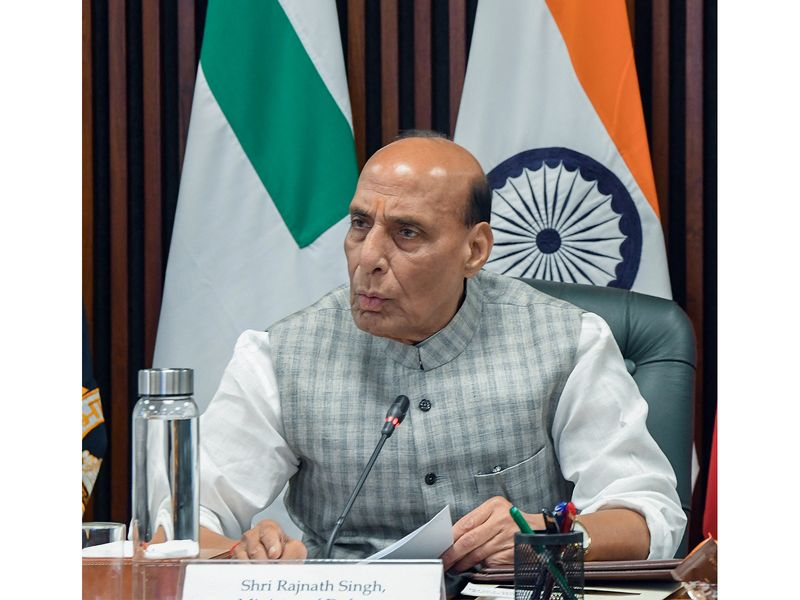
Raksha Mantri and his Russian counterpart co-chair 22nd India-Russia Inter-Governmental Commission on Military & Military Technical Cooperation Meeting in New Delhi
Both sides reiterate that India-Russia ties are based on a deep sense of trust, common principles & mutual respect
Shri Rajnath Singh stresses on new opportunities to enhance collaboration across niche technologies
Russian Defence Industry is ready to support India towards becoming self-reliant in defence production, says Mr Andrei Belousov
Raksha Mantri Shri Rajnath Singh and the Defence Minister of Russia Mr Andrei Belousov co-chaired the 22nd session of India-Russia Inter-Governmental Commission on Military & Military Technical Cooperation (IRIGC-M&MTC) at Manekshaw Centre, New Delhi on December 04, 2025. Both sides reiterated that the India-Russia relationship is based on a deep sense of trust, common principles and mutual respect. This meeting precedes the 23rd India-Russia Annual Summit between Prime Minister Shri Narendra Modi and President of Russia Mr Vladimir Putin.
Shri Rajnath Singh voiced the Government of India’s determination for capacity building of its indigenous defence industry for both local production and exports, under the vision of ‘Aatmanirbhar Bharat’. He also stressed on new opportunities for enhancing collaboration between both counties across niche technologies.
The Russian Defence Minister emphasised on deepening relationship between both the countries which is based on mutual trust. He highlighted that both countries are united by many years of friendship and strategic cooperation. He stated that the Russian Defence Industry is ready to support India towards becoming self-reliant in the field of defence production. Minister Belousov also invited Shri Rajnath Singh to visit Russia to co-chair the 23rd session of IRIC-M&MTC in 2026.
At the end, the two Ministers signed the protocol of the 22nd IRIGC-M&MTC meeting highlighting the ongoing and prospective areas of cooperation.
Prior to the meeting, Raksha Mantri and the Russian Defence Minister laid the wreath at the National War Memorial, New Delhi and paid respect to the Indian bravery who made the supreme sacrifice in the service of the nation. The visiting dignitary also inspected the Ceremonial Tri-service Guard of Honour.
1. Bharathvarsh is a Punya Bhoomi, a sacred land, endowed with a number of holy rivers and Theertha Kheshtras, ie pilgrimage centres, for people of all faiths. Bharathvarsh has been home to a number of Sages, Saints, Gurus & Tapasvins born at different periods of time and places to guide mankind on the path of Dharma. Guru Nana Devji 2. One such enlightened Soul was Guru Nanak Devji, born on 15 April 1469 at Nankana Sahib, present day Pakistan. Guru Nanak Devji preached love, brotherhood & compassion. He believed in Oneness of the Lord Almighty and Oneness of Man and asked his followers to eschew bigotry by shunning differences on account of caste, creed & religion. Guru Nanak Devji was an embodiment of piety & virtue and dedicated his life for promoting Ekta & Sadhbhavana amongst the people. Guru Teg Bahadurji 3. With the passing away of Guru Nanak Devji, there followed nine more Gurus of great piety & reverence who tread the hallowed path of Guru Nanak Devji. The Mughals had gained ascendance and the Delhi Darbar was being ruled by the despicable Auranzeb at the time of Guru Teg Bahadurji, the ninth Guru. Aurangzeb had let loose a reign of terror and was hell bent on converting the Hindu populace to Islam by coercion; and if that failed, then by the sword. Unable to withstand the tyranny of Aurangzeb, the Hindus led by the Brahmins sought refuge and protection of Guru Teg Bahadurji, the ninth Guru. This infuriated Aurangzeb and he ordered that Guru Teg Bahadurji be brought to Delhi and be forcibly converted to Islam. When Guru Teg Bahadurji was chained and brought to Delhi, he was commanded to convert to Islam, failing which he would be put to death by the sword. And when Guru Teg Bahadurji refused to eat Beef as a token of conversion to Islam, the pious Guru was beheaded at Delhi on 24 November 1675, at the place where Sis Ganj Gurudwara, today stands. Not being content with beheading Guru Teg Bahadurji, the cruel Aurangzeb had the pious followers of the Guru roasted in raging fire and fried in cauldrons of boiling oil. So much for Islam; the religion of peace, mercy & compassion. May Allah be praised.
4. When Guru Teg Bahadurji was put to the sword, his son, the young Gobind Rai, only nine years of age, queried, “Was there none to stand up to fight the Mughal zulum when Guru Teg Bahadurji was put to the sword?” Guru Teg Bahadur sacrificed his life to protect the Honour of the Hindus, viz. their Janeoo (sacred thread worn mainly by the Brahmins) and their Tilak (sindoor worn by womenfolk of Hindus). Guru Gobind Singhji 5. Gobind Rai, son of Guru Teg Bahadurji, was formally anointed as Guru Gobind Rai, the tenth Guru, on Baisakhi, 1676. 6. Come Baisaki, 13 April 1699 at Anandpur Sahib, Punjab. It was on the auspicious day of Baisaki, 13 April 1699 that, Guru Gobind Rai the tenth Guru, founded the Khalsa Panth, an Army, calling its brave soldiers as Sikhs, the Lion hearted, the sword arm of the Hindus, to fight against Mughal Zulum (tyranny). When he asked for volunteers, the Panj Pyaras stood up. And who were the Panj Pyaras? 1. Bhai Daya Ram 2. Bhai Dharam Dass


Bhai Mokham Chand 4. Bhai Himmat Rai 5. Bhai Sahib Chand. These Panj Pyaras after being baptized by partaking of the sacred Amrith were christened Singhs, the Lion Hearted. It was on Baisakhi, 13 April 1999 that Guru Gobind Rai christened himself as Guru Gobind Singh after partaking the Amrith. He baptized ordinary Hindus by asking them to partake the sacred Amrith and turning them into Sikhs, the Lion hearted,the Saviours of Dharma. Panj Pyaras 7. Life sketch of Panj Pyaras. (i) Bhai Daya Singh Ji (Daya Ram) was born in Lahore (now Pakistani Punjab) in the year 1669 A.D.. He was Khatri by Caste. He offered his head to Guru Gobind Singh on the Baisakhi day 1699 A.D., at the age of 30 years. He remained with Guru Gobind Singh till he left his mortal coil in Nanded in the year 1708 A.D. (ii) Bhai Dharam Singh Ji (Dharam Dass). He was Jat by caste and belonged to Hastinapur (Delhi). He was born in 1666 A.D. He also passed away in Nanded in the presence of Guru Gobind Singh Ji. (iii) Bhai Mokham Singh Ji (Mokham Chand) He belonged to Dwarka in Surashtra region of Gujarat. He was born in 1663 A.D. in low caste family of Chheemba (Washermen). He sacricficed his life in battle of Chamkaur Sahib in 1704 A.D. (iv) Bhai Himmat Singh Ji (Himmat Rai) He was born in the year 1661 A.D. in a low caste Jhiwar (Water bearer) family. He belonged to Jagannath Puri in Orrisa. He also became a martyr in a battle of Chamkaur Sahib in 1704 A.D.
(v) Bhai Sahib Singh Ji (Sahib Chand) He Was born in Bidar (Andhra) in 1662 A.D. in low caste Nai (Barber) family. He also sacrificed his life in the Battle of Chamkaur Sahib in 1704 A.D. 8. Thus it will be seen that the Panj Pyaras were all Hindus and were from both High and Low caste; and they came from all parts of India. Likewise, the Indian Army too, comprises soldiers of all castes & creeds, from all parts of India 9. Who formed the Khalsa Panth, the Sikhs (the Lion Hearted), the sword arm of the Hindus to fight Mughal Zulum? It was one son, mostly the eldest son of each & every Hindu family who were baptized and christened as Sikh. It must be remembered that Sikhs are no different from Hindus. Bharath is Punya Bhoomi in which numerous Saints & Tapaswins have taken birth. Each Guru came at various points of time to guide mankind on the path of Dharma; and each Guru taught or preached a way of life most conducive to betterment of society, at that point of time. So also, Guru Nanak Devji, the first Guru and down the line to Guru Gobind Singhji, the tenth Guru. Are Sikhs a separate ‘Race’ or ‘Koum’? 10. Starting from Guru Nanak Devji, the first Guru, to Guru Gobind Rai (Singh), the tenth Guru, all of them were Hindus. Yet, to say, Sikhs are NOT Hindus, displays lack of understanding. It is akin to saying that Soldiers of the Indian Army wearing OG uniform on their commissioning or after their Kasam Parade are not Indians; but are a separate ‘Race’ or ‘Koum’. No soldier of the Indian Army is born donning the uniform with a weapon in hand; but becomes a Soldier, ie. dons the Uniform and bears arms only after Commissioning or Kasam Parade, on completion of Military training. So also, no one is born a Sikh sporting the five Ks, ie. Kachcha, kada, Kes, Kanga & Kirpan. All Sikhs are born Hindus; and it is only a Hindu on being baptized, ie. on partaking Amrith and on sporting the five Ks, ie. Kachcha, kada, Kes, Kanga & Kirpan, that he is called a Sikh, the Lion hearted, the protector of the oppressed, in other words, Saviour or upholder of Dharma. Baptising of a Hindu Male child as a Sikh as fulfillment of Mannath. 11. Even today, there is a custom among Hindu families, that when there is no male progeny in the family, the family observes a Mannath or offers prayers, that in case blessed with a male child, the child would be baptized as a Sikh and would sport the five Ks, viz. Kachcha, Kada, Kes, Kanga & Kirpan. The Question that needs to be asked is: When the boy’s father is a Hindu and his mother is a Hindu, just because on account of a ‘Mannath’ the young boy has been baptized as a Sikh, does that boy cease to be a Hindu and now forms part of a different religion called Sikhism?
A Hindu would always remain a Hindu even when he turns a Sikh and sports the five Ks. Only thing is, he is guided by different set of rules or way of life. It is just like a Soldier on wearing the uniform, is guided by a different set of rules or a way of life, different from his compatriots; but in no way does he cease to be an ordinary citizen. Calling Sikhs a separate ‘Race’ or ‘Koum’, not in consonance with basic tenets of Sikhism
The secessionist sentiments or feelings that Sikhs are a separate ‘race’ or a separate ’koum’ have been fanned or accentuated by self seeking politicians adept at exploiting human follies & weaknesses; to the detriment of National Unity and goes against the very grain of Philosophy preached by Guru Nanak Devji. Oneness of God and Oneness of Man is the fundamental tenet of Sikhism.
ABOUT WRITER COL SS RAJAN
Col SS Rajan, born 13 Oct 1944, was commissioned in the Corps of Engineers (The Bombay Sappers) on 30 June 1963. During the 1971 War, he commanded 182 Engineer Construction Company (of 268 Engineer Regiment) in Boyra-Jessore-Khulna sector in the Eastern Theatre; culminating in the liberation of Bangladesh on 16 Dec 1971.
He was Commander 24 Border Roads Task Force (BRTF) in Mizoram during the period Dec 1984-May 87; and, commanded a Training Battalion in Bombay Engineer Group & Centre, Kirkee, Pune, thereafter. Having done Higher Defence Management Course (HDMC) in 1988-89 from the College of Defence Management, Secunderabad, he was Col incharge Administration, HQ UP Area (1989-90), Col incharge Administration, HQ Delhi Area (1990-93) and Additional Chief Engineer & Engineer Advisor to AOC-in-C Training Command (IAF), Bangalore (1993-96); from where he retired on 31 Oct 1996.
35 years on, Army officially pays tribute to Indian soldiers killed in Sri Lanka peace keeping operations
About 35 years after the last troops of the Indian Peace Keeping Force (IPKF) stepped off Sri Lankan soil, the Army, for the first time officially paid tributes to those who had laid down their lives in the three-year operation, with Chief of Army Staff, Gen Upendra Dwivedi laying a wreath at the National War Memorial in New Delhi on Tuesday.
It was on November 25, 1987, that Major Ramaswamy Parameswaran of the 8th Battalion of the Mahar Regiment made the supreme sacrifice during Operation Pawan, the most significant operation undertaken by the PPKF in Sri Lanka. He was decorated with Param Vir Chakra (PVC), the highest award for gallantry and was the sole IPKF recipient of this award.
Sri Lanka was India’s first major overseas military campaign post-Independence. While it is considered to be tactically successful, albeit as a heavy human cost, the political, diplomatic and intelligence aspects continue to be debated. By the time the last Indian troops withdrew from Sri Lanka, the force had lost 1,171 troops with another about 3,500 being wounded.
Over the years, veterans have been holding private remembrance ceremonies to honour the war dead of India’s military intervention in Sri Lanka. For long, veterans have been campaigning for official recognition and commemoration of the Sri Lanka operations.
The IPKF was deployed in Sri Lanka from July 1987 to March 1990, under a bilateral accord to disarm Tamil militant groups, particularly the Liberation Tigers of Tamil Eelam (LTTE) and end the civil war in that country.
Initially envisioned as a quick and low intensity operation with little armed engagements, it quickly escalated into intense combat after strong resistance from militant groups, resulting in grueling battles involving jungle warfare, urban assaults and counter-insurgency operations and throwing up some hard lessons.
Operation Pawan was the code name for the IPKF campaign to take control of the Jaffna peninsula in northern Sri Lanka from the LTTE and to enforce its disarmament as a part of the Indo-Sri Lanka Accord. In brutal fighting lasting about three weeks, the IPKF took control of the Jaffna Peninsula from the heavily armed LTTE, something that the Sri Lankan Army had earlier tried but failed to do.
As part of the operation, Major Ramaswamy Parameswaran of the 8th Battalion of the Mahar Regiment, was returning from a search operation in Sri Lanka, late at night on November 25, 1987, when his column was ambushed by a group of militants.
“With cool presence of mind, he encircled the militants from the rear and charged into them, taking them completely by surprise. During the hand-to-hand combat, a militant shot him in the chest. Undaunted, Major Parameswaran snatched the rifle from the militant and shot him dead. Gravely wounded, he continued to give orders and inspired his command till he breathed his last. Five militants were killed and three rifles and two rocket launchers were recovered and the ambush was cleared,” the citation for his award reads.
“Major Ramaswamy Parameswaran displayed the most conspicuous gallantry and thought nothing of dying at his post,” the citation adds. He was the only PVC recipient of the campaign. In addition over 250 decorations, including three Maha Vir Chakra, the second highest gallantry award, were conferred on IPKF personnel.
Operating under the aegis of the Southern Command, the IPKF deployment peaked at around 100,000 troops involving the Army’s 4 Mountain Division, 36 Infantry Division, 54 Infantry Division and 57 Infantry Division along with para-military forces as well as Special Forces, Air Force and Navy elements.
Jaffna, Palaly, Vavuniya, Trincomalee, Batticaloa, Ampara and Mannar were along areas in northern and eastern parts of Sri Lanka where the IPKF was deployed.
While Indian involvement in the Sri Lankan civil strife had been continuing at the political and diplomatic level since the tenure of Indira Gandhi as prime minister, the induction of the IPKF had been preceded by the first overt military operation, Poomalai, when five IAN An-32 transport aircraft escorted by Mirage 2000 flew over Jaffna to airdrop 25 tons of supplies in June 1987.
Operation Viraat, Operation Trishul, Operation Checkmate, Operation Main Road, Operation Tiger Hunt and Operation Thrividra are among other major anti-insurgency operations and strike missions undertaken by the IPKF in different areas. Sri Lanka was also the first combat exposure for the Navy’s newly formed Special Forces unit, the Indian Marine Special Force, now known as the Marine
Army flags ‘negligible’ contribution by Punjab in defence industry
Amidst a push for indigenisation and self-reliance, the Army on Thursday flagged the negligible contribution of Punjab in the country’s defence industry and urged the state government to facilitate an eco-system to encourage industries to venture into the defence domain.
Pointing out that out of the thousands of industries listed in the Army’s database, only 18 are in Punjab, the Additional Director-General, Army Design Bureau, Maj Gen CS Mann, said that the state’s share was barely 0.01 per cent in the military industry.
“A compendium of problem definition statements released by the Army contained in total about 152 problem statements. And we have received 1,327 responses to this from across the country out of which only seven came from Punjab. This includes four government institutes and one student,” he said in a virtual address at ‘Defence Dialouge: How Can North India Contribute to the Growing Military Industrial Complex in India’, organised by the Gyan Setu Think Tank in collaboration with the Confederation of Indian Industry in Chandigarh on Thursday.
He said that in the past two years, about 116 contracts worth about Rs 1,08,000 crore have been signed by the Indian Army, out of which there is only one contract from Punjab. The ongoing research and development projects being handled by the Army Design Bureau are worth Rs 2,10,000 crore, in which Punjab has just one project valued at less than Rs 1 crore.
Stressing upon the need to move out from traditional domains and comfort zones, Maj Gen Mann said that the defence industry will procure what is required by them and not just what the industry has to offer the armed forces. “So, therefore, there may be a need to modify whatever is being done by the industry, customise it for the defence applications,” he said.
On the changing nature of warfare and the required platforms, he said that today the armed forces were looking at advanced materials along with autonomous and AI-enabled systems with multiple sensors and the ability to fuse their data for decision making and precision targeting.
Maj Gen Mann said that the industry in Punjab needs to venture out into these technology domains of these emerging technologies, which can very well be done by established industries by diversifying their existing domains.
There is also a lot of scope for startups that can also play an important role and the government has adequate funding schemes for them to venture into the defence domain. Academic institutes in Punjab need to focus on these technologies, which are dual-use technologies.
He also suggested that the Punjab Government can provide grants and financial assistance to startups, special incentives to the industry like loans, some patents, subsidised land and subsidised electricity rates.
Col RS Bhatia (retd), president of the Society of Indian Defence Manufacturers said that Indian industry has the competence and capability to design and develop indigenous weapon systems and the government should provide accelerators and the requisite infrastructure for its expansion. He pointed out that the average growth of the military-industrial complex in India is 18 percent, which is expected to continue.
Former Deputy Chief of the Army Staff, Lt Gen JP Singh (retd) stressed on greater focus and budgetary allocation for research and development and said that government policies must favour indigenisaion and procedures should be fast tracked.
Punjab, HAL look at manufacturing aircraft components in state
The Punjab Government and state-owned defence sector undertaking Hindustan Aeronautics Limited (HAL) are looking at manufacturing aircraft components in the state.
A three-member HAL team, including two Deputy General Managers from Bengaluru, is scheduled to arrive in Chandigarh on Friday for discussing the modalities of this venture. A prospective list of products that the HAL wants to manufacture in Punjab has been drawn up.
Besides, representatives of BrahMos, the firm that produces the supersonic precision cruise missile, are also expected to hold talks with the state government to examine the feasibility of producing weapon components in Punjab.
This was brought out at a seminar, ‘Defence dialogue: How can North India contribute to the growing military industrial complex in India’, organised by the Gyan Setu Think Tank in collaboration with the Confederation of Indian Industry here on Thursday.
The Punjab Government is establishing a 1,200-acre industrial park in Rajpura in partnership with the Centre, which will provide 85 per cent funding for the project. About 200-250 acres in the park will be earmarked for the defence industry.
As part of its sectoral thrust on the aerospace and defence sector, Punjab is also developing drone testing infrastructure at the flying club in Patiala and establishing a Remote Pilot Training Organisation for drone operators.
Though Punjab has introduced several sops for defence manufacturers as part of its industrial development policy of 2022, the contribution of the state towards the military-industrial complex is “negligible”, as was highlighted by the Additional Director General, Army Design Bureau, Maj Gen CS Mann in his virtual address at the seminar.
He said out of the thousands of industries listed in the Army’s database, only 18 were in Punjab accounting for barely 0.01 per cent in the military industrial complex. He added that of the 1,327 responses received to the Army’s compendium of problem definition statements issued this year, only seven came from Punjab, which included four government institutes and one student.
He said in the past two years, about 116 contracts worth about Rs 1,08,000 crore have been signed by the Army, out of which only one was from Punjab. The ongoing research and development projects being handled by the Army Design Bureau are worth Rs 2,10,000 crore, in which Punjab has just one project valued at less than Rs 1 crore.
He added the industry in Punjab needs to move out of traditional domains and comfort zones and venture into emerging fields of advanced materials and autonomous and AI-enabled systems, which also require adequate support from the state government.
Col RS Bhatia (retd), president of the Society of Indian Defence Manufacturers, said the Indian industry had the competence and capability to design and develop indigenous weapon systems and the government should provide accelerators and the requisite infrastructure for its expansion. He pointed out that the average growth of the military-industrial complex in India is 18 per cent, which is expected to continue.
Former Deputy Chief of the Army Staff Lt Gen JP Singh (retd) stressed on greater focus and budgetary allocation for research and development and said government policies must favour indigenisation and procedures should be fast-tracked.
Army Chief highlights self-reliance among 4 transformation targets
Army Chief General Upendra Dwivedi on Thursday listed four distinct targets to transform the force and make it future-ready, while the Chief of Defence Staff General Anil Chauhan said technology would define outcome of future wars.
The two were speaking at separate sessions at the inaugural day of the two-day Chanakya Defence Dialogue in New Delhi.
General Dwivedi termed the four targets for transformation as ‘springboards’ that will drive the Indian Army’s change in the upcoming years. These four targets will be a part of the three-phased graded plan to transform till 2047.
He said the first target was self-reliance, empowerment through indigenisation. He said, “It remains our first springboard. Its results are visible in the field of defence manufacturing, space achievements and rapid absorption of military technology. Yet much more remains to be done as we deepen our self-reliant capability base.”
According to General Dwivedi, having accelerated innovations is the second ‘springboard’. “We must move on from experimentation to enterprise-scale impact at a much faster pace in the fields of AI, cyber, quantum, autonomous systems, space and advanced materials,” he said.
The third ‘springboard’ is adaptation, reforming the ecosystem. General Dwivedi said the fourth and last ‘springboard’ is the military-civil fusion. The development of warfighting capabilities is a multi-agency, multi-modal endeavour wherein the troika of academia, industry and the military must achieve deep cross-domain synergy, he added.
Talking about a three-phase plan to transform the Army, he said, “The Army has envisioned Phase-1 till 2032. It includes comprehensive framework under the decade of transformation or accelerated transition. The phase-2, which will be undertaken between 2032 and 2037, will focus on consolidated gains from phase 1. During the phase -3 from 2037 to 2047, we will graduate to the next level of integrated and future-ready force design.”
The Army Chief said ‘5-S approach — Sammaan, Samvaad, Saiyog, Samridhi and Sulaksha (respect, dialogue, cooperation, prosperity and security)’ would drive the Army’s progress.
At the same event, the Chief of Defence Staff said military affairs were witnessing a second revolution, which is about net-centric warfare. He said technology was making geography a bit irrelevant. “Technology is going to be one of the most defining factors of future war,” the CDS said.
“Besides, a number of technologies are converging together to define a war winning strategy. Integrated networks, automation, robotics and cognitive tools now shape the tempo and outcomes of combat,” the CDS said, adding how unprecedented advances in stealth, precision and long-range missiles are shaping battles.
The battlefield is now transparent as sensors read electro-optical, infrared, magnetic, seismic, acoustic and chemical signatures.
State Stalwarts
DEFENCES FORCES RANKS
ARMY, NAVY, AIRFORCE RANKS
FORMATION SIGNS
FORMATION SIGNS
ALL HUMANS ARE ONE CREATED BY GOD
HINDUS,MUSLIMS,SIKHS.ISAI SAB HAI BHAI BHAI
CHIEF PATRON ALL INDIA SANJHA MORCHA
LT GEN JASBIR SINGH DHALIWAL, DOGRA
SENIOR PATRON ALL INDIA SANJHA MORCHA
MAJOR GEN HARVIJAY SINGH, SENA MEDAL ,corps of signals
.
.
PRESIDENT CHANDIGARH ZONE
COL SHANJIT SINGH BHULLAR
.
.
PRESIDENT TRI CITY COORDINATOR
COL B S BRAR (BHUPI BRAR)
.
.
INDIAN DEFENCE FORCES
DEFENCE FORCES INTEGRATED LOGO
FORCES FLAGS
15 Th PRESIDENT OF INDIA SUPREME COMMANDER ARMED FORCES
Droupadi Murmu
DEFENCE MINISTER
Minister Rajnath Singh
CHIEF OF DEFENCE STAFF (2nd)
General Anil Chauhan PVSM UYSM AVSM SM VSM
INDIAN FORCES CHIEFS
CHIEF OF ARMY STAFF(29th)
General Upendra Dwivedi, PVSM, AVSM (30 Jun 2024 to Till Date)