
Juxtaposition of J&K and Ukraine war in Pak-EU statement strikes a jarring note
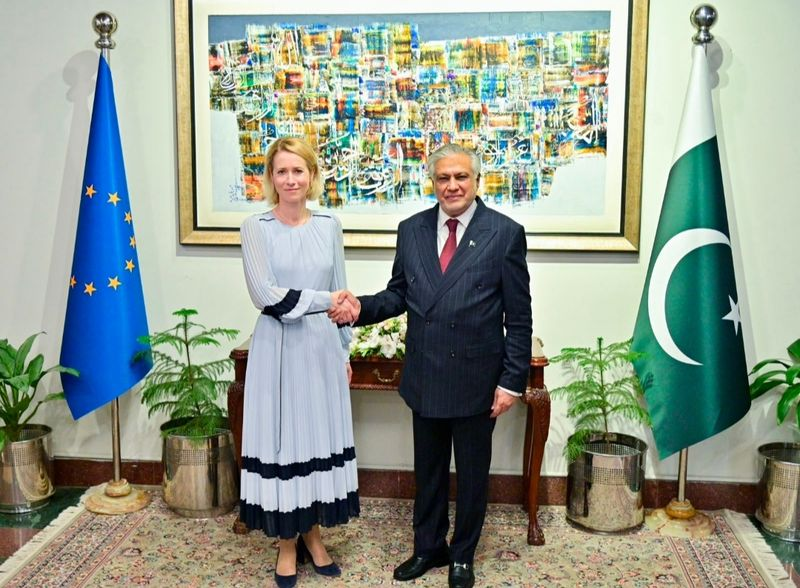
UST when Indian policymakers thought that India-EU ties were on an upward trajectory, they received a rude shock. Standing beside Pakistan’s Foreign Minister Ishaq Dar in Islamabad on June 1, EU’s High Representative for Foreign Affairs and Security Policy, Kaja Kallas, said: “Pakistan is a major regional power and an important partner for the European Union”.
Praising Pakistan’s mediation between the US and Iran, she said: “Your diplomatic efforts have helped to prevent a return to full-blown war on several occasions, and these efforts are much recognised and appreciated across Europe”. This would have been music to Pakistani ears and jarring to some circles in Delhi, for there has been no change in Pakistan’s reliance on terrorism to keep India on the defensive.
Paragraph 11 of the EU-Pakistan joint statement, which came out after Kallas’ discussions with Dar was unprecedented and offensive. It stated: “The Pakistan side briefed on the issue of Jammu and Kashmir. The EU side briefed on Russia’s war on Ukraine. Both sides expressed support for the peaceful resolution of conflicts through dialogue and diplomacy in accordance with the principles of the UN Charter.”
Prima facie, these lines are innocuous, but it is the juxtaposition of J&K and the Ukraine war that gave them an entirely different complexion. The skilled and professional EU diplomats who negotiated the joint statement would have known that putting J&K and the Ukraine war in the same paragraph would be unacceptable to India. Moreover, by joining the two issues through a sentence containing homilies on “dialogue and diplomacy” and invoking the UN Charter, they only added insult to injury. If the diplomats had slipped, why did Kallas do so too?
Kallas was Estonia’s Prime Minister for three years and has held her present office since December 2024; hence, she does not lack experience. The inescapable conclusion, therefore, is that the EU deliberately agreed to a formulation which the Pakistanis may have proposed. In accepting it, the EU showed complete disregard for Indian sensitivities.
Lest some readers think that this writer is getting carried away by unimportant minutiae of diplomatese, a peep into the arcane world of diplomatic drafting is called for. Diplomats endeavour to find common formulations for joint statements. When they fail and one side insists that unless its views are recorded it will not agree even to a mention of a matter of surpassing importance to the other, unilateral statements are framed. They indicate that the other side has merely heard the view of the other. However, in recording these formulations, it is ensured that no link can be drawn between the unilateral comments. These inevitably come about if they are included in a single paragraph.
At present, it was naturally essential for the EU to mention the Ukraine war in a joint statement. In turn, the Pakistanis would have demanded the inclusion of their viewpoint on J&K. Even while accepting such a compromise, the EU should have insisted that J&K and Ukraine be mentioned in separate paragraphs. And, while diplomacy was being urged for J&K, the EU should have called for the right conditions being created by the cessation of cross-border violent extremism. The EU did not do so.
Responding to a question on the reference to J&K in the joint statement, the Ministry of External Affairs (MEA) spokesperson said on June 2: “We categorically reject such unwarranted references in the joint press communique on matters internal to India. The Union Territories of Jammu and Kashmir and Ladakh are integral and inalienable parts of India. Those who have no locus standi on such matters should desist from making any comment on them”. This was a routine and weak response to an unprecedented and unjustified paragraph in the joint statement. Why did the MEA not even mention the EU, let alone strongly condemn it?
Is it because the Modi government did not want the focus to be on its embarrassment? It had done the EU the high honour of inviting Ursula von der Leyen, President of the European Commission, and Antonio Costa, President of the European Council, as Chief Guests for this year’s Republic Day. During the visit, the India-EU Free Trade Agreement was signed; the EU itself acknowledged that the pact accorded “a significant competitive advantage in key industrial and agri-food sectors”.
Prime Minister Narendra Modi’s discussions with EU leaders laid the groundwork for an extensive and comprehensive partnership in the security sector and other domains. The leaders’ statement noted: “Enhance cooperation to counter terrorism, in all its forms and manifestations including cross-border terrorism…” The term “cross-border terrorism” in such statements indirectly refers to, at a minimum, the infrastructure of terror in Pakistan.
In March this year, External Affairs Minister S Jaishankar visited Brussels. His host was Kaja Kallas, though he also interacted with other senior EU leaders. According to a MEA readout, the visit was “reflective of India’s sustained high-level engagement with the European Union.” It went on to say: “India-EU relations have entered a phase of renewed strategic momentum…” Some strange momentum, indeed, if the EU shows a lack of basic sensitivity to India’s significant concerns, as shown during Kallas’ visit to Islamabad.
It is a fact that Pakistan’s stock has risen in the world because of its mediation efforts between the US and Iran. Recently, in his reply to an Indian journalist’s question on China-Pak ties, Russian President Vladimir Putin denied that Pakistan was under China’s full control. He went on to say: “Pakistan is a large country and it has multifaceted ties with different countries.”
These assessments of Pakistan should not bother Indian policymakers, but it should worry them when the EU (or, in future, others) makes unwarranted, even if indirect, comparisons of India’s concerns with other global matters. That is where India has to call the EU out — not through smart one-liners but logic backed by action. And perhaps Jaishankar could sweeten his interaction with his EU counterpart with Kaja (oops, that should be Kaju) Katli!