
Sanjha Morcha

What’s New

Click the heading to open detailed news

Current Events :

web counter

Print Media Reproduced Defence Related News

Not too late: Why Indian Army must bring closure to Major Leetul Gogoi’s ‘human shield’ case

Indian Army may have punished Major Gogoi for indiscipline, but it’s the ‘human shield’ case that it needs to probe before it faces a PIL.
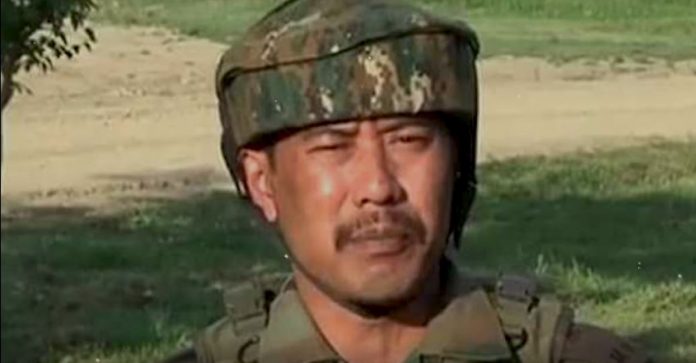
Major Leetul Gogoi

In less than a year, Major Leetul Gogoi of the ‘human shield’ fame has gone from being a ‘national hero’ to an officer facing a loss of six months of seniority in the Indian Army for violating ‘military discipline’.

The punishment to Gogoi for “fraternising” with a local girl and “being away from place of duty while in an operational area” may have closed last year’s episode. But, the Indian Army still needs to bring a much-needed closure to his celebrated act from 2017 of tying a man to the jeep in Kashmir.

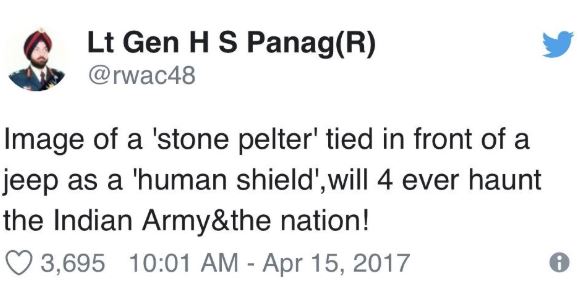
On 9 April that year, by using Farooq Ahmed Dar as a “human shield” in the alleged rescue of election commission officials held hostage by a “blood thirsty” mob of 700-900 people, Major Gogoi had violated Indian Army’s ethos, standard operating procedures, rules of engagement, Chief of Army Staff (COAS)’s Commandments, Supreme Court guidelines for application of Armed Forces (Special Powers) Act (AFSPA), Article 21 of the Constitution and Sections 63 and 69 of the Army Act read in conjunction with the Indian Penal Code.

It is not too late for the Indian Army to reopen the “human shield” case by holding a fresh court of inquiry and take necessary follow-up action depending upon the investigation.

Also read: How should the Indian army ethos handle Major Gogoi’s case?


The reopening of the case is important because under both civilian and military laws, there is no scope for making exceptions to “save casualties in a unique situation” in order to justify a grave offence. Only if proven by evidence, “actions in good faith” and “circumstances” are given due consideration to decide the severity of punishment. Nearly two years later, not an iota of evidence has surfaced to uphold the version of the officer.

At the time, however, and even before the military court of inquiry was finalised, Army chief General Bipin Rawat, cheered by the emotional nationalists, had rewarded Major Gogoi with a Commendation Card. Contrary to rules and regulation, Gogoi was allowed to interact freely with the media and made into a ‘national hero’. What happened a year later at Hotel Grand Mamta in Srinagar was merely the undoing of a ‘default’ hero who thought he was a law unto himself.

On 23 May 2018, Major Gogoi had posed as a businessman from Assam while checking into the hotel with an 18-year-old Kashmiri girl. Citing their rules, the hotel staff had refused entry to the girl, which led to an altercation with Major Gogoi who was joined in by his driver, Sepoy Sameer Mala. Gogoi, his driver and the girl were detained by officers at the Khanyar police station for questioning. The girl had later deposed before the magistrate that she had willingly gone out with Major Gogoi — her “Facebook friend”.


Also read: Why an Indian Army Major can’t just meet a woman at a hotel anywhere


Now nearly a year later, the ‘national hero’ has been found guilty by the Army for an act that is in ‘violation of good order and military discipline’.

The punishment that is likely to come Major Gogoi’s way is nowhere near what was promised by the Chief of Army Staff two days after the officer was caught : “…Agar Major Gogoi ne koi galat karwahi kari hai, toh main aapko yaqeen ke sath keh sakta hoon, ki jaldi se jaldi usko saza di jayegi, aur saza aisi doonga main, ki woh ek udharan ban kar reh jayega. (If Major Gogoi has done anything wrong, then I assure you that he will be punished and I will give such a punishment that it will become an example.)”

On the face of it, for what it amounts to, this seems to be the logical conclusion to a case where an Army officer was in violation of rules, regulations and law of the Indian Army.

However, the other episode — the ‘human shield’ case — still needs closure. The Indian Army must act fast before someone files a public interest litigation and the Supreme Court forces it to do so, as has happened in cases of human rights violations in Manipur.


Also read: What happened to the Kashmiri woman who went with Major Gogoi to a Srinagar hotel


In all fairness, I must compliment the Army for making an in-house course correction by issuing unambiguous orders to prevent unlawful “out of the box tactics” becoming the norm. I must also compliment all ranks for not emulating the rogue hero. But let there be no doubt that unless the “human shield” incident is properly investigated and legally closed, it will remain an indelible blot on the Indian Army’s reputation.

Lt Gen H S Panag PVSM, AVSM (R) served in the Indian Army for 40 years. He was GOC in C Northern Command and Central Command. Post retirement, he was Member of Armed Forces Tribunal.
clip


Surgical strike hero submits national security plan to Rahul

Man Behind Surgical Strikes Submits National Security Report To Congress

New Delhi: Lt Gen (retd) DS Hooda, the main architect of the 2016 surgical strikes on terror launch pads in PoK, on Sunday submitted a report on national security to Congress chief Rahul Gandhi, over a month after he was tasked by the party with scripting a vision document. The former northern Army commander prepared the paper in consultation with a select group of experts. “Lt General (Retd) DS Hooda & his team have put together a comprehensive report on India’s National Security, that he presented to me today. This exhaustive report will at first be discussed & debated within the Congress party,” Rahul tweeted. PTI

13 coaches derail in Bihar, six injured

Patna: Six passengers were injured after 13 coaches of Chapra-Surat Tapti Ganga Express derailed in Bihar’s Saran district on Sunday. The accident occurred near Gautam Asthan railway station in Varanasi division at 9.45 am, minutes after the Surat-bound train left Chapra Junction, Sanjay Yadav, chief public relations officer of North Eastern Railway, said. No casualty has been reported so far, he said, adding the injured were discharged after being administered first aid at a local hospital. PTI
Teen strangled by father for befriending boy

Ahmednagar: A 17-year-old girl in Ahmednagar district of Maharashtra was allegedly killed by her father who was against her friendship with a boy studying with her in a college here, police said on Sunday. Jamkhed police station inspector Pandurang Pawar said they suspected it to be a case of ‘honour killing’. The incident took place in Chondi village, the native place of state minister Ram Shinde, who demanded stringent punishment for the accused. The deceased’s father, Pandurang Shreerang Saygunde, 51, and two maternal uncles — Rajendra Jagannath Shinde (30) and Dnyandev Jagannath Shinde (35) — were arrested on Saturday evening, Pawar said. The police also questioned around 35 persons. PTI

https://twitter.com/i/status/1112287379451248645


Indian Army Recruitment Alert 2019: Apply for Soldier posts via joinindianarmy.nic.in, details here

Indian Army has invited candidates to fill up Soldier posts through the Army Recruitment Rally. Candidates can register themselves through the official site of Indian Army at joinindianarmy.nic.in.

Indian Army Recruitment Alert 2019

Indian Army Recruitment Alert 2019  |  Photo Credit: Times Now

Indian Army has invited candidates to fill up Soldier posts through the Army Recruitment Rally. Candidates who want to go for this job can register themselves through the official site of Indian Army at joinindianarmy.nic.in. The registration process will commence from April 4 and will end on May 18, 2019.

The recruitment rally will be conducted from June 3 to June 15, 2019, at Junga, Shimla (HP) for the category of Soldier General Duty and Soldier Clerk/Store Keeper Technical candidates of Shimla, Sirmaur, Solan and Kinnaur Districts of HP.

Indian Army Soldier posts: Important Dates

  • Opening date of application: April 4, 2019
  • Closing date of application: May 18, 2019
  • Download of admit card: May 18, 2019
  • Recruitment rally: June 3 to June 15, 2019
  • Date of Examination: July 28, 2019

Indian Army Soldier posts: Eligibility Criteria

Educational Qualification

  • Soldier General Duty (Sol GD): Candidates should have passed matric with 45% marks in aggregate (main subjects) and 33% marks in each subject. No stipulation of percentage required if the candidate has higher qualification i.e. 10+2 and above. However, 33% marks in each subject in matric is compulsory. Candidates passing 10th in Grade System will have minimum D grade in each subject and overall aggregate C-2 grade or 4.75 pts.
  • Soldier Clerk/ Store Keeper Technical: Candidates should have secured 50% marks in each subject and 60 % marks in aggregate in class XII. Should have studied English and Maths/ Accts/ Book Keeping in Class XII and should have secured min 50% marks in each of these subjects in Class XII. Even if a candidate is a graduate or has a higher qualification, percentage marks scored in Cl XII would be applicable towards his eligibility.

Age Limit

  • Soldier General Duty (Sol GD): Candidates should be between 17 ½ – 21 Yrs of age.
  • Soldier Clerk/ Store Keeper Technical: Candidates should be between 17 ½ – 23 Yrs of age.

Official Notification 

Indian Army Soldier posts: Selection Process

Candidates will have to appear for Physical Fitness Test, Physical Measurement Test, Document verification and Medical Examination. All candidates found medically fit after review will be issued Admit Card for Common Entrance Examination (CEE) at Army Recruiting Office (ARO), Shimla.

Other Details

The CEE will be conducted at Govt Girls Sr Secondary School, Portmore, Shimla (HP) on the given date at 5 am onwards. Candidates who will be selected for document verification should bring all the documents along with 2 photocopies of the documents duly attested. 20 recent colored passport size photographs showing both the ears of the candidate should also be carried. Candidates can check for more details from official site of Indian Army.


Why Balakot may not be a game-changer

POLL IMPACT Air strike may consolidate votes, but not necessarily ensure seats

NEWDELHI: Until February 14, the Bharatiya Janata Party (BJP)’s 2019 prospects did not look very good. In December 2018 it lost elections in three key Hindi belt states – Rajasthan, Madhya Pradesh and Chhattisgarh – to the Congress. A Hindustan Times analysis showed that the BJP’s losses in these three states cut across regional, caste and occupational divide (see https:// bit.ly/2PKacL3 for details). The BJP swept the 2013 elections in these states. In fact, it was this election cycle which heralded the beginning of the Narendra Modi wave, which catapulted the BJP to a majority in the 2014 Lok Sabha elections.

PTI FILEPeople celebrate IAF pilot Abhinandan Varthaman’s release by Pakistan authorities, at the Attari-Wagah border near Amritsar. Several commentators believe that air strikes on a Pakistani terror base have given the BJP a decisive edge over its opponents, with debates on national security taking centre stage.However, the political narrative seems to have changed after a suicide terror attack killed 40 CRPF personnel in Jammu and Kashmir on February 14, 2019. Amid widespread anguish in the country, the Indian Air Force carried out what were described as non-military, pre-emptive strikes at a terror camp in Pakistani territory on February 26, 2019. A lot of commentators believe that this military action has given the BJP a decisive edge vis-à-vis its opponents, as voters might prioritise national security over the prevailing economic disenchantment which had hurt the BJP in the previous election cycle.

The political developments after the air strikes in Balakot also suggest that the BJP is looking to create a polarisation on the issue. Questions by the Opposition trying to seek proof of exact damage and casualty in the air strikes have been portrayed as unpatriotic and targeted at questioning the credibility of the armed forces.

The BJP’s larger design of trying to portray the Opposition as anti-national has been commented upon by political scientists earlier as well. For example, Suhas Palshikar wrote in an August 2018 Economic and Political Weekly article, “Of course, from the beginning, Hindutva has claimed to be coterminous with nationalism. But since he appeared on the national scene, [Narendra] Modi has spoken less about Hindutva and more about nationalism. This tactical shift has helped him generate enormous support for not only his personal leadership but also the overarching nationalist narrative — a narrative that encompasses development, national power and Hindutva.”
Academic arguments aside, the question is whether such a polarisation could help the BJP in the forthcoming general elections. This author had argued in an earlier piece that there is mixed evidence on whether military conflicts impact political outcomes in India (https:// bit.ly/2HcNKJU). Would 2019 be different from earlier times, as the BJP tries to convert the elections into a polarisation between nationalist and “anti-national” forces?

Looking at what could perhaps be described as India’s two most polarised elections — 1993 assembly election in Uttar Pradesh and 2002 assembly election in Gujarat — could offer some insights on what could happen. The 1993 Uttar Pradesh elections happened in the aftermath of demolition of the Babri mosque.

The 2002 Gujarat polls were held months after the communal riots in Gujarat. In both these elections, the BJP was the incumbent party and was seen has having forced a polarisation by the Opposition.

The BJP increased its previous vote share in both these elections. This suggests that polarisation worked in its favour. However, its seat share went down in Uttar Pradesh while it increased in Gujarat.

The former happened because the BJP had to face an alliance of the Samajwadi Party and the Bahujan Samaj Party in Uttar Pradesh. In other words, a rise in polarisation behind the BJP might or might not create a counter-polarisation behind the Opposition.

See chart 1: BJP’s seat share and vote share in Uttar Pradesh 1993 and Gujarat 2002

Herein lies an important lesson on why even a favourable polarisation in terms of vote share might or might not work for a party in terms of seats. In a first-past-the-post (FPTP) system, it is extremely difficult to predict change in seat shares for a given change in vote share. This can be seen from chart 2, which gives the ratio of percentage point change in seat shares for the Congress and the BJP for one percentage point change in vote share.

See chart 2: Ratio of change in seat share and vote share for Congress and BJP

Last, but not the least, is the question of what was the level of support which the BJP and its opponents had before the Pulwama terror attack. The electoral impact of polarisation and counter-polarisation, which might happen in the aftermath of Pulwama, will critically depend on these base levels.


In last India-Pakistan border village: Can’t forget Pulwama, but war leaves lifelong scars

With India-Pakistan tensions running high since a Jaish-e-Mohammad suicide bomber killed 40 CRPF personnel in Pulwama, the whole village of Mohar Jamsher — the last on the India-Pak border in Fazilka, Punjab — has been on high alert.

In last India-Pakistan border village: Can’t forget Pulwama, but war leaves lifelong scars

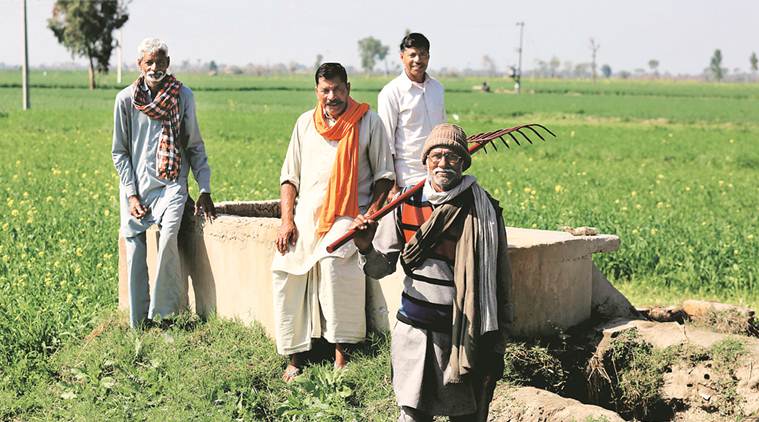
Gurdas Singh (front) with his brothers. (Express photo: Gurmeet Singh)

Since the Pulwama terror attack on February 14, Makhan Singh hasn’t had a full night’s sleep. His eyes and ears are fixed across the border and even his son’s wedding solemnised three days ago, didn’t weaken his vigil.

He is not the only one. With India-Pakistan tensions running high since a Jaish-e-Mohammad suicide bomber killed 40 CRPF personnel in Pulwama, the whole village of Mohar Jamsher — the last on the India-Pak border in Fazilka, Punjab — has been on high alert.

Watch | What is Jaish-e-Mohammed, the terror group that attacked the CRPF convoy

And with good reason. For, every time there is disquiet on the border, they pay a price. The last was in October 2016, after the surgical strikes, when they were asked to leave their homes and moved to a safe location.

Also Read | Across the aisle: Grief, anger but no wisdom

Surrounded by Pakistan on three sides and the Sutlej river on the fourth, Mohar Jamsher’s 1,500 residents have two choices to enter Punjab — row across the river or cross a high-security bridge. There is a BSF post at the entrance of the village, where every visitor is questioned before being allowed in.s sabre rattling between India and Pakistan intensifies, the destruction caused by the wars of 1965 and 1971 is still fresh in the minds of locals and over the last few days, the movement across the border has been of immense interest to all in Mohar Jamsher. On Saturday, women in the village were seen storing leftover dry rations while most men discussed Pakistan.

Sitting in his house, which is the closest to the barb wire fenced border, Makhan Singh is always tuned in to the loudspeaker on the other side. “That yellow building visible from our fields is their mosque and the green one is the Pakistan check post. These days, we are extra careful. We listen to the loudspeaker carefully to determine if it is azan or some other message after we heard of Pakistan Prime Minister Imran Khan’s threatening message.”


The brothers say even though there were two weddings in the village on February 20 and 21, people were busy discussing the possibility of war. And only a few houses are pucca, most are temporary. “We live on the border and have left our homes four times in the past. You never know when we will be asked to do the same yet again, so no one invests much money on houses,” said Hansa Singh.

Hansa was a teenager when the 1971 war broke out. “Our entire family shifted to relief camps except me and my father as we had to take care of cattle. I remember hearing a loud noise. I thought it was a cracker but soon the Army came and told us `Jung shuru ho gayi hai (war has begun).”

Next to Mohar Jamsher is Mohar Kheewa, from where the border and Pakistan check posts are seen even more clearly. Khushaal Singh (76) said, “Although all seems to be well, looking at TV debates and social media posts, it seems the whole country is ready for war. The Pulwama attack cannot be forgotten but we still have harsh memories of the 1965, 1971 and Kargil war with Pakistan when we had to flee and start life from scratch, each time after a gap of 18 to 24 months.”

According to Kushaal, in 1971, 28 villages of Fazilka were overrun by Pakistan including Mohar Kheewa. Then, they were given Rs 500 per acre per year as compensation for about two years. “When we got our villages back after about 18 months there were landmines in the fields. They were taken out by the Army but it was difficult to farm after such a gap. It was the same story in 1965 and 1999. War leads to destruction and nothing else,” he said.

Also Read | Inside Track: Pulwama and after

Gurdas Singh, in his late sixties of Mohar Jamsher village, has a word of caution. “Going by history, Pakistan attacked us first always. This is an age of nuclear weapons. So, damage to India will be more. Pakistan is far behind us. I wish there could be a solution without war.”

Advertising

All farming is done under strict BSF security between 10 am and 4 pm. He said: “We do see Pakistanis also farming on the other side. Our side is more green than theirs. At times some try to talk to us and wave saying `Sat Sri Akal’ but we never respond. In the 1960s people used to talk to each other freely. Times have changed. We don’t exchange a word now for we don’t want to be mistaken for a spy.”


Here’s how you can donate to families of martyred CRPF jawans

Here's how you can donate to families of martyred CRPF jawans

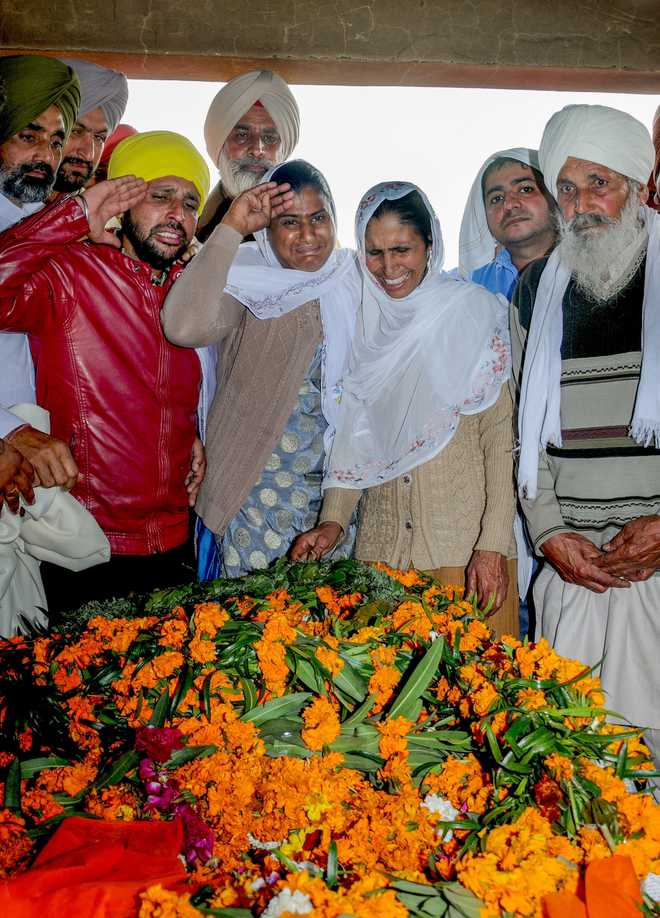
Family members pay salute to slain CRPF jawan Sukhjinder Singh, at his residence before his funeral in Gandiwind village of Tarn Taran district on Saturday, February 16, 2019. PTI

Tribune News Service
New Delhi, Febraury 16 

Those who want to contribute voluntarily to the families of CRPF jawans martyred in Pulwama terror attack can do so on the official website of ‘Bharat Ke Veer’.

This fund is managed by a committee comprising Director Generals of Central Armed Paramilitary Forces  (CAPFs) under the aegis of the Ministry of Home Affairs.

‘Bharat Ke Veer’ is a trust into which public can contribute voluntarily to support families of martyrs of CAPFs — BSF, CRPF, CISF, ITBP, NDRF, NSG, SSB and Assam Rifles, the MHA said.

Expressing gratitude for the support, MHA said, “During the last few days there has been a tremendous response from people wanting to contribute through the website : bharatkeveer.gov.in.”

However, due to heavy traffic, sometimes a slowdown is reported in accessing  the website, it added.  

“It is also reported that some unscrupulous elements are soliciting contributions from people through other accounts. It is advised that people desirous of supporting families of martyrs of CAPFs should only contribute through the website — bharatkeveer.gov.in,” the Ministry of Home Affairs said.


Kangra CRPF man among J-K martyrs

Shimla, February 14

A CRPF jawan, Tilak Raj, hailing from the Jawali area of Kangra, was among those killed in the militant attack in Srinagar. The 30-year-old, hailing from Dhewa village, is survived by his wife Savitri Devi.

Chief Minister Jai Ram Thakur has deputed Civil Supplies Minister Kishan Kapoor and Jawali MLA Arjun to be with the family in this hour of grief.

The Chief Minister said that those involved in this incident would not go unpunished. He also prayed to the Almighty to give peace to the departed souls and strength to the bereaved families to bear this irreparable loss. — T


Suicide bombs a signature move of Jaish-e-Mohammad

NEW DELHI: Masood Azhar, the head of Jaish-e-Mohammad (JeM), responsible for the attack on the CRPF convoy, has had India in his sights for nearly three decades. He formed the terror organisation within a few months of his release at Kandahar on December 31, 1999. Azhar was flown to freedom in a special plane in exchange for the passengers on board an Indian passenger plane hijacked from Nepal.

REUTERS■ Soldiers examine the debris after a terrorist attacked a CRPF convoy in Pulwama on Thursday.

Azhar made his presence felt within a few months. On 20 April 2000, the JeM carried out the first suicide bombing in Kashmir, exploding a bomb in an Indian army barracks, killing five soldiers. Azhar, in fact, is the father of fidayeen attacks, and he has the dubious distinction of introducing them in the Valley where the gun first surfaced in 1989.

The second suicide attack was even bigger. On October 1, 2001, three Jaish militants carried out an attack on the Jammu and Kashmir state legislative assembly in Srinagar, using a Tata Sumo loaded with explosives. As many as 38 people were killed in an attack that shook the security establishment. Then too, the terror group claimed responsibility and named a Pakistani national Wajahat Hussain as the suicide bomber. In Thursday’s attack, Jaish named a local, home grown militant, who is believed to have rammed an explosive-laden vehicle into the CRPF convoy carrying as many as 2500 personnel.

The last big attack – the Jaish did not openly claim responsibility for this – was on the air force base in Pathankot in 2016. Phone calls made by the suicide bombers who infiltrated the high-security zone were tracked to the Jaish headquarter in Bahawalpur. The Narendra Modi government allowed a joint investigation team from Pakistan to visit Pathankot but according to the Dawn newspaper, the team concluded that India itself had staged the attack. The Pathankot attack led to cancellation of India-Pakistan talks and the two countries have had no formal engagement since.

Azhar first landed in India in 1994 on a fake Portuguese passport and few know that Srinagar was not the city he first went to. He chose Lucknow as his first stop after landing at Delhi’s international airport on January 29, 1994. Reaching Ayodhya was far more important because , according to his interrogation report, the demolition of the Babri Masjid was the spark that ignited his desire for jihad.

Protected by the deep state in Pakistan, Azhar is considered a big asset, who has escaped being proscribed by the United Nations Security Council because China has continually blocked moves to declare him a global terrorist. His terror group is also suspected to be behind the attack on an army camp in Uri that killed 19 army soldiers in 2016. The government retaliated through multiple surgical strikes across the line of control.