Sanjha Morcha

What’s New

Click the heading to open detailed news

Current Events :

web counter

Print Media Reproduced Defence Related News

BRO gets more financial teeth

BRO gets more financial teeth

Tribune News Service

New Delhi, August 20

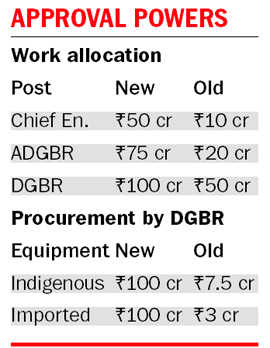
The Ministry of Defence today delegated greater administrative and financial powers to the Border Roads Organisation. This will increase financial powers of the decision-making authorities in the BRO.Functioning under the control of the Ministry of Defence since 2015, the BRO is engaged in road construction to provide connectivity to difficult and inaccessible regions in the border areas of the country.The decision is in line with bringing in transformational changes in the BRO.Various powers have been revised in the organisation. Earlier, a Chief Engineer in the BRO could give administrative approval of works only up to Rs 10 crore, that too only for departmental works, whereas the Additional Director General Border Roads (ADGBR) had the powers to accord administrative approval only up to Rs. 20 crore for departmental works. For contractual works, all administrative approvals were given by the DGBR, who had powers only up to Rs 50 crore.Enhancing the powers at all levels, the ministry has allowed the Chief Engineer to accord administrative approval of up to Rs 50 crore, ADGBR up to Rs 75 crore and DGBR up to Rs 100 crore.Similarly, the BRO needs modern construction. Earlier, the DGBR had powers to allow procurement of indigenous equipment costing up to Rs 7.5 crore and imported equipment worth up to Rs 3 crore.All other cases of procurement had to be referred to the Ministry of Defence.In order to fast-track the procurement of latest construction machinery and equipment in the BRO, the Ministry of Defence has enhanced the delegation of powers up to Rs 100 crore to DGBR for procurement of both indigenous/imported equipment.The ministry in consultation with the armed forces would identify the roads to be entrusted to the BRO and fix priorities.


Doklam and beyond by Gen VP Malik (retd)

Doklam and beyond
FRENEMY: China’s approach towards India has always been aggressive.
1malik

Gen VP Malik (retd)

THE ongoing China-Bhutan-India confrontation at the Doklam grazing ground is characterised less by soldiers sitting eyeball to eyeball and more with bullying, threatening and disparaging language being used by China against India. With soldiers from both sides digging in, the consequences of this confrontation remain unpredictable.On China’s India-specific attitude, I will start with the Agreement on the Maintenance of Peace and Tranquillity along the Line of Actual Control (LAC) in the India-China Border Areas signed in1993. As a senior Army officer then, I was involved in discussions regarding military confidence-building measures with China, as well as advising Bhutan on the India-Bhutan-China border issues. Para 2 of the agreement stated: ‘The two sides agree to reduce their military forces along the LAC in conformity with the requirements of the principle of mutual and equal security to ceilings to be mutually agreed. The extent, depth, timing and nature of the reduction of the military along the LAC shall be determined through mutual consultations between the two countries. The reduction of military forces shall be carried out by stages in mutually agreed geographical locations sector-wise within the areas along the LAC.’ However, after the agreement, despite our best efforts, China backed out on the delineation or disclosure of its perception of the LAC, which had to be the start point for any troop reduction or relocation by either side. In 1996, during an official visit to China, I called on Gen Chi Haotian, then defence minister, and raised this issue. He not only brushed it aside, but also displayed his annoyance. I felt then — and do so now — that China wants to settle India-China boundary issue on its own terms, at some opportune time.China’s aggressive approach towards India began in the late 2000. It opposed nuclear exemption for India at the NSG, as it opposes India’s membership of the NSG now. Despite the political acceptance of Sikkim’s status within India, China has made attempt to create ambiguity on this issue. It started issuing ‘paper visa’ to travellers from J&K and Arunachal Pradesh. In the recent past, several incursions have been attempted in Ladakh. The Chumar incident took place when Chinese President Xi Jinping was being feted in India. China has refused to declare Masood Azhar as a global terrorist despite near unanimity in the UN on this issue.Beijing stopped bothering about India’s sensitivities when it began to use its economic and military clout to influence and wean away India’s South Asian neighbours. Its embrace of Pakistan has got tighter. China is now an integral part of India-Pakistan disputes. It took no notice when India objected to CPEC passing through the disputed territory of Gilgit-Baltistan, but felt insulted when India did not attend the OBOR jambooree in Beijing. With its string of pearls strategy, and CPEC entry to the Arabian Sea, its influence in the Indian Ocean and its littorals is expected to rise sharply.Doklam has been an ‘accepted’ disputed area between Bhutan and China since the 1980s. When China started road construction — a unilateral attempt to change the status quo in the area — Bhutan called for India’s help under the purview of India-Bhutan Friendship Treaty of 2007. India’s action is also in its own national interest. If allowed to be completed, this road would not only extinguish Bhutan’s claim over Doklam, but also improve Chinese reach to India’s narrow Siliguri corridor. Yet another obvious purpose is to dent the good relations between India and Bhutan.Now to the larger, global perspective of China. Paul Kennedy in his book The Rise and Fall of Great Powers stated that ‘Long-term shifts in economic productivity of nations are co-terminus with the increase or decrease of their global influence’. After developing its economy and military power, China is now emerging as a revisionist, expansionist and a combative power; its ‘peaceful rise’ stage seems to be over. Under Jinping, it is pursuing a strong domestic national identity and the dream of once again becoming the Middle Kingdom. China has running territorial disputes with many countries, including India, Japan, Taiwan, Philippines and Vietnam. In the process, it has started asserting dubious claims, bullying smaller nations and adopting a defiant attitude like the one on the International Tribunal award over the South China Sea.In redrawing borders and expanding spheres of influence, China is indulging in cartographic subjectivity. History and selective interpretation of colonial-era decisions are quoted in accordance with its own prerogatives — China rejects McMahon Line with India as a colonial era accord, but accepts this line as a boundary with Myanmar. And now it cites the 1890 Anglo-Sikkim Convention in the case of India-China-Bhutan tri-junction in Chumbi Valley.India has displayed accommodation and timidity in dealing with China’s numerous provocations — its territorial claims, encroachments, nexus with Pakistan, supporting insurgencies inside India, trade imbalance, violation of bilateral agreements and opposing India’s vital interests in multilateral forums. After Doklam, this attitude may change. Any display of weakness will not only encourage Chinese coercion and bluster, but also impact India’s relations and credibility in South, Southeast and East Asia. India will need to carry out a holistic review of its China policy.In the last two months, China has made several military threats. Keeping in view the nuclear status of both countries and geopolitical sensitivities involved, I doubt if there can be a high intensity India-China armed conflict. A major armed skirmish in Chumbi Valley is also unlikely. The geography here places serious operational disadvantage to China. The scope of any limited conflict/skirmish can be expected to shift to the less accessible areas in Ladakh, Central Sector or Arunachal Pradesh, where it has better mobility and logistic advantages. Yet, another option China could adopt is to restart helping India’s secessionist elements in the North-East and along the Siliguri corridor. Or to use its cyber capabilities to damage any national-level IT-enabled systems. It would then be able to cause greater intimidation without going to war.While preferring a solution through a dialogue on equal terms, India must be prepared for all eventualities. There is considerable asymmetry in power potential between China and India. Without getting into an arms race, India must start thinking strategically to cope with China’s power. Doklam is a wakeup call to look at our defence capabilities and infrastructure along the LAC and to review the long comatose military transformation.The writer is a former Army Chief 


Kirti Chakra for 5, 17 get Shaurya Chakra

New Delhi, August 14

Two Army men, who sacrificed their lives during anti-terror operations, were among five security force personnel selected for the prestigious Kirti Chakra, the second highest peacetime gallantry award.On the eve of the 71st Independence Day, President Ram Nath Kovind approved 112 gallantry awards for defence and paramilitary personnel for making sacrifices in the service of the nation, the Defence Ministry said.Havildar Giris Gurung of Gorkha Rifles, Major David Manlun of Naga Regiment and Pramod Kumar, Commandant of 49 Battalion, CRPF, were chosen for the Kirti Chakra posthumously.(Follow The Tribune on Facebook; and Twitter @thetribunechd)Maj Preetam Singh Kunwar of Garhwal Rifles and Chetan Kumar Cheeta, CRPF Commandant, have also been selected for the award. No one has been awarded the Ashok Chakra, the highest peacetime gallantry award.The gallantry awards approved by the President, who is also the Supreme Commander of the armed forces, include five Kirti Chakras, 17 Shaurya Chakras, 85 Sena Medals (Gallantry), three Nao Sena Medals and two Vayu Sena Medals. On May 20, Havildar Gurung sacrificed his life during an anti-terror operation in Kupwara district of Jammu and Kashmir. Despite being grievously injured, he charged at a terrorist and fired at him, displaying extreme courage and dedication towards call of duty. Major Manlun was killed during an encounter with militants in Mon district of Nagaland on June 6. He was a role model for his colleagues as he always led from the front, the Army said.Major Kunwar has also been awarded the Kirti Chakra for showing grit and determination during an anti-terror operation in Jammu and Kashmir on May 25 during which he killed three dreaded terrorists.

CRPF Commandant Cheeta had slipped into coma after being hit by bullets during a gun fight with terrorists in Jammu and Kashmir earlier this year.Kovind also approved a President’s Tatrakshak medal, four Tatrakshak gallantry medals and two Tatrakshak meritorious service medals to Indian Coast Guard personnel.Navy personnel selected for the Nao Sena medal are Pushpendra Tyagi, Jaskaran Singh and Azhar Azharuddin.

The Vayu Sena medals will be conferred on Wing Commander Subhash Singh Rao and Wing Commander Ravinder Ahlawat. — PTI


  • Havildar Giris Gurung of Gorkha Rifles (posthumously)
  • Major David Manlun of Naga Regiment (posthumously)
  • Pramod Kumar, Commandant of 49 BN, CRPF (posthumously)
  • Major Preetam Singh Kunwar of Garhwal Rifles
  • Chetan Kumar Cheeta, Commandant, CRPF


HAFIZ SAYEED’S MILLI MUSLIM LEAGUE PAKISTAN : RAISING THE PERFECT ‘POLITICAL TERROR OUTFIT’ by Lt Gen Syed Ata Hasnain

So Hafiz ‘Bhai’ now wants to further legitimize terror, its employment as a strategic tool, continue escaping the ban placed on him by various international organizations and nations and exploit the emerging political space in Pakistan. The formula for this is simple; just float a political party. Hafiz Saeed, the man in question here is commonly known as the Chief of the Lashkar e Toiba (LeT) now called the Jamat ul Dawa (JuD),  after the  US and later the UN bans  placed against him. The proposed party is to be named Milli Muslim League Pakistan. What is all this about why is he doing this?

It is not difficult to assess Saeed’s intent but a little background always helps. A nobody, he was picked out by General Zia ul Haq in early Eighties to be an Islamic studies teacher and thereafter made his way to Saudi Arabia where he came under the influence of returning mujahideen from Afghanistan and the Ahle Hadith sect. On return, along with Abdullah Yusuf Azzam, the mentor of Al Qaida he founded the Markaz Dawa-Wal-Irshad (MDI). Azzam was a rabid Palestinian heavy on jihad and Saeed’s orientation can be traced to him. In all probability the MDI was part funded by the ISI and part by elements of the Ahle Hadith, no doubt with sponsorship of Abdullah Azam. It became the ideological element for the launch of so called jihad in J&K. In 1990 it gave rise to the Lashkar e Toiba (LeT) again inspired by the needs of the ISI based on the grandiose plans of Zia ul Haq to launch a war of a thousand cuts against India. The LeT formed the militant arm of the MDI and has undergone change of name more times than one can remember due to international bans and sanctions against it.

It has taken long for Saeed to realize that he could be a rabble rouser and a ‘friendly terrorist’ for the larger Deep State as long as he was useful to the ISI. With the changing political environment of Pakistan, uncertainty about the political dispensation after next year’s general elections and the fickle state of the world order, wherein alliances are yet un-cemented, being just the head of a friendly terrorist organization may not be enough in terms of lasting capability. The idea that his organization, with its ideological arm of the MDI and the militant arm of the LeT (JuD) would exercise no genuine power and continue to act at the whims of the state has dawned on him rather late. Possibly his faculties were dulled by the street power that the MDI can today exercise in terms of recruitment rallies and fund raising campaigns. This realization has led him to believe that without a political face to his organization he would always be at someone else’s mercy. Direct power can only be exercised through the political route and an opportunity seems to be emerging on Pakistan’s political canvas. The Bhutto inspired Pakistan People’s Party (PPP) is a pale shadow of the past and the Pakistan Muslim League (PML), the property of the Sharif family, has clearly got the ire of the Pakistan Army. Imran Khan’s Tehreek e Insaaf (TeI) hardly has pan Pakistan reach and Imran’s own personal reputation is questionable. In Oct 2016, Pakistan daily Dawn reported that a PML-N lawmaker, Rana Muhammad Afzal had questioned why Saeed was being mollycoddled at the cost of Pakistan’s international image and the inability to withstand criticism of the JuD’s role in Kashmir. Saeed’s appreciation of the situation probably led him to conclude that before many more Rana Afzals emerge to question his credentials it was safest to create a political space for himself.

It is unknown whether MDI/JuD combine can pass muster to register as a political party in Pakistan’s yet to mature political system but clearly what Saeed is looking for is an escape route and greater legitimacy to protect his fiefdom which he has created with much care. If a Prime Minister of the main party from heartland Punjab could be brought down by the Supreme Court so could Saeed’s empire wither at orders of someone in authority who found him no longer useful.

There is no guarantee that Saeed’s move will take him through to a position of political legitimacy. If it does then the next question will be whether it will translate into seats. Pakistan’s electorate has shown a penchant for electing ‘feudals’ but not radicals. However, in five years much has changed in the Islamic world and after Mumtaz Qadri gained iconic status as the assassin of  Punjab Governor Salman Taseer what can one say of Pakistan and its electorate.

For India, the acceptance of the JuD/MDI as a political party under the Pakistan Constitution will give one more piece of evidence of the state involvement in the proxy activities in Kashmir. However, given the geo-strategic importance that international players accord to Pakistan, the evidence is likely to remain lost in the maze of the grey zone that Pakistan has successfully created in relation to its dubious activities.                                  


Our Army is far from battle-ready

The recent CAG report shows that our troops lack the ammunition for long and intense hostilities

There is bad news for those Facebook warriors eager for a war with China and Pakistan. The report that the country’s Comptroller and Auditor General (CAG) has submitted to Parliament about the Indian army has some significantly disturbing findings. Despite all its bravery, our army is battling with a drastic shortfall of necessary ammunition.

The report is a follow-up to the conclusions of May 2015. Its objective was to evaluate the progress that has been made over the last three years. The CAG report on ammunition management reveals that the situation in September 2016 has not changed very much since March 2013.

The reason? Our ordnance factories have not improved their output or quality and the procurement process continues to run on the old pattern. The wishlist of weaponry that the army headquarters wanted to acquire which was on the government’s files had not been fulfilled even till January 2017.

The CAG report also says that of the 170 kinds of ammunition in 2013, just 27% was ready for 20 days of intense fighting, while in September 2016, 80% ammunition was below the required levels. The situation has improved only marginally in the months that followed. The government has given the rights for procurement to the vice-chief of the army staff in the event of an emergency. With this, the risk has reduced but it hasn’t entirely vanished.

In this situation the question that comes to one’s mind is whether the government has set a standard where it should have a minimum level of arsenal and associated ammunition? The ministry of defence had devised a roadmap in 2013 according to which it had to procure 20 days of ammunition that was necessary to win a small-scale war, by 2015. It was also decided that these supplies would be increased to 40 days by 2019 so that we can prepare for bigger battles. Both these plans are hanging fire.

Even the best marksman and commando can forget his craft without adequate practice. According to this report, the army has had to cut down on its training drills in light of the shortage of essential resources. The shortfall in resources required for training is between 77% and 88%. Can you imagine any country winning a war without the requisite ammunition and training?

The situation continues to be so bad despite facing the repercussions of such shortfalls during the war with China in 1962. Even then, our soldiers were neither equipped with the requisite weapons, nor maps that are essential in the dangerous mountainous terrain.

We may have won the Kargil war in 1999, but at what cost? At the end of Operation Vijay, the shoulders of the Indian nationstate were drooping with the burden of 537 martyrs. Even during this war the shortfall of essential ammunition had been revealed. When the initial group of soldiers tried to scale the high peaks, they didn’t have the requisite clothes and shoes required for snowbound terrain. This has been the sorry picture of our military affairs from 1962 to 1999. Who should be held accountable for this ?

With utmost humility, I hold the nation’s political class responsible for this. The manner in which the Bofors ghost was created and used to pursue selfish goals for years together instilled terror in Delhi’s political corridors. Politicians began to be reluctant to buy the ammunition essential for the army and an issue critical to the nation’s security was pushed into the background.

The time has come when our politicians should stop the mud-slinging and create a consensus on subjects of national interest. Just because our soldiers are not afraid of making sacrifices, none of us have a right to push them into the jaws of death. On July 26 this year, in the memory of Operation Vijay, the people organised a number of events and sang patriotic songs. But how many of those participating in this group were perturbed over the findings of the CAG report?

The country’s foreign and military policy should be guided by facts, not emotions. The government in Delhi these days displays adequate sensitivity towards our soldiers on international borders. You may recall that Prime Minister Narendra Modi spent last Diwali with the soldiers guarding our borders. The defence ministry is being led by the sharp and astute Arun Jaitley. We sincerely hope that the duo gets rid of this old malaise afflicting the country.


Army has formulated policy on social media use: Govt

New Delhi, August 4

The Army has formulated a policy on the use of social media by its serving personnel which lists out dos and don’ts, the government said on Friday.

In a written reply to a question in the Lok Sabha, Minister of State in the Defence Ministry Subhash Bhamre said the guidelines have been issued primarily to ensure security of information and avoid its manipulation or distortion.

“The Indian Army has promulgated the policy on the use of social media by serving Army personnel, organisations which list out the dos and don’ts guidelines and content which are barred from being posted on social media platforms,” Bhamre said.

He said violations of above guidelines are investigated by the units and formations concerned.

The social media policy comes in the backdrop of reports about soldiers airing their grievance on social media.

Following such complaints, the Army also came up with a WhatsApp number where soldiers can post their problems which will be directly addressed to Army chief Gen Bipin Rawat instead of going to social media.

In response to another question, Bhamre said 14,63,512 youths applied to the Indian Army since 2014.

He said, replying to another question, a panel has been set up to examine and give their recommendations on the changes in the promotion policy and Quantified System of Selection (QSS) for officers of the Army.

The two-member panel comprises retired Army officers Lt Gen G S Khatoch and Lt Gen A K Ahuja. PTI


Doklam issue: India must be ready to give China a real bloody nose

Beijing is currently waging full­throttle psychological warfare over Doklam to tame India

The current troop standoff with China at Doklam offers India important lessons that go far beyond the Chinese intrusion into this Bhutanese plateau. Unless India grasps the long-term threat posed by an increasingly muscular China and responds with an appropriate counterstrategy, it is sure to confront much bigger problems than Doklam. Unfortunately, institutional memory in India tends to be short, with a mindset of immediacy blurring the bigger picture.

APChina’s strategy is to subdue India by attacking its weak points, striking where it is unprepared, and hampering its rise to the extent possible.For example, Jammu and Kashmir Chief Minister Mehbooba Mufti’s recent statement that China is “meddling” in her state was seen as signifying a new trend. In truth, China — occupying a fifth of the original princely state of J&K and now enlarging its strategic footprint in Pakistanoccupied J&K — has long been playing the Kashmir card against India. In 2010 it honed that card by aggressively adopting a stapledvisa policy for J&K residents.

To mount pressure, Beijing has tacitly questioned India’s sovereignty over the 45% of J&K under Indian control and officially shortened the length of the Himalayan border it shares with India by purging the 1,597-kilometre line separating Indian J&K from Chinese-held J&K.

China’s Kashmir interference will only increase as a result of its so-called economic corridor through Pakistan-held J&K, where Chinese military presence is growing, including near Pakistan’s ceasefire line with India. India now faces Chinese troops on both flanks of its portion of J&K.

China, which fomented the Naga and Mizo insurgencies, taught its “all weather” client Pakistan how to wage proxy war against India. China still fans flames in India’s northeast. For example, Paresh Barua, the long-time fugitive commanderin-chief of ULFA, has been traced to Ruili, in China’s Yunnan province.

Some other Indian insurgent leaders have been ensconced in Myanmar’s Yunnan-bordering region controlled by the China-backed Kachin Independence Army. This newspaper reported in 2015 that Chinese intelligence played “an active role” in assisting nine northeast Indian insurgent groups to form a united front.

The illicit flow of Chinese arms to India, including to Maoists, was confirmed by Home Secretary G.K. Pillai in 2010. Meanwhile, the deepening China-Pakistan nexus presents India with a two-front theatre in the event of a war with either country.

China’s strategy is to subdue India by attacking its weak points, striking where it is unprepared, and hampering its rise to the extent possible. As part of this strategy, it is waging a multipronged unconventional war without firing a single shot. It is closing in on India from multiple flanks, extending from Nepal to the Indian Ocean.

Sixty-six years after gobbling up buffer Tibet and mounting a Himalayan threat, China — with the world’s fastest-growing submarine fleet — is opening a threat from the seas against India.

Its recently opened naval base in Djibouti, at the Indian Ocean’s northwestern edge, constitutes just a first step in its game plan to dominate the region.

For India, whose energy and strategic infrastructure is concentrated along a vulnerable, 7,600-kilometre coastline, this represents a tectonic shift in its threat calculus.

Add to the picture China’s economic warfare to undermine India’s strength in various ways, including stifling its manufacturing capability through largescale dumping of goods. Artificially low prices of Chinese products also translate into India losing billions of dollars yearly in customs duties and tax revenue.

Portentously, China, including Hong Kong, made up 22% of India’s imports in 2015, with the US just at 5% and Japan at 2%.

Yet India has yet to fully shed its policy blinkers. As India repeats the same old platitudes about conciliation and cooperation, China is making clear that there cannot be “two Suns in the sky” — or, as a Chinese idiom goes, “one mountain cannot accommodate two tigers”. With its rekindled, atavistic nationalism, China plainly wants to be Asia’s sole tiger.

Beijing is currently waging full-throttle psychological warfare over Doklam to tame India. Deception and mendacity are its tools. If India gives in, it will endure strategic subordination and ignominy forever.

Foreign Minister Sushma Swaraj’s excellent rebuttal in Parliament of Chinese disinformation begs the question: Why has India been so slow in countering Beijing’s propaganda war?

New Delhi must play psychological hardball: Instead of appearing zealous for talks, it should insist that China first withdraw both its troops and preconditions, while leaving Beijing in no doubt that India will hold its ground, come what may. If India is to stop China’s creeping, covert encroachments and secure Himalayan peace, it must be ready to give Beijing a real bloody nose if it escalates the standoff to a conflict. Humiliating China even in a localised military engagement, in 1967 style, is vital to help destabilise its expansionist regime.


PRINT MEDIA DEFENCE RELATED NEWS HEADLINES ::19 JUL 2017

  • Jawan kills major over mobile use at uri post

  • मोबाइल छीना तो जवान ने धर्मशाला के मेजर को मारी गोली

  • Moga jawan dies in pak firing in j&k

  • War widows, dependants to get money in lieu of land

  • Punjab cm approves cash grant for war widows in place of land

  • Prime minister: india first by lt gen pg kamath

  • In valley, no magic bullet by lt gen by d.s. hooda

  • ‘China not afraid of going to war with india’

  • Pak hits new low, targets three schools along loc

  • India keeps all options open as china decries ‘trespass’ in fresh warning

  • Indo-thai joint military exercise concludes

  • Tough terrain to blame for unfinished border roads

  • Orbit verdict, as expected erosion of justice system dangerous

  • CIA agent confesses on deathbed: ‘we blew up WTC 7 on 9/11’

  • Army’s Poona horse turns 200


PDP MLA’s driver arrested in connection with terror attack on Amarnath pilgrims

PDP MLA's driver arrested in connection with terror attack on Amarnath pilgrims
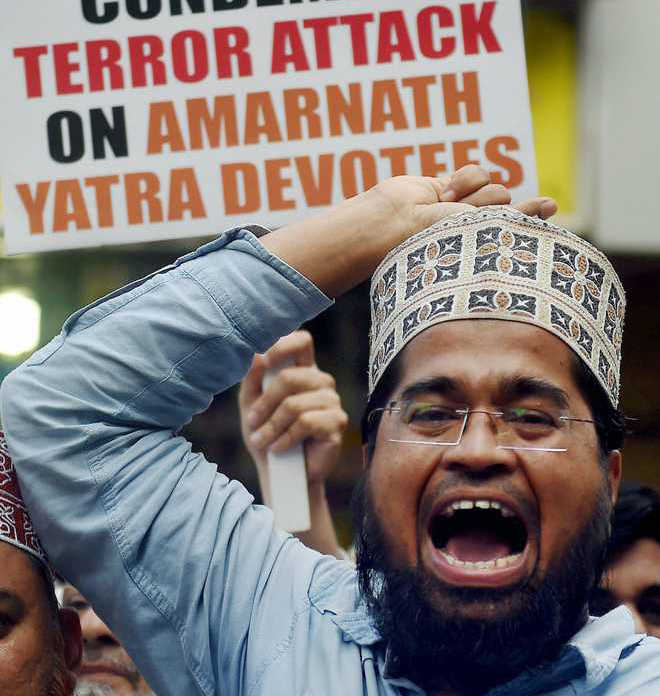
A man condemns the terror attack on Amarnath pilgrims. PTI/File

Srinagar, July 15

The Jammu and Kashmir Police on Saturday arrested People’s Democratic Party (PDP) legislator Aijaz Ahmad Mir’s driver in connection with the recent Amarnath Yatra terror attack on pilgrims.Touseef Ahmad was picked up by the police for questioning today.(Follow The Tribune on Facebook; and Twitter @thetribunechdSuperintendent of Police (SP), Shopian, Ambarkar Shriram Dinkar, said: “Touseef was co-operating with the investigators. He was deputed as a driver some seven months ago from the security wing of the Jammu and Kashmir Police. He has been detained in a terrorism-related case.”Earlier in the week, seven people were killed and 20 others were injured after terrorists opened fire on a bus carrying pilgrims from Baltal to Mir Bazar around 8.20 p.m. on Monday night. —ANI


After Yatra attack, act with maturity Syed Ata Hasnain

Syed Ata Hasnain

Syed Ata Hasnain, a retired lieutenant-general, is a former commander of the Srinagar-based 15 Corps. He is also associated with the Vivekananda International Foundation and the Institute of Peace and Conflict Studies.

Though the yatra is based on Hindu belief and tradition, there is something deeply inclusive about it.

Security person stand guard after militants opened fire on the Amarnath Yatra in which some pilgrims were killed in Anantnag in Jammu and Kashmir. (Photo: PTI)

 Security person stand guard after militants opened fire on the Amarnath Yatra in which some pilgrims were killed in Anantnag in Jammu and Kashmir. (Photo: PTI)

The Amarnath yatra is one of those iconic annual pilgrimages many Indians look to undertake at least once in their lifetime. What is the yatra all about? Located far into Kashmir’s lofty mountains, at the virtual confluence of the Kishtwar and the Great Himalayan ranges, is this huge unusual rock cavern on the face of the hillside with a deep cave comprising a large icicle. Tradition has it that the icicle symbolises Lord Shiva, and the cave is the place where he shared the secrets of his immortality with wife Goddess Parvati. The icicle, shaped in a phallic form, remains intact through most of summer. In July-August each year, over 300,000 pilgrims (it touched 640,000 in 2011, and come down since) travel long distances to finally get an opportunity to walk, ride or be carried to the holy cave along some treacherous high-altitude mountainous routes. Though the yatra is based on Hindu belief and tradition, there is something deeply inclusive about it. The vast logistics for the challenging journey include the major involvement of Kashmiri Muslims, many of whom also equally revere Lord Shiva. The yatra gives sustenance to many Kashmiris and adds to the state’s tourist economy, The journey involves a long drive from Jammu to either Pahalgam (Chandanwari) or Baltal, the two bases, and then a walk to the holy cave.

The 28-year-old strife triggered by the Pakistan-sponsored proxy war in J&K has created an atmosphere of mistrust between the faiths. This was Pakistan’s basic intent: to deepen the faultlines in India’s inclusive culture, with mutual respect and coexistence between faiths as an essential ingredient. Always wary of India’s strength as a tolerant and inclusive nation, in contrast to its own single-faith non-inclusive culture, Pakistan has aimed to drive a communal wedge with selective acts of terror and propaganda. Pakistan and its anti-India cohorts saw the Amarnath yatra with its iconic and emotive image as an event that can be exploited. The large movement and gathering of pilgrims over six-eight weeks (the yatra ends on Raksha Bandhan each year) can be targeted on the roads anywhere from Jammu to the two bases. Thereafter, the 48-km trek with multiple resting points and camps can also be targeted from multiple mountain tops, where small teams of terrorists can infiltrate. Improvised explosive devices or the use of small arms would suffice to cause a large number of casualties anywhere along these routes.

The yatra’s management involves very detailed logistics but even more demanding is the security cover. The last time a major incident occurred during the yatra was in 2000 when a yatri camp at Pahalgam was targeted by the Lashkar-e-tayyaba, leading to large-scale casualties.

Since 2016, various anti-India elements have chosen to step up the level of violence, and through it exploit unfortunate chinks appearing in India’s inclusive landscape. After this change in the nature of the Kashmir Valley’s proxy war, we have seen terror groups showing no remorse in selecting targets for the perpetration of attention-seeking acts of violence. Unarmed policemen and local Army officers on leave becoming victims is an indicator that there would be no qualms about targeting the yatra for psychological gains and creating deeper schisms in Kashmir and consequently in the rest of India.

On Monday evening, a well-planned ambush near Khanabal, Anantnag, targeted a bus full of yatris returning after darshan from the Baltal camp. The bus apparently moved as a part of a small yatri convoy with escort, but got left behind due to a tyre puncture, and that too without an armed escort at a time when road protection had been lifted. Obviously a lapse in standard operating procedure, but even if the escort was there a deliberate ambush like this would have caused the desired harm even before any escort could react. That underlines the main challenge of securing the yatra, where 100 per cent security may never be achieved. Whether the bus being from Gujarat and all yatris from that state was a factor may never be known. What is needed is a gingering of awareness among the security forces on the types of methods the terror groups could employ. Many of these forces have been deployed from outside the Valley and would not be familiar with the history of violence in the state. Second, no one can treat security in a transactional manner, assuming that once the road protection is lifted, no yatri vehicles will move. There are enough takers for breaching rules, and they can’t be allowed to make themselves targets. These are the chinks in the armour, and the security system must devise robust checkpoints and a no-nonsense approach in tackling errant yatris who may unwittingly risk their lives.

With the social media now a tool in the hands of terror groups and other anti-India elements, the scope for giving spark to deep-rooted sentiments is vastly higher. It is heartening to see this time, though, that the negativity has been comparatively muted. The rare political consensus, that could be temporary, has added weight to the mitigation of the terrorist intent and that of their sponsors. Even in Kashmir, where alienation has become even more deep-rooted, there has been widespread condemnation for this horrific act. This has helped to soothe the increasingly charged environment in the rest of India. The temperature on the social media, which these days serves as a barometer of public opinion, was comparatively more mature and condemnatory towards the terrorists than towards a community. No doubt the right choice of words by political leaders was a great facilitator for the harmony displayed.

Yatra 2017 is just three weeks old and will continue till almost mid-August. While security can hardly ever be foolproof, the efforts towards achieving such a state must receive the total attention of the authorities. War-gaming contingencies down to the lowest levels even as they remain deployed must be done in earnest. Securitymen unaware of the actual threats are more a constraint on the system than any help.

An attempt to test India’s nerves as pinpricks on its borders continue is part of a larger gameplan of the deep-set hybrid conflict both China and Pakistan have launched against it. Their failure to achieve the desired ends due to India’s public and political maturity must send a strong message. India too must be prepared to tackle bigger challenges, with this incident having steeled national nerves.T

http://www.asianage.com/opinion/oped/130717/after-yatra-attack-act-with-maturity.html