Sanjha Morcha

What’s New

Click the heading to open detailed news

Current Events :

web counter

Print Media Reproduced Defence Related News

Of Nationalism & Anti-nationalism by Major General Mrinal Suman

If India has been ruled by foreign powers for centuries, our penchant for according primacy to personal interests over national concerns has been a key contributory factor. India has been adept at spawning throngs of people who can stoop down to despicable levels of anti-nationalism for their petty gains. They encourage disruptive forces and revel in India’s discomfiture at every juncture. Even today, fading political leaders, pseudo-intellectuals and prestitutes get rewarded handsomely for their perfidious acts by the forces inimical to Indian interests.
 
The issue of nationalism and anti-nationalism has been the subject of intense debate for the last three years. In fact, every occurrence, act, statement and view point is subjected to similar typecasting (national or anti-national), thereby generating questions about the very concept of nationalism. A significant section of Indian media and intelligentsia considers Indian nationhood to be a nebulous proposition. For them, freedom of speech/action is of far more import and criticality. Therefore, they give precedence to individual freedom over the perceived national interests.
 
The question arises as to what is nationalism and how does an act/ activity qualify to be termed anti-national. Notwithstanding multiple definitions given by politico-social scientists, nationalism in its simplest form means – ‘an unflinching belief that the interests of one’s nation-state are supreme and take precedence over everything else’. Conversely, anti-nationalism denotes attitudes and acts associated with an opposition to nationalism. Anti-nationalism flows from an attitude of repugnance for the concept of nation states, thereby assigning overriding primacy to individual rights over all other considerations.
 
Coming to anti-nationalism, it’s gamut is vast. On one end, there are overt acts of violence to include social unrest, agitations, terrorism, insurrection and insurgency. Covert activities occupy the other end of the spectrum and include far more seditious subterfuges that cause social disharmony, generate distentions amongst the people, make citizens lose confidence in the governing regime and defame the country internationally. Being dreadfully lethal, they have the potential of causing severe damage to the soul and body of a nation-state.
 
Anti-nationalism has two key imperatives. One, it does not exist in innocence but contains malicious intent and ulterior motives, albeit camouflaged under high sounding ideological phrases. Two, anti-national acts are carried out by the perpetrators in full knowledge of the ensuing detrimental impact on national interests.
 
Judging against the above two criteria, Hamid Ansari’s last interview as the Vice-President of India certainly qualifies for the tag of anti-nationalism. After having enjoyed all the perks and privileges of office for the last ten years (three years under the present government), his conscience troubled him only on the last day in office. His assertion that India’s  Muslims are living with a “feeling of unease” and “a sense of insecurity is creeping in among them” was certainly malevolent in intent and designed to damage India’s secular image.
 
Undoubtedly, facilitation of illegal immigrants from Bangla Desh has been the gravest anti-national mischief in Independent India. To create a loyal vote bank, the ruling party passed ‘Illegal Migrants – Determination by Tribunals (IMDT) Act of 1984 for Assam’. It shifted the onus of proving illegal status of a suspected immigrant to the accuser, which was virtually impossible. As a result, immense damage has been done to the demography of Assam. Nearly 30 Islamic groups are thriving in the area to further their Islamist and Pan Bangla Desh agenda.
 
Perhaps, India is the only country that has an ignominious track record of producing Home Ministers who readily shamed the country to please their master. One concocted theories of saffron terrorism while the second one declared a terrorist to be innocent in an affidavit to the court to ensnare the opposition leaders in a false case. Government’s linking of the Samjhauta Express blasts to a Hindu group, whereas most initial reports suggested involvement of the Islamic groups Lashkar-e-Toiba and Jai sh-e-Mohammed. In the process, they provided anti-India ammunition to the hostile foreign media. Similarly, terming of Batla House encounter that led to the death of two terrorists and one police officer to be stage-managed made Pak media ecstatic. It keeps mocking India to date.
 
Some of our leaders of suspect loyalties, predisposed intelligentsia and presstitutes display compassion for the stone-palters who abet terrorism but never shed a tear for the hapless soldiers and policemen braving them. Use of young boys and women as human shield to thwart anti-terrorist operations is acceptable to them but not the ingenuity of an officer to ensure safe passage through hostile mobs. A section of the intelligentsia has been demanding that Jammu and Kashmir be allowed to separate from India if it wishes to do so.
 
The self-proclaimed secular intelligentsia has done maximum damage to India’s prestige and standing. Some of them appear to be fifth columnists anti-nationals masquerading as progressive intellectuals. It can be said with certainty that the well-orchestrated campaign of intolerance was totally malicious in intent. The sole objective was to stall all progressive reforms by tarnishing the image of the government.
 
Seditious acts and utterances that bring disgrace and disrepute to the country are always anti-national in intent. When a political leader declares ‘it’s safer to be a cow than to be a Muslim in India today’, he puts the whole country to shame. The world media flashes such headlines with sinister pleasure. Many social-media activists indulge in spreading negativity in the environment. Their sole pursuit is to search out and propagate any news or article that is critical of the regime, howsoever innocuous or ill-informed it may be. For them, India is a cheerless country with no hope. They see darkness and spread pessimism.
   
As stated above, the concept of nationalism is based on the premise that national interests are supreme and allegiance to them is absolute. Opposition to the government policies, criticism of its performance and differences  with the majority view cannot be termed as anti-national activities. In fact, they are essential for the survival of democracy in India. Freedom of speech falls under the same convention. The concept of ‘good faith’ being the sole measure.
 
Finally, if India has to survive and flourish as a nation; anti-nationalism has to be dealt with ruthlessly. Anyone promoting hatred between communities or undertaking divisive actions should be punished for anti-national activities (or even treason/sedition), as internal distentions are the start point of all civil strife. Similarly, any act or statement that harms national interests should be viewed as anti-nationalism and censured accordingly. Human rights and personal freedom cannot be allowed to be misused to pose a threat to national wellbeing.*****

Kashmir: It is a bumpy ride for the Army

Kashmir: It is a bumpy ride for the Army
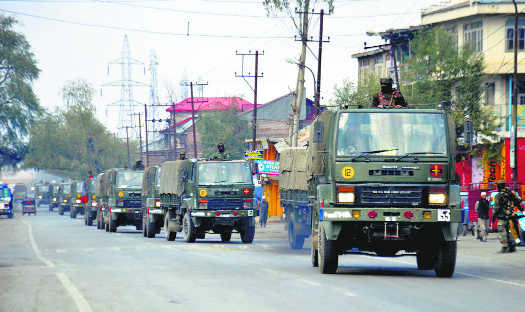
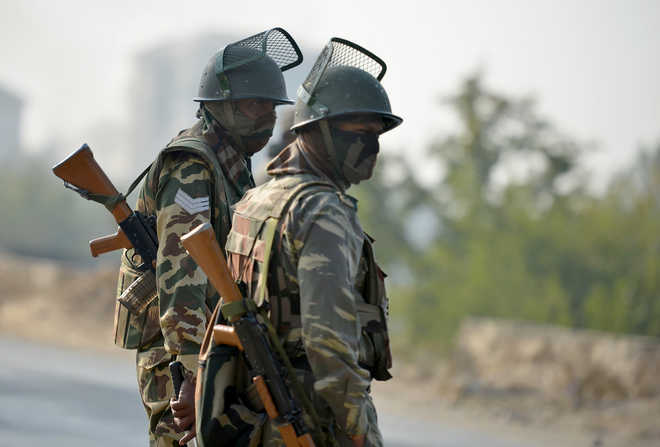
An Army convoy in the Valley. Tribune file Photo

Majid Jahangir

Tribune News Service

Srinagar, November 26

Last week thousands of Kashmiri youth participated at an Army recruitment rally at Panzgam garrison in frontier Kupwara district to don the olive green. In July, more than 3,000 youth from J&K took the written exam for the selection of officers in the Territorial Army.In April, Farooq Dar, a shawl weaver, was tied to a jeep and used as a “human shield” by a Major for allegedly escaping stone throwers during the parliamentary bypoll in Budgam. The officer was later awarded the Chief of Army Staff Commendation (COAS). The human shield incident had sparked outrage in the region, deepening the army-civilian divide.These two examples explain the two narratives about the Army in Kashmir which is at the forefront in counter-insurgency and counter-infiltration operations in Kashmir since the outbreak of militancy. The past baggage of the alleged mass rape in Kunanpospora, Kupwara, in 1991 and a series of fake encounters like Pathribal, Machil and ‘enforced disappearances’ have dealt a major blow to the Army’s image. The Army, however, has always denied the allegations of mass rape in Kunanpospora.Over the years, however, the complaints of human rights violations against the Army in Kashmir have considerably reduced as the force has focused on image-building in the Valley.To win the hearts of people, the Army in 1998 started Sadbhavana — a goodwill programme — with an objective to bridge the gap between the ‘jawaan’ (Army) and ‘awaam’ (people). At present over 500 projects of Sadbhavana are underway in various developmental sectors across Kashmir.However, over the years the Army has been successful in bridging the gap only to some extent. In Kupwara, for example, the Army has maintained good relations with people for over a decade but the district witnessed hundreds of stone-throwing incidents during the 2016 unrest.“It is wrong to interpret that Sadbhavana will have an impact on the political situation of Kashmir. Kupwara has the highest military concentration, but when there is a political problem, it also behaves like the rest of the Valley,” said Mohammad Adil, 32, a businessman from Kupwara town.A postgraduate student from Srinagar, Shabnum Kulsum said the Army was “meant for security but their image is negative among youth for killings and creating an atmosphere of fear”.“No matter how many publicity programmes the Army tries to organise in Kashmir, its image will always scare a Kashmiri,” Kulsum said.Political scientist Noor Ahmad Baba said relations between people and the Army are never good in a conflict situation. “Naturally when the Army is in contact with people, especially in a conflict situation, relation are not always good,” he said.However, the surrender of footballer-turned-Lashkar-e-Toiba militant Majid Khan tells a different story of the ties between the Army and people in south Kashmir.“When young Majid Khan decided to return, the Army was contacted and not any other security agency. This shows the level of trust the Army has been able to gain from the people. “Even when one militant was injured in a gunfight where we lost a soldier, we accepted his surrender. It shows the humane face of the Army and the trust it enjoys here,” said an Army officer in Kashmir. “However, there are always elements in some pockets who want to create issues and widen the gap between the locals and the Army. A majority of the people supports us, but due to fear they don’t want to say it in public. We are enjoying excellent relations with the people.”In the early 1990s, when militancy was at its peak, few Kashmiri youth used to join the Army. The trend, however, changed slowly after the Army started holding massive recruitment rallies. Over 5,000 Kashmiris are serving in the Army at present and there are nearly 8,500 ex-servicemen. At least seven Kashmiri Army men, including the unarmed Lt Ummer Fayaz, have been killed in Kashmir.The continuation of AFSPA is another issue with the people. “The Army recently said around 200 militants were active in the Valley. How does the government justify such a large presence of the Army now and AFSPA?” asked Khursheed Ahmed, a Srinagar resident. The Army, however, has been maintaining that time is not ripe for the withdrawal of the Armed Forces Special Powers Act.

Bridging the gap

Over the years the Army has been successful in bridging the gap only to some extent. In Kupwara, for example, the Army has maintained good relations with people for over a decade but the district witnessed hundreds of stone-throwing incidents during the 2016 unrest. 


The Dignity of a ‘Fallen’ Soldier by LT GENERAL BHOPINDER SINGH

Citizen

NEW DELHI: ‘Fallen’ soldiers evoke tremendous emotions, passions and reverence within the soldering fraternity. The dignity accorded to them emanates from the sacred warrior credo that, ‘you leave no man behind’ – physically, emotionally and spiritually.

This truism resonates from the US Rangers (fifth stanza of the Army Ranger creed), the 7th article in the Code d’honneur du Legionnaire (“In combat you act without passion or hatred. You respect vanquished enemies. You never surrender your dead, your wounded, or your weapons”), as indeed, in the timeless DNA of the Indian Armed Forces.

It is therefore hardly surprising that all professional militaries are steeped in the highest ceremonial sensitivities, symbolic traditions and etiquettes, when it comes to the solemn occasion of handling the ‘fallen’ brothers.

Strict protocols and traditions are laid determining the handling of the poignant moment – with the ultimate respect afforded by the draping of the warrior’s coffin with the National flag.

This spirit was profoundly echoed by a 24 year daredevil, Captain Vikram Batra PVC, who besides immortalising, “Yeh dil maange more!” had also prophetically stated, “Either I will come back after hoisting the Tricolour, or I will come back wrapped in it. But I will be back for sure”, and indeed his body came wrapped in the Tricolour, as the nation mourned its valiant son who paid the ultimate price.

At military funerals the uniform, saluting protocols, gun salutes to laying of the wreaths – the somber occasion has an unmistakable air of decorum, structure and nobility attached to the entire proceedings. The hauntingly melancholic, ‘the last call’ is played by the military buglers signifying the end of the soldier’s journey, as an unforgettable ode to his martyrdom.

It is in this context that the ‘Coffingate scam’ in the aftermath of the Kargil victory, acquired a hugely emotional import and dimension, beyond the standard contours of procedural lapses and financial compromises.

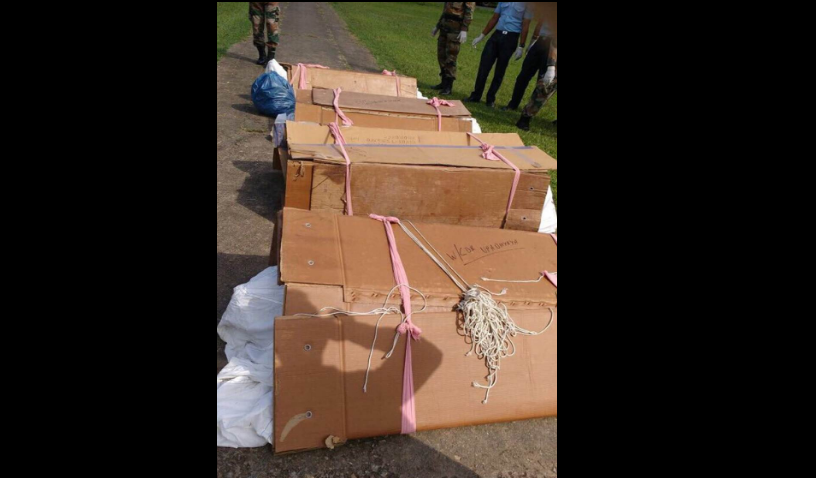
Recently the pictures showing the dead bodies of seven soldiers of the IAF helicopter crash, wrapped in paperboard cartons with ropes tying the makeshift coffins, as opposed to body bags have militated against the conscience and natural emotions of all. The coincidence of the moment, with the Air Force Day celebrations, added to the immediate irony.

The virulently polarised and politicised environment of the day, which has deeply infected mainstream polity, has not spared the relatively insulated domain of the Armed Forces, and soon calls of ‘disrespect’ and ‘apathy’ were countered in equal measure by trolls counter-claiming the needless politicisation of the tragedy – unfortunately today, events like the civilian tragedies runs the risk of vitiating the environment for a proudly, apolitical Defence Forces. Therefore it is important to understand the background, prevailing circumstances and the need to remain ever-sensitive to such symbols of military honour, correctness and above all, pride.

Thankfully, the military institution reacted swiftly and the Army’s Additional Directorate General of Public Information, immediately clarified that the wrapping of corpses in the ‘local resources’ as an ‘aberration’ and as a situational necessity, and further added that the soldiers were ultimately given full military honours by the Air Force.

Willy-nilly the Defence Forces acknowledged the basic unacceptability of the initial handling, but perhaps attributable to the constraints of the helicopter crash that took place at a height of 17,000 feet in Tawang sector.

That a lot of ‘forward’ areas do not have body-bags is a reality, as they are equipped by just about the bare-essentials of the administrative wherewithal, not the ideal situation, but the reality, nonetheless. The issue was rightfully and promptly doused by timely response and necessary clarifications by the officials.

However terming the heartbreaking images that would naturally infuriate the sensibilities of all, especially those who are serving and the Veteran community as needlessly, ‘creating a controversy’, is equally unfair and unnecessary. Any soldier worth his salt who has served in the Uniform, would be instinctively hurt at the initial images, and is in his full right to question and demand a correction to the perceived indignity, inherent in the images, to his sacred institution.

It is important to recognise that the serving institution rightfully expresses no opinion or dissenting voice, as that could complicate the institutional construct, ethos and efficacy. Therefore it is invariably the Veteran community that espouses institutional causes that are perceived to be detrimental, hurtful or insulting.

It is the Veterans who have been in the forefront of expressing serious displeasure on issues like the OROP, slides in Pay Commissions, concerns on material and personnel adequacies, overstretched deployments et al – as long as these concerns emanate from the singular motive of protecting the institutional steel, pride and dignity, no political motive or dimension needs to be read, thereon. Like the serving fraternity, when it comes to issues pertaining to the Services only, the Veterans ought to maintain political indifference, distance and rectitude.

Already, over the decades the politico-bureaucrat combine has pushed the Services to a stage bordering neglect and despair. The last thing the institution needs is a further snubbing of its ‘voice’, however uncomfortable it is to any political dispensation – the soldier fights for the nation only, and not for any political party. Thus the Veteran lamenter and the counter-trolls need to spare the taints of political aspersions on such queries.

The significance of the ‘fallen’ soldier can be gauged from the fact that the Republic Day parade starts with the PM and the three Chief’s saluting the Amar Jawan Jyoti (Tomb of the Unknown Soldier). The marble cenotaph of the rifle and a helmet with an eternal flame is unfathomable in its emotive significance.

As the other inspirational epitaph of the ‘fallen’ soldier at the Kohima cemetery evocatively states, “When you go home, tell them of us, for your tomorrow, we gave our today”.

This incident was indeed an ‘aberration’ as stated, which logically evoked initial concerns by Veterans – matter ends with no political or personal aspersions or bickering, as the dignity for the ‘fallen’ soldier, is foremost.

(Lt General Bhopinder Singh (Retired) is former Lt Governor of Andaman and Nicobar Islands & Puducherry)



Pakistan PM issues threat of short-range nuclear missiles

Pakistan PM issues threat of short-range nuclear missiles

Pakistan PM issues threat of short-range nuclear missiles
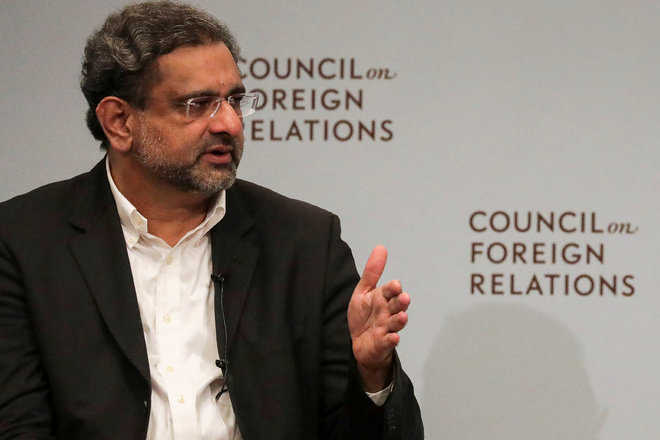
Pakistani Prime Minister Shahid Khaqan Abbasi

New York, September 21

Pakistan has developed short-range nuclear weapons to counter the ‘Cold Start’ doctrine of the Indian Army, Prime Minister Shahid Khaqan Abbasi said today.On his maiden visit to the US as Pakistan Prime Minister, Abbasi also said that Pakistan’s nuclear arsenal was safe and secure.(Follow The Tribune on Facebook; and Twitter @thetribunechd)
On the assertion that Pakistan had the fastest growing nuclear arsenal in the world, Abbasi said: “As far as tactical nuclear weapons (are concerned), we do not have any field tactical nuclear weapons.”“We have developed short-range nuclear weapons as a counter to the Cold Start doctrine that India has developed. Again, those are in the same command-and-control authority that controls the other strategic weapons,” Abbasi said in response to a question at the Council on Foreign Relations, a top American think-tank.“We have a very robust and secure command-and-control system over our strategic nuclear assets. Time has proved that it’s a process that is very secure. It’s a process that has complete civilian oversight through the NCA,” Abbasi said. The Nuclear Command Authority (NCA) of Pakistan is responsible for command, control and operational decisions regarding the country’s nuclear arsenals. Abbasi said that the command-and-control systems they have in place are as secure as anybody else’s in the world.“The last 20 years are testament to that,” Abbasi said in response to another question.“So let there be no doubt that any extremist element or somebody like that can gain control of fissile material or a nuclear weapon. There is just no possibility of that. And it’s time-tested, and it’s a very secure system that has been put in place,” he said.The Pakistan premier sought to dispel the notion surrounding the country’s inability to handle its nuclear programmes properly.“We do have nuclear capability. There’s no doubt about that. And we know how to handle nuclear waste. We had a nuclear programme in the early ’60s, one of the first countries in Asia to have a nuclear programme. So if we’ve managed it for over 50-odd years, I think we can continue to manage it,” he said. — PTIWhat is ‘Cold Start’ doctrine

  • ‘Cold Start’ doctrine was developed by Indian Army for a possible war with Pakistan
  • Involves various branches of the Indian Army conducting offensive operations as part of unified battle groups
  • Intends to allow conventional forces to perform holding attacks to prevent N-retaliation from Pak

‘India has zero Afghan role’ Pakistan sees “zero” political or military role for India in Afghanistan, PM Abbasi said, weeks after US President Donald Trump sought more help from New Delhi to bring peace and stability in the war-torn country. “We don’t foresee any political or military role for India… it will complicate the situation,” Abbasi said. ‘Indus dispute can be resolved’The disputes between India and Pakistan over the Indus Waters Treaty can be resolved within the context of the agreement itself, Pakistan’s PM Shahid Khaqan Abbasi said. “That’s been our stance from day one, that the issue should be resolved as per the provisions of the agreement. 


80 militants killed in south Kashmir in 6 months: Army

80 militants killed in south Kashmir in 6 months: Army
Major General B S Raju said the Army and other security agencies would continue to take all necessary actions against militants so that the people of south Kashmir could live in peace. PTI file

Srinagar, November 3

Around 80 militants have been killed in south Kashmir in the past six months and around 115 ultras are still active in the region, of whom over a dozen were foreign terrorists, a top Army official has said.

“There are around 115 militants in south Kashmir and out of them, 99 are local and 15-16 are foreign terrorists. The actions that we have taken in past 6-7 months, we have neutralised nearly 80 terrorists including top leadership.

“…as soon as the number of terrorists decreases, the situation will improve,” General Officer Commanding of the Army’s Victor Force, Major General B S Raju, told reporters.

Asked about the killing of a BJP youth leader in Shopian yesterday, Major General Raju said these were “acts of desperation” by the militants.

“Two to three such incidents have taken place in the recent past. We are given to believe that these are acts of desperation by the terrorists.

“They are not able to make any concerted action against the security forces. So they are looking at weaker targets and I am given to believe that police are taking necessary action against the perpetrators of these crimes,” he said.

He said the Army and other security agencies would continue to take all necessary actions against militants so that the people of south Kashmir could live in peace.

“The situation in south Kashmir is much better. Stone pelting and random acts initiated by terrorists have also decreased. As the winter season sets in, our actions would be more effective and peace shall return,” he added.

On the Jaish-e-Mohammad militants in south kashmir, Major General Raju said the process of neutralisation of the Jaish cadre has already begun.

“We intend to act particularly against the Jaish”.

On fresh recruitment among the militant ranks, he said that it was definitely a cause for concern.

“A lot of stakeholders need to work in a concerted manner to ensure that new recruitment is put in check. I would put the onus on the parents to ensure that they are able to take care of their children and I would put the onus on village elders, to the Moulvis in the villages and towns to ensure that they get right message across to the young people,” he added.

He said teachers and principals of schools and colleges also have a role to play.

“The security forces have to ensure that they conduct operations in such a manner that would not alienate the population and the youth,” he added. PTI


Punjab: State-level event to mark 120 years of Saragarhi battle today

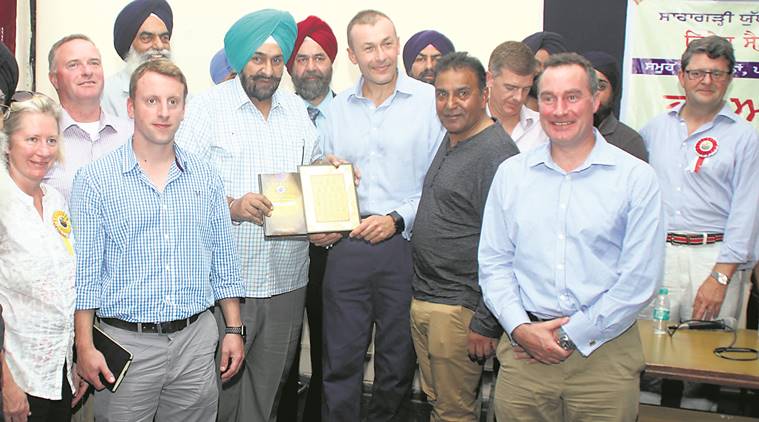
Descendants of 12 martyrs have been invited and they will be honoured on Tuesday. Apart from this, a 14-member British contingent has also arrived in Punjab to take part in the September 12 function in Ferozepur.

Saragarhi battle, punjab Saragarhi battle, what is Saragarhi battle, Saragarhi memorial, indian express, india news

The SARAGARHI Memorial and gurdwara premises in Ferozepur is abuzz with activity as the district administration prepares for a state-level function to mark 120 years of the Saragarhi battle.

Although tributes are paid to 21 martyrs of 36th Sikhs of British Indian Army every year on September 12, this year the state government has planned a state-level function for the first time. Out of the 21 martyrs of this historic battle, families of only 12 are living in Punjab at present and the rest have migrated out of country, Ferozepur district administration revealed.

Descendants of 12 martyrs have been invited and they will be honoured on Tuesday. Apart from this, a 14-member British contingent has also arrived in Punjab to take part in the September 12 function in Ferozepur. The Battle of Saragarhi was fought between 21 Sikh soldiers of British Indian Army and 10,000 soldiers of Pashtun Orakzai on 12 September, 1897. Havildar Ishar Singh was the commander at the post when British Indian Contingent was attacked by 10,000 Afghans. He, however, chose to fight to death, which is considered by some military historians as one of the history’s greatest last stands.

Santokh Singh, the fifth generation descendant of Havildar Ishar Singh, said, “Although we were given an invitation every year, but we went 2-3 times in the past. As the day has been given importance of a state-level function with a holiday in government offices, we are feeling honoured. I will be going for sure tomorrow to be part of this historic day so as to remember the martyrdom day of my great-great grandfather and 20 other martyrs. We do observe the day in our village as well, but now we have postponed the function for a day.” Santokh lives in Jagraon’s village Jhrur and is a small farmer. After Ishar Singh, no one from the family joined the Army. Santokh said,”I could not clear the recruitment tests. So had no choice but to be a farmer.”

Harkirat Singh, is from the fourth generation descendant of Naik Lall Singh from Dhun Dhai Wala village of Tarantaran district.

About Tuesday’s function, he said,”Martyr Lall Singh was my uncle and he had no child.. He had just got married when he was martyred. My niece, Simranjeet Sandhu, is serving as Squadron Leader in the Indian Air Force. No one else could make it, though everyone had a zeal to serve the nation. We are excited to go to Ferozepur tomorrow. The function in our village will be observed on September 13, where we will be getting some monetary help from government for the first time, while earlier we were doing from our own pocket.”

Finance Minister Manpreet Singh Badal, Local Bodies Minister Navjot Singh Sidhu will attend Tuesday’s event. The British contingent will also visit villages of Ishar Singh and Lall Singh, their families said.


Fire in Army ammo depot; no loss of life

Fire in Army ammo depot; no loss of life
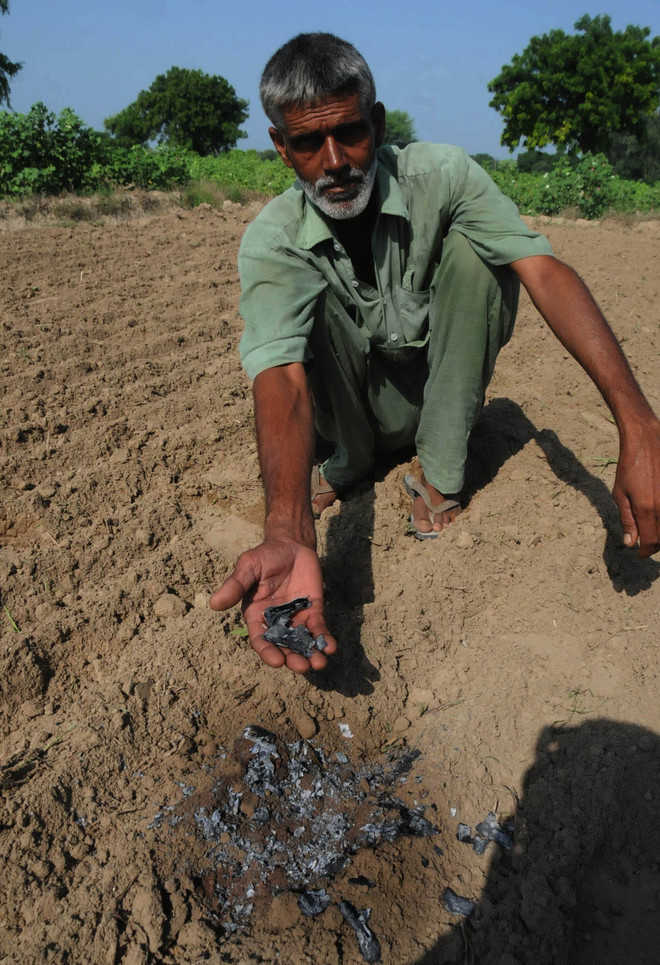
Flames after the blast in the Bathinda Cant areas could be seen from several kilometres away in Bathinda on Thursday.– A Tribune photo

Varinder Singh & Gagandeep Sharma

Tribune News Service

Bathinda, September 7

A fire broke out at the Army’s ammunition depot in the Bathinda Cantonment around 5:10 am today. It was controlled by fire tenders pressed into service by the Army. No casualty or injuries were reported.“The minor fire broke out in a concrete shed and was controlled in half an hour,” said a defence official.The Ministry of Defence has ordered an investigation. A committee has been set up for the purpose.A preliminary investigation indicated that a short circuit might have caused the fire. “Mainly, it was dry grass which caught fire,” the official said.As a precautionary measure, Northern Railways halted trains arriving at or leaving the local railway station. Rail traffic was resumed after the fire was controlled.Sukhmander Singh, a resident of Bhaagu village, said he heard a blast and saw flames. “We came out of our houses and rushed to the fields. Later, I found half-burnt wooden pieces in my fields,” he added.Deputy Commissioner Diprava Lakra said the fire was controlled by 6:30 am


Restructuring: 57,000 Armymen to be redeployed for combat roles

Restructuring: 57,000 Armymen to be redeployed for combat roles
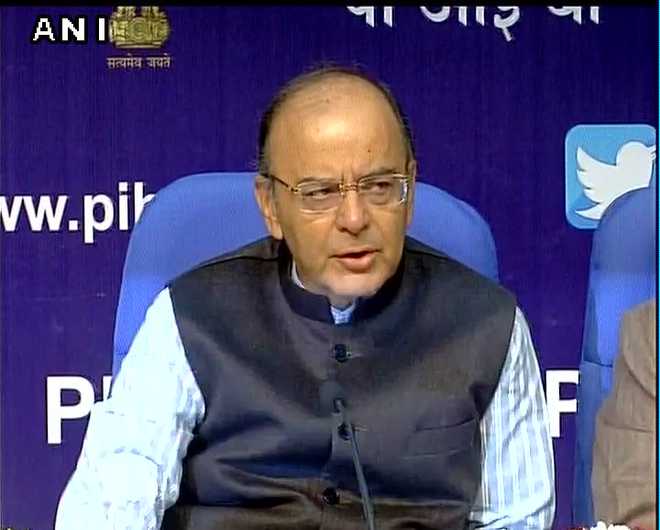
Defence Minister Arun Jaitley. ANI file

Ajay Banerjee

Tribune News Service

New Delhi, August 30

The Centre on Wednesday announced a major change in the Army. As many as 57,000 officers and soldiers will be redeployed to have more combat-oriented roles. This is part of restructuring of some British-era prevailing systems.Defence Minister Arun Jaitley announced the “far-reaching changes” here. Jaitley said a committee headed by Lt Gen DB Shekatkar (retd) had suggested 99 points for structural changes in the Army–cutting down flab and reducing revenue (maintenance) expenditure.Of these, the Ministry of Defence (MoD) on Tuesday accepted 65 suggestions, Jaitley said.The restructuring will be done in phases till 2019.The major changes will be in reorganisation of signals, engineering corps and ordnance. This will include monitoring companies, including merger of engineering units and signals units. Army postal establishments in peace will be shut down. All 39 military farms will be shut down. Of these 12 had been closed before August 15.

(Follow The Tribune on Facebook; and Twitter @thetribunechd)

The Committee was set up in May last year by then defence minister Manohar Parrikar.The MoD says the addition of new equipment (modernisation) does not mean a corresponding rise in the personnel strength.The MoD had ordered the restructuring as the ever-increasing revenue expenditure on manpower leaves less than 20 per cent of the defence budget for weapons and equipment modernisation.Prime Minister Narendra Modi, in his address at the Combined Commanders’ Conference in December 2015, had laid the foundation for this saying, “At a time when major powers are reducing their forces and relying more on technology, we are still constantly seeking to expand the size of our forces. Modernisation and expansion of forces at the same time is a difficult and unnecessary goal.”The military commanders have been asked to promote ‘jointness’ among the three services across every level, shorten the tooth-to-tail ratio, and re-examine assumptions that keep massive funds locked up in inventories.During late 1990s, the then Army Chief Gen VP Malik decided to suppress 50,000 manpower (mostly from non-field force) over a period of three years, provided the money saved would be given to the army for capital purchases.DB Shekatkar, then a Major-General heading the Perspective Planning Directorate, worked on details in consultation with the heads of arms and services, principal staff officers and army commanders. There was considerable opposition within the army and outside. It was down for two years and in the third year the Kargil skirmish happened.The Indian army is the third largest in the world with over 38,000 officers (sanctioned strength is 49,631) and 11.38 lakh soldiers. Cadre reviews and implementation of the Ajai Vikram Singh report has made it top-heavy with bloated headquarters. This is definitely not in line with modern defence management to win short and swift wars.Over the last decade, India’s armed forces have absorbed a fair amount of technological developments, including communications and digitisation.


SC: Privacy is your fundamental right Constitution Bench: Part of right to life and liberty

SC: Privacy is your fundamental right

Satya Prakash

Tribune News Service

New Delhi, August 24

In a landmark verdict, the Supreme Court on Thursday declared right to privacy a fundamental right under the Constitution, saying it was “the constitutional core of human dignity”.“The right to privacy is protected as an intrinsic part of the right to life and personal liberty under Article 21 and as a part of the freedoms guaranteed by Part III (Fundamental Rights Chapter) of the Constitution,” a nine-judge Constitution Bench headed by Chief Justice of India JS Khehar ruled in a unanimous verdict.

Edit: Fundamentally right

Oped: Now, make privacy law However, the Bench clarified that like other fundamental rights, the right to privacy was not absolute and any encroachment will have to withstand the touchstone of permissible restrictions. A law to survive a challenge on the ground of violation of Article 21 must be fair, just and reasonable.Noting that informational privacy was a facet of the right to privacy and dangers to privacy in an age of information could originate from both the state and non-state actors, the Bench asked the Centre to put into place a robust regime for data protection. “The creation of such a regime requires a careful and sensitive balance between individual interests and legitimate concerns of the state,” it said.(Follow The Tribune on Facebook; and Twitter @thetribunechd)“The legitimate aims of the state would include, for instance, protecting national security, preventing and investigating crime, encouraging innovation and the spread of knowledge, and preventing the dissipation of social welfare benefits,” the top court said.The court said, “These are matters of policy to be considered by the Union government while designing a carefully structured regime for the protection of the data.”“Since the Union government has informed the court that it has constituted a committee chaired by Justice BN Srikrishna, former SC judge, for that purpose, the matter shall be dealt with appropriately by the Union government having due regard to what has been set out in this judgment,” it added.The verdict, which lays down the law on right to privacy, would have a bearing on petitions seeking to declare illegal Section 377 which criminalises gay sex. It will also affect the outcome of petitions challenging the ‘two-finger test’ conducted on rape victims.The government’s ambitious Aadhaar scheme will get impacted as petitions challenging it on the ground of violation of right to privacy would be decided by a smaller Bench separately on the basis of the law declared by the nine-Judge Bench.The verdict assumes significance in the age of social media, as individuals can claim constitutional protection for their data. It will also impact the outcome of petitions challenging the WhatsApp privacy policy pending before a five-judge Constitution Bench.The Bench said life and personal liberty were “inalienable rights”. “Privacy with its attendant values assures dignity to the individual and it is only when life can be enjoyed with dignity can liberty be of true substance. Privacy ensures the fulfilment of dignity and is a core value which the protection of life and liberty is intended to achieve,” the Bench said.The all-important ruling came on petitions filed by former Karnataka High Court Judge KS Puttaswamy, child rights activist Shanta Sinha, former bureaucrat and activist Aruna Roy, former Major General Dr Sudhir G Vombatkere and others who contended that right to privacy was a fundamental right and the Aadhaar scheme violated it.The nine-judge Constitution Bench specifically overruled two earlier verdicts that said right to privacy was not a fundamental right under the Constitution.In MP Sharma and others versus Satish Chandra, an eight-judge Constitution Bench had held in 1954 that right to privacy was not a fundamental right. A similar view was taken by a six-judge Bench in 1962 in Kharak Singh versus the State of Uttar Pradesh.It was on the basis of these two judgments that the then Attorney-General Mukul Rohatgi had asserted before the top court in 2015 that citizens didn’t have a fundamental right to privacy, inviting criticism from civil society and rights activists.But during the hearing, Rohatgi’s successor KK Venugopal had conceded that right to privacy was a fundamental right. He, however, had asserted that it was a qualified right and the government had a right to regulate it through a law.In all there were six separate but concurring verdicts. The CJI, who didn’t write one, pronounced the operative part of the verdict signed by all nine judges in a jam-packed courtroom at 10.39 am. Other judges on the Bench were Justices DY Chandrachud, J Chelameswar, SK Kaul, SA Bobde, RF Nariman, AM Sapre, RK Agarwal and Abdul Nazeer.LANDMARK VERDICT DECODED 
What it said

  • The decision in MP Sharma case (1954), holding that right to privacy is not protected by the Constitution, stands over-ruled
  • The decision in the Kharak Singh (1962) case, to the extent that it holds that right to privacy is not protected by the Constitution, also stands over-ruled
  • The right is protected as an intrinsic part of right to life and personal liberty under Article 21 and as part of  freedoms guaranteed by Fundamental Rights chapter of the Constitution
  • Decisions subsequent to Kharak Singh case, which say right to privacy is protected as an intrinsic part of the right to life and personal liberty, lay down the correct position in law.

Likely impact

Aadhaar scheme

Based on the law laid down by the nine-judge Constitution Bench, a smaller Bench would examine the validity of Aadhaar law and decide whether it violates right to privacy of individuals

Whatsapp privacy policy

A five-judge Bench is seized of petitions against it. Issues of right to privacy will be decided on the basis of the law declared by the nine-judge Bench

Homosexuality

Section 377, which criminalises gay sex, becomes vulnerable after right to privacy has been declared a fundamental right. Pleas seeking to declare this Section illegal pending before Curative Bench

Pornography

Petitions seeking a blanket ban on pornography will now face robust opposition as those opposed to it might seek to defend it on the ground of right to privacy

Two-finger test

Petitions challenging two-finger test on rape victims now have a better ground in the form of right to privacy

clip


After SC bail, Lt Col Purohit says eager to rejoin Army

After SC bail, Lt Col Purohit says eager to rejoin Army
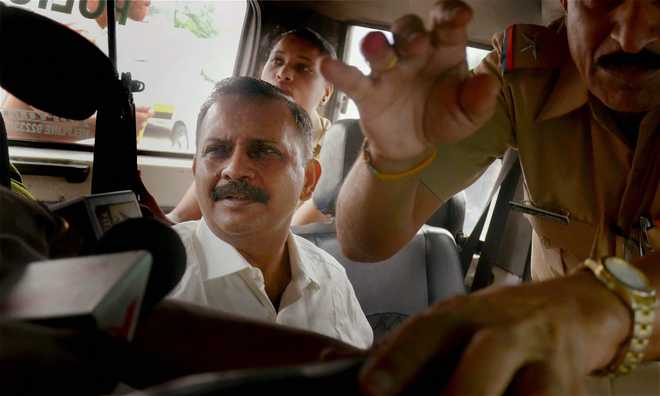
Lt Col Shrikant Prasad Purohit, who was granted bail by the Supreme Court on Monday in the 2008 Malegaon blast case, being taken to the Sessions Court from Taloja Jail in Navi Mumbai on Tuesday. PTI

Mumbai, August 22

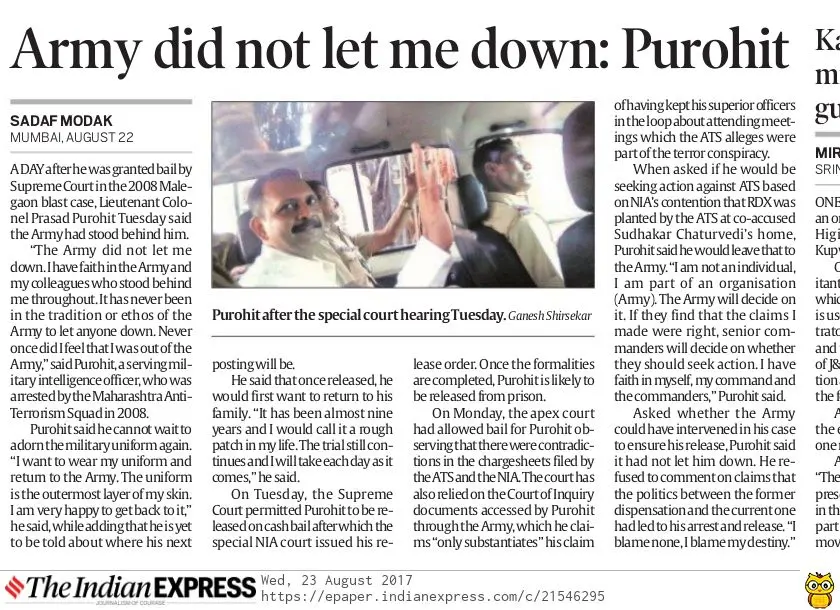
A day after the Supreme Court granted him bail in the 2008 Malegaon blast case, Lt Col Shrikant Prasad Purohit said he wanted to rejoin the Army as soon as possible.”I want to wear my uniform. It is outermost layer of my skin. I am wedded to it. I am very happy to get back into the service of the best organisation in the country if not the world, the Indian army,” he told reporters outside a sessions court here.Purohit — whose bail formalities are yet to be completed — had been brought to the court for a hearing on framing of charges.”I have two families — the Army and my family which includes my wife, my two sons, sister and mother. I cannot wait to return to them,” he said.The Army didn’t “let me down”, said Purohit.”It’s been the tradition and ethos of the Army not to let down its men,” he said, adding, “I never even once felt that I was out of the Army.”He praised his wife for helping him in his legal fight.Asked if he will seek action against the Maharashtra Anti-Terrorism Squad for allegedly “planting (explosive) RDX on him”, Purohit said he was part of an institution, and if those claims were true, his “seniors” (in the Army) will deal with the matter.”I am too small a fry to fight this,” he said.Asked if he blamed anybody for his plight, the officer said no one was to blame but his “destiny”.”The Army is the only institution in the country which is not shaken by the ripples of what is happening in society,” he said.

Release likely tomorrow

He, however, will have to spend one more night in jail before he is released.Purohit was produced before the special NIA judge S D Tekale here today. The court is hearing the accused on framing of charges in the Malegaon blast case.In the afternoon, Purohit’s lawyers in Delhi approached the Supreme Court, seeking modification of bail conditions.”The SC accepted our request and allowed us to avail of cash bail instead of producing sureties,” said advocate Shrikant Shivde, Purohit’s lawyer.Purhoit’s lawyers then initiated the procedure for getting a release order, which the special NIA court issued in the evening.Police escorted Purohit back to Taloja jail near Mumbai a little after 6.30 pm. An Army vehicle had reached there to take Purohit, but it left after realising that he may not come out today as formalities for his release will take some more time.The apex court had yesterday granted bail to Purohit, who has been in jail for almost nine years for his alleged role in the 2008 Malegaon blast case.Six people were killed in a bomb blast on September 29, 2008 at Malegaon, a communally-sensitive textile town in Nashik district of north Maharashtra.The apex court said there were “material contradictions” in the charge sheets filed by the ATS and the National Investigation Agency (NIA), which were required to be tested at the time of trial. — PTI 

clip