Sanjha Morcha

What’s New

Click the heading to open detailed news

Current Events :

web counter

Print Media Reproduced Defence Related News

China plans to downsize army to lowest strength in its history

STRATEGIC DRAWDOWN This is the first time that PLA Army personnel would be reduced to below one million

BEIJING : China will downsize its 2.3 million-strong People’s Liberation Army to under one million.

REUTERSA soldier of China’s People’s Liberation Army holds a PLA flag at a military port in Zhanjiang.Besides its biggest troop reduction in history, the world’s largest military plans to bolster its navy and strategic missile forces, the official media reported.

The troop reduction is part of the restructuring of the People’s Liberation Army and evenly proportioning the army and other services, the PLA Daily reported. The PLA will increase the numbers of other services, including navy and missile forces, said the official newspaper of the Chinese military.

“This is the first time that active PLA Army personnel would be reduced to below one million.”

The article on structural reform in the military said: “The old military structure, where the army accounts for the vast majority, will be replaced after the reform.”

The number of troops in the PLA Navy, PLA Strategic Support Force, and the PLA Rocket Force would be increased, while the PLA Air Force’s active service personnel would remain the same.

“The reform is based on China’s strategic goals and security requirements. In the past, the PLA focused on ground battle and homeland defence, which will undergo fundamental changes,” said the article published on PLA Daily’s WeChat account.

China has cut down its defence spending in the past two years, with the military budget in 2017 remaining at 7%, the lowest hike in more than a decade.

Chinese President Xi Jinping wants a lean but modernised armed forces. In 2015, he had announced a reduction of 300,000 troops in the PLA.

Over the years, China has emerged as a major sea power and its disputes are more on seas than land. Of the 14 neighbours, China has land disputes only with India and Bhutan.

According to the Chinese defence ministry, PLA had about 850,000 combat troops in 2013.

“This reform will provide other services, including the PLA Rocket Force, Air Force, Navy and Strategic Support Force, with more resources and inputs, and the PLA will strengthen its capability to conduct overseas missions,” defence expert Xu Guangyu was quoted as saying by Global Times.

“The PLA must be capable of spotting overseas threats and destroying hostile forces thousands of kilometers away before they enter our 12 nautical mile territorial waters,” Xu said.

clip


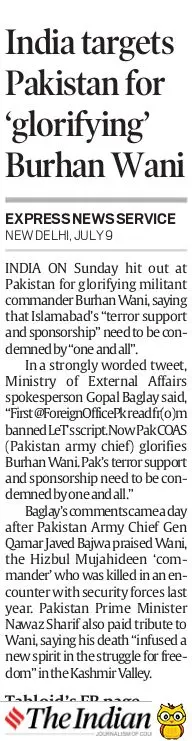
India flays Pak for ‘glorifying’ Wani

Simran Sodhi

Tribune News Service

New Delhi, July 9

India today hit out at Pakistan for glorifying slain Kashmiri terrorist Burhan Wani on his death anniversary. The Pakistan establishment, starting from Prime Minister Nawaz Sharif onwards, has played the Burhan Wani card and called him an inspiration for the freedom struggle of Kashmir.“The blood rendered by Burhan Muzaffar Wani has infused a new spirit in the freedom movement. The Kashmiri people are steadfast to take their movement to logical conclusion,” Pakistan PM Sharif said on Saturday.Ministry of External Affairs spokesperson Gopal Baglay tweeted in response to an earlier tweet which mentioned Pakistan army chief praising Burhan Wani.“First Pakistan’s Ministry of Foreign Affairs spokesperson read from banned LeT’s script. Now Pakistan’s COAS glorifies Burhan Wani. Pakistan’s terror support and sponsorship needs to be condemned by one and all,” Baglay said.He was referring to the tweets of Pakistan army spokesperson Maj Gen Asif Ghafoor, who said army chief Gen Qamar Javed Bajwa had reportedly eulogised Hizbul terrorist Burhan Wani on July 8, the day he was killed in an encounter with Indian security forces in Kashmir last year.“Kashmiris have right of self-determination. Sacrifices of Burhan Wani and generations against Indian atrocities are a testimony of their resolve,” Ghafoor had tweeted quoting Gen Bajwa on Saturday.Statements from Pakistan come in the backdrop of the US recently designating Hizbul Mujahideen Syed Salahuddin as a global terrorist.


clip

clip


Govt. approves air travel for JCOs

Following a significant move by the Centre under the 7th Pay Commission, Junior Commissioned Officers (JCOs) are now entitled to fly while travelling on work.

“Level 6 to 8 of Pay Matrix to be entitled for air travel. Level 5A of defence forces to be clubbed with Level 6 for travelling entitlements,” the gazette notification issued by the Government on allowances said.

The Union Cabinet had recently approved the recommendations made by the 7th Central Pay Commission (CPC) with minor modifications. All allowances are effective from July 1.

Level 6 to 8 pertain to the three ranks of JCOs — Naib Subedar, Subedar and Subedar Major — in the Army, and their equivalents in the Navy and Air Force.

Level 5A is only in the Navy, forming an intermediary level between Junior Warrant Officer and Warrant Officer in the Air Force. “This entitlement is for travel on temporary or permanent movement,” one Air Force JCO said.

JCOs constitute a small fraction in the military and form the bridge between the officers and Other Ranks (ORs).


‘Pak may look to Iran for support on Kashmir issue’

News channels have hosted talk shows in which the visit has been discussed extensively while many newspapers have carried political commentary on it.

English language daily Dawn, in an editorial on Thursday, commented: “Amidst the tumult in global affairs, the Indo-Israeli relationship has emerged as a steady bilateral alliance, surprising to some, while others have been watching the ties between Tel Aviv and New Delhi grow over the decades.”

The paper said Modi’s visit seems to have cemented the alliance between the two nations as the warm embrace between Modi and his Israeli counterpart Benjamin Netanyahu on the tarmac of the Ben Gurion International Airport on Tuesday showed.

Dawn noted that Indians have come a long way from their past policy regarding Israel and Palestine.

India established relations with Israel as late as 1992 while former Palestine Liberation Organisation chief Yasser Arafat enjoyed a great rapport with Indira Gandhi, calling her “his sister”.

The editorial said those days of mutual support are “clearly” gone and “Modi has no love lost for the Palestinians” as a meeting with Palestinian leaders was reportedly not on the cards.

Dawn’s commentary tried to draw parallels between Israel’s “atrocious behaviour” towards Palestinians, India’s towards Kashmiris.

“Perhaps the Indo-Israeli embrace has provided an opportunity for Pakistan to highlight the Kashmir issue with Iran and others, in order to build world opinion against the atrocities unleashed upon both the Kashmiris and Palestinians,” Dawn said.

A similar theme was followed by other news organisations in the country. In his TV programme, political commentator Farrukh Pitafi stated that Islamabad was curious as to whether Israel would also help India “crush” the uprising in Kashmir.


Pious hope of a peacenik on Kashmir TKA NairPious hope of a peacenik on Kashmir by TKA Nair

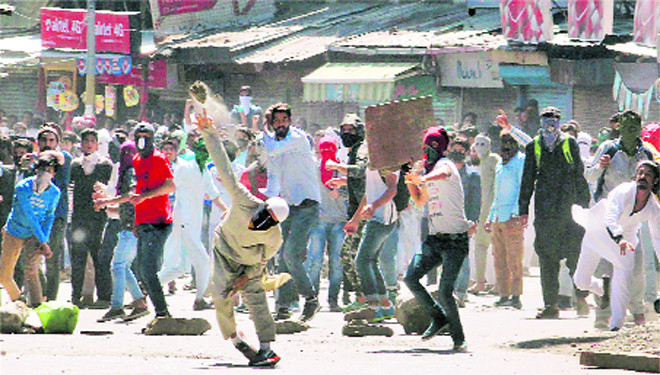
The people of Kashmir have been sucked into the seething cauldron of violence for no fault of theirs except by the sheer accident of their birth. As the younger generation challenges the might of the State by stone pelting and normal life gets disrupted time and again, it’s time to take stock of our approach to the K-problem. Strong-arm tactics and unbridled use of force cannot usher in peace. Only a humane approach can provide the much-needed healing touch

THE  advent of the Narendra Modi government with the massive mandate of the electorate and the euphoria it generated raised vague but high hopes of new initiatives on the India-Pakistan and Kashmir fronts.  With his penchant for dramatic action and out-of-the-box thinking, Prime Minister Modi was expected to somehow break new ground paving the way for normalisation of relations with Pakistan and resolution of the Kashmir issue.The symbolism surrounding his formal inauguration and his dramatic landing on Pakistan soil to shake hands with his counterpart lent some credence to popular expectations. Alas, three years down the line, India-Pakistan relations have not only not improved but have nosedived several notches — causing serious concern both nationally and internationally.  Recently, the Turkish President Recep Tayyip Erdogan and more significantly, the US President Donald Trump, during his election campaign and subsequently, offered to use their good offices to resolve the potentially explosive Kashmir issue.  Russia has steadfastly backed India’s stand on the Kashmir issue, but there are straws in the wind indicative of it moving towards a more nuanced approach in the context of emerging global geo-political and economic developments.  Though China is backing its all-weather ally to the hilt, there is mounting pressure on the nuclear-armed neighbours to settle their long-standing dispute over Kashmir, the “powder-keg” of South Asia.

Seeds of violence

The seeds of violence, death and destruction in the Kashmir Valley were sown on the birth of independent India and Pakistan.  Kashmir is central to India-Pakistan relations and  these relations are critical to militancy in Kashmir.  The latest wave of violence in the Valley was triggered by the death of Hizbul Mujahideen Commander Sabzar Bhatt and his associate in an encounter in Pulwama.  The embers of the last major bout of violence over the killing of Burhan Wani, though nearly a year ago, had not yet fully subsided before the fresh eruption. The mob violence, specially pelting of stones at the security forces by the youth on both the occasions, has inevitably led to the imposition of curfew and call for protests by the Hurriyat followed by more stringent security measures and curbs on freedom of movement and detentions.  Cross- border terrorist intrusions and the methods used to effectively deal with them, coupled with internal violence and the measures to counter them, have taken many lives of the security forces and Kashmiris.  Thousands of widows, young and old, live in perpetual agony specially in districts like Kupwara.

Unmoved by suffering

Neither the loss of human lives nor human sufferings move the protagonists on either side of the India-Pakistan divide —notwithstanding the predictable outbursts of patriotic rhetoric, salute to the coffins and phoney pledges of eternal commitment to human rights and universal brotherhood. The Indian side is fighting on two fronts in the Valley: The separatist militants from within and the armed infiltrators from across the border. The two have become integral to each other, making it often practically impossible for the instruments of State authority to deal with them differently on the ground. The consequences have been disastrous as they inevitably lead to escalation of violence, disruption of normal life and the consequent alienation of local people.The increasing phenomenon of educated youth, including college-going girls, joining the ranks of the protesters, specially the stone-throwers, is ominously perturbing as it reflects the mood of the younger generation.  The situation has become so dauntingly complex that an exasperated Army Chief wished: “The people instead of throwing stones at us were firing weapons at us ……..”.  Vocal sections of angry youth proclaim Burhan Wani and Zakir Musa their heroes and role models. They perceive the security forces as instruments of State oppression and increasingly sympathise with the cause of the Hurriyat.  Their hatred of the forces, coupled with their total mistrust of the political class, have made them easy targets of militant secessionist ideology and propaganda.  The stern stand taken against them by the Centre has so far had  no deterrent effect.   To the contrary, they seem to add fuel to fire as  evident from the swelling ranks of the violent protestors.  That some of them are speaking the language of the separatists is disturbingly ominous.  Regrettably, a new generation infused with anti-India sentiments is on the making which is a matter of very serious concern about  Jammu and Kashmir as an integral part of the Indian State and its democratic polity.   The militant separatists and the youth are undoubtedly no match to the might of the Indian Army, but a running battle with them is a negation of the very concept of Indian nationhood and pluralistic democracy.    The near -total absence of any serious engagement with them at any level makes matters worse by reinforcing their animosity and hatred of the  Central Government and Indian State.Though the BJP-PDP government in Jammu and Kashmir from its inception has been a coalition of convenience, it was vaguely hoped that it would slowly but steadily meander its ways to assuage the hurt feelings of the Kashmiris — thus paving the way for restoration of normalcy and at the same time strengthening the hands of the security forces to deal with infiltration from across the border.  Developments in the Valley have proved these hopes to be futile.  Distancing itself from the BJP, its partner-in-government, the PDP is charting its own course for talks with the Hurriyat and Pakistan reflecting its conciliatory approach as against the tough stance of the BJP and the Centre that maintain talks would follow the cessation of cross-border infiltration and militant terrorism sponsored by Pakistan and the Hurriyat.  According to its spokespersons, PDP is keen on the dialogue process in order to give the suffering people the much-needed relief by setting the stage for reconciliation and dialogue with all stakeholders, including the Hurriyat and Pakistan. 

Striking a different chord

“The resolution of the Kashmir issue is an article of faith with the PDP.  The people of Kashmir are agonised by the confrontationist policies and provocative voices”, the PDP Vice President Sartaj Madni said recently.   At the same time, the Government of India has reportedly evolved a strategic action plan towards a permanent solution to the Kashmir issue which envisages giving carte blanche to the Army to neutralise terrorists and their sympathisers both at the border and inside the Valley; cutting off funds to the terrorists and separatists; blocking of communication facing ongoing military operations; an aggressive media blitz to highlight how all this is done without killing innocent lives.  The much-publicised surgical strike, the statements of the Army Chief and the near-total absence of any overt or covert engagement with the agitating youth, the Hurriyat  and Pakistan confirm the tough strategic action plan in operation.  The cold response of the Centre to the overtures for talks with all the stakeholders made by the Chief Minister of Jammu and Kashmir reinforces the current official position of the Government of India.The recent developments are most disturbing and cruelly agonising for the people of the Kashmir Valley. With the state and Central governments openly divided over the approach and strategy to deal with the complex  problem with its security concerns, political sensitivity and international ramifications, most regrettably the human aspects and the suffering of the people of the Valley are overlooked.  Given the current international context, in spite of our superior economic and military might, we cannot force our own solution to the border dispute with Pakistan however justified or rational it is.  Similarly, it is unlikely that the militancy in Kashmir which has spread its tentacles can be nipped through strong-arm tactics.  Well, then are there any options available to the Indian State?

Provide succour to people

The people of India are passionately possessive of Kashmir as an inalienable part of their country.  The people of Jammu and Kashmir, including the stone-throwing youth, are as much citizens of India as the people of any other state in the Indian Union.  They are strife-torn for no fault of theirs, except the accident of their birth.   Random killing of them, however heinous their crimes might be, should not be the Indian way of dealing with them for bringing peace in the violence-prone state.     Just as we provide succour to the people in distress in any other part of  India, we must rally round the people of Kashmir, engage with them, share their concerns and help them out of their genuine grievances.  Our helping hand and healing touch would win their hearts and minds.  Let the Indian State extend its olive branch to the Kashmiri youth, establish channels of communication with them and talk to them with full trust and without reservations and preconceived notions.  The path of peace and reconciliation is the only possible humane way of stopping the violence and ameliorating the sufferings of the people. Build confidence in them about the sincerity of our approach, about the security of their lives and their future in a peaceful Kashmir as honourable citizens of India and they will for sure be the best bet for facilitating the process of engaging with our inimical neighbour for peaceful coexistence.  No doubt, it is an outrageously uncertain path, which our security establishment and “patriotic nationalists” would pooh-pooh and reject out of hand with contempt, but let us remind ourselves that for 70 years periodic devious political ploys, half-hearted talks, surgical strikes and other invasive measures have only helped shedding more and more blood on the soil of Kashmir.  Prime Minister Narendra Modi is uniquely placed, as no other Indian Prime Minister ever was, to walk the path of peace in the Kashmir valley and rise as a Messiah of hope for its tormented people in Kashmir.  Evil cannot be effaced by evil, though Tolstoy and Gandhi are dead and nearly forgotten for long!The writer served as the Principal Secretary and Adviser to former Prime Minister Manmohan Singh . THE  advent of the Narendra Modi government with the massive mandate of the electorate and the euphoria it generated raised vague but high hopes of new initiatives on the India-Pakistan and Kashmir fronts.  With his penchant for dramatic action and out-of-the-box thinking, Prime Minister Modi was expected to somehow break new ground paving the way for normalisation of relations with Pakistan and resolution of the Kashmir issue. The symbolism surrounding his formal inauguration and his dramatic landing on Pakistan soil to shake hands with his counterpart lent some credence to popular expectations. Alas, three years down the line, India-Pakistan relations have not only not improved but have nosedived several notches — causing serious concern both nationally and internationally.  Recently, the Turkish President Recep Tayyip Erdogan and more significantly, the US President Donald Trump, during his election campaign and subsequently, offered to use their good offices to resolve the potentially explosive Kashmir issue.  Russia has steadfastly backed India’s stand on the Kashmir issue, but there are straws in the wind indicative of it moving towards a more nuanced approach in the context of emerging global geo-political and economic developments.  Though China is backing its all-weather ally to the hilt, there is mounting pressure on the nuclear-armed neighbours to settle their long-standing dispute over Kashmir, the “powder-keg” of South Asia. Seeds of violence The seeds of violence, death and destruction in the Kashmir Valley were sown on the birth of independent India and Pakistan.  Kashmir is central to India-Pakistan relations and  these relations are critical to militancy in Kashmir.  The latest wave of violence in the Valley was triggered by the death of Hizbul Mujahideen Commander Sabzar Bhatt and his associate in an encounter in Pulwama.  The embers of the last major bout of violence over the killing of Burhan Wani, though nearly a year ago, had not yet fully subsided before the fresh eruption. The mob violence, specially pelting of stones at the security forces by the youth on both the occasions, has inevitably led to the imposition of curfew and call for protests by the Hurriyat followed by more stringent security measures and curbs on freedom of movement and detentions.   Cross- border terrorist intrusions and the methods used to effectively deal with them, coupled with internal violence and the measures to counter them, have taken many lives of the security forces and Kashmiris.  Thousands of widows, young and old, live in perpetual agony specially in districts like Kupwara. Unmoved by suffering Neither the loss of human lives nor human sufferings move the protagonists on either side of the India-Pakistan divide —notwithstanding the predictable outbursts of patriotic rhetoric, salute to the coffins and phoney pledges of eternal commitment to human rights and universal brotherhood. The Indian side is fighting on two fronts in the Valley: The separatist militants from within and the armed infiltrators from across the border. The two have become integral to each other, making it often practically impossible for the instruments of State authority to deal with them differently on the ground. The consequences have been disastrous as they inevitably lead to escalation of violence, disruption of normal life and the consequent alienation of local people. The increasing phenomenon of educated youth, including college-going girls, joining the ranks of the protesters, specially the stone-throwers, is ominously perturbing as it reflects the mood of the younger generation.  The situation has become so dauntingly complex that an exasperated Army Chief wished: “The people instead of throwing stones at us were firing weapons at us ……..”.  Vocal sections of angry youth proclaim Burhan Wani and Zakir Musa their heroes and role models. They perceive the security forces as instruments of State oppression and increasingly sympathise with the cause of the Hurriyat.  Their hatred of the forces, coupled with their total mistrust of the political class, have made them easy targets of militant secessionist ideology and propaganda.  The stern stand taken against them by the Centre has so far had  no deterrent effect.   To the contrary, they seem to add fuel to fire as  evident from the swelling ranks of the violent protestors.  That some of them are speaking the language of the separatists is disturbingly ominous.  Regrettably, a new generation infused with anti-India sentiments is on the making which is a matter of very serious concern about  Jammu and Kashmir as an integral part of the Indian State and its democratic polity.   The militant separatists and the youth are undoubtedly no match to the might of the Indian Army, but a running battle with them is a negation of the very concept of Indian nationhood and pluralistic democracy.    The near -total absence of any serious engagement with them at any level makes matters worse by reinforcing their animosity and hatred of the  Central Government and Indian State. Though the BJP-PDP government in Jammu and Kashmir from its inception has been a coalition of convenience, it was vaguely hoped that it would slowly but steadily meander its ways to assuage the hurt feelings of the Kashmiris — thus paving the way for restoration of normalcy and at the same time strengthening the hands of the security forces to deal with infiltration from across the border.  Developments in the Valley have proved these hopes to be futile.  Distancing itself from the BJP, its partner-in-government, the PDP is charting its own course for talks with the Hurriyat and Pakistan reflecting its conciliatory approach as against the tough stance of the BJP and the Centre that maintain talks would follow the cessation of cross-border infiltration and militant terrorism sponsored by Pakistan and the Hurriyat.  According to its spokespersons, PDP is keen on the dialogue process in order to give the suffering people the much-needed relief by setting the stage for reconciliation and dialogue with all stakeholders, including the Hurriyat and Pakistan.  Striking a different chord “The resolution of the Kashmir issue is an article of faith with the PDP.  The people of Kashmir are agonised by the confrontationist policies and provocative voices”, the PDP Vice President Sartaj Madni said recently.   At the same time, the Government of India has reportedly evolved a strategic action plan towards a permanent solution to the Kashmir issue which envisages giving carte blanche to the Army to neutralise terrorists and their sympathisers both at the border and inside the Valley; cutting off funds to the terrorists and separatists; blocking of communication facing ongoing military operations; an aggressive media blitz to highlight how all this is done without killing innocent lives.  The much-publicised surgical strike, the statements of the Army Chief and the near-total absence of any overt or covert engagement with the agitating youth, the Hurriyat  and Pakistan confirm the tough strategic action plan in operation.   The cold response of the Centre to the overtures for talks with all the stakeholders made by the Chief Minister of Jammu and Kashmir reinforces the current official position of the Government of India. The recent developments are most disturbing and cruelly agonising for the people of the Kashmir Valley. With the state and Central governments openly divided over the approach and strategy to deal with the complex  problem with its security concerns, political sensitivity and international ramifications, most regrettably the human aspects and the suffering of the people of the Valley are overlooked.  Given the current international context, in spite of our superior economic and military might, we cannot force our own solution to the border dispute with Pakistan however justified or rational it is.  Similarly, it is unlikely that the militancy in Kashmir which has spread its tentacles can be nipped through strong-arm tactics.  Well, then are there any options available to the Indian State? Provide succour to people The people of India are passionately possessive of Kashmir as an inalienable part of their country.  The people of Jammu and Kashmir, including the stone-throwing youth, are as much citizens of India as the people of any other state in the Indian Union.  They are strife-torn for no fault of theirs, except the accident of their birth.   Random killing of them, however heinous their crimes might be, should not be the Indian way of dealing with them for bringing peace in the violence-prone state.     Just as we provide succour to the people in distress in any other part of  India, we must rally round the people of Kashmir, engage with them, share their concerns and help them out of their genuine grievances.  Our helping hand and healing touch would win their hearts and minds.  Let the Indian State extend its olive branch to the Kashmiri youth, establish channels of communication with them and talk to them with full trust and without reservations and preconceived notions.   The path of peace and reconciliation is the only possible humane way of stopping the violence and ameliorating the sufferings of the people. Build confidence in them about the sincerity of our approach, about the security of their lives and their future in a peaceful Kashmir as honourable citizens of India and they will for sure be the best bet for facilitating the process of engaging with our inimical neighbour for peaceful coexistence.  No doubt, it is an outrageously uncertain path, which our security establishment and “patriotic nationalists” would pooh-pooh and reject out of hand with contempt, but let us remind ourselves that for 70 years periodic devious political ploys, half-hearted talks, surgical strikes and other invasive measures have only helped shedding more and more blood on the soil of Kashmir.   Prime Minister Narendra Modi is uniquely placed, as no other Indian Prime Minister ever was, to walk the path of peace in the Kashmir valley and rise as a Messiah of hope for its tormented people in Kashmir.  Evil cannot be effaced by evil, though Tolstoy and Gandhi are dead and nearly forgotten for long! The writer served as the Principal Secretary and Adviser to former Prime Minister Manmohan Singh


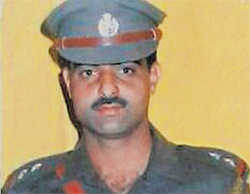
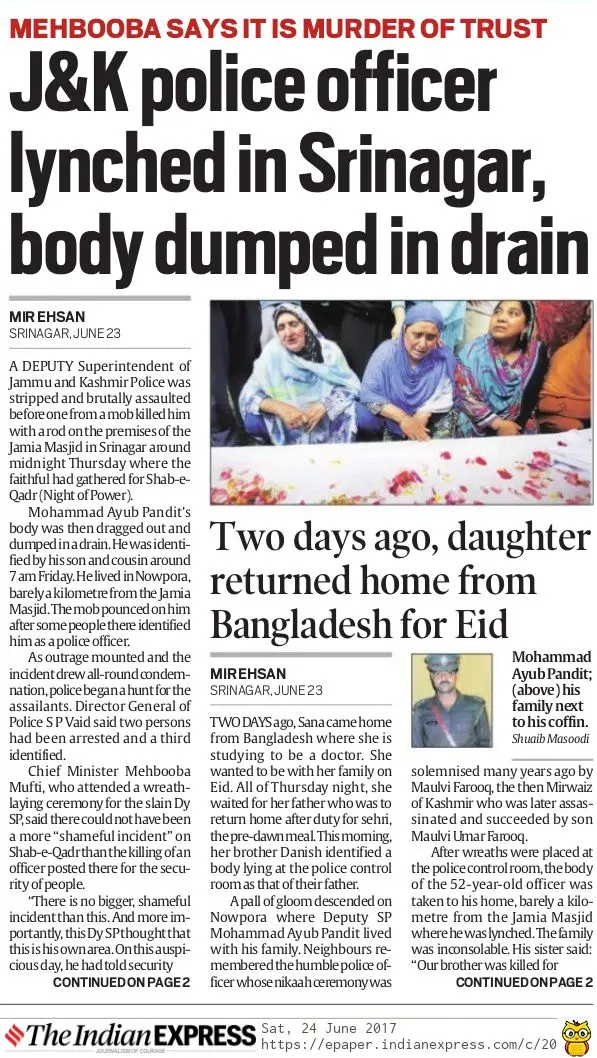
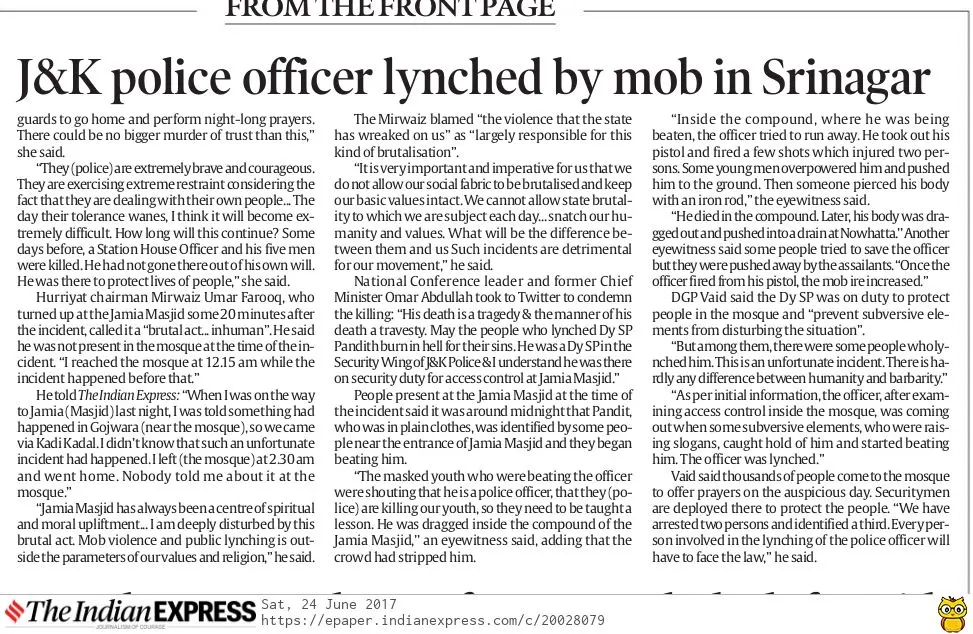
DSP lynched outside Srinagar Jamia Masjid Was part of security for Mirwaiz Farooq’s address

DSP lynched outside Srinagar Jamia Masjid
Mohammed Ayub Pandith

Majid Jahangir

Tribune News Service

Srinagar, June 23

A senior Jammu and Kashmir Police officer, who was part of security arrangements at the local Jamia Masjid for separatist Mirwaiz Umar Farooq’s address, was lynched by an unruly mob outside the grand mosque last night.Edit: Savagery in SrinagarDeputy Superintendent of Police (Security Wing) Mohammed Ayub Pandith, 57, was beaten to death in the Nowhatta area of old city around 12.30 am as people gathered for congregational prayers for Shab-e-Qadar, a pious night in Islam.(Follow The Tribune on Facebook; and Twitter @thetribunechd)A senior police officer said Pandith was on security duty for “access control” at the mosque when he heard some noise in a nearby lane as Mirwaiz — who has round-the-clock police protection — was about to reach the mosque.“As the officer came out of the mosque, he was initially manhandled by a mob. Sensing trouble, the officer pulled out his service revolver but did not fire at the mob directly. Later, the irate mob overpowered him, snatched his pistol and stripped him naked before beating him to death,” said ADGP (Security) Dilbagh Singh.Sources said over 200 people attacked the DSP with sticks, iron bars and stones. The officer died on the spot.Even the men of the security wing that the officer was heading abandoned him, the sources said, adding that the officer was not taking pictures when the mob attacked him.“I believe many people in the mob knew his identity and attacked him. They checked his ID and suspected him to be an intelligence officer initially,” a source said, adding that three persons were injured when the DSP opened fire on the attackers.Additional forces from the local police station arrived at the scene and fired tear gas shells and bullets to retrieve the body, which lay on the road for around 10 minutes. It was identified by the family in the morning.J&K Director General of Police SP Vaid said the DSP was posted to guard people and check miscreants.“The line between humanity and bestiality has blurred. The man who was protecting them was lynched,” the DGP said at the wreath-laying ceremony. He said two of the three suspects had been arrested. 



‘Most unfortunate’ The incident is most unfortunate… I am deeply disturbed by this brutal act. Mob violence and public lynching is outside the parameters of our values and religion — Mirwaiz Umar Farooq, separatist leader

It’s shameful’What can be more shameful? J-K Police are one of the best in the country… They are brave but are showing maximum restraint. The day their patience wanes, I believe things will be difficult — Mehbooba Mufti, J&K Chief Minister

‘Guilty, burn in hell’May the people who lynched DSP Pandith burn in hell… Such heinous elements are enemies of Kashmiriyat, humanity and should get  the sternest sentence — Omar Abdullah, ex-CM

clip

clip


Modi, Trump And The Future Of India-US Relations by Lt Gen Syed Ata Hasnain –

Modi, Trump And The Future Of
India-US Relations

SNAPSHOT

Can Prime Minister Modi convince President Trump that what is in India’s interest is also in the interest of the US?

After a successful run on the home front with Uttar Pradesh elections, and notwithstanding the ongoing problems in Jammu and Kashmir (J&K) and the farmer agitation, Prime Minister Narendra Modi is once again active on the strategic foreign policy front with a chain of visits to important countries. Having completed his Sri Lanka, Europe, Russia and Kazakhstan (SCO) tours, he is about to embark on the most important tour of the United States from 25 June, and will then round it up with a visit to Israel.

The US visit is a little different this time. The bonhomie and personal relationship Prime Minister Modi established with former US president Barack Obama is missing, and the potential of developing a similar bond with the maverick new US President remains a challenge. The European, Russian and SCO sojourns would have given Mr Modi a deeper insight on how the rest of the world perceives the new US Presidency, which has belied the principle that in democracies policies rarely change with change of chief executives.

The US is undergoing a deep change in foreign policy orientation but without any degree of certainty about the exact direction. It has internal challenges for the President and an opposition which isn’t going to give up too soon on making the life of President Donald Trump seriously troublesome. Two regions, recently visited by Trump – Middle East and Europe – reveal his thinking. In the Middle East, he has opted for a stronger Saudi Arabia-lead Sunni-oriented setup with an eye on containing Iran. Arms deals and memorandums of understanding signed for $110 billion worth of weapons really do not mean much, although it seems to have tempted Trump. He has reversed Obama’s attempts to play a more conciliatory role between Iran and Saudi Arabia to ease Tehran out of isolation, and hopefully force it to be less confrontationist on the Syria and Iraq related problems.

He forced the Qatar crisis, taking credit for it, and then signed a $12 billion deal with the Gulf state. This displays the lack of clarity in the US State Department. None of it is going to stabilise the Middle East, which remains a core area of concern for India too. With an 8 million Indian diaspora in the Middle East, huge dependency for its energy supplies from the region and the necessity of maintaining equidistance in its relationships between Iran and Saudi Arabia, Mr Modi is bound to look towards getting more indicators on which way the cookie of US Middle Eastern policy is going to crumble.

Trump’s recent visit to Europe gave more indicators that he is as serious as he was during his election campaign about ensuring that the US does not pay for the security of others, including time-tested arrangements such as North Atlantic Treaty Organization (NATO). It left European leaders with a degree of clarity that European security is now their own business, although the US will continue to remain in consultation mode. Given the depth of the NATO relationship and the trust it carried over time, what would Trump be looking at with regards to emerging relationships? The relationship with India that had just entered into early stages of a preferential strategic one would need to fit the Trump blueprint of ‘America First’.

The emerging strategic relationship with India under Obama did not expect the US to play any role in the defence of Indian territory as against the European pattern and what the Saudis largely expect; that is a plus. If the billion dollar arms deal which has tempted Trump no end materialises with the Saudis, there will be payment issues; Saudi Arabia isn’t exactly in the pink of economic health. With India, the recent Lockheed Martin-Tata deal for the production of F-16 jets in India may be the indicator, in fact the tip of the iceberg. The US is already India’s largest arms supplier. As per an official government of India report, arms worth Rs 28,895 crore ($4.35 billion) were contracted with the US during 2013-14, 2014-15 and 2015-16. This is only set to grow as India’s arms need to proliferate even under the clause of joint production. All this is to Mr Trump’s liking.

The world order has perhaps not been in greater flux since the end of the Cold War as it is in current times. Even in 2014-15, when Obama was in power and the new Indian government was elected, there was a degree of stability since Obama had maintained the US traditional role of being the world’s policeman albeit in diluted terms. Two aspects contributed to the change. First was the inability to control the scourge of the Islamic State, which gave an impetus to global terror. The second was the continuing rise of China under Xi Jinping. Beijing’s ambitions then appeared more conciliatory, but it has been its aggressive stance towards the South China Sea and the outreach in terms of the Belt and Road doctrine, which has given it a less cooperative approach in terms of maintaining balance of power with the US.

Among issues, which Mr Modi and his advisers will no doubt be taking into account will be the threats to India’s neighbourhood spelled by China’s aggressive attitude towards cultivation of smaller nations in South Asia; the future of Afghanistan and what the US intends to do about it as the Taliban is nowhere near defeat; the Indian Ocean region and the prospects of strategic partnerships with the Pacific region under the US umbrella with like-minded nations such as Japan, Vietnam and South Korea – all of whom are worried and feel threatened by China. On the purely bilateral front, the issues concerning H1B visas should also be on the agenda.

Trump’s dealing with the Middle East doesn’t appear anywhere near creating stable conditions and the core area which gives vigour to global terror is likely to remain in flux. Although India can take solace from the fact that Pakistan was not given the significance it seeks, Trump has yet to show any clarity on how he intends to deal with the errant state. He may have gone back partially on Obama’s Cuba and Iran deals but nothing emerging from his administration thus far seems to show concerns about Pakistan, its role in Afghanistan and J&K, and in the general spread of radical violent extremism.

Mr Modi would probably dwell on his host to explain how Pakistan’s relationship with China is helping increase its belligerence and that without anything substantial against it, it is unlikely to retract its hand in Afghanistan and J&K. Considering Trump’s policy of reducing US role in security of others, it needs to be realised by the US that in the case of Afghanistan-Pakistan, it is its core interests which are being affected. It is quite unlike Europe, where the nations are quite capable of dealing with ‘dirty’ threats; Afghanistan-Pakistan issue cannot be left to the shenanigans of Islamabad. The only tricky issue that Mr Modi is likely to confront is the extent to which India is willing to go to assist the US in defeating the Taliban. It is not soft power alone which can qualify, although it has been India’s major contribution.

Issues regarding provision of Indian troops for a more active role in Afghanistan have emerged before and warded off under the pretext of lack of common borders with Afghanistan and the problem of logistics without an adequate strategic air lift capability. Some compromise by Mr Modi through provision of enhanced lethal military hardware and training to the Afghan security forces could be possible, but this will be at the cost of India’s policy of keeping a window open to the Taliban in the event of things going completely out of hand. This is likely to be a tricky affair, where the US would demand more from India and India would need to consider its interests from a wider perspective.

On China, it appears that Trump is looking at short-term support from it to counter the threat from North Korea, a problem more of US making. This prevents him from looking at the larger picture of the growing Chinese threat. While India may not wish to be seen in any anti-China alliance, its partnership with like-minded nations that feel threatened by China’s ambitions gives it the leeway to consult and be consulted. This is what Mr Modi should seek. Denying India a role in multinational maritime exercises out of fear of China is unlikely to help in the containment of China’s runaway ambitions; this is what Mr Trump needs to realise.

Lastly, on China, both India and the US have misgivings on the Belt and Road Initiative perceiving it as a hegemonic doctrine. The promotion of an Indian Ocean to Pacific trade corridor needs greater thinking, involvement and energy to be considered a viable alternative. Will this be touched upon in Mr Modi’s discussions? Strategic partnerships, no doubt must enable the discussion of issues, which concern both partners, but must equally address the concerns of any one of the nations; that become the basis of enduring and strong relationships.

On the Paris Climate Deal, the prevailing mood in Washington precludes the chance of the issue coming up in the talks, although India was at the receiving end of Trump’s diatribes, mostly without much substance. Such lack of understanding of basics must be left to ministerial aides to clarify and hopefully resolve because they will not contribute towards greater confidence building between the two leaders. This argument may not be extended to the issue of H1B visas. Business leaders such as Satya Nadella, also of Indian origin, have had discussions with President Trump to explain the reality, which is the fact that US needs highly-qualified foreign manpower as its high-end technological research and development capability is not matched by the technical manpower it produces.

The Indian diaspora has been an asset to the US in generating wealth and keeping itself out of trouble. Its presence actually helps in creating more jobs, part of which is subscribed by US citizens. Someone also needs to remind Mr Trump and his aides that Indians do not involve in acts of terror including the 180 million Indian Muslims, many of whom also flock to the US. In the natural abhorrence towards immigrants, there is no reason to fear the Indians who form perhaps the safest diaspora.

Much will depend upon Mr Modi and his team’s ability to explain India’s worldview and how it only enhances the US agenda for securing America. There are irritants galore and many out of a sense of misunderstanding more than anything. How pinpricks are converted to bouquets is the art of knowing how far to go with how much. Mr Modi has displayed an innate ability to strike personal relationships with just that attitude. Will that happen in the case of President Trump is for us to see the next week.


Killing of jawans at Sukma not rights violation: CRPF

Killing of jawans at Sukma not rights violation: CRPF

New Delhi, June 20

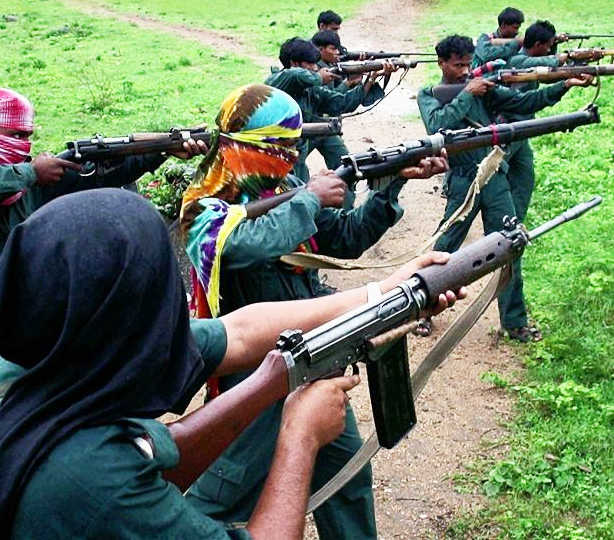
For the CRPF, the killing of 25 personnel by Naxalites in Chhattisgarh’s Sukma district does not qualify as the “human right violation” of the slain jawans, judging by the paramilitary force’s reply to a Right to Information (RTI) query.The CRPF gave this response while refusing to share its inquiry report into the incident with an RTI applicant. Human rights activist Venkatesh Nayak had sought the report, saying the massacre violated the human rights of those killed in April this year. The force is exempted from making disclosures under the RTI Act unless the information sought pertains to allegations of human right violations and corruption.Citing the exemption clause, the CRPF in its response said: “In the instant matter, there appears to be no violations of human rights as well as facts of the case do not attract allegations of corruption. Moreover, your application does not make any reference to such allegations. Hence this department is not liable to provide any information in this regard to your under RTI Act-2005.”The CRPF also said the report also could not be shared because it contained operational details.Nayak said the murderous attack by the ultras amounted to a violation of human rights by “non-state actors” and by denying this “reality”, the CRPF may be doing injustice to its personnel. “Every time such an attack occurs, self-appointed conscience-keepers of the ‘nation’ and advocates of a belligerent brand of ‘nationalism’…  accuse right advocates of not raising their voice against the violation of the rights of security personnel,” Nayak said. —

PTI – See more at: http://www.tribuneindia.com/news/nation/killing-of-jawans-at-sukma-not-rights-violation-crpf/425422.html#sthash.vvdn2hmt.dpuf