Sanjha Morcha

What’s New

Click the heading to open detailed news

Current Events :

web counter

Print Media Reproduced Defence Related News

Rana Gurjit, Majithia spar over ‘sexual harassment’ by tehsildar

Jupinderjit Singh

Tribune News Service

Chandigarh, September 12

Congress MLA Rana Gurjit Singh and Revenue Minister Bikram Singh Majithia were involved in a heated exchange during zero hour today over a case of alleged sexual harassment of a soldier’s wife by a tehsildar in Amritsar.Rana Gurjit alleged that the tehsildar sought sexual favours from the woman on the pretext of providing her property documents. He said the tehsildar made several calls to the victim from a Dubai SIM card. He said the woman informed her husband and relatives, who asked her to call the revenue official home. They allegedly beat him up when he reached there.Rana Gurjit claimed that a case was registered against the woman and six of her relatives, but no action was taken against the tehsildar due to political patronage. Reacting angrily, Majithia said the tehsildar had already been booked, adding that the ADGP (Crime) was investigating the matter.Majithia said the Congress MLAs had made it a habit to politicise every issue, but they should spare such sensitive ones. Deputy CM Sukhbir Badal intervened to end the verbal duel. He assured the House that strict action would be taken in the case within 24 hours


Identity, lost and found Col DS Cheema (Retd)

I RECALL the days when, as a young man, I was carefree. Today, I see those days as the wheel of fate that turned for me.My first posting, in 1963, was to a field unit in the East. The long journey from Secunderabad to NEFA, first by train and then by road, was not eventful, as most of the time I was concerned about the safety of my personal weapon, a Sten gun, which was an essential inventory of an Army officer posted in the East then. My unit had two young officers like me and was commanded by a Major. Except for the Officer Commanding (OC), who had his basha near the Officer’s Mess at the foot of a hillock, the rest of us were put up on the hilltop. Young officers consider their first posting as a two-year ‘honeymoon’ which they try to make the best of. One evening, a friend was waiting for me in my basha so we could go for an exciting outing we had planned days earlier. After some aborted attempts to tie the turban, I, abetted by my friend, was convinced that the only way I could leave on time for any engagement was to change my head-gear permanently and start wearing the jungle hat. The next morning, the OC did not recognise me at the breakfast table and when he learnt from others about the change of my identity, he asked me in a stern voice to report immediately to him in his office. In the Army, any change in identity is possible only after taking prior permission from the higher authorities. Furious, the OC ordered me to get back to the original me as early as possible, failing which disciplinary action would be initiated against me. There was no way I could obey his order, and so, after a few days, I was handed a confidential envelope containing a show-cause notice. Though it scared me, I did not understand the gravity of the situation and wrote back, well before the deadline, to be forgiven for the mistake committed. Two days passed off peacefully, during which the OC did not interact with me, except nodding in response to formal greetings. However, the very next day, I learnt that I would be marched to the Commander (a Lt Col) for necessary action. It came as a bolt from the blue. In those days, the gap between a barsati Captain (which I was) and a Lt Col was very wide. After interviewing me, the Commander thought it a fit case to be forwarded to the higher authorities, in this case, the Corps HQ.When I reached the Corps HQ on the fateful day, I felt as if everyone there had come to know of my misconduct and were looking at me with contemptuous amusement. I was marched to a Brigadier who barked a few unprintable, harmless abuses and dismissed me in just a minute or so. I later learnt that immediately after dealing with me, he called the Lt Col who was waiting in the next room and admonished him for not being able to handle the problem at his level. I felt happy to know that the Commander had received more dressing down than me! I applied for a new identity card and the matter was settled once for all. A few years later, I regained my identity due to another interesting turn of events.


Will work to bring back normalcy in Valley: Army chief

SRINAGAR: Assuring support to bring normalcy in the Valley, particularly the four restive districts of South Kashmir, Army Chief General Dalbir Singh reinforced the need to synergise efforts with all stakeholders.

Calling for high vigil along the Line of Control (LoC), Gen Singh urged the troops to sensitise people, especially the youth, to abandon violence and usher peace.

Singh is in Srinagar to review the security situation in the Valley, especially the volatile North and South districts.

Singh’s visit comes amid reports that army will be deployed in South Kashmir where widespread protests were reported after the death of militant commander Burhan Wani on July 8. At least 75 people have died in the Valley in clashes between the security forces and civilians.

The army spokesperson in Srinagar denied having any information about the new strategy, however, sources say the army will be used for increased “area domination and patrolling’’ and not for crowd control. Law and order enforcement will remain with the local police and the Central Reserve Police Force (CRPF).

General Dalbir Singh arrived in Srinagar on Friday morning and was briefed by General Officer Commanding of Chinar Corps Lt Gen Satish Dua.

According to the army spokesman Gen Singh visited defence formations in the north and south of the Valley to get first-hand account of the situation.

He was accompanied by Northern Army Commander Lt Gen DS Hooda and Chinar Corps Commander Lt Gen Satish Dua. The chief reviewed the security situation and collaborative measures taken by the security forces to bring peace in the region.The Chief also interacted with the J&K DGP and briefed Governor N N Vohra about the prevailing situation.

“The chief commended all ranks of Chinar Corps for their operational preparedness and commitment. Reinforcing the need to maintain high vigil along LoC, he also appreciated humanitarian initiatives by the troops to bring relief to locals during the ongoing unrest. He asked them to sustain positive engagement with the people,’’ the spokesman said.

Later, the Army Chief also came to BB Cantonment, Srinagar where he was briefed by the Chinar Corps Commander on the initiatives taken by the Army all across the Valley to bring about peace.

clip


No underwater locator in AN-32, search still on

New Delhi, August 1

The missing AN-32 aircraft, which had flown multiple times over the Bay of Bengal carrying military personnel and equipment, did not have an underwater locator system, making it difficult for the rescuers to pinpoint the position of the plane that went down over the sea with 29 persons on board on July 22. In fact, none of the upgraded AN32 aircraft, the main workhorse of the military, has an underwater locator, unlike the modern transport planes such as C130J or C17.This means the search and rescue team has no idea where the plane is. The search, which entered the 11th day today, is being carried taking into account the last contact point of the aircraft before it disappeared. “We are using sonars of submarine, ships and other naval assets to locate the aircraft. There is no signal available to track the missing aircraft,” a defence source said, adding the search would continue.The missing aircraft came with two Emergency Locator Transmitter (ELT)—a stationary ARTEX C406-1 ELT manufactured by ACR Electronics/Artex Products, the US, and a French-made portable KANNAD 406AS ELT manufactured by Orolia. In emergency, the pilot has to activate the ELT beacon manually. The integrated ELT gets activated when the impact is about 2.3 G or 4.5 feet per second.However, ELT would not get activated automatically since radio waves are not transmitted in water. “There is no signal from ELT under water for this reason,” IAF sources said.Trials were already on to procure underwater ELTs for the aircraft and, as an emergency measure, effort is to have some kind of an underwater ELT on any aircraft that flies over water.Also, the AN-32 aircraft does not have the Automatic Dependent Surveillance – Broadcast. This system relies on navigational satellites to automatically transmit an aircraft’s journey in real time and it can be switched on and off based on operational needs.Defence Minister Manohar Parrikar had said as per the standard operating procedures started at 1230 hours, one hour after the scheduled arrival at Port Blair and nearly three-and-a-half hours after the plane went out of ground radar cover area. It was only at 1225 hours that Maritime Rescue and Coordination Centre, Chennai, reported that an IAF AN-32 (AF-330) was not in contact. The weather at the time when the plane went missing was overcast with multi-layered clouds and embedded convection. — PTI


Sikh US veteran stands out in pink turban at Democratic convention

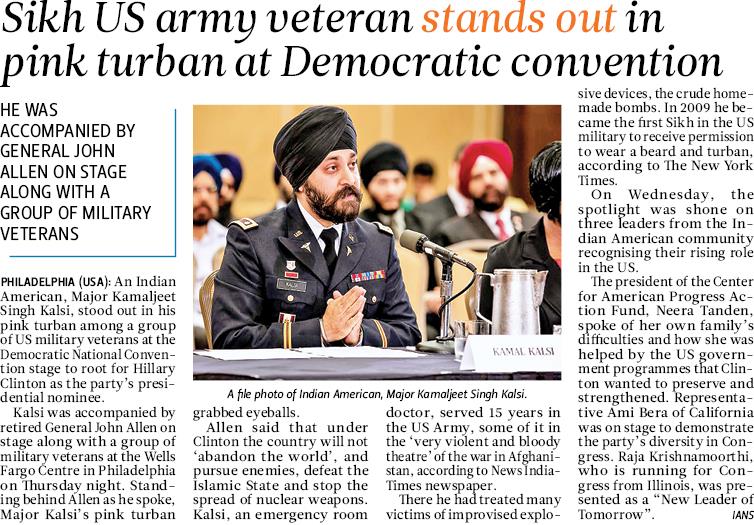
PHILADELPHIA (US): An IndianAmerican Sikh, Major Kamaljeet Singh Kalsi, stood out in his pink turban among a group of US military veterans who took the stage at the Democratic National Convention, to root for Hillary Clinton as the party’s presidential nominee on Thursday night.

NYT PHOTOIndian-American Sikh, Major Kamaljeet Singh Kalsi, seen on the stage as Gen John Allen (retd) speaks on the final day of the Democratic National Convention at Philadelphia in the US.

Kalsi was accompanying General John Allen (retired) along with a group of military veterans at the Wells Fargo Centre in Philadelphia. Standing behind Allen, as he spoke, Major Kalsi’s pink turban grabbed eyeballs.

Allen said under Hillary the country will not “abandon the world”, and pursue enemies, defeat the Islamic State and stop the spread of nuclear weapons.

Kalsi, an emergency room doctor, served 15 years in the US Army, and earned a Bronze Star in Afghanistan for his meritorious service in combat zone. There he had treated many victims of improvised explosive devices, the crude home-made bombs.

Raised in New Jersey, Kalsi became the first Sikh in the US military to receive permission to wear a beard and turban in 2009. He had to wage a two-year campaign that resulted in the army granting him a special exception, the first such to a policy established in 1980s.

Kalsi left active duty in 2013, and started a campaign to challenge the strict grooming policy that he believes has blocked hundreds of Sikhs from joining the military.

(With inputs from NYT)

59576


Why is AFSPA under constant attack? Lt Gen Harwant Singh (retd)

The very fact that the military is called upon to join is an admission that the situation is extraordinary. It is well outside the capabilities of the state and central police to manage. An area or a state has to be first declared as a “disturbed area” and only then can AFSPA be brought in.

Why is AFSPA under constant attack?
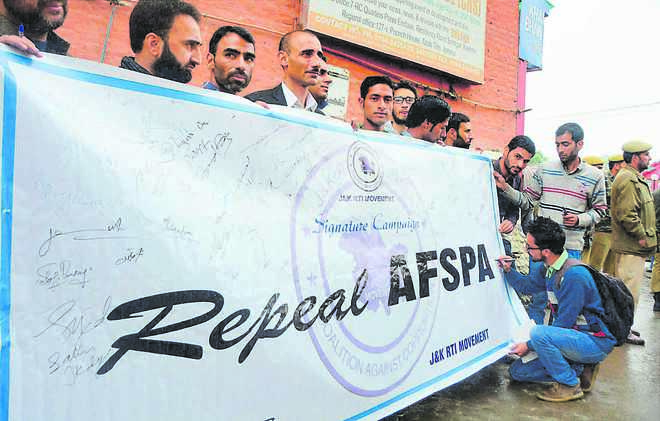
Members of the Jammu and Kashmir RTI Movement hold a signature campaign for repealing the Armed Forces Special Power Act (AFSPA) at Lal Chowk, Srinagar. PTI

Counter-insurgency operations are a messy affair. There are no definite, lines, modes and structures that determine the scope and specificity of scales of operations by the military in dealing with them. Every situation has its own peculiarities and operating environment. Therefore, no same set of rules and methods can be applied in every case, though caution and restraint should be a constant factor in such operations.  What needs to be borne in mind is that the overall environments in which these operations are conducted are generally hostile towards the security forces and people’s sympathy is invariably with the insurgents.

Disenchantment of the people

Insurgencies have their roots in the disenchantment of the people with the prevailing socio-politico-economic environment in a given area. Such conditions impel some to take up arms where sympathy and support of the local population of the area invariably follows. In such an environment, intelligence sources for counter-insurgency operations are few and under the constant threat of elimination. Unless the root causes for emergence and sustenance are addressed, insurgencies, tend to go on with their usual ups and owns, depending on counter-insurgency resources deployed to counter them and the successes they achieve. In other words, the alienation of large sections of the population is both the cause as well as the life-support system of insurgencies. These may be indigenous or foreign inspired and supported.The Army at best can create an environment for a period of time for the politico-socio-economic steps to be initiated rapidly and purposefully implemented, so as to limit, if not completely remove, the grounds for alienation. During such windows of opportunities general administration too must act and together with politico-economic efforts seriously attempt to remove the root causes of disaffection.  Unfortunately, our long experience, both in Jammu and Kashmir and the North-East has been contrary to such expectations. Consequently, insurgencies have persisted and counter-insurgency operations and AFSPA have been continuing. Although a plethora of police organisations are available to the government, it is due to their failure to contain insurgency on their own that the Army is called in. The very fact that the military is called upon to join is an admission that the situation is extraordinary and well outside the capacity and capabilities of the state and central police to manage.  An area/state has to be first declared as a “disturbed area,” and only then can AFSPA be brought in. Military when called in to aid to civil administration, even to deal with law-and-order situations, is not bestowed with any legal or police powers. The magistrate has to be at hand for a military detachment to engage with or fire on an unruly crowd or a lawless group indulging in arson and looting. In the absence of AFSPA and during counter-insurgency operations, a magistrate would be required to give written permission to the military to resort to firing.  If the military were to engage terrorists without AFSPA, every incident may call for judicial inquiry and with a hostile population, motivated evidence will invariably pile up against the military.  Troops will be demotivated and may even turn a Nelson’s eye in their hunt for terrorists. No soldier would like to do the rounds of civil courts for a decade and more. The Supreme Court has rightly opined that indefinite continuation of AFSPA negates and mocks our democratic process and symbolises the failure of civil administration.  The judges have further observed that ordinarily our armed forces should not be used against our countrymen and women and that every person carrying a weapon in a disturbed area cannot be labelled as a terrorist or an insurgent and be killed without any inquiry!  My Lords, the situation in insurgency areas is very often such that it is impossible to tell an insurgent from a peaceful citizen, more so, if he is carrying a weapon in certain restricted areas. On many an occasion for a soldier it is either kill or get killed. Undoubtedly, due care and restraint must be exercised in the counter-insurgency operation, so as to avoid collateral damage in way of death or injury to innocent men. However, there are occasions when unavoidable collateral damage does take place, in spite of best of precautions. Very often, collateral damage is inflicted by the terrorists, knowing full well that the blame for such damage will invariably rest with the Army. While situation and causes for insurgency in Jammu and Kashmir and the North-East are quite apart, a common thread runs when it comes to accusing the military for fake encounters and extra-judicial killings. It may be recalled that there was much media hype and engineered public outcry at the alleged rape and killing of Manorama by the Assam Rifles personnel.  Manorama was a terrorist and a PLA member, involved, over a period of two to three years in laying IEDs, leading to the death of six civilians and two Army men.  At the time of her arrest, a transmitter and a grenade were recovered from her. She was killed while trying to escape. Two separate and independent autopsies ruled out torture and rape. The nature of bullet injuries confirmed the escape story.  It is not to contend that there have been no fake encounters or extra-judicial killings, but it needs be stated that in all such cases military carries out its internal investigations to determine the truth. It may not be in the knowledge of the public and the media that well over a hundred court martials have been held where some senior officers too ended up behind bars.The point that needs consideration is that with more than enough central police is available to combat insurgency, in Jammu and Kashmir and the North-East, why seek deployment of the Army in these areas? Consequently, the government can do away with AFSPA. When an Army post or vehicles column is attacked by insurgents, they have the legal right to protect themselves and the government property. Central police deploys companies but rarely full battalions. While they do corner special allowances when deployed as companies, but their efficiency in this manner of deployment does suffer.   The writer is a defence analyst


No clue of AN-32, satellite imagery sought

Chennai/Visakhapatnam: As the arduous operation to trace the IAF’s missing AN-32 aircraft with 29 people on board stretched into the third day on Sunday, the search and rescue team sought satellite imagery to find any clue of the plane that lost contact over the Bay of Bengal. “There is no sign of the plane as yet,” a senior defence official said. At least 18 navy and coast guard ships, including a submarine and eight aircraft, are involved in the round-the-clock operation to search for the Port Blair-bound transport plane that went missing after it took off from the Tambaram air base near Chennai on July 22. PTI


Only Kashmiris can give verdict on Kashmir: Pak

Tribune News Service

New Delhi, July 24

Insisting on its right to comment on developments in Jammu and Kashmir, Pakistan today said only people of the state could deliver a verdict on the future of Kashmir and not External Affairs Minister Sushma Swaraj.(Follow The Tribune on Facebook; and Twitter @thetribunechd)Countering Swaraj’s statement that J&K belonged to India, Pakistan Foreign Affairs Adviser Sartaj Aziz said: “Such a verdict on the future of Kashmir can only be given by the people of Kashmir and not by the External Affairs Minister of India. This right has been promised to the people of Kashmir by the UN Security Council. It is high time that India allowed the people of Jammu & Kashmir to exercise this right through a free and fair UN-supervised plebiscite. Once the majority of the people of Kashmir have voted for joining either Pakistan or India, the whole world will accept this verdict of the Kashmiri people.”


America unhappy with Pakistan for allowing Hafiz Saeed’s anti-India rally

Wanted by the US.

Washington, July 22

The US administration has taken a serious note of Pakistan permitting Jama’at-ud-Da’wah leader Hafiz Saeed, a terrorist wanted by the United States and with a bounty of USD 10 million on his head for information leading to his arrest and conviction for involvement in the Mumbai terror attacks of 2008, to openly lead an anti-India rally of his supporters from Lahore to Islamabad on July 19.Saeed led a Pakistan government call to observe July 19 as a “Black Day”, apparently to draw attention to the “burning issue of Kashmir”.The Obama Administration has been taken aback by this event, as it clearly established a link between the Pakistan government and Hafiz Saeed who is on America’s most wanted list. The United States has designated Saeed-led organisations–the Lashkar-e-Toiba (LeT) and the Jama’at-ud-Da’wah (JuD) as foreign terrorist organisations. Saeed has also been listed as a terrorist by the UN Security Council’s 1267 Al Qaeda Sanctions Committee.South Asia watchers in Washington say that by allowing a terrorist to take up a government-sponsored cause, Islamabad has bared its selective approach towards terrorism. When banned outfits are allowed to openly hold rallies in Pakistan at the behest of the government, the allegations about Pakistan using terror as state policy appear to gain ground.Experts say that had Pakistan banned Saeed from holding the rally, and instead placed someone else in charge of the July 19 protests, that would have been understandable. The question that arises in the minds of South Asian analysts is why Saeed? Is it because he is a terror asset which the state cannot do without?Experts have questioned is Saeed so important that Islamabad is risking an important relationship with the United States.

Pakistan’s irrevocable links with Saeed have disappointed the Obama Administration, but have not shocked officials. It was always known in Washington’s South Asia circles that Saeed is an asset that the Pakistani state will always protect notwithstanding the fact that he is a designated global terrorist.Saeed’s terror group, the LeT, remains active and open in Pakistan, and just recently, had the audacity to attack Medina in Saudi Arabia, in which 12 of its suspected members were arrested. This connection was also highlighted by a European Parliament Report by Vice-President Ryszard Czarnecki, where he pointed out how the Falah-e-Insaniyat Foundation (FIF), a charity front of the LeT, was radicalising Pakistani diaspora while the state was a mute spectator.The Saeed-Pakistan linkage as evidenced by the July 19 Kashmir rally is certain to be brought up on Capitol Hill where proposals are afoot to cut financial aid to Pakistan in the absence of a complete and verifiable delinkage with  terror groups.While the Obama Administration has been supporting Pakistan as an important ally in the war against terror, the latest incident where a wanted terrorist has been given state patronage is certain to raise questions and embarrass the former. ANI


Emergence of a new dynamics in Kashmir ::::Arun Joshi

There has been a drastic shift in Kashmir. The notion that militants should die for they have picked up the guns to fight and die has now been replaced with “save-the-militants” refrain. There was a time when attendance at militants’ funerals had been reduced to a trickle.
Emergence of a new dynamics in Kashmir
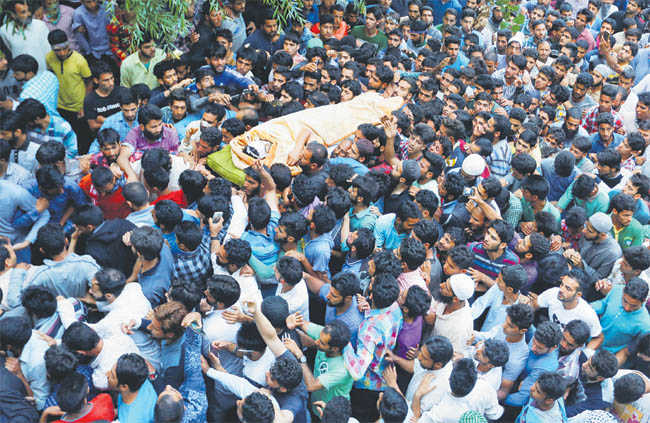
The upsurge at militants’ funeral needs to be analysed. Kashmiri Muslims carry the body of Burhan Wani at his funeral in Tral, south Kashmir. Reuters.

The ongoing street protests in Kashmir have unveiled the new dynamics of conflict.  Common Kashmiris  are faced with an inescapable dilemma. There is an unfathomable reservoir of sympathy with stone-throwing crowds in streets. Targeting the police and the security establishments represents  anger against the uniformed men — the other side  of the conflict.  For those, from bureaucrats, politicians (ruling or opposition) besides the known faces and voices of separatism, the other side  should be out of the Valley. Ironically, the same majority is also yearning for normalcy — disciplined  working in offices, uniformed children heading to schools, markets open  and plying  of vehicles without the fear of being hit by stones. Only the people of Kashmir know what they are undergoing. The reconciliation between the yearning for normalcy and the sympathy for the anarchy on streets is something that has haunted them for over the years. This time, it is different. Street protests triggered by the killing of Hizb-ul-Mujahadeen commander Burhan Wani on the night of July 8 have assumed new dimensions. Social media played a critical role in evoking such protests because Burhan epitomised  the pure Kashmiri face. It was in  the forests of this village where he was born that he received his training in arms, thereby contributing to his glamorous appeal for youngsters on the social media. In Kashmir, like any other conflict area, the social media appeal traverses far beyond entertainment and routine morning greetings. It is a potent tool to spread disaffection to enbale the drafting of more youth into militancy. Guns symbolise romance and the chances of becoming a known face, if not a hero, overnight. Looking at this thinking would reveal that the images of the past have faded into insignificance. This is the legacy of the Burhan cult. When the youth get killed or wounded by the security forces on the streets, sympathy  pours in  from parents otherwise  angry  over the audacious  defiance of their advice to children not to venture into stone-throwing  zones. The whole neighbhourhood joins in.  The rest of the job is done by the  social media. The government is wrong in believing that it has placed curbs because the images  that attract youth to the streets  are still  doing the rounds. Satellite phones are available and are working. Many are enjoying official patronage and facilities. This  dreaded cycle of violence has been going on for years now. The 1990 phenomenon was processions, hit-and-run tactics, hurling of grenades and firing of thousands of bullets with not even a single injury, or the panick-stricken  troopers firing into the crowds. That was the 20th century. The 21st century, particularly after  9/11, was an era of shift in staging attacks  as  horrifying as the  attack on the legislature. There was an intensity in “fidayeen” missions. Now, post-Burhan, there is a gigantic change in the thinking of Kashmiri Muslims. The refrain: “Let militants die, for they have picked up guns to fight and die,” has been replaced with the “save militants.” There was a time  when attendance at militants’ funerals had been reduced to a trickle. The anger would spill over  only if the civilians were killed. In 2008 and 2010, situations were created where only civilians, protesting in streets, were killed or injured. Similar scenes are getting replayed  in 2016, with a significant change in tactics. This time, the security establishments face a volley of stones. Security forces, under orders not to retaliate in proportion to the level of attack, have started  shifting their posts. The objectives  are becoming clear. For saving militants, the first method was offering  a human shield and the disruption of forces’ operation against them, no matter whether they were Pakistanis or Kashmiris. Now the massive protests are organised with a call that the militants should not be touched at all.  Let militants kill and wound the security personnel, but there should be no retaliation. This is a new phenomenon in this state.  They saw the eight CRPF personnel gunned down, but wanted no retaliation. Two militants were killed, but then the sympathies were with the two militants and not the eight CRPF personnel — a typical mindset reflecting a conflict situation. Reasons are not far to seek.  For long, Kashmiris had  felt that the Centre imposes governments on them. “The Indian democracy never crosses Lakahanpur ( the gateway of Jammu and Kashmir bordering Punjab)”, is what late Abdul Gani Lone, the founder of Peoples Conference, said He had contested a number of elections and won. In 1987, he felt cheated, like many others. Syed Ali Shah Geelani had won that election from Sopore. Post-2014 polls, the people in Kashmir could not reconcile to the saffron of the BJP and the green of the PDP marching together. They felt betrayed. This sense of betrayal engendered frustration and hopelessness with a question: If the PDP cannot stand for us, then who can?  Separatists too have chinks in their armour.  Political frustration has made them empathise with  protestors, whom they see representing a challenge to  the system imposed on them. Also, there are hard realities which they cannot overlook. There has been no solution of the Palestinian issue that has been simmering for decades, despite all what the Palestinian groups like the PLO and Hamas could do — ranging from   wars  to intifada  to suicide bombings, shootings at public places and killing  of Israeli soldiers with knives. Kashmiris want a stable and  normal future for their children. “We are happy our children are not here  (Kashmir),” is what one hears from the parents whose children are studying outside the Valley. Obviously, they don’t want  their children to live in  the troubled state  or become a part of  the wheel of violence. Those who cannot afford to educate their children outside have no option. They have the overwhelming desire that their children stay out of trouble and shape their careers in normal times. They want this cycle of violence to come to an end. More than anyone else, Kashmiris pray that no killing should take place so that normalcy can return. They yearn for and wish for restraint on the part of the security forces.  The appeals for restraint to security forces sound music to their ears. But when they are asked to restrain their children from the violent protests, they know that their advice will fall on deaf ears. Their unending dilemma stems from this. A Kashmiri in his thirties advising his child not to venture onto the streets, was told by the child that he had posted something contrary  on his Facebook account for the (children) of others. This is what today’s Kashmir is. 




ajoshi57@gmail.com.