









Sanjha Morcha

What’s New

Click the heading to open detailed news

Current Events :

web counter

Print Media Reproduced Defence Related News

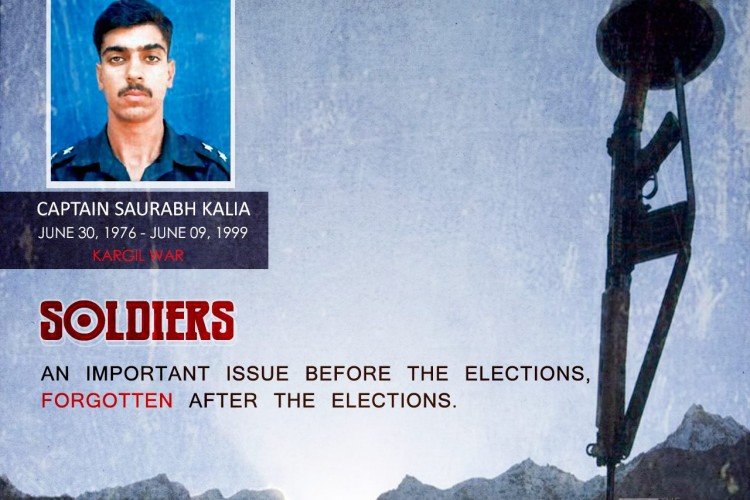
Justice for Himachal’s braveheart, first M A R T Y R of Kargil war Saurabh Kalia remains ‘Political Gimmick

A person who suffers very much or is killed because of their religious or political beliefs, and is often admired because of it.
 

IMG-20160622-WA0016

According to Cambridge Dictionary this is what a “martyr” is.

May it be NDA or UPA, the Govt. failed him. Mr. Modi made huge promises during his election campaign in 2014 and one of it was that his government will approach The International Court of Justice, in Hague against Pakistan for the injustice done to a brave son of India. Till now it has just proved out to be a ‘Political Gimmick’.

SHIMLA- It was May of 1999 when winter was about to end, and snow had started to melt down on the mountains of Kargil. Due to extreme temperature at such high altitude of 14000 feet all the check posts and barracks of Indian army were seized by snow. In first two weeks several patrols were conducted by different patrolling teams in Kaksar Langpa area of Kargil district by Indian Army to check whether the snow had retreated enough for the summer positions to be re-occupied.

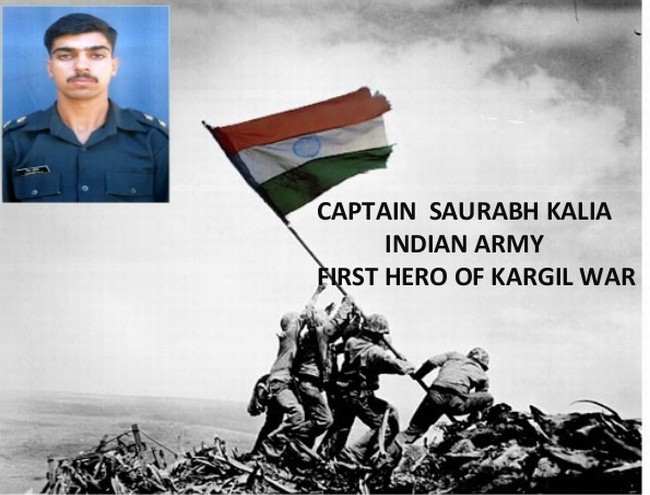
First patrol team who observed and reported large-scale intrusion on Indian side of the Line of Control(LoC) at Kargil was of Captain Saurabh Kalia and his men. It was 15th of May when patrol team of Captain Saurabh Kalia with his men from 4 Jat Regiment were on regular patrol of Bajrang Post in Kaksar sector, where they had an encounter with intruded Pakistani Army. Five Indian Soldiers faced nearly 200 Pakistani rangers with very limited ammunition.
justice for captain-saurabh-kalia

Before Indian reinforcements could reach them, they ran out of ammunition and were captured alive by Pakistani Rangers. And as well planned incident, no trace was the patrol was left by Pakistan. After this incident that India discover hundreds of guerrillas had established fortified positions on the peaks of the hills deep inside the Indian Line of Control, with sophisticated equipment and supply lines back to Pakistan Controlled Kashmir.
Parents of saurabh kaliya

Captain Saurabh was searched by Indian army in rugged, treeless Ladakh Mountains but there was no sign of the missing troop. After 22 days from the first encounter between two nations in Kargil area, Pakistan Army handed over dead body of Captain Saurabh Kalia to Indian army commanders at the Kargil sector. The injuries on their body clearly revealed the horrible torture they had faced before being murdered. After the Post-mortem examinations the result shocked the whole nation. It was one of the most inhumane and extreme cases of torture in the history of wars. The Geneva Convention was ripped apart and Captain Saurabh was tortured for 22 days and killed after he was captured at Kaksar.

According to post-mortem report there were several burn marks on the body which seems that they were BRUTALLY BURNT with cigarettes all over the body. Their eardrums were PIERCED with hot rods, their eyes were PUNCTURED and removed with knife. Most of the teeth and bones were BROKEN. The skull was HAMMERED and FRACTURED. Lips and Nose was CHIPPED. Limbs and Genital were CHOPPED OFF. And finally he was shot DEAD.

This death was first casualty of the Kargil war which saved lives of other soldiers and we won Kargil war because Captain Saurabh Kalia opted to bear all this torture rather than revealing secrets of Indian Army to enemies.

Mr. Modi made huge promises during his election campaign in 2014 and one of it was that his government will approach The International Court of Justice, in Hague against Pakistan for the injustice done to a brave son of India. Till now it has just proved out to be a ‘Political Gimmick’.


The government of India has failed to do justice to this martyr, may it be NDA or UPA all are the same.
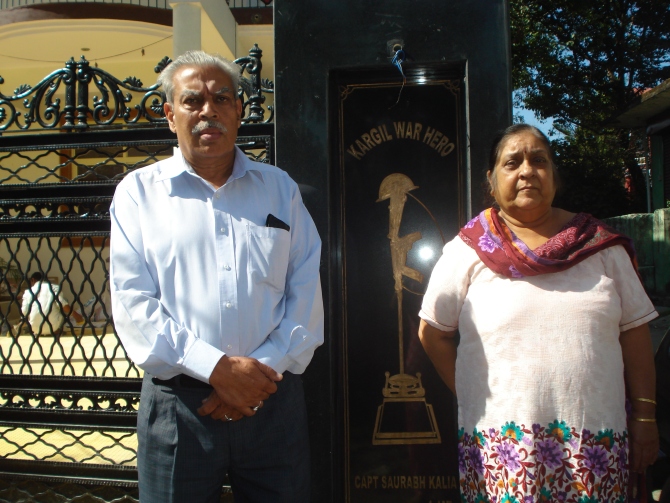
It is the sole responsibility of a nation to ensure the respect and justice to its martyrs, which has been denied in this case. Captain Saurabh Kalia is a martyr and he is still with us in our thoughts and hearts, because a martyr never dies.
Kashmir on boil again, unclear who’s stirring pot

Kashmir on boil again, unclear who’s stirring pot

Arun Joshi

Tribune News Service

Srinagar, July 13

The truth of Kashmir today is that it is different from the summer of 2008, when protests were held against the transfer of ownership of land to the Amarnath Shrine Board, and from the summer of 2010, when a student’s killing had triggered violent unrest.There are no demands and no one is sure about what will happen next. Friday, the day of congregational prayers, will be the litmus test of how the summer unfolds.That Kashmir is burning is an understatement. The flames leaping out of police stations, Syed Ali Shah Geelani’s call not to attack such installations notwithstanding, and the street violence and 34 deaths point to a grim situation. There’s a bigger concern: the anger of the youth, on brazen display following the death of Hizbul Mujahideen commander Burhan Wani last Friday.To those who question whether one militant leader’s death could be the sole reason for the violence and killings, there are no easy answers. A taxi driver puts in his perspective: “Wani used to be active on Facebook, you know, every youngster had his picture in the mobile phone.”Separatists had warned of a major agitation after Eid, celebrated last week, but were unsure about how to pull it off. Hurriyat leader Mirwaiz Umar Farooq had spoken of a massive agitation if the government failed to clarify its position on the setting up of “Sainik Colony” and townships for migrant Kashmiri Pandits. But within the separatist camp, there was no consensus on stirring the Kashmir cauldron. Their shutdown calls were receiving a mixed, almost tepid, response.In the aftermath of Wani’s killing, separatists as well as Pakistan have attempted to own the near-spontaneous reaction of people, which has been so widespread that markets have remained shut for the first time in villages in the past 26 years of unrest. However, the separatists have so far achieved little success in gaining control of the unrest, Geelani’s appeal not to attack police stations a case in point. The bitter truth is that Burhan Wani, 21 — with a few pictures and two videos — has singularly managed to almost demolish the effort of the state and Central governments to win the hearts and minds of people.

Sharif calls Cabinet meeting to discuss Kashmir situation

Islamabad, July 13

Pakistan Prime Minister Nawaz Sharif called a special Cabinet meeting in Lahore on Friday to discuss “deteriorating situation” in Kashmir on Wednesday as death toll in violence that followed the killing of Hizbul Mujahideen commander Burhan Wani climbed to 36.”The Cabinet will discuss the oppressive actions of Indian security forces against innocent civilians and the over all situation in Kashmir after the brutal assassination of Burhan Wani,” the Prime Minister’s Office said in a statement.The meeting at the Governor House in Lahore will discuss the “rapidly deteriorating situation” in Kashmir to discuss a “future course of action”, the statement said, in a move that is likely to antagonise India.Pakistan’s Foreign office has summoned the Indian High Commissioner to have him convey “concerns of the Pakistani government and people on rapidly deteriorating human rights situation in Kashmir and increasing oppression by Indian security forces” to the Indian establishment.Ambassadors of permanent members of UN Security Council were also briefed of what it calls “excesses” by Indian security agencies.”The resolution of the Jammu and Kashmir dispute is only possible by the realisation of the right to self-determination of the people of Jammu and Kashmir, as per the UNSC resolutions, through a fair and impartial plebiscite under UN auspices,” Sharif said in a statement.Pakistan Foreign Secretary also spoke to ambassadors of countries in the OIC Contact Group on Jammu and Kashmir (consisting of Azerbaijan, Saudi Arabia, Turkey and Niger) and the ambassadors of European Union. India has already asked its neighbour to keep out of what its “internal affairs” after Sharif issued a statement conveying “shock” over Wani’s killing.India and Pakistan frequently spar over Kashmir, a disputed territory that both countries claim. India accuses Pakistan of interference and encouraging terrorism in the area. — Agencies


Haryana Sainik school expedition flagged off

AMBALA: Kharga Corps Chief of Staff and local board of administration, Sainik School, Kunjpura, chairman Major General Somnath Jha on Monday flagged-off 38-members mountaineering expedition team, comprising 36 cadets, representing Sainik Schools of the country and two staff members to Stok Kangri Peak (6158 meters) in the Leh region of Jammu and Kashmir.

HTPHOTOSainik School team at the flagging off ceremony on Monday.

On the occasion, principal of Sainik School, Kunjpura, Col YS Parmar informed about the various adventure activities that form an integral part of the power packed training imparted to the students in Sainik Schools.

The expedition will be for 25 days.


Naval safety in choppy waters

Dinesh Kumar
It has been raining accidents, casualties and court martial in the Navy. In the last ten-and-a-half years alone, there have been at least 65 mishaps of various kinds involving the Navy’s surface, sub surface and air fleet.

Naval safety in choppy waters
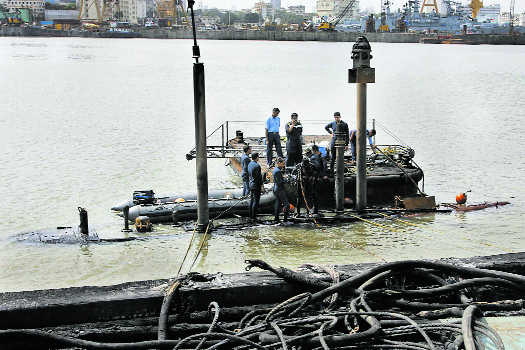
Indian Navy divers at the conning tower of the INS Sindhurakshak, after it sank in August 2013, at the naval dockyard in Mumbai. AFP

Already plagued by delays in fresh inductions to replace an ageing fleet of ships, submarines and aircraft, the Indian Navy, cited as the world’s seventh largest, continues to be regularly afflicted by accidents on a scale otherwise unprecedented in India’s post-Independence history. In the latest incident, a sailor along with a civilian worker died on June 10 following a toxic gas leak on board India’s 34-year old Soviet-origin aircraft carrier, the INS Vikramditya, inducted in June 2014. This is the fourth known incident so far this year which, combined, has claimed the lives of four Navy men and one civilian. In March, a sailor was killed battling a fire and steam leak on board the navy’s second aircraft carrier, INS Viraat, a 56-year-old British-origin carrier that is expected to be decommissioned this year. This was followed soon after with the death of two officers, including a lady pilot, when a German-origin Dornier-228 aircraft crashed at sea. Then, in April, a sailor lost his leg while two more were injured in an oxygen cylinder blast aboard INS Nireekshak, a diving support vehicle. 

Human & material failure

It has, in fact, been raining accidents, casualties and court martial in the Navy. In the last 10-and-a-half years alone (December 2005 till date), there have been at least 65 mishaps of various kinds involving the Navy’s surface, sub surface and air fleet that have resulted in the death of at least 37 navy personnel including officers; the loss of four vessels, including a submarine; the loss of at least nine aircraft, including two unmanned aerial vehicles; and disciplinary action against at least as many as 148 navy personnel (112 officers and 36 sailors) as of March 2015.This has included dismissals and divesting captains of command. Inquiries have either been just concluded or are continuing in about 10 cases, which are expected to increase the figure of those court martialled. The accidents, attributed mainly to either human error or material failure, have ranged from grounding of ships and damage to their propellers and sonars to on board gas leaks, fires, collisions, explosions, sinking of vessels and air crashes. There have been at least a dozen incidents of collisions at sea and in the harbour area, eight incidents of grounding or of vessels touching the sea bottom and 11 incidents of fire in addition to vessel and aircraft loss during this period.The worst incident in India’s post-Independence naval history has been the horrific sinking of INS Sindhurakshak, a Russian-origin submarine, following a series of explosions in its torpedo compartment in the wee hours of August 14, 2013 making it the first post-World War-II peace time sinking of a submarine while docked in harbour. Three officers and 15 sailors were killed in the tragedy. Three other vessels that have sunk during this period are INS Prahar, a Corvette, after colliding with a merchant vessel off the coast of Goa (the commanding officer was dismissed from service) on April 22, 2006, INS Vindhyagiri, a frigate, which capsized following a collision with a merchant vessel near Mumbai harbour on January 30, 2011 and a Torpedo Recovery Vessel (TRV-72) which sank near Vishakapatnam in November 2014, killing one sailor while four went missing. Earlier, on August 20, 1990, INS Andaman, a patrol boat, sank due to material failure in the Bay of Bengal. In all, the Navy has lost five vessels during “peace time”— in contrast to only one vessel, INS Khukhri, lost in a war (the 1971Indo-Pak war).The accidents have not been without its impact at the highest levels of the Navy. Admiral Devendra Kumar Joshi resigned as the Chief of Naval Staff on February 26, 2014, just six months after the sinking of INS Sindhurakshak, following a fire on board another Russian-origin submarine, the INS Sindhuratna, that claimed the lives of two officers. Much later, Admiral Joshi,who became the first Service chief to resign and demit office in post-Independence India’s history, was to comment on the questionable higher defence-management system in the country, an issue on which every Service chief has either privately or publicly commented.“The root cause”, Admiral Joshi, a distinguished submariner, tellingly remarked, “is this dysfunctional and inefficient business model that we have…While professional competence, accountability and responsibility is with the Service, this is not the case with authority…For example, when it comes to charging submarine batteries, which are available indigenously, or commencing refits and repairs of ships, aircraft, submarines in Indian yards, the Service (Navy) does not have that empowerment…Where there is authority, there is no responsibility. And where there is responsibility, there is no authority.”

Standard operating procedures

For 50 days after Admiral Joshi’s resignation, the Indian Navy functioned on an ad hoc basis with the Navy’s then Vice-Chief, Vice Admiral Rabinder Kumar Dhowan, officiating as the Navy’s Chief before being confirmed to the post. In the process, Vice Admiral Shekhar Sinha, the then senior-most officer, was superseded as most accidents had occurred in the latter’s jurisdiction of command (the Western Naval Command). Interestingly, Admiral Dhowan was appointed to the top post without his ever having earlier commanded even a Fleet let alone an operational command,setting a questionable precedent. Although the Navy has established a series of standard operating procedures and inspection-and-monitoring mechanisms, it is obvious that it has not had the desired effect. The Navy, which is losing men in accidents and in disciplining officers, is already suffering a 14.5 per cent officer shortfall of 1,578 and a 17 per cent sailor shortfall of 11,110. Training is a major area for concern as successive accident inquiries have revealed. But there are some areas which are outside the Navy’s domain. For example, the maritime environment comprising congestion in harbour areas which are part cause for collisions; delays in building naval bases far from congested areas; and material failures and the quality of repairs and overhauling on ageing ships and submarines in dockyards and shipyards. The responsibility has to be collective. Clearly, authority must involve responsibility and vice versa. 

dkumar@tribunemail.com


Lessons in schooling::: Brig MP Singh (retd)

Private schools were in the public eye recently due to many reasons. Government-run schools are marred by apathy, while private schools give education at a cost. Both need to thrive to eradicate illiteracy and optimise the potential of education

Lessons in schooling
Government schools have failed to fulfil the responsibility for educating children. Neither educational nor pedagogical needs are met. Privatisation has become indispensable. A file photograph of a government school in Jalandhar. Tribune Photo: Sarabjit Singh

Our Constitution has placed education on the Concurrent list, which has made central and state governments responsible for regulating all matters relating to all types of education, including technical, medical and vocational. However, education was not included in the list of Fundamental Rights. Resultantly neither the central nor the state governments made adequate arrangements for imparting even basic school education to its citizens. Illiteracy which was rampant before 1947, has continued to grow among the masses, particularly among the poor. Belatedly, the Right to Education Act, 2009,which has granted all children right to free and compulsory education, is expected to give relief from illiteracy. The Act was evaded for nearly 60 years after Independence because the education of large masses could not be supported financially and a sufficient number of schools was not built. Infrastructural and pedagogical needs could not be met fully. Since governments failed to fulfil educational responsibilities towards its citizens, privatisation of education became indispensible. Many private schools were opened and (some even with indifferent standards) have grown in numbers. The quality of education in government-run schools has been questioned time and again and there is need for considerable improvement. Even the CBSE Class X results released recently have not shown as impressive performances as private schools. As per the 2009 Act, children in the age group between 6 and 14 are compulsorily required to attend school and the penalty for not sending children to school on parents was fixed at one year of imprisonment. But no such punishment appears to have been awarded. To popularise attendance of school by children, schemes like mid-day meals, zero-fee and issuing of free books and stationery were introduced in some states. Even unaided private schools were required to admit a proportion of underprivileged children. These measures have shown some positive results, particularly in the case of education of girls. Even otherwise the number of school-attending children has increased and as per a government report (2013), nearly 22.9 crore children were enrolled in rural and urban schools, a figure that was higher as compared to 2009 — when the Right to Education Act was enforced. However, eradication of  illiteracy requires a lot to be done. A reason which may be responsible for poor performance can be that children attending school up to Class VIII cannot be detained. This provision needs review. The TSR Subramanian Committee, set up to draft the new education policy, has recommended detention after Class VI. In my view, even after the introduction of the system of continuous and comprehensive evaluation, examinations could not be dispensed with totally as education is not just about sending a child from Class I to Class VIII. Some achievements are necessary for continuing education later.  Privately run schools have a mixture of good and not-so-good schools. Public schools generally aim at the all-round development of a child. They are more expensive but are preferred schools. Lord Macaulay, who framed the education system in India in the 1830s, had built the school education system on the lines of the British system, where government-run schools and public schools coexisted. This became necessary as free education in government-run schools could not become affordable. The public schools in UK and Wales were “student selective and expensive fee-paying schools”. These schools were granted full autonomy in case of fee and allied charges and were managed by the board of governors. They were kept outside government interference. The first seven schools were: Eton School, Strawberry School, Westminster School, Charter House, Rugby House, Winchester School and Harrow School (Jawaharlal Nehru was educated here). These schools were associated with the ruling classes and they took the responsibility of educating the sons of officers and administrators of the British empire. On the lines of these public schools, Macaulay opened schools in the three Presidencies —namely, La Martiniere schools in Calcutta and Lucknow in 1836 and 1845, respectively, in the Bengal Presidency, Lawrence school Lovedale, Ooty, in the Madras Presidency and Elphinstone School in the Bombay Presidency. Soon after annexation of Punjab, the British opened Lawrence School Sanawar, in 1847 and Bishop Cotton School Shimla, in 1859. On the lines of the seven schools in UK, Aitchison College, Lahore and Rajkumar College, Rajkot were opened for the education of students from princely states.  All public schools in UK as well as those in India were self-financed, they concentrated on the over-all development of students, for which they provided expensive facilities, such as equitation, swimming, co-curricular activities and in some cases organised “exchange programmes,” which made them much more expensive than government-run schools. Lately, many schools in the private sector have come up and fancy calling themselves public schools. Needless to say, that some qualitative mandatory requirements must be laid down in case a school boasts of being a public school. As per the Human Resources Development Ministry, 29 per cent school children are studying in private schools, including public schools. Many more schools are required to accommodate nearly 6-7 crore non-schoolgoing children. Evidently, both public and private sector schools must go hand in hand to make the Sarva Shiksha Abhiyan a success. The writer is a former Colonel Commandant of the Army Education Corps. and an adviser of Mukat Educational Trust, Patiala.

COMMENTS

All readers are invited to post comments — responsibly. Any messages with foul language or inciting hatred will be deleted.

Share On


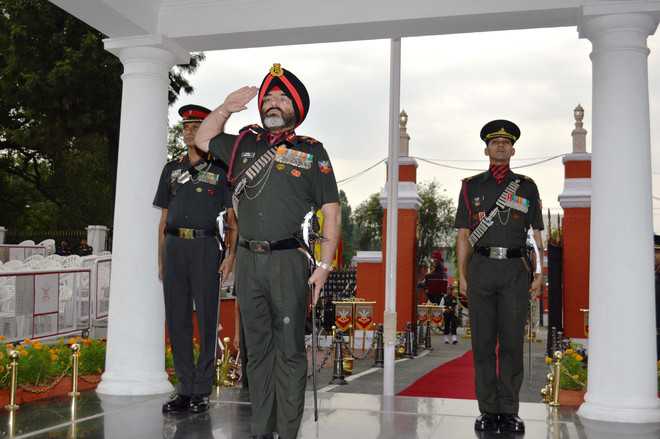
Maj Gen Mandip reviews parade at IMA

Maj Gen Mandip reviews parade at IMA
Maj Gen Mandip Singh takes the salute at a parade on the premises of the Indian Military Academy in Dehradun on Tuesday. tribune photo

Tribune News service

Dehradun, June 7

The parade for the deputy commandant and chief instructor of the Indian Military Academy (IMA) was conducted at the historic Chetwode drill square here today.As many as 565 Indian and 45 foreign Gentlemen Cadets displayed enthusiasm, vigour and zeal in the drill movements performed by them.Major General Mandip Singh, who has recently taken over as the deputy commandant and chief instructor of the IMA, reviewed the parade. He complimented the Gentlemen Cadets (GCs) of the passing-out course for a good parade. The efforts of the faculty and the hard work of the GCs was quite evident from the crisp and coordinated movements. The standards would further improve as the IMA nears the final passing-out parade on June 11, he stated.Maj Gen Mandip Singh complimented the GCs for their hard work and for having finally reached the threshold of a world filled with challenges and responsibilities. The GCs had been taught repeatedly to ‘lead by example’ and the soldiers who would be under their command should look up to them with pride. The duty of the IMA to train the GCs has ended and now they would step into their units and regiments, which would groom them further and make them responsible and competent leaders, he added.The event was a success and was witnessed by a large number of schoolchildren, residents and Army personnel with their friends and families.



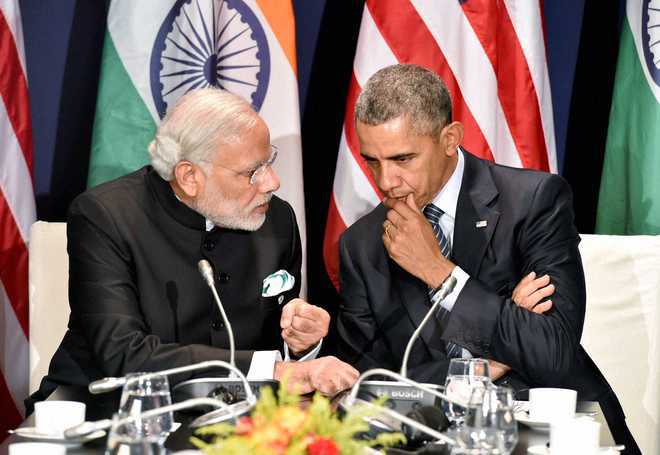
US expects India to join missile technology control group ‘very quickly’

US expects India to join missile technology control group ‘very quickly’
Prime Minister Narendra Modi and US President Barack Obama. PTI file photo

Washington, June 7

India may join the Missile Technology Control Regime (MTCR) “very quickly” as there are no longer any major obstacles and things are moving positively, a senior US official has said.“We do expect that India will join MTCR very quickly. I think things are moving positively,” a senior Obama administration official told PTI when asked about the possibility of India joining the 34-member group.“There are no longer any major obstacles that we are aware of,” the official said on Monday.US President Barack Obama has strongly backed India’s membership into the MTCR and three other export control regime–Australia Group, Nuclear Suppliers Group and the Wassenaar Arrangement.The move will boost India’s efforts to purchase Predator drones from the US and export its high-tech missiles to friendly nations.However, on India becoming a member of Nuclear Suppliers Group (NSG) where China is openly opposing it, the Obama administration is keeping its fingers crossed for the moment.“On NSG, there is a process that is still ongoing. I do not think the NSG plenary is meeting until later this month. Let’s see how it goes but the US is absolutely, categorically, unreservedly committed to India’s membership in the NSG.“The US and India and other friendly countries are working actively together to see that India get there,” the official, who requested anonymity, added.Established in April 1987, the voluntary MTCR aims to limit the spread of ballistic missiles and other unmanned delivery systems that could be used for chemical, biological and nuclear attacks.The MTCR regime urges its 34 members, which include most of the world’s key missile manufacturers, to restrict their exports of missiles and related technologies capable of carrying a 500-kilogram payload at least 300 kilometres or delivering any type of weapon of mass destruction.Since 2008, India has been one of the five countries that are Unilateral Adherents to MTCR.After MTCR’s announcement, India and the US are expected to fast-track their discussion on sale of predator series of unmanned aircraft for the Indian military. PTI


Army climber slams govt over lack of sports policy

Tribune News Service

Jammu, June 6

Ace Army mountaineer Lt Col Ranveer Singh Jamwal today slammed the state government for not having a full-fledged sports policy. Colonel Jamwal, hailing from Badhori village in Samba district, had recently scaled the Mount Everest for a third time.Interacting with media persons during a “Meet the Press” programme organised by the Press Club of Jammu on its premises here today, Colonel Jamwal criticised the present and previous state governments for lacking in formulating a sports policy and suggested the government should draft a policy on Haryana’s pattern, so that sportsmen from the state could shine in their fields.“It is unfortunate that despite having no dearth of talent here, the state government has not yet framed a plan for budding players. This is the reason players prefer to move out of the state and represent other states,” he said.Feeling proud to be a Dogra to conquer the world’s highest peak for a third time, Colonel Jamwal said, “The Indian Army has made me. It hardly matters whether the state government acclaims my achievements or not”.He also expressed concern over global warming. “There is threat to glaciers across the world. Khumbru Glacier on the Everest used to melt in the month of June but because of rising temperatures this year it started melting in April,” he said.



Pak ‘not desperate’ for talks

Islamabad, June 6

Pakistan is “not desperate” to resume peace talks with India which has never opened a window of opportunity for dialogue and goodwill with it, Adviser on Foreign Affairs to Prime Minister Sartaj Aziz has said.“It is a very strange thing to say as it was decided here on December 9 that the dialogue will resume but then the Pathankot incident occurred and everything vanished into thin air,” Aziz told a news channel yesterday.His remarks came in response to Indian Defence Minister Manohar Parrikar’s recent statement that the window for dialogue with Pakistan was “slowly closing”.Aziz said if India continues to repeat the old allegation of terrorism when it comes to the negotiating table, they must remember that terrorism is a part of the composite dialogue that Pakistan proposes, Dawn reported.“They say that they will talk if we (Pakistan) make some progress on terrorism, but we say that they (India) should talk on all issues, including Kashmir,” Aziz said.Aziz also said that Pakistan was “not desperate for talks and there is no restlessness on the Pakistani side for dialogue”.“The whole world agrees that India and Pakistan should have composite dialogue,” Aziz said, adding if the region has to see peace, it has to see co-ordination first.Aziz said Pakistan was not unaware of Indian efforts to integrate Kashmir and change its demography as “such efforts by India would not succeed”. Pakistan is supporting the Kashmiri people “morally and diplomatically” and will raise the issue with the UN General Assembly, Human Rights Council and also with permanent members of UN Security Council, he said. — PTI


Pakistan’s National Psyche: The Missing Self Esteem:::Syed Ata Hasnain

SNAPSHOT

Being the epicentre of terror, having a struggling economy, and living with an army that is existentially anti-India; Lt Gen Syed Ata Hasnain (retd) reflects on the burdens of the modern Pakistani national identity

I sometimes wonder what it must be like to be a citizen of Pakistan. I often meet the elite Pakistani citizenry which paints a picture that all is well at home. Sipping mojitos, they speak of Clifton in Karachi and high-end shopping; money seems to be oozing out of their pockets. Yet, facts give it all away.

To attend a conference or simply to travel as tourists, Pakistanis can never be sure how long it will take them to get a visa; although officially, 29 countries are listed in websites, which grant them visa-on-arrival, as compared to India’s 59. To be perceived worldwide as a nation which sponsors terror, is the core center of Radicalism and which concerns itself least with development and welfare of its citizenry, isn’t a brand to be proud of; neither is it to belong somewhere where wives can officially be given light beating by husbands and Governors are assassinated on grounds of blasphemy.

The compound in Abbotabad, Pakistan, that served as Osama Bin Laden’s hideout (Getty Images) 

Pakistanis usually laugh it away embarrassingly and admit that India has indeed made great strides in building an international image. The Pakistani diaspora is reputed to be hard working; of course nowhere near the brand of Indians, but their ability to integrate well within other societies is always suspect because of the image that goes along with them.

I remember the time when the role and image were the opposite. Pakistanis visiting India in the Sixties brought along various foreign goods and a unique water pumper called Rahber. They were immensely proud of their quality of life and looked down upon us Indians in socialist India.

Today, one can see Pakistani artistes wishing to settle here. If anything, they are fully aware that despite all its limitations, India aspires and works towards the betterment of its common citizens. There may be corruption, poverty, overruns of projects and too much bureaucracy, but at the end of the day the Indian citizen can legitimately aspire for a better life and that cuts across strata of society, farmer suicides notwithstanding. An Indian enjoys high international reputation. Worldwide, people speak of India’s century along with that of China. The old world hyphenation of India with Pakistan is now transformed to hyphenation with China and other emerging nations.

A Pakistani citizen may have to wait nine months or more for a visa to visit Hong Kong because being Pakistani is synonymous with being reasonably undesirable and alien to civilized society. How did this come to pass and why does that image persist? Is Pakistan doing anything as a nation to dilute that image? That would be worth examining because Pakistanis themselves would be interested to find out.

At the outset we need to go back to 1977 and the Zia mission. It was all about the planned retribution by the Pakistan Army against India, for the loss of its eastern segment (now Bangladesh). General Zia knew that to take on India he needed to do two things; one, go nuclear and two, exploit India’s ethnic, religious, caste and regional fault lines through a low cost, long term proxy war.

Pakistan went covertly nuclear in early 80s. On the second front, it started with Punjab and moved on to J&K before targeting other parts of India. Pakistan’s military establishment, not the Government, thinks it is still winning the low intensity proxy war that it commenced in the 80s and continues to support it. Zia had no qualms in radicalizing the Army because Radicalism in his vocabulary meant total support from the moneyed elements of the Middle East.

The Pakistani citizens need to know and so does the rest of the less-informed world that the tenuous hold that Islamic radicalism has over the world today can be squarely placed at the altar of Zia and his advisers of the ISI and the Army. It also attracted the much needed funding for Pakistan on the pretext of the Afghan refugees and the trans-national Islamic mercenaries. The Zia Plan continues to the day, followed by his successors. What it has succeeded in doing is to keep the ‘terror sponsor’ label closely affixed to Pakistan’s national persona.

A civil society instrumental in removing Ayub Khan from the presidency in 1968-69 through street power, today is virtually cowering and held to ransom by a brute military; one of the major achievements of the Pakistan Army. The common citizen is under fire from different directions; the radicals and the clergy along with the Army all combine to make life hellish. There is a vibrant media which feels intimidated; remember the Hamid Mir case. The ubiquitous face of the Pakistan Army is everywhere. It seems it never lost power ever.

Jamaat-ud-Dawa members burning the flags of India, U.S and Israel to celebrate Pakistan’s independence day on Aug. 14, 2015. (BANARAS KHAN/AFP/Getty Images) 

Surprisingly, the citizenry extols the virtues of its domineering Army and perceives that Pakistan is a true democracy. No one seems to have told them that nations do not become democracies just because their citizens have universal suffrage; it’s more about developing institutions which are democratic. Pakistan’s national psyche is one of self-delusion and not surprisingly because for far too long the national discourse has been dictated by an army whose byline is unpredictability. Many say that the Pakistan Army’s greatest weapon is it irrationality.

What never ceases to amaze is how an institution such as the Pakistan Army has been allowed to prosper and hijack much of the world’s agenda for peace. There are three stakeholders in this.

The first are the people of Pakistan whose self-esteem has taken a nosedive with no apparent hope of recovery, given the circumstances and the power that their Army wields.

Second is the international community; different segments have different interests. For instance China is least concerned about the wellbeing of the Pakistani people; its concern is about stability and unity of Pakistan because of the huge investments at stake for future economics of China. Pakistan’s geo-strategic location affords China the ability to counter-balance India.

It is China’s national interest which gives the Pakistan Army the scope and gumption to exercise power and employ the much discussed and condemned strategy of ‘good terrorist bad terrorist’. The US perhaps is the one single entity most responsible for bolstering the confidence of the Generals in Pakistan. The long standing relationship going back to the CENTO/SEATO days has been an enduring one, not the least because of the US realization that Pakistan occupies the world’s most crucial strategic space.

I do not want to be clichéd in my analysis and therefore do wish to state that from a professional angle I find the Pakistan Army extremely proficient. This perception is based on a lifetime of meeting Pakistani officers on the LoC, in UN operations and in training courses and seminars abroad. However, the obsession with targeting India appears to come from a mindset that the position of pre-eminence they enjoy in Pakistani society only comes from maintaining a standoff with India. Many times we hear Pakistani citizens regretting the state of relations with India but the Pakistan national mindset remains fixated on what its Army desires. Perfectly educated, very articulate and extremely forward looking minds in all other spheres go berserk when the India-Pakistan context emerges. The rationality of a friendly India, a quiet and peaceful neighborhood and cooperation to take the teeming millions in the subcontinent to a better destiny, never seems to appeal to the Pakistan military leadership as an element of Pakistan’s national interest.

The tragedy of the Pakistani people is that the control over their lives is not alone in the hands of the Army but equally in the hands of a radical clergy and it’s more than equal radical followers. The Army used the clergy at one time to establish its own control. Now it cannot dismount from the proverbial tiger. That is why this situation will persist and India has to be prepared for that. Peace processes will meet their end after fits and starts and the charade will go on. In a few years the already yawning gap between India’s economy and that of Pakistan will have a telling effect of the citizens of Pakistan. That is when things will begin to happen, from within the people, unpredictably and therefore dangerously.

Through my years as a senior Indian Army officer I always made it a habit to ask my officers to do an annual review of Pakistan. The subject was always ‘The Psyche and Mindset of the Pakistan Army’. The deductions I received from the studies then continue to be the same today. Will they ever change? Only Allah and Pakistan’s Generals know.

images

Lt. Gen Syed Ata Hasnain (Retd) is the former Corps Commander of the Srinagar based 15 Corps, and is currently associated with Vivekanand International Foundation and the Delhi Policy Group, two major strategic think tanks of Delhi