All posts by webadmin

BRIG SON BEATEN IN DELHI : POLICE WAS SPECTATOR ONLY

Deja vu—history repeats itself. Hear it firsthand from the wife of Brigadier who was assaulted in Delhi. This mirrors exactly what happened in the Col Baths case: in that instance, the police were the perpetrators; in Delhi, they merely watched


Cabinet Secy urges Army to develop sovereign AI

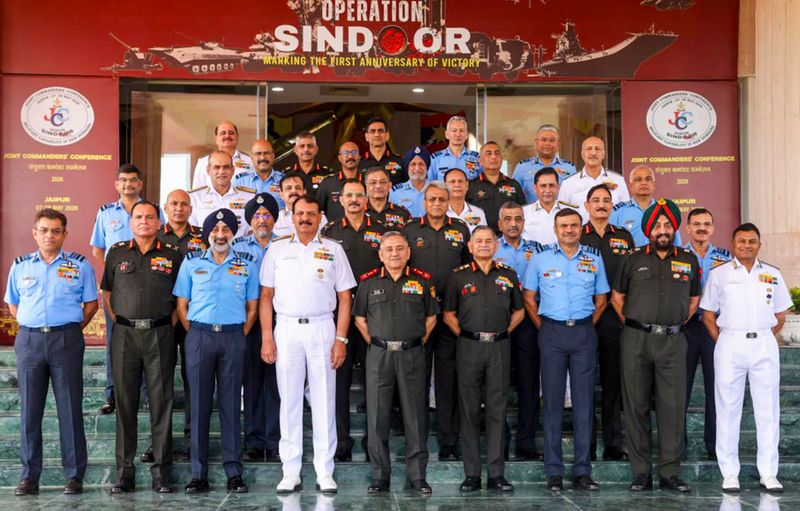
Separately, the Navy’s top leadership today commenced its ‘Commanders’ Conference’ to deliberate on maritime threats in light of the situation in West Asia.

Cabinet Secretary TV Somanathan, addressing the senior leadership of the Indian Army today, emphasised the need to develop sovereign Artificial Intelligence models and highlighted the importance of resilient supply chains to safeguard national interests amid evolving geopolitical challenges.

Separately, the Navy’s top leadership today commenced its ‘Commanders’ Conference’ to deliberate on maritime threats in light of the situation in West Asia.

Speaking at the Army Commanders’ Conference, the Cabinet Secretary also stressed the necessity of stronger civil–military cooperation, observing that a whole-of-nation approach remains essential for achieving optimal outcomes in both conflict and peacetime. Reflecting on *Atmanirbharta* (self-reliance), he described it not merely as a policy objective but as a national mindset, in which every sector, institution and citizen contributes to building a self-reliant and resilient India.

The interaction formed part of the ongoing Army Commanders’ Conference deliberations, which are focused on strengthening national security, preparedness and institutional synergy.

Meanwhile, the Indian Navy’s three-day biannual Commanders’ Conference 2026 began today. This edition carries particular significance given recent swift naval deployments to safeguard India’s energy security amid the ongoing conflict in West Asia, alongside the convergence of Multi-National Forces (MNFs) in the Indian Ocean Region.

The conference includes addresses by the Chief of Defence Staff and the Home Secretary, as well as embedded discussions with senior naval leadership. These interactions aim to enhance interoperability and jointness, while providing a broader perspective on national stability, security architecture and collaborative approaches to future maritime challenges. The forum serves as a platform for close engagement with national leadership, setting strategic direction for naval planning.


Iran-Israel War LIVE updates: Trump hints at new Iran talks as Hormuz standoff intensifies

The US military claimed Tuesday that it has successfully begun to enforce a blockade of Iranian ports, as the standoff between the US and Iran deepens. Tehran threatened to strike targets across the region, a day after Trump warned on social media that any Iranian warships nearing the blockade would be destroyed in a “quick and brutal” strike.

With Pakistan racing to bring the sides together for more talks, US President Donald Trump said Tuesday that a second round “could be happening over the next two days.” The first round ended without an agreement on Iran’s nuclear ambitions, which the White House says is a sticking point.

Neither side has indicated what will happen after the ceasefire expires on April 22.

Trump says Iran war is very close to over

April 15, 2026 8:14 am

In clips showing excerpts of an interview he taped with Fox Business Network’s “Mornings with Maria,” Trump says of the Iran war, “I think it’s close to over, yeah. I mean, I view it as very close to over.” He adds, “If I pulled up stakes right now, it would take them 20 years to rebuild that country. And we’re not finished. We’ll see what happens. I think they want to make a deal very badly.”


The Law of Flow

A missed opportunity: A precedent lost at Islamabad

article_Author
Lt Gen SS Mehta Retd

THE modern world speaks the language of peace but operates through a machinery of disruption. Conflicts no longer remain confined to borders or trenches; they pulse through supply chains, vibrate across financial systems, and stall within digital networks and maritime routes. The arena of competition has expanded into every vessel of our survival, but our governing principles remain trapped in the static logic of 17th-century Westphalian sovereignty.

We are trying to manage a flood with tools designed for a fence.

The core insight: Stability as continuity

History reveals a quieter truth: stability comes from the continuity of exchange, not the absence of rivalry. When routes remain open and movement is protected, the world prospers. When flow breaks, decline follows. Stability travels with flow. It is not a destination we reach, but a momentum we maintain.

Just as Newton recognised gravity rather than inventing it, the disruptions of our time reveal an underlying law: stability follows continuity of flow.

Advertisement

The logic is not new. Physics settled it long ago. Flow is conserved, shaped by resistance, and driven by difference. Constrain it, and pressure builds elsewhere. Disrupt it, and turbulence follows. The global system behaves no differently.

Missed precedent: The Islamabad moment

At a high-stakes table in Islamabad, an opportunity to set a precedent was missed.

Two sides met after weeks of escalation. Positions were defended, histories invoked, red lines drawn. They walked away empty-handed. What unfolded was not negotiation, it was a missed opportunity to set a precedent when the world was watching. Nothing that both sides needed to keep moving was placed on the table.

The interlocutor remained confined to positions, not pathways. They met as adversaries. They could have left as custodians of flow. They did neither.

When we negotiate over pride or land, we stall. When we negotiate over the shared arteries of survival, we move.

The new constant: A horizontal gravity

We are no longer governed by the mass of a throne or the distance of a frontier. The new constant is interdependence, the invisible pull that binds energy routes, data networks and financial systems into a single operating reality.

What gravity is to the vertical, flow is to the horizontal.

It does not wait for consensus or yield to protocol; it compels. We do not choose interdependence; we are born into it. To deny flow is to deny the oxygen of the modern state.

The doctrine of flow: Nature’s first principle

Flow is nature’s first principle: continuity creates stability; disruption returns systems to chaos. To survive the next decade, responsibility must align with dependence.

What must flow must not fail.

From open routes to shared rules

The United Nations Convention on the Law of the Sea recognised that certain spaces, the high seas, must remain open. It preserved access; it did not secure continuity.

The Law of Flow is the necessary addendum. It converts access into obligation: in a networked world, routes must not only remain open, they must remain functional. Disruption of critical flow is not leverage; it is systemic risk.

Had this principle been placed on the table in Islamabad, the conversation would have shifted from positions to pathways, and a precedent would have been set — not for settlement, but for continuity.

The expansion of the commons

The commons have migrated. They are no longer just oceans and atmosphere; they now include energy corridors, trade straits and the fibre-optic veins of the Internet.

These are not assets to be owned; they are lifelines to be kept alive.

They are not possessed; they are presided over. Their disruption travels globally because interdependence is design, not choice. What is required is not a surrender of sovereignty, but an extension of norms that protects continuity. The guardian of a choke point is not a gatekeeper, but a trustee of the global pulse.

Responsibility and consequence

A law without consequence is a suggestion.

Investment: Those who secure flow, whether in the Malacca Strait or global data networks, must receive tangible returns. Stability is a service; it must be valued.

Correction: Those who disrupt flow for tactical gain must face automatic, collective consequences. These are not punitive; they are corrective, like a white blood cell restoring circulation. The aim is not to punish, but to restore flow.

From conflict to continuity

This is not idealism. It is realism in its most disciplined form. The Law of Flow does not end conflict; it limits its reach. It ensures that rivalry does not hold the systems of human survival hostage.

Stability is the presence of continuity, not the absence of conflict.

In the narrow gateways of the world, Hormuz, Suez, or the digital gateways of the cloud, continuity can stabilise what politics cannot. States bound by shared dependence can define norms and share burdens, building order through utility rather than waiting for a central authority that may never arrive.

The missing link: Custodians of flow

A doctrine without custodians cannot endure.

From the straits of Malacca to Hormuz and Suez, and onward to the invisible gateways of the digital age, the pathways of continuity already reveal their natural custodians.

In an age of grey-zone conflict, disruption rarely announces itself. A strait is slowed, not closed. A network is degraded, not destroyed. Attribution is delayed, and responsibility diffused. Yet the effect is the same: flow falters, and with it, stability.

The Law of Flow, therefore, demands a new category of actors: custodians of continuity.

These are not alliances in the traditional sense, nor instruments of coercion. They are pre-designated responders, states or coalitions entrusted with the immediate restoration of critical flows, whether in maritime chokepoints, energy corridors or digital networks. Their mandate is limited; their legitimacy derived not from power, but from function.

To enable this, flow must be recognised as a global service. Those who secure it must be compensated. Those who disrupt it must trigger automatic, collective response mechanisms, swift, rules-based and insulated from political delay.

In this framework, sovereignty is not diminished. It is disciplined by interdependence.

Flow, once broken, cannot wait for consensus. It must be restored by design.

Conclusion: The risk of standstill

History opened routes. Law gave them structure. Our moment demands their continuity.

The Law of Flow is indifferent to political deadlock. It operates with the precision of physics.

We have mistaken sovereignty for isolation, forgetting that a heart cannot claim independence from the blood that sustains it. If responsibility does not align with dependence, the system will not merely stall; it will break.

In this century, power will be measured not by what nations control, but by what they keep flowing.

What must flow must not fail.


HEADLINES :14 APR 2026

SANJHA MORCHA TEAM WISHES ALL VETERANAS/READERS ENDLESS

MoA between BEG & Centre Roorkee & IIIT Vadodara

Major provisions of Cantonment Act decriminalised: What it means

Tehran Issues Regional Maritime Warning Following US Announcement of Total Port Blockade

Indian Navy Commanders To Address West Asia Crisis And Energy Security At Key Conference

Pakistan’s ISI Exploited Chinese CCTV Systems To Spy On Indian Military Sites, Delhi Police Reveal

Air Chief Marshal AP Singh’s F-15EX Flight In The US May Rattle Rivals

India–US Seal Landmark Jet Engine Pact: HAL And GE Aerospace Finalise Technology Transfer For IAF Fleet Expansion

NCC launches nationwide cyber security capacity building programme for cadets

500 drones supplied to Army

15 Indian vessels stuck in Hormuz; working on safe return, says govt

India, US ink pact on first-ever fighter jet engine tech transfer

Trump blocks traffic to Iranian ports as Tehran threatens to target US’ Gulf allies

Iran-Israel War LIVE updates: Trump vows to destroy Iranian warships that get near US blockade


MoA between BEG & Centre Roorkee & IIIT Vadodara

The Bengal Engineer Group & Centre, Roorkee, has signed an MoA with IIIT Vadodara to upscale the IT knowledge of our troops through curated academic programs and niche technological solutions

https://x.com/i/status/2043689280766398600

The MoA between the Bengal Engineer Group (BEG) & Centre, Roorkee, and IIIT Vadodara marks a significant step towards enhancing the IT knowledge of the Indian Army’s troops. This collaboration aims to upscale the IT knowledge of the troops through curated academic programs and niche technological solutions. The initiative is part of a broader digital transformation strategy that seeks to keep the Indian Army well-prepared and professionally equipped to meet modern-day challenges. 


Major provisions of Cantonment Act decriminalised: What it means

While the Bill has a much wider canvas proposing decriminalisation across dozens of central statutes, its implications for the Cantonments Act, 2006, are significant

The Jan Vishwas (Amendment of Provisions) Bill, 2026, recently passed by the Parliament, signals a turning point in the legal history of India’s cantonments.

While the Bill has a much wider canvas proposing decriminalisation across dozens of central statutes, its implications for the Cantonments Act, 2006, are significant.

Why Cantonment Act needs to change

For 61 cantonments under the Ministry of Defence, the amendments signal not just statutory tidying up, but a major shift in legal philosophy.

The Cantonments Act has always stood apart from ordinary municipal law. It regulates civic life in notified cantonment areas, sanitation, roads, public health, water supply, buildings, markets, trade licences and local administration but does so in spaces shaped by military ownership, defence land management and security sensitivities.

This dual character has historically produced a more control-oriented legal framework. Like many older statutes, the Act relied heavily on criminal law even for minor civic or regulatory lapses.

Technical breaches were routinely cast as offences “punishable with fine”, thereby subjecting ordinary non-compliance to the machinery and stigma of criminal process.

What the new law does

The new law addresses the issue of needless punishments. The Ministry of Defence reviewed 38 criminal provisions in the Cantonments Act and identified 31 for decriminalisation and three for partial decriminalisation.

Several contraventions that were earlier criminally punishable have now been converted into civil defaults, attracting administrative penalties. In provision after provision, the phrase “punishable with fine” has been replaced with “liable to penalty”. This shift marks the movement from a prosecution-led system to a compliance-oriented one.

Mechanism to adjudicate penalties

The centrepiece of this reform is the insertion of Section 333A, which creates a formal mechanism for adjudication of penalties.

Under this framework, the Chief Executive Officer of the Cantonment Board would be empowered to impose penalties for specified contraventions after giving the affected person an opportunity to be heard.

The Act also makes an important conceptual clarification: a penalty under this framework is civil in nature, does not amount to a conviction, and the proceeding itself is not a criminal prosecution. An appeal lies with the President of the Cantonment Board.

There are defined timelines for filing and disposal. This structural change will reduce unnecessary criminalisation of municipal and licensing defaults, lessen the burden on courts, and enable more prompt disposal of minor regulatory matters.

Relief for traders

The new adjudication mechanism will provide relief to traders, shopkeepers, property owners and residents in cantonment areas. This will mean a more proportionate response to first-time or technical breaches.

For the administration, it will mean faster enforcement in areas such as sanitation, markets, licensing, public nuisances and building compliance.

No blanket relaxation

The law does not provide blanket relaxation of regulatory standards. Instead, it adopts a calibrated and graded enforcement framework. Under this approach, initial violations are treated with relative leniency through the imposition of civil penalties.

Repeat or subsequent breaches attract stricter, including criminal, consequences. The treatment of building-related violations reflects a nuanced balance between deterrence and fairness.

Penalties

Under Section 244, which governs restrictions on the use of buildings within cantonment areas, a first contravention attracts a civil penalty of up to Rs 1 lakh.

However, any second or subsequent violation escalates into criminal liability, with a conviction-based fine of up to Rs 2 lakh, along with additional daily fines for continuing non-compliance. A similar graduated enforcement mechanism is incorporated under Section 247 concerning unauthorized constructions.

The intent is clear to extend leniency to first-time offenders while ensuring stringent action against habitual violators.

The framework recognises that not every regulatory lapse warrants criminalization, yet it equally ensures that the law retains sufficient deterrent force to address repeated and deliberate non-compliance.

Way forward

The amendments will move the cantonment regulation away from a criminalisation-first model and toward a civil enforcement regime. That is a sensible and overdue transition, government officials say.

Overall, the Jan Vishwas Bill represents a concerted effort to move towards a more citizen-friendly, efficient, and modern administrative framework, while maintaining necessary safeguards for public order, safety, and planned development, and will be seen as a modern, trust-based reform that reduces harassment and improves governance efficiency.


Tehran Issues Regional Maritime Warning Following US Announcement of Total Port Blockade

The Iranian government has issued a stern condemnation of United States plans to enforce a blockade on its maritime gateways, asserting that the stability of the entire Persian Gulf region will be at risk if its own security is compromised.

This response follows an announcement from the United States Central Command (CENTCOM) indicating that, under the direction of President Donald Trump, a blockade on all traffic entering or exiting Iranian ports would commence on 13 April at 10:00 am ET.

A spokesperson for the Khatam al-Anbiya Central Headquarters, which serves as Iran’s primary operational command for both the Army and the Islamic Revolutionary Guard Corps (IRGC), communicated through state media that maritime security must be maintained as a collective responsibility.

The spokesperson emphasised that the Iranian armed forces view the protection of the nation’s sovereignty and rights within its territorial waters as both a natural and legal obligation.

The statement issued a clear ultimatum, declaring that security for ports in the Persian Gulf and the Sea of Oman is an “all or nothing” proposition. Iranian officials warned that if the safety of their own ports is undermined, no other port within those strategic waters will remain secure. This suggests a potential for wider regional disruption should the American blockade proceed as planned.

Furthermore, Tehran reiterated its intention to maintain strict control over its waters, specifically mentioning the Strait of Hormuz. The Iranian military stated that while standard commercial traffic would be permitted to transit according to Iranian regulations, any vessels affiliated with “hostile entities” would be strictly prohibited from passing through the narrow and vital waterway.

Iran has characterised the American strategy as an illegal act of “piracy” that defies established international norms. The spokesperson argued that the US-imposed restrictions on ship movements in international waters represent a criminal breach of maritime law.

In light of what it perceives as persistent threats to its national security, Tehran has also announced the implementation of a permanent, long-term mechanism to monitor and control the Strait of Hormuz, which will remain in place even after any immediate hostilities conclude.

On the other side of the escalating tension, US CENTCOM clarified that its blockade is intended to be applied uniformly to ships of all nationalities that are operating in and out of Iranian ports along the Persian Gulf and the Gulf of Oman.

However, the American command specified that it does not intend to disrupt the general freedom of navigation through the Strait of Hormuz for vessels destined for non-Iranian ports.

To manage the situation, CENTCOM has advised the international commercial shipping industry to monitor official broadcasts and maintain constant communication with US naval forces.

Further formal notices and guidance are expected to be issued to mariners to navigate the complexities of the enforcement zone. This confrontation marks a significant escalation in the maritime friction between Washington and Tehran.

ANI


Indian Navy Commanders To Address West Asia Crisis And Energy Security At Key Conference

The Indian Navy’s top commanders are set to deliberate on the implications of the ongoing crisis in West Asia, with a particular focus on safeguarding India’s energy security, during a three-day conclave beginning Tuesday in New Delhi.

The conference, scheduled from April 14 to 16, will bring together senior naval leadership to review operational posture and capability development in line with national security objectives.

Chief of Defence Staff General Anil Chauhan and Navy Chief Admiral Dinesh K. Tripathi will be present at the event, which the Navy has described as significant in light of swift deployments aimed at protecting India’s energy interests amidst conflict in West Asia.

The convergence of multinational forces in the Indian Ocean Region has further heightened the importance of this edition of the biannual conference.

Government contract bidding

The Navy has not elaborated on its specific role in safeguarding energy security, though disruptions in the transit of ships through the Strait of Hormuz remain a pressing concern. For several years, Indian naval forces have been escorting Indian-flagged merchant vessels, particularly those carrying crude oil and natural gas, to ensure safe passage through the Gulf of Oman.

Admiral Tripathi, along with operational commanders and senior leadership, will assess plans to address multi-dimensional challenges in the current geo-strategic environment. Discussions will extend beyond immediate security imperatives to include decisive operational success, enhancement of blue-water capabilities, training, human resource management, sustainable maintenance practices, effective employment of uncrewed systems, operational logistics, and other enablers of combat readiness.

The conference also carries weight in reaffirming the Navy’s operational doctrine, inter-services coordination, and technology-driven response mechanisms following ‘Operation Sindoor’. A key objective is to promote the Indian Navy as the preferred security partner in the Indian Ocean Region and the wider Indo-Pacific.

Chief of Defence Staff General Chauhan and Union Home Secretary Govind Mohan will address the commanders, with interactions designed to enhance interoperability, jointness, and a broader perspective on national stability, security architecture, and collaborative approaches to future maritime challenges. 

The conclave serves as a platform for close interaction with national leadership, setting strategic direction for naval planning.

On a wider canvas, the Navy’s apex leadership will review preparedness to deliver military success when directed by the government, in line with the four roles outlined in the Indian Maritime Doctrine. 

This includes sustained operations, expanding international cooperation, and advancing the government’s vision of Mutual and Holistic Advancement for Security Across Regions (MAHASAGAR). Efforts towards indigenisation and innovation will also be a focal point.

PTI