All posts by webadmin

Army chief meets murdered soldier Aurangzeb’s family

Army chief General Bipin Rawat on Monday met the family of martyred soldier Aurengzeb who was kidnapped and killed by terrorists in Kashmir last week.

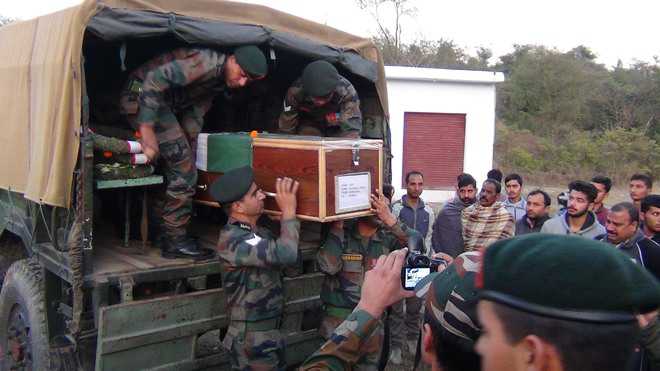
Rawat spent over 30 minutes with the parents of Aurangzeb who was a rifleman with 4 Jammu and Kashmir Light Infantry. His bullet-ridden body was found on June 14 at Gusoo Pulwama after a day long search operation.

A video has also surfaced on the internet in which the trooper is seen being interrogated by suspected Hizbul Mujahideen militants about the encounters he had participated in.

The video is believed to be taken moments before the army jawan was killed by militants.

The rifleman was abducted by militants at Kalampora in Pulwama when he was on his way home in Rajouri district for Eid celebrations.

The soldier’s family has also demanded PM Modi to take action. “I want to ask PM Modi if he’s listening to me, why are you appeasing stone-pelters and separatists? Punish the terrorists who killed my son. Why was Ramzan ceasefire announced? Terrorists have no religion, then why operations were stopped against them during Ramzan?” Mohammad Haneef, Aurangzeb’s father had said earlier.

ALSO READ | Shiv Sena attacks ‘extremely weak, inactive’ Defence Minister Sitharaman


Chilling facts about conflict and journalism by Aasha Khosa

Shujaat Bukhari was probably killed to silence a voice of a free-thinker and to scare others like him

Chilling facts about conflict and journalism

Aasha Khosa
Senior journalistShujaat Bukhari’s cold-blooded murder by terrorists in Srinagar’s busiest quarter is a chilling reminder of how journalists are among the most vulnerable targets in a conflict situation. Bukhari’s rise from a salaried journalist to the owner-editor of an English newspaper in a short span of time was the envy of many. He was ambitious and keen to play even bigger roles in life. Being articulate, Shujaat was the most sought-after Kashmiri journalist in the seminar circuits of New Delhi and even abroad and part of the back-channel efforts to make India and Pakistan settle Kashmir on the table.Though his newspaper — Rising Kashmir — was in no way promoting the Indian interests in Kashmir, terrorists couldn’t stand his enterprising spirit and free thinking. Probably, he had been under their watch for long and the proverbial last straw on the camel’s back happened recently when he wrote an article disapproving of separatists’ spurning of New Delhi’s offer of talks. He was probably done to death in the most ghastly manner to silence a voice of a free-thinker and also to send a chill down the spine of others who are trying to join the peace-and-talk bandwagon.Bukhari’s violent death reminds me of the time when my late husband George Joseph and I reported from Kashmir under a threat to our lives. Our fault was that we had simply reported a happening and a fact. However, those holding the gun want everyone to see the situation only from their perspective and in the process, they obfuscate the truth and kill the human spirit. They tried to do the same with us.On a cold winter day, the phone in our two-room apartment in Srinagar rang and George picked it. The caller said he was from Hizbul Mujahideen and claimed the largest pro-Pakistan group had split but no local journalist was ready to publish the news. The main faction of the Hizbul had issued a handout that had been quickly canceled (verbally), apparently on instructions from Pakistan. Now, this anonymous caller — from the marginalised and smaller faction — had approached us in the hope that we will not take sides (between the two Hizb factions) and expose the truth.It was quite a story. The Indian Express, for which George was reporting, carried it as a banner; The Tribune — I worked for it back then — too carried it on the front page.  The Hizbul split was one of the turning points in Kashmir’s militancy and if one goes through the archives of local newspapers today, it has never happened!The Hizbul reacted violently. It banned the circulation of The Tribune and The Indian Express in Kashmir and asked us to leave Kashmir within 48 hours.We continued to stay put and report from the Valley. Not to offend the terrorists further, George started using the Jammu dateline for his stories even as he was reporting from Srinagar. No journalist in Kashmir supported us; media activists in Delhi didn’t issue statements either. On a personal level, friends would praise us for being bold but none cared about how difficult it was for us. There were no trolls back then, but a majority of Srinagar-based journalists spread lies and propaganda about us to many visiting journalists from Delhi.One local Urdu newspaper wrote that we were ISI agents; a few days later, another one said we were IB agents. Another newspaper report claimed that George and I had received arms training in Zeevan! All this was meant to scare us and force us to leave Kashmir. George left after his office negotiated a deal with the Hizbul Mujahideen through a person who is today a member of the BJP’s national executive committee. He was transferred out of the Valley and the Indian Express resumed its circulation.I lived alone and worked for another year from Kashmir. Believe me, life wasn’t easy. To even buy veggies and groceries, I had to plan my camouflage of the day. To beat my loneliness and to vent my anger against what had happened to our lives, I started working hard on my stories. I was doing well and not giving a clue to anyone on my routine. And, then came reports in newspapers that I was being offered scoops by the government. Before this, terrorists had managed to scare away many veteran journalists, most of them Kashmiri Hindus and non-Kashmiris, through targeted killings of Lassa Koul, Director of Srinagar Doordarshan, and PL Handoo, an officer of the state information department.  A non-Kashmiri Muslim journalist working for the Times of India was manhandled in public and he left the same night. This gave rise to a bizarre situation: the international news agencies and newspapers were hugely interested in Kashmir and their search for local journalists ended with makeup artists and teleprinter operators. Over the last two decades, reporting from Kashmir has undergone a sea change; almost all regular news is being reported by Kashmiri Muslims. Shujaat was a product of this transformation and, in a way, he should have been hailed as a visionary and enterprising editor. His reporting and newspaper seemed to be in no conflict with the narrative unleashed by the separatists and yet he was killed.Prima facie, it seems that he took the threat to his life not so seriously or else he would not be moving out of his office at a predictable hour. His friends have scooped an insidious write-up about him by an anonymous writer on the worldpress.com. It was posted four weeks back and clearly targeted him for ‘betraying and making use of the movement.’Like all sane people, Shujaat Bukhari probably wanted his two children to grow and live in peace and, therefore, he tried to work for peace in Kashmir and paid with his life.


IAF rescues three Israelis from Rohtang

New Delhi, June 5

The Air Force on Tuesday rescued three Israeli nationals after their vehicle fell down a gorge on the way to Rohtang Pass and one of them later succumbed to injuries.All three were evacuated in an MK III chopper from Kullu to Chandigarh, along with an Israeli Embassy official and a medical officer, a statement by the Air Force said.One of the rescued Israelis succumbed to his injuries, the statement said.“The ‘Himalayan Dragons’ based at Air Force Station Sarsawa were tasked to undertake a challenging casualty evacuation of three Israeli nationals whose vehicle had fallen down in a gorge on the way to Rohtang Pass,” the statement said. PTI


Saving men from jaws of death by Col HP Singh (retd)

Saving men from jaws of death

Col HP Singh (retd)

He was leading a patrol of six men on the icy moraine of the Siachen glacier, which has the dubious distinction of being the highest battlefield in the world. The weather was inclement and blizzards made movement extremely difficult; taking a hundred steps warranted a minute’s halt to catch up with breath. Every step he took made him sink knee-deep in the loose snow and extricating it to step forward was getting tougher by the minute. The whiteout conditions were getting worse and he feared losing the beaten track, lest his party should sink in the crevasse covered by a thin layer of ice which appeared deceptively firm. Their destination, though in sight, seemed hours away. Lack of oxygen at 18,000 feet above the sea level had made everybody’s senses numb. If they didn’t reach their post in the next hour or so, they could be victims of hypoxia, a condition were the supply of oxygen is reduced to a level causing malfunction of brain cells. It was not easy to move with six layers of clothes adding to your weight and reducing the flexibility of the limbs.Moments later, he felt that he was gradually sinking in the snow. He cautioned his patrol members who were all tied to one another with a specially made rope that could withstand the weight of 15 men without snapping. His party, as per training, instantly took to the lying down position with their ice axes anchored to the ice of beaten track which arrested their free-fall into the bottomless crevasse they had just encountered. Before they could take any further action, he was already chest-deep inside the snow, gasping for breath, with no energy left to extricate himself. His team tried to pull him out, but with every attempt, he was only getting deeper into the snow. It was a matter of time when the anchorage of the ice axes would give way and all of them would meet their icy end. By now, the vapours of breath he exhaled had transformed into ice crystals over his moustaches and beard. He slid further down into the quagmire of snow till it became all white, before becoming dark all around. Asphyxiated and desperately trying to breathe, he felt sleepy and was soon in a different world. The commotion and vibrations of the helicopter interrupted his slumber as we made the final approach to the helipad. He gave a faint smile of gratitude as he was transferred to the ambulance waiting for him. We had successfully added a few positive points to our karmic account. We were about to switch off our engine when we got a call from the control tower. There were some more karmic points left to be scored for the day. A shell splinter injury case was awaiting evacuation at another forward post. I looked at my equally fatigued co-pilot, took a few puffs from the oxygen cylinder, and once again got airborne to extricate some other soul from the jaws of death.


IAF choppers help douse forest fire in Pathankot

IAF choppers help douse forest fire in Pathankot

An IAF chopper engaged in firefighting operation in Pathankot.

Tribune News Service

Pathankot, May 28

A massive forest fire, which engulfed a 100-acre area at Karoli village near the Mamun Army Cantonment, was brought under control after a joint operation by the Pathankot district administration, Air Force and the Army.A thick blanket of smoke enveloped Pathankot city. Information about the fire was received by the Army on Sunday evening following which fire tenders and water tankers were pressed into service. In view of the intensity of the fire, the Army sought the help of the Deputy Commissioner.DC Neelima informed Divisional Forest Officer (DFO) Sanjeev Tiwari who rushed to the spot at Karoli village and engaged his men in dousing the flames. Hundreds of Army personal too joined the fire-fighting operation.However, an hour later the DFO sent an SOS to the DC, saying strong winds were making the situation difficult and cited some technical reasons and told the DC that the fire could be controlled only through an aerial fire-fighting exercise.The Deputy Commissioner called up the Chief Secretary, who then got in touch with the Air Chief Marshal. An hour later, a helicopter from the Udhampur airbase was sent.The chopper began the operation on Monday morning. Officials claimed that rice stubble burning in the area made things difficult for the chopper which was equipped with a water carrier.The DFO said there could have been several reasons for the forest fire.“Either it could be an accident or a handiwork of some miscreants. A major part of the affected area has been brought under control now,” the Divisional Forest Officer said.At the time of filing this report, operations were under way though officials maintained that a major part of the fire had been doused.


Army orders court of inquiry into Major Gogoi’s conduct Exemplary punishment if found guilty: Army chief

Army orders court of inquiry into Major Gogoi's conduct

Tribune News Service

New Delhi/Srinagar, May 25

The Indian Army ordered a court of enquiry on Friday into the conduct of Major Leetul Gogoi following the incident at a hotel in Dalgate Srinagar.  The major had booked a room for himself in the hotel where a woman was scheduled to come and meet him.

The woman has recorded a statement under Section 164 of the CrPC saying she knew Major Gogoi.Army Chief Bipin Rawat had earlier in the day said exemplary punishment would be given to Major Leetul Gogoi if he was found guilty of “any offence”.(Read: Hotel fracas: Girl states she met Major of her ‘own will’)

“If Major Gogoi has done something wrong then I can say that he will be given due punishment and the punishment will be such that it will set an example,” Gen Rawat told reporters in south Kashmir’s Anantnag district. He arrived on a two-day visit to Kashmir on Thursday to review the security situation.

On May 23, Gogoi was briefly detained by police in Srinagar after an altercation when he was allegedly trying to enter a hotel with an 18-year-old woman, according to a police official.“If any officer of the Indian Army is found guilty of any offence, we will take strictest possible action,” Rawat told reporters at Pahalgham while on a visit to the Army Goodwill School. “If Major Gogoi has done something wrong, I assure you that he will be awarded punishment at the earliest…the punishment will set an example,” the Army chief said.The Jammu and Kashmir Police has initiated an inquiry into the incident involving Gogoi, whose decision to tie a civilian to the bonnet of his vehicle in Kashmir last year sparked a row. — With PTI


Reversing the Army officers’ ratio by Lt-Gen Syed Ata Hasnain (retd)

The MoD’s acceptance of the proposal for reversing the ratio of the Main to Support segments of the Army’s officer cadre will afford both better cadre and financial management


Reversing the Army officers’ ratio

Skewed ratio: The Indian Army”s officer cadre structure has Main to Support ratio of 4:1. Tribune photo: Mukesh Aggarwal (file)
8

Lt-Gen Syed Ata Hasnain (retd)To understand the readiness of the Ministry of Defence (MoD) to implement, in phases, the Army’s recent proposal to “increase the intake of officers under Short Service Commission (SSC) and correspondingly reduce the number of permanent commission or regular commissioned officers”, the public needs to have a deep grasp of the army’s cadre.   A professional army’s cadre management is not the easiest of responsibilities; it needs to be known that the army’s cadre structure is hugely pyramidal, necessitating high wastage as promotions take place at different select ranks from Colonel upwards to Lt-Gen. With an average intake of approximately 2,000 commissioned officers every year and the majority being regular permanent cadre officers, only a few can be promoted (20-50 per cent) even at the first selection promotion level; this can be as early as 37 years of age and 14 years of service. The non-empanelled have to remain in the same rank till the age of 54, necessitating five to six rotations of placement in appointments. They conventionally cannot be placed in frontline units which are then under the command of officers junior to them. It’s a huge social and financial burden on the government due to no fault of the officers who are simply victims of the cadre structure. 

World position

Every professional army in the world follows a system of main and support cadres; the main being lean, with officers who are in service having undergone longer training duration and looking towards long careers, including consideration for higher promotions. The support cadre, on the other hand, with shorter initial training and by virtue therefore not aspiring for higher level command or staff responsibility, is a much larger cadre; the terms of service dictate only short-term engagement —  5, 10 or 15 years. The ratio, main to lean is ideally at 1:5. That reduces aspirants for higher training and promotion opportunities, improves promotion approval percentages and keeps available the younger support cadre officers to man lower command responsibilities in units.

Indian Army structure

The Indian Army’s officer cadre structure is skewed with main to support at 4:1, thus forcing a large number of non-empanelled officers in the system, all of whom are carried to the final retiring age and given pension, and a below par manning of units. The Ajai Vikram Singh Committee (AVSC) set up to implement the Group of Ministers recommendations after the Kargil Review Committee’s deliberations  recommended 1: 1.1 as the better ratio, probably realising that doing anything better than that would take many years; a detailed professional study by the College of Defence Management did help towards that recommendation. The current proposal for short service engagement of officers for duration of 10 or 14 years entails that they will be part of the support cadre. None will serve beyond rank of Major or Lt-Col. They will receive a golden handshake package of two months’ salary per completed year up to 10 years and four months’ salary for the same up to 14 years, thus sweetening the exit (maximum 36 months by one calculation). Training for post-exit jobs is also included in the recommendations, thus overcoming many of the earlier objections which spelt out the disadvantage to exiting officers at an age when they bore family responsibilities. The lump sum payments will entail high financial outgo, but far lesser than recurring pension liability.The advantages of 1:1.1 ratio are many 

  • First, a younger officer profile in front line units will manifest.
  • Second, the pension bill will reduce as the number of officers exiting with pension will greatly reduce. Progressively, the advantage will be even more as life expectancy keeps increasing.
  • Third, lower numbers in non-empanelled ranks whose motivation can be managed through financial increments and reservation of some promotion vacancies a few years later than their approved colleagues.

Employment opportunities for exiting army officersThere exist two employment opportunities for exiting officers. 

  • First, a Cabinet approval already exists for the implementation of ‘peel effect’, whereby officers exiting the army cadre are to be absorbed in fixed vacancies of Central Armed Police Forces (CAPFs) and other government cadres. This is on the assumption that a large part of the exiting officers form an efficient segment of experience which cannot be absorbed by the Army’s pyramidal system and will contribute to other government services with minimal training. The approved decision is pending due to lack of energy in commitment for implementation.
  • Second, another approved decision involving corporate responsibility (termed industrial deputation) with terms and conditions towards initial secondment with the government bearing expenses and ultimate absorption, has also not been implemented for lack of awareness and inability to take the industry on board.


Pakistan to give greater authority to PoK, Gilgit-Baltistan

Pakistan to give greater authority to PoK, Gilgit-Baltistan

The meeting was chaired by Pakistan PM Shahid Khaqan Abbasi.

Islamabad, May 20

Pakistan’s top civil and military leaders have decided to give greater administrative and financial authority to Pakistan-occupied Kashmir and Gilgit-Baltistan, the region through which the controversial $50 billion China-Pakistan Economic Corridor (CPEC) passes.During a meeting of the National Security Committee (NSC) — the top civil and military body—Sartaj Aziz, Deputy Chairman Planning Commission and the Ministry of Kashmir Affairs & Gilgit-Baltistan, yesterday briefed the Committee on the PoK and Gilgit-Baltistan reform proposals, an official statement said.The meeting chaired by Prime Minister Shahid Khaqan Abbasi reviewed these proposals and after detailed deliberations a consensus was reached on the “devolution of greater administrative authority and financial powers” to the PoK government and the Gilgit-Baltistan government, according to the statement.The details of administrative and financial reform have not been shared so far.However, there was also consensus over retention of the PoK and Gilgit-Baltistan Councils as advisory bodies; and the grant of a five-year tax holiday to Gilgit-Baltistan so as to create adequate incentives for the development of the region and bring it at par with the other areas of Pakistan.Gilgit-Baltistan is treated as a separate geographical entity by Pakistan. Balochistan, Khyber-Pakhtunkhwa, Punjab and Sindh are four provinces of Pakistan.India has termed as “entirely unacceptable” any possible attempt by Pakistan to declare the Gilgit-Baltistan region, bordering the disputed Pakistan-occupied Kashmir, as the fifth province. India has protested to China over the CPEC which goes through Gilgit-Baltistan region.It is believed that China’s concerns about the unsettled status of Gilgit-Baltistan prompted Pakistan to change its status.Earlier media reports had said Pakistan plans to elevate the constitutional status of the region to provide legal cover to the CPEC.The NSC also endorsed that FATA shall be merged with Khyber Pakhtunkhwa along with the introduction of the administrative and judicial institutional structures and laws of Khyber Pakhtunkhwa, the statement said.The Committee directed the ministries concerned to work out the constitutional, legal and administrative modalities for the merger in consultation with all parties in the Parliament.The meeting was attended by Interior Minister Ahsan Iqbal, Minister for Defence & Foreign Affairs Khurram Dastgir Khan, Chairman Joint Chiefs of Staff Committee Gen Zubair Mahmood Hayat, Army chief Gen Qamar Javed Bajwa, Chief of Naval and Air forces, ISI chief and other senior civil and military officials. — PTI


Recruitment rally for Gorkha Regiment

Una: A recruitment rally for entry to the Gorkha Regiment as general duty and professional duty soldiers will be held at the 14 Gorkha Training Centre, Subathu, in Shimla district on June 4 and 5.  According to an official press release, candidates should be either Indian citizens or Indian citizens with Nepalese origin  . OC


North Korea threatens to cancel US summit: KCNA

North Korea threatens to cancel US summit: KCNA

Seoul, May 16

North Korea threatened on Wednesday to cancel the forthcoming summit between leader Kim Jong-un and President Donald Trump if Washington sought to push Pyongyang into giving up its nuclear arsenal.If the Trump administration “corners us and unilaterally demands we give up nuclear weapons we will no longer have an interest in talks and will have to reconsider whether we will accept the upcoming DPRK-US summit”, first vice foreign minister Kim Kye Gwan said in a statement carried by the official KCNA news agency.Washington is pressing for Pyongyang’s complete, verifiable and irreversible denuclearisation. But so far the North has not given any public indication of what concessions it is offering.At a summit with the South’s President Moon Jae-in last month, Kim Jong-un reaffirmed his commitment to the denuclearisation of the Korean peninsula.But the phrase is a diplomatic euphemism open to interpretation on both sides.“We already expressed our willingness for a denuclearised Korean peninsula and repeatedly declared that the US must end its hostile DPRK policy and nuclear threats as preconditions,” minister Kim said.In the past, Pyongyang has demanded the withdrawal of the US troops stationed in the South to protect it from its neighbour, and an end to Washington’s nuclear umbrella over its security ally.Kim Kye Gwan also blasted US National Security Adviser John Bolton, who has spoken of a ‘Libyan model’ for North Korean denuclearisation.It was a “highly sinister attempt to enforce the fate of Libya and Iraq upon the DPRK,” Kim said.“I cannot suppress anger over this US move and it is doubtful whether the US really wants to improve ties with the DPRK through dialogue and negotiation.”The North has long said it needs nuclear weapons to protect itself against a US invasion. After giving up his atomic programme, Libyan leader Moamer Khadafi was killed in an uprising backed by NATO bombing. AFP