Sanjha Morcha

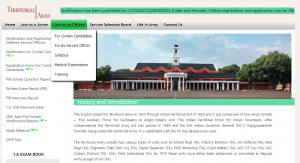
Territorial Army Recruitment for Officer Posts: Get more Updates

Indian army is recruiting candidates for the officer posts as per the latest news coming from the army circle. It is a great opportunity to make use for the people who wish to have a career in Indian Army. Applications have already started its round to the candidates. One common question on everyone’s mind before applying for the post is eligibility criteria and of course that is the important question to cross the mind. Candidates with any degree from a recognized university can apply for this post.

Candidate should be physically and mentally fit in all aspects of the body and mind. Maximum age limit for this post will be 42 years of age and minimum age limit will be 18 years of age on the date of application. Candidate can visit https://www.territorialarmy.in/ for applying for the post on or before 25th of June 2019.

A career and a post in territorial army is one of the proudest professions an officer can carry in his lifetime. It gives him a legacy and respect among the society.

Important dates for this post:

Opening date of the applications will be on 26th of May 2019.

Closing date of application forms will be on 25th June 2019.

Written examination will be held on 28th July 2019.


Targeting pods, laser-guided bomb system for Mirage was done for Kargil’

http://

Gwalior, June 24

The integration of targeting pods and laser-guided bomb system for the Mirage 2000 aircraft for the Kargil war was done in a record time of 12 days, Air Chief Marshal BS Dhanoa said on Monday.

Dhanoa was speaking at an event at the Gwalior air base to commemorate 20 years of the Kargil war.

“Modification to the Mirage 2000 was in process and expedited, and system was brought in place for the Kargil War,” the IAF chief said.

“The integration of Litening targeting pod and laser-guided bomb system was done in a record time of 12 days,” the IAF chief said.

He said deploying Mirage 2000 jets and air support to ground forces turned the tide in the 1999 war.

On the Balakot air strike and subsequent events, the IAF chief said, “Pakistan did not enter our airspace, we hit the terror camps and it failed to target our army bases.”

To a question on the recent crash of an IAF AN-32 aircraft in Arunachal Pradesh, Dhanoa said, “The AN-32 aircraft will continue to fly in mountainous areas. We don’t have any replacement.”

“We are in the process of getting more modern aircraft which will be put in critical role once received, and the AN-32 will be out and used for transport and training purposes,” he said.

All 13 air warriors on board the transport aircraft died in the crash in a heavily forested mountainous area in Arunachal Pradesh this month. PTI


IAF officials, arms dealer booked for graft

IN MAY 12, INDIA PAID ~2,895.63 CRORE FOR 75 PILATUS TRAINER AIRCRAFT. IN 2015, INDIA BOUGHT AN ADDITIONAL 38 PILATUS TRAINERS

NEW DELHI : Unnamed officials of the Indian Air Force (IAF) and Pilatus Aircraft Limited of Switzerland, and Sanjay Bhandari, an alleged arms dealer and middleman, have been booked by the Central Bureau of Investigation (CBI) for allegedly influencing the sale of the Swissmade basic trainer aircraft to India, the CBI said on Saturday.

India paid ~2,895.63 crore for 75 Pilatus trainer aircraft in May 2012. The Swiss-made planes replaced the indigenously built, 1988 vintage HPT-32 trainers, which were grounded after a series of accidents.

The Pilatus was picked through a two-year selection process.

Others who were in the fray for the deal included Korean Aircraft Industries (KAI) of South Korea, GROB Aircraft of Germany, EADS PZL of Poland, and Hawker Beechcraft of the US

Subsequently, India bought an additional 38 Pilatus trainers in 2015.

The CBI’s investigation relates to the purchase of the first batch of 75 Pilatus aircraft.

On Friday, the CBI searched nine premises including the residence and office of Bhandari in Delhi and elsewhere in the National Capital Region. The CBI has been investigating the case since 2016.

According to the CBI, its investigations showed that the Swiss company had entered into a service provider Agreement with Bhandari in 2010.

Pilatus Aircraft is alleged to have concealed the payments of 77,887,900 Swiss francs to Bhandari’s Offset India Solutions FZC during 2012 and 2015.

“It is suspected that the said commission amount was paid in order to influence the public servants of IAF, MoD and Government of India,” the CBI said in the first information report (FIR) it registered in connection with the case. HT has seen a copy of the FIR.

The CBI alleged that Pilatus had entered into “a criminal conspiracy” with Bhandari and Bimal Sareen, both directors of Offset India Solutions Private Ltd.

The service provider agreement it signed with Bhandari in June 2010 was in violation of the defence procurement procedure and inked to win the contract for the supply of 75 basic trainer aircraft to the Indian Air Force, it alleged.

Giving details of the alleged money trail, the CBI said Pilatus made a payment of 1,000,000 Swiss francs into a bank account of Offset India Solutions in New Delhi in two tranches in August and October 2010.

In addition, ~350 crore was transferred in Swiss francs from 2011 to 2015 to the bank accounts of Dubai-based Offset India Solutions FZC, also belonging to Bhandar, it said.

“There is a strong suspicion that the aforementioned.. ..amount was the part of the commission amounts paid by Pilatus Aircrafts Limited to Bhandari to obtain the contract,” it alleged.

Apart from Bhandari, the CBI has also booked his companies Offset India Solutions Private Ltd and Offset India Solutions FZC, and his alleged associates have been booked by the CBI for criminal conspiracy, cheating and under provisions of Prevention of Corruption Act.

The Indian Air Force (IAF) did not officially react to the registration of the case and formal inquiry.

“If there is evidence, punish the guilty by all means, inquiry into wrongdoing is welcome; however, the process of modernization of the IAF should not suffer,” a senior IAF officer, who did not want to be named, said.

The IAF is going through a crucial phase of transformation and is looking to acquire new platforms and weapon systems to fill critical gaps and replace obsolete weapon systems. For instance, the IAF needs a minimum of 42 fighter squadrons for credible deterrence along the western and northern borders. It has just 30 fighter squadrons.


Army commanders whose bases breached in terror attacks may be told to quit

Essentially, the government wants these officers to put in their papers and retire. The officers will still be eligible to receive all the benefits that are due to them, a government officials said requesting anonymity

Commanders,Army bases,Sunjuwan militray camp

The government has told the Indian Army that three commanders in charge of the Uri brigade, Sunjuwan military camp and the Nagrota army base should be told to go home. (File photo)

Commanders who were in charge of the Uri brigade, the Sunjuwan military camp and the Nagrota army base in Jammu and Kashmir when their establishments were stormed by terrorists in past years may have “to go home”, the government has decided, seeking to take action against the senior leadership for security lapses that may have aided the attacks.

The government has communicated its recommendation to the Indian Army, a senior official in the security establishment said, requesting anonymity because he is not authorised to speak to the media.

Essentially, the government wants these officers to put in their papers and retire. The officers will still be eligible to receive all the benefits that are due to them, he added.

Also Read | IED expert from Jaish’s Balakot terror camp behind Kashmir vehicle attacks

“The army was communicated that commanders should put in their papers days after the new government was sworn in,” said a second official in the security establishment, who also did not want to be named.

The decision comes less than a month after the Bharatiya Janata Party-led National Democratic Alliance (NDA) was sworn in for a second successive term in office after winning a commanding majority in the April-May general elections.

A total of 36 army personnel died in the three attacks, two of which — on the Uri brigade and the Nagrota base — took place in 2016, and the third — on the Sunjuwan camp — last year.

An Indian Army spokesperson did not comment on the government’s decision. “I have no information,” the spokesperson said in reply to a query by HT.

A group of terrorists sneaked into the Brigade Headquarters in Uri, killing 19 soldiers, on September 18, 2016. Seven soldiers, including an officer, died when terrorist stormed the 16 Corps Artillery Brigade located in Nagrota on November 29, 2016. Eleven soldiers were killed when terrorists attacked the Sunjuwan camp on February 10, 2018.

Also Read | Worrying trend in Valley as more locals join militancy

The Uri attack prompted the Indian Army to carry out cross-border “surgical strikes” on terrorist camps on 28 September, 2016, an action that sparked fears of war between India and Pakistan

Inquires by the Indian Army into the Uri attack revealed lapses, according to the first official. For instance, troops were housed in tents although safer shelters were available. Importantly, there had been prior information about a possible attack.

Similarly, inquiries into the attacks in Nagrota and Sunjuwan also revealed command and control lapses, the official said. For instance, a terrorist breached the security cordon in Nagrota and entered the camp but was not detected by multiple layers of security. A machine-gun mounted security post that came in the way of the terrorist allegedly offered no resistance.

Action against commanders is not a completely new proposal. During the NDA’s previous regime, then defence minister Nirmala Sitharaman had pushed for strong action in such cases. Prime Minister Narendra Modi had expressed his extreme displeasure over the attacks in conversations with the army and air force chiefs, a third government official said on condition of anonymity. The military, however, resisted, he added.

On its part, the government wants to hold senior leadership responsible for lapses that may have aided the terror attacks. After the Modi government came back to power last month, it revived the move for action against commanders under whose watch their establishments were attacked by terrorists, a fourth senior official who did not want to be named said.

The Indian Army is not keen to retire the commanders because of operational issues. “The attacks have been probed. Necessary steps have been initiated already, can action be initiated again?” a senior Indian Army officer, who did not want to be named, asked.

Also Read | IAF chief BS Dhanoa gifts his ‘wings’ to new flying officer

Interestingly, one of the base commanders had just assumed charge two days before the attack.

The military had resisted previous attempts by the government to initiate exemplary action against officers on grounds that any action, other than removal from command, against them could set a bad precedent and make future commanders engaged in counter-insurgency and counterterror (CICT) operations apprehensive.

“Being removed from command is disgraceful,” General Bipin Rawat, the army chief, had earlier said when asked whether the army was considering stricter action.

The army had also argued that punishing officers for terror attacks would lead to a “fortress mindset” at a time when militaries spend more energy protecting bases and minimising casualties rather than pursuing terrorists.

“If officers are punished for terrorists managing to carry out an attack, casualties of soldiers, the focus and tempo of counterterror operations in Jammu and Kashmir and the north-eastern states will have to change,” another senior army officer, who has served many years in Jammu and Kashmir, said.


Rajnath, Army Chief Pay Tribute to Major Ketan Sharma Martyred in Anantnag Encounter

Rajnath Singh Leads Tribute To Army Major Killed In Jammu And Kashmir Encounter
Major Ketan Sharma’s wife with his body, which was flown to his hometown Meerut
MEERUT: Thousands turned up to pay their last respects to Major Ketan Sharma, who was killed in an encounter with terrorists in Jammu and Kashmir’s Anantnag, as his mortal remains were brought to his hometown Meerut in Uttar Pradesh on Tuesday.

The 29-year-old officer was killed in an encounter in Achabal area of the south Kashmir district on Monday. A terrorist was also killed in the gun fight which broke out after the security forces launched a cordon-and-search operation in the area.

Major Sharma’s mortal remains were flown from Jammu and Kashmir to Delhi. Defence Minister Rajnath Singh and Army Chief General Bipin Rawat paid tributes to the killed officer at the Palam airport in the national capital before his mortal remains were taken to Meerut.

The Armyman, who will be cremated in Surajkund later, was accorded a gun salute by his colleagues in Meerut.

A pall of gloom descended on the officer’s residence in Kanker Kher area. Senior Army officers consoled Major Sharma’s family. State minister Suresh Rana also visited his house.

Major Sharma’s father, Ravindra Kumar Sharma, said his son had returned to work on May 27 after a 20-day leave.

Besides his parents, Major Sharma is survived by his wife and a five-year-old daughter.

5 COMMENTS

Major Sharma’s wife has been inconsolable since she learnt about her husband’s death, while their daughter hasn’t realised yet that her father is no more. Defence Minister Rajnath Singh pays his last respect to Major Ketan Sharma, who died fighting militants in Jammu and Kashmir's Anantnag district a day earlier. (Image: PTI)

Defence Minister Rajnath Singh pays his last respect to Major Ketan Sharma, who died fighting militants in Jammu and Kashmir’s Anantnag district a day earlier.  Army chief General Bipin Rawat pays tributes to Major Ketan Sharma, who died fighting militants in Jammu and Kashmir's Anantnag district a day earlier. (Image: PTI)

Army chief General Bipin Rawat pays tributes to Major Ketan Sharma, who died fighting militants in Jammu and Kashmir’s Anantnag district a day earlier.  Army personnel carry the coffin of slain Army officer Major Ketan Sharma after it was brought at AFS Palam, in New Delhi. (Image: PTI)

 Army personnel carry the coffin of slain Army officer Major Ketan Sharma after it was brought at AFS Palam, in New Delhi.
 Defence Minister Rajnath Singh pays tributes to Major Ketan Sharma after his mortal remains were brought at AFS Palam, in New Delhi. (Image: PTI)
 Defence Minister Rajnath Singh pays tributes to Major Ketan Sharma after his mortal remains were brought at AFS Palam, in New Delhi.

Security men pay tributes to soldier killed in Anantnag

Security men pay tributes to soldier killed in Anantnag

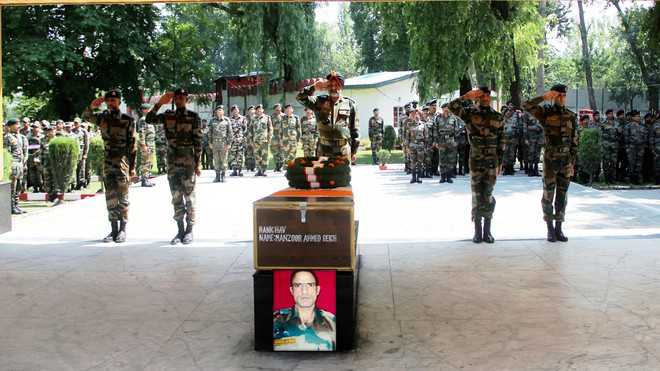
Havildar Manzoor Ahmad Beigh being given the last salute.

ibune News Service

Srinagar, June 7

The Army on Friday paid a befitting tribute to late Havildar Manzoor Ahmad Beigh who was killed by militants on Thursday evening. Beigh had come home for Eid in south Kashmir’s Anantnag district when he was attacked by the militants.

In a solemn ceremony at Badamibagh Cantonment, Chinar Corps commander Lt Gen KJS Dhillon and all ranks paid homage to the soldier on the behalf of a proud nation.

“In a show of solidarity, representatives from other security agencies also joined in to pay their last respects to the martyr,” an Army statement said.

Beigh was serving with the Territorial Army. He shot at and grievously injured by the militants at his house. The soldier was taken to the nearest hospital where he succumbed to his injuries.

“The soldier was unarmed and on a 12-day leave from June 4 to celebrate Eid with his family,” it said. Beigh (41), who had joined the Army in 2004, belonged to Sadura village of Dooru. He is survived by his wife and three children.


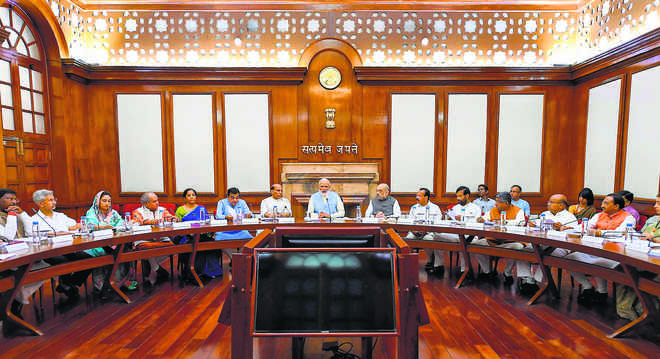
PM Modi at the high table by Neerja Chowdhury

PM Modi at the high table

A team: Some gained Modi’s favour while predictably others fell out.

Neerja Chowdhury
Senior Political Commentator

Team Modi 2019 is in place and carries the ‘chhaap’ of the PM, unlike 2014 when he was new to Delhi, and Arun Jaitley was an integral part of the ministry-making exercise. An important takeaway of NDA-2 is that Modi would like to move India from being a soft state to a muscular one, both internally and externally. The PM has opted for continuity, and for change. Mandate 2019 was to give Modi another term, and he has retained many ministers in the positions they held in the previous government.

But he has brought about a change in the constitution of the high table of government, the Cabinet Committee on Security, which is the apex decision-making body, with the PM, Home Minister, Finance Minister, Defence Minister and the External Affairs Minister on it.

The PM has opted for Amit Shah as Home Minister and not as Finance Minister, which at one point seemed likely with the buzz emanating from Mumbai and Gandhinagar that Shah would plump for the most powerful ministry — Finance and Corporate Affairs — with its outreach to business, industry and corporates. 

Heading the Home Ministry, Shah is seen as the clear No. 2 in the government, though this would have been a given, whichever of the four top departments he held, with his preeminent position in the party and his proximity to the PM. He would now be giving both a political as well as a governmental push to the BJP’s core agenda. During the campaign, Shah spoke unambiguously about abrogating Articles 370 and 35 A, which confer a special status to J&K; and the creation of the National Register of Citizens to weed out ‘illegal immigrants’, which may make the minorities even more apprehensive. He did not refer to the Ram temple issue, currently before the SC, or the  enactment of a uniform civil code. These are issues which can be hyped at appropriate moments, and can be used to help offset pain on the economic front.

There was speculation that Shah’s induction might see a downgrading of the otherwise powerful National Security Adviser Ajit Doval. But that has been put to rest with Doval given Cabinet rank and a five-year tenure. 

In what was an out-of-the-box move, the PM brought a career diplomat S Jaishankar to head the MEA. He dropped Sushma Swaraj, who had publicly announced that she would not contest because of ill health. She could have been given the Rajya Sabha, but that she had made the announcement at the peak of the campaign in MP last year, and apparently without consulting the PM and Shah, did not go down well.

Jaishankar knows the nuts and bolts of foreign policy, having been Foreign Secretary till 16 months ago. He has always maintained a low profile, something the PM appreciates. Even after retirement, he played a role at the Pravasi Bharatiya meet in Varanasi. The PM’s euphoric meeting with the Indian diaspora at New York’s Madison Square Garden — which made the world take note of Modi — was crafted by Jaishankar when he was ambassador to the US. Given his understanding of China, having been ambassador there, he can navigate the emerging situation with the US-China trade war not showing signs of abating.

Even in his first term, the PM showed a preference to work through bureaucrats and domain experts, rather than his ministerial colleagues. Could Jaishankar’s entry be a precursor to more technocrats entering his ministry?

The high table now has two ministers from the South, where the BJP will try and increase its footprints in the next five years. Jaishankar was quick to troubleshoot for the government after the outcry in Tamil Nadu against the possibility of the imposition of Hindi as part of the three-language formula.

Nirmala Sitharaman’s elevation as FM has come as a surprise. She emerged as a compromise choice, preferred to Piyush Goel, who was being also considered, and Jaitley is believed to have had a role in her elevation. Sitharaman, with an economics background from JNU and known for probity, is expected to ensure continuity, with Jaitley no longer able to take up the responsibility due to ill health. She has her task cut out, with the slowing down of the economy posing the biggest challenge to Modi-II. The crisis in the banking sector and non-banking financial companies, growth slumping to a 5.8% figure, unemployment at its highest, and food inflation, are all a cause for immense worry.

Ministers have been chosen keeping in mind states going to the polls at the end of the year —Maharashtra, Jharkhand, Haryana — to give suitable signals to improve the BJP’s prospects. Arjun Munda has been given Tribal Affairs, so he can ensure the implementation of schemes in Jharkhand.

Bihar elections are due in 2020. Five ministers from Bihar, where the BJP won 17 seats, have been inducted. This has caused heartburn in ally JD(U) which won 16 seats and was offered only one ministry as a ‘symbolic’ gesture, which it has turned down. All allies were offered one ministership as a token of appreciation. The Shiv Sena is also unhappy with the Heavy Industry portfolio. While the BJP does not need allies, it may not want to take the risk of dumping them in state elections, particularly as it keeps its sights fixed on a majority in the Rajya Sabha by 2020-end to push through its agenda.

By choosing someone like Pratap Sarangi, who lives in a hut and rides a bicycle, as a minister, the PM is eyeing Odisha in the future. Given the subalternisation of politics that is taking place under him — the chaiwallah opting for those on the margins, and with the backward castes and the more deprived among the Dalits also having rooted for him — he has sent a powerful signal to his new constituency.

Equally significant is the thinking behind the list of those left out.

The PM’s ministerial exercise shows that Narendra Modi expects competence, and also total loyalty.




India handed over body of Pak soldier killed in Kargil on grandfather’s request: Ex-Army chief

India handed over body of Pak soldier killed in Kargil on grandfather's request: Ex-Army chief

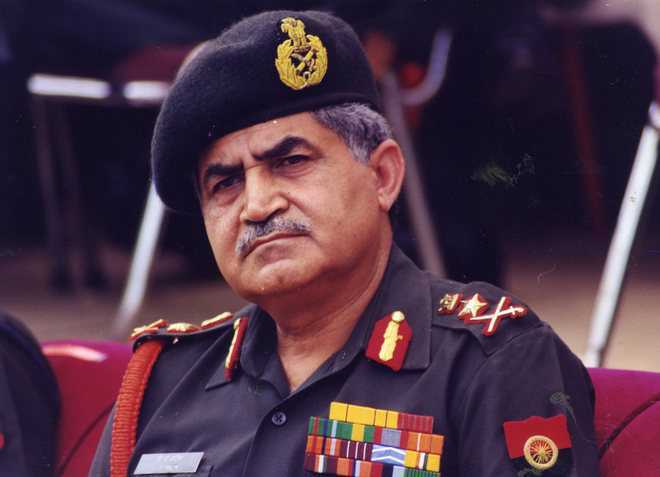
General VP Malik (retd). File photo

New Delhi, June 27

As the country commemorates 20 years of the Kargil War, former Army Chief General (Retd) VP Malik shared how the grandfather of a slain Pakistani soldier had approached India to get back the body of his grandson.

The then Chief of Army Staff General Malik had received a letter from the Defence Attache (DA) in London on a request from the grandparents of Captain Taimur Malik, a young Pakistani soldier who was killed during the Kargil conflict, requesting the body be handed over to them.

Gen Malik on Wednesday tweeted, “After capture of Pt 5770. Pak Army Capt Taimur Malik of SSG was killed. Taimur’s grandfather approached our DA in London. Requested return of grandson’s body & his request be conveyed to me. Got young Taimur’s and other bodies exhumed. Returned them to Pakistan with military honour”.

When IANS asked the general about the incident, he said he did not meet the grandfather but got the message through the Defence Attache in London about the request for handing over the body.

“I did not meet the grandfather. Only received his message through DA. Bodies were handed over to the Pakistan Army,” the general told IANS.

On July 29, 1999, the Indian Army recaptured all posts in Kargil that were occupied by Pakistan.

The infiltration into the Indian side was by both Pakistani troops and militants who had positioned themselves at strategic points on the mountain peaks. — IANS


Army officer urges students to join army as priests

Islamic seminary Darul Uloom at Deoband in Uttar Pradesh. PTI file photo

For the first time in its 150-year history, the prestigious Islamic seminary Darul Uloom at Deoband in Uttar Pradesh witnessed a visit from a top Army officer, who urged its students to join the forces as ‘maulvis’ (Islamic priests). Major General …

Read more at: https://www.deccanherald.com/national/army-officer-urges-students-to-join-army-as-priests-742313.html