Sanjha Morcha

Pak hits new low, targets three schools along LoC

217 students rescued from all 3 schools by 730pm. Great job by team. A narrow escape at Bhawani (sic). SHAHID IQBAL CHOUDHARY, Rajouri DC, on Twitter

JAMMU: Pakistan sunk to a new low when its army targeted schoolchildren in at least three schools along the Line of Control (LoC) in Nowshera sector of Rajouri district on Tuesday. The Pakistan army also pounded Indian posts and forward villages along the de-facto border in neighbouring Poonch, prompting India to retaliate in equal measure.

Rajouri senior superintendent of police Yougal Manhas told Hindustan Times that over 200 children had to be evacuated to safety in bulletproof vehicles in Nowshera.

“Even at 5.45pm, intense shelling is on. In a day-long exercise, we rescued 11 children from a school, 50 from another and then there was the third school where children had to be kept inside due to severe shelling. It all happened in Bhawani area of Nowshera sector,” the SSP said.

He said heavy shelling was reported in Bhawani, Sair and Kadali villages of Nowshera sector. “At least 11 students were trapped in the middle school and nearly 50 in the high school in Sair. Around 150 students were confined in a high school in Bhawani. With great caution, we eventually rescued the children,” Manhas said.

SECURITY PERSONNEL RUSH TO SPOT

Rajouri deputy commissioner Shahid Iqbal Choudhary rushed to Bhawani to take stock of the situation and evacuation.

“All the schools in 23 villages close to the LoC and new areas which came under Pakistan shelling on Tuesday have been closed indefinitely. We are keeping a watch on the situation. Five relief camps are already in place where 840 families comprising around 3,500 villagers are residing,” Choudhary said.

“Field officers have been deputed for coordination and those staying close to the LoC have been asked to stay indoors,” Choudhary said, adding that close to 5,000 people in the district have been adversely affected by the firing from the other side of the LoC.

At around 7pm, Choudhary tweeted, “217 Students rescued from all 3 schools by 730pm. Great job by team. A narrow escape at Bhawani (sic).”

Defence spokesperson Lt Col Manish Mehta said there was an unprovoked ceasefire violation was initiated by Pakistan in Bhimber Gali and Poonch sectors at 6.45am on Tuesday before the Pakistani troops opened heavy fire, including mortars, around 1.50pm in Nowshera.

On Monday, Pakistan army violated the ceasefire in Balakote and Poonch sectors, killing a minor girl and a soldier besides injuring four others. Pakistani forces also violated the ceasefire in the Manjakote sector.


Respected Veterans,

Jai Hind.

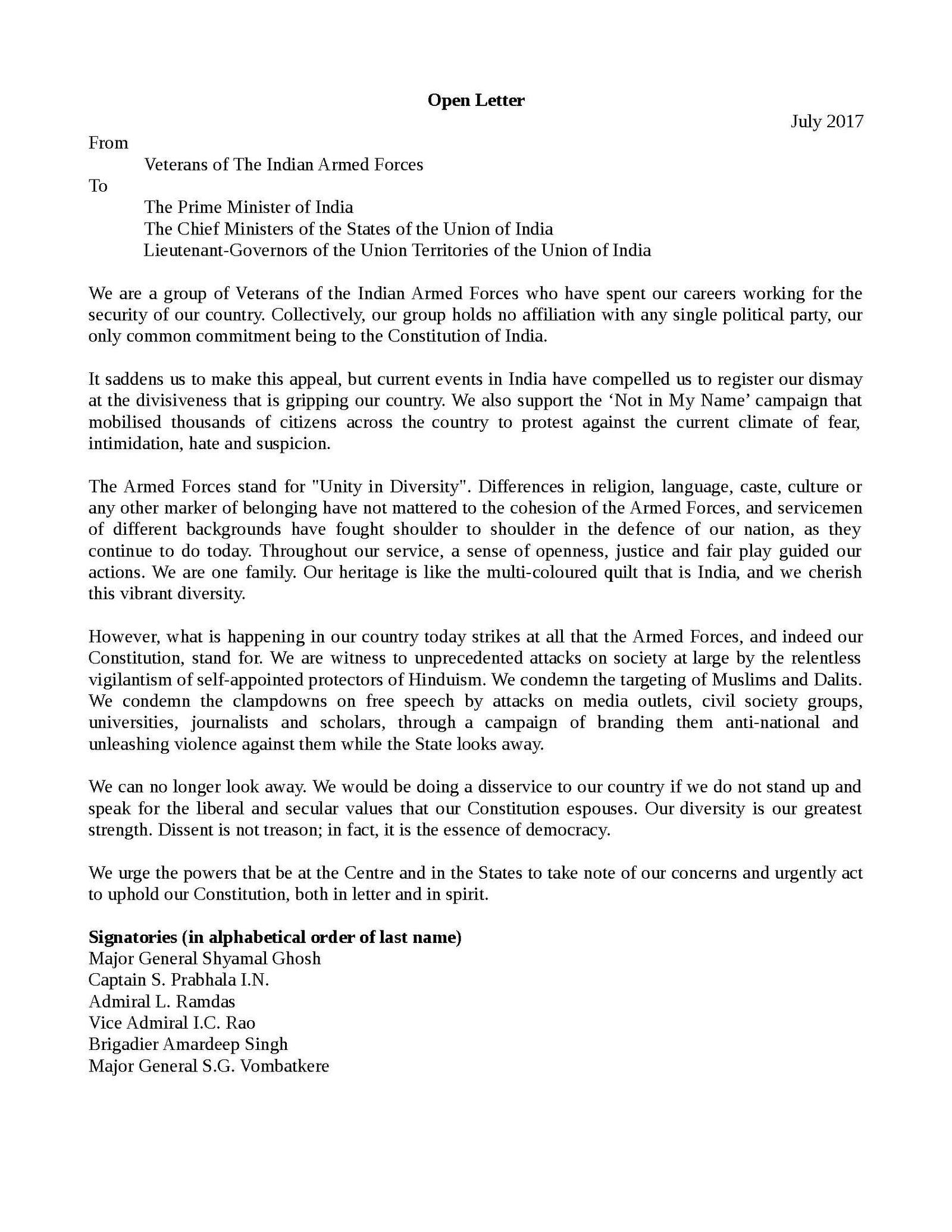
Please find ATTACHED, an Open Letter addressed to the Hon’ble PM, signed by the following six Military Veterans.

Ø    Major General Shyamal Ghosh.

Ø    Captain S. Prabhala I.N.

Ø    Admiral L. Ramdas

Ø    Vice Admiral I.C. Rao

Ø    Brigadier Amardeep Singh

Ø    Major General S.G. Vombatkere

The letter expresses dismay at the recent acts of intimidation and violence by certain ideologues creating a climate of fear and suspicion while the State looks away.

We, veterans of the Armed Forces, are inheritors of a glorious tradition of esprit de corps among persons of different backgrounds, be it of religion, caste or language. It is therefore incumbent on us to speak up for the democratic and secular values enshrined in our Constitution. To remain silent would be a disservice to our cherished values.

If you agree with the sentiments expressed in the Open Letter, kindly send an email to <constitutional.dharma@gmail.com>saying “I agree. Please include me as a signatory”. While doing so, please give your rank at the time of retirement and your full name.

In addition, after deleting my e-mail ID, I request you to forward this covering note and the ATTACHED Open Letter to your veteran friends and colleagues to gather more support for the cause. Our intention is to give wide publicity to the Appeal after a reasonable number have signed in. For the present, therefore, kindly do not circulate this outside of the veterans community.

colRajan

Col SS Rajan

Bangalore, 9449043770

click to open pdf file below


Moving-picture-down-arrow-on-spring-animated-gifVETERANS’ OPEN LETTER

VETERANS' OPEN LETTER


India-China standoff: What is happening in the Chumbi Valley?By Lt Gen H S Panag

Depending upon the situation, we must mobilise to call China’s bluff and be prepared for border skirmishes or even a limited war.

“Yatung was a small spread out town… we were received by representatives of the Chinese General in Command at Lhasa, and of the Dalai Lama and Panchen Lama.” Thus wrote Jawaharlal Nehru to the Chief Ministers of India on October 15, 1958, describing his stay at Yatung for two days in September-October 1958, during his to and fro journey to Bhutan through the heart of the Chumbi Valley. Today it seems like a fairytale, but for 50 years up to 1954, we had an Indian Army Infantry Battalion located at Yatung with a detachment at Gyantse. These were gradually withdrawn after the Panchsheel Agreement was  signed on 27 April, 1954. We continued to have our Consul General in Lhasa and Indian Trade Agency trading posts at Yatung, Gyantse and Gartok upto 1962 when they were wound up.

Chumbi Valley has been in the news for a couple of weeks owing to reports about the Chinese intrusion into the Doklam (Donglang according to China) Plateau. There has been some confusion created about the place of intrusion with names like “trijunction”, “Doka La”, “Sikkim Border”, “Donglang”, “Mount Gipmochi (Gyemo Chen)” and “Doklam” used by the angry People’s Republic of China (PRC) and People’s Liberation Army (PLA) spokespersons, and our media.

Where is Doklam Plateau?

Doklam Plateau is an 80-89 square km plateau with average altitude of 4,000-4,500 meters, located in Western Bhutan. It is a salient of Bhutanese territory that juts north into the Chumbi Valley with India (Sikkim) to the north-west, west and south-west and Tibet to the north, east and south-east. The trijunction of India, Bhutan and Tibet is on the north-western edge of the Doklam Plateau where the Batang La post of India is located and north-west of which along the crest line are the Indian defences of Sikkim.

What is the military significance of the Chumbi Valley and the Doklam Plateau?

Salients on borders whether towards own or enemy’s territory have military pros and cons. Chumbi Valley is a 100-km dagger-shaped north- south salient that lies between India (Sikkim) to the north-west, west and south-west, and Bhutan to the north-east, east and south. Some 100 km south of the dagger point is Bangladesh and, in between, lie 70 km of rugged mountainous terrain of India/Bhutan and the Siliguri Corridor, which at its narrowest point is only 30-km wide and has a number of rivers running in north-south direction. On the face of it, at the strategic level, it gives the PLA a launch pad to choke India’s vital lines of communications running through the Siliguri Corridor to the North East. But this will require a major offensive by five to six divisions as part of an all-out war, with holding forces to contain the north western, western and eastern flanks. Given the existing road communication, limited deployment space as the Chumbi Valley at Yatung is only 25-30 km wide as the crow flies, vulnerability to air power and Indian counter-offensive from the flanks, this hypothetical threat is a non-starter.

In fact, the Chumbi Valley is more vulnerable to an Indian offensive or counter-offensive from the north-west and west from Sikkim and ‘by your leave’ complementary offensive via Bhutan from the east. Again this can only happen in a major war, the probability of which is very low. Nations armed with nuclear weapons do not generally risk an all-out conventional war, though probability of border skirmishes or a limited war cannot be ruled out.

The Doklam Plateau gives the PLA the advantage of outflanking from the south west, the defences of Sikkim, where we have a major terrain advantage vis the Chumbi Valley. The implications are strategic. We not only lose our major advantage of a strategic offensive / counter offensive from Sikkim but also give the PLA a launch pad for an offensive through the Rangpo River valley towards Kalimpong without violating the neutrality of Bhutan. The probability of war may be low, but the bottom line is that India cannot afford to surrender its strategic advantage and create a vulnerability by allowing the PLA to take possession of the Doklam Plateau. It is pertinent to mention that all the disputed areas that the Chinese claim along the Line of Actual Control (LAC) are related to strategic or tactical advantages in event of a war.

What is the dispute in the Doklam Plateau?

Map released by the Chinese spokesperson*

*Map released by the Chinese spokesperson showing the disputed area as per its perception of the 1890 Anglo-Chinese Convention. The Trijunction is marked at Gyemo Chen (Mount Kipmochi). The dotted line on the map running through Sinche La shows the Indian and Bhutanese perception of the Trijunction and the boundary.

The LAC only defines the approximate border which has emerged out of the frontier regions over the last 100 years. Same is the situation on the Bhutan border. There is no mutually accepted International Boundary.  Even in respect of the de facto borders, there is no delineation agreement, which China has signed with India or Bhutan.  Ancient feudal and colonial treaties or agreements are cited to press rival claims. There is no de juresanctity of the border. Empirically, it is the de facto position, which reigns supreme with respect to borders. And the de facto position is signified by physical possession and presence. The problem with the borders with Tibet is that the rival claimants have not physically secured all their claimed areas. Hence, jostling for positions of advantage as part of the continuous competitive conflict is a constant feature which may take place by design or at times by default.

The de facto position is that India holds the posts of Batang La and Doka La  to the north-west of Doklam Plateau as part of its defences in Sikkim. India and Bhutan consider that the trijunction is located at Batang La. The Doklam Plateau is in the possession of Bhutan but it secures its possession with only one post at Zompleri, which is occupied only in summers. China claims the entire plateau and as per its version the Trijunction is at Mount Gipmochi (Gyemo Chen) which is 7-8 km to the south-east of the de facto present position. Since the Doklam Plateau is largely not physically held by the Bhutan Army, the PLA has been patrolling this area at will. India also patrols this area with a mutual understanding with the Bhutan Army to safeguard its vulnerable eastern flank. Indian and PLA patrols have confronted each other in this area in the past and matters were resolved by agreeing to disagree to maintain status quo for peace.

China bases its claims on the Anglo-Chinese Convention 1890 as per which the Sikkim-Tibet border was agreed upon. Ironically, Sikkim and Bhutan were neither invited to nor are signatories to the convention. This convention did not prevent China from starting confrontation at Nathu La in 1967. Moreover, China’s approach to various colonial treaties/conventions has been selective on one pretext or the other. China has officially acknowledged the various areas of dispute including the Doklam Plateau with Bhutan and 24 rounds of negotiations have been held. It has formally been agreed to by China and India, in 2012, that the Trijunction points between India, China and third countries will be finalised in consultation with the concerned countries. In 1988 and 1998, China and Bhutan have also formally agreed to maintain status quo with respect to the disputed areas pending final settlement. Notwithstanding the patrolling by both sides, this status quo has not been disturbed until June 2017.

Bhutan, being a small nation, has a special relationship with India based on formal treaties renewed over the 100 years. As per the 2007 treaty, India and Bhutan have agreed to cooperate with each other on issues relating to their “national interests” and not allow the use of their territory for activities harmful to national security and interest of the other. Shorn of diplomatic ambiguity, it implies that Bhutan will be guided by India with respect to its foreign and defence policy. De facto, India is responsible for the defence of Bhutan, but except for the Indian Military Training Team no Indian troops are permanently stationed in Bhutan. However, troops of both countries do carry out joint training on as required basis. On the borders, there is intimate cooperation between the Royal Bhutan Army and the Indian Army particularly in disputed areas like the Doklam Plateau. Bhutan, being a small country, was keen to settle the disputes on its western boundaries in favour of China in exchange of a favourable settlement for two northern areas of dispute. However, keeping in view India’s sensitivities it refrained from doing so particularly with respect to the two disputed areas of Doklam Plateau and Sinchulumpa-Giu-Darmana south and east respectively of the Chumbi Valley.

The present standoff

On June 16, China began construction of a road from Sinche La towards the Bhutan Army post of Zompleri. Indian troops from Doka La confronted the PLA troops in conjunction with the troops of the Bhutan Army. No fire arms were used, but, human chains were formed by both sides and “jostling” (pushing and shoving) which has become a common feature in such confrontations have continued on and of since then. Both sides seem to have reinforced the present positions with additional troops and the standoff continues.

While such ‘standoffs’ have taken place for prolonged periods in the Depsang Plains in 2013 and Chumar in 2014, the emphasis still was on diplomacy and having made the ‘political statement’, the PLA reverted to status quo. However, this time the official statements and Chinese media have been unusually belligerent giving short shrift to diplomatic niceties. Words and phrases like “do not forget 1962”, “PLA will teach India a lesson”, “no talks until Indian troops withdraw”, “option of war is open” and “either Indian troops return to their territory with dignity or will be kicked out of the area by the PLA”, have been freely used. India and Bhutan in typical diplomatic language have urged China to maintain status quo ante pre June 2017 and respect the interim agreements with respect to Trijunction points reached with India in 2012 and the 1988, and 1998 agreements with Bhutan to maintain the status quo pending final settlement.

Chinese Strategy

What are the reasons for this unusually belligerent stance of the Chinese? Are we heading towards border skirmishes or even a more serious confrontation?

The Doklam incident as also other border incidents in the past have nothing to do with the territorial disputes per se. Nations with credible conventional and nuclear deterrent, do not part with territory under their control whatever be the nature of the dispute. China is well aware of this, but selectively starts such confrontations to make ‘political statements’ and keep India on the edge. Such incidents always take place to coincide with major diplomatic events or as a response to perceived Indian actions that are contrary to Chinese world or regional view.

India is the only country in the region that has not accepted Chinese political hegemony. China views India as a competitor that challenges its preeminent position. Indo-USA strategic cooperation is seen as a threat. India is seen as the principal instigator of the Tibetan struggle for freedom. The presence of the Dalai Lama and the Tibetan Government in Exile at Dharamsala only reinforces the Chinese belief. The recent visit of the Dalai Lama to Tawang annoyed the Chinese no end. India, along with Bhutan, is the only country that has not become part of the much-touted One Belt, One Road. Prime Minister Modi was scheduled to meet President Donald Trump in the third week of June.

China decided to embarrass India in the Doklam area by trying to alter the status quo. It aimed at driving a wedge between India and Bhutan and thus chose to show its presence in Bhutanese territory, to which India also is very sensitive. China’s strategy is to make India lose face by forcing it to withdraw and thus wean Bhutan to its own sphere of influence.  Anything short of mutual withdrawal will leave China in de facto control of the Doklam Plateau outflanking and compromising the Indian defences in Sikkim.

What should be the Indian strategy?

This is a critical moment in Sino-Indian relationship. Any sign of weakness will have repercussions on the entire boundary question. Today, it is Doklam and tomorrow, it will be somewhere else. Acceptance of Chinese position in Doklam will lead to unacceptable ‘loss of face’ domestically and internationally.

China understands only one language and that is the language of strength. Our own experience of the 1967 confrontation in Sikkim and the Sumdrong Chu incident in 1986-87 proves this point. India must not back down unless it is mutual withdrawal to restore status quo ante pre-June 2017 and respect for past interim agreements to maintain status quo with respect to Trijunction points. In Doklam, we are in a position of advantage and from Batang La can cut off the PLA intrusion at Sinche La. We can build up much faster than China for any serious military confrontation. Depending upon the situation, if need be, we must mobilise to call China’s bluff and be prepared for border skirmishes or even a limited war. The tenor of the Chinese statements and our measured and nuanced response itself reflects that we have the psychological advantage.

There is no gain in saying that we must engage with China to settle the matter diplomatically and a direct military confrontation is the last resort. This is a defining moment, as giving in to Chinese bullying at this juncture will have serious repercussions for our rightful place in the comity of nations and our status as an emerging power.



HEADLINES :::13 JUL 2017

breakl line

MAJ GEN SATBIR SINGH ::ISSUE RECEIPTS TO VETERANS FOR DONATED AMOUNTS TO UFEM FOR TAX EXEMPTION–PART V

Untitled


SMOOTHER SAILING FOR TOP BRASS BY LT GEN SYED ATA HASNAIN PVSM, UYSM, AVSM, SM, VSM & LT GEN GAUTAM MOORTHY,PVSM, AVSM, VSM,ADC

ARMY GETS POWERS TO BUY AMMO

CHANGE THE KASHMIR NARRATIVE BY G PARTHASARATHY

CHINA READY FOR ‘CONSTRUCTIVE’ ROLE IN J AND K

2 SOLDIERS DIE IN LOC FIRING J&K PUT ON ‘HIGHEST’ ALERT, ANTI-TERROR OPERATIONS LIKELY TO BE STEPPED UP

EX-SERVICEMEN BURN PAK FLAG

CHINA PLANS TO DOWNSIZE ARMY TO LOWEST STRENGTH IN ITS HISTORY

STRATEGIC DRAWDOWN THIS IS THE FIRST TIME THAT PLA ARMY PERSONNEL WOULD BE REDUCED TO BELOW ONE MILLION

CAPT SEEKS MODI’S HELP IN CHECKING UNEMPLOYMENT

TWO SOLDIERS KILLED IN PAKISTAN FIRING AT LOC

SENA: SEND COW VIGILANTES TO FIGHT MILITANTS IN VALLEY

WHY MUM ON CONVICTED NETAS, SC PULLS UP EC

breakl line


The spirit of 1962 by Zarrar Khuhro

The spirit of 1962
In February this year, a delegation led by Maj Gen Zhao Jin Song, the Vice Chief of Staff of PLA’s Headquarter Western Theatre Command, Chengdu, China, called on senior Indian Army officers, in New Delhi. — Agencies/File

IN a subcontinent dominated by Pak-India conflicts, the short, sharp Sino-Indian war of 1962 remains rather neglected, with little analysis of how it helped shaped the region into what it is today. The recent standoff at the Doklam plateau, and the inevitable parallels that are being drawn, makes it worthwhile to take another look at this conflict.The road to the 1962 war starts in Tibet — in fact, it starts because of the road to Tibet. No sooner had Mao proclaimed the People’s Republic of China (PRC) in 1949 that troops were sent to conquer this land, via a road that passed from the western Chinese province of Xinjiang through Aksai Chin and on to Tibet. When a Tibetan uprising took place in 1959, this was again the route Chinese reinforcements took. The revolt failed and the Dalai Lama fled to India where he was granted asylum, much to China’s chagrin. Soon after, India starts to strengthen its position along the McMahon line, the border between Indian and China. In particular it expanded its positions in Ladakh, which borders Aksai Chin.The Indo-China war’s role in regional politics is often ignored. To the Chinese, this potentially threatened a crucial supply route to Tibet, and thus their hold over it. Then there was the fact that India was a Soviet ally, and though China and the USSR shared the communist ideology, a Cold War waged between the two nations. Pressed on its long border with the USSR, China saw India was a potential threat that needed to be whittled down at some point, and that point came in 1962.The Chinese struck in force, one army moving into Ladakh and another striking across the McMahon line from Tibet at four points. Unprepared and underequipped, with primary units deployed against Pakistan, the Indian forces were hopelessly outmanned and outmatched. The shock was such that a larger invasion was feared, but Beijing then announced a unilateral ceasefire, withdrawing to maintain a strategically favourable position along the sprawling border.Up until then, Pak-China relations had been cordial but wary, and no warmer than Sino-Indian relations in the days of “Hindi-Chini Bhai Bhai.” After all, Pakistan was a card-carrying capitalist US ally, and China had fought a bloody war against the US in Korea in the 1950s.Moreover, China also had territorial claims on parts of Azad Kashmir, and Tibet and Korea had demonstrated China’s willingness to take decisive action to secure its interests.The build-up to 1962 changed this, and while Pakistan did not engage in hostile action against India, it did pile pressure by announcing the holding of border negotiations with China. When the war ended with India being militarily and diplomatically humiliated, Pakistan was quick to conclude a border treaty with China in 1963. Justifying the deal, then foreign minister Zulfikar Ali Bhutto said Pakistan “would not like to see the tantrums and crisis (that marked the dispute) between the PRC and India”. The lessons learned by Pakistan were that (a) disputes with China were to be avoided, (b) this state was a potential hedge/ ally against India and (c) that the Indian army was not as strong as it had seemed during its capture of Goa. This latter conclusion was crucial, as the idea of the Indian army being susceptible to strategic surprise played a significant role in the calculations that led to the ’65 war. The war also seems to have led to a feeling that China might overtly aid Pakistan in a future conflict with India. While this proved untrue, it was something that New Delhi also feared, and there was much speculation in India at the time that the Sino-Pak border agreement had secret military clauses too.For India, while this war resulted in military humiliation and a serious loss of prestige, it served to unify the nation, feeding nationalist sentiment and spurring the process of militarisation. That, in turn, had the effect of slowing Indian economic growth somewhat as funds were diverted to the military. On the international front, Anglo-American military aid given to India after the war brought India closer to the West, while simultaneously souring Pakistani attitudes towards its Western allies. Ayub Khan bluntly told both Washington and London that they must abandon the aid-India programme to keep Pakistan’s friendship.Consequently, when the US State Department protested at the signing of economic and trade agreements with China, the complaints were shrugged off. When Zhou-En-lai was invited to visit Pakistan in 1964, the US protested again to no avail. Pakistani officials and newspapers adopted a clear pro-Beijing line, questioning the value of a Western alliance that couldn’t resolve the Kashmir dispute.Trends and attitudes were established in this period that have marked the dynamics of the subcontinent ever since, and the alliances and enmities of today can be said to find their genesis in 1962.By arrangement with the Dawn


Police quiz 6 persons to trace Army deserter

Police quiz 6 persons to trace Army deserter
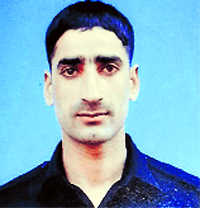
Sepoy Zahoor Ahmed Tokar

Majid Jahangir

Tribune News Service

Srinagar, July 7

The J&K Police have questioned over six persons, including family members, to trace the whereabouts of a Kashmiri soldier who deserted his base.The police are also investigating whether the soldier, a resident of Pulwama district in south Kashmir, was in contact with militants or any over-ground worker (OGW) back home. Pulwama district is home to nearly 20 militants.Sepoy Zahoor Ahmed Tokar, who was posted in the 173 Territorial Army (Engineering) unit at Gantmulla Baramulla, went missing along with an AK rifle and three magazines.After Tokar went missing, a high alert was sounded as the deserted soldier has a good knowledge of the “security system.” While the police suspect that Tokar may have joined militancy, but so far they have got no confirmation or any hard evidence regarding it.“Before deserting, Tokar had talked to his father and a friend over phone. We questioned them but the duo had no clue about his deserting the Army base,” a senior police officer said. “We have questioned other people also and we are trying to find out whether the soldier had any contact with any militant or OGW in Pulwama. The jawan was in fact home on Eid and had joined after availing two-day leave,” he said.Inspector General of Police, Kashmir, Muneer Khan said there was no confirmation about his whereabouts.There have been instances in J&K where policemen have joined militant ranks, but this is the first such incident of a Kashmiri soldier deserting Army ranks. In May this year, Constable Syed Naveed Mushtaq, a resident of Shopian district in south Kashmir, had fled with four INSAS rifles, including his own rifle, from the guard post at the Food Corporation of India godown in Budgam and later joined militant ranks. In past five years, at least five cops have joined militancy in Kashmir.


MAJ GEN SATBIR SINGH MUST STOP FOOLING EX-SERVICEMEN FOR HIS OWN VESTED INTEREST—JM A HOAX NOW–PART-I

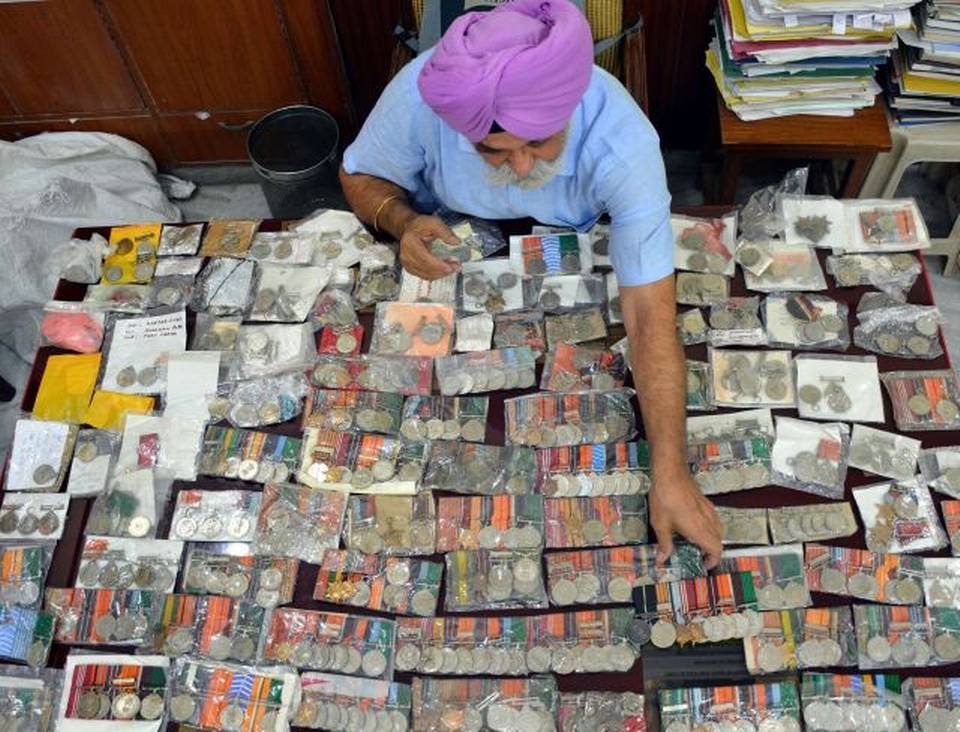
 WHERE ARE THE MEDALS MAJ GEN SATBIR?? :

CAN YOU GET IT BACK THE MEDALS TO ESM IF WORTH CALLING YOURSELF AS LEADER OF JM

 CONFIRMS NO LOVE LOST.

MANY HAVE LEFT TO HEAVENLY ABODE  WAITING FOR RETURN OF MEDALS BUT SATBIR HAS NO REGRETSmedals

Untitled

Cdr Ravindra Waman Pathak I.N. (Retd) Writes to Maj Gen Satbir Singh 

 Moving-animated-down-arrow

 On Thu, Jun 29, 2017 at 4:44 pm, Ravindra Pathak

<raviwarsha@gmail.com> wrote:

Dear Satbir Singh Sir

I am writing to you a personal appeal once again to call off JM agitation.

I am not getting into the past where most of your now defunct GB members had differed with you and resigned.

This is a fresh appeal based on a very very  reliable information that the OMJC report is not being signed by the RM on instructions to the PM who is very peeved by the JM activity.

Please see reason. Unless the OMJC report or its implementation is out in the open we will have little grounds to take on the issue even in  court. At present we are in a no win situation. If you call off we will have a report in open domain and if that is not in  our favor our case in SC is still there.

So kindly reconsider the continuation of the activity at JM for any delay in release of the OMJC report and its implementation will rest squarely with you and your new found friends.

Untitled

Brgds
Pathak

Cdr Ravindra Waman Pathak I.N. (Retd)

Member ​Veterans ​Pension Group 

1 Surashri,1146 Lakaki Road
Shivajinagar 

Pune 411016
raviwarsha@gmail.com
9822329340  

Untitled

COL ANIL KAUL Vrc  QUESTIONS MAJ GEN SATBIR FOR HIS UNWARRANTED ACTIVITIES FOR SELF INTEREST AND NOT FOR WELFARE OF ESM COMMUNITY.

It amazes me how you all have glossed over the legal implications of the court order of 9 May 2017. We all seem to feel that the interpretation put out by Gp Capt Gandhi is correct and the gospel truth. Far from it. I have a few points that mat merit your re-think though an onslaught against my mail from vkg and the ss support group is expected.

Fact 1. The High court has revived the General Body  of 2012. 

Fact 2. Gen Raj Kadiyan  retains the post of chairman  and Gen Satbir Singh as the Vice Chairman  (This has not happened)..

Fact 3. The involvement of two parties in the case in org the AGM & elections specifically Gen Kadiyan  & VK Gandhi has been barred (Though I could not find such mention in the order that was circulated. If someone can quote line,  chapter and verse I shall be grateful).

If that be so the case was filed by some Jco’s and Gen Kadiyan  and    VK Gandhi  in his capacity  of Gen secy of IESM are respondents. Not as individuals, this was with the registrar. Subsequently IESM filed an appeal in the high court. The court case was being overseen by Gen Jaini till he unfortunately took ill. Thereafter vkg has been monitoring the case in his official not personal capacity. Also funds being paid for the case were from the IESM  account till it was frozen. Not from any personal account. 

This brings me to the point of law that if the above is correct as has been advised by some legal friends , then VK Gandhi interpretation of selective barring of Gen Kadiyan and himself is totally flawed. In fact since it is an institutional case the entire 2012 GB should be debarred including Brig Kambhoj. 

Since this irregularity is progressing with inputs from VK Gandhi (trailing mails conclusively prove his day to day guidance of the good brigadier) the whole process is heading for a sham , and repeat of 2012. 

Maybe the reason why Gen Satbir Singh still is affixing  Chairman  to his name in all correspondence as a likely well org pre determined fait accompli to be installed as chairman. 

As a life time member of IESM I demand the following. 

  • The current process be stopped immediately. 
  1. A registrar rep be appointed asap to oversee from prep to reorg stages. All meetings, decisions, approvals be taken in his presence. 
  1. An ad -hoc 5 member committee outside of 2012/2014 GB including members from three services, officers, jco’s and OR be appointed.

If we want to set things right then we must allow fair play. However if we want to be the muddle through brigade then only God can help us. 

My warm regards to all of you

images-4
Col  Anil kaul. 

Untitled

COMMENTS
  • #The Jantar Mantar is now the face value of Maj Gen Satbir Singh as it has lost its relevance and ESM have disassociated  from the daily drama of Satbir.
  • @ He is misusing the donated amounts by ESM and paying Rs 12000/- per day for the JM.
  •  @He is media hungry wants to be in the news all the time.
  • @Maj Gen Satbir has politicised  the Jantar Mantar by forming Fauji Janta Party of which he is the Patron to control the funds collections and Col Mullick the President of FJP.
  • @ Even FJP is a defunct organisations as it could not get a single seat in Punjab ,Uttar Pradesh or Harayana. Thus let down the ESM in the eyes of the Nation.
  • @He is continuing to sit a JM with a hope to get more donations by fooling ESM  and has opened a new account probably in Andhra Bank and deposited about 20 to 25 Lakhs collected recently. who are the signatory of the accounts no body knows.
  •  @He has stooped down to such a level that he is in a hurry to enroll fresh members from Punjab and distributing Cash in Lakhs to support him to become the Chairman of IESM. 
  • @He is having regular meetings with ESM of Punjab to Split them against Capt Amarinder Singh  for not projecting him as Rajiya Sabha Candidate. The last meeting he held was at Brig Harwant Singh Residence on 05 Jul 2017 along with Col Rangi and Col HS Bajwa the strong supporter of Kejriwal .
  • @He dare not go to Harayana as he will not be entertained by any ESM so wants Brig Harwant Team of APP Fame in Punjab to assist him support from Harayana.
  • @ He is provoking Punjab ESM  against Brig Inder Mohan President IESL to split IESL Punjab.

WELL DONE SATBIR

“USE AND THROW IS YOUR POLICY “


‘Where do I bring up my children?’

DARK SIDE Increase in violence and a prolonged unrest have scarred the region for many locals, including an HT journalist, who worries about her children’s future

Tomorrow A losing social media battle. WHILE MY SON NURTURES THE DREAM OF JOINING AN IIT, I AM LEFT WONDERING WHAT THE WORLD WILL HAVE COME TO IN 7 YEARS WHEN HE IS THINKING OF MOVING TO COLLEGE

From page 01 SRINAGAR: On Saturday, June 24, WhatsApp groups here buzzed with reports of militants entering the Valley’s elite Delhi Public School. Being a journalist, I got the news around 5:30 pm, just as it was happening. Violent encounters have become commonplace, but my reaction to this one was far from normal.

PTI FILESpecial task force personnel stand guard outside a school during the search operation after a CRPF vehicle was attacked by militants at Pantha Chowk in Srinagar on June 24. A CRPF jawan was killed and another injured in the attack.Instead of updating the online team of the Hindustan Times, I called home. My two children attend Delhi Public School. Although I knew that school had ended at 2:30, I still wanted to make sure my children were safe.

In May, my son, who is in Class 5, stayed back until 6 pm for his music lessons, something that many students do for sports and other extracurricular activities. The attack could have occurred on such a day, I thought.

As soon as he heard the news, my husband, Asif Qureshi, who is also a journalist, arrived at the scene. He barely evaded bullets mis fired by a policeman. To our shock, a video of him nearly being shot was repeatedly played on TV.

“Why are they saying, ‘Asif Qureshi bal bal bache’ (Asif Qureshi survived by the skin of his teeth)?” both my children kept asking in disbelief. Between their father nearly being killed and army vehicles entering their school, my kids weren’t able to get particularly excited for Eid ul-Fitr. Last year’s celebrations, which occurred around the time of the killing of militant leader Burhan Wani, were spoiled too.

The safety of Baba (Asif) overshadowed the images of military forces in their school. For the children, damage to the school was not actually an unmitigated disaster: it meant extra holidays. But it was not a happy occurrence either. My daughter, who is still in kindergarten, worried about her classroom getting damaged, since the paper plates she had painted during club activities lined the walls. My son was sure his classroom had been spared after he asked us about the exact location of the militants, but he feared for the safety of the school library.
That night, my son and his friends speculated about the violence and its implications on WhatsApp. They used words and phrases like “bazooka”, “encounter”, “machine gun”, and “pulling down walls”. “School ki halat kharab, hum tou gaye (School is in bad shape, we’re off),” the boys decided.

So when the school declared, the next day, that summer vacation would start early, the children were unsurprised. Sitting at home with nothing to do has become normal for them. Like other children, my kids went without school for more than six months last year.

My son, who turns 10 this October, is starting to form ideas of his own. He hears things on the bus to school, on TV, during family dinner with two journalists for parents who cannot help discussing killings and encounters. He is more and more inclined towards Kashmiri ‘nationalism’.

When he says things like “India wants Kashmir for its water resources” or “the Modi government wants all Kashmiris to die’’ or “the US president seems like an extension of the Indian Prime Minister”, I am shocked.

Just the other day, he couldn’t remain untouched by the frenzy and euphoria surrounding the clash between India and Pakistan for the Champions Trophy.

When a police officer was recently lynched, I did not want my children to see our society’s brutality. The list of such events is long. I don’t want my children to see the pellet-scarred faces of other small children; I don’t want them to see the mutilated bodies of militants; I don’t want them to see a weaver tied to an army jeep.

But what do I have to offer instead? In Kashmir, there is no alternative ‘idea of India’.

While my son nurtures the dream of joining an IIT to become a scientist, I am left wondering what the world will have come to in seven years when my son will be thinking of moving to college.

Some of my friends suggest I move back to Delhi whenever Kashmir turns violent, but recently, one of them advised against it. She thought the cow vigilantism, Islamophobia, and anti-Kashmir sentiment in the rest of the country had grown too strong.

My biggest dilemma as a mother is -what do I offer my son instead of a violent Kashmir’? If Kashmir has grown violent, the idea of India has taken a hit.

Where should I bring up my children? At times, I just want to push them back into my womb and run away.


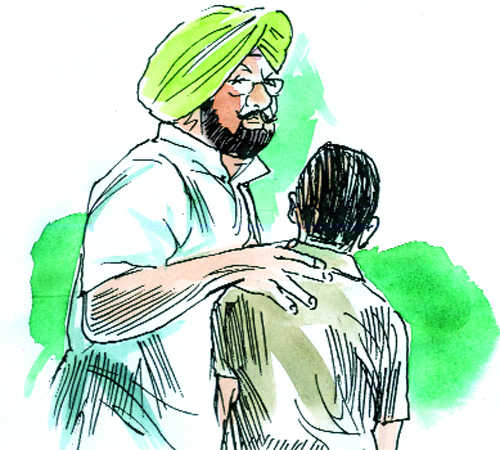
‘We are opening windows of opportunity’ BY Capt Amarinder Singh

A young man voiced his despair in the columns of The Tribune yesterday. He had asked the Chief Minister questions that mirrored his anxiety about the future. The Chief Minister responds to the many unemployed youth in Punjab, stating that his top priority is boosting the job market.

‘We are opening windows of opportunity’

ON page 8 of The Tribune dated June 30, 2017, a young man Ankush Mahajan, has asked me a question. He is faced with a dilemma that many youth in Punjab, in fact across the country, are facing. He wants to know where he can or should go for a job after completing his postgraduation. I can understand the sense of despair that motivated him to share his helplessness through your esteemed columns. At the same time, I also appreciate his candour and boldness in escalating his concerns to me — after all, if the people have elected me they have every right to expect me to resolve their problems and dilemmas.While it is not possible to list down everything we are doing to help young men and women like him to become gainfully employed, let me share in brief some of the ways in which we are trying to create employment opportunities for them.The entrepreneurial schemes we have launched — Apni Gaddi Apna Rozgar, Harra Tractor, Yaari Enterprises etc, are excellent resources to make our youth gainfully employed and independent. And to my colleagues in the opposition who have accused me of trying to convert the state’s youth into taxi drivers, I can only say — isn’t it better than making them drug addicts and criminals? In any case, some of the most successful youth in the world today are not those in white-collared jobs but those who have taken the entrepreneurial route. What we are doing through these schemes is to promote self-employment, which I am sure will go a long way in helping the unemployed youth.Our focus on skill development in the education system, which we are revamping in order to make it more goal-oriented, is in line with our thrust on stimulating the job market, which had become totally stagnant over the past decade. The results of this revamp will start becoming visible on the ground soon, helping lakhs of youngsters become job-ready and fully prepared to take on the new opportunities that are opening up for skilled professionals not just in India but across the world. While skill development and entrepreneurship are the core areas of my government’s focus, we are, at the same time, cognizant of the need to create regular job openings for those who are not skillfully empowered in any way. We will soon notify vacancies in PCS to fill administrative posts in the government. Horticulture, health, education and agriculture are some of the other areas in which we are looking to create more job opportunities, in addition to industrial establishments such as Bathinda Refinery and power projects in the state. Industrial development to boost employment generation is, in fact, a key solution we are pursuing aggressively to address the problem of large-scale unemployment. The next few months will see a host of big and small industries setting up business in the state, thus opening up new job prospects for the job-seeking youth.The private sector is coming out aggressively to support our initiatives. Only yesterday, Quark City Infrastructure assured me that their company will generate 500 new jobs, with 5,000 more likely to be added by IT and other companies seeking to enter the Mohali Quark City at Mohali.Finally, a small word of advice for those who belong to the so-called General class of society. It is no more a curse than belonging to some special class is. It is all a matter of finding the right opportunity at the right time and the right place. And I can promise that my government is committed to give you such opportunities, now and for the next five years, irrespective of the so-called class, creed or religion you belong to!


Bluster as foreign policy BY Sandeep Dikshit

Hostility has left neighbours unmoved

Bluster as foreign policy
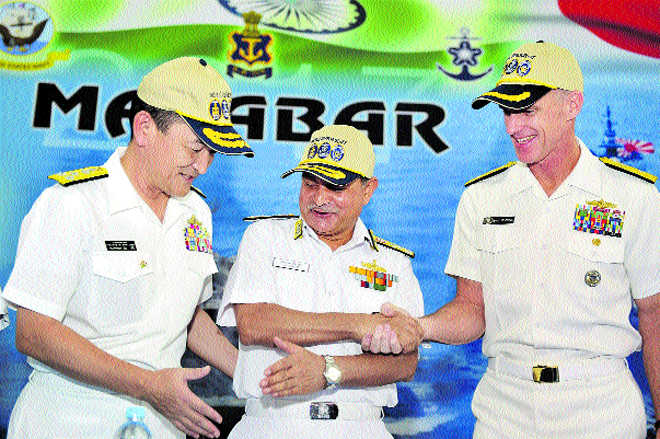
Rebonding: Joint naval exercises are symbolic of changing equations.

Sandeep Dikshit

AN unnamed US navy top brass sought to enlighten us about the end game behind the recent week-long excitement in the waters of the Bay of Bengal involving navies of the US, India and Japan. “They [China] will know that we are standing together and that it is better to stand together,” he said at the end of the war-like maneuvers involving, as breathless defence correspondents put it, three aircraft carriers for the first time.Like all naval exercises this comes with a name, this one is called the Malabar. It began in 1992 as India began reaching out to the other side of the Cold War divide and has now assumed proportions that are the interest of every sea-faring nation in the world because it involves Japan, India and the US with a very interested onlooker in Australia, all of whom disagree with Beijing’s modus operandi of reworking the power equations in the region.  Astute as they are, the Chinese would have noticed that the famed US aircraft carrier Nimitz came for the exercises with a leaner complement of accompanying warships. The Japanese contributed two warships. More than war-fighting machines, they remain symbols of Shinzo Abe’s overturning of Japan’s post World War law forbidding its participation in international conflicts. Australia, which was kept out of the Malabar exercises, is still reorienting its navy for a blue water role.  Clearly, the comforting words of the American naval officer and the temporary presence of a number of warships in the Bay of Bengal can have no impact on the border standoff on the India-China-Bhutan tri-junction or dampen the Sino-Pakistani tango where Beijing has promised to do the heavy lifting for a massive infrastructure buildup that straddles Indian Kashmir.   Prime Minister Narendra Modi has recently jet-setted to the US, Russia, Spain, France and Germany, all with a thriving military-industrial complex. Very few have responded to his call to manufacture military hardware on Indian soil, partly because most would not wish to rework their equations with China.The belligerent realists who have come to dominate the Indian foreign policy may draw comfort from the Donald Trump’s maiden defence budget that has a few lines about India. So far India has largely bought surveillance and detection equipment from the US while going slow on offensive platforms like fighters, tanks and submarines.Both sides have their reasons. The US had abruptly suspended the Malabar exercises after India conducted the nuclear tests in 1998. As part of US sanctions at that time, Pentagon even ordered the British to seize Indian Navy’s helicopters that had come for repairs because they had American parts. India’s strategic planner learnt their lessons. Just like they were left stranded after the US withdrew military assistance in 1965 (and unwittingly left a vacuum filled by the Soviet Union) after India had clashed with Pakistan, they realised military trade with the US can be halted anytime if it conflicts with American foreign objectives.The proximity brought about by the foreign policies of successive Indian administrations has caused those apprehensions to recede. There is even talk of the US transferring its F-16 manufacturing facility to India.  But the US will not easily offer any of the top-end offensive military platforms without a demonstrative expression of strategic closeness.This could be tactical such as positioning Indian armed forces in Afghanistan. But to get into the real meat of the US arms industry, this is inadequate. Even countries in a client-patronage relationship with the US like Pakistan have been let down on crucial occasions (Kargil War) or rewarded for their occasional usefulness with a few military toys that are grossly inadequate for a full-fledged war.The US would ideally like to sink a long strategic hook into India that makes the alliance irreversible. One element — signing of three military agreements — has been on the table since the Manmohan Singh-AK Antony era. The duo withstood immense American pressure to sign these agreements because that would have meant an irreversible entry into critical defence systems that countries with independent foreign policies try to prevent.The Modi government has succumbed to the easiest of the three military agreements. But even its complexities have meant that the two sides could not operationalise the pact for the Malabar exercises. The signing of the other two pacts will certainly cause the Russians to turn lukewarm in supplying top-end military hardware to India.With neither a credible sea denial strategy in hand or adequate military platforms to deter China, it was inevitable that the bluster in foreign policy would have a short shelf life. The Army Chief made a show of muscularity by dashing to Sikkim when the faceoff with the Chinese began. Three weeks later, he has reverted to expiating on Kashmir.This approach has brought negative returns with Pakistan as well. High on Chinese backing, utility for the Arabs and Russian mending of fences, Islamabad has little appetite for dialogue on New Delhi’s terms. The attempt to square Pakistan’s meddling in Kashmir with reciprocal interference in Balochistan has suffered a massive blowback with the arrest of the former Indian Naval officer. Nepal too is not looking too good and India has been left with too few diplomatic tools to turn the situation around. The antipathy with China could have been best avoided when Nepal was looking to balance India’s testiness with approaches to Beijing.  This cul de sac may have persuaded Foreign Secretary S Jaishankar to complain that the Dokalam military standoff between India and China has blown out of proportion due to “supra-nationalism” — beyond the authority of one national government. Apart from the usual suspects and slogans — boycott of Chinese manufactured goods, annexure of Kailash Mansarovar — the Foreign Secretary may also be hinting at the wind being provided to the sails of hyper-nationalists by foreign strategic experts with the single point agenda of showing up China poorly.India has been hedging against Chinese dominance for nearly two decades. But its policy makers eschewed bluster towards China in favour of painstaking incremental diplomatic dexterity. The three years of belligerence may have turned the clock back.