










Sanjha Morcha

What’s New

Click the heading to open detailed news

Current Events :

web counter

Print Media Reproduced Defence Related News

Blocking dissent may prove counterproductive

he showdown between Twitter and the Indian govt is another marker of how tough New Delhi can get. But as long as India keeps its Net space open, trying to block contrarian opinion and protest on these platforms is a bit like standing with an umbrella to avoid a tsunami. It’s a battle the govt cannot win, short of banning the site altogether. Twitter is an American company and threatening its employees has attracted criticism in Western media.
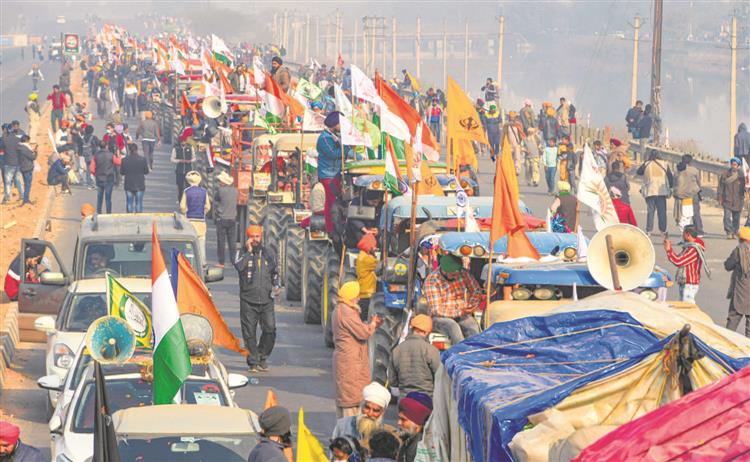
Blocking dissent may prove counterproductive

Word war: The battle to counter dissent over the farm stir has entered cyberspace. PTI
Saba Naqvi

Senior journalist

In a healthy democracy, the State is not afraid of the opinion of its citizens, be they critical of the regime. One of the classic signs of a backsliding democracy is the State seeking to criminalise or shut down amplification of opinions by those who disagree. From terra firma, the battle inevitably goes to cyber space these days.

The Indian government is currently in a battle with Twitter, the micro-blogging site with millions of subscribers. It wants to block 1,178 accounts that it says are propagating Khalistani content, in some instances backed by Pakistan. Twitter has made it an issue of free speech though it’s also begun capitulating and has reportedly blocked some 500 accounts, leaving those of journalists, activists and politicians. This is actually the first time that Twitter has taken a ‘free speech’ stance in India, possibly a result of changes in the US where it is headquartered and famously terminated the account of a sitting President Donald Trump this year, just before President Joe Biden took over.

In India, the Modi regime is faced with its biggest challenge in the ongoing agitation against the farm laws; it clearly wants to manage and counter the dissent and to do so is ready to take the battle into cyberspace. Because new media, such as Twitter, is hard to contain, supporters of the regime and prominent ministers have taken it upon themselves to shift to a made-in-India app called Koo and #BanTwitter was the hash-tag trending on, well, Twitter on February 10.

In a nation where demonetisation was abruptly announced and a national lockdown declared at four hours’ notice, it’s not impossible to imagine Twitter being banned. But it’s worth mentioning that the Prime Minister has the largest Twitter following of political leaders in office with 65 million (currently, former US President Barack Obama has the largest following in the world — 129 million). But ever since pop star Rihanna with 101 million followers (the fourth largest) put out a tweet asking “why aren’t we talking about this #FarmersProtest” along with a story about India cutting internet at protest sites, Delhi seems to have lost a certain balance.

The MEA reacted with an official statement, about “sensationalist social media hashtags’ and “poor understanding of facts”, thereby making a celeb tweet a matter of State concern. Since then, other international personalities have also tweeted about the farmers’ protest, illustrating clearly that you can’t shut down social media in an interconnected world. The counter campaign asking or compelling Indian achievers in cinema and sports to tweet identical words in support of the government’s actions was a poorly executed command performance.

The showdown between Twitter and the Indian government is another marker of how tough New Delhi can get. But as long as India keeps its Net space open, trying to block contrarian opinion and protest on these platforms is a bit like standing with an umbrella to avoid a tsunami. Organised protesters have prepared back-up Twitter IDs and intend to share information and opinion linked to the farm protest in accounts bearing other names. It’s a battle the government cannot win, short of banning the site altogether, akin to actions taken in nations that do not claim to be democratic. Twitter is an American company and threatening its employees with arrest has already attracted criticism in the Western media.

Beyond cyberspace, what is being done on the ground is to use the police to intimidate the media. Just look at the events of January alone: two journalists covering farm protests were arrested for allegedly obstructing police, FIRs were filed from BJP-ruled states against a total of 10 journalists and three Manipur journalists were arrested under the draconian UAPA for an opinion piece.

Conditions in Kashmir remain deplorable and the restoration of 4G Internet there was a reminder of how long people there were denied freedoms. This week, there were raids on the Delhi-based news website Newsclick that’s done several gritty ground reports on the farmers’ protest.

The assault on independent media is a sign of paranoia as it takes place in spite of mainstream broadcast media being overwhelmingly in support of all policies of the regime. Little wonder, India is slipping on the Democracy Index prepared by the Economist Intelligence Unit (EIU). Last week, it slipped two places in the 2020 report to land at position 53 and therefore in the category of “flawed democracy”. In 2014, India was 27 in the rankings, but has been steadily moving downwards since.

More challenges await some citizens. Any Indian who has ever applied for a passport would know that there is a police verification required. The police in Uttarakhand have declared an intention of monitoring social media posts to see if passport applicants have “anti-national sentiments” which in the current climate may be a case of supporting the farm protests or being politically opposed to the state or Central regime. There is nothing in the Passports Act that supports this, but the police can certainly impede the process. Likewise, the regime of Bihar CM Nitish Kumar, himself a product of the JP movement, has threatened a similar sort of police verification to deny protesters a government job, financial aid from the state and a passport.

A democracy at its best represents all the people all the time. We have already created an election template where we get some of the people against another set of people and mobilise voter blocs to get adequate votes to win a seat in the first-past-the-post system. One section of India’s society is all too often treated as the enemy within. With the farm protests, we are labelling other industrious citizens as hostile inhabitants of the land.

The vocal section that sees the nation embodied in an individual or a party has ironically amplified its views through the very social media platform that the government would now like to censor. The government has consistently refused to call out hate speech or fake news peddled by accounts loyal to its ideological fraternity. Indeed, it is the right wing cause that has gained the most through social media campaigns and hash-tags.

New media has played a big role in changing the nature of discourse in the post-truth age. It has promoted the worst tribalism and prejudice, but it can also be used to counter them. Democracy is not about electoral conquest that culminates in the victorious regime treating all critics as enemies of the State. If that were indeed to be the permanent state of mind, India would fall into the category that the EIU Democracy index calls authoritarianism. If India bans Twitter, the long protest, the crackdown and the state of our democracy would invite further international scrutiny.
Need a reality check on China’s designs

The reasons for the border dispute lie in the pages of history that show why an acceptable settlement is still a far cry, despite several Sino-Indian pacts. For China, there is Mao Zedong’s vision that saw Tibet as the palm of its right hand and Ladakh, Nepal, Sikkim, Bhutan and Arunachal Pradesh as its five fingers that China has to ‘liberate’. For India, it meant accepting Chinese claims.

Need a reality check on China’s designs

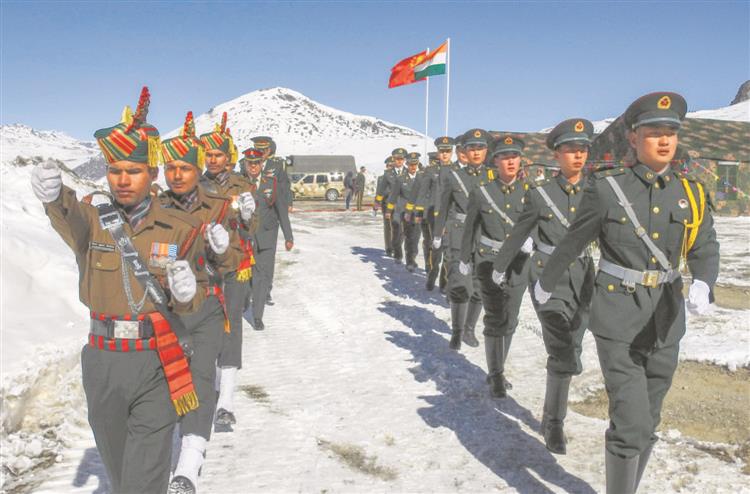
At odds: China has been alarmed at the thrust laid by India in areas over which it claims hegemony. PTI

Maroof Raza

Strategic Affairs Analyst

The Chinese army is there to stay in Aksai Chin. This reality had become known to our leadership in the 1950s and so it is now — though admitting this fact will be seen as a mark of defeat — and hence the claims and counter-claims, even when the reports about China ramping up its military capabilities and infrastructure in Tibet continue to appear in the Indian media. The Chinese are past masters at giving assurances and then doing another thing on the ground. No wonder that our External Affairs Minister S Jaishankar had recently stated that “significantly, to date, we have yet to receive a credible explanation for the change in China’s stance or reasons for massing troops in border areas”. Furthermore, his comments at Vijayawada (as reported in the print media) indicated that not only had Chinese actions shown ‘disregard’ for the commitment to minimise troop levels, but also ‘a willingness to breach peace and tranquillity’.

The reason why China has resorted to this build-up, and would stay there as long as it takes, hasn’t been lost on the policy-makers at South Block. Thus, Jaishankar has said, “We know the reason why China amassed troops at the border and breached peace.”

The reasons lie in the pages of Sino-Indian history that show why an acceptable settlement is still a far cry, despite the Sino-Indian ‘agreements’ signed in 1993, 1996, 2005 and 2013. These did provide a clear direction, if there was a sincere desire to settle this long-standing issue. But in some ways, it is like the India-Pakistan dispute over Kashmir. Neither side can be seen to be giving in, with so much at stake for their political leadership. For China, there is Mao Zedong’s vision that saw Tibet as the palm of its right hand and Ladakh, Nepal, Sikkim, Bhutan and Arunachal Pradesh (earlier NEFA) as its five fingers that China has to ‘liberate’. For India, it meant accepting the Chinese claims — as suggested by China’s Zhou Enlai in 1959 and 1960 — which would lead to charges of ‘horse trading’, as Nehru had put it, since all the territory that China claimed, “whether Arunachal Pradesh in the east or Aksai Chin in the west, were Indian,” states Zorawar Daulet Singh in his recent book, Power Shift: India-China relations in a Multipolar World. For many years even after Nehru had passed away, Indian diplomats were loyally hanging on to his legacy. This stand in due course has become an Indian article of faith.


Thus, despite the much publicised meetings between the leaders of India and China — Prime Minister Narendra Modi and CPC Chairman Xi Jinping — who had first engaged in 2014, and then following the standoff over Doklam in 2017, over structured summits at Wuhan in 2018 and then at Mamallapuram, near Chennai, in 2019, there were major Chinese intrusions across the LAC in 2014 and then in 2020. One reason was that the directions to their respective militaries, to have better and more frequent communication and strengthen the existing confidence building measures (CBMs), so that the special representative (SR) could “seek a fair, reasonable and mutually acceptable settlement to the border question”, were quite vague.

And so, there was room for (mis)interpretation leading to transgressions by troops on either side of the LAC, whenever the opportunity arose. But these were generally by patrols along the LAC or the McMahon Line, and were rarely entrenched intrusions, barring a few like those in 2013, in eastern Ladakh, before April 2020.

However, the absence of political drive to find a solution over the boundary disputes, especially after the 2013 Chinese intrusions in east Ladakh, and the 2017 Doklam stand-off, and a Chinese desire to position oneself at an advantage became more noticeable, with ‘nearly 75 per cent of the transgressions’ by Chinese troops taking place across the LAC, and only 20 per cent in India’s eastern front along Sikkim and Arunachal Pradesh. This makes it apparent that for the Chinese, the Aksai Chin area was ‘a valued piece of real estate’, and the Ladakh crisis could thus be explained as a ‘belated reassertion of China’s original claims over the area’.

What had brought matters to a head in 2020 — as China would’ve seen it — were several actions initiated by India in recent years. First, India’s effort to improve infrastructure — roads, bridges, tunnels and communication arteries — at various points along the Sino-Indian boundary. For years after the 1962 conflict, India hadn’t developed these for fear that better roads from the Himalayas onto the plains would aid an invading Chinese force to roll down! Then in July 2013, a decision was taken to raise a strike corps for the Indian Army in the eastern sector, with offensive (defence) capabilities to monitor China’s activities and have acclimatised Army units for rapid responses. But it was finally the Modi government’s decision to abrogate Article 370 of the Constitution — that gave J&K special status — and the creation of the Union Territory of Ladakh, and the call thereafter “to liberate 38,000 square kilometres of Aksai Chin” by no less than the Home Minister that contributed to China’s aggressive behaviour. These issues have been brought out in detail in essays in a recent book compiled by bureaucrat-turned-academic Shakti Sinha, One Mountain Two Tigers.

With talks leading nowhere, in early 2020, the Chinese army dramatically increased its presence in Aksai Chin, along the LAC as the snow melted, which India mistook as military exercises, even though there were substantially larger elements of tanks and artillery. Thereafter, Beijing made its intentions known. It was in no mood to pull back its army, and as it did in 1959-60. China then conveyed to New Delhi, that a solution to the latest boundary tensions could be found around the Chinese proposals of 1959. Is it time, therefore, for India to do a reality check?


Expand maritime footprint to check China

China recognises that geography gives India special position in the Indian Ocean but has warned that the ocean is not its backyard. China’s Defence Papers have linked its national security and development interests. China buys most of its oil from the Middle East and access to ports in the Indian Ocean Region is among its economic and security priorities.

Expand maritime footprint to check China

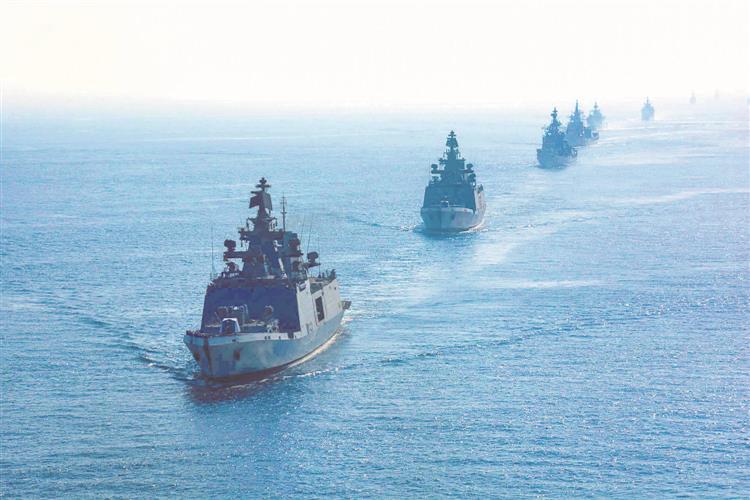
Choppy waters: Traditionally, India has regarded the Indian Ocean as its maritime sphere. PTI

Anita Inder Singh

Founding Professor, Centre for Peace and Conflict Resolution

Geography gives India a strategic edge in the Indian Ocean, but that is insufficient to counter China’s growing influence in the Indian Ocean Region (IOR), which stretches from Africa to Australia. Sino-Indian rivalry and New Delhi’s wish to balance China largely explain India’s offer to sell arms to countries in the IOR at the inaugural Indian Ocean Defence Ministers’ Conclave, held on the sidelines of the Aero India show in Bengaluru on February 4. More than 20 countries — from Madagascar to Singapore — attended the meeting, which focused on the enhancement of stability and prosperity in the IOR.

As an arms retailer, India will face tough competition from China. The world’s seventh largest arms vendor, China is already the top seller of weapons to several Indian Ocean states, including India’s friendly neighbours like Sri Lanka, Bangladesh and Myanmar. India ranks 23rd as an international arms seller. So, how realistic is New Delhi’s aim of selling $5 billion worth of arms in five years’ time? That is an open question.

Attempts by India and China to expand their influence in the IOR highlight the strategic and economic importance of the ocean’s international waters to both countries. Traditionally, India has regarded the Indian Ocean as its maritime sphere. Parts of the ocean comprise India’s territorial waters. Most of India’s trade by volume and all its vital oil imports traverse the ocean, so maritime security in the IOR is a strategic and economic imperative.

China recognises that geography gives India a special position in the Indian Ocean but it has warned that the ocean is not India’s backyard. Since 2015, China’s Defence Papers have linked its national security and development interests. The world’s largest oil importer, China buys 40 per cent of its oil from the Middle East, so the openness of the ocean’s seaways, access to ports in the IOR and the acquisition of a stake in them are among China’s top economic and security priorities. Throughout the IOR, China’s presence and influence have increased. Most countries in the IOR have joined China’s Belt and Road Initiative, presenting it with the opportunity to offer them both investment and military gear.

China’s naval strength in the Indian Ocean is greater than India’s. The People’s Liberation Army Navy is bigger than the Indian Navy and it can deploy more sea-based aircraft. India is safeguarding its interests in the IOR. The Indian Navy has significantly increased its deployment of warships, submarines and other assets in the IOR, in an attempt to send across a message to China. The extent to which India is able to deploy advanced technologies will have a bearing on its status as major South Asian and Indian Ocean power.

China’s growing presence in the Indian Ocean reflects its wish to consolidate its role in the IOR and enhance its global maritime power. China has moved submarines, destroyers, special operations forces and guided-missile frigates into the Indian Ocean.

With most states in the IOR, China has strengthened its trade and investment ties. It has developed ports in Pakistan, Sri Lanka and Myanmar and enhanced its influence in the region. It has also built its first overseas naval base in Djibouti in north-west Africa. Djibouti is strategically located at the southern entrance to the Red Sea, en route to the Suez Canal. The canal connects Asia to Europe and Africa.

The China factor also represents the most significant challenge to India’s politico-military strategy in the Western Indian Ocean. In recent years, China has strengthened trade ties with Middle East countries. Beijing is a major import-export partner of India’s friend, Israel. It is also Saudi Arabia’s largest trading partner and is helping to finance Riyadh’s ‘Vision 2030’ to help diversify the Saudi economy and transform Saudi Arabia into a major industrial powerhouse and an international logistics hub.

India must contend with the hard fact that it cannot take even friendly neighbouring countries for granted. Take the case of Sri Lanka. On January 15, about 10 days after External Affairs Minister S Jaishankar visited Sri Lanka, President Gotabaya Rajapaksa declared that because of regional security considerations — implying India’s suspicions of China’s clout in Sri Lanka — India’s Adani Ports company and its Japanese partners would build the East Container Terminal of Colombo port. But on February 2, Sri Lanka made the shock announcement that Adani Ports would not be allowed to develop the terminal because the “foreign company” did not agree to its proposals and because of opposition from trade unions. Some Indian officials see Chinese prodding behind Sri Lanka’s volte face. News of its U-turn came a few days after Sri Lanka received free anti-Covid vaccines from India. Good vaccine diplomacy is clearly not intertwined with success in port diplomacy.

China’s strengthening influence in the Indian Ocean goes against the Indian vision of an IOR where security rests on the balance of power rather than dominance by any single country — whether that is the US or China. This is a major reason why New Delhi has signed logistics agreements with the US, France and Australia to counter China’s naval presence beyond India’s immediate maritime neighbourhood. But to counter China successfully in the choppy waters of the Indian Ocean, arms sales, military strength and partnerships must be accompanied by more economic investment and trade with countries in the IOR.


No longer farmers’ stir alone: Unions

http://

Kuldip Bhatia

Jagraon (Ludhiana), Feb 11

Not just farmers, but people from all walks of life attended Punjab’s first “kisan mahapanchayat” here on Thursday. Women too participated in large numbers. Enthused by the massive turnout, Sanyukt Kisan Morcha leader BS Rajewal claimed that the determination shown by farmers camping at Delhi borders had shaken the Modi government, “which is now trying to find a face-saving formula to wriggle out of the mess it created through the agri laws.”

Ready to amend laws, if need be: Centre

The Union Government is ready to discuss the new laws with farmers’ leaders with an open mind and to amend these, if necessary, Defence Minister Rajnath Singh said on Thursday.

He said the agitation had “awakened” the entire nation and the global community too was keenly watching the developments in India. “The government is out to disband the mandi system by allowing free trade of foodgrain so as to leave the farmers at the mercy of big business houses,” Rajewal alleged.

He said farmers would hold candlelight marches on February 14 to pay tributes to the Pulwama martyrs and observe February 16 as “kisan-mazdoor day” in memory of Sir Chhotu Ram. Other leaders, SS Dharamkot, KS Sandhu, Manjit Dhaner, Nirbhai S Dhudike, HS Lakhowal and JS Ugrahan, vowed to take the agitation to its logical conclusion. Dhaner claimed it was no longer a farmers’ struggle. “With a majority of people backing the farmers, it has become a mass movement,” he said. Ugrahan exhorted the people to prepare for a long battle. “The government is trying to impose a globally failed model of agricultural system on the farmers. Over 80 per cent farmers, especially small cultivators, will lose their landholdings to corporates because of the laws” he claimed.

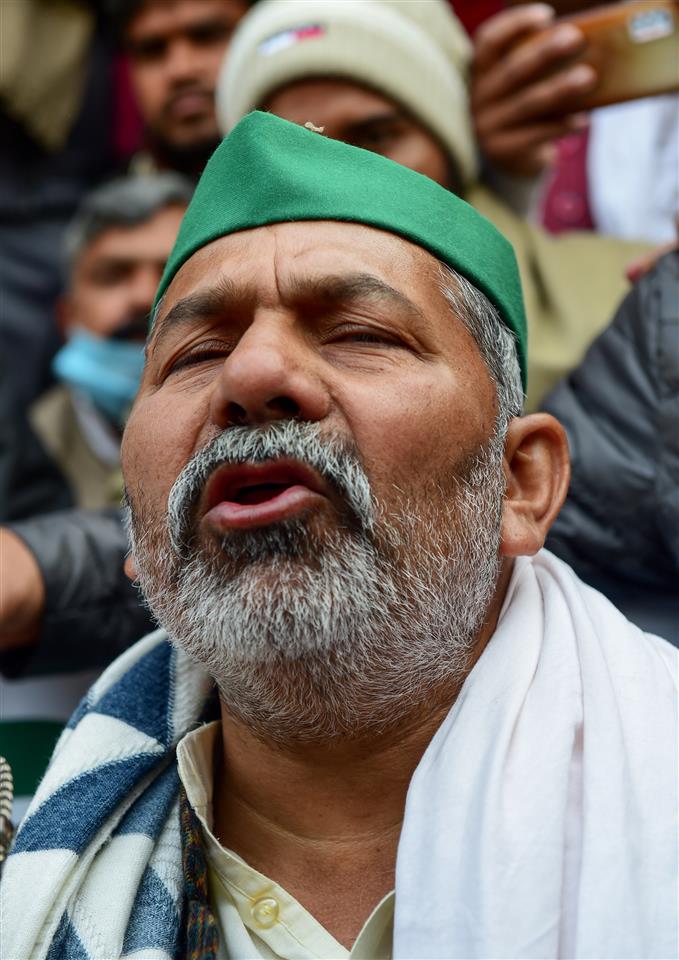
A series of ‘mahapanchayats’ have been held in Haryana against the farm laws.Three of these were addressed by BKU leader Rakesh Tikait, who has been spearheading the protest at the Ghazipur border for over two months.


Tikait to address kisan mahapanchayat in Maharashtra on February 20 Yavatmal has earned the dubious distinction of being the hotspot of farmers’ suicides

Tikait to address kisan mahapanchayat in Maharashtra on February 20

Rakesh Tikait. PTI file

Nagpur, February 12

Farmer leader Rakesh Tikait will hold a kisan mahapanchayat and a public rally in Yavatmal district of Maharashtra on February 20, an office-bearer of Samyukta Kisan Morcha has said.

Samyukta Kisan Morcha (SKM) is an umbrella body of 40 farmer unions protesting at various Delhi border points against the three farm laws.

Its Maharashtra coordinator Sandip Gidde told PTI that Tikait, Yudveer Singh and several other leaders of the SKM would hold the mahapanchayat and public meeting at Azad Maidan in Yavatmal.

“Tikait wants to start the kisan mahapanchayat in Maharashtra from Yavatmal, which has earned the dubious distinction of being the hotspot of farmer suicides,” he said.

Farmers from Vidarbha and parts of Maharashtra are expected to participate in the mahapanchayat, for which permission has been sought.

A police official from Yavatmal said the organisers had sought permission for the event. PTI


Modi has ceded India’s land to China: Rahul The Congress leader was addressing a press conference

http://

Tribune News Service

New Delhi, February 12

A day after Defence Minister Rajnath Singh told Parliament that India had not lost any territory in the LAC standoff in Eastern Ladakh, the Congress on Friday alleged that the government had ceded land to China saying the Indian territory between Fingers 3 and 4 had been ceded to China.

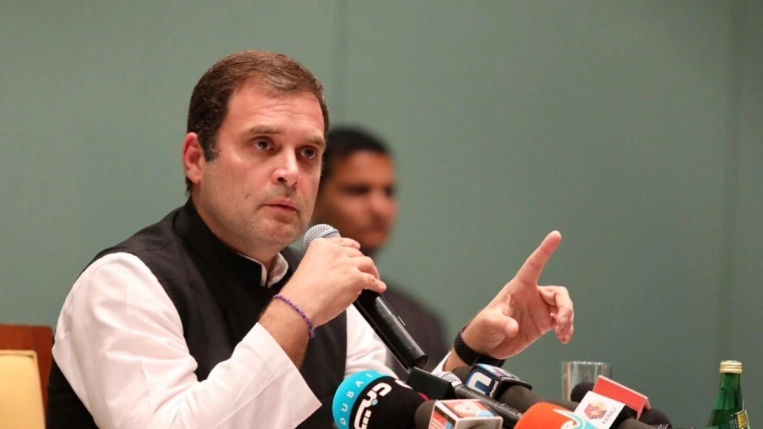
In a press conference at the AICC headquarters before leaving for his tractor rally in Rajasthan, Congress leader Rahul Gandhi accused the government of compromising the previous demand or status quo ante as of April 2020.

“There are a couple of things that need to be made clear. The government position at the beginning of the LAC standoff was status quo ante as of April 2020. Now, sheepishly the Defence Minister comes and makes a statement and we find that the Indian troops are going to be stationed at Finger 3. Indian territory was till Finger 4. Why has the PM ceded the land between Fingers 3 and 4 to the Chinese?” Gandhi asked accusing the PM of cowardice and of not being able to stand up to China.

Gandhi asked why the Chinese had not withdrawn from the Depsang Plains and the Gogra and Hot Springs areas.

Attacking the PM for not protecting Indian land, Gandhi said, “Why have the Indian troops after all the hard work they did capturing Kailash Ranges been asked to move back? Why have the Chinese not withdrawn from strategic areas?”

Gandhi said India didn’t have any strategic advantage during LAC discussions and the only proof of any advantage was when the Indian troops captured Kailash Ranges.

Even that had been lost, said Gandhi, asking the PM to explain the position and accusing him of betraying the valour of Indian troops.


Farmers’ protest: Unions to hold ‘kisan mahapanchayats’ across country in coming days

Farmers’ protest: Unions to hold ‘kisan mahapanchayats’ across country in coming days

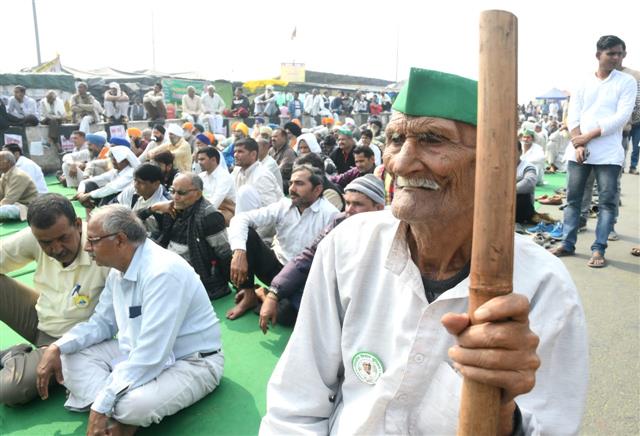
Farmers at Ghazipur border during the ongoing protest against Centre’s new farm laws in New Delhi on Thursday. Tribune photo: Manas Ranjan Bhui

New Delhi, February 11

The Samkyukta Kisan Morcha, an umbrella body of protesting farmer unions, on Thursday announced that ‘kisan mahapanchayats’ will be organised across the country in the coming days against the Centre’s three agri laws.

The morcha made it clear that it will not call off the ongoing protest until its demands to repeal the laws and bring legal guarantee for minimum support price on their crops are met.

In a statement, the protesting farmers’ body said its teams are planning the programmes of the state-wise mahapanchayats.

The move comes a day after it announced a four-hour nationwide ‘rail roko’ (rail blockade) on February 18 to press for their demands.

Protesting farmer leader Darshan Pal said a mahapanchayat will be held in Moadabad (Uttar Pradesh) on Friday, followed by Bahadurgarh bypass (Haryana) on February 13, Sri Ganganagar (Rajasthan) on February 18, Hanumangarh (Rajasthan) on Februrary 19 and Sikar (Rajasthan) on February 23.

Thousands of farmers, mostly from Punjab, Haryana and western Uttar Pradesh, have been camping at the three Delhi border points — Singhu, Tikri and Ghazipur — for over 75 days.

In a statement, Pal alleged that the government is not serious to fulfil the “fair and genuine” farmers’ demand of ‘karza mukti, pura daam’.

The unions also claimed that the Haryana government has proposed to install CCTV cameras at the Tikri border protest site.

Meanwhile, Swaraj India leader Yogendra Yadav, who has been actively involved in the agitation, issued a statement terming as “baseless” the allegation made by Congress member Ravneet Singh Bittu blaming him for the Republic Day violence in the national capital.

Speaking in the Lok Sabha on February 9, Bittu claimed that Yadav had incited the farmers which lead to the violence on January 26.

At the Singhu border protest site, the unions have begun strengthening the infrastructure by installing CCTV cameras for enhanced security, electric fans to beat the heat in the coming months, and laying separate optical fibre line for wi-fi facility in case there is another internet shutdown.

These are some of the measures taken by the agitating farmers to prepare for a long haul as a resolution of the stalemate over the new farm legislation seems unlikely anytime soon.

“We are strengthening our communication and other infrastructure to continue the agitation for a long period,” said Deep Khatri associated with managing logistics at the Singhu Border protest site.

To increase security measures and keep miscreants at bay, 100 CCTV cameras with digital video recorders are being installed at the main stage used by the Morcha and also at some identified spots across the protest site’s stretch on the GT Karnal Road.

The protesting farmer unions have been alleging that the laws will weaken the minimum support price mechanism and end mandi system.

But the government says the new legislations offer more options to farmers to sell their crops, and will help raise their incomes. PTI


Laws will destroy mandis, help corporates: Rahul Says entire country backing farmers’ protest

Laws will destroy mandis, help corporates: Rahul

Tribune News Service

New Delhi, February 11

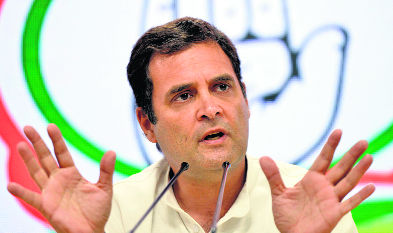
In a stinging attack on the Narendra Modi government, Congress leader Rahul Gandhi today accused it of destroying mandis and promoting hoarding to “benefit a couple of corporate friends”. He spun around an old family planning slogan “hum do hamare do” to make his point.

“The nation is being run by four persons,” said Rahul.

Rahul Gandhi, Congress leader

‘Hum do, humare do’

Rural economy will be destroyed and the country will not be able to generate employment. This is not the first time PM Modi has tried to benefit hum do, humare do. He first did it with demonetisation and then GST.

He did not name anyone, saying everyone knew who he was talking about. His comments resulted in a virtual bedlam in the House, with allegations flying against his (Gandhi) family and Union Minister Anurag Thakur, accusing him of “telling lies” and coming unprepared to speak on Union Budget.

“The PM has given us three options — hunger, unemployment and suicide,” said Rahul, amid repeated disruptions and requests by Speaker Om Birla to restrict his speech to the Budget. Rahul did not take their names but Union Minister Pralhad Joshi, who raised the point of order and asked him to prove his claims, ended taking the names of two corporates.

“Let me tell what will happen when these laws are enacted. Small farmers and traders will be wiped out and only ‘hum do hamare do’ will run the country,” said the Congress leader.

“Do not think it is farmers’ agitation alone. It is the agitation of the entire country. Farmers are showing way to the country, which is rising against ‘hum do, hamare do’….Let me give you in writing. Farmers will not move back an inch. You will have to take back the three laws,” warned the Congress leader.


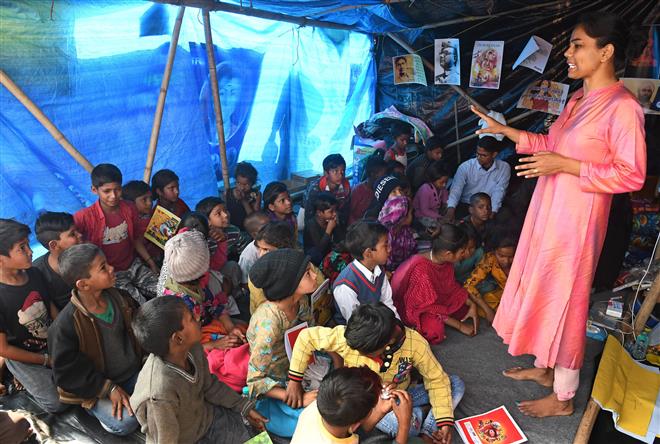
A school for ragpickers, poor bringing a lot of cheer in Ghazipur

A school for ragpickers, poor bringing a lot of cheer in Ghazipur

Nirdesh Singh, a social activist, talking to children at Savitribai Phule Pathshala at the Ghazipur border farmers’ protest site, in New Delhi. Tribune photo: Manas Ranjan Bhui

Vinayak Padmadeo
Tribune News Service

Ghazipur, February 10

Mata Savitribai Phule Mahasabha (MSPM) tent is attracting a lot of attention from the crowd in Ghazipur.

Over 30 children, mostly rag pickers and children of guards from the nearby colonies and a few from farming families sitting in protest are making a big ruckus as they repeat numbers and alphabets in chorus.

The noise quotient is bringing a number of curious onlookers to the tent.

The Savitribai Phule Pathshala has been running at the Ghazipur protest site since January 22.

The pupils — their numbers fluctuate from 30 to 60 daily — started off with a great difficulty as the Andolan Committee weren’t keen on having a school at a protest site.

The indifference notwithstanding, the school is not only prospering, it is bringing a lot of change in the lifestyle of these young students in terms of their keenness to learn and also towards their personal hygiene.

“Initially we couldn’t see the colours on their clothes. They were all covered in dirt,” said Nirdhesh Singh, who runs the school along with three other teachers.

“Now they have all started to work towards cleanliness and personal hygiene. Nowadays they troop in well before the start of the school,” Singh, who had to initially lure these children with candies and other treats to bring them anywhere near a white board, said.

“Madam I haven’t got my notebook yet. You have to give me two books as well,” Shabbo, who is seven, asked Limdevi Maurya, who took the class on Tuesday.

Karthik, 10, whose father is a guard in the nearby Gaursons apartment, was in attendance.

Kunal Pradhan, 8, a student of Balvidya Public School, said, “Sir mera school lockdown se band hai, isliye aata hun (my school is shut since lockdown that’s why I come).”

Young Jamshed, whose father Jawaid is a rickshaw puller, has been a regular attendant.

“Bahut accha lagta hai (It feels really good),” he says.

Nirdhesh, who is also the national president of MSPM, said the organisation works for the poor and downtrodden in Uttar Pradesh and when they joined the protest only then this idea of running a school came about.

“We run a campaign for de-addiction and suggest to take up education to prosper,” she explained.

“Nobody is bothered about the lifestyle of poor. So it was important for us to show these children that they are also a part of our society. And that’s how this school came into being,” she added.

Besides pupils, the school has also started to attract attention of teachers like Limdevi, who has travelled all the way to the protest site from Bastar, Chhattisgarh.

“I came here yesterday,” Maurya said.

“Today was my first day. I enjoyed it thoroughly. And it helped that these children already know the numbers and alphabets,” she added.