












































Current Events :















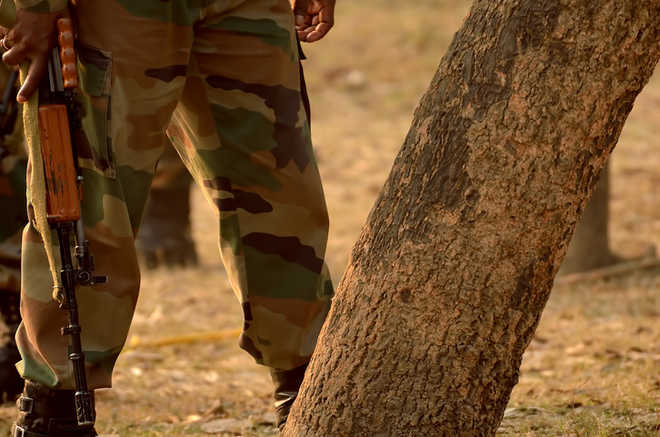
hoto for representation only. Source: iStock.
Vijay Mohan
Tribune News Service
Chandigarh, February 24
In a move that resolves a long pending anomaly related to grant of benefits to the kin of posthumously decorated armed forces personnel, the Punjab Government has extended the benefits to the families of those awarded peace time gallantry medals before 2017.
The state government had instituted an “Honour and Gratitude” policy in 2000, offering government jobs to families of posthumous gallantry awardees as per their qualifications.
However, due to an oversight, the policy had only included war-time gallantry awards and had left out peace time awards even if those happened to be higher in precedence.
Param Vir Chakra, Maha Vir Chakra and Vir Chakra, are classified as war-time medals and are awarded for gallantry in the face of the enemy, while Ashok Chakra, Kirti Chakra and Shaurya Chakra are peace time medals for acts of courage other than in the face of the enemy.
The policy was finally rectified in the year 2017, but the authorities concerned had interpreted the amendment to mean that family members of only those personnel would be eligible who were awarded after the year 2017 whereas the original policy of the year 2000 did not contain any such cut-off date.
The rectification of the anomaly remained pending with the government since 2017.
In December 2020, the Punjab and Haryana High Court had directed the government to take appropriate measures and introduce clarity in the policy within a period of three months.
The fresh policy issued this week now includes all ‘Chakra’ series awards in its ambit without any cut-off provision as to the date of the award. The applicant, however, needs to be within the prescribed age limits for the job that he or she is applying for.
Sources familiar with the matter said that although the number of affected applicants may not be very high, the rectification of the anomaly is a huge morale booster both for past and future cases and indicates the commitment of the government in resolving such issues, adding that the policy was amended well before the time provided by the High Court.
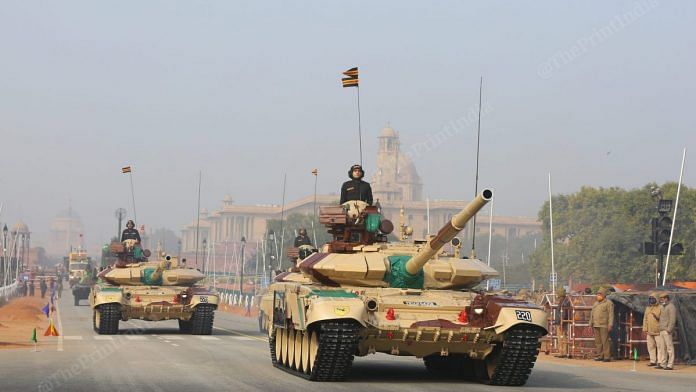
New Delhi: The Union Defence Ministry has decided to earmark around 64 per cent of its modernisation funds under the capital acquisition budget for 2021-22 — a sum of over Rs 70,000 crore — for purchases from the domestic sector.
This marks an increase from 2020-21, when a capital budget allocation for domestic vendors was first made. At 58 per cent, this came to an amount of Rs 52,000 crore.
The announcement for 2021-22 was made Monday by Union Defence Minister Rajnath Singh at a seminar on defence budget organised by the Society of Indian Defence Manufacturers (SIDM), an association representing domestic industry players. It is part of the Modi government’s larger push to make India — currently the world’s second biggest arms importer — self-reliant in the field of defence.
In his address, Singh also spoke about widening the ‘negative import list’, which lists items that India seeks to stop buying from other countries. In 2020, the government listed 101 items — including weapons systems and assault rifles — and specified an indicative date by which the import embargo will kick in for each of them.
Singh said discussions are underway on including certain spares in the list.
Announcing the increase in allocation for purchases from domestic defence vendors, Singh said “it will have a positive impact on enhanced domestic procurement, having a multiplier effect on our industries including MSMEs and start-ups … and also increase employment in the defence sector”.
Experts in the field say the decision is a welcome step towards encouraging Atmanirbhar Bharat (self-reliant India) and ‘Make in India’ — the Modi government’s mission to boost local manufacturing. However, they add, its success is something that will only be known with time.
Also read: 7 big-ticket ‘Make in India’ defence projects that have failed to get off the ground
Under the Atmanirbhar Bharat campaign, the defence sector has been identified as one of the core areas to boost ‘Make in India’.
Big-ticket defence projects currently being pursued under Make in India include the Light Combat Aircraft Tejas (83 of which have been ordered), transport aircraft C-295 (to be manufactured by Tata-Airbus, deal with the government in final stages), and the AK-203 rifles (to be made in India as part of a joint venture between the Ordnance Factory Board, Kalashnikov Concern, and Rosoboronexport, the Russian state agency for military exports.).
In 2021-22, the Army has been allocated a capital outlay — for acquisitions, repair, etc — of Rs 36,000 crore, the Navy Rs 33,000 crore, and the IAF Rs 58,000 crore.
The 64 per cent allocation for domestic vendors in 2021-22 means the import legroom has shrunk to 36 per cent. According to government sources, the three defence services were asked to arrive at a ratio of planned procurements from the domestic and global sectors before finalising this figure.
Rajnath Singh Monday said that the defence ministry also plans to channelise about Rs 1,000 crore in 2021-22 for procurement from iDEX, a defence ministry initiative to encourage start-ups.
The government’s push to promote indigenous defence equipment is evident in the Defence Acquisition Procedure 2020, which prioritises capital acquisitions from domestic players over foreign ones.
Earlier this month, the 15th finance commission advised the government to devise a road map to reduce India’s dependence on defence imports while enhancing indigenous production at a faster rate.
On Monday, PM Modi said the government has taken several initiatives like de-licensing, de-regulation, export promotion, and foreign investment liberalisation, to give the defence manufacturing sector a boost.
India, he added, should look at achieving defence-related exports to the tune of Rs 35,000 crore to become a net exporter of defence equipment in the next five years.
Also read: Dassault Aviation eyes Made-in-India Rafale, looks to raise investment in country
Talking to ThePrint, a senior services officer said the decision to increase fund allocation for domestic procurement is a good move to boost the Indian defence sector.
“However, the actual expenditure on domestic procurements from the capital budget set aside for the purpose would be clear only when the expenditure estimates come at the end of the financial year,” the officer said. “That would determine the success of the move.”
Another officer said the way forward would mean targeted earmarking of funds for the domestic sector.
“Expenditure and utilisation will also depend on the absorption capacity of the domestic defence industry,” the officer added. The move, the officer said, “will also enhance investment sentiments in the domestic defence industry”.
Brigadier Ashis Bhattachayya (retd), a senior adviser at SIDM, said the benefits of a high capital allocation for the domestic defence sector are “colossal” because the entire “industrial base gets a chance to mature”.
“This is most important for an Atmanirbhar Bharat … to develop the ecosystem. We were behind schedule on that front,” he said.
“Earlier, it was 70 per cent for foreign sellers, which went down to 65 per cent. It is indeed a big boost to the defence industry when you turn the figure around,” he added. “That is because the entire ecosystem gets a chance to service this demand placed on platform makers,” he said.
Also read: India’s defence needs money. If Budget can’t provide it, we need to change how we fight
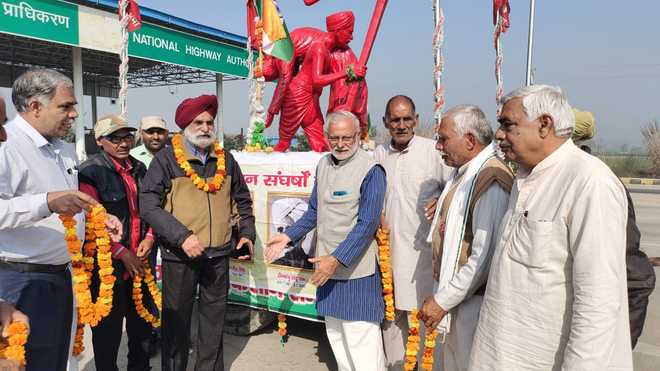
Farmers welcome Shaheed Bhagat Singh’s nephew Prof Jagmohan Singh in Rohtak on Wednesday.
Tribune News Service
Jhajjar, February 24
Shaheed Bhagat Singh’s nephew Prof Jagmohan Singh today demanded release of all farmers arrested by the Delhi Police during the tractor parade on January 26 and withdrawal of cases registered against farmers during the three-month-long protest.
He raised the demands at a programme organised by the All-India Kisan Sabha (AIKS) at the Rohad toll plaza on the Rohtak-Delhi national highway. The event was organised to mark the “Daman Virodhi Diwas”.
“The Modi government is pro-corporate. It becomes evident by its stance on the three contentious farm laws. The Centre is adamant on not revoking the legislations. The arrest of farmers is unjustified. They must be released immediately, while the police repression against farmers should come to an end,” said Prof Jagmohan, who is an agricultural economist.
Inderjit Singh, state vice-president, AIKS, said the “Daman Virodhi Diwas” was observed with enthusiasm, giving out the message that protesters were angry.
Earlier, Prof Jagmohan was welcomed with slogans of “Shaheed Bhagat Singh Zindabad” at the Rohad toll plaza. He was garlanded at the Madina toll plaza in Rohtak district.
At the Tikri border, protesting farmers marked the “Daman Virodhi Diwas” by criticising the Centre for alleged repression against protesting farmers.
Kaithal/Karnal: Farmers today pasted a memorandum of demands on the premises of the Kaithal DC’s office after they were informed that the DC was absent.
They demanded opening of all entry points to Delhi.
In Karnal, farmers handed over a memorandum of demands to the tehsildar.
Panipat: Members of the BKU and other organisations led by Sunil Dutt and Bintu Malik held a protest march to mark the “Daman Virodhi Diwas”. They later submitted a memorandum to tehsildar Kuldeep Malik.
Another from Punjab dies
Sonepat: A-65-year-old farmer from Hoshiarpur district died at the Singhu border on Wednesday. The deceased has been identified as Malkeet Singh. When he did not wake up in the morning, fellow protesters took him to the general hospital, where doctors declared him as brought dead. The police said the farmer might have died of a heart stroke. tns
New Delhi, February 23
Farmers organised “Pagdi Sambhal Diwas” on Tuesday at the Delhi borders to register their opposition to the government’s three agricultural laws.
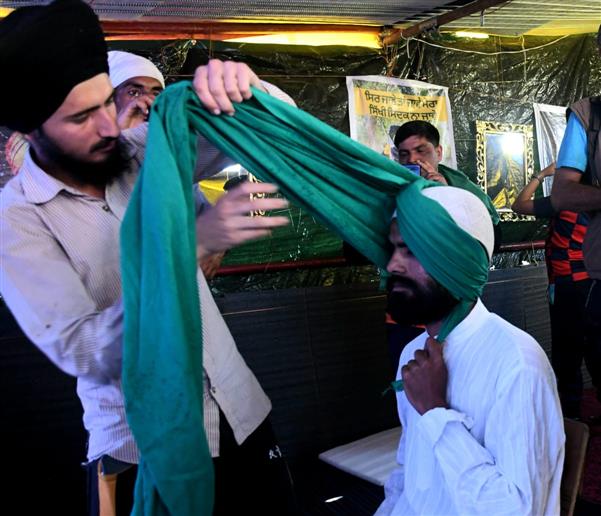
Wearing colourful turbans, the agitating farmers at the Singhu, Tikri and Ghazipur borders, celebrated the day following a call by the Samyukta Kisan Morcha. The move is to assert the self-respect of farmers in memory of ‘Chacha’ Ajit Singh, the uncle of iconic revolutionary Bhagat Singh and founder of the “Pagdi Sambhal” movement.
The song “Pagdi Sambhal”, written by Banke Dayal, was a precursor to the peasant movement against agricultural laws by the colonial British government, in 1906. The reflections of the movement that Chacha Ajit Singh had started at that time can be observed in this farmers’ movement as well.
Reinforcing their demands, the farmer leaders said, “The government will have to withdraw these laws and remove the misconception that the farmers will go back.” Farmers’ organisations have decided to observe different days with varying themes to boost and strengthen their agitation.
On Wednesday, ‘Anti-Suppression Day’ will be observed in which “repression” on the farmers’ movement will be opposed. On this day, memorandums will be submitted to the President at all tehsils and district headquarters.
On the completion of three months on February 26, the contribution of the youth will be celebrated as “Yuva Kisan Diwas”. On this day all the forums will be run by the youth. Youths from different states have been told to reach the Delhi borders.
Also, “Mazdoor Kisan Ekta Divas” will be celebrated on February 27 on the martyrdom day of Guru Ravidas and Chandrashekhar Azad. IANS
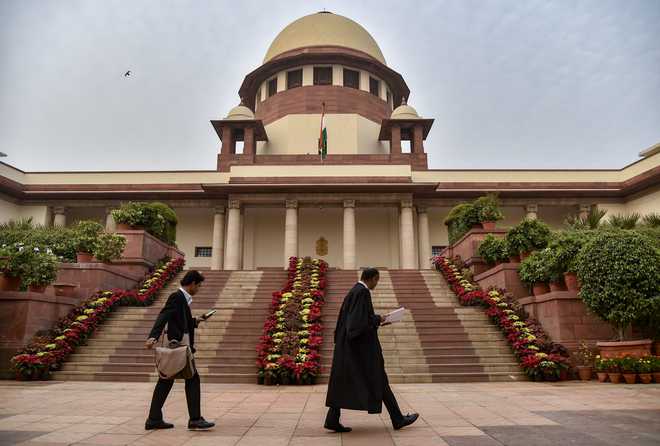
File photo of the Supreme Court.
New Delhi, February 24
The Supreme Court on Wednesday made clear that it cannot modify its verdict directing the Centre to consider granting permanent commission to women officers in the Army by entertaining individual grievances, that too almost a year after its pronouncement.
The top court, in its landmark verdict delivered on February 17, 2020, had asked the Centre to consider all serving Short Service Commission (SSC) women officers for permanent commission irrespective of them having crossed 14 years or, as the case may be, 20 years of service.
“We will not tinker with our judgement on the basis of such miscellaneous applications that too after one year. We cannot be looking into individual cases and start modifying our judgement. There is something called judicial discipline,” a Bench of Justices DY Chandrachud and MR Shah said.
The Bench, however, granted the counsel for Lt. Col. (Retd.) Priamvada A Mardikar, to approach the Armed Forces Tribunal with her grievances.
It also asked senior advocate R Balasubramanian, appearing for the Defence Ministry, to use his “good office” in trying to get the grievances of the former Army officer resolved.
“I will certainly use my good office to ensure that her issue is considered,” the lawyer assured the Bench during the hearing conducted through video conferencing.
The court noted the arguments of lawyer SS Pandey, appearing for the former woman officer, that there were two similarly-placed officers and one of them was granted the permanent commission and the second was denied and she later retired.
The lawyer said it was held by the top court in the verdict that the women officers, who retired during the pendency of the case, will be getting the retirement benefits as commissioned officers.
Permanent commission has been granted to Short Service Commissioned officers in all the ten streams of the Indian Army including Army Air Defense (AAD), Signals, Engineers and Army Aviation.
Justice Chandrachud had authored the last year verdict which had said that as a one-time measure, the benefit of continuing in service until the attainment of 20 years pensionable service shall also apply to all the existing SSC officers with more than fourteen years of services.
It had held that the option of grant of permanent commission shall be given to all women SSC officers and if those with more than 14 years of service do not opt for it then they will be entitled to continue in service until they attain 20 years of pensionable services.
While granting permanent commission to women officers in Army, it had rejected the Centre’s stand of their physiological limitations as being based on “sex stereotypes” and “gender discrimination against women”.
The top court had accepted the Centre’s policy of February 25, 2019 to grant permanent commission to SSC women officers in all the 10 streams in the Army.
The top court had said SSC women officers with over 20 years of service who are not granted permanent commission shall retire on pension in terms of policy decision.
It had noted that Indian Army has sanctioned 50,266 posts for officers, while the posts currently occupied are 40,825 including 1,653 by women officers.
It had noted that there is a shortage of 9,441 officers in the Indian Army. — PTI
Tribune News Service
New Delhi, February 23
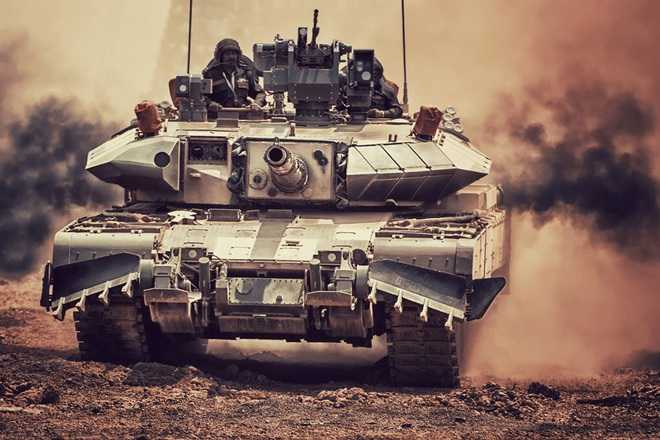
An upgraded version of the Arjun tank, having better firing and mobility, has been okayed by the Ministry of Defence for induction by the Indian Army.
The Defence Acquisition Council (DAC), headed by Defence Minister Rajnath Singh, on Tuesday accorded its approval to the project that will entail making 118 tanks for Rs 8,379 crore.
The Defence Research and Development Organisation (DRDO) will be issued a formal request for proposal to produce these tanks and formal signing of contract could take a year.
The first tank will roll out within 30 months of signing the contract. The existing facility at Avadi in Tamil Nadu will produce these tanks.
The Mark 1A has a total of 14 major upgrades over the existing version and another 57 minor upgrades.
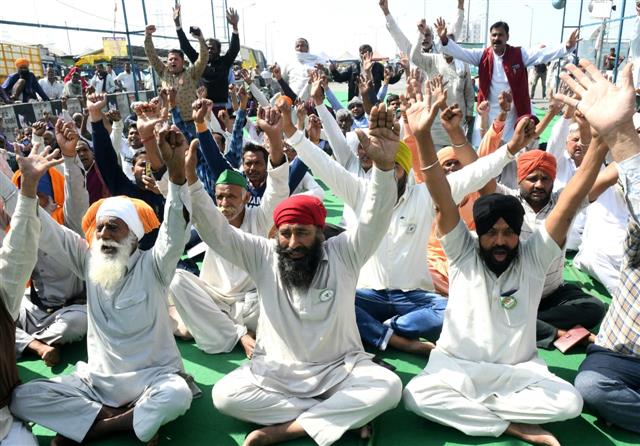
Farmers sitting during their ongoing protest over Centre’s new farm laws at Ghazipur border in New Delhi on Wednesday. Tribune photo: Manas Ranjan Bhui
New Delhi, February 24
The Samkyukta Kisan Morcha on Wednesday wrote to President Ram Nath Kovind demanding “unconditional” release of arrested farmers and withdrawal of “false” cases in connection with the stir against the agri laws.
In its letter, the Morcha, an umbrella body of farmer unions agitating against the three central laws, also said notices allegedly being sent by police and other investigating agencies to the protesting farmers should be stopped.
“Under the banner of Samkyukta Kisan Morcha, farmers have been staging sit-in around Delhi for the last three months, but hundreds of farmers and agitation supporters have been lodged in jails by the Government of India and many state governments and false cases have been registered against them,” stated the letter shared by the SKM.It said that “innocent” farmers should be released from jails without any condition.
The letter was sent to the President as protesting farmer unions observed the day as “Daman Pratirodh Diwas”.
Meanwhile, the SKM welcomed the release of climate activist Disha Ravi, arrested by the Delhi Police in the toolkit case earlier this month.
On Tuesday night, Ravi was released from Tihar Jail hours after a city court granted her bail.
“SKM welcomed many observations made by judge Dharmender Rana in his orders,” it stated.
“SKM demanded immediate action against the Delhi Police which flouted many norms and arrested Disha Ravi in an illegal and extra-constitutional manner,” the statement stated.
Thousands of farmers, mostly from Punjab, Haryana and western Uttar Pradesh, have been camping at the three Delhi border points of Singhu, Ghazipur and Tikri since late November to press for a complete repeal of three farm laws and a legal guarantee on the minimum support price for crops.
Scores were arrested when protesters taking part in a tractor rally on January 26 deviated from the path, clashed with the police and stormed the Red Fort. PTI

New Delhi: The Army has ordered an emergency procurement of M4 armoured vehicles, which were tested in Ladakh during the standoff with China, from the Pune-based defence company Bharat Forge of the Kalyani group.
In a statement released Tuesday, the company said it had “received an order worth Rs 177.95 crores from the Indian Ministry of Defence for supply of Kalyani M4 vehicles”.
According to sources in the defence and security establishment, the emergency procurement is for a small number but they are looking to further increase the number of armoured vehicles in the Army’s inventory.
The sources added that the Army is in need of wheeled armoured vehicles that can transport troops faster and capable of operating in high altitude regions.
They noted that the Kalyani M4 comes with certain extra features than the regular vehicles, but refused to elaborate further on the details.
The vehicle had undergone trials in Ladakh, along with its competitors, in August 2020.
The contract was announced a day after Prime Minister Narendra Modi stressed on the importance of private sector participation to develop India’s defence manufacturing base.
Also read: India, China agree to ‘further disengagement’ at Ladakh after 16-hour Corps Commander talks
The Kalyani M4, which will be built at the company’s Pune plant, is a multi-role platform, designed to meet the requirements of the armed forces for quick mobility in rough terrain and in areas affected by mine and IED threats.
It has ballistic and blast protection from up to 50 kg TNT side blast, or IED or roadside bombs due to its design that is built on a flat-floor monocoque hull. With a thrust speed of 140 km per hour, the vehicle has a payload of 2.3 tonnes and an operating range of about 800 km.
The M4 is an original product of the South African arms firm Paramount Group but has been fine-tuned for Indian conditions by Bharat Forge.
The two firms have also signed a deal to join their technologies, capabilities and expertise to manufacture armoured vehicles in India.
In a statement Monday, the Paramount Group said it wanted to position the M4 as the “future of protection” in all markets across the world.
Also read: India successfully test fires Helina, Dhruvastra anti-tank guided missiles
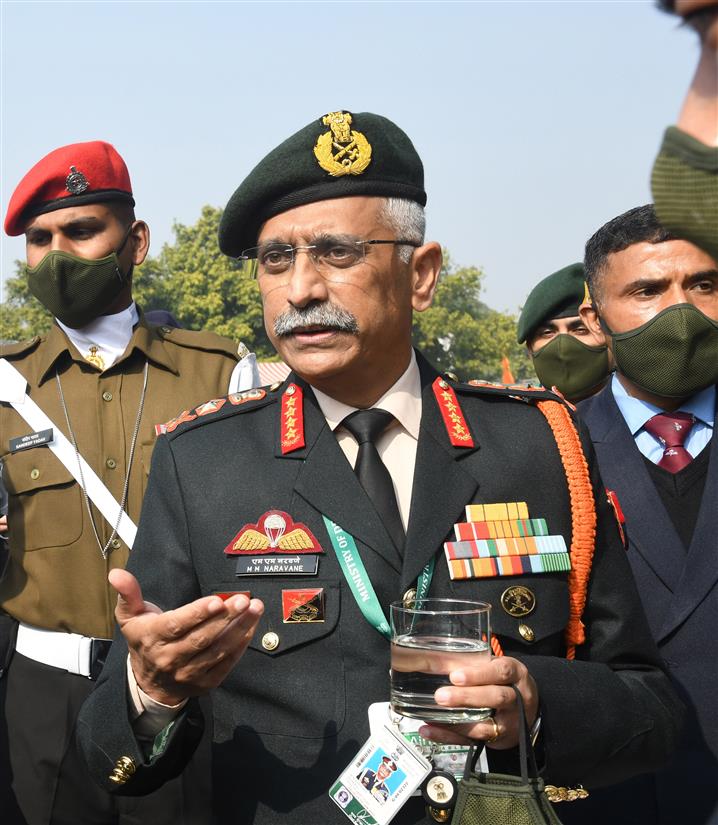
Army Chief Gen M M Naravane. Tribune file photo
New Delhi, February 24
The disengagement of armies of India and China from north and south banks of Pangong Tso is a “very good end result” and a win-win situation for both the sides, Army Chief Gen M M Naravane said on Wednesday, stressing that there are strategies in place to address other pending issues in eastern Ladakh.
He said there were no signs of an “overt collusion” between China and Pakistan during the Ladakh standoff but India also caters to a long term strategy for not a two, but a two-and-half front war. With the half front, he was referring to the internal security.
He said right from the beginning of the standoff, all sides on the Indian side worked together.
Be it at the political level, Defence Minister Rajnath Singh and External Affairs Minister S Jaishankar spoke to their Chinese counterparts, he said.
“We were all in it together. We had our plan chalked out which we had discussed on what should be the way forward. Whatever has panned out, has happened as a result of that. What we have achieved so far is very good,” Naravane said at a webinar organised by Vivekanada International Foundation.
The advice which was given by National Security Adviser also came in extremely handy and his insight into strategic level affairs definitely helped us chalking out the response, the Army chief said.
“As a result of this whole approach, this disengagement has taken place. I think it is a very good end result. It is a win-win situation. For any agreement to last, both sides should feel that they have achieved something. I think a good outcome that has resulted out of the 10 rounds of talks which have taken place so far,” he said.
Last week, armies of the two countries concluded withdrawal of troops and weapons from north and south banks of Pangong Tso in the high-altitude region.
Naravane said there are some issues which remain in the area of Depsang, in the area of eastern Ladakh and in other areas along northern border.
“…But we have our strategies in place for that. Do we have anything to negotiate in future? Yes, definitely we have. But I would not, of course, for obvious reasons, what those strategies would be to further and progress our negotiations and come out with a favourable outcome.” PTI






























