









Sanjha Morcha

What’s New

Click the heading to open detailed news

Current Events :

web counter

Print Media Reproduced Defence Related News

Farmers to intensify agitation with ‘Bharat bandh’ on March 26, burning farm laws on Holi

Strike to start from 6 am and will continue till 6 pm

Farmers to intensify agitation with 'Bharat bandh' on March 26, burning farm laws on Holi

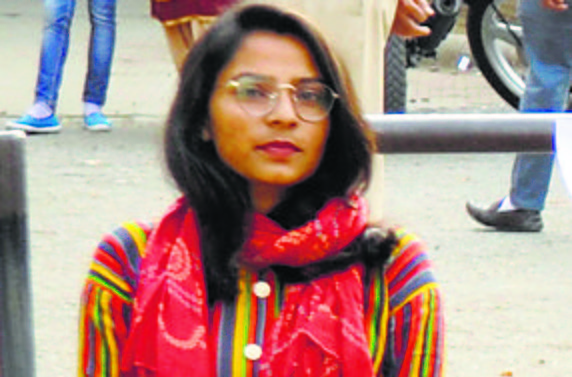
Women from Punjab and Haryana participate in farmers’ protest against the Centre’s new farm laws, at Tikri Border in Delhi. PTI file

New Delhi, March 17

Ahead of their Sampurna Bharat Bandh on March 26, farmer leaders on Wednesday said they were preparing to intensify the agitation against the three farm laws.

During the nationwide strike on March 26 that also marks four months of the farmers’ movement, all shops and other business establishments will remain shut for 12 hours, followed by the burning of the copies of the three laws during “holika dehan” on March 28.

“The strike will start from 6 in the morning and will continue till 6 in the evening, during which all shops and dairies and everything will remain closed.

“We will burn the copies of the three laws during Holi and hope that better sense prevails within the government, and it repeals the laws, and gives us a written guarantee for MSP,” said Ranjit Raju of Ganganagar Kisan Samiti addressing a press conference.

The bandh has found support in all trade and transport unions, students’, youth and women’s unions.

“We are also trying to create such meetings at the state level so that the strike is observed everywhere,” said another farmer leader Purushottam Sharma.

All India Kisan Sabha (AIKS) leader Krishna Prasad said the fact that the movement had managed to continue for as long as 112 days was an achievement in itself, and it would only get stronger from now.

He added that the Bharat Bandh will happen at “state, zila, tehsil and village levels”.

“The protest has been going on for 112 days. That itself is an achievement. Neither you, nor us had thought that we could do this, and the public has shown that it supports us,” he said.

Prasad also expressed concerns over the central government’s move to introduce the Electricity Amendment Bill 2021, claiming that any amendments made to the act would be in violation of the government’s commitment made to the farmers in January.

“During the 11 rounds of talks that we have had with the government, Agriculture Minister Narendra Tomar said that they accepted our demands over the electricity bill.

“The media wrote that 50 per cent demands of the farmers’ movement were resolved. But, now they are trying to introduce the act again. This is cheating,” he said.

Enacted in September, the three farm laws have been projected by the Centre as major reforms in the agriculture sector that will remove the middlemen and allow farmers to sell their produce anywhere in the country.

The protesting farmers, on the other hand, have expressed apprehension that the new laws would pave the way for eliminating the safety cushion of the Minimum Support Price (MSP) and do away with the “mandi” (wholesale market) system, leaving them at the mercy of big corporates. PTI


Probe in Army recruitment scam finds candidates in defence academy who paid ‘bribes’ to get in

National Defence Academy | Twitter | Headquarters Integrated Defence Staff

ational Defence Academy | Twitter | Headquarters Integrated Defence StaffText Size: A- A+

New Delhi: An internal probe by the Army revealed that at least two candidates made it into the prestigious Officers Training Academy (OTA), Chennai, and another cleared the Service Selection Board (SSB) of the National Defence Academy (NDA) in December 2020 through corrupt practices, ThePrint has learnt. 

The investigation, sources in the defence establishment said, also revealed that a Non-Commissioned Officer (NCO) managed to become an officer in the Grenadiers regiment after paying close to Rs 10 lakh to the main accused, a Lieutenant Colonel rank officer.https://f4fde36d4c2d7edfe8b04b9ef1532ee8.safeframe.googlesyndication.com/safeframe/1-0-37/html/container.html

The alleged scam is believed to involve several serving personnel, including five Lt Colonel rank officers and two Majors.

The probe began last month after the Army’s Military Intelligence wing got a tip-off about the alleged payment of bribes to clear rejected officer candidates during their review medical exam at the Base Hospital in New Delhi, sources told ThePrint. 

The Army investigation led to the identification of some of the accused. However, the Army chief, sources said, suspected that the scam may run deeper and directed that the case be handed over to the CBI, which filed an FIR in the matter Monday.

“The Army first did an internal investigation and found that there were many others who were involved, including serving officers and their family members. Having realised that the scale could be higher, the Army chief decided to hand over the case to the CBI so that a proper investigation could be done and this case be made an example of,” a source said.

Based on this direction, the Additional Directorate General, Discipline & Vigilance, Adjutant General’s Branch in the Army Headquarters, wrote to the CBI on 13 March, giving full details of the alleged scam. The case, the officer said, “involves wider network of service personnel and civilians”.

“To take this case to the logical conclusion, the case is being shared with CBI. The same will ensure that culprits do not go scot-free,” the Army note to the CBI said.

The CBI Monday booked 17 Army officers and personnel — including a Lt Col, Major, Naib Subedar, and Sepoy — and six private individuals, among others, for alleged bribery and irregularities in recruitment of officers and other ranks through SSB.

In a statement, the CBI said it had conducted searches at 30 places, including the Base Hospital, Delhi Cantonment, other Army establishments, and civilian areas covering 13 cities — Kapurthala, Bathinda, Delhi, Kaithal, Palwal, Lucknow, Bareilly, Gorakhpur, Visakhapatnam, Jaipur, Guwahati, Jorhat and Chirangon — and recovered several “incriminating documents”. The documents are being scrutinised as the investigation continues, the CBI added.

The aforementioned source said the allegations will lead to a lot of noise against the force, and questions on the recruitment format, but added that Army chief Gen M.M. Naravane “felt that a firm example should be made of all those who took part in this corrupt practice


Also read: ‘Booze Brigadier’ to egg & tent scams: Indian military must check falling standards in ethics


The accused

The Army’s internal probe led to the identification of Lt Col. MVSNA Bhagwan of the Army Air Defence as the alleged mastermind of the scam. Lt Col. Bhagwan is currently on study leave in Visakhapatnam.

Naib Subedar Kuldeep Singh, posted at the Base Hospital, Delhi Cantonment, is believed to be the main middleman who scouted for candidates willing to pay money for selection through the SSB.

Naib Subedar Singh is accused of seeking assistance from Lt Col Bhagwan for SSB exams “in lieu of money” and “touted aspiring candidates” to him, according to the Army probe.

Along with him, the Army has identified Major Bhavesh Kumar, Group Testing Officer, Selection Centre North, Kapurthala, Lt Col Surender Singh, 31 SSB Selection Centre North, Lt Col Y.S. Chauhan, 6 Mountain Division Ordnance Unit, Lt Col. Sukhdev Arora, Directorate General Recruiting, New Delhi, and Lt Col Vinay, Group Testing Officer, Selection Centre South Bangalore, as “facilitators”.

Besides them, the Army has identified Lieutenant Navjot Singh Kanwar of 12 Grenadiers for “fraudulently” clearing SSB for SL (Special List) Commission, a way for NCOs to become officers.

Others accused are Cadet Hemant Dagar, SSC (Tech)—53 OTA, along with Cadet Inderjeet NCC (SPL) Entry—47, OTA.

Havildar Pawan Kumar is accused of paying money to get his son Neeraj Kumar to clear the SSB. The son cleared the SSB at the NDA in December 2020.

The CBI FIR mentions more Army personnel as accused, including Major Amit Fagna of 422 Field Hospital Delhi Cantonment.

Modus operandi

Sources said the scam revolved around clearance of candidates rejected temporarily by the medical board. One of the accused, Havildar Rajesh Kumar, Independent Recruitment Organisation, Delhi Cantt, used to collect a list of such rejected candidates and divulged the merit list prematurely.

It is suspected that payments for these transactions used to be made through cash and UPI to family members of the accused, including parents.

Military Intelligence, sources said, managed to track down several UPI payments and also video footage of “packages being exchanged”.

The CBI FIR says Major Bhavesh Kumar allegedly accepted bribes for 10-11 candidates, while Lt Col Surender Singh is alleged to have “accepted bribe for selection of 10-15 candidates”. 


Also read: Don’t criticise CDS, service chiefs for integrity pledge. Accept corruption in armed forces


Role played by the crucial Akhil Bharatiya Pratinidhi Sabha of RSS, which meets this week

Role played by the crucial Akhil Bharatiya Pratinidhi Sabha of RSS, which meets this week

ashtriya Swayamsevak Sangh (RSS) volunteers taking part in ‘Path-Sanchalan’ in Ahmedabad (representational image) | PTIText Size: A- A+

New Delhi: The Akhil Bharatiya Pratinidhi Sabha (ABPS), the top decision-making body of the Rashtriya Swayamsevak Sangh (RSS), is all set to hold its annual meeting in Bengaluru on 19-20 March. 

In recent years, there has always been a great deal of buzz and speculation around these meetings, especially since the Bharatiya Janata Party (BJP), an ideological mentee of the RSS, came to power in 2014.https://1fa97e4ab79b4ddf37dc400f6e55f2f5.safeframe.googlesyndication.com/safeframe/1-0-37/html/container.html

Due to lack of an understanding about the structure and functioning of the ABPS, observers and commentators often end up interpreting these organisational meetings from a unidimensional perspective, with the RSS-BJP relationship as the reference point. The reality is quite different, though.

The structure of the ABPS itself defines its functioning. It is, therefore, important to understand it, although it may appear to be a little complex for a rank outsider.


Also read: Material mindset causing ‘unchecked desires’, stress and divorce, says RSS


Who all participate in the meeting & what all is discussed

The RSS functionaries at prant (state/province) level and above, take part in the ABPS meetings. In addition, representatives of more than three dozen organisations, which are ideological mentees of the RSS, also participate. 

The list of these organisations include Vishwa Hindu Parishad, Sewa Bharati, Vanvasi Kalyan Asram, Bharatiya Mazdoor Singh, Bharatiya Janata Party, Akhil Bharatiya Vidyarthi Parishad, Vidya Bharati, Bharatiya Shikshan Mandal and Swadeshi Jagran Manch.

The meeting generally lasts between two and four days, and is attended by RSS brass, including the sarsanghchalak (chief mentor) and sarkaryavah (general secretary), who preside over it. There are several sessions during the day where issues are discussed, presentations about RSS activities on the ground are put forward and future plans made.

A report on the status of the RSS is also presented at the meeting by the sarkaryavah, and the challenges faced by the nation as well as a way forward for the organisation are also discussed. The representatives of different organisations also share an overview of their works, highlighting the new initiatives they have undertaken.

The objective is to replicate good practices in social work across sectors and throughout the country, while facilitating synergy among various organisations and initiatives taken at different levels by the swayamsevaks.


Also read: The media thinks the RSS is obsessed with the BJP. It couldn’t be more wronghttps://1fa97e4ab79b4ddf37dc400f6e55f2f5.safeframe.googlesyndication.com/safeframe/1-0-37/html/container.html


ABPS meet to elect a new sarkaryavah this year

The members of the ABPS go back after every meeting with a message from the brass as to what is going to be the broad direction of the RSS work for the coming year. 

This message is then percolated down to the shakha-level through a series of meetings. The shakha is the basic unit of the RSS, which is held daily for an hour at more than 60,000 places across the country. It is broadly a one-hour meeting of RSS volunteers (swayamsevaks) where they take up activities aimed at creating people with noble character who keep the nation ahead of everything.

The ABPS usually also passes resolutions on issues of national significance, spelling out the RSS’ stand and approach on them. In the past, it has passed resolutions on issues ranging from cow protection, Sabarimala to India’s foreign policy.

The ABPS also forms an electoral college as according to the RSS’ constitution, the sarkaryavah has to be elected after every three years. The election of the sarkaryavah has always been unanimous ever since the process started in 1950 when ABPS met for the first time and elected Bhaiyya ji Dani to the position. This year the ABPS meet will elect a new sarkaryavah.

Over 1,000 members

The ABPS comprises delegates of RSS shakhas from all over the country — sanghchalaks (mentors), karyavahak (chief executive) and pracharaks (full-time workers) of kshetras (regions) and prantas (provinces). 

It also comprises members of Akhil Bharatiya Karyakari Mandal, another key decision-making body of the RSS, although a smaller body than ABPS.

According to the constitution of the RSS, “The ABPS shall review the work of the sangh and lay down its policies and programmes. Sarkaryavah may invite certain categories of workers to attend the meetings of the ABPS. However, such special invitees shall not be entitled to vote.

“There are certain permanent invitees in the ABPS that include heads of different spheres of sangh work in Kshetra Karyakari Mandals (Regional Executive Councils) and Kshetriya Pracharak Pramukh (Regional in-charge of full-time workers) and Prant Pracharak Pramukh (State level in-charge of full-time workers).”

The ABPS is supposed to meet at least once a year. Every third year, the meeting is held in Nagpur. Last year, the ABPS meet, which was scheduled to be held in Bengaluru, was postponed due to the nationwide Covid-19 lockdown.  

Had this meet not been postponed, then this year’s meeting would have been held in Nagpur. But the RSS decided that since the meeting in Bengaluru couldn’t be held last year, so it would be held in Bengaluru this year.

The ABPS currently has more than 1,000 members, but due to the prevailing situation of the pandemic, the meeting would be physically attended by only a handful of delegates, while the rest would participate online from their states, districts and regions.

The last ABPS meeting was held in 2019 in Gwalior, Madhya Pradesh, where sarkaryavah Bhaiyya ji Joshi mentioned in his annual report that the number of daily shakhas stood at 59,266. In March, 2018, this number was pegged at 58,967. 

The writer is research director with the Delhi-based think tank Vichar Vinimay Kendra. He has authored two books on RSS. 

(Edited by Debalina Dey)


Also read: Why covering RSS top decision-making body’s annual meeting is a nightmare for journalists


Canada: Armed forces veterans’ body seeks to end rift over India’s farm laws

The Veterans’ Association of Ontario is bringing together representatives from Hindu and Sikh organisations to resolve differences over the laws that have divided the Indo-Canadian community

A file photo of women farmers attending a protest against farm laws on the occasion of International Women's Day at Bahadurgar near Haryana-Delhi border, India on March 8, 2021. (REUTERS/File)

A file photo of women farmers attending a protest against farm laws on the occasion of International Women’s Day at Bahadurgar near Haryana-Delhi border, India on March 8, 2021. (REUTERS/File)WORLD NEWS

Canada: Armed forces veterans’ body seeks to end rift over India’s farm laws

The Veterans’ Association of Ontario is bringing together representatives from Hindu and Sikh organisations to resolve differences over the laws that have divided the Indo-Canadian communityBy Anirudh Bhattacharyya I Edited by Nadim SirajPUBLISHED ON MAR 14, 2021 11:30 AM IST

A group of armed forces veterans in Canada has started a campaign to try to mend a growing rift between various communities in the country over farm laws passed in India last year that have sparked protests.

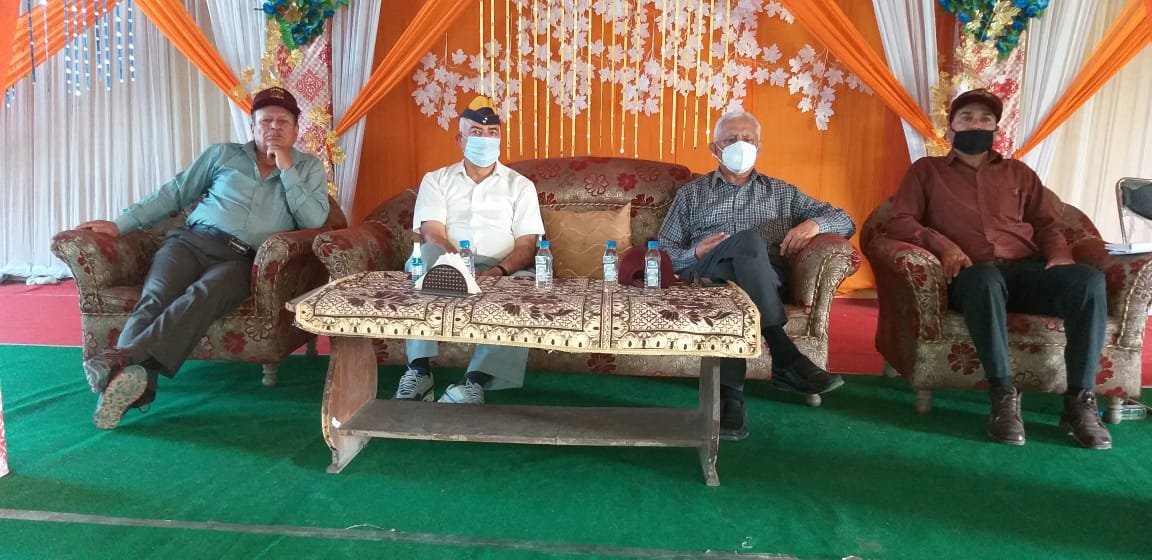
The Veterans’ Association of Ontario, which comprises Indian-origin members who have served in the armed forces in India and Canada, is bringing together representatives from Hindu and Sikh organisations to resolve differences over the farm laws that have divided the Indo-Canadian community.

Brigadier (Retd) Nawab Heer, chair of the association, told HT he was “hopeful” the situation will be “defused”, adding, “I don’t know why we should be creating tensions among ourselves. Views should be respected on both sides. If the Indian diaspora has to flourish here, we have to be together.”

The association has facilitated dialogue between some leaders of the two communities, while religious establishments like gurdwaras have also been brought into the process of trying to create harmony.


Union of India/ PCDA/ IAF have lost a petition in Supreme court against Veteran

Union of India/ PCDA/ IAF have lost a petition in Supreme court against Veteran JWO Bharat singh khatana for grant pension as per last Rank held. This is applicable for Pre 2006 retirees only. Now every one who held the rank for less than 10 months are eligible for pension of retired rank as per the supreme court judgement. Earlier, everyone who approached CDA/AFRO/DAV were getting reply that the case is under appeal in supreme court. I request every individual to write a letter to DAV/PCDA and seek revision of pension as per last rank held


Farmers Getting Poorer, Government Officials Richer”: Meghalaya Governor :

'Farmers Getting Poorer, Government Officials Richer': Meghalaya Governor

Baghpat: 

Siding with farmers protesting the Centre’s new agriculture laws, Meghalaya Governor Satya Pal Malik here on Sunday urged Prime Minister Narendra Modi and Home Minister Amit Shah not to offend them.

Speaking at an event in his home district, Malik said if the Centre gives legal guarantee of the minimum support price (MSP) for crops, farmers will relent.

The Meghalaya Governor also claimed that he prevented the arrest of farmer leader Rakesh Tikait when he heard rumours about it.

Malik further said he had requested the prime minister and the home minister not to use force against farmers, and not to send them home from Delhi empty-handed.

“None of the laws are in favour of farmers. The country in which farmers and soldiers are not satisfied, that country cannot move ahead. That country cannot be saved. Hence, the Army and farmers should be kept satisfied,” Malik said urging PM Modi and Home Minister Shah not to offend them.

Describing the condition of farmers as bad, Malik said, “They are getting poorer day by day while the salary of government officials and staff increases after every three years. Whatever is sown by a farmer is cheap and whatever he buys is expensive.”

“They do not know how they are becoming poor. The ‘satyanaash‘ (annihilation) of the farmers is taking place without their knowledge. When they go to sow (crops), there is some price, and when they go to reap it, the price decreases by almost ₹ 300,” Malik said.

Taking a jibe at the arguments offered in favour of the new farm laws, Malik said, “A lot of noise was created that farmers can now sell (crops) at any place. This is a 15-year-old law. Despite this, when a farmer from Mathura goes to Palwal with wheat, there is a lathicharge on him. When a farmer from Sonipat comes to Narela, there is a lathicharge on him.”

“There are many questions of farmers, which must be answered. Today, there is no law in favour of farmers. This has to be corrected. I want to assure you that in the matter of farmers, I will go to any extent to solve their problems,” he said.

Apparently referring to Sikh farmers protesting against the laws, Malik said, “The Sikh community does not back down and forget things even after 300 years.”

“Indira Gandhi (ex-PM) had got the ‘Mahamrityunjay Mantra Jaap‘ done for a month after the Operation Blue Star. Arun Nehru told me that when he asked her that you do not believe is such rituals, then why are you performing these, she said you don’t know, I have damaged their ‘Akal Takht’. They will not spare me.”

5Comments(Except for the headline, this story has not been edited by NDTV staff and is published from a syndicated feed.)


Afghan peace plan an opportunity for India

India should draw comfort from the fact that it has been offered a seat on the decision-making table along with China, Russia, Iran, Pakistan and the US. This is a big opportunity, given the fact that India has been losing leverage in Afghanistan ever since the Taliban came back to battle in 2004, getting stronger and stronger. So, the issue for India is whether it should stick to its stance of loyalty to the Afghan government or be flexible in its approach.

Afghan peace plan an opportunity for India

WIST IN THE TALE: A few weeks before the day agreed upon for the withdrawal of US forces, America has come out with a new peace plan for Afghanistan. REUTERS

Lt Gen NPS Hira (Retd)

Former Deputy Chief of Army Staff

Afghanistan has been suffering for the past 40 years. Today, it is one of the poorest countries and has the highest daily death toll from militant violence and security forces’ killings. With a few weeks to go before May 1, the day agreed upon for the final withdrawal of American forces, the US has come out with its new proposal for peace in Afghanistan. Perhaps, no analyst would disagree that in the present circumstances there may be no solution to the problem without power-sharing with the Taliban.

The situation has been further precipitated by Donald Trump’s election agenda of withdrawing troops from Afghanistan. Unfortunately, he continued with the withdrawal even after he had lost the elections. If we go back to the time before the US elections were due in 2016, Barack Obama had planned to withdraw completely out of Afghanistan. But when he realised that doing so was against American interests, he changed the plan and left 10,000 troops in Afghanistan to keep the options open for the new President to be elected.

But Trump is made of a different clay. He has, unfortunately, tried to close down the options for Biden. As a result, much as Biden may desire to promote the western style of democracy, his options to put pressure on the Taliban stand constrained. A lot has been written about the details of the new plan of Biden as well as the bad optics of the language of the letter by Antony Blinken to Afghanistan’s elected President Ghani.

Biden’s plan needs to be viewed in the larger context of the limited options open to him. The plan, in essence, is an interim power-sharing set-up between the Afghan government and the Taliban, an essential revision of Afghanistan’s Constitution as well as the judicial system by commissions with members from the Afghan government as well as the Taliban. This exercise is to be followed by fresh elections in Afghanistan. A ceasefire has also been proposed in Afghanistan during this period.

Neither the Afghan government nor the Taliban are happy with the plan, though it is difficult to say if Biden can be faulted for his effort. There is a fair amount of public opinion in the US to get its troops out of Afghanistan and let the Afghans decide their own fate, irrespective of the course it may take.

Ghani secured his presidency last year for a further period of five years. He is obviously unhappy with the plan because if put into effect, he as well as his government stand to lose a lot. The harsh tone of Blinken’s letter to Ghani suggests that if he were not to accept the proposal, the US may have no option but to watch him thrown to the wolves, if the US is to complete its withdrawal as planned.

To be fair to Biden, the Taliban have been as much, if not more, pressured to agree to a ceasefire and also face a popular mandate. The Taliban’s only strength in this tug-of-war is the use of violence and, therefore, this proposal is anathema to them. The plan has built-in safeguards for women, human rights and a popular mandate of the people.

Given the animosity and distrust between the Afghan government and the Taliban, both can draw comfort from the fact that the US has proposed this plan to unfold under the supervision of the United Nations. This implies the deployment of a peacekeeping or, more aptly, a peace-enforcement contingent from different nations. The plan does seem to rely on a fair amount of wishful thinking, but Biden does not have a choice. It is difficult to think of any other better option under these circumstances for peace in Afghanistan.

India should draw comfort from the fact that it has been offered a seat on the decision-making table along with China, Russia, Iran, Pakistan and the US. This is a big opportunity, given the fact that India has been losing leverage in Afghanistan ever since the Taliban came back to battle in 2004, getting stronger and stronger.

So, the issue for India is whether it should stick to its stance of loyalty to the Afghan government or be flexible in its approach. The people in Afghanistan have suffered a lot. To help improve their sad plight, it may be more apt to take a humane approach.

No doubt, the Afghan government is an elected body, but one may also not overlook that the Taliban have come to enjoy a considerable following among the rural masses and cannot be wished away. It represents the Pashtuns, which is the biggest and most dominant ethnic tribe and has ruled Kabul in the past. The Taliban have also recently been taking recruits from all ethnicities, including the Hazaras, who are Shia Muslims.

So, if the Taliban agree to a ceasefire and also to take part in the elections, it may not be a bad option to work with them in the larger interest of peace.

Since a man of Biden’s sensibilities for democracy and human rights has come around to the above viewpoint, as is reflected in the proposed plan, India may also need to look at it with an open mind. It is logical to conclude that if we cannot wish the Taliban away, it is better to get them to agree to join the democratic process and moderate their policies.

One can also read between the lines: that if the Taliban do not agree, Biden, by floating this proposal, has created sufficient grounds for the US military to stay back in Afghanistan and continue with its military option against the Taliban. So, the plan has not only made Ghani’s position somewhat vulnerable, it has also put the Taliban in a tighter corner. It looks unlikely that the Taliban would agree to the proposal, unless the US shows its teeth by declaring its intention to stay put beyond May 1. Even with that option, finding a solution to the Afghan problem is a tall order.

In the past, India had good reasons for not getting involved militarily in Afghanistan, but as a part of the UN contingent, it is a good opportunity to send troops to Afghanistan. This is likely to give India more leverage in Afghanistan against Pakistan than what it has today. Its soft power in Afghanistan will multiply manifold if it is able to put boots on the ground under the UN mandate. Its presence will help take care of its immediate interests as well as build a lasting relationship with Afghanistan, irrespective of the composition of the future governments.


Punjab second among all states in contributing to Army’s rank and file

Accounts for 7.7 per cent of Army’s manpower, though its share in national population is 2.3 per cent

Punjab second among all states in contributing to Army’s rank and file

hoto for representational purpose only. Reuters

Vijay Mohan

Tribune News Service

Chandigarh, March 15

Piping its neighbours, Punjab, often referred to as the sword army of the nation, has the second highest number of soldiers, other than officers, serving in the Army amongst all states and union territories in the country.

The strength of army personnel from Punjab is 89,088, according to information placed by the Ministry of Defence in Parliament today. This accounts for 7.7 per cent of the Army’s rank and file, even though its share of the national population is 2.3 per cent.

With 1,67,557 soldiers, Uttar Pradesh tops the list of states contributing manpower to the Army. While Uttar Pradesh, the nation’s most populous state, makes up 16.5 per cent of the country’s population, its share in the rank and file is 14.5 per cent. Maharashtra, with 87,835 soldiers occupies the third slot followed by Rajasthan, with 79,481 soldiers.

Among other states in the region, Haryana is sixth in the national tally while Jammu and Kashmir and Himachal Pradesh 11th and 12th position, respectively. The contribution of these states to the Army, however, is significantly more than their share of the national population.

The Ministry’s data shows that with 65,987 soldiers, Haryana accounts for 5.7 per cent of the rank and file where as its share of the national population is 2.09 per cent. Jammu and Kashmir, along with Ladakh, and Himachal Pradesh have 47,457 and 46,960 active duty soldiers, respectively. While they account for 1.01 per cent and 0.57 per cent of the national population, respectively, they make up 4.1 and 4 per cent of the army’s strength,

The Army currently has 11,51,726 soldiers on its rolls against the authorised strength of 12,29,559, facing a deficiency of 77,833 men in the ranks. As far as officers, other than those in the medical stream, are concerned, the present holding is 42,959 against the authorised 50,806.  

Unlike the Air Force and the Navy, the Army does not maintain state-wise details of the number of officers on its strength. As far as the Air Force is concerned, Haryana has the second highest number of officers after Uttar Pradesh and the third highest number of airmen.

Incidentally, the number of doctors presently with the Army Medical Corps and the Army Dental Corps is 6,608, which is higher that the sanctioned strength of 5,736. The posted strength of Military Nursing Officers at present is 3,841 against the authorised number of 4,389.

The region has a strong martial heritage and a rich military history that dates back thousands of years, and is a witness to many wars and battles. Joining the armed forces is a tradition in many families and several generations have donned the uniform.

In the infantry, the largest component of the army, the Punjab Regiment, Dogra Regiment, Sikh Regiment, Sikh Light Infantry, Jammu and Kashmir Regiment, Jammu and Kashmir Rifles and Ladakh Scouts draw their manposer from this region. Soldiers from these states also make up a sizable chunk of other arms and services.

Vacancies in the rank and file are allotted to the state on the basis of their respective population. In case a state fails to fill up the allotted vacancies, these can then filled from, other states.


Government rushes to open Ladakh roads

Routes critical in maintaining supplies to Army, IAF stationed along LAC

Government rushes to open Ladakh roads

Amid the ongoing military tensions along the Line of Actual Control (LAC) in eastern Ladakh, India is racing to open both road routes that connect the plateau of Ladakh with mainland India. File photo

Ajay Banerjee

Tribune News Service

New Delhi, March 15

Amid the ongoing military tensions along the Line of Actual Control (LAC) in eastern Ladakh, India is racing to open both road routes that connect the plateau of Ladakh with mainland India.

In February end, Zoji-La, a 11,500-ft-high mountain pass on the Srinagar-Leh route, was opened weeks ahead of the schedule. Now, the Border Roads Organisation (BRO) has sent a special team to open Baralacha-La, a 16,000-ft-high Himalayan pass on the Manali-Leh route.

Strategic move

  • Zoji-La, a 11,500-ft-high mountain pass on the Srinagar-Leh route, was opened last month, weeks ahead of the schedule
  • Baralacha-La, a 16,000-ft-high pass on the Manali-Leh route, is likely to be opened by month-end
  • Supplies to the Army and IAF in eastern Ladakh are dependent on these two road routes

Baralacha-La is the first high pass on the 427-km-long Manali–Leh highway. The road normally opens in mid-May, but the BRO might open it by the end of this month. Supplies like oil, food, ammunition and spares for the Army and IAF locations in Eastern Ladakh are dependent on these two routes. Once the passes close during the winter, the only option is to fly men and supplies from logistics hubs in Chandigarh or Hindon.

On Sunday, a team of the BRO clad in arctic clothing trekked across the snowbound Baralacha-La to reach Sarchu, a location where the road opening equipment was kept during the winter. The team is fully stocked with ration, spare parts, communication equipment etc.

Connectivity on 59 roads achieved

Connectivity has been achieved on 59 roads with 3,205 km length along the India-China border, Defence Minister Rajnath Singh said in Rajya Sabha on Monday.

It attempted to cross the pass on March 11 and again on March 12, but heavy snowfall held them back. The crossing was again attempted on March 13, which was successful. The team, however, fell short of the destination, Sarchu, where it reached the next day. Snow clearance work has started on access routes to the pass. There is a minimum of 20 feet of snow for more than 10-15 km on either side of the pass.

Meanwhile, Zoji-La, located 130 km east of Srinagar, was opened in February, but fresh snow around March 10 blocked the Srinagar-Kargil-Leh road.