





News dated 08 Apr 2021

Current Events :
















Tribune News Service
New Delhi, April 7
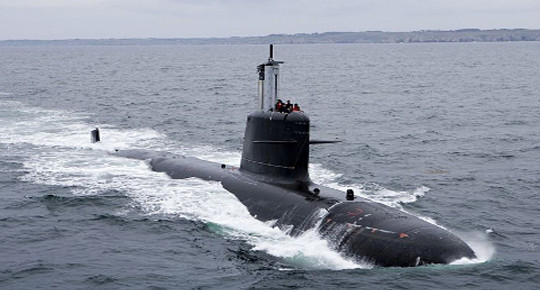
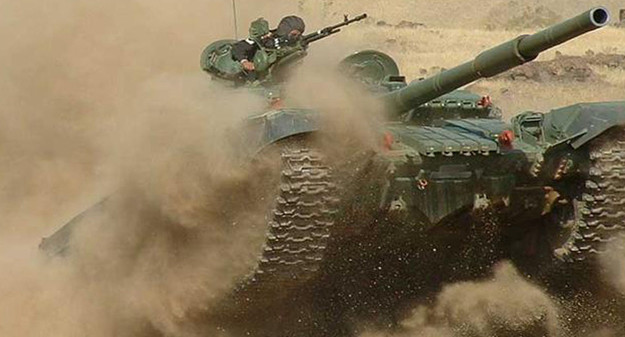
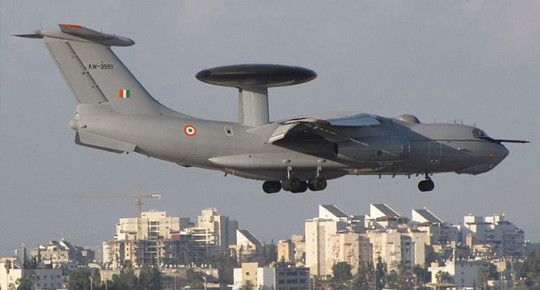
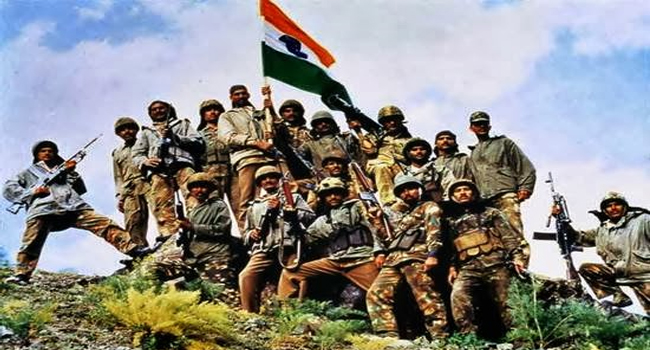
Chief of Defence Staff General Bipin Rawat said today that the forces should completely shed the “colonial-era syndrome”. Speaking at the Vivekananda International Foundation, General Rawat sought to highlight how a changed global environment demands a change in outlook and policies.
General Rawat was speaking on the theme ‘Shaping the armed forces to meet likely current and future challenges’. “We cannot fight the next war premised on the experiences and structures of the past wars,” said the CDS. The way forward is jointness, integration and modernisation in line with the changing security environment and utmost optimisation of resources.
“A series of initiatives are being undertaken that will change the way Indian armed forces fight and the way capability is developed. Greater emphasis would now be on advancing jointness and integration across the board to shape congruent perception for the three armed forces to jointly operate efficiently and effectively. The central theme is to be future ready by balancing preparedness for today’s requirements with what we need to do differently to meet tomorrow’s challenges,” he said.
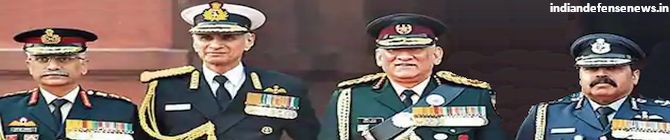
With the threat of a two-front war simultaneously with China and Pakistan always looming, Army Chief General MM Naravane said on Tuesday India is “facing renewed challenges” along its borders. Keeping this in view, military officers undergoing training should keep themselves abreast of these developments, he said.
Making this observation in his lecture on ‘Developments along the Western and Northern Borders and their Impact on the Future Road Map of the Indian Army’ at Defence Services Staff College (DSSC), Wellington, Tamil Nadu, he also focused on enhanced synergy and jointmanship amongst the Army, IAF and Navy.
“He (Army Chief) emphasised that the nation is facing renewed challenges along its borders and exhorted the students on the need to remain abreast of all developments,” said the Indian Army’s statement.
Naravane was on a two-day visit to the college. The lecture was delivered to the faculty and officers attending the 76th staff course at the college.
Commandant of the College Lt General MJS Kahlon gave an update to Naravane on the ongoing training activities and incorporation of new initiatives with specific reference to professional military training on “jointmanship” among the three services, the Army’s statement said.
The Army Chief was briefed on the changes being undertaken in the training curriculum and infrastructural development as a step towards enhancing the role of DSSC as a centre of excellence for professional military education, it noted.
He complimented the college for maintaining a very high state of training in spite of COVID-19 pandemic constraints, the statement said.

Pakistan’s powerful army chief General Qamar Javed Bajwa has told India’s national security adviser that he was prepared to declare a moratorium on fighting in Kashmir, Financial Times has reported.
The British newspaper reported on Tuesday that the Pakistan Army chief “has launched talks with nemesis India to secure an eventual meeting between the neighbouring countries’ prime ministers”.
The newspaper reported that it gained information from “three people with direct knowledge of the matter”.
According to the report, Pakistan’s General Bajwa has told India’s national security adviser Ajit Doval that he was “prepared to declare a moratorium on fighting in Kashmir”.
FT further reported that Pakistan military’s public relations arm denied that Bajwa had pledged a moratorium on hostilities. “It’s a pack of lies,” said a spokesman. “It is all speculation.” However, the Indian Army chief recently said the line of control, which separates Indian and Pakistani controlled parts of Kashmir, had been “silent” for the first time in five years. “This really bodes well for the future,” he said
Several reports in recent weeks had hinted that Bajwa and Doval are spearheading the negotiations, which comes nearly two years after New Delhi revoked Kashmir’s limited autonomy which had frozen its relations with Islamabad.
Financial Times reported the latest initiative was “reportedly” launched by Bajwa in January and was backed by Mohammed bin Zayed al-Nahyan, the UAE’s ruler, and his national security adviser Sheikh Tahnoon bin Zayed al-Nahyan made “a positive start with a ceasefire on February 25”.
“The next steps include reopening border trade, pandemic response co-operation and India’s participation in an anti-terror drill to be held in Pakistan. If successful, a meeting between the prime ministers could happen in the next 12 months,” the newspaper reported.
“There is a senior-level dialogue going on in preparation for a potential meeting between Modi and Imran Khan,” Financial Times quoted a person with knowledge of the back-channel efforts.
Pakistan had flip-flopped last week on the trade commitment with India when it first announced it would allow sugar and cotton imports from India and then backtracked from it, saying trade would only resume once Kashmir’s special status was restored.
An Indian government official, however, said the talks were still going ahead and that the rhetoric from Khan’s government was intended to satisfy the conservative element in his support base, the newspaper reported. Politicians “have to make these symbolic gestures”, the official said.
In the weeks since the ceasefire was announced, Bajwa has struck a conciliatory tone, saying it was time to “bury the past and move forward”. He lamented that the potential of Kashmir has “remained hostage” to the dispute, conspicuously omitting any reference to restoring its special status. India has reciprocated in kind and Modi made headlines for wishing Khan a speedy recovery from coronavirus on Twitter.

The key focus will be early disengagement in other areas of Eastern Ladakh like hots springs, Gogra, and Depsang plains
New Delhi: The 11th round of India China military talks is expected to happen this Friday (April 9).
The key focus will be early disengagement in other areas of Eastern Ladakh like hots springs, Gogra, and Depsang plains.
Both countries were able to achieve complete disengagement at Pangong lake in February.
Last week in response to a question, the spokesperson of India’s external affairs minister said, “hope that the Chinese side will work with us to ensure that disengagement in the remaining areas is completed at the earliest.”
The spokesperson added that this “would allow both sides to consider de-escalation of forces in Eastern Ladakh” as that “alone will lead to the restoration of peace and tranquillity and provide conditions for the progress of our bilateral relationship.”
Last year saw Chinese aggression at the Line of actual control in eastern Ladakh, including at the Galwan in which India lost 20 of its soldiers. Since then the ties between the two countries remain strained.
New Delhi has even taken measures to cut down investments from China.
The 10th round of India, China military talks happened in February, post complete disengagement at the Pangong Lake.
The same month saw telephonic talks between External Affairs Minister Dr S Jaishankar and Chinese FM Wang Yi. During the talks, both sides decided to establish a hotline for “timely communication”.
The General Court Martial was convened in Delhi to try the Army person after a Junior Commissioned Officer levelled allegations of sexual assault against him.
Crest of the Indian Army | Representational image | WikipediaText Size: A- A+
New Delhi: A General court-martial has acquitted an Army jawan facing charges of inappropriately touching a girl child under the Protection of Children from Sexual Offences (POCSO) Act.
The General Court Martial was convened in Delhi to try the Army person after a Junior Commissioned Officer levelled allegations of sexual assault against him. The GCM consisting of senior officers, including a lady officer from the army and Judge Advocate Branch, started its proceedings last year.https://58d807efda89e1c56ca3700cc633ace3.safeframe.googlesyndication.com/safeframe/1-0-38/html/container.html
“After a trial of several months and questioning several witnesses, the prosecution could not prove its case and the accused Army person was found to be ‘not guilty’ by the Army court,” sources told ANI.
The accused Army person’s lawyer Anand Kumar said the justice system of the Army has been fair.
“It is only in Army that trial in such cases is completed expeditiously as compared to civil counterparts which also bestows faith in the military justice system,” he said.
The POCSO Act is landmark legislation to prevent sexual abuse and exploitation of children and the Act intends to protect the children from sexual assault, sexual harassment, and pornography.
Recently, the Supreme Court had stayed a controversial Bombay High Court’s order which had acquitted a sexual offender of charges under the stringent POCSO Act on the ground that the man had touched the child over her clothes and there was no skin to skin contact.
Also read: ‘Touching bums with sexual intent crime under POCSO’ — Mumbai court gives man 5 years in jail
This time round, the military is learning that it can’t ‘rein in’ people
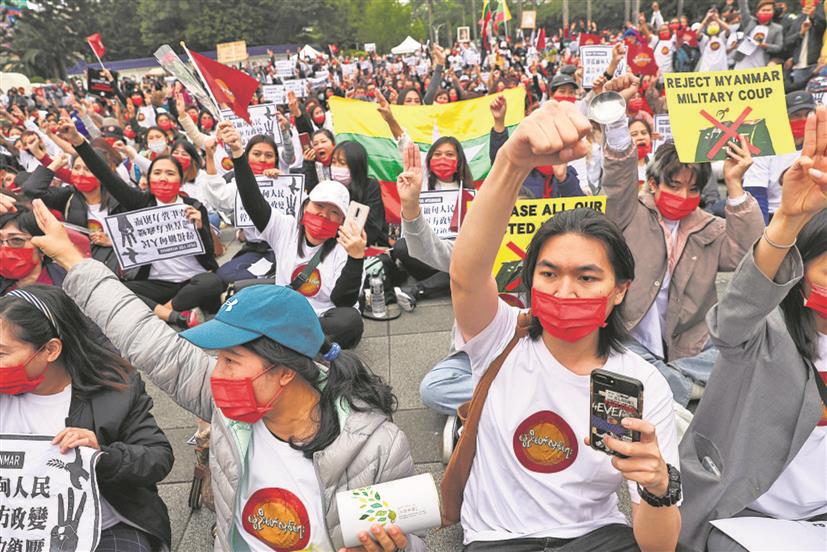
UPRISING: It is now two months since the coup took place but large-scale protests have continued on the streets in several cities. Reuters
The situation in Myanmar continues to deteriorate as the military raises the level of violence unleashed against peaceful pro-democracy demonstrators. According to the UN Human Rights Office in Southeast Asia, to date, over 500 lives have been lost in firing by security forces at protesting crowds. As many as 2,600 others have been detained since February 1 when the coup took place. There are reasons to believe that this time round, the Myanmar military may have miscalculated its ability to frighten ordinary citizens into abject submission. This playbook of unmitigated violence against its own citizens has worked in the past, whether the protesters are political party workers and civilians or Buddhist monks who enjoy deep respect in a devout Buddhist country. It is now two months since the coup took place but large-scale demonstrations have continued on the streets in several cities, including the capital city of Naypyidaw. The barbaric violence indulged in by the security forces has led to greater outrage and anger and a determination not to submit to such repression. Furthermore, the very constituencies that the regime depends upon to run the state and its agencies and the economy, are also joining the protests, crippling administration in many areas. The impact on the economy, which has already been badly damaged by the pandemic, is severe. It could well descend into a free fall if the political unrest continues, and, worse, if it escalates.
The barbaric violence indulged in by the security forces has led to greater outrage and anger and a determination not to submit to such repression.
There is another important difference from the past similar instances. Politics in Myanmar works through a ‘three-legged’ dynamic, the military, the mainly Burman civilian political constituency and the 17-odd ethnic groups, some of which are heavily armed. If two legs come together, the remaining leg will come under intense pressure. In the early 1990s, when the military overturned the results of elections which were also won by the National League of Democracy (NLD), it managed to neutralise the various ethnic groups by concluding ceasefire or arms for peace agreements with them conceding a high degree of autonomy to them in their respective regions. The Chinese who had maintained strong links with some of these groups located in the China-Myanmar border, such as the Wa and the Kokang, helped the Myanmar military in negotiating such agreements. This time, several of the ethnic groups have shed their reservations about the NLD and the leadership of Aung San Suu Kyi and are joining in the popular protests against the military. Clashes between the ethnic armed forces and the Myanmar military are growing. It is estimated that these ethnic armed forces may number at least 1 lakh. If two legs of the stool come together, the military will find itself under great pressure. Of course, thanks to their close connections with China, the Wa and the Kokangs have maintained a studious silence so far but other groups are not only joining in the condemnation of the military but also providing shelter to Burman activists in areas controlled by them. The aerial strikes against the Karen National Union on the Myanmar-Thai border appear like an act of desperation and as a warning to other ethnic groups.
Currently, there are two opposition groups that are active, one being the Committee Representing the Parliament (CRP), which is composed mainly of the NLD members of the elected body, and the General Strike Committee of Nationalities (GSCN), made up largely of various ethnic groups. While the CRP is pressing for the convening of the newly elected parliament and release of ASSK, the GSCN has a more ambitious political agenda. The latter wants the abrogation of the current military-inspired constitution of 2008 and the adoption of a new federal polity with significant local autonomy for Myanmar’s numerous ethnic groups. Even the CRP is talking about the need for a federal, democratic, civilian political dispensation. This would be an anathema to the military. While in the past, the military could tap into the majority Burman anxiety about national unity being undermined by powerful ethnic groups seeking autonomy, what we are witnessing is the coming together of these two key constituencies in the face of indiscriminate violence perpetrated on both.
What about the external environment? Since its takeover in 1991, the Myanmar military has been relatively insulated from external pressures by the tacit support of China and key ASEAN countries. Since the late 1990s, India, too, decided to engage with the military government. As long as its borders to the east (India), west (Thailand) and north (China) remained open and trade could continue despite western sanctions, it could afford to ignore external pressures. That situation continues to prevail, as of now. But prolonged unrest and growing violence is already affecting the substantial economic assets which China, Singapore, Indonesia and Thailand have come to acquire in Myanmar. Chinese projects, in particular, are the target of attacks by demonstrators leading to Chinese demands on the military government to protect these assets. Anti-Chinese popular sentiment is growing and this cannot be a good augury for the future of the ambitious China-Myanmar economic corridor. Myanmar is the key to resolving China’s ‘Malacca dilemma’, enabling direct access to the Bay of Bengal. Would China play a more active role in resolving the current political crisis? This is unlikely because even in the military, the suspicion about Chinese intentions runs fairly deep. This is reinforced by Chinese links, with some of the important ethnic groups on the border. Could India have a role to play? While expressing concern over the growing violence in the country and conveying support to the democratic transition, the Indian position has been cautious and in the nature of watch and wait. India has one advantage. It has maintained a good relationship with Myanmar’s military leaders and has also earned a degree of trust with the NLD. India has assisted the NLD in nurturing the nuts and bolts of democratic functioning and contributed significantly to capacity building. This goodwill could be useful if deployed together with ASEAN countries, and perhaps Japan as well. Maybe the military is ready to consider walking back from the brink and these efforts could offer a way out.
The bottom line seems to be that the Pakistan army is prodding the government to forget about the Kashmir issue for the moment, to deal with a crisis which is making it difficult for the army to keep itself afloat in unremitting operations along the Line of Control, not to mention the continuous counter-terrorism operations in the tribal areas.
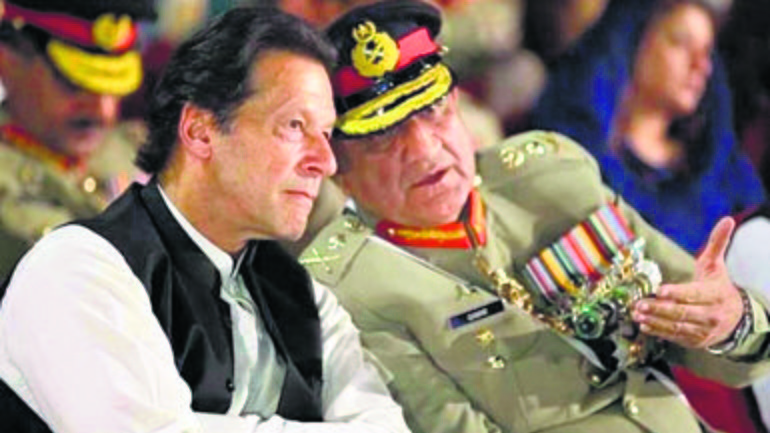
TIGHTROPE WALK: Imran Khan is secure till he retains the backing of the military.
INDIA-PAKISTAN relations resemble nothing more than a game of snakes and ladders, with more snakes than ladders. That tendency was worsened recently by the Imran Khan government taking yet another U-turn on its policies, this time on reopening trade with India, making everyone wonder whether it was even worth trying to get the relations with this troublesome and erratic neighbour on an even keel.
First, the clearance for importing sugar and cotton from India was done by Pakistan’s Economic Coordination Committee headed by Finance Minister Hammad Azhar, who had attended this meeting on his very first day in office. Till then, it was Prime Minister Imran Khan who was holding charge of the Finance Ministry, after the unceremonious exit of his predecessor Hafeez Sheikh after less than two years in office on March 30. But he was luckier. Another Finance Minister — Asad Umar — lost his job in just eight months. Now, there are rumours that another of Imran Khan’s affiliates, Shaukat Tarin, may be considered for the job or to head the Economic Advisory Board. In short, it’s complete chaos.
Whatever the context, the meeting itself seems to have made clear the reason for this decision. Sugar is clearly cheaper in India; and as for textiles, it’s no secret that while production has seen some recovery after the government offered several sops, it’s far from being in even recovery mode. Apart from a poor cotton harvest driving up prices to a 10-year high, industry leaders also observe that the quality of Pakistan cotton is poor, leading to a demand for imported cotton.
Meanwhile, an interesting fact. Pakistan’s order books could benefit due to the strained US-China relations, particularly after the ban on cotton from Xinjiang on grounds of forced labour. There’s money to be made. So, it’s no wonder that textile exporters are upset at the sudden reversal of the government policy. People on the ground are likely to be upset too. After all, it employs about 40 per cent of the workforce, employing relatively unskilled labour as well. It also comprises 60 per cent of the total exports. This deal with India matters to the Pakistani people.
Then came the complete turnaround — so complete as to risk upsetting the applecart altogether. The Cabinet reportedly decided that the decision had been ‘deferred’ until a complete reinstatement of Article 370 in Kashmir.
True, decisions by any ministry have to be endorsed by the Cabinet, and some of them do get rejected. But as Pakistan’s daily Dawn commented, the reversal “is a bizarre development — one that falls squarely under the unfortunate category of the left hand not knowing what the right is doing.”
Obviously, even if the minister was new to the job, the ministry itself doesn’t work on its own, especially on such a sensitive subject as trade with India. Someone okayed the discussion on the proposal, and someone else or the same person got cold feet. It now appears that the item was not even on the agenda of the cabinet. It was ‘raised’ at a meeting on Gilgit-Baltistan, and Imran Khan promptly opposed it and called for a review. This kind of policymaking falls squarely in the category of “cutting off your nose to spite your face.”https://e66bba17b2ac755e035ea94638359f35.safeframe.googlesyndication.com/safeframe/1-0-38/html/container.html
Meanwhile, opposition to the idea was expected from the usual quarters. Sections of the Urdu media declared that Pakistan would rather die of starvation than give in on Kashmir. Television anchors debated the ‘wisdom’ of the move, but the overall reaction was speculative rather than negative. Post the turnaround on trade, the general tone has been critical of the government and Imran Khan, in particular, in terms of the recent events. In Kashmir, entirely expectedly, the All-Party Hurriyat Conference and the Jammu and Kashmir Democratic Political Movement issued separate statements welcoming Khan’s refusal on trade.
Finally, there’s one important input. According to veteran journalist Najam Sethi, the Chief of Army Staff, General Bajwa, recently summoned six Cabinet ministers to give them a talking-to on the abysmal performance of the government, particularly on the economic front. It appears that the sacking of Finance Minister Hafeez Shaikh occurred shortly thereafter. The COAS is also credited with the sudden invitation from Saudi Arabia to visit Riyadh, thus possibly ending a chill that led to the stoppage of the badly needed economic aid from that quarter.
The bottom line seems to be that the Pakistan army is prodding the government to forget about the Kashmir issue for the moment, to deal with a crisis which is making it difficult for the army to keep itself afloat in unremitting operations along the Line of Control, not to mention the continuous counter-terrorism operations in the tribal areas.
The World Bank report released recently paints a grim picture of the economy, predicting that growth would slow down further, and that the debt-to-GDP ratio, already at 87.2 per cent, would worsen to 94 per cent. The writing is on the wall. The Army Chief and the Chinese, not to mention the US and Pakistan’s international lenders, see it. The Prime Minister and his warring ministers don’t.
The U-turn, perhaps, may be explained by the party’s recent political embarrassments, including the election of former Prime Minister Yousaf Raza Gilani to the Islamabad Senate general seat, which, in turn, led to Khan seeking a vote of confidence from the House.
While it may be Dutch comfort to point out that the Opposition — the Pakistan Democratic Movement — is embarrassing itself to an almost equal extent, the truth is that Khan remains secure as long as he retains the backing of the military establishment. Now it seems that he’s in danger of losing that as well. Experts talk of his ‘voodoo vision’ of the economy, which has contributed to the free fall of the economy, while the rapid changes in crucial posts have upset the market.
But this is Imran Khan, a Prime Minister, not quite even a first among equals, and who is not quite in his prime in terms of his ability to manage what is admittedly a very difficult situation. That inability is, however, giving everyone else a massive headache. The trouble is that, rather like India, there doesn’t seem to be anyone who is even remotely a viable political alternative.
Govt volte-face highlights the vulnerability and implicit power of the middle class
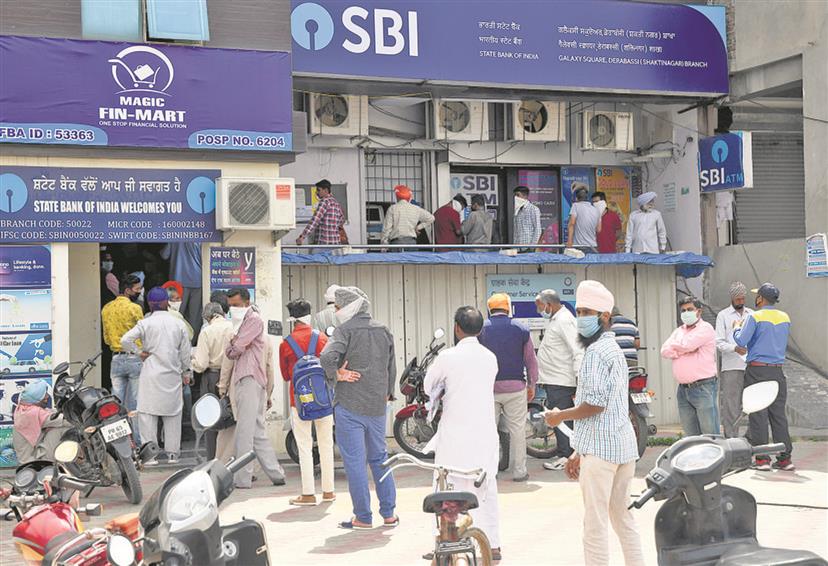
NO-GO: Interest rates on small savings schemes, an important source of household savings, should be left intact. Tribune photo
An old acquaintance from the management side of the newspaper house, in which I once was ‘business editor’, was on the line not so long ago. He was bemoaning that interest rates on small savings had been cut again. The return on the deposit in his PPF account, in which most of his life’s savings had been placed, would be hit. This interest income was his pension as his lifelong private sector employment did not fetch him a pension which government service would have. I could do little more than sympathise. These past few days, I have been expecting a call from him again, bemused by the interest rates being cut yet again, and then restored in less than a day.
There is good economic logic and political compulsion behind not tampering with interest rates.
The gentleman’s plight and the volte-face on the part of the government highlight the vulnerability and implicit power of the middle class. It does not have the numbers compared to those below it in the economic hierarchy, but makes up in terms of being able to set the public mood. Nothing turns the mood more sour than the sight of a pensioner’s income being threatened even as prices have started to go up again.
Small savings schemes — grouped under post office deposits, savings certificates and social security schemes, like PPF and senior citizens savings schemes — are an important source of household savings. The money collected under the entire gamut of small savings schemes is used by the Central and state governments to finance their fiscal deficits. The balance left over is invested in government securities.
The decision on the part of the government’s economic administrators to advise and implement the rate cuts in the first place cannot be faulted. The fiscal deficit, the primary benchmark of the stability of the government’s finances, must be brought under control after it had gone haywire in the preceding year of lockdown and economic slowdown. A good way to do this would be to reduce expenditure by bringing down interest outgo on government borrowings, and this is best done by lowering the rate of interest at which the government borrows.
In the hierarchy of interest rates — right from what is paid by the government on its long dated bonds to what banks pay their depositors — small savings interest rates (a form of government borrowing from you and me) cannot be the odd man out. If interest rates for the most part are going down, then those on small savings must follow suit.
If small savings rates remain out of line, then money will flow out of banks into small savings. This will prevent banks from giving higher accommodation to commercial borrowers so that they can bump up business levels and overall economic activity. This, in turn, will stymie the nascent recovery that is taking place in the economy which will prevent a rise in the government’s revenue earnings and put paid to efforts to bring down the fiscal deficit, which is where we began in the first place.
A government is asking for trouble if it tries to lower small savings rates even as a vigorous election campaign is entering its final phase. This is particularly so when inflation seems to be on the way up again. The February figures, the latest available, show an uptick for both consumer prices and food inflation. When they fell during the previous few months, the expectation was that the high inflation rates through 2020 were now behind us.
So the dilemma is that to keep bank interest rates low to aid credit expansion and economic recovery, it is necessary to bring down the entire interest rate regime of which small savings interest rates are a part. But lowering small savings interest rates during election time is to antagonise the middle class, of which pensioners are a part.
Is there a way out? Yes. What the government must learn to do is not to miss the wood for the trees. The fiscal deficit number is important, but more important is the need for overall economic recovery. Once that begins to take place, aided by growing bank credit facilitated by moderate bank lending rates, the growing volume of economic activity will increase the government’s tax revenue collection, and thereby, address the fiscal deficit number after a time lag.
Clearly bank lending rates should go down or remain low. But simultaneously, there is good economic logic and political compulsion behind not tampering with small savings interest rates. Not lowering them will increase confidence levels among the middle class and aid consumption expenditure. This is particularly so because pensioners who depend on survival on the interest income from their small savings, and do not save anymore to keep creating a post-retirement nest egg, spend all on keeping body and soul together, that is, channel the entire interest earnings into consumption expenditure.
What we are arguing for is small savings rates be left intact in a regime of declining interest rates. This will undoubtedly make them more attractive vis-à-vis bank deposits, but there will not be an automatic and similar outflow from one to the other, as small savings are typically long-term savings which are planned well in advance. On the other hand, bank deposits fall in two categories. Current and savings bank deposits represent the amount customers leave aside to meet day-to-day cash needs and there is a disincentive to pre-encash bank fixed deposits as that attracts an interest penalty.
Over and above all this, there is a welfare argument in favour of ensuring that the superannuated are able to look after themselves by ensuring that their post-retirement incomes are not impeded in any way. Just as basic healthcare and up to secondary level education need to be adopted as social security goals — that is, the state should foot the bill and to the needy citizen they should be free — a post-retirement cash flow, or a pension by whatever name, should also be provided by the state to the not so well-off.
The bottom line is — don’t tamper with the middle class’s superannuation-related savings, whatever a narrow reading of economic theory might suggest.
(Interest declared: I am a superannuated private sector employee!)
State minister holds virtual meet with Piyush
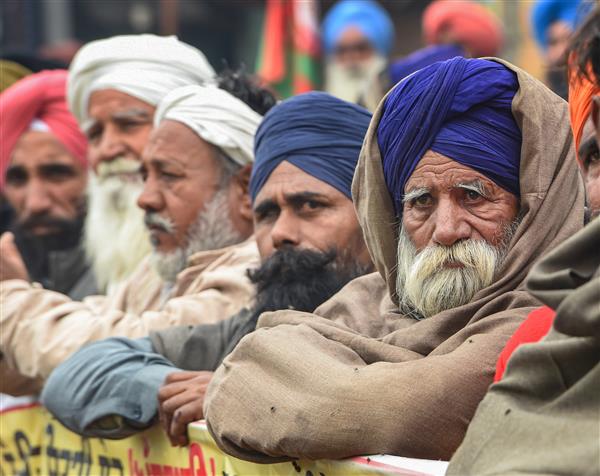
Even as the Punjab Government has started testing software for making direct payment to farmers, it remains firm on its stand that the arhtiya system should continue.
Tribune News Service
Chandigarh, April 6
Even as the Punjab Government has started testing software for making direct payment to farmers, it remains firm on its stand that the arhtiya system should continue.
Agents threaten stir
If the Punjab Government switched to the DBT system, the arhtiyas will go on strike. — Vijay Kalra, Punjab Arhtiya ASSN Chief
The government is expected to procure nearly 130 lakh metric tonnes of wheat this season starting Saturday.
Sources said a virtual meet was held between Union Food Minister Piyush Goyal and Punjab Food and Civil Supplies Minister Bharat Bhushan Ashu today, but it remained inconclusive.
Goyal reportedly told Ashu that Punjab was the only state that was not making direct payment to farmers and the law could not be changed for one state. The sources say the Centre could defer the demand for uploading land records on the portal, but is unlikely to give more time to implement the DBT system.
Ashu maintained it was best to stick to the arhtiya system. On testing software to make direct payment to farmers, Ashu said they had to be ready with plan B.
Another meeting between the two sides is scheduled for Thursday in Delhi.






























