



Sanjha Morcha

What’s New

Click the heading to open detailed news

Current Events :

web counter

Print Media Reproduced Defence Related News

WHY IS THE US NAVY IN INDIA’S BACKYARD?

US and Indian Navy ships during the Malabar exercise in 2020
by Sandeep Unnithan
The US Navy’s Seventh Fleet conducted what it calls a Freedom of Navigation Operations (FONOPs) drill through India’s Exclusive Economic Zone (EEZ) on April 7. A strong and unusually worded release from the US Seventh Fleet headquartered in Yokosuka, Japan, said that the destroyer USS John Paul Jones asserted ‘navigational rights and freedoms approximately 130 nautical miles west of the Lakshadweep Islands, inside India’s EEZ or continental shelf’ without requiring India’s prior consent, consistent with international law. (The EEZ is a 200 nautical mile belt of oceanic territory around a costal state.)
India’s demand for prior consent for military exercises or manoeuvres in its EEZ was a claim inconsistent with international law, the release said. The ministry of external affairs (MEA) response on April 9, two days after the US statement, said it had ‘conveyed its concerns regarding this passage through our EEZ to the government of the USA through diplomatic channels’. The MEA said that the government of India’s stated position on the UNCLOS (United Nations Convention for the Law of the Sea) is that ‘the Convention does not authorise other States to carry out in the Exclusive Economic Zone and on the continental shelf military exercises or manoeuvres, in particular those involving explosives, without the consent of the coastal state. The warship was ‘continuously monitored transiting from the Persian Gulf towards the Malacca Straits’.
The US has used FONOPs over the past four decades as a way of asserting its right to sail through the EEZ of several coastal countries. It is the explicitly worded statement issued by the Seventh Fleet that has caused dismay in New Delhi. “To issue a press release is a change in approach and obviously a deliberate move,” says Lt General D.S. Hooda (Retd), former Northern Army Commander. It is this change that India will likely have to figure out in the days ahead. Could it be, for instance, a way of telling the Chinese that FONOPs are not China-specific but a principle that the US follows across the world, even with strategic partners.

While attention has been focused on the FONOPs that the US has used to challenge China’s expansive territorial claims in the South China Sea, what has gone unnoticed is a deliberate US policy to simultaneously conduct operational assertions through the EEZ of even close allies like Australia, Japan and South Korea. A study of the annual statements between 1992 and 2021 placed before the US Senate by the Department of Defence reveals only 10 occasions over the last 30 years that the US has not conducted ‘operational assertions’ through India’s EEZ. In the last such drill, in 2019, India was among 21 other countries, including Taiwan, through whose territorial waters the US sailed its warships.
The US Department of Defence identifies “excessive maritime claims” by coastal countries to unlawfully restrict the freedom of navigation and overflight and other lawful uses of the sea as reasons for its FONOP drills. UNCLOS, which came into effect in 1994, recognises the rights of coastal nations to exploit the resources of a 200 nautical mile belt of coastline outside their territorial waters. The US is yet to ratify it as 168 other countries have, because of Section XI of UNCLOS which governs the mining of deep seabed resources. In 2010, India had petitioned the UNCLOS, asking for its EEZ to be extended from 200 nautical miles to 350 nautical miles, which would greatly increase the area for the exploitation of natural resources. This proposal has yet to be accepted.
Interestingly, the USS John Paul Jones, which left the Persian Gulf, also carried out a FONOP drill through the territorial waters of the Maldives. The US issued a similar statement on the FONOPs through the Maldivian EEZ. The US and the Maldives signed their first framework agreement last September. The agreement was signed by the deputy assistant secretary of defence for South Asia. Earlier, in 2012, the US had proposed a Status of Forces Agreement, or SOFA, with the Maldives. The SOFA was a precursor to the US stationing its forces on Maldivian soil. New Delhi was then not in favour of the agreement and it died a quiet death but is believed to now favour closer ties between the US and Maldives to checkmate China’s growing presence in the Indian Ocean region.
“The irony is that the Chinese, who are signatories to UNCLOS, violate it all the time and the Americans, who have signed it but never ratified it, expect everyone else to stick to it,” says Rear Admiral Sudarshan Shrikhande, former ACNS Foreign Cooperation and Naval Intelligence.

AFTER FRESH ALLEGATIONS ON RAFALE DEAL, WHAT NEXT FOR INDIA’S DEFENCE PROCUREMENTS?

The future of defence procurements will be certainly marred by the infamous Rafale deal, particularly the fate of 114 fighter jets for which request for proposal was already floated a few years back
Two issues struck me when I read a three-part investigative series put out by a French news website, particularly the last part, which allegedly exposes the role of an agent in the Rafale deal.
The first is the question of what should be done now. The Defence Procurement Procedure (DPP) 2013, under which the deal was concluded, mandates that “all actions regarding procurement of any equipment are totally transparent and carried out as per established procedures” and makes it incumbent for the supplier “to accept our standard clauses regarding agents/agency commission, penalty for use of undue influence and Integrity Pact, access to books of accounts, arbitration and laws which would be incorporated in the contract.”
However, this wasn’t the case in the Rafale deal as per widespread revelations. This was expressly precluded by the last-minute removal of the anti-corruption prescriptions in the DPP 2013.
The second issue that arises is the long shadow that this present deal will likely cast on future defence procurement. The acquisition of 114 Medium Multi-role Combat Aircraft (MMRCAs) – for which the Request for Proposal (RFP) was floated a few years ago by the Indian Air Force (IAF) – is presently on the anvil.
Probe And Penalties?
When it comes to the question of what action should be taken in light of the Mediapart revelations, the answer is not very clear. If agents are found to have been indeed engaged by Dassault to clinch the deal after proper investigations (the company staunchly denies all allegations), what punitive action can be taken by the Indian government in the wake of the deletion of the anti-corruption clauses?
Can the Centre outright invoke the provisions of para 23.1 of the DPP, 2013? This para states that:
“The SELLER will also be debarred from entering into any supply Contract with the Government of India for a minimum period of five years. The BUYER will also have a right to consider cancellation of the Contract either wholly or in part, without any entitlement or compensation to the SELLER who shall in such event be liable to refund all payments made by the BUYER in terms of the Contract along with interest at the rate of 2% per annum above LIBOR rate for foreign vendors and Base Rate of SBI for Indian vendors. The BUYER will also have the right to recover any such amount from any contracts concluded earlier with the Government of India.”
Or, can the Centre seek access to the book of accounts of Dassault as per para 35 of DPP, 2013 by leveraging the ‘letter of comfort’ provided by the French government? This is rather unlikely, especially when the anti-corruption clauses have been expunged from the ambit of the supply protocols signed by India with Dassault and MBDA.
That being so, neither can any action be taken against any of the four principal French companies involved in the Rafale deal (Dassault Aviation for design and manufacture; Thales for electronic equipment; Safran for jet engines; and MBDA for missile weaponry) nor can they be debarred from future acquisition projects.
This complicates an already uneven playing field because beyond the 36 Rafale aircraft, it will inevitably raise many gnawing questions for future buys. As I noted in February 2019:
“For one, will this Rafale deal not impact on future benchmark price determination of fighter jets among different vendors that includes Dassault Aviation? Will Dassault not willy-nilly get a head start over other vendors in overall assessment/evaluation of future fighter aircraft RFP(s)? How contractually ‘correct’ and moral will that be? Will it not endow on Dassault an advantage vis-à-vis other competing firms, especially on India specific enhancements (ISE) (or by any other technical specifications these are spelt out in the Request for Proposal (RFP)) that lately have been much in the news and are said to be the vital elements in pushing up the cost of the Rafale deal beyond the cost of bare-bone aircraft?”
The issue here relates to the 13 India Specific Enhancements, which senior journalist N. Ram flagged in his January 2019 story in The Hindu:
“It was the National Democratic Alliance government’s acceptance of the cost of €1.3 billion claimed for the ‘design and development’ of 13 India Specific Enhancements (ISE), and the distribution of this ‘non-recurring cost’ over 36 instead of 126 bare-bones aircraft, that was the major reason for the big increase in price.
Dassault claimed a €1.4 billion cost for the ‘design and development’ of 13 India Specific Enhancements, that is, additional capabilities in the form of hardware as well as software that had been specified by the Indian Air Force all along, and this cost was negotiated down to €1.3 billion. What it meant was that the design and development cost, now distributed over 36 Rafale fighter jets, shot up from €11.11 million per aircraft in 2007 to €36.11 million when the deal was struck in 2016. [Emphasis supplied]”
If one were to say that the amount paid towards “design and development” is indeed the fixed cost for development of the India Specific Enhancements (ISEs), it logically would mean one thing: that the amortisation cost absorbed in the 36 fly-away aircraft (which, as per the NDA government’s decision, ought to have been spread across the 126 MMRCAs), and which, with the number shrunk to 36 pushed up the procurement cost per MMRCA in the 2016 deal, would be offset by no additional outgo from India’s public fund to Dassault for the fresh lot of 114 MMRCAs with the ISEs.
But that, paradoxically, would also have meant that the earlier procurement, in a way, sowed the seeds for Dassault to bag future MMRCA contract(s) – a kind of subinfeudation in the international arms bazaar – by giving the company an unfair and uneven advantage, in an uneven and unlevelled field, and with no matching competitors to generate competition and economise spending and set the ball in motion for eventual price discovery and benchmarking.
Questions For The French
That, in short, was bad enough. But the Mediapart allegations seem to have upset Dassault’s, even India’s, apple cart by adding another dimension — the need to investigate the company’s alleged payment to the agent who just two years ago was arrested in India for his involvement in the VVIP chopper scam.
The logical question is this: what if Dassault is implicated in the case for illegally engaging an agent and practicing unholy business practices proscribed by the DPP 2013? Can the government of India, despite waiving the anti-corruption clause from the body of the Rafale contract, implicate the company and refuse to entertain their RFI?
And, on the contrary, if they do go ahead, how will that action go down in the global defence market? Either way, it seems we are in a bind. But one thing seems fairly clear: the future MMRCA purchase will be at a far higher price mark, and India’s long and vaunted history of murky defence deal shall stand more sullied than before. Like one lie forcing another lie and yet another leading to serial lies, one serious departure from the prescribed integrity pact will not only spawn many more of its kind but will make India pay dearly in terms of loss of face and in more haemorrhaging of taxpayer money.



U.S. INTELLIGENCE REPORT WARNS OF LARGE-SCALE WAR BETWEEN INDIA AND PAKISTAN

A report from the United States has claimed that nuclear-armed neighbours India and Pakistan might engage in a large-scale war unwittingly, even as they would like to avoid military hostility
The Global Trends report, released April 7 in Washington, noted: “India and Pakistan may stumble into a large-scale war neither side wants, especially following a terrorist attack that the Indian government judges to be significant.” The report is compiled by the U.S. government’s National Intelligence Council once every four years.
A similar report released by the Obama administration in 2017 had warned of a pandemic and a vast economic disruption as its fallout.
The report looks at the trigger for the potential war between India and Pakistan. It said the ability of some militant outfits to conduct attacks, New Delhi’s resolve to retaliate against Islamabad after such an attack and Islamabad’s determination to defend itself “are likely to persist and may increase” in the next five years.
It warned: “Miscalculation by both governments could prompt a breakdown in the deterrence that has restricted conflict to levels each side judges it can manage.”
The U.S. intel report also noted that such a war could translate into long-term economic fallout. It noted that “a full-scale war could inflict damage that would have economic and political consequences for years”.
The report further underlined that the U.S. policy in Afghanistan is likely to impact the neighbouring countries, especially India and Pakistan. “U.S. actions in Afghanistan during the next year will have significant consequences across the region, particularly in Pakistan and India,” it said.
This would be “especially true” if a security vacuum emerges in Afghanistan that results in a civil war between the Taliban and its Afghan opponents, expanding freedom of manoeuvre for regional militant networks, or criminals and refugees flow out of the country, it adds.
The report concluded that developments in Afghanistan would fuel political tensions and conflict in western Pakistan and sharpen the India-Pakistan rivalry.


INDIA-CHINA BORDER DISPUTE TALKS LASTED 13 HOURS; NO FORWARD MOVEMENT ON DISENGAGEMENT IN REMAINING FRICTION POINTS

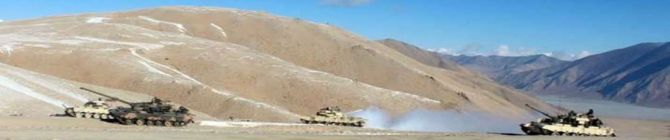
PLA armoured vehicles retreating from the Pangong-Sa area in Ladakh
The 11th round of the Corps Commander talks at Chushul took place after almost a two-month gap
There was no visible forward movement at the latest round of military talks between India and China for disengagement of troops at the remaining friction points of Hot Springs, Gogra and Depsang in eastern Ladakh as the Chinese side did not show flexibility in their approach on this issue, people familiar with the negotiations said on Saturday.
A day after the 11th round of talks that lasted for 13 hours, the Indian Army said in a statement that both sides held a detailed deliberation on disengagement in remaining areas and agreed to jointly maintain stability on the ground, avoid any new incidents and resolve the outstanding issues in an “expeditious manner”.
The people cited above said the Chinese delegation came to the talks with a “premeditated mindset” and did not show any flexibility in moving forward on the disengagement process at the remaining friction points.
The Indian Army statement said it was highlighted at the talks that completion of disengagement in other areas would pave the way for considering “de-escalation of forces” and ensure full restoration of peace and tranquillity in the region.
The Corps Commander-level talks took place at the Chushul border point on the Indian side of the Line of Actual Control (LAC) in eastern Ladakh. The parleys began at around 10:30 AM and ended at 11:30 PM.
The people cited above said the Indian delegation, led by Commander of the Leh-based 14 Corps Lt Gen PGK Menon, particularly insisted on resolving outstanding issues in Hot Springs, Gogra and Depsang.
“The two sides had a detailed exchange of views for the resolution of the remaining issues related to disengagement along the LAC in eastern Ladakh,” the Army said.
It was the second high-level military talks between the two sides after disengagement of troops in the Pangong lake areas in eastern Ladakh in February.
“The two sides agreed on the need to resolve the outstanding issues in an expeditious manner in accordance with the existing agreements and protocols,” the statement said.
In this context, the Army said it was also highlighted that completion of disengagement in other areas would pave the way for the two sides to consider de-escalation of forces and ensure full restoration of peace and tranquillity and enable progress in bilateral relations.
“The two sides agreed that it was important to take guidance from the consensus of their leaders, continue their communication and dialogue and work towards a mutually acceptable resolution of the remaining issues at the earliest,” it added.
“They also agreed to jointly maintain stability on the ground, avoid any new incidents and jointly maintain peace in the border areas,” the statement said.
The border standoff between the armies of India and China erupted on May 5 last following a violent clash in the Pangong lake areas and both sides gradually enhanced their deployment by rushing in tens of thousands of soldiers as well as heavy weaponry.
As a result of a series of military and diplomatic talks, the two sides completed withdrawal of troops and weapons from the North and South banks of Pangong lake in February in line with an agreement on disengagement. India has been insisting that a resolution of outstanding issues including in Depsang, Hot Springs and Gogra is essential for overall ties between the two countries.
Late last month, Army chief General MM Naravane said the threat to India has only “abated” following the disengagement in the Pangong lake areas, but it has not gone away altogether.


Corps Commander talks ends after 13 hours, India and China discuss further disengagement

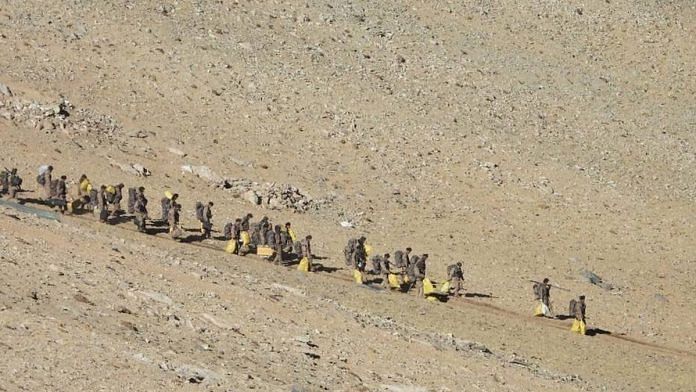
Chinese PLA troops march back from the Pangong Tso area in eastern Ladakh | Photo released by Indian Army

Chinese PLA troops march back from the Pangong Tso area in eastern Ladakh | File image| Photo released by Indian ArmyText Size: A- A+

New Delhi: After having successfully disengaged with China in the Pangong lake area, India and China held the 11th round of Corps Commander-level talks in Ladakh on Friday where disengagement from remaining friction points including Gogra heights, Hot Springs and Depsang Plains was discussed, Army sources said.

According to sources, the meeting lasted for around 13 hours on Friday and concluded at 11:30 pm. The two countries have been engaged in a military standoff for almost a year but disengaged from the most contentious Pangong lake area last month after extensive talks at both military and political levels.

The credit for the disengagement was given to all stakeholders by Army Chief General Manoj Mukund Naravane who also talked about the country benefitting from the inputs given by the National Security Advisor Ajit Doval during the crisis.

Earlier, India and China held 10 round of talks at the Corps Commander level to reach the arrangement to disengage from the Pangong lake area.


Also read: US Navy ship violates Indian law as it sails through exclusive zone in ‘messaging to China’


Marine Maha Virs in eastern sector

Inspirational Commander Mohan NR Samant, Lt Commander Joseph PA Noronha and Leading Seaman Chiman Singh Yadav

Marine Maha Virs in eastern sector

Lt Col Dilbag Singh Dabas (Retd)

As a student, Chiman Singh Yadav was passionate about swimming and diving in the village pond. In 1961, he accompanied a group of students to watch the Republic Day Parade in Delhi. There he saw for the first time a tableau of a ship, with young men atop attired in immaculate whites performing mock drills on diving from the deck. Fascinated, he needed no counselling on what career to choose.

Son of Rao Nand Kishore Yadav, Chiman was born at Gokalgarh village in Gurgaon district of then undivided Punjab on June 1, 1945. Gokalgarh, incidentally, was one of the villages in the water-starved south-west Haryana called Ahirwal. Some of the villages though had small ponds to fetch water from when the wells went dry.

After matriculation from BS Ahir High School, Rewari, and at just about 16, Chiman joined the Navy as a sailor through the Boys Entry on June 8, 1961. Within seven years, Chiman, as Leading Seaman, was a Clearance Diver Class 2 and underwater bomb disposal specialist at the Naval Diving School, Cochin. He also specialised in the use of limpet mines against enemy warships and submarines.

In 1965, consequent to Pakistan Navy’s unsuccessful raid on Dwarka’s front waters, the Indian Navy wanted to retaliate, and in a big way, but was kept on leash, possibly based on strategic thought to restrict the scope of the war. But six years later, the maritime sword arm of the Indian military could no longer be kept on leash. It was widely believed that domination over Arabian Sea could prove to be the game-changer.

During the war with Pakistan in 1971, Operation Trident, the Indian maritime offensive by its Western Naval Command, did change the game by not only blasting the Karachi harbour but also effectively denying West Pakistan war efforts from reaching its eastern half, thereby contributing a lot to the Indian victory during the 14-day war.

Before the outbreak of the war in December, Chiman Singh, now a Leading Seaman (LS-2), not only trained the Mukti Bahini guerrillas in covert sea-borne operations, but himself led many successful operations deep inside East Pakistan waters.

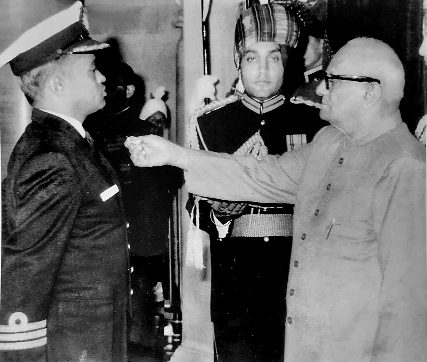
During the 1971 war in the eastern theatre codenamed Operation Cactus Lily, Leading Seaman Chiman Singh, for his conspicuous bravery, unparalleled camaraderie and strong determination in the face of the enemy far superior in number and strength, was awarded the Maha Vir Chakra. The write-up on his gallantry decoration reads:

During Operation Cactus Lily, Leading Seaman Chiman Singh was part of the crew of a small naval vessel entrusted with the task of attacking enemy targets in Khulna, Mongla and Chalna bays in East Pakistan. On December, 11, 1971, while on the mission, the vessel was subjected to enemy air attack while operating off Khulna and was sunk. Leading Seaman Chiman Singh was thrown overboard and seriously injured by shrapnel. Simultaneously, the enemy shore defences opened fire at the survivors in water.

Chiman Singh noticed that the survivors, including an injured officer, were finding it difficult to keep afloat. Despite himself being seriously injured, unmindful of his own safety against enemy automatic fire, he rescued and brought all the survivors to the shore. On reaching the shore, not bothering about his own injured condition, Chiman, to make it possible for his two colleagues from being captured, charged at the enemy, exposing himself to the hostile fire.

Leading Seaman Chiman Singh was eventually overpowered and taken prisoner by the enemy. He, however, was released upon the liberation of Bangladesh. His valiant action behind the enemy lines and in the face of perceivably insurmountable opposition was an embodiment of the Indian Navy’s core values of duty, honour and courage and the diving cadre’s ethos of strong will to succeed and surmount all odds.

For his conspicuous act of bravery and display of utmost courage and determination in the face of the enemy, Leading Seaman Chiman Singh Yadav was awarded the Maha Vir Chakra.

Chiman Singh Yadav was also awarded the ‘Friends of Liberation War’ Honour by the Bangladesh President in 2013. Incidentally, his name figures prominently on the list of invitees by Bangladesh in its yearly celebrations on December 16 every year.

Even after retirement, Chiman Singh continues to live up to his one-liner — once a diver, always a diver, and is a visiting faculty at INS Venduruthy (Naval Diving School, Cochin), a premier training establishment that trains commandos not only from the Indian Tri-Services but also from friendly countries. He is also often invited to attend seminars on updating of the Standard Operating Procedures regarding use of limpet mines.

Petty Officer Chiman Singh Yadav, the living legend, incidentally, is the only sea warrior below Officers rank in the Indian Navy to have been conferred the Maha Vir Chakra, the second highest gallantry decoration.

For the naval operations between December 8 and 11, 1971, against targets on shore at Khulna, Mongla and Chalna bays in south-west East Pakistan, emerged not just one Maha Vir, but three; the other two being Commander Mohan Narayan Rao Samant and Lieutenant Commander Joseph Pius Alfred Noronha.

Samant, the eldest of five children of Subedar Major Narayan Ramchandra Samant, hailed from Parule village in Sindhudurg district along the Konkan coast in Bombay state. He studied in schools wherever his father was posted, mainly at Peshawar, Chaklala and Meerut.

After Intermediate (Science) from Wilson College, Bombay, Samant joined the Royal Indian Navy and was shipped to the United Kingdom for four years’ training at the Royal Navy College, Dartmouth. After his fifth year as a midshipman, Samant returned in 1953 as Sub-Lieutenant (Navigator) along with the last batch of Indian executive officers commissioned in the UK.

During the sea-borne operation deep inside the enemy’s backwaters in the eastern theatre, Samant, now a Commander, headed the task force of three boats armed to the teeth — INS Palash, INS Padma and INS Panvel, which not only neutralised the shore defences but also blasted and set ablaze the oil installation in Khulna, the second biggest in East Pakistan.

For not just commanding but also leading the task force from the front, Commander Samant, for his conspicuous bravery, was awarded the Maha Vir Chakra.

Lieutenant Commander Noronha, Alfred to his friends, son of Joseph C Noronha, a postmaster from Mysore, never wanted to follow in his father’s footsteps, and was a man in search of an elusive destiny. Good at academics, he topped the UPSC entrance and joined Joint Services Wing (present-day National Defence Academy) in 1955 and was commissioned in the Indian Navy in October 1959.

Lieutenant Commander Noronha, commanding INS Panvel, was part of the task force under Commander Samant which attacked Mongla, Chalna and Khulna bays. His ship was subjected to incessant air attacks and enemy fire from shore defences. Lieutenant Commander Noronha, with total disregard to personal safety, handled his ship in the most competent and fearless manner in very restricted waters and effectively engaged enemy shore defences.

For his conspicuous gallantry in silencing the enemy’s shore defences and causing extensive damage to vital enemy installations, Lieutenant Commander Noronha was awarded the Maha Vir Chakra.


Army pays tributes to soldier shot dead by militants in Anantnag

Army pays tributes to soldier shot dead by militants in Anantnag

Photo for representation only. Source: iStock.

Srinagar, April 10

The Army on Saturday paid floral tributes to Havildar Mohammad Saleem Akhoon who was shot dead by militants in Anantnag district of Jammu and Kashmir.

In a solemn ceremony at Badamibagh Cantonment, Chinar Corps Commander, Lt Gen D P Pandey and all ranks paid homage to the gallant soldier on behalf of the proud nation, an Army spokesman said.

He said Akhoon was on leave in his native village and unarmed when he was attacked by militants on Friday.

The injured soldier was immediately evacuated to District Hospital Janglat Mandi, Anantnag, but the doctors there declared him bought dead.

Akhoon (43) had joined the Territorial Army in 2004 and belonged to Bijbehara village of Bijbehara tehsil in Anantnag district of south Kashmir.

Akhoon is survived by his wife, a daughter and a son.

“The mortal remains of Akhoon were taken for last rites to his native place, where he would be laid to rest with full military honours. In this hour of grief, the Army stands in solidarity with the bereaved family and remains committed to their dignity and wellbeing,” the spokesman said. — PTI 


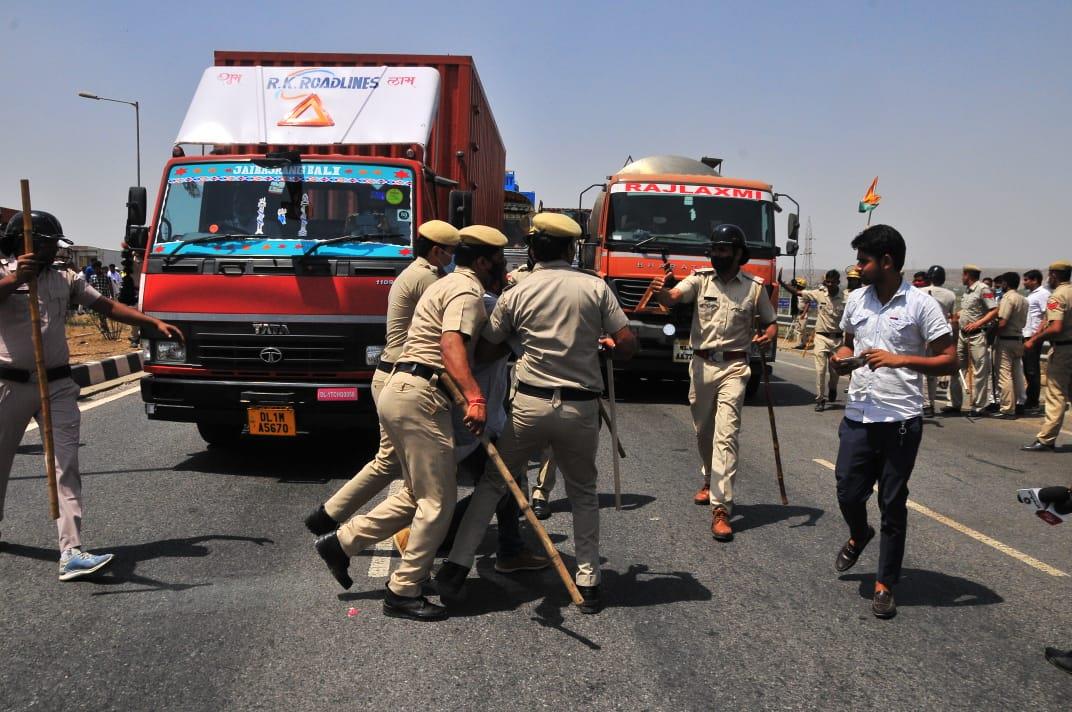
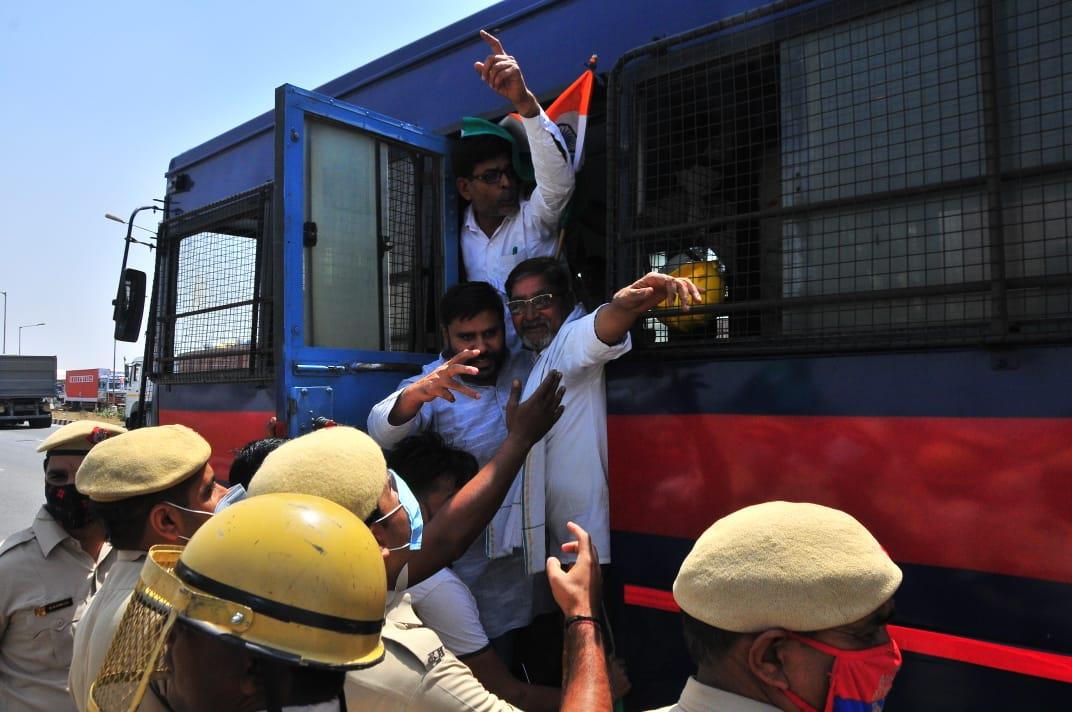
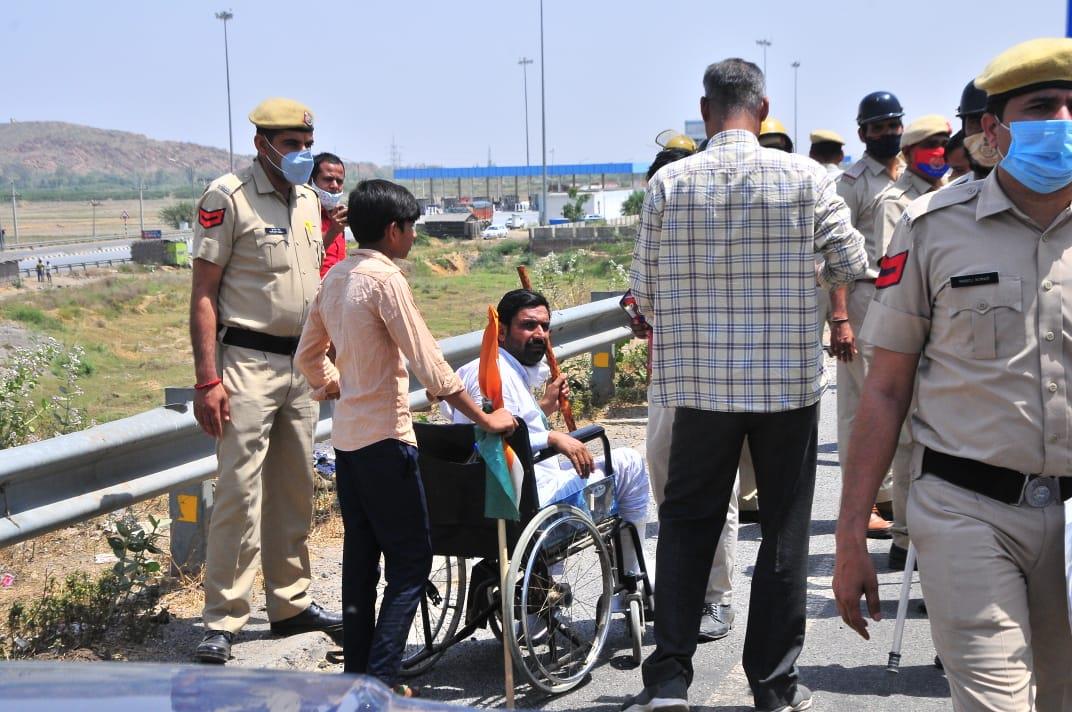
In pictures, cops forcibly remove protesters at Tewasan toll plaza to clear KMP expressway in Haryana

Tribune Web Desk
Chandigarh, April 10

The Haryana Police detained several farm union leaders and supporters on Saturday as the protesters blocked the Kundli-Mewat-Palwal (KMP) Expressway as part of their ongoing protest against the central agri laws.https://www.youtube.com/embed/dM7vTqDTscQ

Tribune photo: S.Chandan

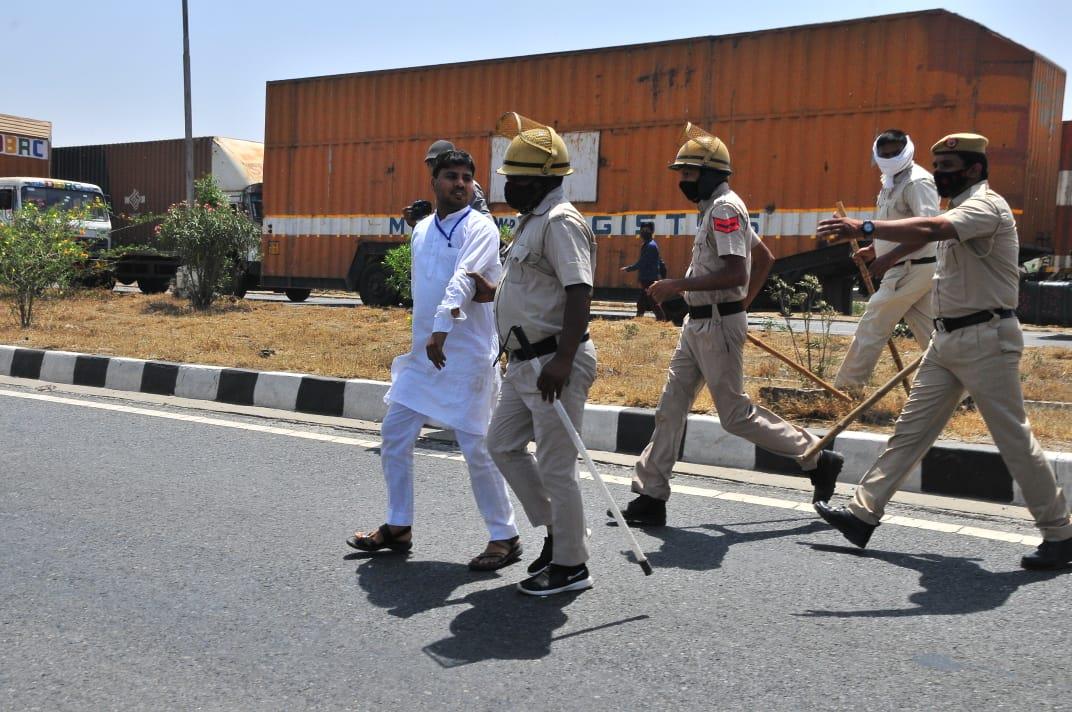
The police were seen forcibly removing the activists at Rewasan toll plaza to clear the way for motorists.

Tribune photo: S.Chandan

Farmers blocked the Kundli–Manesar–Palwal expressway at some places in Haryana early on Saturday.

Also read: Farmers block KMP expressway at three points in Jhajjar

The blockade started at 8 am and would last 24 hours.

Tribune photo: S.Chandan

The Samyukta Kisan Morcha, an umbrella body of protesting farmer unions spearheading the agitation against the agriculture-related legislations, on Friday gave a call for a 24-hour blockade of the KMP expressway.

Tribune photo: S.Chandan

A long traffic jam was witnessed on both sides the KMP.


Farmers’ protest hits Sonepat hard; Nuh normal

Farmers’ protest hits Sonepat hard; Nuh normal

Farmers block the KMP expressway near Mandothi village in Jhajjar district on Saturday and protesters camp at the Rewasan toll plaza in Nuh. Sumit Tharan & S Chandan

Tribune News Service

Sonepat, April 10

Intensifying their stir against the Centre’s three contentious agricultural laws, farmers today blocked the 136-km Kundli-Manesar-Palwal (KMP) and Kundli-Ghaziabad-Palwal (KGP) expressways.

The call for a 24-hour blockade was given by the Samyukt Kisan Morcha (SKM), an umbrella body of farmer unions spearheading the agitation. The blockade started at 8 am and will last 24 hours till Sunday morning.

Farmers, including women, carried flags of their organisations and raised slogans against the government. They squatted on the expressways while slamming the Centre for not repealing the farm laws.

As per the scheduled programme, hundreds of farmers gathered at the KMP and KGP zero point and then proceeded towards a toll plaza on the KMP e-way near Nahra-Nahri village where they staged a protest.

Farmer leaders Dr Darshan Pal, Jagjeet Singh Dallewal, Balbir Singh Rajewal, Surjeet Singh Phul, Harinder Singh Lakhowal and Baldev Singh Sirsa were also present at the toll plaza. They addressed farmers, appealing to them to maintain peace during the protest.

They also said the today’s blockade was a warning to the Centre.

Because of the road blockade, long queues of vehicles, especially commercial four-wheelers, were seen in Sonepat.

However, the SKM’s call for blockade did not evoke much response at Nuh, Manesar and Farukhnagar.

The blockade was scheduled to continue till 8 a.m. on Sunday. However, the Gurugram police had diverted traffic near Panchgaon and Farukhnagar and advised commuters to avoid travelling on the super expressway.

Suchha Singh of Phillaur said, “We have been camping at the Delhi Borders for the past four months, but the Centre did not pay heed to our demands.”

In Jhajjar, farmers blocked the KMP expressway at three points near Aasoda, Mandothi and Badli villages

Bharatiya Kisan Union (Ekta) president Joginder Singh Ugrahan said, “It is a long battle, not against the Modi government but against the corporate sector. Farmers are ready for a long haul. They will continue their dharna until the three farm laws are repealed.”


Probe fair, will challenge High Court decision in apex court: Capt Amarinder Singh

SAD politicising sensitive issue, says CM

Probe fair, will challenge High Court decision in apex court: Capt Amarinder Singh

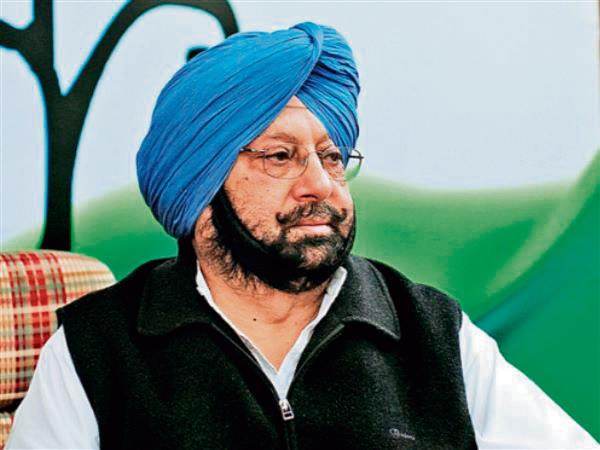
Punjab Chief Minister Captain Amarinder Singh. File photo

Tribune News Service

Chandigarh, April 10

Terming the probe into the Kotkapura firing case as totally fair, impartial and unbiased, Chief Minister Capt Amarinder Singh on Saturday said his government will challenge the orders of the High Court for quashing the investigation of the Punjab Police SIT or removing its chief in the Supreme Court.

Reacting to media reports in this regard, the Chief Minister said he has directed the state government’s legal team in the case to examine the orders of the Punjab and Haryana High Court as soon as the copy is received, and prepare to challenge the same in the apex court if either the SIT probe is directed to be scrapped or its leader is asked to be removed.

He said he had full faith in the state’s legal team, headed by Siddharth Luthra, Senior Advocate from Delhi, who appeared for the state in the case before the High Court.

Won’t spare guilty, will ensure justice

The Kotkapura firing case will be taken to its logical conclusion and nobody who is guilty will be spared, irrespective of his political affiliation or position, Chief Minister Capt Amarinder Singh said, declaring his commitment to fulfilling every single poll promise of his government, including ensuring the much-awaited justice for the families of the victims of the firing case.

The case will be taken to its logical conclusion and nobody who is guilty will be spared, irrespective of their political affiliation or position, said the Chief Minister, declaring his commitment to fulfilling every single poll promise of his government, including ensuring the much-awaited justice for the families of the victims of the firing case.

Expressing full confidence in SIT chief Kunwar Vijay Partap Singh, and the probe conducted so far under his supervision, the Chief Minister said he was an extremely competent and experienced officer who had been working relentlessly on the case since the SIT was constituted. The inquiry is being conducted in a completely fair and unprejudiced manner by the SIT under the leadership of Kunwar Vijay Pratap Singh, he said, adding that neither changing the officer nor setting up a fresh SIT at this stage was acceptable to his government. He pointed out that the investigations were in an advanced stage, with four challans already filed against persons in the 2015 case that followed the Bargari sacrilege incident, with final reports submitted to the sessions court for trial.

The Chief Minister also slammed SAD president Sukhbir Badal for continuing to play “dirty politics” over such a grave and sensitive issue.