The Haryana government today stopped the purchase of wheat in 18 mandis of the state for 24 hours due to the excess arrival of wheat in the mandis. The state government has urged the farmers to bring their crops to their respective procurement centres only after receiving the SMS for bringing their crops in the mandis.
Farmers’ protest: Reach Delhi borders for Ambedkar anniversary, appeals SKM
The Samyukt Kisan Morcha (SKM) today appealed to Dalits to reach the Delhi borders in large numbers to celebrate the Save Constitution Day and Kisan-Bahujan Ekta Diwas on April 14 on the occasion of BR Ambedkar’s birth anniversary. Dr Darshan Pal Singh, a member of the SKM, said: “Representatives of the Bahujan Samaj will be reaching Singhu, Tikri, Ghazipur and other borders on April 14 to support farmers.”
“Ambedkar is the architect of our Constitution, which the Modi government is hell bent on amending it,” he said.
Meanwhile, farmer leaders met protesters in their trolleys, camps and huts to boost their morale and urge them to stay at the morcha until the Centre repealed the three controversial farm laws.
Some farmers shared their problems related to sanitation at the protest sites and scarcity of water. The leaders assured them to resolve their problems. — TNS
No nation is more important than India as US seeks to counter China, states think tank report
A leading think tank for science and technology policy has said as Washington seeks to counter a rising China, no nation is more important than India with its abundance of highly skilled technical professionals and strong political and cultural ties with the United States.
It however cautioned that “overreliance” on India as an IT services provider could become a strategic problem if major disagreements emerge between the two nations on issues such as intellectual property, data governance, tariffs, taxation, local content requirements or individual privacy.
The Information Technology and Innovation Foundation (ITIF) think-tank in a report released on Monday describes the worst and best-case scenarios.
In one, tensions between India and China are reduced and the many business synergies between these two neighbouring nations come to the fore. In this case, the heart of the global economy would shift to the east, and there would be little the United States could do about it, the report stated.
In the second scenario, the interests of India and the United States become increasingly aligned, as the economic, military, and international relations challenges from China grow. In such a case, democratic norms could prevail across most of the developed world, as developing nations start looking to a ‘Delhi model’ instead of a ‘Beijing model’, it stated.
“As America seeks to counter a rising China, no nation is more important than India, with its vast size, an abundance of highly skilled technical professionals, and strong political and cultural ties with the United States.
“But the parallels between America’s dependency on China for manufacturing and its dependency on India for IT services are striking,” said the think-tank.
According to David Moschella, a non-resident senior fellow at ITIF and co-author of the report, the same forces that increasingly divide the United States and China are now pushing the US and India closer together.
“The interplay between the United States, India, and China will shape global competition and digital innovation for years to come. While there is a wide range of possible scenarios, two things are clear: India should be an essential part of US efforts to compete with and reduce its dependence on China, and this will inevitably expand America’s global dependencies from manufacturing to services,” he said.
“America’s technology dependencies on India in the 2020s seem certain to rise. Yet it is important to know whether the United States will be dependent on a strategic partner with strong mutual interests, or an increasingly neutral rival,” said ITIF President Robert D. Atkinson, who co-authored the report with Moschella.
Much will depend on the strategic choices that the Joe Biden administration and Indian government make in the next several years. One thing is clear that economic and geopolitical stakes could not be higher, he said.
Web talk on strategic importance of Indo-Pacific region conducted by Central University of Jammu
A web talk on “Indo Pacific: A Construct in Offing” was organised by the Department of National Security Studies, Central University of Jammu, today.
Highlighting the strategic significance of the Indo-Pacific region Prof Rakesh Datta from the Department of Defence and National Security Studies, Panjab University, Chandigarh, said that the geopolitical construct of the ‘Indo-Pacific’ region is not only related to the foreign policy strategies of major powers but also has serious implications for a rising power like India.
Stating that there was a need of maintaining balance of power by containing China in the Indo-Pacific through India’s rise in the region, he added that this region is becoming the most attractive destination for foreign direct investment, trade and business
Prof Datta stressed that there was a desperate need for cooperation in areas such as defence, information sharing, counter-terrorism and peacekeeping and in the given scenario, where the common threads of geopolitics, geoeconomics and geostrategy are closely intermeshed across the Indian and Pacific oceans, this new conceptualization needs to be accorded deeper consideration.
In his presidential remarks, Vice Chancellor of Jammu Central University, Prof Ashok Aima, shared Chinese discernibility in trapping countries through debt diplomacy and was equivocal about bursting of Chinese bubble in the near future with the rise of market forces.
Prof Rasal Singh, head of the department at Jammu University gave his initial remarks on the relevant theme and highlighted the changing role of India internationally and how India is seen as a global partner by major powers at present.
Large convoy of farmers from Punjab to march towards Delhi on April 21: Ugrahan
Farmers organise ‘Kisan Conference’ at Talwandi Sabo on Baisakhi
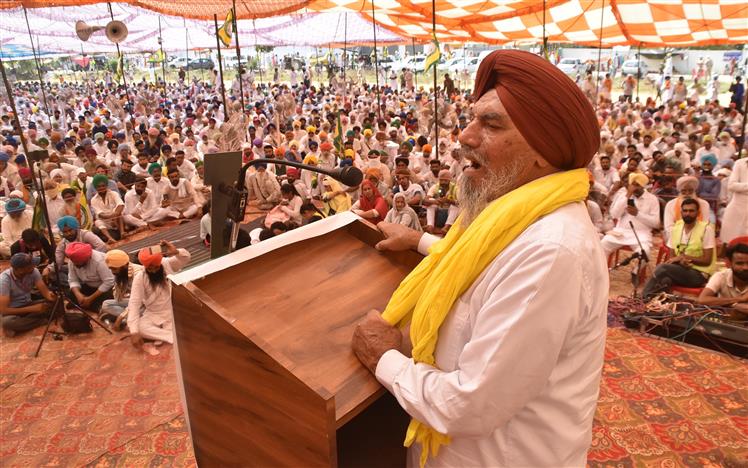
BKU leader Joginder Singh Ugrahan addresses gathering during farmers’ conference on Baisakhi at Talwandi Sabo on Tuesday. Tribune photo: Pawan Sharma
Sukhmeet Bhasin
Tribune News Service
Talwandi Sabo, April 13
For the first time, farmers organised a “Kisan Conference” on the occasion of Baisakhi at Talwandi Sabo.
BKU Ekta-Ugrahan president Joginder Singh Ugrahan announced that he would continue his struggle for the rollback of ‘black’ agricultural laws introduced by the Narendra Modi government and “complete liberation from the imperialist plunder of the agricultural sector”.
He also announced that on April 21 a large convoy of thousands of farmers, youth and women from all over the state would again march towards Delhi under the leadership of union general secretary Sukhdev Singh Kokri Kalan and Jhanda Singh Jethuke.
He paid homage to the martyrs of Jallianwala Bagh. He said Modi government was acting like a puppet of domestic and foreign corporate houses. He said BJP government is trying to divide our farmers struggle on communal lines and establishing it only as a Sikh
struggle. The plans of the BJP also need to be defeated, he added.
He said Khalsa Panth was formed by Guru Gobind Singh to unite all the working peasants by abolishing the caste system to eradicate looting and oppression. He announced that a massive and forfeited march would be held towards Parliament in May to further the current struggle.
Another Sanyukt Kisan Morcha leader Balbir Singh Rajewal said that the farmers’ struggle which started from Punjab has turned into a mass struggle of the farmers of the entire country which is getting support from all sections of the people.
He said this historic peasant struggle had exposed the anti-people nature of the political parties. He said this struggle was between the people and the corporate houses of the country and abroad. Rajwal claimed that the Modi government had lost badly at the negotiating table.
Farmers leader Ruldu Singh Mansa, state president of Punjab Khet Mazdoor Union Zora Singh Nasrali, Kiranjit Singh Sekhon, DTF leader Resham Singh and employees leader Megh Singh Sidhu also addressed the gathering
Chhattisgarh Armed Force officer commits suicide in Bastar
A 59-year-old Chhattisgarh Armed Force (CAF) officer allegedly committed suicide by shooting himself with his service weapon in Bastar district on Tuesday, police said.
Kuber Singh, company commander of CAF’s 19th ‘Pokhran’ battalion, shot himself with his Insas rifle this evening at his unit’s camp in Karanpur village under Nagarnar police station limits, a senior official here said.
“When his colleagues heard the gunshot from his barrack, they rushed there and found him lying in a pool of blood. Singh was declared dead on arrival by doctors. Why he took this step is being probed,” he said.
He was a native of Chhatarpur in Madhya Pradesh but his family was currently staying in Bhilai in Chhattisgarh’s Durg district, the official said. PTI
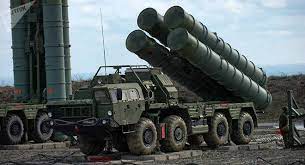
A top Republican Senator has urged the Biden administration to give CAATSA waiver to India, saying any plan to impose sanctions on New Delhi for buying Russian S-400 missile defence system would undermine its relationship with the US and also affect the QUAD’s ability to counter China. Countering America’s Adversaries Through Sanctions Act or CAATSA is a tough US law which authorises the administration to impose sanctions on countries that purchase major defence hardware from Russia.
Senator Todd Young, a key member of the powerful Senate Foreign Relations Committee, wrote in the Foreign Policy magazine that if the Biden administration imposed sanctions on India, it would not deter New Delhi’s purchase of the S-400 missile system from Russia, but would weaken two strategic fronts at a critical time — undermine Washington’s relationship with India. — PTI
What then are India’s options to protect its broader strategic interests, namely, keep the Chinese at bay. (Photo: AP)
MANISH TEWARI Manish Tewari is a lawyer and a former Union minister. Present MP from Anadpur Sahib(Pb) The views expressed are personal. Twitter handle @manishtewari
The persisting stand-off with China must make India rethink its relationship structures both in the Asian and global context. How is India geo-strategically placed currently? On its northern borders it confronts an aggressive China. On its western borders it is currently in a state of a partial thaw qua Pakistan. A melt that can again go back to a state of deep freeze at any point of time. On the east the strains with regard to the economic blockade of Nepal in 2015 still continue to linger. Bhutan is caught in the Sino-Indian cleft stick. Bangladesh, though reaffirming the centrality of India to its external environment, is both conscious of and eager to leverage the rise of China. Myanmar is in the throes of violent convulsions following a military coup d’état on February 1, 2021, that is having reverberations across the Indo-Burmese border as well.
Down south, the Rajapaksa administration in Sri Lanka still continues to bend to the Chinese wind. Relations with Maldives have definitely improved after Ibrahim Mohamed Solih ascended to office in September 2018. His predecessor President Abdulla Yameen foreign policy was most eloquently summed up by current Maldivian foreign minister Abdulla Shahid in the following sentence, “The mistake President Yameen made was to play India against China and China against India. That is a childish way of dealing with international relations; it will blow up in your own face.” However, Maldives’ debt to China that ranges from 1 to 3 billion USD should worry India, too, for Maldives’ GDP is only 5.46 billion USD in 2021. Things could easily go the Hambantota way. On balance it does not seem to be a very happy situation for India overall.
However, it is the reinvigorated “great game” in Afghanistan that could once again have a profound impact on the future of the region. As the Americans desperately attempt to sever the two-decade-old umbilical chord in Afghanistan, a deep void may open up in that country once more. Pakistan, Iran, Turkey China and Russia view this vacuum from their own strategic perch. India should also seriously evaluate what its hard strategic interests are in Afghanistan and then proceed accordingly.
Further west, the Saudi Arabia-UAE-Israel triangle is not going to have a free run of the Middle East and Gulf region as it did under the Trump Administration. President Joe Biden is seeking to pick up the threads of the Donald Trump aborted Joint Comprehensive Plan of Action (JCPOA) colloquially referred to as the Iran Nuclear deal once again in Vienna through the E3+2 process
The JCPOA signed on July 14, 2015, was further endorsed by the UN Security vide Council Resolution 2231, adopted on July 20, 2015. President Trump unilaterally walked out of this arrangement on the 8th of May 2018 and reinstated sanctions against Iran.
The irony is that none of the Second Nuclear Age powers are party to the current process as they were not to the previous one either.
For India, the Iran situation is further compounded by the epic 25-year Sino-Iranian Strategic Partnership agreement signed on the 27th of March 2021 that envisages a range of investments by China into Iran in fields ranging from oil to agriculture. Interestingly, Iran metaphorically booted India out of the Chabahar-Zahedan railway link in the July of 2020, citing a lack of interest by the Indian side. If the Iran nuclear deal gets reinstated it would further expand Iranian influence in the Middle East.
Iran has been the biggest gainer of the ill-conceived American intervention in Iraq and the subsequent developments in the region post 2003. The US invasion of Iraq allowed Iran to create the Shia crescent encompassing Lebanon, Syria, Iraq, and Yemen, and embracing the Shia populaces in each of these countries. Anchored by Tehran, it spawns major surrogate satellites such as Hezbollah, Hamas, Houthis, and southern Iraqi militias. A rejuvenated Iran in partnership with China having its own strategic interests in Afghanistan and profoundly averse to the growing Saudi-UAE-Israel-India bonhomie would be something New Delhi should watch closely.
India’s great power relationships are also far from rock steady. With Russia warming up to both Beijing and even Pakistan and the United States also requiring Pakistan’s help qua the Taliban to action the Doha deal signed between the US on February 29, 2020, things look rather messy for India.
What then are India’s options to protect its broader strategic interests, namely, keep the Chinese at bay, guarantee that the Sea Lanes of Communication (SLOC) in the Indo-Pacific open, not allow Afghanistan to become Pakistan’s strategic depth, insulate India’s energy security from the evolving dynamic in the Middle East and ensure that the “great powers” while acting in their own interests do not end up acting against India’s interests
One option that needs to be focussed upon among myriad others is to reengage with the European continent across the spectrum. This essentially from a strategic perspective entails an assignation with Nato (North Atlantic Treaty Arrangement) Conceived as a cold war construct in April 1949 to keep the Soviet Union at bay, Nato, over the years, has evolved both in its role and character.
An engagement does not mean that India should become a Nato adjunct or be designated as a Non-Nato ally by the United States. What it would mean is that India would be able to have access to both political and the military-to-military relationship with 30 odd European nations. Europe remains the neglected template that can still be leveraged by India to further its interests.
The experience and evolution of the Nato alliance over the past seven decades could provide interesting institutional pointers to New Delhi if it were to consider at some point in time in the future the possibility of turning the “Quad” between US, Japan, Australia and India into the linchpin of a broader Asian Nato.
Moreover, India’s engagement with Nato would also be a salutary signal to even Russia that, while India values the “special relationship of the erstwhile years”, it would not be averse to exploring alternative avenues, including alliance arrangements, if Russia’s relationships with China or Pakistan start becoming too close for comfort.
The concept of *Veterans Day* is fast gaining momentum in popularity and support amongst our civilian brotheren. It’s heartening to see Producer Mahima Sharma teaming up with Director Divyansh Ganjoo in bringing out an emotive 2min 30 secs Video to make more and more people aware of the Veterans Day and to garner respect for Veterans and Veer Naris.
Please watch this short but touching and lovely short film. *A MUST WATCH*