Photo for representation only. – iStock file photo
NEW DELHI, APRIL 10
India has lodged diplomatic protests here and in Washington DC over the passage of its warship, USS John Paul Jones, through its exclusive economic zone (EEZ) without consent. India and the US differently interpret a key clause in the United Nations Convention on the Law of the Sea (UNCLOS).
India is among the group of countries insisting that its consent is essential for an external military power to hold exercises, in particular those involving the use of weapons or explosives. The US, however, maintains that this interpretation restricts the concept of a free and open ocean, and needs to be challenged, which it does practically every year. The only additional element this year is that the US Navy also issued a statement immediately after the passage.
The Pentagon insisted that Indian misgivings were misplaced, stating it was an “innocent passage” to assert navigational rights and freedoms. Interestingly, the Pentagon claimed that the passage tool place through Maldives’ EEZ without requesting prior permission. — TNS
Controversy erupts over Prashant Kishor’s leaked audio chat on West Bengal polls
TMC election strategist dares BJP to release full conversation
As the fourth phase of polling in West Bengal concluded today, the BJP was quick to lap up the purported claims of ruling TMC’s election strategist Prashant Kishor to buttress its argument that the saffron outfit has gained popular support in the state.
Tribune News Service
New Delhi, April 10
As the fourth phase of polling in West Bengal concluded today, the BJP was quick to lap up the purported claims of ruling TMC’s election strategist Prashant Kishor to buttress its argument that the saffron outfit has gained popular support in the state.
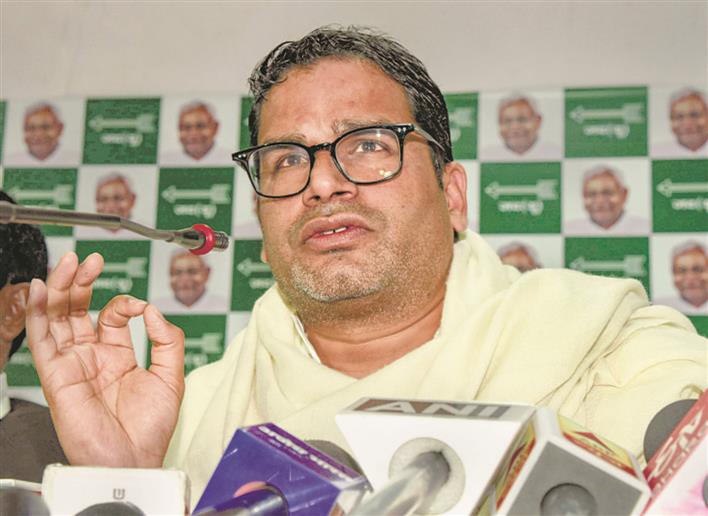
Prashant Kishor
BJP won’t cross 100-seat mark
I am glad BJP is taking my chat more seriously than words of their own leaders. They should show courage & share the full chat instead of getting excited with selective use of parts of it. I have said this before & repeating again – BJP will not to cross 100 in WB.
The BJP IT cell head and co in charge for West Bengal Amit Malviya argued that Kishor’s comments made to a few Delhi-based journalists during a social media audio discussion amounted to the TMC conceding defeat in the state Assembly elections.
Further, the saffron party’s IT cell went all out to amplify the clips of the purported audio conversation in which Kishor is heard saying that Prime Minister Narendra Modi continues to enjoy as much popularity in West Bengal as Chief Minister and TMC leader Mamata Banerjee. Kishor is also heard saying that 27 per cent Dalit voters in the state are voting for the BJP. In the audio, which Malviya shared on Twitter, Kishor can be heard making claims that there’s anti-incumbency factor against the TMC and it is also at the receiving end because of appeasement politics.
“On a day Bengal is voting for 4th phase on as many as 44 seats, TMC cadre and leaders woke up to find out that Mamata Banerjee’s election strategist (Prashant Kishore) has conceded the election. Every voter in Bengal has these videos on their mobile and is watching them as s(he) queues up to vote,” tweeted Malviya, who also claimed that the TMC election had just been thrown away.
Kishor purportedly stated during the conversation that PM Modi enjoyed cult status to an extent that a substantial chunk of population in the state gives him a demigod status. “There is anti-incumbency against the TMC and polarisation is a reality, says Mamata Banerjee’s strategist in an open chat,” Malviya said.
Taking purported claims of Kishor to strengthen BJP’s narrative against Mamata for minority appeasement, Malviya quoted TMC’s election strategist having said that “all that the Left, Congress and TMC ecosystem have done in the last 20 years is Muslim appeasement. It has resulted in resentment.”
Meanwhile, Kishor, on his part, also took to Twitter to counter the saffron party.
‘PM enjoys cult status’
Prashant Kishor purportedly stated during the conversation that PM Modi enjoyed cult status to an extent that a substantial chunk of population in the state considers him a demigod. “There is anti-incumbency against the TMC and polarisation is a reality, says Mamata Banerjee’s strategist in an open chat,” BJP IT cell head and co in charge for West Bengal Amit Malviya said.
India, China agree to maintain stability and peace on ground
So far, the People’s Liberation Army (PLA) of China has been inflexible to this suggestion. As of now, the ‘disengagement’ has happened only at one sector — Pangong Tso. – File photo
Ajay Banerjee
Tribune News Service
New Delhi, April 10
India and China military-level talks have hit a deadlock. India has made it clear that pulling back troops from friction points along the Line of Actual Control (LAC) in eastern Ladakh could be done only after the Chinese army ‘disengages’ from areas like Gogra, Hot Springs and the Depsang plains.
So far, the People’s Liberation Army (PLA) of China has been inflexible to this suggestion. As of now, the ‘disengagement’ has happened only at one sector — Pangong Tso.
A statement of the Ministry of Defence (MoD) today gave details of the outcome of the meeting of military commanders on Friday. “It was highlighted that completion of disengagement in other areas would pave the way for two sides to consider de-escalation of forces and ensure full restoration of peace and tranquility and enable progress in bilateral relations,” it said.
Sources in New Delhi explained that until there was a timeline for the three-step process for pulling back troops, weapons and war equipment from the entire stretch of the LAC in eastern Ladakh, India could not focus on a complete pull back only for the Pangong Tso sector.
The MoD statement came after a marathon 13-hour meeting between the Corps Commander-level officers of both sides at the Chushul-Moldo border point on April 9 that ended around 11. 30 pm. “The two sides had a detailed exchange of views for the resolution of the remaining issues related to disengagement along the LAC in Eastern Ladakh,” it said.
The two sides agreed to jointly maintain stability on the ground, avoid new incidents and jointly maintain peace in the border areas.
India finalises air bubble pact with Sri Lanka: Ministry
ndia has established a bilateral air bubble arrangement with Sri Lanka for operation of special international passenger flights between the two countries, the Civil Aviation Ministry said on Saturday. – File photo
Tribune News Service
New Delhi, April 10
India has established a bilateral air bubble arrangement with Sri Lanka for operation of special international passenger flights between the two countries, the Civil Aviation Ministry said on Saturday.
With this, India now has such pacts with 28 countries, including Afghanistan, Bahrain, Canada, France, Germany, Iraq, Japan, the Maldives, Nigeria, Qatar, the UAE, the UK and the USA.
Under an air bubble pact between two countries, special international passenger flights can be operated by their airlines into each other’s territories under restrictive conditions stipulated by the respective countries.
“India has finalised an air bubble agreement with Sri Lanka, making it the sixth such arrangement in SAARC region and the 28th in total,” the Civil Aviation Ministry said on Twitter. “Eligible passengers will be able to travel between the two countries in the near future,” it stated.
Scheduled international flights have been suspended in India since March 23, 2020, due to the Covid-19 pandemic. But special international passenger flights have been operating under the Vande Bharat Mission since May last year and under bilateral air bubble arrangements since July.
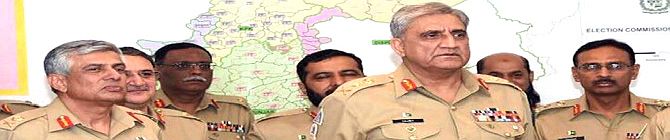
The 240th Corps Commanders’ Conference chaired by Chief of Army Staff (COAS) General Qamar Javed Bajwa was held at GHQ, Rawalpindi and the participants undertook a comprehensive review of global, regional and domestic security environment. The Pakistan Army’s top brass on Thursday discussed the situation along the border with India, including the Line of Control, after an agreement to restore the ceasefire agreement. The 240th Corps Commanders’ Conference chaired by Chief of Army Staff (COAS) General Qamar Javed Bajwa was held at GHQ, Rawalpindi and the participants undertook a comprehensive review of global, regional and domestic security environment. The army said in a statement the forum expressed confidence in operational preparedness of the army displayed during recently-held formation exercises. “Forum held a detailed discussion on the situation along the Eastern Border/LOC especially the environment post ceasefire understanding 2021 between the DGMOs,” it said. In February, Pakistan and India agreed to strictly observe all agreements on ceasefire along the Line of Control (LoC) and address each other’s core issues and concerns which have the propensity to disturb peace and lead to violence. An agreement was reached between the two countries after the Director Generals of Military Operations (DGMOs) of India and Pakistan held discussions over the established mechanism of hotline contact. A joint statement issued in Islamabad and New Delhi after the talks said the two sides reviewed the situation along the LoC and all other sectors in a “free, frank and cordial atmosphere.” “Both the DGMOs have agreed that the existing 2003 understanding should be implemented in letter and spirit,” Pakistani army spokesman Maj Gen Babar Iftikhar had said. The conference also expressed satisfaction over positive developments in Afghan peace process and efforts made so far. The meeting was also apprised about military engagements with friendly countries. The commanders undertook a detailed review of security situation in the newly-merged districts of Khyber-Pakhtunkhwa (KP). The meeting also reviewed internal security situation, including the ongoing third wave of COVID-19 and reaffirmed the resolve of the armed forces to extend full support to civil administration in controlling the pandemic. The Corps Commander Conference is held regularly to review the external and internal security situation. Meanwhile, a two-week long multinational air exercise ACES Meet 2021-1 hosted by Pakistan Air Force (PAF) concluded on Thursday at one of its Operational Bases. Saudi defence attaché Air Vice Marshal (Pilot) Staff Awad Abdullah Al Zahrani and US Air Attache Colonel Wallin David were also present in the ceremony along with observers from Bahrain, Egypt and Jordan. “With the successful and meaningful conduct of exercise, we have consolidated our resolve that we stand by each other as allies and friends,” said Air Commodore Ali Naeem Zahoor, Base Commander PAF Base. The exercise was organised by the Airpower Centre of Excellence (ACE) set up by the PAF in 2016 to transform air force capabilities to meet future challenges and to strengthen relations with friendly air forces.
AIR SUPPORT A BETTER AID TO BOOST THE MORALE OF SECURITY FORCES IN ANTI-NAXAL OPERATIONS
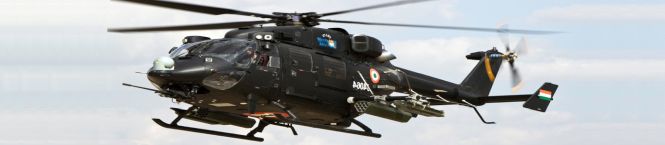
India made Dhruv derived weaponized Rudra Attack Gunship by Barshan Karmakar On Sunday, 4th April 2021, around 22 CRPF personnel have been reported to be killed, with 32 injured one soldier missing. Now, it has been a long time since the personnel of our paramilitary forces have to fight out operations against the Naxalites in the Red Corridor. The results of these operations have been both successful as well as quite shattering too at some times. But, following this incident, the CRPF officials and the top-brass of our national Security Council are of the view to initiate, air-operations against the Naxalites. But at the same time, various factors are being looked upon, starting from the available options to the area of tactical and natural factors as well. An important and most distracting factor that hinders the security forces to use heavy weapons in this area is the obstructions posed by the Human Rights and Environmental activists. As Chhattisgarh is considered to be a stronghold of Naxalites, its natural condition also aids in a way. It contains Tropical Deciduous Forests that shed their leaves during the Autumn season and in local terms, they are known as ‘Patjharivan’. It thereby, gives a clear visibility on that time, which makes it easy to conduct any kind of operations, and air operations can be easy to perform. But, it always doesn’t signify that visibility can be clear, for which the requirement of thermal cameras can be felt. In the past air operations have been carried out as well but those were mostly of relief nature, the Mil Mi-17 choppers had been used as air-ambulances. But this time air operations are being looked as an alternative. Also, at the same time, the available options along with their suitability need to be checked for conducting such operations. Close fights are quite often held against the Maoists from nearby proximity, and the conformity of these types of fights will come only then when the enemy’s presence is located to be at a close range. A challenge, in this case, can come at a time, if there are ground operations by the Maoists, and a helicopter being detected to be flying, and then they can either be able to retreat from their area of operation or take cover. In this case, they will not be able to sustain air operations for a long time with a successful outcome. In this case, 4 major options have been considered, which are analysed below: The use of Drones can be better, because of its high altitude flight and stealth technology will help it for both ensuring surveillance and attack. But in times of guerrilla warfare, if it fires a weapon from proximity and a particular height it can injure the friendly units, as in times of ground operations use of drones may pose a risk. Drones can be used successfully if the operational units have data regarding the position of the Naxalites. Due to natural disruptions, the use of heavy weapons or faster aircraft won’t serve the purpose of attacking from proximity, keeping in mind the need for accuracy; thermal imaging can be of great help to spot the enemy positions. The Mil Mi-35 ‘Hind’ attack helicopters of the Indian Air Force can be an ideal option, as it has undergone an upgrade in Israel with new IR and CCD cameras. It contains a 12.7 mm turret gun that is capable to be fired from any direction, along with 6 hardpoints that can carry a 23-30 mm guns-cum-rocket pods. It is the fastest attack helicopter that has not been much used in combat roles; it has never served the need of the Air Force to fight high altitude operations with service ceiling being quite less. But if considered it can serve a good purpose in Chhattisgarh. The HAL LCH or Rudra can also be considered for such a role, as the LCH has a 20 mm M621 mounted gun turret that can fire from any direction, 70 mm rockets and is able to move faster. It also has an Albeit-compass turret with a CCD camera and IR sensor. If the CRPF is looking for a budget free opportunity, then the light and faster HAL Lancer helicopters can be considered a good option. It is mounted with two gun-cum-rocket pods, which has a 12.7 mm gun with three 70 mm rockets, which can prove to be a lethal weapon against the enemy. The CRPF can keep this as an option for anti-Naxal operations. Another option can be sought if considered with prime importance for the future. The HAL HTT-40 basic trainer, which is to be improvised and is now under trials with the armed variant being under planning. The HTT-40 has a 950 horsepower engine that makes it capable to run at a speed of 450 kmph enabling the aircraft to conduct reconnaissance mission for a long time. Making it capable to fly at high altitude and attack in times of need. At the same time, if we compare the HTT-40 with the A-29 Super Tucano, it can have one machine gun, each at its wings, and 70 mm rockets along with CCD and IR camera turrets. Having these kinds of specifications, the A-29 can be a good Light Combat Aircraft to perform quick surveillance operations by providing air support in times of need. Therefore, looking at this aspect air operation can be performed, if needed as it has a major tactical reason behind it. But at the same time, these environmental and human rights activists needs to be tackled by the state, citing major reasons for security threats. As environmental protection can be important, but not at the cost of lives and the nation’s sovereignty or peace. Barshan Karmakar tracks military and aerospace issues closely. Views expressed are of the author and do not necessarily reflect the views of IDN
INDIAN ARMY STRENGTHENS MOUNTAIN STRIKE CORPS LOOKING AFTER CHINA BORDER
Further strengthening its deployments along the Northern borders, the Indian Army is adding around 10,000 more troops to its only mountain strike corps responsible for looking after offensive operations along the China border. The strengthening of the Mountain Strike Corps is part of the steps taken by the force to rebalance its focus more towards the Chinese border from the western front with Pakistan. An existing Division formation, with around 10,000 troops, located in the Eastern sector has now been assigned to the 17 Mountain Strike Corps headquartered in West Bengal’s Panagarh, government sources said. “The Mountain Strike Corps was cleared by the Centre about a decade ago but it had only one Division attached to it and with the latest step, it will now have more firepower and manpower at its disposal to carry out its assigned task,” they said. The Army has also done a lot of rebalancing in the recent past and a number of formations have been given dual tasks and asked to focus more towards the China border which erupted last year due to the Chinese aggression in eastern Ladakh and other areas. Meanwhile, the Indian Army and other security forces have also started returning to the summer deployments in the Ladakh sector and other mountainous areas along the Line of Actual Control (LAC). Both Indian and Chinese Armies have a large number of troops deployed at the border since last year. The formations of Mathura-based One Strike Corps have also been reoriented towards the Northern borders while one of its Armoured formations would continue to be with it. The deployment of formations and troops in the Sugar sector, Central sector and the north eastern borders have also been strengthened. Due to the Indian tactical operations along the southern bank of Pangong Tso, the Indian Army managed to secure disengagement from the Finger area, the two sides are continuing to hold talks for further disengagement and de-escalation from other friction points in the area. India is demanding disengagement at the Gogra, Hot Springs and Depsang plains area by the Chinese Army for which the 11th round of corps commander talks are being held today.
Selling defence land seen as only way to raise money for new modernisation fund
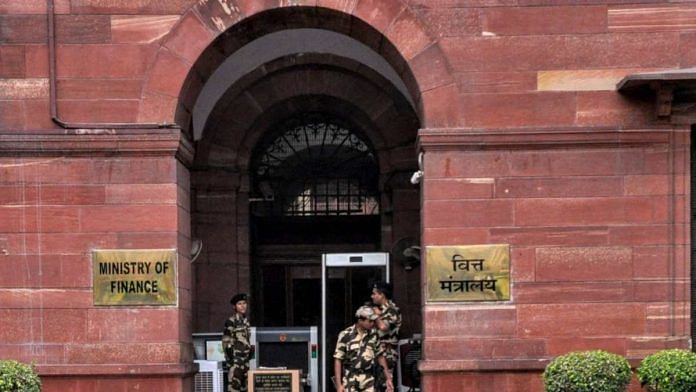
New Delhi: The Ministry of Finance has pegged monetising defence land as the only way to generate revenue for the proposed non-lapsable modernisation fund, ThePrint has learnt.
Draft cabinet note based on ministry’s comments is undergoing inter-ministerial consultations, but Department of Military Affairs had said selling land alone wouldn’t be enough.
According to government sources, a draft cabinet note on setting up the defence modernisation fund is currently undergoing inter-ministerial consultations, and a final decision is expected soon, following which it will be placed before the Narendra Modi cabinet for approval.
The Controller General of Defence Accounts (CGDA) and the Directorate General, Defence Estates (DGDE) have also been entrusted to carry out the task of a realistic assessment of surplus defence land available for monetisation, the sources said.
The concept of a non-lapsable defence modernisation fund is not new. In the interim budget of 2003-04, then Union finance minister Jaswant Singh had announced such a fund of Rs 25,000 crore, which would be made available to the defence ministry. However, in the subsequent years, the finance ministry had repeatedly objected to setting up the fund.
The fund has now been recommended again by the 15th Finance Commission, which made its report public on 1 February this year. The same month, Finance Minister Nirmala Sitharaman said her ministry had agreed in-principle to the fund. “The modalities and the structure will be worked upon,” Sitharaman had said in the Lok Sabha.
ThePrint reached the spokespersons of the finance and defence ministries through emails, but there was no response till the time of the publication of this report.
The Finance Commission had suggested several sources of revenue, including disinvestment proceeds of defence public sector enterprises (DPSEs) and receipts from defence land — to be transferred to state governments and for public projects in future — for this new fund.
The sources said other avenues discussed in the government included levying a defence cess for a certain period, defence bonds, proceeds from defence exports, tax on certain strategic projects, and reimbursements from aid to civil authorities, among others.
However, the sources said the other suggested sources of revenue are unlikely to be included, as the finance ministry has only recommended monetisation of defence land.
The finance ministry has said all proceeds from defence land monetisation will be received in the Consolidated Fund of India, the sources said. Half of such receipts will be transferred every year to the non-lapsable fund, it has recommended.
The new fund, the ministry has said, will be created in a public account and transfer of money will take place after parliamentary authorisation through ‘Demands for Grants’ by the defence ministry.
The finance ministry also said the money from the modernisation fund would be spent on modernisation projects only after the allocated capital budget is exhausted. Whatever is left over after deducting the amount for modernisation projects will be used for construction of family accommodation for defence officials, purchase of indigenous defence stores and logistics,a defence source said.
A senior government official familiar with the matter said just monetising surplus defence land is unlikely to keep the fund going in the future, and other sources of revenue need to be considered.
“Defence land is a finite source of funding, and the roll-on fund needs to keep going even after the defence land is exhausted,” the official told ThePrint.
“Moreover, the majority of defence land belongs to the Army, whereas the proposed modernisation fund is for all the three services,” the official pointed out.
The Department of Military Affairs, headed by Chief of Defence Staff Gen. Bipin Rawat, had told the government last year that that proceeds from defence land monetisation would be barely adequate to meet the armed forces’ requirements, a defence source told ThePrint.
The DMA had also highlighted that the capital budget of the defence forces is inadequate to meet their committed liabilities, and objected to 50 per cent of the funds from defence land monetisation going to the CFI.
“DMA also suggested that the condition that such funds will go back to CFI in case of non-utilisation in three years also needs a relook since defence planning and acquisition takes time,” the source said.
Other recommendations made by the DMA included setting a minimum limit for the fund at Rs 65,000 crore, and include alternate sources.
However, a second official justified the finance ministry’s recommendation, saying monetising defence land is just a start, and that other suggested sources of revenue are also not infinite.
“There is no point in parking additional money in the fund if the existing corpus is not utilised. The idea is to start with defence land monetisation first, which itself will be a long and tedious procedure,” the second official said. “Other recommendations like cess are not an option, as states would object to it.”
The first official quoted above said while a blanket defence cess is not a good idea, the government could explore cess on customs duty or defence exports to boost self-reliance in defence.
Why defence modernisation fund is needed
The fund was recommended keeping in mind the emerging needs for modernisation of the defence services, in the wake of a consistently-declining defence budget in the last few financial years. For 2021-22, the defence budget stands at Rs 4.78 lakh crore — way short of the three services’ budget projections based on their committed liabilities.
The Navy, which had projected a requirement of Rs 70,920.78 crore for 2021-22, was allotted less than half — Rs 33,253.55 crore.
The Army had projected a need for Rs 51,492 crore for modernisation, but got only Rs 36,531 crore, while the Air Force, with a projection of Rs 77,140 crore, got Rs 53,214.77 crore.
File image of USS John Paul Jones (DDG 53) | Photo:
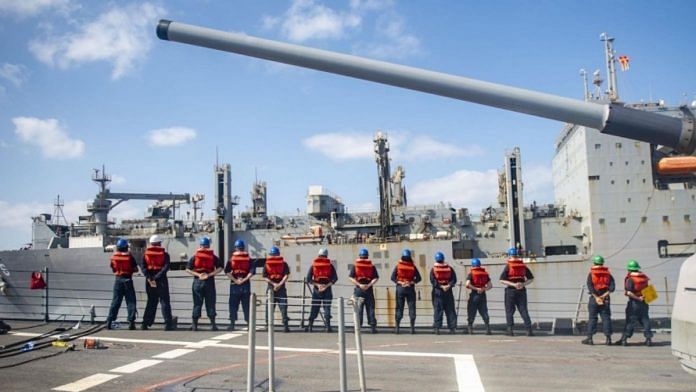
New Delhi: A US guided missile destroyer sailed through India’s Exclusive Economic Zone (EEZ), 130 nautical miles west of the Lakshadweep Islands, without intimating India — in violation of the Indian law.
Sources in the Indian naval establishment, while accepting that the US move was a violation, said it is more of a “messaging to China” than anything else.
A statement released by the US Navy’s 7th Fleet said, “On April 7, 2021 (local time) USS John Paul Jones (DDG 53) asserted navigational rights and freedoms approximately 130 nautical miles west of the Lakshadweep Islands, inside India’s exclusive economic zone, without requesting India’s prior consent, consistent with international law.”
It said India requires prior consent for military exercises or maneuvers in its EEZ or continental shelf, and added that this claim is inconsistent with international law.
This Freedom of Navigation Operation (FONOP) upheld the rights, freedoms, and lawful uses of the sea recognised in international law by challenging India’s excessive maritime claims, it said.
“We conduct routine and regular Freedom of Navigation Operations (FONOPs), as we have done in the past and will continue to in the future. FONOPs are not about one country, nor are they about making political statements,” the US’ 7th Fleet said in its statement.
India’s Ministry of External Affairs, however, raised “concerns” through diplomatic channels over the passage of USS John Paul Jones through its EEZ, and noted the country’s adherence to the United Nations Convention for the Law of the Sea (UNCLOS).
According to UNCLOS 1982, to which India is a signatory, waters upto 12 nautical miles of a coastline is that country’s sovereign waters and between 12 and 200 nautical miles its EEZ.
Both India and China have made their own rules with regard to this despite being a signatory to the international convention. India says foreign vessels travelling through India’s EEZ has to give prior notification while China says foreign countries need permission from Beijing.
While innocent passage of foreign ships, including navies, through EEZ is allowed by India, no commercial or research activities, including fishing, is allowed.
While the Indian Navy is yet to respond officially to the US move, former Navy chief Admiral Arun Prakash told ThePrint: “This action, especially publicising it, was both uncalled for and unnecessary — especially in context of a friend and strategic partner.”
Explaining the nuances of the US move, the admiral said it was a messaging to China. He added that the situation is ironic because the US itself has not ratified the UNCLOS but quotes it to other countries.
“The US is quoting UNCLOS 1982, which it has not ratified. India has ratified the law but says that prior intimation is needed for passage through EEZ and restricts any kind of economic or research activity,” he said.
The former Navy chief added that there is no restriction on innocent passage through India’s EEZ but needs prior intimation.
“What the US has done is violated India’s rules but it has not violated any international law. This step is actually part of its messaging to China,” he said.
The US statement said it operates in the Indo-Pacific region on a daily basis.
All operations are designed in accordance with international law and demonstrate that the United States will fly, sail and operate wherever international law allows, it said.
“We conduct routine and regular Freedom of Navigation Operations (FONOPs), as we have done in the past and will continue to in the future. FONOPs are not about one country, nor are they about making political statements,” it added in what is seen as an oblique messaging to China.
MEA responds
In a statement issued Friday evening, India’s external affairs ministry said it had raised the matter of the USS John Paul Jones passing through the EEZ with the US.
“The USS John Paul Jones was continuously monitored transiting from the Persian Gulf towards the Malacca Straits. We have conveyed our concerns regarding this passage through our EEZ to the Government of U.S.A through diplomatic channels,” it said.
India reiterated its adherence to the UNCLOS and said that the laws under this “does not authorise other States to carry out in the Exclusive Economic Zone and on the continental shelf military exercises or manoeuvres, in particular those involving the use of weapons or explosives, without the consent of the coastal state.”
The incident comes close on the heels of US Secretary of Defence Lloyd Austin’s visit to India, which was the first high-level visit under the new Joe Biden administration.
India, US, Japan and Australia — that constitute the Quad grouping — also recently held their first summit in March under the larger ambit of the strategic Indo-Pacific strategic initiative.
(With inputs from Nayanima Basu)
(This report has been updated with details of the statement issued by India’s Ministry of External Affairs.)