



Sanjha Morcha

What’s New

Click the heading to open detailed news

Current Events :

web counter

Print Media Reproduced Defence Related News

Fertiliser price hike: RSS affiliate BKS asks govt to check ‘exploitation’ of farmers

‘Withdraw import duty order on pulses’

Fertiliser price hike: RSS affiliate BKS asks govt to check ‘exploitation’ of farmers

hoto for representation. Tribune file

Vibha Sharma

Tribune News Service

New Delhi, May 19

Pointing towards increase in prices of chemical fertilisers, including DAP, RSS affiliated Bharatiya Kisan Sangh on Wednesday urged the Narendra Modi government to intervene immediately and check the “exploitation” of farmers during the Covid pandemic.

The farmers’ organisation also asked the Centre to withdraw its May 15 order removing import duty on pulses, calling such actions “contradictory” to its stated intention on making India self-sufficient in pulses and oilseeds.

According to the general secretary of the BKS Badrinarayan Choudhury, there is an increase in chemical fertilisers’ prices to the extent of 1.5 times of the existing price. “Even IFFCO raised the price of DAP from Rs 1200/50 kg to 1900/50 kg this May. Retailers are selling with this new price, though the Chemicals and Fertilisers Ministry barred them from doing so.”

“There is huge confusion in the market. We demand that the Government should intervene immediately with a clear-cut order to check the exploitation of the farmers during such pandemic,” he said, addressing media.

Choudhury also asked the government to rethink and withdraw its order removing all import duties on tur, moong, and urad, stating that it was sending the wrong message to farmers. “The Commerce and Industry Ministry on May 15 declared that they are removing all import duties on tur, moong, and urad. All these crops are to be grown this monsoon. This has sent a message to the farmers that they should not go for cultivation these grains that they are not going to get a better price for them. While the Modi government wants to make our country self-sufficient in pulses and oilseeds and we are about to achieve that target, such action will act contradictory,” he said.

The BKS also demanded subsidy in interest for KCC cardholders. The KCC cardholders get a subsidy of a 3 per cent interest rate if they repay the loan in time. Choudhury said though the government has extended the date of repayment in relation to pandemic, banks are collecting the loans with full interests. “The Government should ensure subsidy in interest till the situation become normal,” he said, also asking it to waive off KCC loans of any farmer deceased due to coronavirus.

“We are now passing through a difficult time of the second phase of Chinese corona. As the largest farmer organisations in our country, the members of BKS are spreading awareness across villages, encouraging people to vaccinate themselves as quickly as possible and empowering them to be more mentally powerful to overcome this pandemic. Our members are working actively probably in and around 35,000 to 40,000 villages during this pandemic to help people,” the BKS said.


Secunderabad-based officer leaked Army exam paper: Pune police

So far nine persons have been arrested in the case

Secunderabad-based officer leaked Army exam paper: Pune police

Photo for representation only. Source: iStock.

Pune, May 18

An officer of the lieutenant colonel rank arrested from Secunderabad was the “mainculprit” in the Army recruitment paper leak case, investigators claimed here on Tuesday.

Lt Col Bhagatpreet Singh Bedi (44) was the one who leaked the paper, said a police officer a day after the arrest.

Bedi was responsible for the printing of the question paper for the local centre for the`Army Relation Recruitment Exam’ scheduled for February 28.

The exam, meant for close relatives of army personnel, was to take place at mutliple centres across the country, but was cancelled when the paper leak came to light.

“Probe revealed that he was in charge of the printing of the paper before the exam at AOC centre Secunderabad, and he leaked it,” said Vitthal Patil, senior police inspector, Anti-Extortion Cell.

A team of Pune police comprising Assistant Police Inspector Shirish Bhalerao, police personnel Atul Sathe and Pravin Rajput took him in custody from Secunderabad, he said.

Before that, his associate Virprasad Narnepati (41), posted as storekeeper at the ordnance depot in Delhi, was arrested.

So far nine persons have been arrested in the case.

As per the procedure, just before the exam, every centre is forwarded a secure link from which the question paper is downloaded and printed.

  “During the printing Bedi managed to get a copy while ensuring that the act was not captured by CCTV cameras. He forwarded it to Narnepati who was staying in a hotel in Secunderabad,” said another officer acquainted with the probe.

Narnepati forwarded the paper to one Narsing Rao, who passed it on to one Pawan, he said.

Pawan allegedly sent the paper to Vilas Kilari, a major-rank officer, who sent it to Thiru Murugan Thangvelu, another major-rank officer.

While Narsing Rao and Vinay are wanted, Kilari and Thanvelu have already been arrested.

Eventually the leaked paper was sold to some exam candidates.

“Bedi was supposed to get Rs 1 lakh per candidate. He apparently received some money, but had to refund it when the exam got cancelled,” said the police officer.

Bedi was produced before a court in Pune on Tuesday and sent in police custody till May 25, said Assistant Public Prosecutor Premkumar Agrawal. — PTI


Rajnath reviews preparations by armed forces for relief work

Asks 3 services to provide assistance to civil admns

Rajnath reviews preparations by armed forces for relief work

People move a fishing boat to a safer place along the shore ahead of Cyclone Tauktae in Gujarat on Monday. Reuters

New Delhi, May 17

Defence Minister Rajnath Singh on Monday directed the three services to provide all possible assistance to the civil administrations in the coastal states of Maharashtra and Gujarat in tackling the situation arising out of Cyclone Tauktae.

Singh issued the instruction after reviewing the preparedness of the armed forces to deal with the fallout of the cyclone.

Four saved by Navy helicopters

Four persons were saved by helicopters of the Indian Navy in the Arabian Sea west of Mangalore on Monday morning. A tugboat they were travelling got flooded leaving them with no propulsion or power. The four crew members were winched up in the copter and handed on the deck of Coast Guard ship nearby.

“The Defence Minister directed the three services to provide all possible assistance to the civil administration to deal with the emerging situation,” the Defence Ministry said.

Singh carried out the review at a video-conference, which was attended by Chief of Defence Staff Gen Bipin Rawat, Defence Secretary Ajay Kumar, Navy Chief Admiral Karambir Singh, Chief of Air Staff Air Chief Marshal RKS Bhadauria and Army Chief Gen MM Naravane among others.

121 villages affected in K’taka, 8 dead

Eight persons have lost their lives in the Cyclone Tauktae-hit coastal and surrounding malnad districts of Karnataka, officials said on Monday. According to the officials, till this evening, 121 villages in seven districts of Dakshina Kannada, Udupi, Uttara Kannada, Kodagu, Chikkamagaluru, Hassan and Belagavi have been affected by the cyclone. PTI

The ministry said three ships of the Indian Navy have been put on standby with aid and relief materials for providing immediate assistance to affected areas if required.

Several other ships on the Western seaboard are also being kept ready for any deployment. — PTI


Swiss-made clocks in IAF’s Mi-17 helicopters being replaced with indigenously developed substitute

Swiss-made clocks in IAF’s Mi-17 helicopters being replaced with indigenously developed substitute

Vijay Mohan
Tribune News ServiceChandigarh, May 18

The Swiss-made aviation clock installed in the cockpit of the Russian-origin Mi-17 V5 utility helicopters in service with the IAF are being replaced with an indigenously developed digital substitute.

The project has been entrusted to No.3 Base repair Depot (BRD) here, which is responsible for the maintenance, repair and overhaul of Mi-series helicopters in the IAF’s inventory.https://0169f4f11803e91df41660253ef757cf.safeframe.googlesyndication.com/safeframe/1-0-38/html/container.html

The digital aviation clock, at times referred to as chronometer in aviation and military parlance, will be developed in collaboration with public or private commercial entities while adhering to military specifications and operational requirements, IAF sources said.  

Digital aviation clock displays current time in hours, minutes and seconds as well as keeps track of flying time that has elapsed. It also has options for providing specific information or a particular type of display.

The aviation clock presently installed in the Mi-17 V5 helicopter is manufactured by Thommen Aircraft Equipment based in Switzerland that manufactures cockpit instruments for the global aviation industry.

The IAF has about 150 Mi-17 V5s in service that have replaced the older Mi-8 helicopter and earlier versions of the Mi-17. It is the mainstay of the IAF’s utility helicopter fleet, capable for carrying 36 soldiers internally or 4,500 kg of load. It can also be armed with machine guns, rocket pods or anti-tank missiles.https://0169f4f11803e91df41660253ef757cf.safeframe.googlesyndication.com/safeframe/1-0-38/html/container.html

Indigenisation of aero-spares for all types of aircraft has been a major thrust area for the IAF, for which it has been making in-house efforts as well as tapping the private industry. This includes thousands of types of singular items as well as sub-systems and assemblies, which it is earlier constrained to import.

Besides assembling and flight testing newly procured Mi-17 helicopters, 3 BRD has also carried out several modifications and retrofitments to the fleet to meet IAF’s operational requirements, including modifying the helicopter for VVIP use. A large number of Mi-17 components have also been indigenised by the depot.


One barge runs aground in Arabian Sea; all 137 rescued

A total of 180 men of the 273 on board another barge, ‘P305’, have been rescued so far

Ajay Banerjee

Tribune News Service

New Delhi, May 18

As many as 137 persons on board a barge ‘Gal Constructor’ got lucky as the vessel which was adrift in the Arabian sea ran aground near Wadrai beach – some 90 km north of Colaba Point Mumbai, late Monday night, allowing for their rescue.

With the weather still being very bad accompanied by high winds and rain, the Indian Coast Guard, on Tuesday morning, pressed in its helicopters to airlift these persons from ship to shore. Till 2 pm on Tuesday, 55 of the marooned crew had been airlifted to shore. The Coast guard was then joined in by the Navy which used the bigger Seaking42 copters which can lift up to 20 men in one sortie. 

Read also:

At 5 pm the Ministry of Defence spokesperson A Bharat Bhushan Babu announced “All 137 crew rescued from ‘Gal Constructor’. No individual left. Rescue ops over for this vessel”.

Last night an emergency towing vessel ‘Water Lily’, two support vessels and Coast Guard Ship Samrat were in the vicinity of the Gal Constructor which was floating freely in high seas.

The vessel was among the two barges and one drill ship that had been adrift since Monday morning. There were 435 persons on board. Another barge ‘P035 sank near the offshore Bombay High oil rigs and separate rescue effort is on. A total of 180 men of the 273 on board the ‘P305’ have been rescued so far in collective effort by the Navy and the private marine vessels. Helicopters have been pressed into service to pick up those who are injured and transport to shore. The Barge P305 went down some 70 km west of Mumbai.

Apart from these two rescue sites, Indian Navy warship INS Talwar is proceeding to render assistance to a drill ship Sagar Bhushan of the Oil and Natural Gas Commission (ONGC) that has 101 personnel on board and another accommodation barge SS-3 with 196 personnel on board. Both of are adrift and presently located about 90 km south-east of the Pipavav Port in Gujarat, Navy Spokesperson Commander Vivek Madhwal said Tuesday morning.


Rajnath Singh reviews COVID relief efforts of armed forces

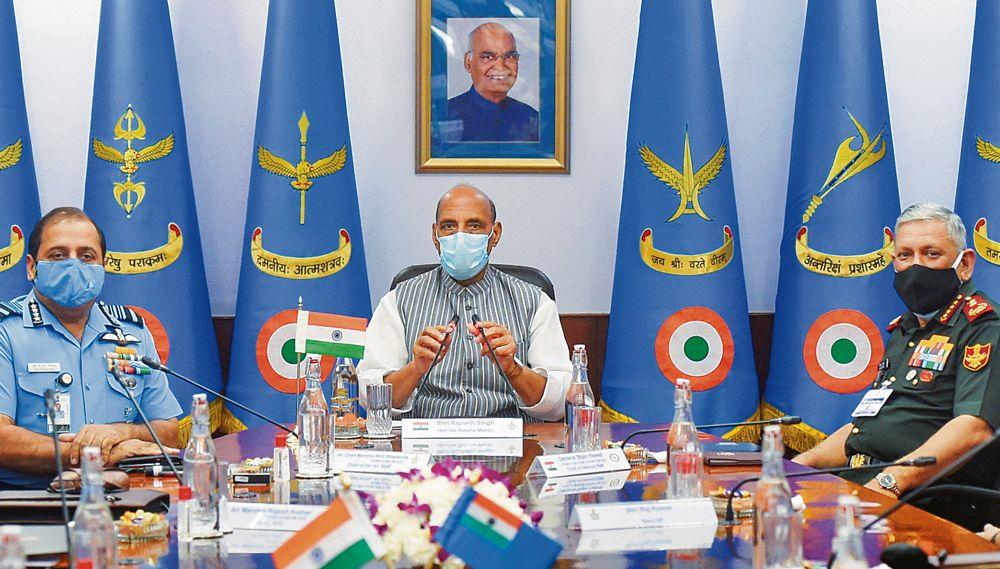
Defence Minister Rajnath Singh on Monday reviewed efforts of the armed forces, defence public sector undertakings (DPSUs) and Defence Research and Development Organisation (DRDO) in India’s fight against a severe wave of the coronavirus pandemic.

At a video conference, Singh was briefed about specific initiatives of the three forces as well as other wings of the Defence Ministry in helping civilian authorities deal with the crisis.

Defence Minister Rajnath Singh on Monday reviewed efforts of the armed forces, defence public sector undertakings (DPSUs) and Defence Research and Development Organisation (DRDO) in India’s fight against a severe wave of the coronavirus pandemic. At a video conference, Singh was briefed about specific initiatives of the three forces as well as other wings of the Defence Ministry in helping civilian authorities deal with the crisis.

The meeting was attended by Chief of Defence Staff Gen Bipin Rawat, Army Chief Gen MM Naravane, Navy Chief Admiral Karambir Singh, Chief of Air Staff Air Chief Marshal RKS Bhadauria and DRDO Chairman G Satheesh Reddy, among others. “Raksha Mantri Shri @rajnathsingh chairing a meeting of secretaries, CDS, service chiefs and Ministry of Defence officials via video conferencing to review the actions taken by the ministry and armed forces in India’s fight against COVID-19 pandemic,” Singh’s office tweeted.RELATED NEWS

Officials said the contribution of the DPSUs and other agencies of the Defence Ministry to the country’s fight against the pandemic was also reviewed. In responding to the crisis, the Indian Army and the Indian Navy have set up a number of hospitals in various states for the treatment of COVID-19 patients.

On its part, the Indian Air Force deployed a significant number of its transport aircraft to bring cryogenic oxygen tanks and other emergency medical supplies from several countries, including Singapore, Thailand and United Arab Emirates. The Indian Navy also deployed nine warships to bring filled oxygen containers to India from countries in the Gulf region and Southeast Asia.

Last month, Singh granted emergency financial powers to the three services to allow formation commanders to establish and operate hospitals as well as quarantine facilities for COVID-19 patients. The emergency powers have been granted initially for a period of three months from May 1 to July 31 and are in addition to the similar powers delegated to the medical officers of the armed forces last week.

Subscribe to FE Daily Newsletter for latest updates on markets, business, money, infra & more, right in your mailbox

Get live Stock Prices from BSENSEUS Market and latest NAV, portfolio of Mutual Funds, Check out latest IPO NewsBest Performing IPOs, calculate your tax by Income Tax Calculator, know market’s Top GainersTop Losers & Best Equity Funds. Like us on Facebook and follow us on Twitter.


Year after first big India-China clash in Ladakh, tensions linger. This is how it all began

Defence Minister Rajnath Singh addresses troops at the Pangong Tso in Ladakh Friday | Photo: ANI
File photo | Defence Minister Rajnath Singh addresses troops at the Pangong Tso in Ladakh, 17 July 2020 | Photo: ANI

Text Size: A- A+

New Delhi: It’s been exactly a year since the first major clash between Indian and Chinese troops, at Finger 4 of the Pangong Tso (lake) in Eastern Ladakh, which then led to the worst-ever tensions between both sides since the 1962 war. 

The skirmish had led to serious injuries on both sides. A year on, the situation at the Line of Actual Control (LAC) remains eerily calm but there has been a widening trust deficit between both countries.https://500823f3d62f256d48ef5864693716d5.safeframe.googlesyndication.com/safeframe/1-0-38/html/container.html

While disengagement has taken place at Galwan Valley and the southern and northern banks of Pangong Tso, stand-offs and tensions continue in at least four other locations in Eastern Ladakh — Depsang Plains, Hot Springs, Gogra and Demchok.

The Chinese have pulled back troops from the Pangong Tso but they have deployed personnel at Rutog, some 70 km from the LAC.

This in effect means that while disengagement (pulling back of face-to-face troops) has taken place, de-escalation has not and the Chinese possess the ability to return to the very same spots they vacated in the Pangong Tso and elsewhere.

Similarly, India too has pulled back from the lake’s southern banks but continues to maintain a higher number of troops in the region besides those in reserve.

New Delhi has also put in place a summer strategy for Ladakh that involves key changes in deployment patterns, equipment and overall strategy.


Also read: China not happy with arms supply, but Russia-India friendship unshakeable: Carnegie Moscow head


No quick-fix solution

Sources in the defence and security establishment said that while there has been some positive development in terms of dis-engagement, the road ahead is very long.

“There is a huge trust deficit. China had sought to change the status quo and draw a new LAC,” a senior officer from one of the Services involved in the whole stand-off told ThePrint. “The heightened deployment will continue. The whole process of de-escalation will take time. There is no quick-fix solution.” 

The source identified Depsang Plains and Demchok, where tensions predate the current round that began in April last year, as the sticky points that will take time.

“The region will see higher force concentration for time to come. The idea is to have enough troops in place in case of any further escalation and the capability to launch our own operations if need be like we did in the southern banks,” a second source said. “We have carried out multiple assessments of areas where they can strike and have plans accordingly.” 

Tensions first began in April in Galwan Valley

Sources said tensions first arose in the Galwan Valley around April end last year when the Chinese objected to four to five crossings that India was building near the Y junction.

ThePrint had in June last year reported that while the Chinese have been objecting to the 60 m-long bridge over the Shyok river, which was completed by India during the stand-off that month, the real problem was “certain construction” being carried out by India beyond the confluence point to prevent patrolling soldiers from wading into the water.

Sources explained that the Chinese never had any strong objection to the 60 m bridge but were adamant against construction being carried out near the Y junction that is about 800-900 m from Patrol Point (PP) 14, which itself is about 500 m from the LAC.

“We had built about 4-5 small foot crossings for our patrolling teams. This was because the soldiers had to wade through the water at five locations to reach PP 14. The Chinese saw this construction and raised objections at the local level through the hotline,” a third source who was involved in the stand-off explained. “The construction continued and we told them that this is within our territory and for only ease of patrolling.” 

The source said the Chinese hadn’t entered the Indian side until early June when they came in and built an observation post near PP 14. 

This led to another tent coming up near the Y junction and the eventual clash on 15 June, which led to casualties.

Following the clash, the Chinese came in large numbers and set up tents at the Y junction area and the Indians too built their own facilities with the two sides being divided by the river.

They only pulled back in early July after both sides agreed to disengage and build a buffer zone of sorts.


Also read: Why the suspicion on China’s Wuhan lab virus is growing. Read these new analyses


The Ladakh clash

On 10 May last year, border tensions between India and China flared up once again with several troops from both sides left injured following fist fights and stone-pelting in the Ladakh and North Sikkim regions in a week.

The clash in Ladakh had taken place on the evening of 5 May. 

“The 5 May clash was more of a brawl among a limited number of soldiers. The PLA had objected to Indian troops patrolling,” a fourth source said. “Laid down protocols were followed to ease tensions. However, a few additional soldiers were brought in subsequent days after Chinese kept stopping Indian patrols.”

Sources said that on 5 May, the Indians were outnumbered.

“The first major clash in Eastern Ladakh between Indian and Chinese troops took place on the noon of 18 May 2020. This time there was a lot of stone pelting and use of sticks and rods,” the source added. “The Indians were adequately numbered initially to inflict a strong resistance. Soon six Chinese vehicles came and dropped off soldiers. These vehicles kept going back and coming with more soldiers. By the evening of 18 May, the Chinese had deployed about 700-800 soldiers at the Finger 4 area.”

The source explained that Indian deployment of additional troops could not match the Chinese speed here because the Indians had to trek a narrow path from Finger 3 to reach Finger 4.

The Chinese had brought in earth movers and set up various posts. In the following days, the Chinese also set up several tents and posts on the heights of Finger 4, as then revealed by satellite pictures.


Also read: Bangladesh has shown courage against Chinese bullying but Sri Lanka still lacks it


Chinese intruded and built up after 18 May

Sources said that after the move in the northern banks of Pangong Tso, the Chinese built up in other areas including Hot Springs and Gogra.

Sources admitted that the scale at which the Chinese moved indicated that there was planning that went into this and cannot be seen as a reactionary move to what happened in Pangong Tso. 

“We too began mirror deployment. One thing led to the other and eventually to actual stand-offs in many locations,” a fifth source said, explaining how things escalated on the ground.

ThePrint had on 25 May last year reported that India was carrying out “proactive localised preventive deployment” at multiple locations along the LAC in Eastern Ladakh even as it carried out “mirror deployment” in areas where it was being challenged by Chinese troops. 

Galwan and southern banks were turning points

Sources said that while Indians were initially caught off guard by the Chinese aggression, troops surprised the PLA too with counter action in the southern and northern banks.

“When you look back, one realises that the Galwan clash and the Indian action of occupying the southern banks heights and sending up a team against the Chinese at the northern banks were turning points,” the fifth source said.

Asked what this meant, the source said, “Galwan showed the Chinese that a cost will have to be paid if they continued with their aggression. Yes, 20 Indians lost their lives, most of them because of hypothermia, but the Chinese suffered fatal casualties as well.”

Talking about the southern banks, the source said, “The ops on the southern and northern banks of 29 August night showed that the Indians could also surprise the Chinese and can pull off what we call a quid pro quo (QPQ). 

“The Chinese were uneasy with our move and were forced to spend the harsh winters in the open. They agreed to pull back from the northern banks only because of this. Otherwise they were ready to stay put and mark a new physical LAC.”

(Edited by Arun Prashanth)


Also read: China does not want war. It’s playing the long game


When Indira Gandhi broke tradition and mentioned Garibpur battle in Parliament

When Indira Gandhi broke tradition and mentioned Garibpur battle in Parliament

Lt Col Dilbag Singh Dabas (Retd)

THIRTEEN days before the declaration of war in 1971, Pakistan army launched its biggest attack on the eastern front. The action took place near Garibpur village, some 7 km inside south-western East Pakistan, wherein one battalion of the Indian Army, with support from the artillery, armour and engineers, successfully took on the might of the enemy’s two infantry battalions supported by matching artillery, armour and recce and support combat elements.

In the early hours of November 21, under cover of dense fog, Pakistan’s 107 Infantry Brigade’s 6th and 21st Punjab battalions, supported by 49th and 55th Field Regiments (artillery) and 3 Independent Armoured Squadron (Chaffees), attacked Indian Army’s 14th Punjab Battalion (Nabha Akal) while it was in the process of organising its defences between Garibpur and Jagannathpur villages in Jessore sector.

Maha Vir chakra recipients

(L-R) Lt Col RK Singh, Maj Daljit Singh Narang, Subedar Malkiat Singh

While the companies were frantically digging the defences and anti-tank guns were in the process of reaching onto their firing positions, at 5.30 am, the Pakistani onslaught caught the battalion not yet fully on guard. But the Commanding Officer of 14 Punjab did not panic, for he knew the Nabha Akals would thwart any attack. He also knew that the Divisional artillery was deployed within range and ready to fire, and the armoured squadron had adjusted its tanks and fire arcs coordinated. With the most credible support of the Bulls (Gunners), the Bisons (Tankmen) and the Sappers and with grit and determination of its officers and men, 14 Punjab foiled the formidable attack and steadfastly held ground.

The battle raged for almost four hours during which the timely and effective support from the Divisional artillery comprising 6 Field Regiment, 14 Field Regiment, 67 Field Regiment and 881 Light Battery, PT 76 tanks of ‘C’ Squadron of 45 Cavalry and a platoon of 102 Engineer Regiment helped 14 Punjab beat back three determined attacks. The outcome of the ‘Battle of Garibpur’ truly paved the way for the creation of Bangladesh.

In those four hours, every combatant gave his best; the artillery guns and mortars fired at an intense rate throughout (the writer was Gun Position Officer with one of the batteries of 6 Field Regiment) without a single report of ‘gun loaded-gun hot’, the 14 Indian PTs took on 14 Pakistani Chaffees head-on and knocked 11 out at the cost of only two, and for Infantry and the Engineers, it was a close quarter battle throughout.

And from the iconic ‘Battle of Garibpur’ emerged three Maha Virs, namely Lieutenant Colonel RK Singh, Major DS Narang (Narag in official records) and Subedar Malkiat Singh; and four Virs — Captain GS Gill, the platoon commander of 14 Punjab who boldly rescued the artillery observation post (OP) officer after the latter was grievously wounded while engaging the enemy tanks before assault; Havildar Lekh Raj, the RCL gunner from 14 Punjab who singlehandedly destroyed one enemy tank; Captain RP Chaturvedi, the daredevil artillery OP officer from 6 Field Regiment who kept directing artillery fire from atop a tree, fully exposed to the enemy fire till he was shot down by the enemy tank’s machine gun fire — old-timers of 14 Punjab still swear by him — and Naib Risaldar RP Singh, the gallant troop leader of ‘C’ Squadron of 45 Cavalry who, at immense risk, gallantly led his troops and himself destroyed one enemy tank.

Among the four Sena Medal winners, Major Kailash Nath, the ‘Q’ Battery Commander of 6 Field Regiment, single-handedly directed the artillery fire after Capt Chaturvedi was seriously wounded and evacuated, and Lieutenant Ram Murthy, the dauntless Engineer Platoon Commander whose Sappers had no time to lay mines but excelled in infantry role, including in some fierce bayonet charges and assisted the battalion pioneers and headquarters personnel in not letting the attackers run over the battalion headquarters.

Lt Col RK Singh was commissioned into 13 Punjab (Jind Infantry), an erstwhile Jind State Force’s battalion which later got amalgamated with the Indian Army. Just before commencement of the war, he assumed the command of 14 Punjab (Nabha Akal), then a 217-year-old battalion that brought commendable laurels during the liberation of Bangladesh in 1971.

During the ‘Battle of Garibpur’, Lt Col RK Singh, for his exemplary leadership and conspicuous bravery, was awarded the MVC:

“Lt Col Raj Kumar Singh, who was commanding a battalion of the Punjab Regiment, was assigned the task of occupying a defended area between villages Garibpur-Jagannathpur on the eastern front to contain the enemy intruding into Indian territory. He planned and organised the defences held by his battalion with great skill and professional competence.

The enemy attacked the battalion defended area with two infantry battalions and a squadron of tanks. Lt Col Singh directed his troops with great courage and confidence. With utter disregard for his personal safety, he moved from one company locality to another, inspiring his junior commanders and troops. The enemy launched three determined attacks but all were beaten back with heavy losses. Throughout, Lt Col Raj Kumar Singh displayed exemplary courage, outstanding leadership and personal gallantry.”

Maj Daljit Singh Narang was commissioned into the Deccan Horse in 1956. Daljit, as a senior Captain, joined the newly raised 45 Cavalry Regiment in May 1965. Popularly known as ‘Chiefy’, Daljit, now a Major, was in command of ‘C’ Squadron of 45 Cavalry in support of 42 Infantry Brigade ex 9 Infantry Division. On November 21, Chiefy was destined to play a decisive role in beating back the biggest enemy attack of the 1971 war in East Pakistan. He was also to become one of the first three MVC awardees during the yet-to-be declared ‘Mukammal Jung’ by Pakistan.

For his exemplary leadership and outstanding personal gallantry during the tank-versus-tank battle (the only one in the eastern theatre), Major Daljit Singh ‘Chiefy’ Narang was awarded the MVC, posthumously. The account of his bravery reads:

“During Operation ‘Cactus Lily’, Major Daljit Singh Narag (sic) was commanding a squadron of a Cavalry regiment in support of an infantry battalion which was attacked by two enemy battalions supported by a squadron of Chaffee tanks. He skillfully and boldly manoeuvred his squadron despite heavy enemy fire and personally knocked out one enemy tank from the closest range. With utter disregard for his personal safety and undeterred by the enemy tank and anti-tank weapons fire, he directed the fire of his squadron standing on the turret of his tank.

His courage and fearlessness so inspired his command that they successfully decimated the enemy squadron of Chaffee tanks and stemmed the enemy advance. Major Narag, however, was killed atop his tank by enemy machine gun fire while leading his squadron.

Throughout this action, the conspicuous bravery, devotion to duty and supreme sacrifice of Major Narag were in the highest traditions of the Indian Army.”

The message about his death had numbed the minds of all tank crews till the voice of Capt Balram Singh Mehta, Squadron Second-in-Command, was heard on the air: “Delta 40 for all stations Delta, I have assumed command.” Capt Mehta, thereafter, led the squadron throughout as boldly as Chiefy would have wanted his number two to lead. Under his leadership, the squadron turned Garibpur into the graveyard of Pakistani Chaffee tanks.

Subedar Malkiat Singh was enrolled in 14 Punjab (Nabha Akal) in 1951. For his conspicuous bravery, Malkiat, now a Subedar, earned the MVC, posthumously. The battle account reads:

“Subedar Malkiat Singh was platoon commander of No 9 Platoon of ‘C’ Company of 14 Punjab (Nabha Akal), which was occupying a defended area around villages Garibpur and Jagannathpur. On November 21, his platoon was attacked by the enemy in overwhelming strength. Subedar Malkiat, undeterred, crawled from trench-to-trench encouraging his men to hold fast. He told all his section commanders to open fire only on his orders. He let the enemy come as close as 50 yards and then ordered fire. The entire platoon opened up with all platoon weapons, including lobbing of grenades. However, despite devastating fire, a section of Punjabis from Pak’s 6th Punjab battalion rushed closer than 50 yards and bravely fought the Punjabis of Indian 14th Punjab. In half an hour, hand-to-hand fight ensued; Pakistani Punjabis took a heavy toll on Malkiat’s platoon, but withdrew after having been overpowered by the Indian Punjabis. Subedar Malkiat remained in the thick of the close quarter battle till he was fatally bayoneted.”

The battle continued till the next day, culminating in shooting down of three Pakistani Sabres by the Indian Air Force.

Later, as prisoner of war, Brig Hayat Khan, Commander of Pakistan’s 107 Infantry Brigade, opened up: “As a result of this battle, not just my brigade but our entire 9th Infantry Division got completely unbalanced. The path to Jessore lay open and my brigade had no tanks left to support it in its future operations. Your PTs were no match to my Chaffees but I suppose that day luck was on your side.”

The iconic ‘Battle of Garibpur’ has gone down in Indian military history as a classic example of perfect synergy between the war efforts of the combat arms of the Army; the armour taking on the enemy armour in equal number head-on and nearly decimating the latter, the artillery leaving no stone unturned in assisting the infantry beat back repeated attacks by inflicting an unimaginable number of casualties, and the Engineers (just about 30 Sappers) excelling in infantry role too. But it was the infantry that held the ground steadfastly with vital support from the supporting arms.

Prime Minister Indira Gandhi broke tradition by mentioning this battle in Parliament on November 24, giving details of tanks and aircrafts destroyed when the war had not yet been declared — first time in tank-versus-tank battle, the enemy squadron was almost completely annihilated by an OIC (Other Indian Classes) squadron considered non-martial till Independence; three enemy Pakistani Sabres were shot down by three Indian Gnats in a dogfight, the high voltage drama in the air watched by many, including the writer.

Twenty gallantry awards were won in the battle, including three MVCs and seven Vir Chakras (three to top guns of the IAF).

This is what Lt Col Quazi SA Zahir (retd), freedom fighter and author from Bangla-desh, speaks of the 45th Cavalry Regiment: “The sacrifice and gallant action of 45 Cavalry during the 1971 war makes the regiment the pride of India, ‘The Bharatera Garbo’.”

I am sure he must have expressed similar appreciation for other participants as well at some other platform.


*Advisory For Veterans*

*Advisory For Veterans*
With the Number of Deaths of Pensioners, I have got lot of Calls from different Cities about  Spouses of Deceased Officers being put to lot of inconvenience for the Family Pension.
Procedure in case of Joint Account has become so simple but Banks due to their lack of concern and ignorance cause harassment to the Spouses.
*I am attaching below the unnecessary issues raised by Banks and proposed reply by the  Spouse of deceased officer.*
Callers have subsequently confirmed the Banks have fallen in line and Family Pension started soon after production of Death Certificate by Corporation / Municipality.  Only for One Case, I was asked to clarify to the Bank Officer.

*Advisory For Veterans*

To
Bank of the Pensioner

Action by your Branch is in absolute contradiction of Government Orders, as regards documents to be completed by way of life certificate, non-marriage certificate, non-earning certificate.
Yout Attention is drawn to Government of India, Min of Personnel, Public Grievances & Pension, Department of Pension & Pensioners’ Welfare Office Memorandum (OM) No. 12/4/2020-P&W(C)-6300 dated 15 May 2020, sent to CMDs of all Pension Disbursing Banks and again reproduced in PCDA (P) Circular 213, addressed to all CPPCs of PS Banks. Specific points are as under:-

*Submission of Documents.* As per Para (ii) of OM *only Death Certificate is required to be submitted by Spouse in event of Joint Account with Pensioner.* It is the  responsibility of the Bank to identify the Family Pensioner based on information available in PPO and its own “Know Your Customer” Procedure.

*Submission of Non-Earning Certificate.* This is not applicable for spouse – Para (vi) of OM.

*Submission of Declaration of Marriage.*

This is not applicable to Spouse – Para (vii) of OM.

*Requirement of Life Certificate.*
This is an annual feature and is to be submitted as required in November 2021- Para (viii) of OM refers.

Please take immediate action to credit Family Pension and refund income tax recovered in interim on account of pension to my husband.

*Government OM dated 15 May 2020  quoted above is attached.* 

👇

*My Request*
Please take print out of Govt OM and keep the same with your Pension documents.

Regards,
Brig Mohinder Mahajan

Answering a Query Raised 

👇

*Enhanced Rate of OFP( Ordinary Family Pension) is 50 % of last drawn RE ( Reckonable Emoluments)  for a period of 7 years from the date of death or till the offr would have attained the age of 67 years had he been alive, whichever is earlier*

*This is Very Important,*
*eg If an Officer dies at the age of 56 and only 2* *years after Retirement, then Family Pension for next 7 years ie till age 63  will be same as that Officer was drawing.*

Brig Mohinder Mahajan


Envisioning Post-Pandemic Ex-Servicemen Contributory Health Scheme (ECHS)

The Covid19 Pandemic has been ravaging the world with over three million dead globally. April 2021 has brought a calamitous second wave of the pandemic that is still raging (in May 2021), is now expanding to rural areas, Tier 2 and 3 towns and taking an immense toll. The efforts to combat the same are on a war footing.  At these times of gloom, one is reminded of Bishop Desmond Tutu saying “…the Hope is being able to see that there is light despite all of the darkness.”

In many ways, the Covid19 Pandemic is an eye-opener, as the medical community is learning the hard way on the intricacies of the fast mutating virus, and constantly evolving contours of treatment.  The Service Hospitals, the Armed Forces Medical Services (AFMS) and ECHS, despite being stretched to the maximum, have made all-out endeavours to provide succour and treatment to the Servicemen, Ex-servicemen (ESM) and the families. Inevitably the sudden, unexpected and massive onslaught of the pandemic left ECHS non-plussed and which led to critical deficiencies in ESM health care. It is necessary to learn from the past and present and extend an opinion for the ECHS, for the future.

The Past

Back in 2002, ESM availed medical facilities only for specific high-cost surgery/treatment for a limited number of diseases covered under the Army Group Insurance (Medical Branch Scheme). These medicare schemes provided some limited relief to the ESM. A comprehensive scheme named ECHS commenced from 01 Apr 2003. The rationale for ECHS was two-fold, to broad base and provide quality medicare to the ESM and to relieve the service hospitals which were unable to take the load of servicemen, ESM and dependents. Under this, ESM and their dependants who were only entitled for treatment in service hospital are now authorised treatment, not only in service hospitals, but also in those civil/private hospitals which are specifically empanelled. Conceptually, ECHS was to be managed through the existing infrastructure of the Armed Forces in order to minimise the administrative expenditure. The existing infrastructure includes command and control structure, spare capacity of Service Medical facilities (Hospitals and MI Rooms), procurement organisations for medical and non medical equipment, defence land and buildings etc. Simply stated, ECHS was to be dependent for primary treatment upon polyclinics (PCs) with laboratories and dispensaries, and for secondary and tertiary treatment upon Empanelled and Service Hospitals.  The management was based upon a duality of command with functionality under the COSC through AG/ DGDC&W in Army HQ and for policy directions and financial sanctions under the Department of ESM Welfare (DESW), MOD.

Skip forward to a decade, ECHS commenced facing severe financial crunch. The dependencies increased greatly, billings of empanelled hospitals went through the roof! It soon became apparent that in the absence of Third Party Administrator (TPA) system followed by health insurance companies, there was over-hospitalisation (in-patient treatment) even for out-patient (OPD) cases, excessive and repeated laboratory testing.    Invariably at the end of financial year (FY), there had to be allocations from the Army’s Revenue Budget to ECHS to have two ends meet, or there were carry-forwards payments that effected the next financial year’s allocations. It fell into a long drawn cycle of proverbial hand-to-mouth existence.  There were many other as serious hiccups like the ECHS Card, strictures of CAG audit report, inadequacy of medicines in the dispensaries and rejections of treatment by the empanelled hospitals on delay in clearance of dues.

The Present

By 2016, the ECHS clientele had grown to over 50Lakhs, the number of PCs to 410, the empanelled hospitals to 2200 approximately and annual budget to Rs3500crores.  The ECHS was increasing with 3 Lakh ESM and dependents annually. The Govt was debating medical insurance scheme or veteran hospitals. The Public sector Banks and Medical insurance companies approached to examine were not able to formulate effective schemes. Creation of veteran hospitals at select stations was also being debated in 2016, but shelved.

It is imperative to examine the mammoth exercise of providing medicare to ESM.  This clientele could be split into various zones in India as follows:

ZoneESMTotal Including Dependents
North Zone10Lakhs +31Lakhs+
South Zone3.2Lakhs +9.5Lakhs
East Zone1.1Lakhs+4Lakhs+
West Zone2.5Lakhs8.8Lakhs+
Central Zone40000130000
North East Zone2000084000
Total18lakhs+56lakhs

It is appreciated that by the turn of 2020, the Primary members of ECHS were nearly 18Lakhs, and the dependents over 38Lakhs, making a gross total of nearly 56Lakhs. This figure may stabilise at 75Lakhs in another ten years. Meanwhile for the ESM, the PCs have increased to 428 and the empanelled hospitals across the nation to over 2700.  The DESW ECHS revenue budget is as below:

Major Head 2076 Minor Head 107 (Revenue) (Rs in Crores)
DetailsRE 2019-20ACTUALS 2019-20RE 2020-21ACTUALS 2020-21BE 2021-22
Projection6781.266781.266054.436054.435643.61
Allotment4872.295199.215351.985351.980.00
Expenditure4277.365193.603757.423757.42 Upto Feb 20210.00

 First fallout of the pandemic was that empanelled hospitals generally refused to admit ESM – apparently for pecuniary interests. The PCs were stretched to the maximum, though in treatment protocol for Covid19, they had little role less providing referral to empanelled hospitals/testing laboratories. The latter provided minimal response to ESM treatment. ECHS bases all payments on Governmental rates as laid down, while the treatment in empanelled hospitals – largely up-market institutions, touched the roof (eg, Rs 1lakh per night in an oxygenated bed, and much more for an ICU). Many hospitals asked the ESM patients to cater for their own oxygen and drugs. The ESM had also to shuttle proverbial pillar-to-post for vaccination too. To be fair, the load on the public health system, which includes private hospitals, became unimaginably high, especially in the second wave in 2021, and all became chock-a-block full. As elsewhere in health care management in the nation, and in fact across the world, ECHS structural heads too remained reactive, at times to grave detriment to ESM health.

Denied medicare from the public/ private hospitals, the ESM load fell back on the Service Hospitals. It is also essential to recount the Service Hospital medical facilities.  There are about 135 Service Hospital of all types – Army, Base, Command, Nodal, General, Military, INHS and AF Hospitals, with approximately 35000 in-patient bed strength. It must be stated that Service Hospitals even in normal times, face a severe shortfall of doctors (including specialists), nursing staff and para-medics. The Service Hospitals hence got a near-total load of Servicemen and their dependents and ESM and their dependents – which, without the benefit of actual data, can be safely presumed as well over 1crore! Responding to the calamitous situation, the Service Hospitals rose to the occasion, despite the constraints. 9000 Covid beds and 3000 oxygen Covid beds created, are grossly insufficient, even with the understanding that Servicemen were been nearly fully vaccinated.  Undoubtedly ESM is most comfortable with Service Hospitals.

Without labouring on the issue, it is apparent that in ongoing scenario, with PCs unable to function optimally, empanelled hospitals raising their hands and the Service Hospitals pushed to the maximum, the ESM (without benefit of health insurance) had to face the wrath of Covid19, as also routine treatment.

And the Future

To say that this pandemic was a Black Swan event, once in a lifetime, will be playing with fire! The likelihood of the third wave has been spoken of, and there is future management to be looked at. In the experience of the last 15 years, an immense amount of data has been generated and available with ECHS Central Organisation (CO). This data can easily be disaggregated, to tabulate typology of diseases that cost maximum, those the veterans are maximally inflicted with, the stations or places that are most hard-pressed with maximum catchment of ESM. To achieve optimal competence in the ECHS organisation, there is need for an oversight mechanism, a governing body of experts that checks and balances and propels the CO towards strong pro-action. Also a competence validation for this specialist field, for those selected at the Apex is mandatory.

Let, hence, medicare be segregated into three parts, one, primary treatment, laboratory services and issue of medicines; two, secondary or tertiary treatment that does not mandate hospitalisation or feasible as OPD, and third hospitalisation for secondary or tertiary treatment or IPD.  It is imperative to envision how must this is executable. It is essential to offset the excessive reliance on empanelled hospitals in two-fold manner as, briefly, recommended in succeeding paragraphs.

Revitalising PCs

There is a need to fully automate procedure at the PCs and simplifies processes for ESM. This can be done by creating electronic medical records for ESM, accessible from the database maintained in central servers.  There must be a system developed that improves the efficiency of Medical officers and quality of treatment. For ESM patients the system has to be tailored to make medicare at the primary level an easy experience. This systemic change should be automated and trigger referral process with should be real-time approval using digital signatures. A schematic diagram can be:

Veterans Super speciality OPD/ Day-care Centres (VSOC)

In 2016, under the DG AFMS, veterans exclusive Cardiology and Dental Centres were created at CTVS and AHDC respectively, in Army Hospital (Research and Referral) in Delhi. This was to facilitate secondary and tertiary treatment in the fields of cardio and dental.  Taking the initiative forward, it is felt that VSOC is created at ESM high-pressure stations.

These VSOC should be tailored as per the data available.  As a generic guideline, the following specialities can be planned for veterans:

25 beds in critical care ward10 bed dialysis ward20 beds Daycare 
  • Endocrinology
  • Rheumatology
  • Nephrology with Dialysis
  • Ophthalmology
  • Onco-Medicine (Chemotherapy)
  • Cardiology

The all-important question is, where will the specialists and health workers come from? Indeed, Service Hospitals and staff will be unable to provide the medical cover. However, large number of AFMS super-specialists and health workers superannuate annually, and should be available. It will be necessary to fix suitable remuneration, comparable with market standards. It can easily be anticipated that excluding initial capital costs for establishing the VSOC and the medical equipment, the recurring costs will be considerably less than that being billed by the empanelled hospitals.  With the statistics available, it is apparent that NCR (two centres – Noida and Delhi), Tri-city (Chandimandir and Mohali), Pune, Lucknow, Jaipur, Kolkata, Bengaluru, Jullunder and Jammu will certainly be eligible. This can be fine-tuned with data available with ECHS CO. Best will be to affiliate the VSOC with the regional/ nodal military hospitals, eg, at Base Hospitals Delhi Cantt and Lucknow, Command Hospitals at Pune, Chandimandir, Kolkata and Pune, and the like.

Tele-medicine is the in-methodology, and even ECHS has established a system for those home-quarantined in the pandemic.  This will have to be firmed in permanence.

Veterans Hospitals

In the next phase, it is imperative to have Veterans Hospitals in the largest centres.  It is appreciated that a 400-bed hospital would have the capital cost of establishing to be about Rs500cr. Depending on locations, these hospitals can engulf the VSOC, making it a seamless systemic. The locations and bed strength (including approximate hospitalisations at any one time in a station) can be worked out in sifting through ECHS data, and in consultation with AFMS. As initial establishment costs and yearly recurring costs are computed, and compared with the empanelled hospitals, VHs will be of immense advantage in the long run. Even if ten VHs are taken forwards in a phased programme, with VSOCs and VHs, nearly 80 per cent of ESM medicare can be undertaken. It is understandable that with the spread of ESM nationwide, total delinking from empanelled hospitals will be improbable, which will be a management issue.

In sum, the immense problems created by empanelled hospitals normally and most especially in the pandemic will be obviated. The ESM will be treated in comfortable environs largely by superannuated AFMS specialists. While the load on the Service Hospitals will be relieved, the VSOCs and VHs can also bank on Service super specialists for opinions if required. Most importantly, the armed forces will retain the responsibility of providing medicare to the ESM.

With hindsight, the transformation of ECHS is mandatory, sooner the better!