The accused attacked not just the duo but also his tenant’s wife and their two children
Sanjay Yadav Gurugram, August 24
In what left the local Rajendera Park area of Gurugram horrified, a landlord allegedly murdered four people, including three members of his tenant’s family and his own daughter-in-law, in the wee hours of Tuesday.
The accused enraged over alleged illicit relationship between his daughter-in-law Sunita and tenant Krishan Kumar attacked not just the duo but also Krishan’s wife and their two children.
While four died on the spot, younger daughter of Krishan Kumar has been rushed to Safdarjung Hospital in a critical condition.
The accused, Rao Rai Singh, who is an ex-Army man and now a property dealer, surrendered before the police confessing to the murders.
The police immediately rushed to the spot and found four dead with evident wounds from a sharp-edged weapon. One of the children was still breathing and was thus rushed to hospital.
Forensic team was also rushed to the spot.
According to the police, Rai Singh walked into local police station to surrender confessing to killing five in their sleep.
He said that he had suspected his daughter-in-law and the tenant of having an affair and there was a constant quarrel at home since the last two years.
The tenant was neither vacating nor withdrawing from the relationship.
“This was the only end to immorality that plagued my house,” Rai Singh reportedly told police.
The police have registered an FIR and sent the bodies for post-mortem.
Pak objects to Kiru hydro plant design; India says it is compliant with Indus treaty
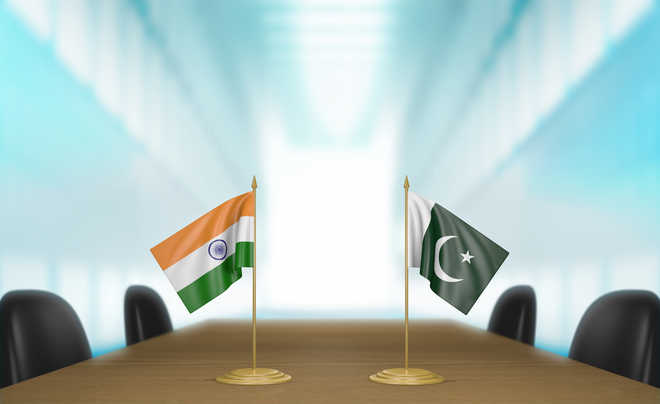
According to Indus Water Treaty, India has been given the right to generate hydroelectricity through run-of-the-river projects on the western rivers subject to specific criteria for design and operation
Photo for representation. — iStock
New Delhi, August 24
Pakistan has raised objections to the design of India’s Kiru hydroelectric plant, a mega 624 MW project over the Chenab in Jammu and Kashmir, but New Delhi asserts that the project is fully compliant with the Indus Water Treaty, officials said on Tuesday.
Confirming this development, India’s Indus Commissioner Pradeep Kumar Saxena told PTI that his Pakistan Indus Commissioner Syed Muhammad Meher Ali Shah raised the objections last week.
Saxena, however, asserted that the design of the project is fully compliant with the provisions of the Indus Waters Treaty. It has been certified by the Central Water Commission, an apex organisation of the country in the field of water resources.
This run of river project is being implemented by Chenab Valley Power Projects Limited, a joint venture of the National Hydropower Company and Jammu and Kashmir State Power Development Corporation (JKSPDC).
“As a responsible upper riparian state, India is committed for full utilisation of its rights and believes in an amicable resolution the issues raised by Pakistan side in letter and spirit of the treaty.
“Pakistan’s objections on this project may come up for discussions in the next meeting of the Permanent Indus Commission scheduled this year in Pakistan. In the forthcoming meeting, the Indian side will explain its position and hope that Pakistan will appreciate the same and its apprehensions will be addressed through discussions,” Saxena said.
The treaty provides Pakistan the right to raise objection on Indian design within three month of the receipt of the information. India has supplied the information on this project in June to Pakistan.
Under the IWT signed between India and Pakistan in 1960, all the waters of the eastern rivers—Sutlej, Beas, and Ravi—amounting to around 33 million acre feet (MAF) annually is allocated to India for unrestricted use. The waters of western rivers—Indus, Jhelum, and Chenab—amounting to around 135 MAF annually has been assigned largely to Pakistan.
According to the treaty, India has been given the right to generate hydroelectricity through run-of-the-river projects on the western rivers subject to specific criteria for design and operation. The treaty also gives right to Pakistan to raise objections to designs of Indian hydroelectric projects on the western rivers.
India is permitted to construct the run of the river plants on western rivers with limited storage as per criteria specified in the treaty, Saxena said.
Earlier this year, during the meeting between Indus Commissioner of India and Pakistan, Shah also raised objections on the designs of Pakal Dul and Lower Kalnai hydropower projects in Jammu and Kashmir. To this, India said the designs are fully compliant with the treaty.
Pakistan has also raised objections on hydropower projects in Chilling (24 MW), Rongdo (12 MW) and Ratan Nag (10.5 MW) are in Leh; while Mangdum Sangra (19 MW), Kargil Hunderman (25 MW) and Tamasha (12 MW) are in Kargil. India had said the designs of these projects are also fully compliant with the treaty. PTI
Will replace grenade No. 36 of World War I vintage design
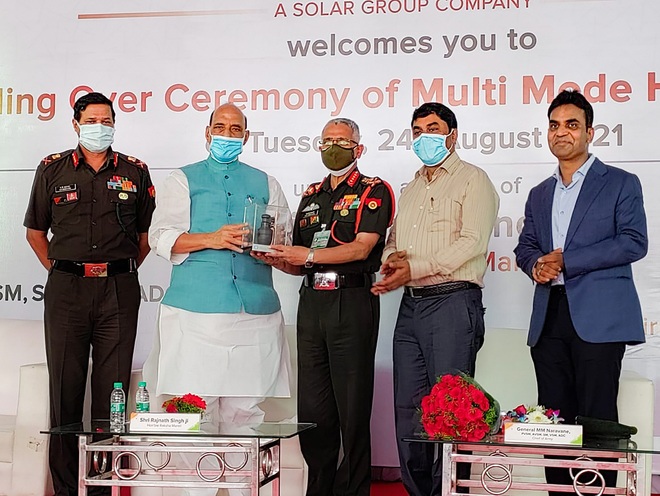
Defence Minister Rajnath Singh being handed over the scale replica of a multi-mode hand grenade by Chief of the Army Staff General MM Naravane in Nagpur on Tuesday. PTI
Tribune News Service
New Delhi, August 24
The first batch of multi-mode hand grenades (MMHG) that have been manufactured by a private company using the transfer of technology from Terminal Ballistics Research Laboratory (TBRL) were handed over to the Indian Army in the presence of Defence Minister Rajnath Singh at Nagpur on Tuesday.
The TBRL, headquartered at Chandigarh, is under the Defence Research & Development Organisation (DRDO). The grenades have been produced by Economic Explosives Limited (EEL).
The MoD says the grenade has a distinctive design that gives flexibility of employment in both defensive and offensive modes. These new grenades will replace grenade No. 36 of World War I vintage design, which had been continuing in service till date. The EEL had signed a contract for supply 10 lakh such grenades.
IAF C-130 fleet to be maintained by US firm
US company Lockheed Martin said it has been awarded a $328.8 million five-year contract from the IAF to provide dedicated and comprehensive support for the IAF’s fleet of C-130J Super Hercules Aircraft. Lockheed Martin is the manufacturer of the plane. The contract is a continuation of a five-year support contract signed earlier.
US won’t extend pullout date; G7 for ‘safe passage’ beyond August 31
Modi, Putin discuss Afghan, agree to form bilateral channel | 14-day quarantine for Afghan evacuees
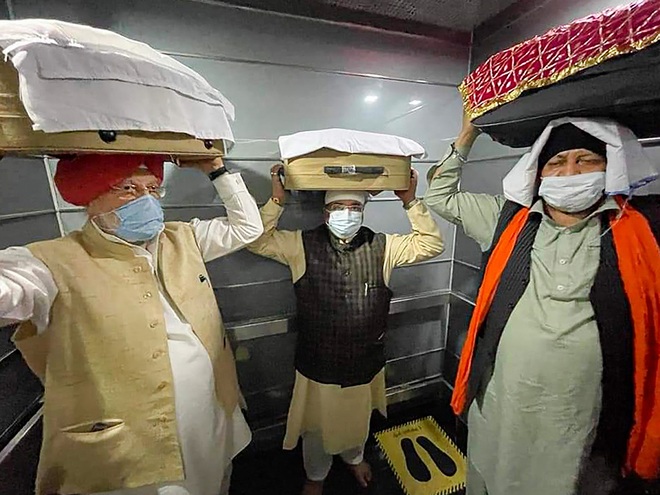
Union minister Hardeep Singh Puri and two others carry saroops of Guru Granth Sahib brought from Kabul, at IGI Airport. PTI
Sandeep Dikshit
Tribune News Service
New Delhi, August 24
US President Joe Biden turned down pleas from other G7 leaders for extending the deadline for the withdrawal of troops from Afghanistan.
A tweet from the White House skipped the deadline extension aspect and said Biden discussed at G7 a continuation of “our close coordination on Afghanistan policy, humanitarian assistance and evacuating citizens and vulnerable Afghans”.
UK Prime Minister Boris Johnson said the G7 had agreed on a roadmap for “future engagement with the Taliban, but are currently insisting on ‘safe passage’ beyond the August 31 deadline”. Sensing US firmness in pulling out, India and Russia have decided to set up a permanent bilateral channel for consultations to discuss Afghanistan.
“It is important for the two strategic partners to work together,’’ said an MEA readout of the 45-minute conversation between PM Narendra Modi and Russian President Vladimir Putin.
PM Modi had on Monday conferred with German Chancellor Angela Merkel on Afghanistan. Along with Italy and Spain, Berlin is playing an important role in evacuations from Kabul and has soldiers on the ground.
Separately, NSA Ajit Doval flagged to his BRICS counterparts, including from Russia and China, cross-border terrorism by groups such as Lashkar-e-Toiba (LeT) and Jaish-e-Mohammed (JeM) which enjoy state support and threaten peace and security.
Their activities tend to slip under the radar during global talks on terrorism in the region and were flagged by Doval at the virtual meeting of “BRICS High Representatives Responsible for National Security”, which he had hosted.
CIA Director meets Taliban top leader
CIA chief William Burns travelled to Kabul this week for talks with Taliban leader Mullah Baradar, US media reported as the US came under pressure from allies to extend withdrawal deadline
78 more evacuated from Afghanistan
India on Tuesday brought back 78 persons, including its 25 nationals and some Afghan Sikhs and Hindus, from Dushanbe, a day after they were evacuated from Kabul
Taliban to send team to Panjshir for talks
On a tense day around Panjshir when the resistance forces stalled Taliban march, reports said the insurgents agreed to send a team for talks with Ahmad Massoud
Hope Pak terror groups don’t use Afghan soil: India at UNHRC
India on Tuesday spoke about the “grave humanitarian crisis” unfolding in Afghanistan and hoped that the situation does not pose a challenge to its neighbours nor is its territory used by terrorist groups such as Lashkar-e-Toiba (LeT) and Jaish-e-Mohammed (JeM) to threaten any country. – File photo
New Delhi, August 31
India on Tuesday spoke about the “grave humanitarian crisis” unfolding in Afghanistan and hoped that the situation does not pose a challenge to its neighbours nor is its territory used by terrorist groups such as Lashkar-e-Toiba (LeT) and Jaish-e-Mohammed (JeM) to threaten any country. Speaking at the UN Human Rights Council’s (UNHRC) special session on “Serious human rights concerns in Afghanistan”, Indian diplomat Indra Mani Pandey called upon all parties concerned to allow unhindered access to international assistance because “stability in Afghanistan is linked to the peace and security of the region”.
UNHRC chief Michelle Bachelet sought a mechanism to closely monitor Taliban’s actions following credible reports of serious violations by the insurgent group, including summary executions of civilians and Afghan security forces. A fundamental “red line” will be the Taliban’s treatment of women and girls and freedom of self-expression and employment, she added.
The special session
was convened following a joint request by Pakistan, Organisation of Islamic Cooperation (OIC) and Afghanistan. Unsurprisingly, the draft resolution penned by Pakistan is mildly worded, doesn’t name the Taliban and doesn’t call for a fact-finding mission. As for monitoring, it has suggested a report after nine months.
HOSTEL FOR VEER NAARIS : COMING UP IN JALANDHAR (Pb)
Following message sent by District Head Jalandhar:
Message of District Head Jalandhar starts:
There is a hostel accommodation coming up in jalandhar cantt for to provide for punjab veer naaris or widows living in penury and requiring organizational support. The facility is being inaugurated shortly. names of needy widows or veer naaris from other veteran sahayata Kendra but there is no one on their roll on date. The facility will provide lodging and care for them. However no dependants are being considered for same.
Message ends:
If there is any one meeting the criteria then the details be shared with District Head Jalandhar for further coordination. Or send an email sanjhamorcha303@gmail.com
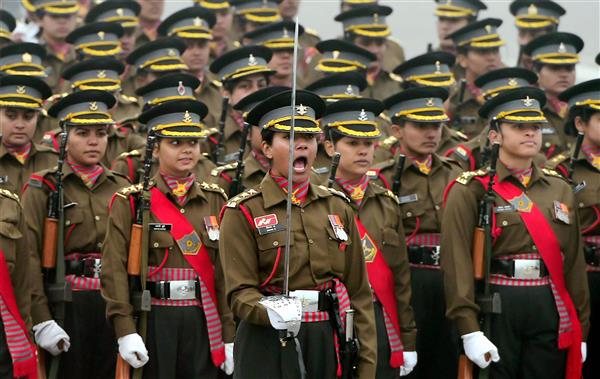
For the first time, the Indian Army has allowed Colonel-level rank for women officers in “support arms” of the force.
Tribune News Service
New Delhi, August 23
For the first time, the Indian Army has allowed Colonel-level rank for women officers in “support arms” of the force.
This is the first time that women officers serving with the Corps of Signals, Corps of Electronic and Mechanical Engineers (EME) and the Corps of Engineers have been approved to the rank of Colonel.
A selection board of the Indian Army cleared the way for the promotion of five women officers to Colonel (Time Scale) rank, post completion of 26 years of service.
The five women officers selected for Colonel (Time Scale) rank are Lt Col Sangeeta Sardana from the Corps of Signals, Lt Col Sonia Anand and Lt Col Navneet Duggal from the Corps of EME and Lt Col Reenu Khanna and Lt Col Ritcha Sagar from the Corps of Engineers.
Previously, promotion to the rank of Colonel was only applicable for women officers in the Army Medical Corps, Judge Advocate General and the Army Education Corps.
The widening of promotion avenues to more branches of the Indian Army is a sign of increasing career opportunities for women officers combined with the decision to grant permanent commission to women officers from a majority of branches of the Indian Army.
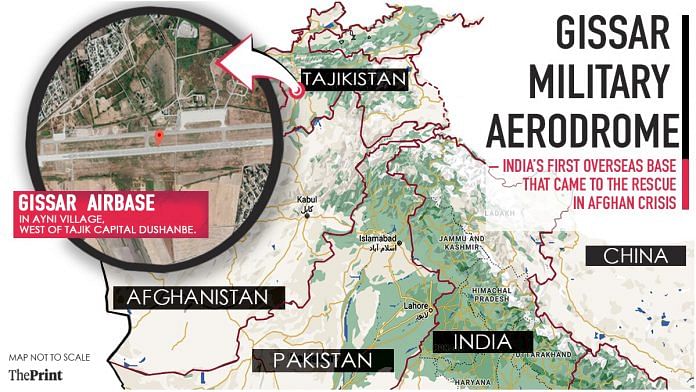
Gissar Military Aerodrome — India’s first overseas base that came to the rescue in Afghan crisis
New Delhi: Gissar Military Aerodrome (GMA), India’s first overseas base operated along with Tajikistan and aimed at giving a strategic heft to their military operations and training, has come in handy in India’s effort to evacuate hundreds of its citizens and Afghans from Kabul, overrun by the Taliban since last Sunday.
The GMA, popularly known as the Ayni airbase named after the village Ayni, is just west of the Tajik capital Dushanbe. It has been administered by India along with Tajikistan for nearly two decades, sources in the defence and security establishment told ThePrint.
National Security Advisor Ajit Doval and former Air Force chief Air Chief Marshal B.S. Dhanoa had a key role in setting up the base, which was funded by the Ministry of External Affairs, sources said.
Though outside the public eye, the base has come under the spotlight because of the ongoing evacuation process from Afghanistan during which C-17 and C-130 J transport aircraft of the Indian Air Force besides an Air India aircraft have used the Tajikistan airbase, reported ANI.
This is a modal window.The media could not be loaded, either because the server or network failed or because the format is not supported.
Similarly, when India evacuated its embassy staff from Kabul along with stranded Indians on August 17, the C 17 was waiting at the GMA for clearance from the Americans to fly in and evacuate them. This was because the aircraft could not remain at the Kabul airport since it would have taken up the already scarce place on the tarmac, sources said.
The GMA is often confused with another Farkhor base. Farkhor in southern Tajikistan — near the border with northern Afghanistan — is a city where India ran a hospital in the 1990s.
It is at the same hospital that the powerful Afghan Tajik guerrilla leader, the late Ahmed Shah Masood of the Northern Alliance — which fought the Soviets and later the Taliban — was brought in for treatment after a suicide bomber blew himself up near him in 2001. However, the military doctors at the hospital could not save him despite all efforts.
Following the 9/11 strikes, the hospital ceased operations, sources said. India runs a still functional 50-bed hospital for Tajik military personnel at Qurgan Teppa in southern Tajikistan.
It was around 2001-2002 that “radical thinkers” in the MEA and security establishment came up with the idea of developing the dilapidated GMA in Ayni, a project which was strongly backed by former defence minister the late George Fernandes, sources said.
The IAF appointed then Group Captain Naseem Akhtar (Retd) to begin the work on the airbase. Akhtar, who retired as Air Commodore, was followed by another officer during whose tenure the private contractor engaged by the Indian government went back on his obligations which then led to a legal suit.
The Indian government also roped in the Border Roads Organisation (BRO) team which was led by a Brigadier. At that point in time, there were around 200 Indians working on the project and the airstrip at Gissar was extended to 3,200 metres — long enough for most fixed-wing aircraft to land and take-off.
Besides this, the Indian team also developed hangars, overhauling and the refuelling capacity of aircraft. It is estimated that India spent close to USD 100 million developing the GMA.
Air Chief Marshal Dhanoa was appointed the first Base Commander of an ‘operational’ GMA around the end of 2005 when he was a Group Captain.
However, it was only under the Narendra Modi government that India undertook the first international deployment of fighters — Su 30MKI — to the GMA on a temporary basis, sources said.
The strategic idea behind the GMA
Sources said that the GMA gives a lot of strategic heft to the Indian military. Tajikistan shares borders with China and Pakistan. It adjoins Afghanistan’s Wakhan Corridor, a narrow strip of land that shares a boundary with PoK and China.
With Tajikistan just about 20 km from Pakistan-occupied Kashmir across the corridor, having the ability to operate from Tajikistan gives a lot of options to military planners.
IAF fighters can target Peshawar from Tajikistan, which puts additional pressure on the resources of Pakistan, sources said.
At a time of war, this means that Pakistan will have to move its assets from its Eastern borders to the Western which weakens its direct front with India.
Another big advantage of having a foothold in Tajikistan is that it opens up different routes into Afghanistan, bypassing Pakistan.
However, some within the defence and security establishment, argue that India has never been able to fully utilise the GMA or the investments made. Other such joint collaborative efforts with other countries, too, have not fully taken off over the years, they said.
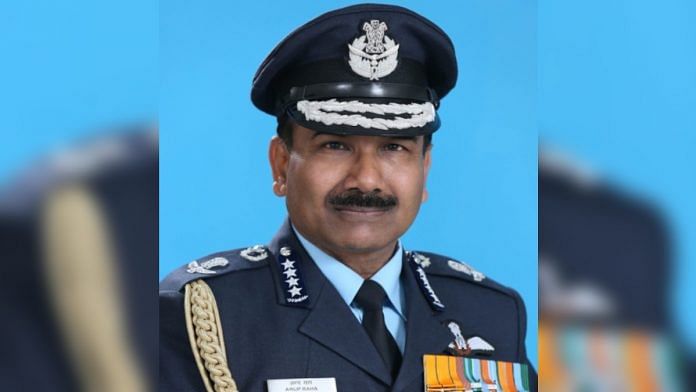
File photo of former IAF chief Arup Raha | indianairforce.nic
Kolkata: India should not get militarily involved in Afghanistan, former IAF chief Arup Raha said on Monday, warning that China and Pakistan will burn their fingers by cosying up to the Taliban.
The former Indian Air Force (IAF) air chief marshal said that the Taliban policy of China and Pakistan will backfire on them as a result of their “dishonest purposes” for getting involved in Afghanistan.https://8a1a64bfaddec4bca32c425539d9b29d.safeframe.googlesyndication.com/safeframe/1-0-38/html/container.html
“I don’t think India should put the boots on the ground there and get into trouble. Military involvement in Afghanistan is dangerous, and India should not be a part of any such future move of the Americans or NATO forces,” Raha told PTI in an interview.
Reminding the adage about Afghanistan that it is the “Graveyard of Empires”, the former IAF chief said that the United States of America (USA) had lost more than 2,000 troops in the country between 2001 and 2021.
Raha, who led the IAF from January 1, 2014, to December 31, 2016, said that with the USA having vacated strategically important Afghanistan, which shares borders with several central Asian nations, countries like China, Pakistan and even Russia feel that they will “have a nice time” in the region.
“There is no possibility of that happening as the Taliban is not going to listen to any of them. China is trying to appease them by offering them money in the name of development,” Raha, a former chairman of the Chiefs of Staff Committee of the three wings of the Indian Armed Forces, asserted.
He said that the Chinese are wary of the possibility of the Taliban getting involved in Xinjiang province and infiltrate its Jihadi culture there, where the communist country has allegedly “mistreated the Uyghur Muslims and suppressed and oppressed them”.
“Within two to five years, China will feel the heat of Jihadi movement in Xinjiang, which shares its borders with Afghanistan. China will face huge trouble; they already have problems in Tibet, Hong Kong, and Taiwan. They will have their hands full. In two to five years, there will be utter chaos as far as the Taliban is concerned,” he said.
Dismissing the Taliban leadership’s claims that they have changed and are a softer version of their previous self, Raha said they are “barbaric and will do what they have been taught to”.
Soon after the blitzkrieg takeover of Kabul by the Taliban following the exit of US forces, China was among the first countries to say that it stands ready to develop good neighbourly, friendly and cooperative relations with Afghanistan.
A Taliban delegation, led by the chief of its Political Commission Mullah Abdul Ghani Baradar, which visited China last month during its talks with the Chinese Foreign Minister Wang Yi, had promised not to permit the Uyghur Muslim militant group from Xinjiang, the East Turkistan Islamic Movement (ETIM), to operate from Afghanistan.https://8a1a64bfaddec4bca32c425539d9b29d.safeframe.googlesyndication.com/safeframe/1-0-38/html/container.html
Within hours of Kabul’s fall on August 15, Pakistan Prime Minister Imran Khan said the Afghan people had “broken the shackles of slavery”.
Raha said that with organisations like the Tehrik-i-Taliban Pakistan being active in the country, the establishment in Islamabad is likely to face a challenge if the Taliban consolidates in Afghanistan.
He said that the Afghan people have good strength and weaponry but are not ready to fight back against the Taliban.
“I don’t think outsiders should get involved too much, let the Afghans fight for their freedom and decide what they want to do and how they want to live,” he said.
Questioning why the western world should decide their way of life, Raha said it is not right and claimed that the West got involved in Afghanistan for their own interest, including business, industry, and the powerful arms lobby in the USA.
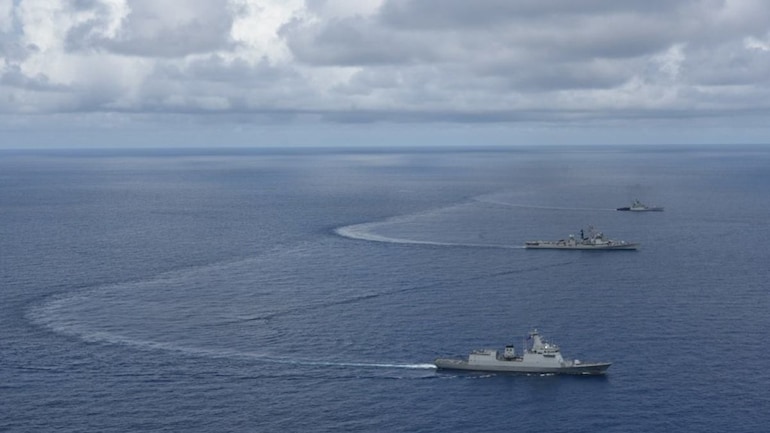
INS Ranvijay and INS Kora are currently deployed to the Western Pacific. (Photo: PIB)
Two ships of the Indian Navy, INS Ranvijay and INS Kora, carried out a maritime partnership exercise with BRP Antonio Luna of the Philippine Navy on Monday in the West Philippine Sea.
The navies of India and the Philippines carried out a maritime partnership exercise in the West Philippine Sea on Monday.
INS Ranvijay (Guided Missile Destroyer, D55) and INS Kora (Guided Missile Corvette, P61) carried out the maritime exercise with BRP Antonio Luna (Frigate, FF 151) of the Philippine Navy.
The joint evolutions conducted during the exercise included several operational manoeuvers and the participating ships of both navies were satisfied with the consolidation of interoperability achieved through this exercise.
INS Ranvijay and INS Kora are currently deployed to the Western Pacific with an aim to strengthen maritime security collaboration with partner nations.
In compliance with the prevailing pandemic guidelines, the exercise was conducted in a contactless manner. After the exercise, the Indian naval ships are scheduled to call at Manila Port for replenishment.