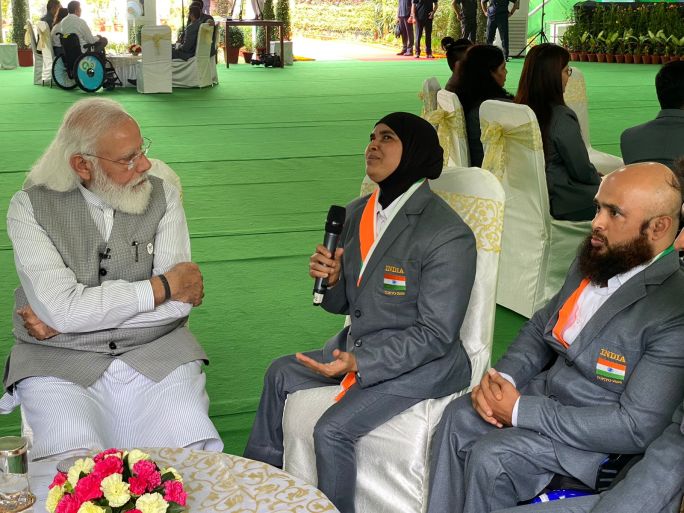
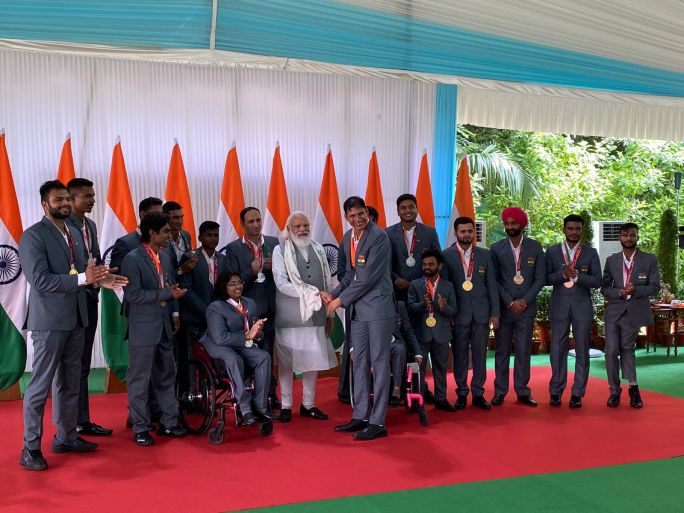
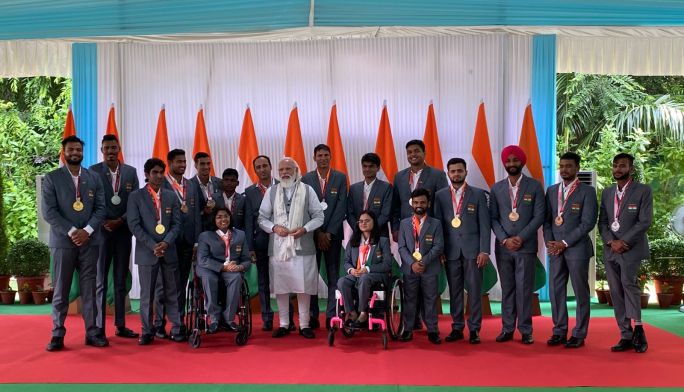
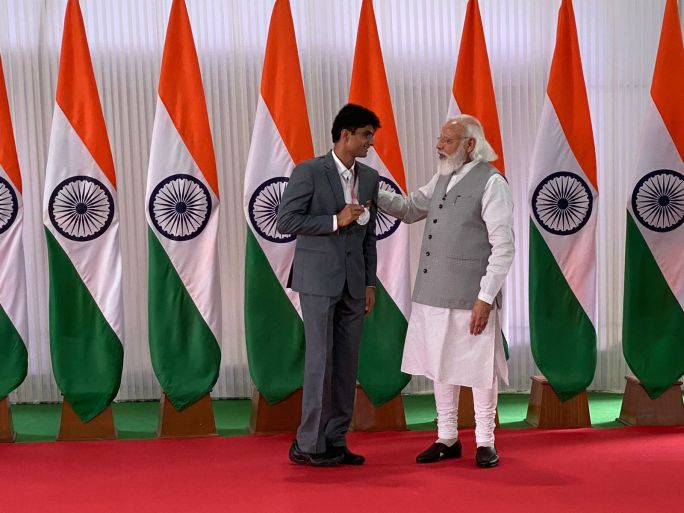
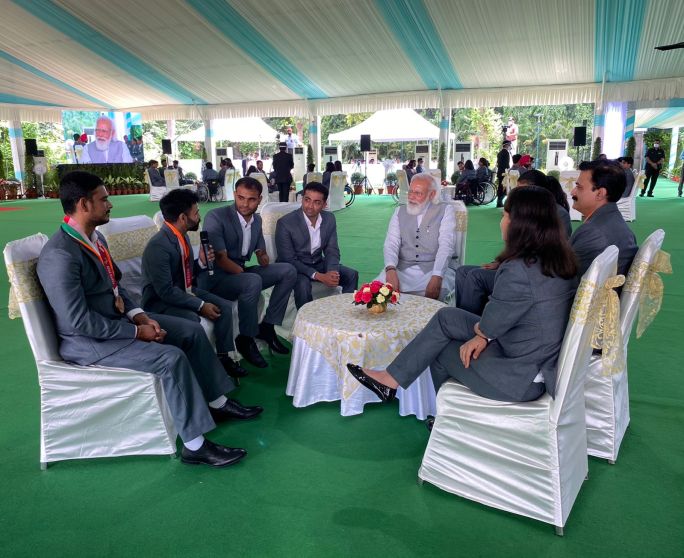
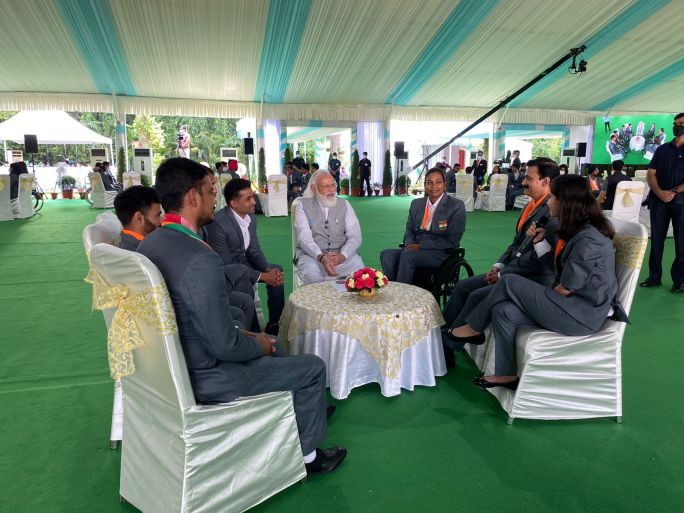
India’s Paralympians presented Prime Minister Narendra Modi with an autographed stole on Thursday during a breakfast hosted by him to felicitate the contingent at his residence here.
The Indian para-athletes returned from Tokyo on the back of a sensational campaign that saw them win an unparalleled 19 medals, including five gold, eight silver and six bronze.
This was the country’s best-eveParalympics campaign as it finished 24th in the overall tally.
The PM was presented with a white stole signed by all the medal winners, which he was seen wearing around his neck.
Modi, who has been the first to congratulate the para-athletes on call after their medal winning feats, was seen talking to shuttlers Suhas Yathiraj, the District Magistrate of Noida, who won a silver, gold medallist Krishna Nagar (badminton) and young Palak Kohli (badminton).
Indian shuttlers bagged four medals including two gold, in para badminton, which made its debut in the Paralympics.
Shooters Avani Lekhara and Singhraj Adana, who both won two medals each in the Tokyo Games, also chatted with the PM.
Lekhara, who was paralysed waist down after being involved in an accident, had scripted history by becoming the first Indian woman to win a Paralympic gold before adding a bronze to her kitty.
The 39-year-old Adana, who is afflicted with polio, clinched a silver and a bronze.
The PM also interacted with veteran javelin thrower Davendra Jhajharia and high jumper Mariyappan Thangavelu, who won gold medals in 2016 Rio Games. The duo finished on podium again, this time with silver medals.
Also, present were table tennis player Bhavina Patel, who won a silver, and bronze medallist recurve archer Harvinder Singh. PT
Rajnath, Gadkari inaugurate emergency landing strip for IAF planes on national highway in Barmer
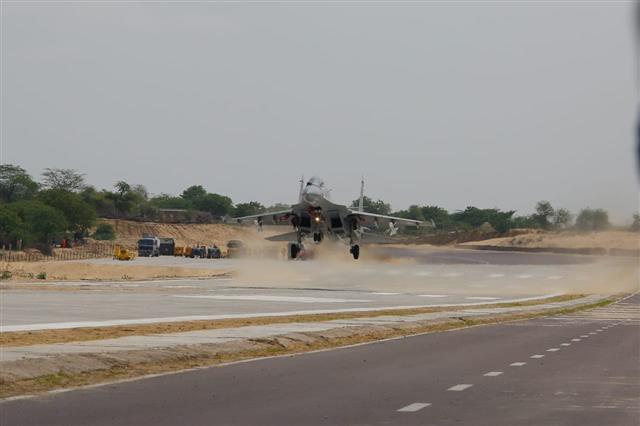
The two ministers also witness multiple aircraft operations on the emergency landing facility of NH-295
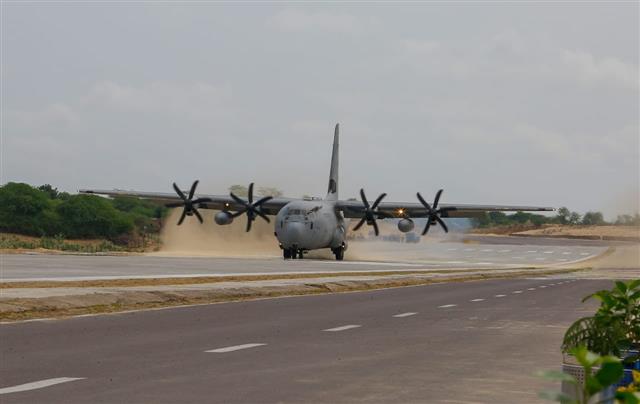
An-32 military transport aircraft and Mi-17v5 helicopter of the IAF also landed at the ELF, showing its complete operational readiness to act as an auxiliary military airbase. Photo credit: Twitter/@rajnathsingh
Barmer, September 9
Union ministers Rajnath Singh and Nitin Gadkari inaugurated an emergency landing strip at Satta-Gandhav stretch on National Highway 925 here on Thursday for Indian Air Force (IAF) planes.
A Hercules C-130J plane of the IAF, carrying the two ministers and Chief of Defence Staff Bipin Rawat, conducted a mock emergency landing on the national highway on Thursday. NH-925 is India’s first national highway to be used for emergency landing of IAF aircraft.
The two ministers also witnessed multiple aircraft operations on the emergency landing facility (ELF) of NH-295 on Thursday.
Sukhoi-30MKI fighter jet also conducted a mock emergency landing at the ELF in front of the two ministers.
An-32 military transport aircraft and Mi-17v5 helicopter of the IAF also landed at the ELF, showing its complete operational readiness to act as an auxiliary military airbase.
The National Highways Authority of India (NHAI) has developed the 3-km section of Satta-Gandhav stretch of NH-925 as an ELF for the IAF. In October 2017, fighter jets and transport planes of the IAF had conducted mock landings on the Lucknow-Agra Expressway to show that such highways can be used by the IAF planes for landing in case of an emergency.
The Lucknow-Agra Expressway, which is not a national highway, comes under the Uttar Pradesh government.
Officials told PTI a total of 27 other highways, apart from the one in Barmer, are being currently studied jointly by the IAF and the NHAI to see if emergency landing strips can be developed on them.
The emergency landing strip, which was inaugurated on Thursday, is part of newly developed two-lane paved shoulder of Gagariya-Bakhasar and Satta-Gandhav section having total length of 196.97 km and costing Rs 765.52 crore under the Bharatmala Pariyojana.
This highway project will improve connectivity between villages of Barmer and Jalore districts located on the international border.
Apart from the emergency landing strip, three helipads (size 100×30 metres each) have been constructed in Kundanpura, Singhania and Bakhasar villages under this project, according to the requirements of the IAF and the Indian Army. PTI
You will stay in our hearts forever: Sidharth Malhotra on Captain Vikram Batra’s birth anniversary
Malhotra, who essayed Captain Batra’s role in a recent biopic, pens an emotional note on the war hero’s birth anniversary
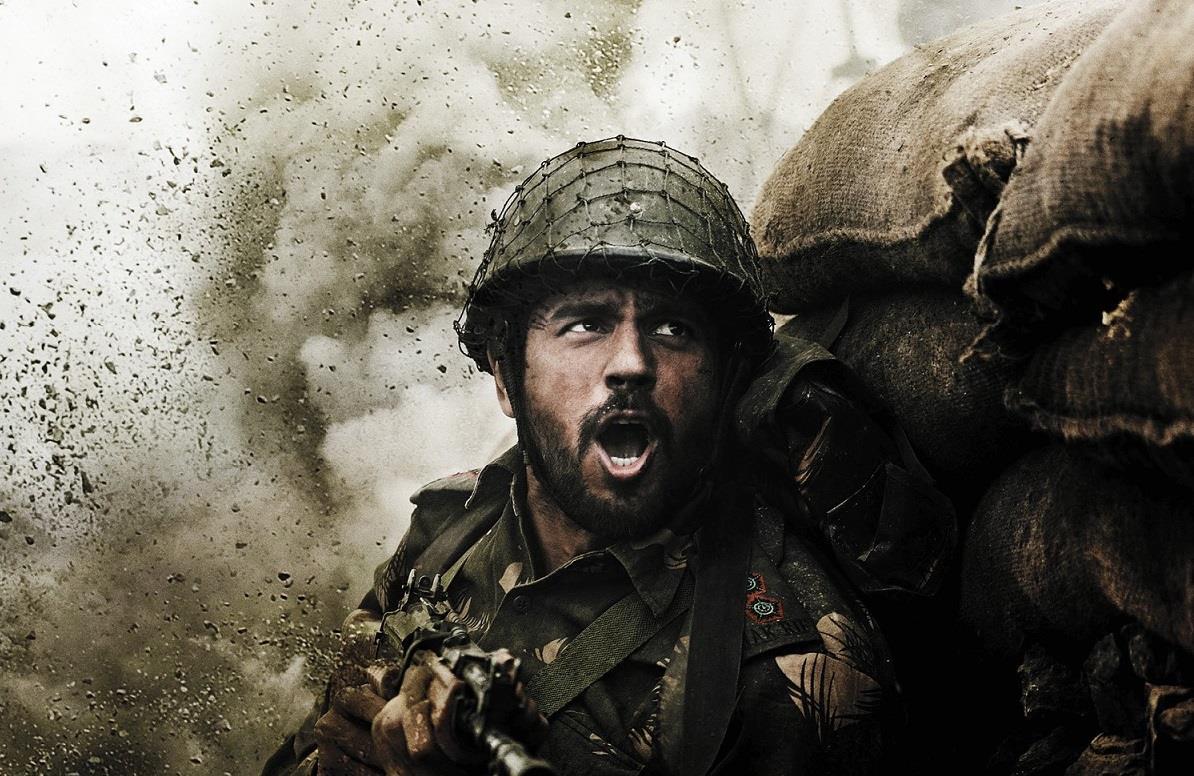
Sidharth Malhotra essayed Captain Batra’s role in a recent biopic.
Mumbai, September 9
Bollywood actor Sidharth Malhotra on Thursday paid tribute to Captain Vikram Batra on his 47th birth anniversary saying the Kargil war hero would “forever” stay in the hearts of people.
Malhotra, who essayed Captain Batra’s role in a recent biopic, penned an emotional note on the war hero’s birth anniversary.
“They say that those who touch our lives stay in our hearts forever. And Captain Vikram Batra, you have touched our lives immensely with your valour, wisdom, charm & love for the nation. You will stay in our hearts forever…In your loving memory, Jai Hind,” he wrote, alongside a collage photo of Captain Batra.
Known for his bravery, Captain Batra died fighting Pakistani forces during the Kargil war in 1999 at the age of 24.
He was given the highest wartime gallantry award Param Vir Chakra posthumously.
‘Shershaah’, based on the life of Captain Batra with Malholtra in the lead role, released on Amazon Prime Video on August 12.
The film, which takes its title from the war hero’s code name, is directed by Vishnu Varadhan. Actor Kiara Advani was seen in the role of Captain Batra’s fiancee Dimple Cheema in the movie. PTI
Top Army officer tasked to lay logistics for theatre command
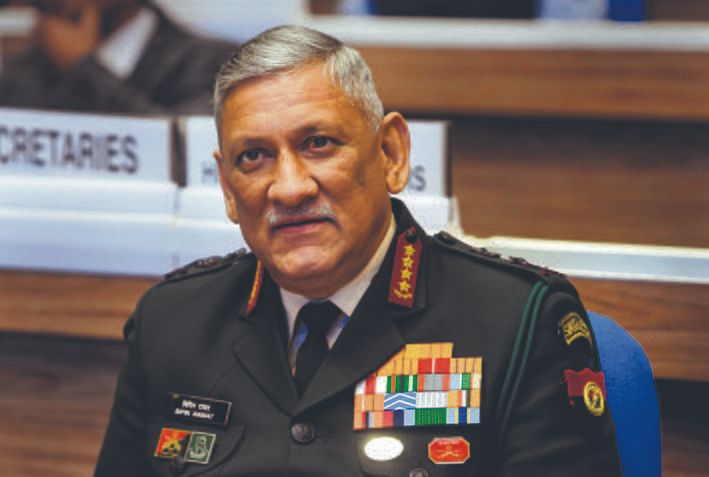
Chief of Defence Staff (CDS) Gen. Bipin Rawat. File photo
Ajay Banerjee
Tribune News Service
New Delhi, September 8
The formation of much-awaited “theatre command” structure for the armed forces has gained ground with a senior military commander being tasked to set up the administrative and logistics structure of the theatre command on the western front.
A theatre command aims at amalgamating available military resources under a single command authority for a specified area. The government has mandated Chief of Defence Staff (CDS) Gen Bipin Rawat to create the theatre commands.
The CDS has tasked the commander of the Indian Army’s South-Western command at Jaipur to set up the structures of the western theatre command that would look after the borders with the western neighbour.
The existing area of the Army’s Northern Command has been kept out of theaterisation ambit. The IAF’s deployment in J&K and Ladakh will also not be altered. The full amalgamation of three armed forces into a “theatre command” would take at least two years, official sources said.
“The thinking process is still on. The Jaipur-based Commander will come with the plan on which all units of the Army, IAF and the Navy will be integrated under the western theatre. Once that plan is ready and the structures are in place, a theatre commander will be appointed and be given the ‘operational command and control’ of the units which come under the western theatre. The existing ‘area commands’ of the Army, IAF and the Navy would cede their ‘operational powers’ to the theatre commander. Gradually, all roles of the existing commands will go to the theatre commander. The existing commands will function as advisory to the theatre commander,” sources added.
ISI chief in Kabul, India watching Afghanistan events, Pak actions carefully
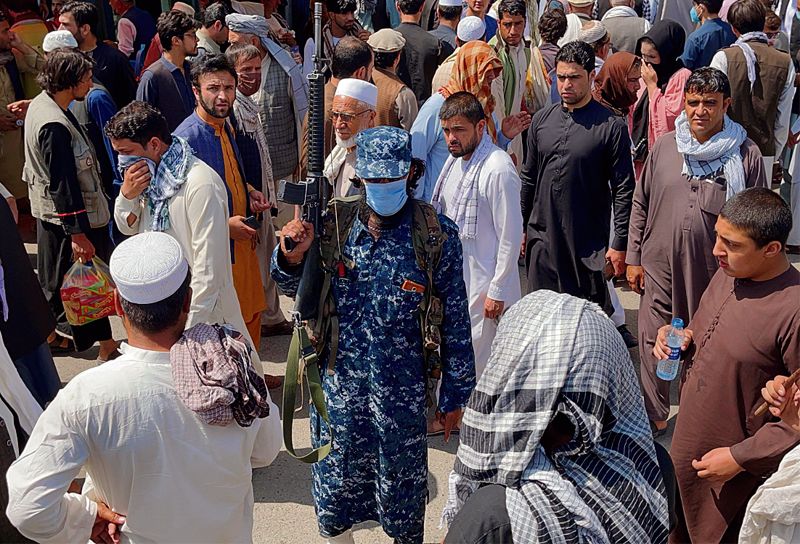
A member of the Taliban force stands guard at a Kabul street. Reuters
Tribune News Service
New Delhi, September 4
Both India and the US are closely watching Pakistan’s actions in Afghanistan, said Foreign Secretary Harsh Vardhan Shringla as ISI chief Lt Gen Faiz Hamid arrived in Kabul amid reports of heavy fighting in Panjshir valley and continued secrecy over government formation in Afghanistan.
Zabiullah Mujahid, Taliban spokesperson
Govt next week
Announcement on new government and cabinet will be made next week.
“Obviously, like us, they’re (the US) also watching carefully. We have to watch Pakistan’s actions with a fine tooth comb,” Shringla said on Saturday at the end of his visit to Washington. “The Taliban have indicated they would be reasonable in addressing New Delhi’s concerns,” he added in reference to an MEA team’s August 31 meeting with the Taliban Leadership Council’s Sher Mohammed Stanikzai in Doha.
Antony Blinken, US Secy of State
Hope Taliban will keep their word
The expectation is to see a government that makes good on commitments that the Taliban have made, particularly on freedom of travel, not allowing Afghanistan to be used as a launching ground for terrorism & upholding basic rights of people, including women & minorities.
“Our engagement has been limited. Whatever conversation we’ve had so far, the Taliban seem to indicate they will be reasonable in addressing India’s concerns,” Shringla said. “The situation is very fluid and you have to see whether the assurances that have been made publicly are actually maintained on the ground, and how things work out,” he explained, dispelling the impression that a wait and watch policy meant doing nothing. Government formation in Afghanistan remains a work-in-progress. There has been no public debate on its structure or constituents but for statements from Taliban leaders that Mullah Haibatullah and Mullah Baradar would hold the top two positions. The ISI chief’s visit is being seen against the backdrop of a stalemate in government formation. Taliban spokesman Zabiullah Mujahid on Saturday said the formation of a new government had been put off to next week.
The Taliban sought to batten down resistance from the Panjshir Valley by moving heavy weaponry up the surrounding hills and is trying to enter Shotul district, the mouth of Panjshir Valley, where it has reportedly placed containers to restrict access. “We are doing what’s humanly possible with what we have. Pray for us,’’ said a social media handle of the National Resistance Front or Resistance 2.
In Kabul, women rights activists and journalists protested for the second day and the Taliban used force to disperse the crowd.
Celebratory fire kills 17
At least 17 persons were killed in celebratory gunfire in Kabul, news agencies said on Saturday, after Taliban sources said their fighters had seized control of Panjshir, the last province in Afghanistan holding out against the Islamist group.
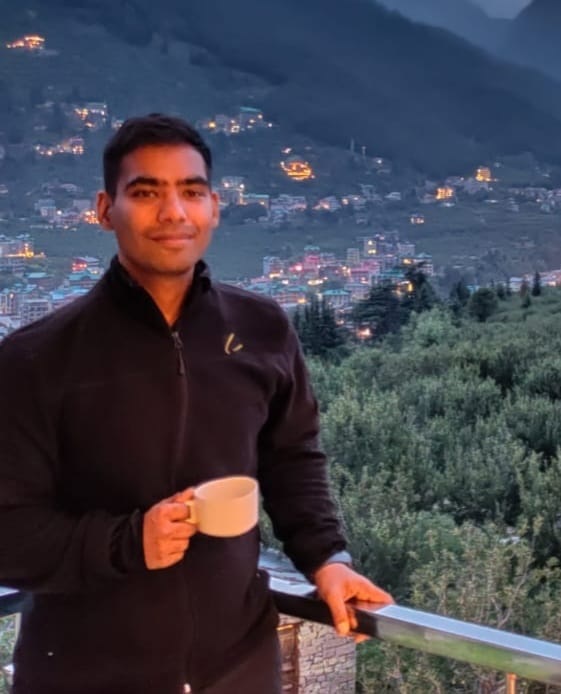
Twentyfive days have passed since Capt Jayant Joshi went missing after his chopper Rudra, an Advanced Light Helicopter, crashed into the Ranjit Sagar Dam lake. His parents Harish and Jeevan Tara Joshi are still waiting for elite Navy divers to fish out his body and hand it over to them.
Officers recall Jayant being a boy brimming with youthful exuberance. He was an officer who could do no wrong, personally or professionally.
On August 25, divers retrieved the body of Lt Col AS Batth from the depths of the reservoir. However, there is no trace of Jayant even after the Army pressed into service the state-of-the art diving equipment.
Search seems to have lost way
There seems to be no end in sight. The search seems to have lost direction. With every passing day, our son’s body is rotting and decaying in water. No compassion and respect is being shown to the soldier. —Parents of Capt Jayant Joshi
All efforts being made
All possible methods continue to be deployed by the Army and Air Force. These include the use of hi-tech equipment, including multi-beam sonar, side scanners and remotely operating vehicles. —Officials
The agony, anguish and angst of the Joshis is being directed towards the officers handling the search operations.
“There seems to be no end in sight. The search seems to have lost direction. With every passing day, our son’s body is rotting and decaying in water. No compassion and respect is being shown to the soldier,” they claimed.
However, officials say, “All possible methods continue to be deployed by the Army and Air Force. These include the use of hi-tech equipment, including multi-beam sonar, side scanners and remotely operating vehicles.”
On the day one of the search, the district administration and police sent in divers. However, they were amateurs forcing the Air Force to call professional divers from the Navy.
With no periodic updates on the operation, Joshi’s kin have been left high and dry. Misinformation often fills voids of information. This is precisely what happened as rumours of all kinds started doing the rounds forcing Pathankot Senior Superintendent of Police Surendra Lamba to warn people engaged in malicious gossip.
Jayant was a student of the prestigious Army Public School, Dhaula Kuan, New Delhi. Later he completed his graduation in electrical engineering. He was commissioned in the 9th Sikh Light Infantry in 2017 and two years later joined the Pathankot based 254th Army Aviation Squadron.
The family is distraught. Every dawn brings with it hope. By dusk this very hope slips into oblivion. “We are holding on to hope and belief that our son will be in our midst soon. For us, hope is being able to see that there is light despite all darkness,” said Jeevan Tara
Recalling the exploits of Lt Col Shamsher Singh, 2nd Lt Shamsher Singh Samra and Lance Naik Ram Ugram Pandey
50 YEARS OF THE 1971 WAR
The Maha Virs of 8 Guards
Recalling the exploits of Lt Col Shamsher Singh, 2nd Lt Shamsher Singh Samra and Lance Naik Ram Ugram PandeySHARE ARTICLE
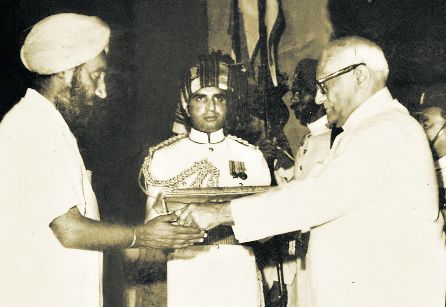
Gurdeep Singh Samra, father of 2nd Lt Shamsher Singh Samra, receiving the MVC (awarded posthumously) from President VV Giri
Sujan Dutta
Hollywood producer Robert Evans of ‘The Godfather’ said every story has three sides: your side, my side and the truth, and nobody is lying. At a stupid border called Hilli in the eastern front of the war, the three sides had names: Lt Col Shamsher Singh, Second Lieutenant Shamsher Singh Samra and Lance Naik Ram Ugram Pandey.
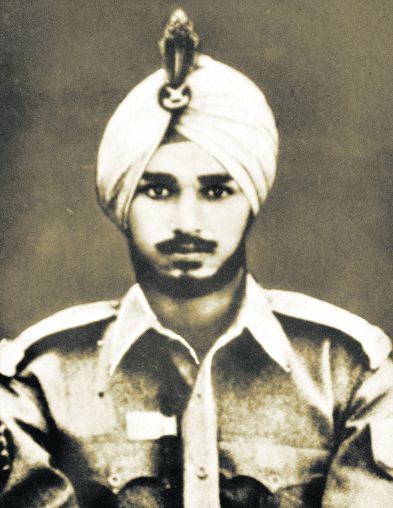
2nd Lt Shamsher Singh Samra
Stories redolent with the truth also destroy shibboleths. Let’s do it first up. The official line then as now is that the war began on December 3 that year. That is a flat lie. What the 8 Guards with the three MVCs were tasked to do is evidence that officialdom lies.
Lies mattered less than a line. A railway line, really, at a point where the border is so intricately carved that a little boy pissing in India could find his deposit crossing an international boundary whichever way a gentle breeze blew. It is that stupid, the border 440 km north of Calcutta, that Englishman Cyril Radcliffe bequeathed. The Partition of India was in reality the breaking up of two provinces — Punjab and Bengal — by squiggly lines.
Lt Col (later Maj Gen) Shamsher Singh was the Commanding Officer of the 8th battalion of the Brigade of the Guards. His battalion was chosen to attack the Pakistani position in Hilli — Hilli is on both sides of the border, the railway station on the Pakistani side — on the night of November 22-23, well before the formal announcement of hostilities. It was to be the “bloodiest battle of the Bangladesh Liberation War”, in the words of the Eastern Command chief, Lt Gen Jagjit Singh Aurora. It was also the longest battle of attrition lasting beyond the Tangail airdrop of December 11.
The Pakistani position was defended strongly. But therein lies another story, a Pakistani one, to be narrated later. The MVC citation reads:
“Lieutenant Colonel Shamsher Singh was commanding a battalion of the Brigade of Guards during an attack on a formidable position in the Eastern Sector. The enemy had put up formidable defences with well-coordinated artillery, tank and machine gun fire combined with mines, wire and booby traps. In spite of strong opposition from the enemy, the battalion launched a series of counter-attacks during which the battalion ran short of ammunition. Undaunted, Lt Col Shamsher Singh engaged in hand-to-hand fighting. He personally directed his troops by moving from place to place and he encouraged his men to hold on to their positions and succeeded in capturing the objective, inflicting heavy casualties on the enemy.”
That was only the beginning for the 8 Guards. By the end of the war, the unit had fought five more battles. It had lost 68 soldiers in the first itself. Hours before his soldiers launched the attack, the first air war had also taken place southeast from his position. Over Boyra, three Pakistani F-86 Sabres were shot down by Indian Gnats. One of the Pakistani pilots who ejected was rescued by a certain Capt HS Panag, then adjutant for the 4 Sikh. The pilot went on to become Pakistan’s air chief decades later. (Panag, of course, is Lt Gen Panag, who retired after heading India’s northern and central commands). So much for the official line that the war began only on December 3
Up in Hilli, where the 8 Guards had crossed the railway line, the Pakistanis put up a stiff fight. The 8 Guards were aiming at Morpara, north of the Pakistani defended position, to which Lt Col Singh assigned a Major to recce it. One possibility would have been to use vehicles but the terrain was boggy, swampy. Even the light PT-76 tanks would be grounded and sitting ducks. The Major was killed. But the position was critical. Shamsher Singh tasked his namesake, Shamsher Singh Samra, to take an RCL and head for it.
The Second Lieutenant (the rank does not exist in the Indian Army any longer) was platoon commander with ‘A’ company. Along with his men, he was held back from the destination by a machine gun nest. He pushed forward, despite taking bullets on a shoulder. After overrunning the nest, they came under fire from a flank
“During the action, our troops came under heavy and accurate fire from automatic weapons. Undaunted by the heavy volume of fire, Second Lieutenant Shamsher Singh Samra encouraged his men to press home the attack. When the officer was about 25 yards from the position, he received a medium machine gun burst in the chest,” reads his citation. The 25-year-old from Tarn Taran, schooled at DAV-Shimla, died holding a grenade in his hand.
That was the nature of the battle of Hilli where wave upon wave of attacks were launched against entrenched and fortified Pakistani positions. Hilli was not the real objective — that was Bogra, a Brigade headquarters east of Hilli, not to be confused with Boyra. The Indians wanted to intercept that to cut off the Pakistan division headquarters at Natore with Rangpur in the north.
Lance Naik Ram Ugram Pandey was with a section that was asked to try and bypass the entrenched Pakistani position in Hilli. He was, says his citation, “commanding a section of a company of a battalion of Brigade of Guards in an attack on an enemy post. The assaulting troops were held up by heavy and accurate fire from well-fortified enemy positions. Lance Naik Pandey crawled up and destroyed in succession two enemy bunkers with hand grenades. He then took up a rocket launcher and destroyed a third bunker when he was mortally wounded and died on the spot.”
Pandey from Ghazipur in UP was killed on November 24, 1971, also before the formal declaration of hostilities. His story did not die with him. It was kept alive for more than 40 years by his widow, Shyama Devi, in Hema-Bansi village of UP’s Ghazipur district.
She kept fighting and pleading for a war widow’s dues. She lived in a dilapidated house that leaked and was open to the elements. After running from pillar to post, she even wanted to return her husband’s laurels. It was one more in a litany of how soldiers’ memories can fade unless nurtured.
Even her recent death with her requests for relief only partly met, is not the end of the twisty tale of the Battle of Hilli that saw three MVCs for a single Indian battalion among other gallantry awards.
The defence of Hilli Bogra was commanded by Brig (later Maj Gen) Tajammal Hussain Malik for Pakistan.
“The battle of Hilli Bogra sector in 1971 war can rightfully be regarded as a classic example of defence in the history of warfare,” he was to repeatedly say later.
Malik refused to lay down arms even after December 16, defying the orders of his shame-faced eastern commander, Lt Gen AAK Niazi, who had signed the instrument of surrender in Dhaka. Indian troops had to drive his divisional commander to him from Natore two days later to make him hand over his service revolver.
Tajammal Malik’s 205 Brigade was the only major one the Indian Army could not break in East Pakistan. He admitted that his army had committed genocide and atrocities on the people of East Pakistan and that had made Bangladesh inevitable.
Nearly four decades after his release as a Prisoner of War and his promotion as a General, he died a bitter man, his thirst for revenge unquenched.
Frustration has sustained on both sides, despite the metal discs pinned to chests. That is the pity birthed in stupid borders.
Kabul attack reinforces need for world to stand united against terrorism, India tells UN Security Council
India’s Permanent Representative to the UN Ambassador TS Tirumurti was speaking at the UNSC briefing on Ethiopia
Photo for representation only. iStock
United Nations, August 27
Strongly condemning the terrorist strikes in Afghanistan’s capital Kabul, India has told the UN Security Council that these attacks reinforce the need for the world to stand united against terrorism and all those who provide sanctuaries to terrorists.
Two suicide bombers and gunmen attacked crowds of Afghans flocking to Kabul’s airport on Thursday, killing at least 60 Afghans and 13 US troops.
“Let me begin by strongly condemning the terrorist attack in Kabul. We extend our heartfelt condolences to the families of the victims of this terrorist attack,” India’s Permanent Representative to the UN and President of the Security Council Ambassador TS Tirumurti said on Thursday.
Speaking in the UNSC briefing on Ethiopia, Tirumurti said the attacks in Kabul “reinforce the need for the world to stand united against terrorism and all those who provide sanctuaries to terrorists.”
US President Joe Biden has vowed to “hunt” down the terrorists and make them “pay” for the deadly attacks outside the Kabul airport.
“To those who carried out this attack, as well as anyone who wishes America harm, we will not forgive. We will not forget. We will hunt you down and make you pay. I will defend our interests and our people with every measure at my command,” Biden told reporters at the White House on Thursday.
UN Secretary-General Antonio Guterres, before heading into the UNSC meeting that discussed the humanitarian situation in Tigray, told reporters that he expressed in the “strongest possible way” his total condemnation about the horrific terrorist attack in Kabul. PTI
Rajnath Singh to commission Coast Guard patrol vessel Vigraha
Abhishek Bhalla New DelhiAugust 27, 2021UPDATED: August 27, 2021 06:43 IST
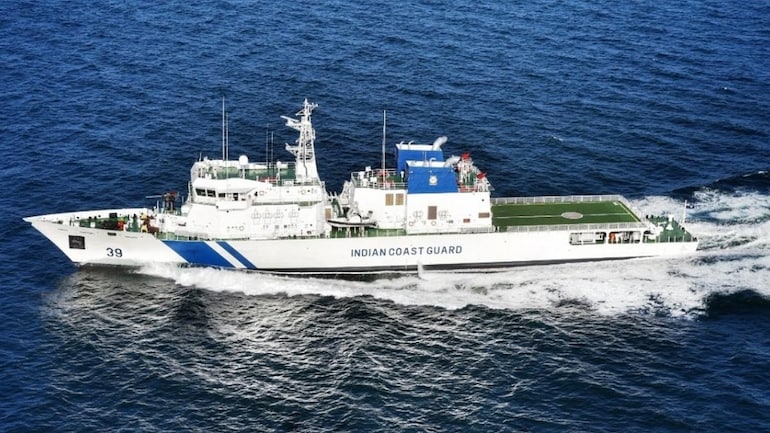
Indian Coast Guard (ICG) Ship Vigraha will be commissioned by Defence Minister Rajnath Singh on August 28 (Photo: India Today)
Indian Coast Guard (ICG) Ship Vigraha, seventh in the series of Offshore Patrol Vessels (OPVs), will be commissioned by Defence Minister Rajnath Singh in Chennai on August 28, 2021.
The ship will be based in Visakhapatnam, Andhra Pradesh and operate on the eastern seaboard under the Operational and Administrative Control of the Commander, Coast Guard Region (East).
The 98-meter OPV, with a complement of 11 officers and 110 sailors, has been designed and built indigenously by Larsen & Toubro Ship Building Limited. It is fitted with advanced technology radars, navigation and communication equipment, sensors and machinery capable of operating in tropical sea conditions. The vessel is armed with a 40/60 Bofors gun and fitted with two 12.7 mm Stabilised Remote Control Gun with fire control system.
The ship is also equipped with integrated bridge system, integrated platform management system, automated power management system and high-power external fire-fighting system.
The ship is also designed to carry one twin-engine helicopter and four high speed boats for boarding operation, search & rescue, law enforcement and maritime patrol. The ship is also capable of carrying pollution response equipment to contain oil spill at sea. The ship displaces approximately 2,200 tons and is propelled by two 9100 KW diesel engines to attain a maximum speed of 26 nautical miles per hour with endurance of 5000 nm at economical speed.ADVERTISEMENT
The ship, on joining the Coast Guard Eastern fleet, will be deployed extensively for EEZ surveillance and other duties as enshrined in the Coast Guard Charter to safeguard the country’s maritime interests. The ICG, with this ship joining the fleet, will have 157 ships and 66 aircraft in its inventory.
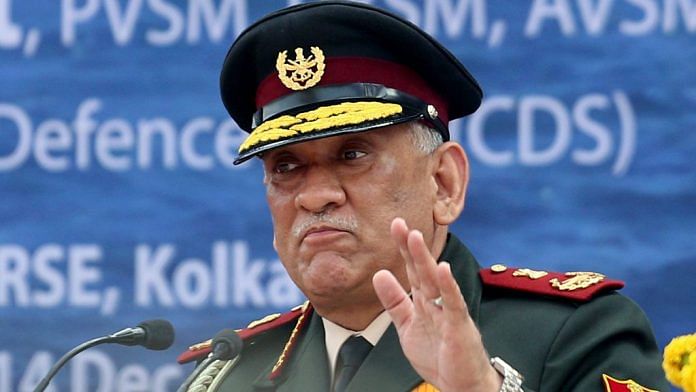
New Delhi: India had anticipated the Taliban takeover of Afghanistan but the speed at which it happened was a surprise, Chief of Defence Staff Gen. Bipin Rawat said Wednesday, giving the first official insight into how the government viewed the Afghan situation unravelling.
The CDS said that India was concerned about the possible overflow of terror activities from Afghanistan, adding that contingency plans have been made.
Gen. Rawat, who was speaking at a seminar organised by the Observer Research Foundation (ORF), also spoke about the expanding Chinese naval and nuclear power but said India had the capability to take on the northern neighbour and Pakistan in conventional warfare.
“Everything that has happened is something that was anticipated. Only the timelines have changed. From the Indian perspective, we were anticipating the Taliban takeover of Afghanistan…,” he said “Yes, the time lines have certainly surprised us. We were anticipating this thing happening a couple of months down the pipeline.”
Explaining how he looks at the Taliban, the CDS said, “It is pretty much the same. It is the same Taliban that was there 20 years ago. News reports and expats who have come from there are telling us the kind of activity that the Taliban is into. All that happened now is that partners have changed”.
He also noted that India was concerned that “terrorist activities from Afghanistan could overflow into India”.
“To that extent our contingency planning was ongoing and we were prepared for it,” he said.
ThePrint had earlier reported that security agencies are worried that the pullout by the western forces and consolidation of power by the Taliban would eventually result in increased terrorist violence in Kashmir.
India has nuclear triad
Asked about reports of China developing new silos for its nuclear weapons, Gen. Rawat said that these are strategic weapons and weapons of deterrence.
“They are not meant for engaging nations in combat. If a nation is developing bigger arsenals, developing a new strategy for improving their strategic deterrence, it is basically to ensure that you cannot overtake that nation in a jiffy. It is only to enhance their strategic deterrence capability,” he said.
He added that India was concerned about what is happening anywhere in the region.
Gen. Rawat pointed out that both Pakistan and China were nuclear powers.
“It is not only our northern neighbour, the western neighbour also has nuclear weapons. We are surrounded by two neighbours who are armed with strategic weapons,” he said “Therefore, we are evolving our strategy accordingly. Studying this intent of our neighbours, we have gone in for a triad. We are also evolving and developing our capability accordingly. We are studying this very carefully.”
Gen. Rawat added that India was conventionally very strong.
“We are quite capable of dealing with our neighbours conventionally. We are confident of dealing with both adversaries in the conventional domain,” he said.






























































 Paralympics campaign as it finished 24th in the overall tally.