The Indian Army, which has its elements deployed in multifarious and often difficult terrain, is developing satellite-based systems to track and monitor troop movements and facilities in remote areas.
Thousands of troops and scores of army convoys move each day for operational, logistic and administrative purposes across the length and breadth of the country, while many military facilities are located in areas where communication is a challenge. The systems, with embedded artificial intelligence, will assist in effective monitoring and quick decision-making during contingencies.
The project to develop the systems has been placed in the 8th edition of the Defence India Start-up Challenge (DISC) that was issued in December 2022. DISC is an initiative of the Ministry of Defence for supporting start-ups MSMEs and innovators to create prototypes and commercialise products and solutions in the area of national defence and security.
“The armed forces operate in rugged and inhospitable terrain where the tracking of deployed troops or assets becomes challenging due to the topological conditions. In view, a pervasive network footprint offered by satellite communication could prove beneficial for such geo-tracking applications,” the DISC document reads.
The system for tracking troops would have two elements – a ‘user’ element in the form of a small terminal that can be carried by mobile teams or vehicles to transmit its positional information to a centralised server using the satellite link, and a ‘logging’ element comprising a server along with the requisite digital capability for displaying and archiving the positional information transmitted by various user terminals.
A secure geo-satellite supported IoT platform for real-time monitoring of remote facilities and assets from dedicated control centres operated by the Army is the other system under consideration.
“Facility monitoring assumes critical importance in both civil and military parlance. Many installations store a variety of equipment and stores, each requiring specialised storage and environmental conditions. Any deviation of these environmental specifications could be detrimental or hazardous,” the document reads
“This becomes challenging when the storage facilities are located at remote locations. Hence a remote monitoring and control solution, based on Internet of Things (IoT) would be ideally fulfilling the requirement,” the documents adds.
The army is looking at developing an IoT-based sensor-control loop working through satellite link that is able to offer machine-to-machine (M2M) communication for relaying the sensor data to a central location for archiving and analytics. The system should be able to achieve automatic control action without human intervention in a near real-time manner.
To counter China, Nyoma airfield in Ladakh to be full-fledged base in 2 yrs
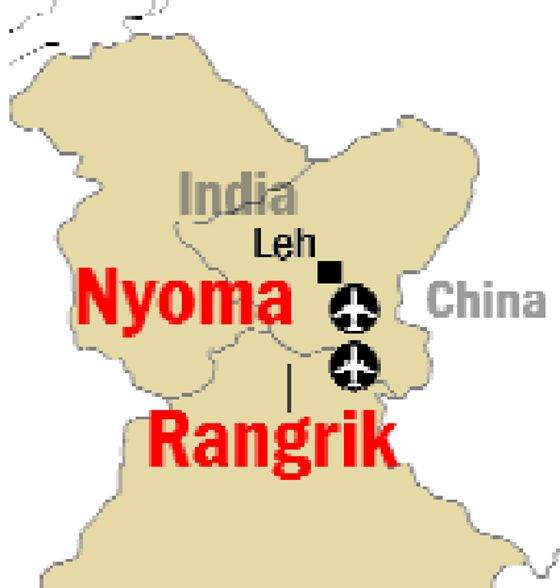
In a two-pronged strategy to match the Chinese airfields located across the Line of Actual Control, the Ministry of Defence has invited bids to upgrade the Nyoma airfield in eastern Ladakh into a full-fledged base with allied infrastructure. Separately, it has approved a new airfield near Kaza in Himachal Pradesh.
The Border Roads Organisation (BRO) had, in December last week, invited bids for upgrading the Nyoma airfield at a cost of Rs 214 crore. Located close to the Indus and some 180 km south-east of Leh at 13,700 feet, it is a part of the Ladakh plateau and is already being used by helicopters and special operation planes such as C-130J, which can land on mud. The plan now is to have a full-fledged fighter jet base that can launch and recover planes and also carry out minor maintenance jobs.
Securing LAC
Nyoma airfield to be upgraded at a cost of Rs 214 crore; it’s located close to the Indus, some 180 km south-east of Leh at 13,700 feet
Rangrik airfield to come up in Spiti valley, close to Chepzi in Tibet from where Chinese troops come for patrolling at LAC
The BRO plans to complete the upgrade in two years, according to the tender document. The site is spread over 1,235 acres where a 2.7-km runway with allied military infrastructure will come up. The alignment at Nyoma is such that aircraft can land from both directions.
The other important aspect is having an airfield at Rangrik in Spiti valley near Kaza. These parts of Himachal have a flat-plateau type terrain. Across the LAC in Tibet is located Chepzi, the place from where Chinese troops come for patrolling close to Chumar and Demchok. The airfield will connect civilian flights too as the Spiti valley gets blocked due to snow in winters.
US-based policy research organisation, The Center for Strategic and International Studies (CSIS), had in March released its report “How Is China Expanding its Infrastructure to Project Power Along its Western Borders”, which says “China has been constructing or upgrading 37 airports and heliports in Tibet and Xinjiang since 2017”. “The pace of this activity sped up significantly in 2020. That year alone, China began constructing seven air facilities and initiated upgrades at seven others,” the report said.
Air power expansion is being supplemented with new road, rail and infrastructure-enabling rapid movement of troops, etc. In 2021, China completed the construction of a road and tunnel system connecting Nyingchi (facing Arunachal), allowing military easy access to the LAC.
US-based General Atomics Aeronautical Systems Inc (GA-ASI) and Bharat Forge Limited, India, have announced a partnership to manufacture main landing gear components, subassemblies and assemblies of armed drones — Predator.
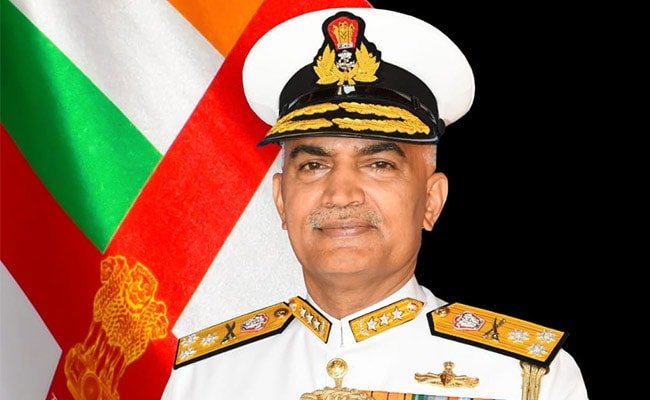
India has already leased two unarmed variants of the Predator for surveillance and is looking to procure 30 armed variants, 10 each for the Army, Navy and the IAF. Navy Chief Admiral R Hari Kumar had last month elaborated on the ability of leased drones saying, “We found it of great value. It provides much reach in terms of surveillance in the Indian Ocean Region.”
Vivek Lall, Chief Executive, General Atomics Global Corporation, said, “GA-ASI is eagerly looking forward to working with Bharat Forge in the critical field of aerostructure manufacturing.”
As the demand for guns surges, profit too skyrockets with the sale of every weapon or machine. Thus, the enterprise of military hardware production and sale becomes too tempting and lucrative to be eschewed, as after a long gap a ‘real’ war has come to European soil, where big-buck investments and astronomical profits are being made. Shortage of food facilitates profiteering too
Abhijit Bhattacharyya
Author and Columnist
ON the eve of the Russian invasion of Ukraine in February last year, UK Defence Secretary Ben Wallace had exclaimed, “The Scots Guards kicked the backside of Tsar Nicholas I in the 1853 Crimea War and we can always do it again,” comparing the 21st-century Russia-Ukraine conflict with the 19th-century war. The Tsar had been pitted against the combined might of England, France and the Ottoman Empire. The Russian defeat of yore and the lack of an international ally were sarcastically invoked to draw a parallel and warn Moscow to watch out for history repeating itself.
What the British Defence Secretary said was neither unsurprising nor unique. War has always had a macabre fascination for Europe. The gory combats and their inglorious consequences have been used to portray the grandeur of the warring West. Most of Europe’s eminent and enlightened scholars, intellectuals and philosophers have been fascinated with, and have spoken eloquently on, the importance of power, war and violence.
Machiavelli pointedly stated, “All armed prophets have conquered and unarmed ones failed.” To him, war, power and hypocrisy are connected. For Thomas Hobbes, conflict emerges from the impulse of self-preservation, thereby making life a “war of all against all” and resulting in it being “solitary, poor, nasty, brutish and short”. The views of Jean-Jacques Rousseau on the power of the state influenced global politics. His ‘Discourse on Inequality’, according to Voltaire, was “against the human race”. Georg Wilhelm Friedrich Hegel unabashedly admired Napoleonic wars and thought that it was a good thing to have wars from time to time. In all these expressions of the European mindset, one thing is clear. There is an element of axiomatic intellectual honesty about justifying, propounding or defending political dishonesty which appears preferable to the hypocrisy of depicting political polemics as an honest and noble enterprise.
In this context, the prolonged Russia-Ukraine war lays bare the stark reality that even an immoral war is good for the moral and ethical health of the West because through wreckage, blood, sweat and tears of widows, destitute and orphans emerge countless opportunities for wealth creation and open plunder by merchants and middlemen. Shortage of food facilitates profiteering too, the way it happened in the 1943 Great Bengal famine, killing 3 million people amid the World War II inflicted by Europe on the world.
As the demand for guns surges, profit too skyrockets with the sale of every weapon or machine. Thus, the enterprise of military hardware production and sale becomes too tempting and lucrative to be eschewed, as after a long gap a ‘real’ war has come to European soil, where big-buck investments and astronomical profits are being made.
Further, if the war is between powerful belligerents, soaring profit is guaranteed because both possess the wherewithal to sustain a protracted conflict. In contrast, smaller wars in Third World countries reduce profitability as they are less destructive. Thus, the end of the 20-year-old Afghan war in August 2021 inflicted huge losses on arms and ammunition manufacturers.
Undoubtedly, Russia is in the wrong. And the criticism thereof is justified. Nevertheless, Russian wrongs also raise a question. Why is Moscow pursuing this seemingly irreversible, hostile path? Although one-third of the answer was given by the British Defence Secretary with his comment on the 1853 Crimea War, it nevertheless leaves two-thirds unanswered, which lies in what happened in the 1810s and the 1940s.
Russia saved the entire West from being annihilated by two European scourges of mankind (Napoleon and Hitler) in successive centuries. Indeed, it crushed the bloodthirsty Napoleon’s ‘Grand Armee’ in the battles of Borodino (September 1812) and Leipzig (October 1813) much before the Duke of Wellington’s victory over a weakened French army at Waterloo in June 1815. From the Napoleonic wars to the two World Wars and from the Balkanisation of the 1990s to the present Ukraine war — all constitute intra-Europe conflicts, like ceaseless continental civil wars. And yet, the non-European world was inexorably dragged into these internecine disputes, thereby giving Europe pole position in world affairs.
So, what’s next for the Russia-Ukraine war? Is a solution possible? Or will it again drag entire Europe and the rest of the world into another Armageddon? Just hear the Europeans themselves on the “war within”, because “Europe is united” and yet “Europe is not united”. Europe is distressed because war fatigue and economic downturn have already gripped virtually every nook and corner of it. Hence, Deutsch Bank warns of the peril in borrowing from US banks and former German Chancellor Angela Merkel admits that the Cold War never ended. French President Emmanuel Macron is being berated for repeatedly calling for considering Russia’s legitimate security guarantee owing to NATO expansion in Russia’s neighbourhood.
The French certainly know best, owing to the post-World War I Versailles Treaty’s monumental folly of humiliating the defeated Germany, thereby sowing the seeds of World War II. Criticism of the US came from top EU diplomat Josep Borrell: “Americans, our friend, take decisions which have economic impact on us.” The EU has also accused Washington of profiting/profiteering from the Ukraine war. A more serious matter, however, is the growing intra-Europe conflict between Serbia and Kosovo. Serbia (former Yugoslavia) was attacked by the NATO and broken into seven pieces in the 1990s. Hence, Serbia, like Russia, is smarting and eyeing revenge.
Indeed, there’s a real possibility of two simultaneous Balkan wars as the region is the ‘tinderbox’ of Europe where issues related to ethnic minorities have repeatedly triggered conflicts. Altogether, the possibility of the Russia-Ukraine conflict raising the stakes higher will only smoothen matters further for the profiteering brigade to make mega bucks from the sale of military merchandise.
PM Modi lauds ‘Nari Shakti’ as Captain Shiva Chauhan becomes first woman Army officer to be deployed at Siachen glacier
The officer was posted at the Kumar post, located at an altitude of around 15,600 feet in Siachen after rigorous training
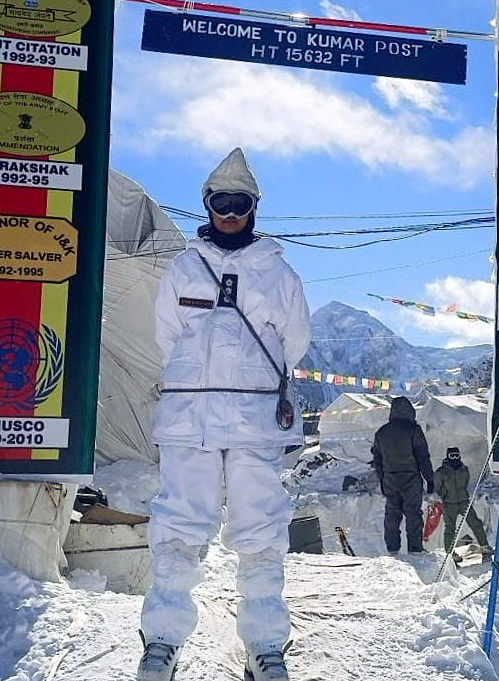
Captain Shiva Chauhan from the Corps of Engineers has been posted at a frontline post at Siachen glacier, in first such operational deployment of a woman Army officer at the world’s highest battlefield. Pic credit-
Prime Minister Narendra Modi on Wednesday hailed Captain Shiva Chauhan of Fire and Fury Sappers after she became the first woman officer to be deployed at Siachen, the highest battlefield in the world.
Modi took to Twitter to laud spirit of India’s Nari Shakti. “This will make every Indian proud, illustrating the spirit of India’s Nari Shakti,” he wrote in his tweet.
Captain Shiva Chauhan from the Corps of Engineers has been posted at a frontline post at Siachen glacier, in first such operational deployment of a woman Army officer at the world’s highest battlefield.
The officer was posted at the Kumar post, located at an altitude of around 15,600 feet in Siachen, on Monday for a three-month stint after she underwent rigorous training, Army officials said.
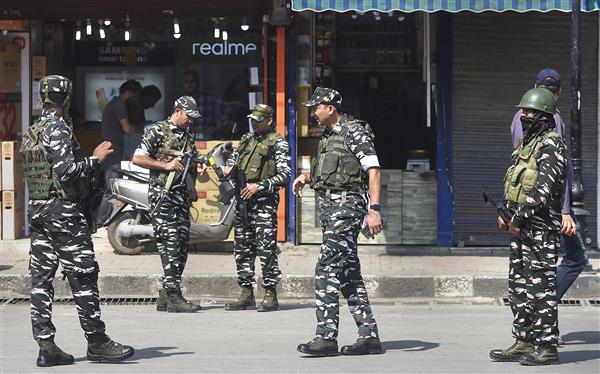
With intelligence inputs indicating possible fresh attacks on civilians in the Jammu region, the Central Government has decided to move and deploy 18 companies of the Central Reserve Police Force (CRPF) in Poonch and Rajouri districts, officials said on Wednesday.
According to the officials, eight CRPF companies will be deployed very soon from nearby locations of deployment in Jammu and Kashmir, while 10 CRPF companies are being rushed from Delhi.
The move followed a recent order issued by the Union Ministry of Home Affairs (MHA) amidst intelligence input about attacks in the Jammu region, said the officials.
Six persons, including two children, were killed and many more injured in two separate terror attacks in Upper Dangri village in Jammu and Kashmir’s Rajouri district on Sunday evening and Monday morning.
In the latest terror attack, two children were killed and several others injured after a suspected Improvised Explosive Device (IED) blast took place in Rajouri’s Upper Dangri village on Monday morning.
ADGP Mukesh Singh cautioned people as another suspected IED was spotted in the area near Upper Dangri village, which is about eight kilometres from Rajouri town.
Nearly a dozen people reportedly injured in the two terror attacks by the terrorists since Sunday evening. The injured were being treated in Jammu hospital.https://4ffeb8df8c1d6f384749ce107a29edc1.safeframe.googlesyndication.com/safeframe/1-0-40/html/container.html
The Army and the CRPF have launched a massive search operation to nab the two “armed men” behind the attack at Upper Dangri village.
A team of NIA sleuths has also visited the village where security has been stepped up.
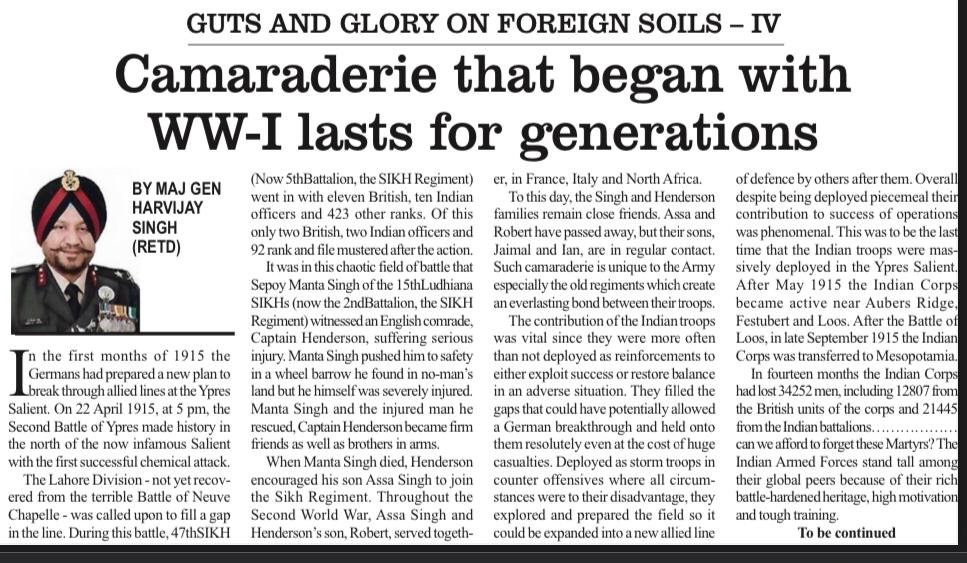
GUTS AND GLORY ON FOREIGN SOILS – IV Camaraderie that began with WW-I lasts for generation
MAJ GEN HARVIJAY SINGH
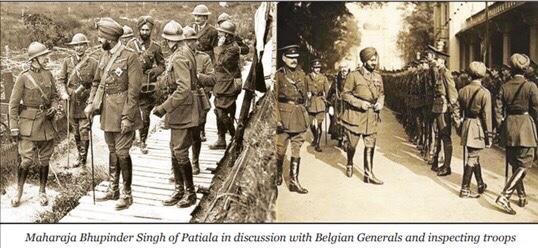
I n the first months of 1915 the Germans had prepared a new plan to break through allied lines at the Ypres Salient. On 22 April 1915, at 5 pm, the Second Battle of Ypres made history in the north of the now infamous Salient with the first successful chemical attack. The Lahore Division – not yet recov ered from the terrible Battle of Neuve Chapelle – was called upon to fill a gap in the line. During this battle, 47thSIKH (Now 5thBattalion, the SIKH Regiment) went in with eleven British, ten Indian officers and 423 other ranks. Of this only two British, two Indian officers and 92 rank and file mustered after the action. It was in this chaotic field of battle that Sepoy Manta Singh of the 15thLudhiana SIKHs (now the 2ndBattalion, the SIKH Regiment) witnessed an English comrade, Captain Henderson, suffering serious injury. Manta Singh pushed him to safety in a wheel barrow he found in no-man’s land but he himself was severely injured. Manta Singh and the injured man he rescued, Captain Henderson became firm friends as well as brothers in arms. When Manta Singh died, Henderson encouraged his son Assa Singh to join the Sikh Regiment. Throughout the Second World War, Assa Singh and Henderson’s son, Robert, served togeth er, in France, Italy and North Africa. To this day, the Singh and Henderson families remain close friends. Assa and Robert have passed away, but their sons, Jaimal and Ian, are in regular contact. Such camaraderie is unique to the Army especially the old regiments which create an everlasting bond between their troops. The contribution of the Indian troops was vital since they were more often than not deployed as reinforcements to either exploit success or restore balance in an adverse situation. They filled the gaps that could have potentially allowed a German breakthrough and held onto them resolutely even at the cost of huge casualties. Deployed as storm troops in counter offensives where all circum stances were to their disadvantage, they explored and prepared the field so it could be expanded into a new allied line of defence by others after them. Overall despite being deployed piecemeal their contribution to success of operations was phenomenal. This was to be the last time that the Indian troops were mas sively deployed in the Ypres Salient. After May 1915 the Indian Corps became active near Aubers Ridge, Festubert and Loos. After the Battle of Loos, in late September 1915 the Indian Corps was transferred to Mesopotamia. In fourteen months the Indian Corps had lost 34252 men, including 12807 from the British units of the corps and 21445 from the Indian battalions……………… can we afford to forget these Martyrs? The Indian Armed Forces stand tall among their global peers because of their rich battle-hardened heritage, high motivation and tough training. To be continue
Captain Shiva Chauhan first woman Army officer from the Corps of Engineers to be deployed at Siachen glacier’s Kumar Post
Captain Shiva Chauhan from the Corps of Engineers has been posted at a frontline post at Siachen glacier, in first such operational deployment of a woman Army officer at the world’s highest battlefield.
The officer was posted at the Kumar post, located at an altitude of around 15,600 feet in Siachen, on Monday for a three-month stint after she underwent rigorous training, Army officials said.
Defence Minister Rajnath Singh conveyed his best wishes to Capt Chauhan and said he was happy to see more women joining the armed forces and take every challenge in stride.
“Excellent news! I am extremely happy to see more women joining the Armed Forces and take every challenge in stride. It is an encouraging sign. My best wishes to Capt Shiva Chauhan,” he tweeted.
The Army said Capt Chouhan became the first woman officer to get operationally deployed at the world’s highest battlefield.
The Siachen glacier at the height of around 20,000 feet in the Karakoram range is known as the highest militarised zone in the world where the soldiers have to battle frostbite and high winds.
In the past, women officers have been posted to Siachen base camp, which is at about 9,000 ft, as part of their regular postings along with the unit.https://531fd973c38590701ec987ace67463c3.safeframe.googlesyndication.com/safeframe/1-0-40/html/container.html
“It was a proud moment for Indian Army when Capt Shiva Chouhan became the first woman officer to get operationally deployed at the world’s highest battlefield, Siachen, after a month’s arduous training at Siachen Battle School along with other personnel,” the Army said in a statement.
Capt Shiva Chouhan from Rajasthan is a Bengal Sapper Officer.
She has done her schooling from Udaipur and holds a bachelor’s degree in Civil Engineering from NJR Institute of Technology, Udaipur.
She lost her father at a young age of 11 years and her mother took care of her studies.
From her childhood, she was motivated to join the Indian Armed Forces and showcased unparalleled zeal during training at Officers Training Academy (OTA), Chennai, and was commissioned into the Engineer Regiment in May 2021.
The officer was put through rigorous training at the Siachen Battle School where she trained alongside the officers and men of the Indian Army, officials said.
The training included endurance training, ice wall climbing, avalanche and crevasse rescue and survival drills, they said.
“In spite of various challenges, Captain Shiva with unflinching commitment successfully completed the training and was all set to be inducted to the Siachen Glacier,” said an official.
The Army said the team of Sappers led by Capt Shiva Chouhan will be responsible for numerous combat engineering tasks and will be deployed at the post for a duration of three months.
Merchant navy officer ‘drowns’ while saving his dog in Punjab’s Morinda; had gone on picnic with wife, kid
A 40-year-old merchant navy officer has been feared drowned in Bhakra canal near Morinda. The incident occurred on Monday evening.
The victim has been identified as Ramandeep Singh, a resident of Sector 3B1 in Mohali.
He had gone for a picnic with his wife and children.
His brother, Jai Veer Singh, a captain in Indian Navy, is searching for the victim with the help of a team of NDRF.
Captain Jai Veer said that his brother had gone for a picnic with his family members and a dog.
When they were strolling on the bank of the canal around 5 pm, the pet fell into the canal and Ramandeep without having second a though jumped into the water to save it.
While the dog was rescued by the locals Ramandeep was missing till the filing of the report.
Ropar SSP Vivek Sheel Soni said that the police tried to locate the missing merchant navy officer and after overnight search NDRF teams too have been deployed to locate the victim.
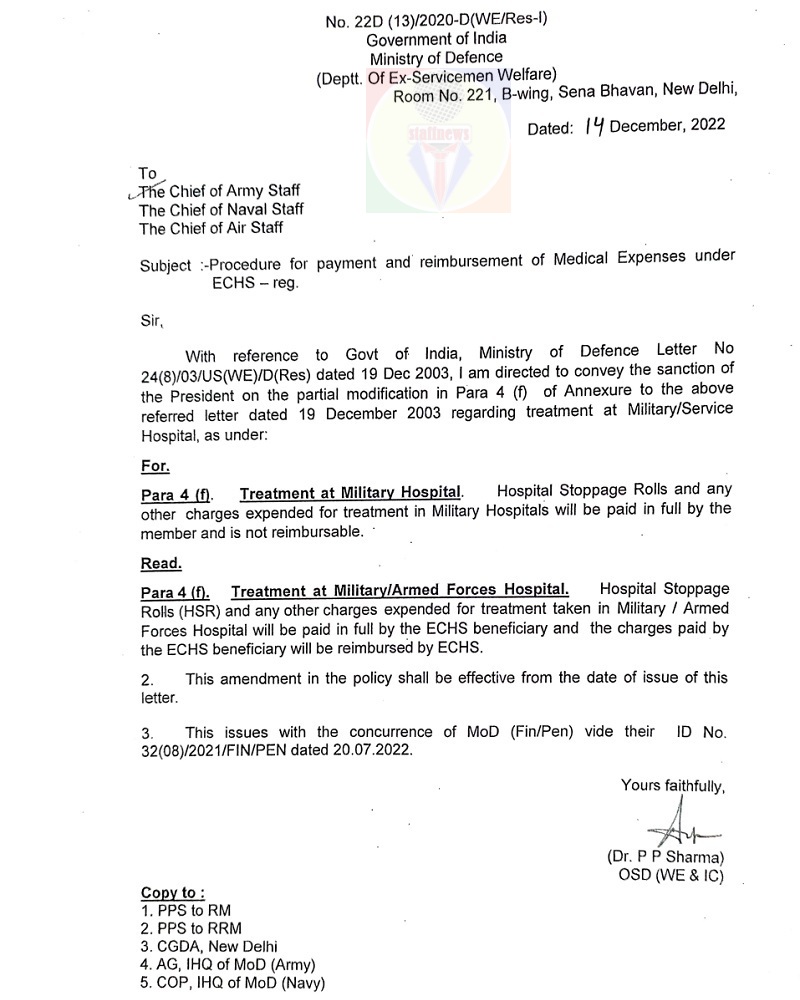
Procedure for payment and reimbursement of Medical Expenses under ECHS: MoD Order