











Sanjha Morcha

What’s New

Click the heading to open detailed news

Current Events :

web counter

Print Media Reproduced Defence Related News

CHINA LOSING GRIP IN INDO-PACIFIC, RESORTS TO FALSE CLAIMS: REPORT

Beijing: Faced with a stiff challenge from Washington to its designs in the Indo-Pacific region, Beijing is now trying to misguide the world by making false claims about the success of its initiatives in the Indo-Pacific region.
The cause for the apprehension of Beijing is not difficult to understand as the European Union has also come up with an Indo – Pacific strategy that aims to enhance its engagement across a wide spectrum. The EU sees itself and the Indo-Pacific as “natural partner regions.”
To check the aggressive moves by China and ensure a free and open Indo – Pacific, the USA and the European Union are putting their acts together. Anxious to defend democracy around the world, the USA has taken steps to prevent Beijing from imposing its own authoritarian model around the globe.
Clearly, in the face of shifting of attention by major world powers from other areas of conflict to the Indian and Pacific Oceans to meet the threat of Chinese belligerence in the South China Sea and attempts to establish its hegemony over the entire seawater, Beijing is unnerved. With Beijing defying the laid down U.N. conventions and international maritime laws, powerful nations are getting together to form the basis for a deeper integration in future and ensure equal access to global commons for all countries as a right under the international law, The Singapore post reported.
Notably, these dire steps may be the result of China’s financial support across the Pacific region being on the decline. From its peak of USD 287 million, it now fell to USD 187 million in 2020. This is the lowest ever since 2008. According to the Singapore Post, a South East Asia news outlet reported.
Beijing in November last year had claimed that representatives of 19 countries had actually attended Indian Ocean Forum on Development Cooperation on November 21 held at the Kunming in the Yunnan province of China an organization that has been connected with the foreign ministry of China, according to The Singapore Post.
Maldives and Australia denied in quick succession Beijing’s claim that they participated in a meeting of the China – Indian Ocean Forum on Development Cooperation on November 21, 2022 thus reflecting China’s losing grip on the Indian Ocean region.
The attending countries of these meets according to China were Indonesia, Pakistan, Myanmar, Sri Lanka, Bangladesh, Maldives, Nepal, Afghanistan, Iran, Oman, South Africa, Kenya, Mozambique, Tanzania, Seychelles, Madagascar, Mauritius, Djibouti and Australia.
Although the countries that were amongst the attendees of the development cooperation meet by China were Pakistan, Sri Lanka, Bangladesh, Kenya and Djibouti and Nepal are beholden to Beijing because of Belt and Road Initiative loans and the oppressive military junta in Myanmar and the obscurantist Taliban regime in Afghanistan are dependent on China’s support to stay in power.
Although contrary to the claims made by China in regard to the matter. Maldives denied attending the meeting. Later Australia too had clarified the same. The Singapore post further mentions that Sydney made these clarifications highlighting that they had not participated despite having an invitation. Similarly, India also refrained from participating in the meet anyhow.
The Singapore post quoted the Maldives Ministry of Foreign Affairs statement. The statement mentioned, “The Ministry would like to clarify that the Government of the Maldives did not participate in the Forum mentioned above and communicated its decision not to participate in the meeting to the Embassy of the People’s Republic of China to the Maldives on November 15, 2022,”. This clearly countered the claims made by China regarding the matter.
The Singapore post also quoted Australian High Commissioner to India Barry O’Farrell who had tweeted that “Contrary to media reporting, no Australian government official attended the Kunming China-India Ocean Forum on Development Cooperation,”.
The Singapore post mentions citing the US’s long-delayed National Security Strategy that emphasized the importance of working with allies to tackle challenges confronting democratic nations and seeking to contain China. In the policy preamble, Joe Biden said “Autocrats are working overtime to undermine democracy and export a model of governance marked by repression at home and coercion abroad. These competitors mistakenly believe democracy is weaker than autocracy because they fail to understand that a nation’s power springs from its people.”
Considering the security strategy, the US decided to deploy up to six nuclear-capable B-52 bombers in northern Australia. Preparations are underway to build dedicated facilities for the long-range bombers at the Royal Australian Air Force Base Tindal. The US Marines already have a presence in Australia, according to the Singapore post report.

INDIA EYES BANGLADESH AS KEY MARKET FOR MILITARY HARDWARE

The two nations are also exploring the prospect of an Indian role in maintaining Russian origin equipment, especially aircraft such as the Mi-17-1V helicopter, Antonov An-32 transport aircraft and MiG-29 jets. India also operates these aircraft and has facilities for their maintenance.
That order came on the back of the Philippines ordering BrahMos missiles and Armenia buying Pinaka multi-barrel rocket launchers from India.
India is eyeing Bangladesh as a market for a range of military hardware, from specialist vehicles to helicopters, and maintenance of Russian origin equipment following the operationalisation of a $500 million line of credit for defence purchases, people familiar with the matter said.
Among the items that Bangladesh has shown an interest in are specialist vehicles from Tata and Mahindra, Tejas combat aircraft and Dhruv light helicopter, the people said, seeking anonymity. Several vehicles have been provided by the two Indian firms to the Bangladesh Army for testing over an extended period of time in different terrains and seasons, including during military exercises, they added.
The two nations are also exploring the prospect of an Indian role in maintaining Russian origin equipment, especially aircraft such as the Mi-17-1V helicopter, Antonov An-32 transport aircraft and MiG-29 jets. India also operates these aircraft and has facilities for their maintenance.
During recent visits to India, Bangladesh Air Force personnel visited facilities where such aircraft are maintained, the people said. For instance, the Bangladesh Air Force chief, Air Chief Marshal Shaikh Abdul Hannan, toured facilities in Chandigarh and Mumbai during a visit to India in December 2021. Hannan also visited a helicopter unit in West Bengal during his latest visit to India in December.
“Bangladesh has purchased protective gear such as bulletproof jackets and helmets. Now both sides are looking at big ticket items,” one of the people said.
While India offered the $500 million line of credit for defence purchases to Bangladesh in 2019, it was operationalised in September 2022 with a contract for what was described at the time by foreign secretary Vinay Kwatra as a “modest amount”. Briefing the media after a visit to India by Bangladesh Prime Minister Sheikh Hasina, Kwatra had said this contract was “an important first step” that will open up the path for further engagement in defence.
During Hasina’s visit, she and Prime Minister Narendra Modi expressed satisfaction at the “intensification” of defence ties and agreed on early finalisation of projects under the line of credit for defence, a joint statement said. India also “welcomed the finalisation of initial procurement plans for vehicles for the Bangladesh Armed Forces”, the statement added.
These developments come at a time when India has sharpened its focus on getting a toehold in foreign markets, setting a target of defence exports of $5 billion by 2025, and put in place a raft of policy measures to boost indigenous defence manufacturing.
In November 2022, Indian defence firm Kalyani Strategic Systems Limited won an export order of $155.5 million for supplying artillery guns to a friendly foreign country, the first order by a local company for the weapon system.
That order came on the back of the Philippines ordering BrahMos missiles and Armenia buying Pinaka multi-barrel rocket launchers from India. India has clocked defence exports of more than ₹30,000 crore since 2014, after the Narendra Modi government came to power.
India’s efforts also come at a time when China has been seeking to increase its role as a supplier of defence equipment, ranging from combat aircraft to warships and radars. In this context, the people noted that the Indian side has been pressing Bangladesh to implement a memorandum of understanding inked in 2019 for providing a coastal radar system for maritime security.
India’s defence exports reached their highest level during 2021-22, hitting ₹13,000 crore and the private sector accounting for 70% of exports. Military hardware exported by India includes missiles, the Dhruv light helicopter, offshore patrol vessels, protective gear, surveillance systems and radars. India has also imposed a phased import ban on 411 weapons and systems over the past two years to boost indigenous defence manufacturing. These weapons and platforms are to be indigenised over the next five to six years.
“India has a good strategy and action plan in place, backed by forward-looking policies, to ensure self-reliance in defence, and boost the country’s status as a net exporter of weapons in the coming years,” military affairs expert Lt Gen Vinod Bhatia (Retd) earlier said.


MOROCCO RECEIVES 92 MILITARY TRUCKS FROM INDIA’S TATA ADVANCED SYSTEMS

Morocco has been rapidly strengthening its military forces over the past couple of years
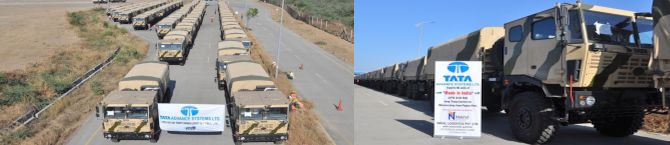
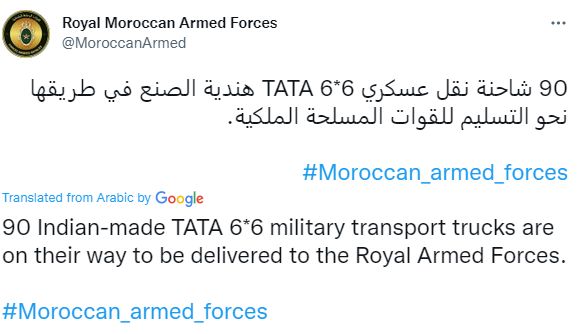
Rabat: Morocco’s Royal Armed Forces has received a total of 92 six-wheel military trucks manufactured by the Indian aerospace, defence, and military company TATA Advanced Systems, the Moroccan Armed Forces reported in a Tweet.
In a statement on Twitter, the Moroccan Royal Armed Forces on Sunday confirmed that the military trucks they ordered were “on their way to be delivered.”

The website Military Africa detailed the truck’s many features, saying that it is “suitable for up-armouring, and can be configured for a variety of applications, including a common gun tower, a multi-barrel rocket launcher, and a missile firing unit,” among others.
The new shipment is part of Morocco’s efforts to diversify its arms purchases, with the aim of strengthening and upgrading its army with state-of-the-art equipment.
In December 2022, American company L3Harris Technologies announced sealing a $29 million deal with Morocco to upgrade the African country’s F-16s firepower and mission flexibility, as well as provide it with “smart weapon release systems.”
In addition, Morocco is committed to increasing military cooperation with countries with some of the strongest armies in the world, including the United States and Israel.
Since Morocco re-established diplomatic ties with Israel in 2022 as part of the US-brokered Abraham Accords, the two countries have remarkably increased military cooperation.
In February 2022, Morocco and Israel concluded a $500 million deal to provide the North African country with the Barak MX air and missile defense system.
In addition, military officials from both Morocco and the US held a series of meetings, expressing their keenness to strengthen their security cooperation.
The latest Global Firepower Index, published in 2022, ranked Morocco’s military strength in 56th position out of 142 countries across the world.


INDIA-BHUTAN RELATIONSHIP: A TESTIMONY OF FRIENDSHIP AND CAMARADERIE

New Delhi: The relationship between India and Bhutan is based on the pillars of trust, goodwill and mutual understanding. The two neighbours have a close civilizational, cultural and economic relationship that dates back centuries. Bhutan considers India as Gyagar, meaning the holy land, as Buddhism originated in India, which is the religion followed by the majority of Bhutanese.
The relationship between the two countries further strengthened with the establishment of diplomatic relations between them in 1968.
The basis of this relationship is formed on the solid foundation of the Indo-Bhutan Friendship Treaty of 1949 which emphasises “perpetual peace and friendship, free trade and commerce, and equal justice to each other’s citizens.”
Bhutan not only shares a 699 kilometres long boundary with India adjoining four Indian states but is also a key player in two of India’s cardinal foreign policy elements – Neighbourhood Policy and Act East Policy.
For India, Bhutan’s socio-economic development and territorial integrity have always been a key plank in its foreign policy agenda. The two countries have a close strategic partnership, with India providing assistance to Bhutan in various sectors, including economic development, infrastructure, education, health and security.
India is not only Bhutan’s biggest development partner but also the most important trading partner both as a source and market for its trade in goods and services. India provides not only the transit route to a landlocked Bhutan but is also the biggest market for a number of Bhutan’s exports including hydroelectricity, semi-finished products, ferrosilicon and dolomite.
Bolstering strategic relations, India deployed its Military Training Team (IMTRAT) in Bhutan to train the Bhutanese security forces in 1961 and since then has been responsible for Bhutanese security. A number of engagements pertaining to security and border management issues, threat perceptions, coordination of Indo-Bhutan border entry exit points, and sharing of real-time information, among other aspects are being undertaken by the two countries on a regular basis.
The Doklam standoff between Indian and Chinese forces in 2017 has made the security matter even more important and has led to even better coordination and partnership between Indian and Bhutanese forces to secure the strategic areas.
The Indo-Bhutan relationship has development cooperation and hydroelectricity generation as its cornerstone. The two countries have committed to jointly develop 10,000 MW of hydroelectricity capacity in Bhutan. The completion of the 720 MW Mangdechhu hydropower project in Bhutan has been deemed an achievement of the partnership between the two countries. This has propelled discussions of the Sankosh Hydropower Project building between the two countries.
The two countries did not deter from their commitment even during the COVID-19 pandemic and commissioned the first-ever joint venture project – the 600 MW Kholongchhu hydropower project during the testing time. The project is aimed at generating surplus hydroelectricity for Bhutan which will be exported to India aiding Bhutan’s revenue as well as employment generation.
India’s assistance to Bhutan’s development is not limited to the hydropower sector but encompasses almost all the sectors including education, health, infrastructure, social services, environmental protection and technology advancement, amongst others. As per Bhutan’s 12th Five Year Plan (2018-2023), India is providing grant assistance to the tune of INR 4,500 crores, along with a transitional Trade Support Facility of INR 400 crores over a five-year period to reinforce the economic linkages.
In the realm of scientific and technological cooperation, the recent launch of a joint India-Bhutan SAT satellite by ISRO marks a new era of India – Bhutan relations. This satellite is expected to enable Bhutan by providing real-time data and high-resolution images for land mapping and facilitating managing its natural resources, forests and agriculture.
This development is in line with the growing India-Bhutan relations in new avenues such as advanced technology, space and digital systems.
Several key initiatives have already been launched in the fields of digital and space, such as RuPay, the integration of Bhutan’s DrukREN with India’s national Knowledge Network and the establishment of Ground Earth Station by ISRO to harness the services of South Asia Satellite. Thus, India is enabling the development of Bhutan’s digital and space infrastructure so as to harness the potential of Bhutanese youth via skill development and employment generation.
Through digital and space cooperation, not only India is spreading its technological footprint but Bhutan is also getting benefitted from India’s investments, research and development, technological know-how and expertise in bringing about transformation in various sectors in Bhutan of the 21st Century.
The ties between India and Bhutan have over time matured into comprehensive partnerships and cooperation on a wider range of issues spanning energy security, business and trade, security and intelligence sharing, digitisation, space technology and conservation biology sectors, amongst others.
India always stood by Bhutan in adverse situations and challenging times in past and Bhutan acknowledged it. As a friendly and helpful neighbour, India has been responsive to Bhutan’s needs exemplified by the support extended to Bhutan supplying essential goods and services and whatever requisites from time to time.
Bhutan expressed gratitude and appreciation for India at the UN General Assembly for its “heart-warming goodwill” and “valuable support” in the supply of COVID-19 vaccines under New Delhi’s ‘Vaccine Maitri initiative’ that enabled the Himalayan country to make the nationwide rollout of the COVID-19 vaccination programme when the entire globe had been reeling under the unprecedented health crisis. The two countries shall be proud of their relationship which is based on trust, shared cultural values, mutual respect and partnership in sustainable development.


INDIA SEEKS TO SPEED UP PLANS IN INDIAN OCEAN AMID GROWING CHINESE PRESENCE IN REGION, SAY EXPERTS

Kuala Lumpur: India seeks to speed up plans in the Indian Ocean amidst growing Chinese presence in the region. Indian aims to convert the Andaman and Nicobar Islands into a shipping and tourism hub with connections to South-East Asia, reported The Star, a Malaysia-based publication.
In a recent meeting, Indian and Indonesian officials agreed to “encourage sail tourism, cruise ship visits, and interaction between tour operators” between the two countries to increase connectivity between the Andaman and Nicobar Islands and Aceh where India is helping to develop the deep sea port of Sabang.
Officials from both countries have agreed to help create opportunities for investors.
Strengthening links between Andaman and Nicobar Islands and Aceh, 150 km apart, is part of the Shared Vision for Maritime Cooperation in the Indo-Pacific signed in 2018 between the two countries, according to The Star report.

Rajiv Bhatia, retired Indian ambassador and Distinguished Fellow at Gateway House, a think-tank, as quoted by The Star, said: “The broader context (of this cooperation) is closer political and economic ties. The idea is that there should be deeper and closer cooperation, and for that, infrastructure should be in place.”
“India’s approach in the past (towards the Andaman and Nicobar Islands) used to be so restrictive, to not do any development of the area and not allow foreign powers. Now there is an evolution in thinking,” Bhatia added.
The Andaman and Nicobar Islands have a population of around 400,000 people, including aboriginal tribes and Jarawas who inhabited the island for years and live off the land.
According to environmentalists, the proposed development would destroy ecologically and culturally sensitive areas of these islands.
The government’s ambitious infrastructure plan includes a leisure zone, a film city, a residential district and a tourism-specific economic zone, underwater resorts and beach hotels in Little Andaman, an island of about 707 sq km, according to The Star.
According to a Home Ministry letter in March 2022, the airport will be a joint military-civil, dual-use airport under the operational control of the Indian Navy, according to a Home Ministry letter in March 2022.
Recently, Mizzima News reported that the China-Indian Ocean Region Forum on Development Cooperation can be perceived as another expansionist attempt by China to amplify its presence in the Indian Ocean Region (IOR) by investing in ports and infrastructure in the IOR countries, especially in South Asia.
According to the report, against the backdrop of the recent setbacks that China faced in the region, including in Sri Lanka and Pakistan, the China-Indian Ocean Region Forum is a clear attempt by Beijing to reclaim some of the lost ground.
China, which has an eye on the strategic benefits the IOR has to offer, has repeatedly said the Indian Ocean is not India’s ocean. The country is looking towards expanding its economic, military, and political influence in the region, the report said.


INDIAN ARMY PROCURES MILREM THEMIS UGV

Milrem – Kalyani THeMIS UGV
The THeMIS Unmanned Ground Vehicle (UGV) by Estonian firm Milrem Robotics is in service with the Indian Army. This was revealed in the Indian Parliament by Minister of State for Defence Ajay Bhatt. THeMIS was listed among the major defence equipment imported in the last three years.
The quantity and date of purchase of the UGVs are unknown. However, the UGVs are likely to have been procured under emergency procurement powers granted to the Army. Indian Army has a net requirement for over 700 ‘autonomous combat vehicles’ with capabilities similar to that of THeMIS.
Milrem has collaborated with Indian defence major Kalyani Strategic Systems Limited (KSSL) to offer the system in India. The role of KSSL in supplying the UGVs remains unclear. Milrem redirected queries by Overt Defense to Bharat Forge, the parent entity of KSSL, which did not respond by the time of publication.
THeMIS is primarily competing with Gridbots Titan UGV for the larger tracked UGV requirement of the Army. Titan has undergone multiple trials including in the Thar desert and high altitude regions such as Ladakh. Gridbots has also tied up with Bharat Dynamics Limited (BDL) and has integrated BDL’s Amogha-III ATGM onto Titan. This configuration was displayed during DefExpo held in October 2022. Both Gridbots and BDL are Indian firms.

Gridbots Titan with BDl Amogha-III ATGM at DefExpo 2022
The Army had conducted a UGV experiment in December 2021 in which THeMIS participated. However, it is unclear what comparative trials the THeMIS went through prior to the import. While emergency powers were occasionally granted to the armed forces to quickly fill capability gaps, products bought largely tended to be imports.

In order to combat this, the MoD has specified that domestic firms be preferred for emergency procurements. Yet the opaque nature of such procurements and partnerships with Indian firms could allow foreign products to be preferred over those truly developed in India.
THeMIS is used by over 16 countries. The UGVs are also being delivered to Ukraine. THeMIS can be equipped with a wide variety of equipment for CASEVAC, fire support, mine clearing and other missions.


Historians highlight Sikhs’ role in freedom struggle

Historians highlight Sikhs’ role in freedom struggle

Tribune News Service

New Delhi, January 5

A three-day Sikh History Congress, which got underway today, discussed multiple issues including the need for Sikhs to write and express history of their community.

Prof Raghuvendra Tanwar, the chairman of the Indian Council of Historical Research (ICHR), said, “A large part of modern India’s map is due to the Sikhs (who opted for India and not Pakistan)”. The congress is being hosted at the Khalsa College in Delhi University.

“The most important contribution of the Sikhs is their urge to stand up against atrocities,” said Prof Tanwar, adding that Sikhs have suffered the most and listed the agitations launched by the community to free the country from the British. Uttarakhand Governor Lt Gen Gurmit Singh (retd) was the chief guest.


IAF Heritage Centre set for Jan 31 takeoff

Defence Minister, Chief of Air Staff to attend event

IAF Heritage Centre set for Jan 31 takeoff

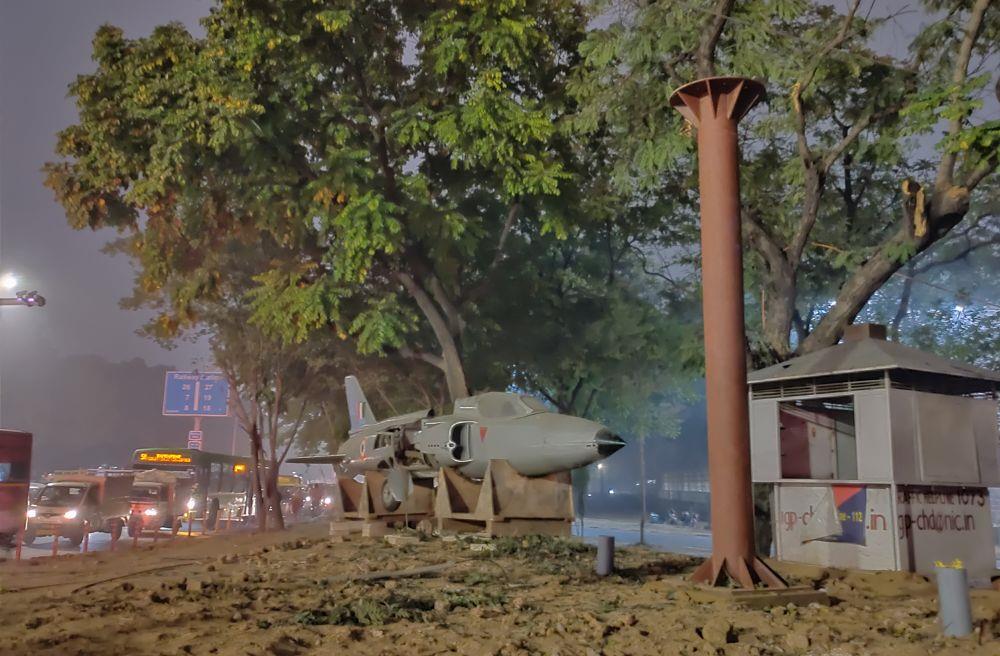
A Gnat fighter aircraft will be mounted on a pillar at the Sector 8-9-17-18 traffic lights, adjacent to the Indian Air Force Heritage Centre at Government Press building in Sector 18, Chandigarh. Pradeep Tewari

https://cdn.vuukle.com/widgets/audio.html?version=1.0.3
Advertisementhttps://401d687cc7743b5a570f9abf8ec2bcd8.safeframe.googlesyndication.com/safeframe/1-0-40/html/container.html

Tribune News Service

Dushyant Singh Pundir

Chandigarh, January 5

After a string of delays, the country’s first Indian Air Force (IAF) Heritage Centre will finally be thrown open to public on January 31.

The centre, being set up at the Government Press building, Sector 18, will be inaugurated by Defence Minister Rajnath Singh in the presence of Chief of the Air Staff Air Chief Marshal VR Chaudhary, Punjab Governor and UT Administrator Banwarilal Purohit and other dignitaries.

Air Marshal Pankaj Mohan Sinha, Air Officer Commanding-in-Chief, Western Command, will visit the centre on Friday to take stock of the preparations. The centre, which is expected to draw tourists from both within the country and abroad, will offer an insight into the rich legacy and glory of the force. The IAF will showcase its vintage aircraft, armament, memorabilia and other artefacts, including audio-video displays.

Among the top attractions at the centre will be a simulator offering visitors the experience of flying an IAF aircraft. This will also act as a platform to motivate and facilitate the youth to join the force. This will not only help provide employment opportunities but also strengthen the force and reinforce national integration. A souvenir shop has been set up for visitors, says an official.

The star attractions, however, will be five vintage aircraft, including a Gnat that is being put up at an adjacent intersection. In 1971, Flying Officer Nirmaljit Singh Sekhon was a pilot of a Gnat detachment based at Srinagar for the air defence of Kashmir Valley against Pakistan air attacks. He was posthumously awarded the Param Vir Chakra.

Another aircraft, a MiG-21, has been installed in the parking area of the centre. The fighter aircraft first entered service in 1963.

Air Force “Kanpur-1”, installed inside the centre, was the first one to have been built by India in 1951 by Air Vice Marshal Harjinder Singh

The IAF had received the vintage prototype aircraft from Punjab Engineering College (PEC) here for display along with other aircraft at the centre.

Installed on the rear lawn of the centre, HPT-32 primary trainer aircraft was manufactured by Hindustan Aeronautics Limited and used for training young flight cadets.

A MiG-23 MF, installed at the rear end of the centre, is a swing-wing interceptor capable of delivering an array of missiles, bombs and guided weapons.

5 vintage aircraft on display

  • Gnat, used in 1971 to defend Kashmir valley, to be showcased at Sector 8-9-17-18 light point
  • MiG-21, which first entered the service in 1963, installed in parking area of the centre
  • “Kanpur-1” vintage aircraft from PEC, first one to be built by India, displayed inside centre
  • HPT-32 primary trainer aircraft, made by Hindustan Aeronautics Ltd, will be put up on rear lawn
  • MiG-23 MF, a swing-wing interceptor, installed at the rear end of the centre

LEST WE CHOOSE TO FORGET: GUTS AND GLORY ON FOREIGN SOILS – V

LEST WE CHOOSE TO FORGET: GUTS AND GLORY ON FOREIGN SOILS – V

WORLD WAR – 1

Festubert;

On 17 May 1915, a company of 15th SIKHs (Now 2nd Battalion, the SIKH Regiment) were in occupation of a section of a German trench. Area between the two had been barricaded with corpses; the stench was un-bearing.

Their state of ammunition was critically low. Resupply from the reserve trenches 250 yards away could enable them to hold out. British units had attempted to do so twice, on both occasions the officer in command had been killed and the party practically wiped out; a frightful situation to say the least. Only a desperate action could save the day.

Lieutenant John Smyth, 15th SIKHs, was ordered to take a bombing party. He took with him ten bombers from a crowd of volunteers. It became difficult for him to reject volunteers and finally he chose randomly perhaps looking for bigger guys who could pull the heavy load. The names of these heroes must be recalled.

They were Lance-Naik Mangal Singh, Sepoys Lal Singh, Sucha Singh, Sampuran Singh, of 15th SIKHs, Sarain Singh, Sundur Singh, Ganda Singh, Harnam Singh, of 19th PUNJABIs and Fateh Singh and Ujagar Singh, of 45th SIKHs.

They set out with a gusty battle cry: ‘Jo Bole So Nihal, Sat Sri Akal’, taking two boxes containing ninety-six bombs. Dropping over the parapet they wriggled their way through the mud, pulling and pushing the boxes along with them. They used pagris attached to the boxes and the men in front pulled them along, over and through the dead bodies, those behind pushed.

Even before they progressed a few yards, Fateh Singh fell, severely wounded.

In another hundred yards, Sucha Singh, Ujagar Singh and Sundur Singh were shot.

Extreme bravado and faith in their Guru kept the remaining six going. They had nearly reached the end, when, Sarain Singh and Sampuram Singh were shot dead, and, Ganda Singh, Harnam Singh and Mangal Singh were wounded.

The second box had to be abandoned. Lieutenant Smyth and Sepoy Lal Singh, wriggled their way ahead yard by yard. Water around them churned by a hail of bullets, and, clambered up the far bank amongst their cheering comrades.

Both were unhurt, though their clothes were perforated by bullet holes. However, shortly afterwards Lal Singh was struck by a bullet and killed instantly.

In the final count, all ten Brave Sikhs were casualties. Once again after Saragarhi all Sikh Soldiers in a detail, had fallen executing an extreme and impossible task. For them the ‘izzat’ (pride) of the regiment and devotion to duty was above any other fear and danger.

So ended one of the most gallant episodes of the World War I.

 “Attaching their puggarees to the fronts of the boxes, the men pulled them over or through the dead bodies, all of the party lying flat on the ground. At any moment the bombs in the boxes might have exploded, for the whole of the ground was hissing with the deluge of rifle and machine gun fire, while the air was white with the puffs from bursting shrapnel.” Page 37, Leader Newspaper (Melbourne), Saturday 31 July 1915

Lieutenant Smyth was awarded the Victoria Cross. Lance Naik Mangal Singh received the Second Class Indian Order of Merit, while the Indian Distinguished Service Medal was conferred on all sepoys of the bombing party; another and only collective award after the epic battle of Saragarhi. Many critics have felt the Sikhs deserved higher gallantry awards; for the gallant bombers, this was never a consideration.

The Indian Armed Forces stand tall among their global peers because of their rich battle-hardened heritage, high motivation and tough training.

………………Contd, because these stories must be told