



Sanjha Morcha

What’s New

Click the heading to open detailed news

Current Events :

web counter

Print Media Reproduced Defence Related News

NIA team visits terror suspect’s house, quizzes family members

Tribune News Service

Haridwar, April 29

A team of the National Investigative Agency (NIA) today arrived in Landaura of Haridwar district in connection with four suspected terrorists arrested in January this year. The arrested youths had links with terror groups and were tasked with carrying out bomb blast during Ardh Kumbh.NIA sleuths went to the house of Azimussan, one of the arrested suspects, and questioned his family members. They also conducted a search operation near the house.The sleuths then headed to the Landaura Railway station where another arrested youth Osama had built a temporary room, near a tubewell, above which they used to store ammunition.An NIA expert also drew a sketch map of the railway station, tubewell, Osama’s room and the nearby area.When mediapersons tried to click photographs of the NIA team, an NIA official on account of secrecy and sensitivity of the case told them not to do so and deleted photos taken by a photographer.SP, Rural, Parmendra Dobhal said the NIA works on its own and hence the district police had nothing to do with the case until the central agency approaches them.Notably, four persons were arrested from Roorkee on January 20, when Adh Kumbh had just begun, for allegedly providing information to terrorists about the Ardh Kumbh security, traffic and other aspects.The initial probe had revealed that the arrested persons were in touch with terrorists through the internet, social media and mobile phone chatting. Laptops, mobile phones and other technical equipment were seized from their possession.All four had done a recce of Har-ki-Pauri, Haridwar railway station, bus station, important government offices, buildings, Mela Control Building near Har-ki-Pauri, important bridges and the public sector undertaking Bharat Heavy Electrical Limited building. They had also surveyed the Roorkee railway station, the Bengal Engineering Group military cantonment area and the Central Building Research Institute. A special Delhi police team in coordination with the Central intelligence agencies had arrested the suspects after getting substantial intelligence inputs of their links with terrorists.

64092 63648


Indian Army’s firing exercise ‘Shatrujeet’ enters its last phase

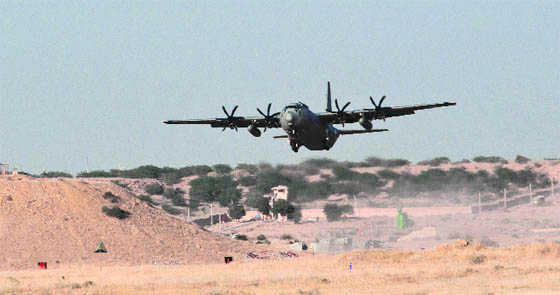
jaisalmer: With about 30,000 soldiers in action, the Indian Army is conducting a major exercise ‘Shatrujeet’ by the elite Mathura-based Strike Corp in desert area of Mahajan field firing range of Rajasthan, wherein the capability to strike, deep into the enemy territory in an integrated air-land battle environment is being evaluated. Now, this exercise is in the last phase and next week on April 22, army chief D S Suhag is likely to come and review the exercise.
The operationally-oriented exercise is focusing on validating integrated theatre battle fighting concept by incorporating new age technologies, weapon platforms and systems as well as long-range precision targeting vectors. Mathura Strike Crops’ Core Commander Lt Gen Shaukin Chauhan on Saturday reviewed integrated operational manoeuvres, including insertion of heliborne and airborne activity.
The focus of the exercise is to achieve joint and seamless coordination among all the forces in a nuclear biological chemical warfare scenario so as to deliver the enemy, a lethal punch with full might at a lightening speed. In order to achieve this aim, high-end technology and all the latest multi-dimensional modern weaponry at the disposal of the armed forces is being utilised. In the last decade or so, there has been a paradigm shift in India’s offensive doctrine and capability and such exercises are undertaken regularly by the Army to train its troops in their offensive role and weapon usage.

In the changing scenario, the Indian Army looking to the increasing new challenges across the border, is trying to make its war talent strong and better in short notice time especially in the context of fighting war in desert.

Top Comment

The exercise which is currently under way in Indian Thar is clearly provocative. If it is to distract world attention from India’s proven role in Pakistan’s destabilization, it may not wo… Read MoreHussain Saqib

Lethality and might of Indian Army with Indian Air Force was fully on display in this exercise. Most modern equipment in the inventory of the Indian Army fired with precision in cohesion with each other with the main attraction being T-90 tanks, which are counted amongst the most technologically advanced tanks in the world. The tanks are capable of firing a variety of ammunition and missiles with sharp accuracy both by day as well as night.
Defence spokesman Manish Ojha said that Indian Army undertakes such exercises at regular intervals at different levels to ensure forces are provided real war-like situations and are kept in high state of battle readiness. The formation and units have been undergoing operation-oriented training for past two months. Post-preparatory training manoeuvres at subordinate units and formation level, the Strike 1 is now poised to conduct integrated operational manoeuvres to validate its operational plans in simulated high tempo battlefield environment and terrain.


41 soldiers killed in Siachen since 2013 in Parliament

Forty-one soldiers have lost their lives in Siachen Glacier since 2013, the government said today. Defence Minister Manohar Parrikar in a written reply in Lok Sabha said 10 soldiers were killed in 2013, eight and nine in 2014 and 2015, respectively. Till March 31, 14 soldiers have died this year, Parrikar said, adding medical equipment existed in all posts for emergencies. pti

41 soldiers died at Siachen Glacier since 2013, says Army

Jammu, April 29

At least 41 soldiers have sacrificed their lives in the line of duty at the Siachen Glacier, from 2013 till March 31 this year.Northern Command’s spokesperson Col SD Goswami said 10 soldiers died in 2013, eight in 2014 and nine in 2015 at the Glacier. “Another 14 soldiers died till March 31 this year at the world’s highest battlefield,” he added.He said adequate compensation was provided to personnel deployed in difficult terrains in border areas, in form of salaries and compensatory allowances. About infiltration bids on the LoC, he said there were 118 infiltration attempts from Pakistan into J&K in 2015. — TNS


SYL Canal: Politicians flog a dead horse

Raman Mohan
Like everything else that is overexploited, the SYL Canal row too is subject to the law of diminishing returns. For some 20 odd years, this controversy did give a decisive edge to the party that succeeded in raising passions of the populace over this issue. But the ill-fated project lost that potential a long time ago.

SYL Canal: Politicians flog a dead horse
DSP Rajpura R S Sohal briefing the anti-riot police deployed along the SYL canal near Rajpura. A public notice has been put up by the police after the Supreme Court order on maintaining status quo, thus barring any activity on the SYL canal Tribune Photo: Manoj Mahajan

Punjab Chief Minister Parkash Singh Badal appears intent on riding the Sutlej-Yamuna Link (SYL) Canal horse in order to romp home in the next assembly poll due in about a year. Towards that end, he has taken on the Supreme Court even by refusing to accept its order to maintain status quo on the land acquired for the construction of the canal through a resolution passed by the legislative assembly. That shows his resolve not to let go of the canal row under any circumstances till the 2017 election. Having spent a life time in politics, the senior Badal may well be risking all in what could turn out to be his last bid at the office of the Chief Minister of Punjab.  Ever since Haryana came into being in 1966, the canal issue has been used by politicians of both states for electoral gains. For some 20 odd years, this controversy did give a decisive edge to the party that succeeded in raising passions of the populace over this issue. But the ill-fated project lost that potential a long time ago.The last time this issue was tested for its political potency was in 2004. In June that year, the apex court directed Punjab to complete the work in its territory. However, on July 12, 2004, the then Chief Minister Amarinder Singh had the Punjab Assembly pass The Punjab Termination of Agreements Bill, 2004, thus terminating its water-sharing agreements, and effectively stopping the construction of the canal in Punjab. But, this did not improve the chances of the Congress in the next assembly poll in 2007. The Congress lost and the Akali Dal-Bharatiya Janata Party combine came to power. Since then, the canal as a political tool had been gathering dust till it was suddenly rescued from oblivion by the Punjab Chief Minister as his weapon of choice for the impending electoral battle.So far as the people of Haryana are concerned, the issue of the canal is no longer an issue that will decide the fate of an election. The SYL Canal issue lost its emotional and political potency with the eclipse of the maverick Devi Lal, former Deputy Prime Minister. The last time the people of Haryana attached importance to this issue was in 1985, after the Rajiv Gandhi-Harchand Singh Longowal accord was signed. The late Devi Lal, who was in political wilderness then after being completely outplayed by that master practitioner of realpoltik the late Bhajan Lal grabbed the chance offered by the accord and launched an agitation which swept him to power in 1987. That was the last election in which the SYL Canal issue had played a decisive role, so much so that months before the election the then Chief Minister Bansi Lal took panches and sarpanches to SYL project sites in Punjab to see the progress of construction.In the 1991 elections, the failure of the Devi Lal clan to run a government for a full five-year term was the main issue not the SYL Canal or other territorial disputes. Similarly, in 1996, the people put their faith in Bansi Lal mainly due to his promise to ban liquor in Haryana. Since then, the people of the two states have attached little importance to the SYL Canal. This indifference towards the project is more pronounced in Haryana than in Punjab. Psychologically, the farmers of Haryana appear to have resigned to their fate. Streetwise as they are, they know by now that whatever their chosen politicians say about the canal, the project is not going to materialise. A farmer put it succinctly: We are not losing something we had. So, it is a lesser loss considering the lost asset was never in our hands. In Punjab, there is a subtle psychological difference. By and large, farmers know that they stand to gain nothing should Punjab abandon this project. Already they are utilising whatever is available from the rivers. Additionally, they are pumping out underground water at an alarming rate. So, the Punjab farmers do not stand to gain substantially from abandoning the project. There are several other reasons why the SYL Canal figures nowhere in the list of priorities of the voters in Haryana. The change in the demographic pattern has a lot to do with the relegation of this issue to the back burner. In Haryana, over 65 per cent of voters are under the age of 35. The SYL Canal is an issue they have just heard of. They have heard politicians cry themselves hoarse over this issue but this generation does not relate to the issue in the same way as their elders did. Besides, the new generation is losing interest in agriculture itself. They are more interested in jobs rather than in more water for their already fragmented land holdings. Demographic patterns and land holdings have changed in Punjab too just as much as in Haryana. Rampant corruption, unemployment, the problem of drug addiction, financial mess and lack of industry and infrastructure are far more important and closer to voters in Punjab than the SYL Canal.  As a result, the SYL Canal issue is now close to the hearts of political parties and their leaders only not the man on the street. No wonder then that Badal’s moves have failed to evoke any reaction among the people of Haryana which could have provoked a reaction from the farmers of Punjab much to the glee of Badals. Of course it is different for politicians and political parties. Haryana politicians, including Chief Minister Manohar Lal Khattar, reacted meekly at first and then stridently in a bid to outdo rivals. That is likely to continue until the issue is once again buried. As against this, people in Delhi attach more importance to the project for the simple reason that that the formal death of the canal project would end all hopes of an improved supply of drinking water there in the near future. Chief Minister Arvind Kejriwal has, therefore, erred by opposing the construction of the canal. The prospects of his party winning the next assembly poll in Punjab have obviously weighed on his mind more than the needs of the people of Delhi. He could well end up annoying voters in the national capital.Nevertheless, the political death of the canal issue does not diminish the importance of the project for Haryana at least. The water is crucial for the thirsty fields and parched throats in several districts of Haryana. The only way to come to an amicable settlement is to sit across the table, forget politics and just keep the interests of the people of the two states in mind. The leaders should keep in mind that had there been no division of Punjab, river waters would have been shared equitably among all areas. A boundary and a new name are hardly any reason not to share natural resources. If politicians of the two states can share space in Chandigarh, why not river waters? The writer is a veteran Haryana journalist.


Tearful adieu to Major Deswal in Jhajjar

Chief of Army Staff, Gen Dalbir Singh, and his wife Namita Suhag console the martyr’s wife, Neeta, and father Rishiraj Deswal during the homage-paying ceremony at Palam Airport in New Delhi on Friday. Tribune photos

Tribune News Service

Jhajjar, April 15

Heart-rending scenes were witnessed as the body of martyr Major Amit Deswal (31) arrived at his residence in HUDA Sector-6 here today. Major Deswal was killed in an encounter with terrorists in Manipur on Wednesday nightAmit’s mother Vedvati and wife Neeta cried, while his three-year-old son Arjun was unaware of the tragedy that had struck the family. The body was brought by an Army chopper.Wrapped in the Tricolour, the body was later taken to his native Surheti village, about 12 km from here, where his younger brother Ankit Deswal lit the pyre. A contingent of the Army reversed arms and fired a volley of shots in the air to bid farewell to the departed soul.Apart from representatives of various social and non-political organisations, former Chief Minister Bhupinder Singh Hooda, Agriculture Minister Om Prakash Dhankar, MLAs Geeta Bhukkal, Raghuvir Kadian and Naresh Kaushik, DGP KP Singh and other administrative officers paid tributes to the martyr by laying wreaths on his body.Retired Subedar Rishiraj Deswal, inconsolable father of Amit, said his son had laid down his life for the sake of the nation and he was proud of his son.Maj Amit of 21 Para SF was killed in a gun battle with ZUF militants in the densely-forested Nungba area during a combing operation undertaken by the Rashtriya Rifles and Special Forces personnel.“Amit, who was born on January 15, 1985, was so passionate about serving the nation that he had started preparations for competitive examinations after 12th class and qualified CDS examination at the age of 19 years in 2005,” said Amit’s uncle Shamsher Singh.He maintained Amit got commissioned in 2006 and his first posting was with an Artillery unit. He had secured ‘Commando Daggar’ during ‘Ghatak’ course after joining the elite Para unit in January 2011. Amit had last visited his home in Jhajjar in February to attend his brother’s marriage.


Pathankot attack staged by India: Pakistan JIT

The Pakistan Joint Investigation Team (JIT) that visited India to probe the Pathankot airbase attack has said in a report that the incident had been staged by Indian authorities, reported Pakistan Today. Calling it a “vicious propaganda” against Pakistan, the team said India did not cooperate with them. The report will be submitted to Pakistan Prime Minister Nawaz Sharif soon.

Man who penned India’s answer to ‘Red Star Over China’ no more

Man who penned India’s answer to ‘Red Star Over China’ no more
Satnam Singh

Vishav Bharti

‘Whose obituary do you want to write?’ he would have laughed at me. ‘G Fellow’, who was admired by the radical Left cadre as a commentator on international politics? Gurmeet Singh — the name that he shed decades ago in Amritsar when he joined the Naxalite movement in the 1970s? Or Satnam, whose classic travelogue Jangalnama was hailed by mainstream English critics as India’s answer to ‘Red Star Over China,’ a 1937 book by Edgar Snow? The account of the Communist Party of China was written when they were a guerrilla army still obscure to Westerners.Satnam, who died in Patiala on Wednesday night at the age of 64, lived many lives. Sometimes as an underground Maoist guerrilla, sometimes as a democratic rights activist on fact-finding missions on human rights violations in Kashmir and Gujarat genocide, or as a creative writer, who would write with equal felicity in Punjabi, Hindi and English.Like many youngsters in 1970s, he also left home with a dream that the world can be made a better place to live. “But he was one of the few who remained steadfast in his belief till their last,” says Prof Bawa Singh, his close friend and former vice-chairman, National Commission for Minorities.All these decades, besides political activism, Satnam kept on writing short stories and political commentary under different pen names. “He had written around 15 short stories but nobody bothered to preserve them and he himself was busy in activism, so most of these are lost,” reveals Singh. Among those writings only one story, World’s Oldest Profession, on prostitution that appeared in a Hindi magazine has survived.“While travelling in Bastar in 2001, it never crossed my mind that I will write something,” he would often say about Jangalnama.Two years later, while reading something, the idea occurred, thus Punjabi literature’s ground-breaking travelogue was written in just 12 days. “Then I didn’t think of publishing it but some friends took the initiative in 2004,” he would tell.People were for the first time reading accounts from the jungles of Bastar that the Maoist movement was not only about Improvised Explosive Devices (IEDs) or killing security personnel, but it was also about how people were struggling to change their fate when the state is absent. Even Arundhati Roy, who admired the work as “the best work on India’s Maoist movement”, later acknowledged that his book inspired her to visit Bastar. But he refused to sell his soul to the logic of manufactured fame.Around five years ago, when Operation Green Hunt was at its peak, he surfaced again after traversing the virtual war zone of Bastar for several weeks. How was it, I asked? “I do not know why I no more fear death,” he quipped.Now I remember his lines in Jangalnama about tribal fighters, “The purity and conviction of their aim gives them the courage to look death in the eye. They love life but they don’t care about death.” He was no different in his life. Nor will he be in his death.(The writer translated Jangalnama into English)


Retd military brass find lucrative careers in growing defence sector

VEXED ISSUE While the plan to build local capacity in defence has opened up new professions for former personnel, it has also raised questions over their conflict of interest

NEW DELHI: The Make in India plan to build local capacity in defence has fuelled a trend of private companies hiring retired top military brass and tap their expertise to get a toehold in the arms bazaar.

LOCKHEED MARTINUS aerospace giant Lockheed Martin has offered to manufacture its F-16 fighter jet in the country under Make in India which has generated more jobs for former military personnel.While the development has opened new and greener pastures for defence personnel it has also raised questions over conflict of interest and propriety.

Recently, Rolta India Limited hired Lieutenant General KT Parnaik, a retired Northern Army commander, to head its defence business. To kick-start its new businesses, Reliance Defence and Aerospace (RDA) inducted a battery of retired three-star officers — Air Marshal M Matheswaran, president of aerospace business; Vice Admiral HS Malhi, group president of Reliance Defence and Engineering Ltd; Lieutenant General MS Buttar, president of land systems and Vice Admiral KN Sushil, president of submarine business.

A senior RDA executive said the officers were hired for their operational expertise and not for liaisoning.

Industry sources said the salaries range from `36 lakh per annum to `One crore, depending on the profile of retired officers and the companies that hire them.

Retired officers are free to join defence companies after a year-long cooling-off period. The opinion is divided on whether this ‘break’ is sufficient to avoid a conflict-of-interest situation.

In 2012, a Parliamentary panel suggested the coolingoff period be extended to five years to address concerns about top officials being hired by firms to influence decisions.

Air Vice Marshal AJS Walia (retd), now the regional executive (India and South Asia) of Sikorsky Aircraft Corporation, argues that top officers have manned sensitive positions in service and are aware of their responsibility to avoid conflict of interest.

“They come with decades of experience. They understand technology and how requirements change. Why should this talent be wasted on the golf course?” he said.

But some serving officers have called for stricter checks and balances to ensure the ‘Lakshman Rekha’ of propriety was not crossed. “There are pros and cons…Old contacts definitely should not be used to push business interests,” said a senior officer on the condition of anonymity.

Industry leaders contend that preference for retired officers rests solely on their understanding of customers’ requirement. “Firms hire them to communicate to the armed forces what they are all about and what they bring to the table,” said Ashok Atluri, managing director of Zen Technologies, an indigenous firm that manufactures simulators.

“There are many experts in the market to interpret the DPP. Retired brass only provides insights into what solutions may be liked by the customers,” said the CEO of a top defence firm, adding that the defence procurement procedure (DPP) was transparent and left no room for outsiders to influence decisions.

Lieutenant General JS Bajwa (retd), editor of Indian Defence Review, concurs. “Gone are the days when people could influence decisions,” Bajwa added.


NUCLEAR SECURITY SUMMIT Modi meets Cameron in US; focus on defence, Make in India

Modi meets Cameron in US; focus on defence, Make in India
Prime Minister Narendra Modi shakes hands with British Prime Minister David Cameron before a meeting at the Nuclear Security Summit at the Walter E. Washington Convention Center in Washington on April 1, 2016.— AP/PTI

Washington, April 2

Prime Minister Narendra Modi met his British counterpart David Cameron here on the sidelines of Nuclear Security Summit (NSS), during which the two leaders discussed defence co-operation and Make in India issues.

“My meeting with PM David Cameron focused on defence cooperation, make in India and other key issues,” Modi said in a tweet before he left for Saudi Arabia after two days of engagement with world leaders during the NSS here.

Briefing reporters, the Ministry of External Affairs spokesman Vikas Swarup said during the meeting yesterday both leaders recalled Modi’s visit to London last year, during which India and the UK had signed deals worth 9-billion pounds and inked a civil nuclear pact.

Modi said that ties between the two countries had become “richer and deeper”.

Defence cooperation came up for discussion and Prime Minister Modi mentioned that Britain could be a partner in the ‘Make in India’ initiative, especially in the defence sector.

Visa issues also came up for discussion, Swarup said.

Both the leaders also reviewed the decisions that had been taken during Modi’s visit to Britain last year in particular the decision to launch rupee bonds at the London Stock Exchange.

Cameron expressed happiness that it was proceeding very well.

“He also said that we need to increase our partnership in defence. Prime Minister said that high-tech defence production has now been opened up to 100 per cent FDI, India had skilled manpower, cheap labour was also available and as such UK can become very important partner in the Make in India initiative particularly in the defence sector,” Swarup said.

The two leaders discussed some of the other pending issues between them including terrorism.

“Prime Minister also raised the issue of Tier II visas for IT companies. He said skilled professionals should not find it difficult to come to work in the UK. And, in this context the recommendations made by the migration advisory committee could caste a negative light,” Swarup said.

“Cameron promised to take a look at it. He said we do not want to disadvantage bonafide IT companies, but at the same time we would also want to ensure that the UK system is not misused,” the spokesman said. — PTI


US challenged China, India and 11 others on navigation rights last year

US challenged China, India and 11 others on navigation rights last year
—Reuters file photo

Washington, April 26

The US military conducted “freedom of navigation” operations against 13 countries last year, including several to challenge  China’s claims in the South and East China seas, according to an annual Pentagon report released on Monday.The operations were against China, India, Indonesia, Iran, Libya, Malaysia, the Maldives, Oman, the Philippines and Vietnam, the report said.It did not specify how many such operations were conducted against each of those countries. The US military carried out single operations against Taiwan, Nicaragua and Argentina, for a total of 13 countries, the department said in the two-page report.The freedom of navigation operations involves sending US Navy ships and military aircraft into areas where other countries have tried to limit access. The aim is to demonstrate that the international community does not accept such restrictions.The US military has repeatedly conducted operations disputing China’s maritime claims in recent years and did so again in 2015, a year in which Beijing’s island-building activity in the resource-rich areas of the South China Sea led to rising tensions in the region.A US guided-missile destroyer conducted a freedom of navigation patrol near one of China’s man-made islands in the Spratly archipelago in October. US military flights near the islands have been warned off.US Defense Secretary Ash Carter said the Navy would continue to operate in the region despite China’s condemnation of the patrols.China’s Defense Ministry said in a statement on its website late on Monday that it was deeply concerned by such operations.”The United States carries out militarisation in the South China Sea in the name of freedom of navigation and overflight, threatens coastal nations’ sovereignty and security and destroys regional peace and stability,” the ministry said.It made the comment in response to what it said were reports of recent US military flights near Scarborough Shoal – known by Beijing as Huangyan Island – an area China seized control of after a stand-off with the Philippine coast guard in 2012.Admiral Harry Harris, the head of US Pacific Command, said this year the Navy would step up the freedom of navigation operations in the South China Sea because of concerns China is attempting to assert its dominance by building military facilities there.US freedom of navigation operations last year also challenged China’s claims of jurisdiction in the airspace above its maritime Exclusive Economic Zone as well as restrictions it has tried to impose on aircraft flying through an Air Defense Identification Zone over the East China Sea.The number of countries the United States challenged last year was down from 2014, when it targeted 19 countries. That was the largest number in more than a decade.Iran and the Philippines have been the most frequently challenged countries over the years, mainly because they sit astride busy sea lanes whose use they have tried to limit or govern. —Reuters