Ruchika M Khanna
Tribune News Service
Chandigarh, March 30
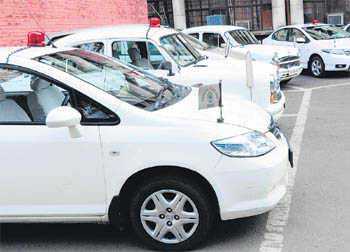
The Capt Amarinder Singh government, which has been quite vocal about the legacy of debt, is set to inherit from the previous Akali-BJP government a fleet of new cars, including a luxury SUV — something it won’t mind.These vehicles were ordered by the SAD-BJP government for the then Chief Minister Parkash Singh Badal, but by the time the Finance Department sanctioned the money, the model code of conduct for the Punjab Assembly elections had come into force.(Follow The Tribune on Facebook; and Twitter @thetribunechd)The new vehicles — a bulletproof Range Rover, and 11 Innovas and Gypsys, estimated at Rs 2.5 crore in total — will be delivered for the Chief Minister’s cavalcade shortly. Sources in the Finance Department said the amount had been released.“The budget was sanctioned by the Finance Department to the Transport Department. A sum of Rs 87 lakh has been released for 11 Innovas and Gypsys, besides Rs 1.3 crore for the Range Rover and another Rs 35 lakh for bullet-proofing it,” said a source, adding tenders had been floated in December.Last year, the former Chief Minister and his deputy Sukhbir Singh Badal had bought new Toyota Land Cruisers after the vehicles used by them were declared as “condemned”. Since parallel cavalcades had to be maintained for the Chief Minister, the new vehicles were cleared by the Akali-BJP government. Fifteen new Gypsys are also being bought to escort ministers and MLAs.
New game, new rules
Vivek Katju
Political propriety is a thing of the past
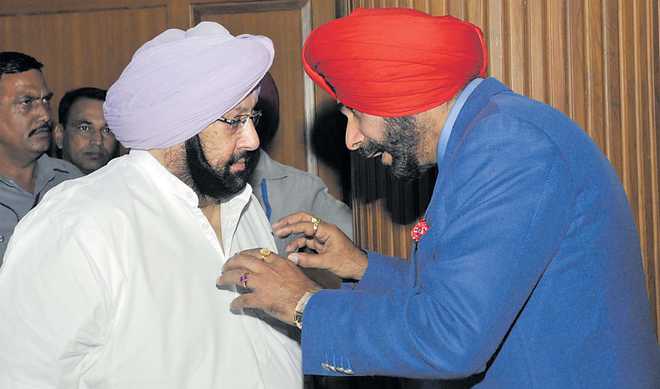 SHOWTIME: The Captain’s fine with his minister providing comic relief to TV audiences.
NAVJOT SINGH SIDHU in his present avatar as a Congress minister in Punjab is insisting on continuing with his participation in a television comedy show. A Shiv Sena member of the Lok Sabha, Ravindra Gaikwad, who has emphasised that he is a teacher, is loudly acknowledging and justifying his beating up of an elderly Air India executive. Sidhu’s approach and Gaikwad’s conduct profile the transformation of the normative landscape of India’s public life. This great change is further underlined by the responses of the leadership of the two parties of these politicians.Punjab Chief Minister Amarinder Singh has treated Sidhu’s desire as a legal matter not as a question of norm and convention. The Advocate-General of Punjab has opined that Sidhu’s wish does not violate the office of profit statute. There is little doubt though that old Congress icons such as Nehru and Indira Gandhi would have had little patience with Sidhu’s demand even if they may have been, as a remote possibility, amused by his hazir jawabi. But times have changed and Amarinder Singh obviously finds nothing wrong with one of his ministers providing comic relief to television audiences. Perhaps he recalls how rajas were kept in good humour. It is unclear, as yet, of what the Congress’ first family feels of the propriety of Sidhu’s insistence.Unlike the civil service which has conduct rules that prescribe dos and don’ts, persons in public life were expected to set standards of propriety. As guardians of public welfare they were expected to have an innate sense of what was ‘the done thing’. Naturally, the ‘done thing’ may change with the passage of time but the need for self-restraint in public life is the bedrock of a democratic system and distinguishes it from an authoritarian order. It is only self-restraint that keeps a check on the limitless temptations that every minister can find to pursue sama-daam-dand-bhed to achieve political ends.Over the years when the hard choice between power and expediency and the upholding of norms and conventions which flowed from the spirit of the Constitution was to be made political leaders and parties often opted for acquiring or maintaining power. Technical and legal reasons were invariably invoked to justify actions, as the Congress did in 1999. Its then Orissa CM Giridhar Gamang’s crucial vote against the Vajpayee government in April 1999 is now a distant memory. He was still a member of the Lok Sabha and chose to cast his vote despite being a CM. Vajpayee was voted out by one vote. Prima facie it is absurd for a CM to cast a vote in the Lok Sabha but now a precedent was set. This is relevant today when Yogi Adityanath even while being CM of UP can take part in a Lok Sabha vote to elect the President. Convention more than any rule demands that professionals, who hold political office, suspend their professional careers so long as they hold such office. Certainly, this was the case in the initial years after Independence. The only exception was for some distinguished doctors to see patients for a few hours every week or month on a purely honorary basis in order to keep up with their skills. Thus Dr BC Roy, the legendary CM of West Bengal who was a distinguished physician, devoted a couple of hours periodically to see patients on an honorary basis. The desire to continue with activity to maintain professional licences such as those of commercial pilots may fall within such exceptions. But can the same exception be invoked to take part in television comedy shows? If simplicity and frugal life styles derived from Gandhiji’s example were the norm followed by those who held ministerial office immediately after Independence, over the decades, it has become its reverse. It may come as a surprise to many that ministers in the 1950s used their private cars, although with official drivers, for their private journeys. This writer may be forgiven for recalling childhood memories of his grandfather, a member of the Union Cabinet in the early 1950s, of occasionally taking him and his other siblings for drives in his personal car, a small Hillman Minx. Obviously, now security considerations may not permit the use of private cars but the idea of self-restraint in these matters has gone. To turn to Gaikwad, the Shiv Sena’s initial response to his reprehensible and potentially criminal conduct was to virtually ask for an enquiry and emphasise his good conduct in his constituency. A few hours later the party made it known that its president Uddhav Thackeray was ‘angry’ with Gaikwad and had summoned him presumably for a tongue-lashing. Perhaps he will ask him to apologise for his behaviour and the party will take recourse to the favourite words in all such situations — the law will take its course. This is especially as an FIR has been registered against him. Legally this may pass muster but does it uphold the norm that is expected of an MP? In all likelihood, the political class will let this pass with only critical comments even though Gaikwad has aggressively asserted and justified that he beat up the Air India executive. Political leaders of the past would have found such brazen conduct unacceptable and taken action. But now we are in a different normative territory.Normative structures in the civil services have also undergone a sea change. Wide discrepancies between the provisions of the conduct rules which concretise them and what the senior bureaucracy and the political leadership not only permit but also perhaps expect have arisen. One such area is that of lobbying for jobs and posts. The rules prescribe that officials will not lobby for posts and transfers and postings. Some years ago, when this writer asked a PMO official the reasons for a suitable officer being overlooked for a job in the foreign office for which he was eminently qualified, he was told that no one had pushed his case by speaking on his behalf. Only the naive now let their work speak for them.Another area is the public airing of views on government policies in areas outside their assignments even though this was not the earlier norm. The conduct rules permit officials to undertake cultural, scientific and literary activities but the expression of personal views on government policies do not fall within this ambit. Perhaps Sidhu will claim that television comedy shows are part of the present-day culture and hence he should be allowed to carry on after office hours!The writer is a former Secretary, Ministry of External Affairs
Road map for Punjab
Leave the rear-view mirror and look ahead
PUNJAB’S fiscal condition has turned out to be worse than what was portrayed in the last budget. While announcing Rs 3,000 crore sops, the pre-poll budget had projected a Rs 1.38 lakh crore debt by year-end. The new Congress government has scaled it up to a mammoth Rs 1.82 lakh crore. This means the SAD-BJP government had disrespected the sanctity associated with budget figures. It did not disclose, or account for, the Rs 25,000 crore expenditure carried out subsequently, according to Finance Minister Manpreet Badal. Doubts about Akalis doctoring figures may be partly cleared after a third-party audit of the state finances, publication of a White Paper and a Vigilance probe into the Rs 31,000-crore “food scam”. Vigilance, as Capt Amarinder Singh ought to know from experience, is unreliable. It is useful more for high-profile bailouts than convictions. More skeletons are expected to tumble out of the Badal closet. The CAG has put up a damning report saying PSPCL under-used its own plants and charged Rs 1,428 crore extra from consumers. The new leadership, however, need not dwell too much on Akali misrule as voters have already punished them. While witch-hunting is certainly undesirable, punishment for violations of the law, if any, can be ensured by letting the law take its course, regardless of the law-breakers’ position or cosy relationship with some in the ruling party.Other than abundant talk and oodles of confidence, the new rulers have displayed little else. The sense of purpose and urgency seen at the first Cabinet meeting was missing in the first assembly session. It needs to go beyond red beacons and focus on the road ahead — how to effect financial transformation of Punjab and arrange funds for keeping the party’s populist promises, including a farm loan waiver. How the GST rollout will affect the state finances needs to be urgently studied, as also the fallout of the likely pay hike. Restoration of the state’s financial health will require hard decisions. Going by the new dispensation’s please-all approach and adjustment of every available Captain loyalist in key posts, populism may triumph over fiscal rectitude.
Pending bills:� Water shocker for residents
Sanjeev Singh Bariana
Tribune News Service
Chandigarh, March 30
The Water Supply and Sanitation Department has issued pending bills in the range of Rs 30,000 to Rs 60,000 to a majority of consumers in 139 towns of the state, leaving them in shock.In several cases, the bills are pending for three to five years. This is so because the department did not issue bills all this while.Legislators have apprised Local Bodies Minister Navjot Singh Sidhu of the situation. He has convened a meeting of officers and MLAs next week.Sidhu told The Tribune, “In certain towns, bills had not been collected for nine to ten months. There are cases where bills accumulated for a long period. I have asked the officer concerned to prepare a detailed note and give us a correct perspective on the situation. I have also called MLAs to join us in a discussion to thrash out the matter next week. The SAD-BJP government slept over the matter.”The department is still to work out the exact figure of dues. But going by the population of more than 1.05 crore in 139 towns, the amount will be “definitely very high”.Sidhu said, “Officers will have to do a lot of explanation over why the bills were not issued for months and, in some cases, years.”Jalandhar North MLA Bawa Henry said, “Slum dwellers and those living in poor localities are the most affected. I have sought the minister’s intervention to find a way out. One solution can be to allow people pay up in easy instalments. Any other solution can be found. The idea is to give people immediate reprieve. But what’s important is that a permanent solution needs to be found to avoid such a situation in the future.”
Japanese envoy meets CM
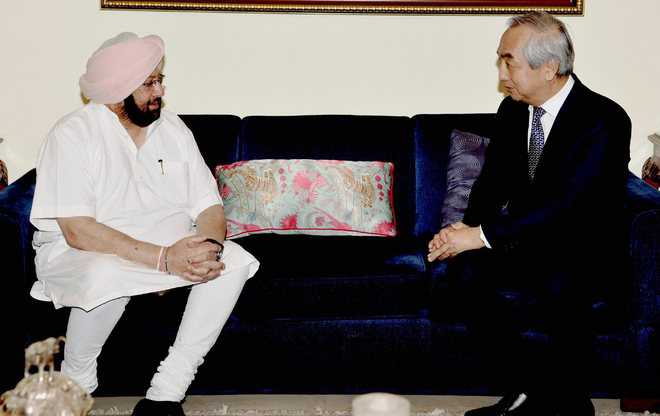 Chief Minister Capt Amarinder Singh with Japanese Ambassador Kenji Hiramatsu in Delhi on Thursday. PTI
New Delhi: A Japanese delegation, including the country’s envoy, met Chief Minister Capt Amarinder Singh here on Thursday and explored the possible areas for investment in the state. The areas discussed were power, Smart Cities, automated guideway transit, industrial parks, agriculture, horticulture and roads. tns
Japanese delegation meets Capt, shows interest in investing in state
HANDIGARH: Japan has evinced interest in investing in Punjab and partnering the state across key segments of growth and development.
 HT PHOTOPunjab chief minister Capt Amarinder Singh meeting Japanese ambassador Kenji Hiramatsu in New Delhi on Thursday.
A high-level Japanese delegation, including its the envoy to India Kenji Hiramatsu and Mitsubishi managing director Kazunori Konishi, met chief minister Captain Amarinder Singh in Delhi on Thursday and discussed possible areas of investment and collaboration.
The discussions were preliminary but it will pave the way for more intensive discussions in future, said a state government spokesman. The discussion covered a wide range of subjects which the two sides agreed to deliberate further to work out a collaborative mechanism.
The spokesperson said after the meeting, Mitsubishi officials made a presentation to the CM listing several important areas for possible investment. These included power, smart cities, (automated guideway transit), industrial parks and captive power plants, besides strengthening of some existing projects.
Amarinder also discussed development of roads and highways as a key step towards improvement of Punjab’s infrastructure.
The two sides decided to explore possible cooperation in agriculture and the CM invited Japanese experts to visit the state, particularly Punjab Agricultural University, Ludhiana, to examine the feasibility of agricultural cooperation. An exchange programme for agricultural scientists could be worked out, the spokesman added. Amarinder said he was committed to Punjab’s modernisation in which Japan could join in as an important partner.
MP Singh to head technical board
Chandigarh: The Amarinder Singh-led Congress government has decided to give the charge of Chairman of the Punjab State Board of Technical Education and Industrial Training to MP Singh, Additional Chief Secretary, Technical Education and Industrial Training. A senior government functionary said till a new Chairman was appointed, MP Singh would remain the officiating Chairman of the board. In other cases, where the politically appointed chairmen of various boards and corporations were resigning from their posts, the principal secretaries of the respective body were being told to take the charge as an interim arrangement. TNS
Guv seeks revamp of sainik programmes
Chandigarh: Governor VP Singh Badnore while presiding over the 32nd meeting of the Rajya Sainik Board Punjab asked the officers to restructure their programmes and involve maximum ex-servicemen and students in their development projects. TNS
Hope floats for ‘neglected’ rest house near Badal resort
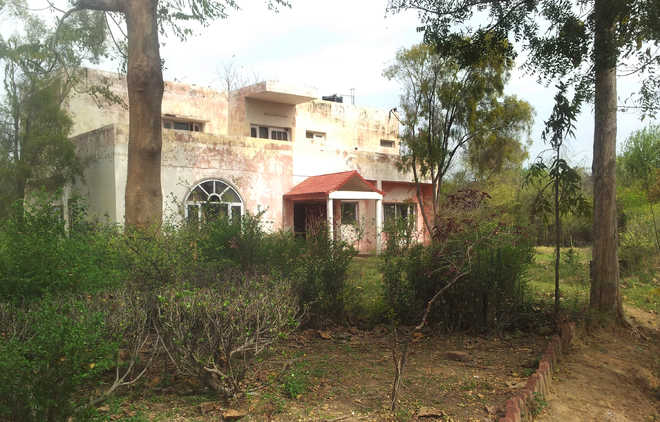 The dilapidated rest house of the Forest Department at Palanpur village near Chandigarh. Tribune photo
Rajmeet Singh
Tribune News Service
Chandigarh, March 30
A “neglected” forest rest house in the vicinity of the Badals’ luxury resort, Sukhvilas, at Palanpur village near here has caught the attention of the Congress government.Forests and Wildlife Minister Sadhu Singh Dharamsot has sought a report from the top functionaries of the Forest Department on the rest house, which also has provision for a forest sensitisation centre (Van Chetna Kendra).Dharamsot confirmed that he had asked the officials to explain why the facility had remained non-functional during the past five years.The rest house fell on bad days when the construction of the resort started in 2012, the year the Akali-BJP government was re-elected. As the road to the rest house passed adjacent to the main premises of the resort, temporary barricading was done to keep passersby away.Due to the apathy, the place has been overrun by wild growth. The two-storeyed building is in a dilapidated condition. The whitewash on the façade has peeled off. “Officially, no order was passed to shut down the centre, but forest officials were told to stay away,” a senior functionary said.Back in 2007, during the tenure of the SAD-BJP government, the rest house had hit the headlines when the then Chief Parliamentary Secretary Harish Rai Dhanda was not allowed by the department to use the premises as his residence. The department had stated that Dhanda could visit the rest house with a permit, but not reside there as it was in violation of the Forest Conservation Act, 1980.
Away from prying eyes
- The rest house fell on bad days when the construction of the resort started in 2012, the year the Akali-BJP government was re-elected. As the road to the rest house passed adjacent to the main premises of the Badals’ resort, temporary barricading was done to keep passersby away
Dept in doldrums, govt must intervene: Roadways staff
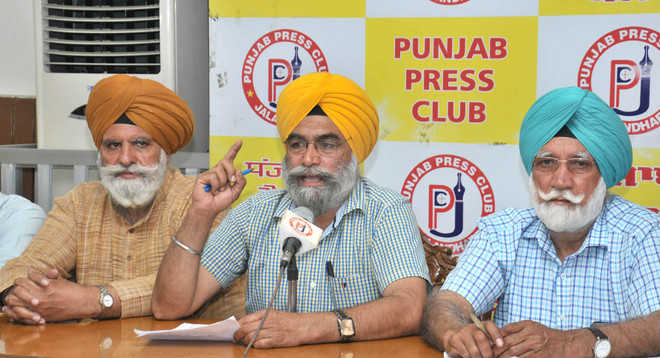 Members of the Punjab Roadways Employees’ joint action committee address the media in Jalandhar on Thursday. Tribune Photo: Malkiat Singh
Tribune News Service
Jalandhar, March 30
A joint action committee of the Punjab Roadways Employees’ Union today blamed the Akali-BJP government for the alleged losses worth crores of rupees which were being incurred by the Transport Department in the state. They demanded that the new government should take remedial action to fix the department which was stuck in the doldrums.They said the Congress government should investigate into the losses caused by the previous regime in the department. Action committee convener Surinder Singh said in the past ten years, the transport mafia in the state had looted the state. They said as the new government had come to power in the state, it should make efforts to save the public transport from the clutches of the mafia.Activists of the committee Jagdish Singh Chahal and Mangat Khan demanded the implementation of the Punjab and Haryana High Court order as per which the HC had on December 20, 2016 rejected all previous transport policies made after 1990, and had cancelled all extension of routes of over 24 kilometres. They also sought a dedicated budget for the inclusion of more buses in the Punjab roadways.The committee also demanded the dismissal of time tables made during the previous government, alleging that these were made to accommodate the Akali-BJP buses in the city.Activists also alleged that general managers had been deputed in the Punjab Roadways without considering the seniority level, despite the fact that the current duty charts were asked to be issued on seniority basis by the government. They also alleged that after three or four months after the passage of the orders, the charge of general managers had not been withdrawn.
Now, police say won’t cut VIP security in haste
CHANDIGARH: After the flip-flop over review of security cover to VIPs, the Punjab Police on Thursday clarified that any cut in the security will not be done in haste.
Senior police officials in the police headquarters here said the March 21 order of pruning the security of many VIPs, including senior SAD-BJP leaders, with immediate effect was issued in “haste” and out of “overenthusiasm”.
“Police department received a letter regarding the security review from the government and the pruning was ordered by the said officer without studying the perception of threat to each individual concerned. Even the field officers were sent the list of VIPs whose security was to be pruned,” sources said.
As the “unrealistic” orders created a confusion and the matter reached the high-ups, it was decided on March 24 to keep these orders in abeyance and a committee headed by DGP (law and order) Hardeep Dhillon was formed to review the threat perception to the VIPs concerned before ordering the cut.
“Dhillon-led committee will make recommendations after going through the reports of various intelligence wings of the police and other factors. There was no question of stopping the review,” Punjab DGP Suresh Arora told Hindustan Times.
On Wednesday, after getting reports from the Dhillon-led committee, security of many low-profile VIPs and those officials who enjoyed the trust of the previous SAD-BJP government, was pruned. More than 175 cops were ordered to join their original battalions with immediate effect.
Interestingly, it’s the Congress leaders who are feeling the pinch of this review exercise. Many party leaders can be seen speaking openly against the move. “In the March 21 list, an MP was left with four cops. Keeping in view the 8-hour duty, only one cop will be with the MP most of the time. Can a single constable guard an MP and his family?” said a Rajya Sabha member from the state. Sources said the SSPs and the police commissioners have even received requests from districtlevel Congress leaders for security.
SIMILAR MOVES FAILED IN PAST
It’s not for the first time that the security of VIPs was pruned in Punjab. In 2012 and 2014 as well, such exercises were carried out and many VIPs lost the security cover. However, both the times, they managed to get back the cover on some pretext. As per officials, in last six months of the previous government, security of the SAD-BJP leaders was heightened just to give them the “feel of power”.