










Sanjha Morcha

What’s New

Click the heading to open detailed news

Current Events :

web counter

Print Media Reproduced Defence Related News

IAF team on cleanliness mission

Tribune News Service

Mandi, August 11

An Indian Air Force car-cum-bike rally for Swachh Bharat Abhiyan reached Manali on Saturday.Participants of the rally also distributed dustbins and pamphlets to people to encourage them for cleanliness.The rally is being headed by Air Vice-Marshal AK Singh. He said the rally began from Delhi via Manali to Leh and Thoise on August 10, which will culminate on August 24. During that period, it will cover 2,372-km distance.He said the objective of the rally was to promote the Prime Minister’s noble mission of Swachh Bharat Abhiyan. It aimed at spreading awareness among tourists and locals to maintain cleanliness in the mountain and make these garbage-free zones.The team has planned to collect garbage for its disposal at the designated places. It is also planned to carry out cleanliness campaign at Leh and Thoise.


Punjab soldier, 3 militants among 6 killed in Kashmir encounters

Punjab soldier, 3 militants among 6 killed in Kashmir encounters

Sepoy Happy Singh of Ram Nagar Talwandi Sabo, Bathinda, Punjab.

Majid Jahangir
Tribune News Service
Srinagar, September 27

Two civilians, a soldier and three militants, including an SPO-turned-militant, were killed in Kashmir on Thursday.

Three encounters broke out in Anantnag, Srinagar and Budgam districts when security forces launched three separate operations in the wee hours of Thursday.

A civilian was killed at Noorbagh locality in Srinagar city, during a cordon and search operation which was launched following an input about the presence of militants.

The slain civilian was identified as Mohammad Saleem Malik. Security sources said they had an input about the presence of two militants in the area when the operation was launched.

Intense clashes erupted in the area and authorities suspended mobile internet in Srinagar to maintain law and order.

J&K Police blamed militants for the death of Malik.

“…The hiding terrorists fired indiscriminately resulting in death of Saleem Malik,” a police spokesman said.  The operation was later called off.

In a separate gunfight, a soldier and a local militant were killed in south Kashmir’s Anantnag district that broke out on Thursday morning.

The gunfight broke at Gaksigund Dooru when the forces were carrying out a search operation in the area.

“In the gunfight, a Lashkar-e-Toiba militant commander and a soldier were killed,” police said.

Police identified the slain militant as Asif Malik.

“He was involved in several attacks on security forces including the killing of CRPF men at Achabal this year and in many other cases of civilian atrocities,” a police spokesman said.

The slain jawan was identified as 25-year-old Happy Singh of 19 Rashtriya Rifles and a resident of Talwandi Sabo in Bathinda.

Two local militants were killed and two soldiers were injured in another gunfight in Budgam district.

The two local militants were trapped in Panzan mosque during a cordon and a search operation. Special forces were deployed to flush out the militants.

“Security forces also appealed to the terrorists to come out.  However, the terrorists turned down the offer and consequently the operation had to be carried out in a deliberate manner keeping intact the sanctity of the mosque. In this operation, two terrorists were killed,” the spokesman said.

The two militants were identified as Sheeraz Ahmad Bhat of Kralwari Chadoora and Irfan Ahmad Dar of Kakapora Pulwama and the two were affiliated with  Hizbul Mujahideen.

Irfan Ahmad Dar was working as an SPO and had deserted a couple of months ago, the spokesman said.

Meanwhile, an unidentified man was killed in alleged Army firing in Kupwara district.

Police said the Army at around 2 am had laid an ambush at Rangward area of Kralpora when they noticed a man moving in the area who was challenged.

“He ran away and the Army fired at him. The man was injured and taken to hospital where he succumbed to his injuries on Thursday morning,” he said.

The identity of the slain youth could not be established. However, he does not appear to be a local.

A Srinagar-based defence spokesman said they were ascertaining the facts about the incident.


Body of soldier killed in 1968 IAF plane crash recovered

Body of soldier killed in 1968 IAF plane crash recovered at Dhaka glacier base cam. Courtesy: ANI news

Uttarakashi, July 21: A body of one of the victims of 1968 Indian Air Force plane crash was found along with some parts of the aircraft at the Dhaka glacier base camp. The plane’s wreckage was found during a cleanliness drive organized by Indian Mountaineering Foundation at the Dhaka glacier base camp on July 1.

On 7 February 1968, an Antonov An-12 twin engine turboprop transport aircraft of the Indian Air Force disappeared while flying to Leh Airport from Chandigarh International Airport. While on approach to Leh the pilot decided to turn back due to inclement weather, the aircraft then went missing with the last radio contact over the Rohtang pass. It was declared missing after the failure to find the wreck. Previous recovery: In 2003 members of the Himalayan Mountaineering Institute who were trekking on the South Dakka Glacier came across the remains of a human body. The body was identified as Sepoy Beli Ram, a soldier of the Indian Army who was on the flight. On 9 August 2007 an Indian Army expedition code named Operation Punaruthan-III, recovered three more bodies. From 2003 till 2009 three search expeditions have been carried out with the recovery of four bodies. The crash location lies at a height of about 18,000 ft 0 in (5,486.40 m), at a gradient of 80 degrees. On 21 July 2018 the Times of India reported that a mountaineering team at the Chandrabhaga-13 peak had found a body at the Dhaka glacier base camp.The team has found wreckage of the plane along with the remains of a soldier.

Read more at: https://www.oneindia.com/india/body-of-soldier-killed-in-1968-iaf-plane-crash-recovered-2739470.html


Politicising Surgical Strikes Erodes the Army’s Potency and Deterrent Value

Political parties desire populist, quick and ostensibly spectacular results with an eye on elections. But what the ruling party wants is not what the army leadership should do.

Politicising Surgical Strikes Erodes the Army's Potency and Deterrent Value

Here’s a sobering thought to reflect upon as India celebrates the anniversary of the ‘surgical strikes’ in which the Indian Army’s special forces (SF) stealthily crossed the Line of Control (LoC) and neutralised a handful of terrorists who would have otherwise infiltrated into Jammu and Kashmir: the more the government politicises the army by using its sacrifices to further its electoral objectives, the more it erodes the the army’s potency, and hence its deterrent value.

The tragic part of this celebratory charade is that the army leadership appears complicit in its own emasculation. It needs to be understood that armies are never politicised, they follow command. It is the army leadership that gets politicised with adverse implications for war preparedness. It is, therefore, a truism that armies are as good as its leadership. So when the army leadership decides to support what the ruling political party wants, its missions – militarily – make less sense. For instance, army chief General Bipin Rawat’s recent call for another surgical strike was not his business; it is prerogative of the political leadership. He should worry about genuine strikes pivoted on preparedness, should the need arise.

Political parties desire populist, quick and ostensibly spectacular results with an eye on elections. But what the ruling party wants is not what the army leadership should do. Otherwise, (a) it demoralises its command since military outcomes are not what they should be, (b) the emphasis shifts away from modernisation, which is a sustained long-term goal, and (c) training for war takes a back-seat. The command ultimately loses respect for its leadership, leading to command break-down. Military leaders, therefore, should question and not blindly acquiesce to political opportunism.

Militarily, the September 29, 2016 strikes made little sense for three reasons. One, surgical strikes are the prerogative of the air force; the army, at best, conducts raids and hot pursuit. Surgical strikes – meant to influence the political and war-fighting levels by its shock and awe effect – are undertaken by the air force after certain preparations to contain a probable escalation. These include using aircraft to jam the enemy’s communication systems, and, by activation of own air defence capabilities, to cater for retaliation by the opposing air force. Given their its strategic effects, surgical strikes are always done by nations with political will and military preparedness. For example, after the 26/11 terror attacks in Mumbai, the Indian Air Force had suggested surgical strikes without crossing the Line of Control to the then government. After mulling for a few days, the government had rejected the suggestion.

Two, the strikes done by the army were not even raids, since they are done against legitimate military targets (in this case, the Pakistan Army) to minimise collateral damage. They were not even hot pursuit, which as the term denotes, is about chasing the enemy back into its own territory. They were what the then foreign secretary S. Jaishankar called them: “Target-specific, counter-terrorist operations (CI ops) across the Line of Control which the army had done in the past too, but this is the first time the government has gone public about it.” He said this to the Parliament Committee on Foreign Affairs.

Three, genuine strikes of this nature are always denied to keep the enemy in strategic suspense about the next move. In this case, India first informed Pakistan and then publicly declared that no more strikes were planned and that the mission was over. It was extraordinary for the army to admit operations by the Special Forces and to announce that there “were no plans for further continuation.” By doing so, India conceded its unpreparedness for – let alone war – even heightened tactical level engagements for fear of an escalation. The strikes were evidently not meant to be an army mission but a political one to create a perception of a first-of-its-kind spectacular operation.

The idea of surgical strikes came from the raids done by the Indian Army in Myanmar in June 2015 which had boosted Modi’s ‘macho’ image. This was confirmed by the then defence minister Manohar Parrikar, who said the preparations for the surgical strikes (in Pakistan occupied Kashmir) started 15 months ago when specialised equipment for SF was purchased from abroad.

On June 4, 2015, the Myanmar-based NSCN-K had ambushed an Indian Army convoy, killing 18 soldiers. The then 3 corps commander, Lieutenant General Bipin Rawat, after clearance from the Prime Minister’s office (PMO) and with support from the IAF (helicopters were kept on stand-by for extrication of Special Forces), conducted raids by SF at two militant sites inside Myanmar on June 10, killing around 100 terrorists. As the government of India publicly celebrated the successful raids inside Myanmar, projecting them as evidence of the Prime Minister’s political will and determination, the Myanmar Army decided to not react, even though the government mildly protested the violation of its sovereignty.

General Bipin Rawat. Credit: PTI

The Myanmar raids emboldened the Indian government to replicate the same model on the Pakistan border with better preparation and thought. This could be the perfect face-saver for the Modi government, which, given the unabated proxy war by Pakistan and the ever-increasing casualties, was having difficulty in maintaining its ‘tough’ image. Since Lieutenant General Rawat had demonstrated his expertise by planning and executing the Myanmar raids, and given his extraordinarily long innings in Kashmir doing counter-insurgency operations (CI ops), he had to be brought to the South Block, perhaps as the vice-chief of army staff (VCOAS) once the incumbent Lieutenant General M.M.S. Rai superannuated on July 31, 2016. This happened on September 1, with the post of VCOAS being vacant for a full month.

The opportunity to do a Myanmar on Pakistan came when terrorists struck at the army camp in Uri on September 18, 2016, killing 19 soldiers. Given the heightened sense of nationalism drummed up by the BJP, and with the coming elections in Uttar Pradesh, the government needed to showcase its muscularity against Pakistan without inviting war. The die was thus cast for the politically driven surgical strikes. Vice-chief Lieutenant General Rawat and northern army commander Lieutenant General D.S. Hooda were the key operational planners, while the Prime Minister, defence minister and the national security adviser were kept in the loop. Army chief General Dalbir Singh made notional, rather than any real, contribution to the task at hand.

Given the involvement of India’s topmost political and army leadership, two concerns were paramount: Pakistan should not retaliate, and no Indian soldier should be caught alive behind enemy lines since it would unravel the real plot. This necessitated extremely shallow penetrations on the Line of Control from where extrication was possible; not attacking Pakistan Army’s posts; finishing tactical-level operations as soon as possible; and informing the Pakistan Army soonest of what had been done in order to ensure that they did not commence counter attacks with troops-in-hand or troops’ build-up for an escalation. In short, pretend to do a major operation with minimal risks.

The military aim, as the director general military operations, Lieutenant General Ranbir Singh said in his official briefing, was to target “terrorist launch pads along the Line of Control”. Mind you, he said ‘along’ and not inside the LoC. With these instructions, SF assisted by local commandos (Ghatak platoons) for guidance and flank protection walked/ crawled up stealthily to seven terrorist launch-pads (which are temporary camps) situated about 700 metres (terrorist launch pads have since been moved in depth under direct protection of Pakistani posts) inside the LoC. The SF did to the terrorists what they had done to Indian soldiers in Uri base camp: they were attacked while asleep. While the exact casualty figures are anyone’s guess since no damage assessment means were employed (for fear of escalation), the big relief (admitted by Manohar Parrikar and Northern army commander, Lt Gen. D. S. Hooda) was the safe return of Indian soldiers.

It was time to draw political mileage by perception management. The electronic media went hysterical with buffoonery showing graphics of soldiers para-dropping on Pakistani soil, and by wargaming military balance of India and Pakistan. They have been willy-nilly assisted by chosen generals. According to Lieutenant General Hooda, “The surgical strikes in some way shattered the glass ceiling. The Special Forces have gained tremendous confidence in their ability to execute a complex operation in very hostile territory.” He said on another occasion, “We proved that we were capable of crossing the heavily guarded Line of Control and strike at multiple points.”

To recall, in the 90s, well before the Indian Army erected the Maginot Line (which represents a defensive mindset) in the form of the fence on the LoC in July 2004, regular army commandos rather than Special Forces, used to frequently breach the so-called glass ceiling. Raids (which are much more than targeting terrorists) on Pakistani posts, killing of its soldiers by surprise attacks and artillery firing were so commonplace that long silence by one side was reason for the other to worry. Moreover, except from 2005 to 2007, when back-channel talks were going on between India and Pakistan, cross-LoC raids were commonplace, and officers were commended for bravery. All this was, of course, done away from the media glare since that is the nature of covert actions.

The opposite seems to be happening at present. After the recent mutilation of a Border Security Force soldier’s body by terrorists, the army chief said, “We need to take stern action to avenge the barbarism that terrorists and the Pakistan Army have been carrying out.” But he did not explain how this would be done. One cannot help but recall wistfully how another chief at another time had chosen to focus on war preparedness instead of allowing him to be used for political sabre-rattling.

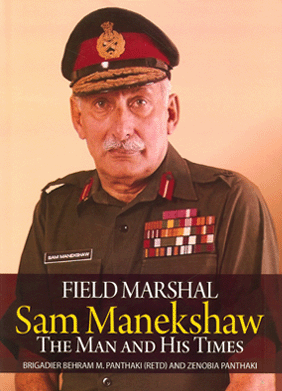
At the height of the refugee influx into India from East Pakistan in March 1971, Prime Minister Indira Gandhi had, in the presence of senior cabinet members, told General Sam Manekshaw that training the Mukti Bahini would not be enough and that it was time to use force. He refused. While offering to resign, the army chief (who was also the chairman, Chiefs of Staff Committee) told the disbelieving Prime Minister that he needed six months of war-preparedness and opportune timing for victory. The rest is history.

In terms of military decorations, General Manekshaw was a mere Military Cross. General Rawat is bursting with decorations from UYSM, AVSM, YSM to SM and VSM. Can General Rawat tell Prime Minister Modi that his army needs to give-up CI ops (which, after 28 years, are giving diminishing results) and focus on war-preparedness to deter Pakistan’s proxy war?

The writer is editor, Force newsmagazine.


Maharashtra govt fast-tracks defence equipment manufacturing cluster

Shiv Kumar

Tribune News Service

Mumbai, August 11

The Maharashtra government has fast-tracked the setting up of a defence equipment manufacturing cluster at the Special Economic Zone (SEZ) in the Multi-modal International Cargo Hub and Airport at Nagpur (MIHAN).

According to state government sources, the cluster which will generate 50,000 jobs have already drawn interest from prominent investors and defence contractors. Earlier this week, the government allotted 20 acres of land for the project. Officials said work on the project will begin immediately.

The Vidarbha Defence Industrial Hub, a special purpose vehicle will construct the manufacturing unit at sector 10 in MIHAN where the cluster is coming up, according to state government sources. The
initial investment involved has been estimated at around Rs 235 cr.

Tata Technologies Ltd, a Tata group company, which will be investing Rs 70 cr in a project here to impart skills to personnel who would be absorbed by micro, small and medium enterprises (MSMEs).

Imparting of specialized training for technicians who will be employed at the defence cluster has already begun and they will be absorbed when the first units are set up in a year’s time, according to
sources.

MIHAN is a mega industrial project spread over 4,300 hectares and was inaugurated 15 years ago.

A few defence and aviation-related industries are already located at MIHAN. Apart from Air India’s MRO and Reliance Dassault Aerospace Park, there are many smaller defence establishments here and the government is hopeful of attracting more companies in this field, officials said.


On Rafale Deal, New Documents Point To Anil Ambani Firm As Essential

Dassault denied the allegation, saying the reference in the document was to the obligation to make offset investments in India and not the compulsion to get into a joint venture with Anil Ambani’s firm.

PARIS: 

HIGHLIGHTS

  1. A French blog has put up images of two trade union documents
  2. Dassault official talking about joint venture with Reliance mentioned
  3. Congress has accused government on corruption and crony capitalism
 In the Rafale jet deal, documents featured in a French aviation blog may fuel more controversy amid opposition allegations that France snagged the Rs. 59,000 crore deal as a trade-off for aeronautics major Dassault tying up with Anil Ambani’s company.

Images of two trade union documents put up by the French blog Portail Aviation may add fodder to the political wrangling over the deal for 36 Rafale jets sealed by Prime Minister Narendra Modi with the French in 2016.

The images are of documents published by two unions of Rafale-maker Dassault – the CFDT and CGT. These are minutes of a meeting held on May 11 2017, in which the number 2 of Dassault Aviation, Loik Segalenn, is talking about the joint venture with Anil Ambani’s Reliance Defence.

fij5om38

The CGT statement says, “…a complete presentation of ‘Make in India’ with the creation of the enterprise ‘Dassault Reliance Aerospace’ at Nagpur was done for us”.

The blog does not interpret the documents and leaves it to readers to conclude whether or not Reliance was imposed on the French as a partner as a condition for the deal.

The CFDT’s document was mentioned earlier in a report by the French publication Mediapart just after former French President Francois Hollande’s explosive statement that France had no choice when it came to selecting Anil Ambani and his rookie company as offset partner for Dassault. According to Mediapart, an internal document of Dassault confirmed Mr Hollande’s statement.

Dassault denied the allegation, saying the reference in the document was to the obligation to make offset investments in India and not the compulsion to get into a joint venture with Anil Ambani’s Reliance Defence.

Details of the meeting appear to present a different picture.

The CGT statement says, “…a complete presentation of ‘Make in India’ with the creation of the enterprise ‘Dassault Reliance Aerospace’ at Nagpur was done for us. According to Mr (Loik) Segalen it was imperative and obligatory for Dassault Aviation to accept this “contrepartie” in order to obtain the export contract Rafale India.” The French word used is “contrepartie”, which can mean “compensation” or could have the negative sense of a “trade off”.

The second union (CFDT’s) statement talks about ‘Make in India’ being “the inevitable consequence” of the deal “imposed” by India, and says a joint venture with Reliance was created to attain this objective.

It is evident that the statements are not talking only about the offset obligation but also about the joint venture with Reliance. Whether the Reliance partnership was mandatory are among the questions raised by the opposition in India as well as a section of the French media.

48 COMMENTS

The Congress has accused the government of corruption and crony capitalism. The party had seized on French president Hollande’s comment to Mediapart last month to go hammer and tongs against the government, alleging that Anil Ambani’s company was imposed as a preferred partner on the French.

https://www.ndtv.com/video/news/news/on-rafale-deal-new-documents-point-to-anil-ambani-firm-as-essential-496550


ATF to move SC on Bhindranwale’s status

Tribune News Service

Shimla, August 5

The Anti-Terrorist Front will file a PIL in the Supreme Court to ascertain whether Jarnail Singh Bhindranwale is a martyr.ATF chief Veeresh Shandilya said politics was being done in the name of Bhindranwale. He said the ATF and the Shri Hindu Takht would file a PIL in the apex court to seek a clarification on the issue.He urged Chief Minister Jai Ram Thakur to set up a museum in Shimla in memory of 52 Kargil martyrs from the state. He urged the government to provide a financial assistance of Rs 50 lakh to next of kin of martyrs and a government job to a dependent.Paying homage to Vijay Kumar from Bilaspur who was killed during an encounter with militants in Jammu and Kashmir, he said his widow should be appointed as a head constable with immediate effect.


Indian Navy’s cave diving rescue capability, like in Tham Luang, does not exist

Indian Navy regularly sends adventure expeditions to the Meghalaya caves, but diving in submerged caves is yet to be attempted.

It was the most daring operation in recorded history to rescue 12 boys and their coach stranded in Thailand’s flooded Tham Luang cave complex after 17 days of being underground. It will now become a case study in 21st century globalisation, leadership, crisis management, utilisation of technological resources and human skills coupled with efficient international coordination. It will also serve as a great precedent in the world of rescue operations in caves, mines and other underwater subterranean spaces. This will be something that future divers will study and be sure to learn from.

In India, most caving exercises are centered in Meghalaya. There are more than 1,200 caves and only about 400 of them have been explored. Indian Navy regularly sends adventure expeditions over there, but diving in submerged caves is yet to be attempted. The Marine Commandos and divers of the Indian Navy are qualified to undertake this kind of operation. In the past, the Navy has undertaken diving operations in the flooded Kolkata metro tunnel in 1991, and also some coal mines. However, the capability of cave diving per se does not exist.

The Tham Luang operation can be divided into three phases: search, rescue, and revival.

Search

The search phase lasted from 24 June to 2 July when the young ‘Wild Boars’ soccer team was located four km inside the caves, 800-1,000 meters below the surface of the Doi Nang Non mountains of Chian Rai province in northern Thailand. To facilitate quick search and rescue in the location and with the prevalent monsoon conditions, it was essential that the rising water levels in the caves be controlled, which posed the main threat to the safety of the trapped group.

The advanced technological capability of submersible pumps to de-water the caves came to the rescue and neutralised the threat of even more flooding. Round the clock pumping out of the water led to most of the cave length being walkable or at least ensured that the total dive time was reduced drastically. It was reported that nearly 120 million litres of water were pumped out over 75 hours, reducing the water levels by around 40 per cent. The submersible pumps installed deep inside the caves removed an estimated 16,00,000 litres of water per hour.

The Czech Republic and India had offered four of these pumps each, showing how camaraderie comes into play between nations in times of humanitarian crisis. Additionally, drones with powerful zoom cameras and thermal imaging were used to create a 3D image replica of the mountain to ascertain the water flow and divert it away from the caves and the location of the group specifically. The reduced level of water now facilitated the establishment of a support base 1.5 km inside the caves where hundreds of air cylinders and other necessary equipment were transported with the help of wire-pulley systems. Waterproof electric cables and lights were installed for better visibility and power requirements. This support base proved crucial for the search divers and extended their reach inside the caves along with prolonging their dive time and providing the trapped group various essentials and sustenance.

Rescue

The rescue phase lasted for eight days commencing on 3 July. This posed its own challenges primarily because the oxygen level down in the caves were reduced to 15 per cent as opposed to the normal 20-21 per cent in our atmosphere. The group was weak due to the lack of adequate food, water, and fresh air. To prevent hypoxia setting in, an air supply line was rigged into the chamber by 6 July. In addition to this, the group was supplied with high protein foods, vitalising liquids, necessary painkillers and antibiotics. A medic along with three divers were positioned with the group to boost their morale and teach them basic swimming and diving skills.

Fiber optic cables were laid up till the group so that they could communicate with the outside world, which would ensure that the spirits of the boys and their families outside along with the rest of the world stayed up. Apart from rescue by diving, the options of drilling an escape shaft and also waiting for the rains to subside were kept open and mulled over.

The Thai authorities had the benefit of advice and help from around a hundred diving experts and thousands of support professionals from across the world. Elon Musk of Tesla and Space X fame even left behind a mini-submarine if required. Israeli company Meshtec provided 17 hi-tech walkie-talkies to enable communication between the rescue teams deep within the cave. These sets could relay and broadcast data and video beyond the line of sight. It proved to be very useful and was responsible for the whole world remaining updated about what was happening in the caves.

In keeping with the adage ‘old is gold’, low-frequency radio sets developed 20 years ago in Britain, which could penetrate through hundreds of meters of solid rock were also provided. To overcome the problem of muddy waters and poor visibility, the divers rigged eight mm guidelines and divers were equipped with long endurance underwater flashlights. Navigation of narrow/tiny crevices and passages was made possible by the use of smaller, lightweight carbon fiber air cylinders which could be pressurised beyond 3,000 psi for longer endurance and dive times. The improved full face masks with positive pressure inside ensured easy breathing and zero leakage. This technology coupled with the latest diving suits and flexible stretchers proved useful in sedating the group and avoiding the risk of making them dive and swim. The method of rescue by sedation and carrying of the rescued persons’ air cylinders by the lead diver proved to be the most efficient.

Revival

After the rescue, the boys were quarantined in the city hospital to check their vitals and for their recovery to good health. It may still take a week or two before they are fully recuperated.

The Thai cave rescue was a combination of advances in technology, human selfless endeavour, the organising capability of the Thai authorities, and ready support of the locals and the world that won the day against all odds.

The author is the Founding Director of the recently established Kahnoji Angre Maritime Research Institute, Nashik. He was commissioned in the Executive Branch of the Indian Navy in July 1982,and later joined the Marine Commando cadre of the Navy. He was the Principal Director of Diving and Special Ops Dpt at NHQ Delhi.


“Hollande Claim Latest In Chain Of Events That Point To Feku Government”: Arun Shourie

https://www.ndtv.com/video/news/left-right-centre/hollande-claim-latest-in-chain-of-events-that-point-to-feku-government-arun-shourie-494615

“Hollande Claim Latest In Chain Of Events That Point To Feku Government”: Arun Shourie

PUBLISHED ON: SEPTEMBER 22, 2018 | DURATION: 5 MIN, 56 SEC

Former Union Minister Arun Shourie took on Prime Minister Narendra Modi’s government on the new revelations in the Rafale controversy that saw former French president Francois Hollande claim that India favoured industrialist Anil Ambani’s Reliance Defence for the multi-million dollar fighter-jet contract. “France’s rebuttal has been cleverly-worded. France does not contradict what Hollande has said,” Mr Shourie said.

Breaking | Indian Govt Proposed Anil Ambani For Rafale Deal : Francois Hollande, Ex French Prez

http://

 India Government Chose Anil Ambani For Rafale, Says Francois Hollande: 10 Facts

Former French President Francois Hollande has been quoted by an article on French website Mediapart as stating that the Indian government had asked the French government to nominate Anil Ambani’s Reliance Defence Industries as its India partner in the Rafale jet deal. The charge has been denied by the Defence Ministry.

Here are the top 10 developments on this big story:

  1. “The report referring to former French president Mr. Hollande statement that the government of India insisted upon a particular firm as offset partner for the Dassault Aviation in Rafale is being verified. It is reiterated that neither GoI nor the French Government had any say in the commercial decision,” the Defence Ministry spokesperson tweeted.
  2. When contacted by NDTV for a response, the French Embassy in New Delhi responded: “No comment.”
  3. The report has emerged amid opposition allegations that there was crony capitalism involved in the nomination of Reliance Defence, since the group has no prior experience in aerospace manufacturing.
  4. The government has repeatedly said it was Rafale manufacturer Dassault that had picked the Anil Ambani group as its India partner and that the government had nothing to do with this process.
  5. Anil Ambani, in a two-page letter in December to Congress president Rahul Gandhi – who has been attacking the government over the Rafale deal – sought to explain why his Reliance Group bagged the multi-billion dollar project.
  6. “Not only do we have the necessary experience but we are also the leaders in several important areas of defense manufacture,” Anil Ambani had said in the letter.
  7. The Anil Ambani led group is manufacturing aerospace components as part of the offset component of the Rafale deal.
  8. As part of the deal, business worth approximately Rs. 30,000 crores needs to be generated in India. Though no components for the Rafales ordered by India are being made by the Reliance group, they are building assemblies for Dassault business jets.
  9. Other French companies also need to fulfil their offset obligations in the deal. These companies are Safran, which manufactures the engines of the Rafale, MBDA, which is providing many of the weapon systems and Thales, which manufactures the avionics of the fighter.
  10. Francois Hollande is also facing allegations of crony capitalism in his country. The Indian Express has reported that two days before he came to New Delhi as the Republic Day chief guest and signed a Memorandum of Understanding with Prime Minister Narendra Modi for delivering 36 Rafale aircraft, Anil Ambani’s Reliance Entertainment entered into a deal to produce a film with Hollande’s partner and actor Julie Gayet.