



Sanjha Morcha

What’s New

Click the heading to open detailed news

Current Events :

web counter

Print Media Reproduced Defence Related News

ECHS Corner

In case emergency, an ECHS beneficiary can be directly admitted to a empanelled hospital of his/her choice and undergo the appropriate medical treatment on cashless basis. Within 48 hours of such admission, nearest ECHS Polyclinic has to be informed so that “Emergency Referral” can be issued to the treating hospital.
Normally, it is seen that empanelled hospital asks the attendants/family members/relatives to fetch the “Emergency Referral” from the ECHS authorities so that the treatment should not be disrupted. The family members out of sentiments immediately rush to the ECHS polyclinic for want of referral. Upto this there is no problem. But in many cases it is seen that most of veterans alone (with spouse only) as their children are away due to their careers. The trauma starts, when the 75 years old spouse is being asked to bring the Referral from the ECHS Polyclinic which is normally at a distance from 5 to 50 kms. And after reaching there one is being asked to register the name for OPD and queue up with general OPD patients which are around 100 registered with any of the Medical Officer. It takes around 3 to 4 hours to fetch said “Emergency Referral Form”. At few ECHS Polyclinics, OIC Sahab, signs the all the forms at 1400 hrs only and the old ladies are standing there and thinking about delay in treatment of their husbands or vice-versa.
So, the whole idea of this narration is that the ECHS beneficiary or his family members/relatives have no business to obtain this Emergency Referral Form. This is the duty of empanelled hospital to send an “Emergency Information Report” online to the concerned/nearest ECHS Polyclinic and in-turn the OIC, Polyclinic will send the “Emergency Referral Form” Online only.
Authority: http://echs.gov.in/chart/7.html
At many  empanelled hospitals and Polyclinic are asking to run from pillar to post to make this arrangement.
The whole idea is we should not accept deficiency in services which are laid down.
If you experience such problems do not hesitate to raise your complaints to concerned authorities.
C. Northcote Parkinson’s Law of Delay: Delay is deadliest form of denial
ECHS:-
1. Kindly make use of facility, if you find any …..Rude behaviour by any Polyclinic or Regional Centre staff, Not getting required medicines, Polyclinics / RC not adhering to policies etc.,…
2. Kindly make use of technology to record events (ie., video recordings through ur mobile phones), if any errant ECHS authority / Emp Hosp misbehaves with you….
3. All medicine procurement and distribution is with the Station HQs, still if any veteran is not able to get medicines, kindly raise the level to RC, Director and Central Org, Medical Director, Dy MD and MD…
ECHS launches ‘Complaint and Litigation  Reduction Scheme (CLRS)’:-
All stake holders including Veterans and their dependents, ECHS employees at all echelons and hospitals / other service providers are invited for direct communication with Central Organisation ECHS to reduce complaints and litigation.
This will assist them in  increased focus on formulation of caring policy and implementating initiatives preserving the time and resources of our veterans who have served the nation in a selfless manner.
Please speak to officer handling non medical complaints on :9968263812.
while  issues related to medical aspects be discussed  on 9910244611.
 In case of non resolution,
please approach
MD ECHS
Central Org ECHS
AG’s Branch
IHQ of MoD (Army)
Maude Lines
Delhi Cantt-10
Tele No – 011 25684846
Email:
mdechs-mod@nic.in
 

Is Medical Care Scheme (ECHS) For Military Veterans & Families on Death Bed? By Col Ashok K Singh; Veteran

A news of medical care scheme of ex-servicemen, called Ex-Servicemen Contributory Health Scheme, being merged with ‘ Ayushman Bharat – Pradhan Mantri Jan Arogya Yojana’ by the central govt, is a hot topic of discussion among military community.

 ECHS is a contributory health scheme, wherein soldiers while on their retirement, contribute one time premium as per their rank, to get medical health cover as entitled. The scheme, when introduced itself came under criticism, as when soldiers were recruited into service, they and their families were promised life time free military medical support services. Whereas now under the scheme soldiers have to pay one time premium to get the support. It itself amounts to govt breaking promise and contract.

Before the issues is discussed further, let us first understand what is medical care concept for military soldiers as followed worldwide as per best practices?

The concept is very simple and can be summarized as under:

  1. If military needs best physical fitness in peace and war then soldiers also need best medical support system. So best managed military hospitals is a necessity and shall not be cause of envy to many in civil. You have no choice baby? You can not simply dismantle military hospitals or overburden these to collapse as govts have done to public health system (Recently some attempts were made to open already overburdened military hospitals to civilian patients).
  2. Soldiers after retirement shall get same medical care as in service, as due to nature of job, their health suffers extra wear and tear. Though soldiers may retire without any visible disabilities but it is a fact that almost 99% of them have some problem or other attributed to military service. You can not simply dump them as use and throw commodity. In armies like Australia, where govts provide best medical facilities to every citizen, every soldier on retirement is examined for even minutest medical problem and is assured 100% free life time medical support for same. Though the soldier is not declared disabled (If same is not done then why shall a solider take risk to buy injuries while in service. He will play safe)
  3. Military families are provided same medical support as they also face similar living hardships and mental trauma as soldiers. Let us not forget, family is the strongest support to a soldier and they deserve same care as soldiers.

With above concept in mind, world over medical care systems for military community have been designed. In most advanced countries where best possible contributory health care system is provided, soldiers are provided free non contributory medical cover for life. Their families are equally compensated accordingly.

Now the unconfirmed news of govt proposal to merge ECHS with Pradhan Mantri Jan Arogya Yojana(PMJAY) is causing anxious debates among military community.

What is actually a Pradhan Mantri Jan Arogya Yojana(PMJAY)? The Yojna has been launched as a contributory health scheme for 10 crores most poor people of India. The scheme itself is yet to settle. No social impact audit reports are available to prove its efficacy. It is too early to call it a success. The scheme has been designed copying US model, wherein in a capitalist order, social welfare schemes of govts are linked with commercial model of business at some stage. In US itself, President Obama tried a change in capitalist model by bringing people friendly scheme called Obama Care. It faced huge opposition from capitalist lobby.

Pradhan Mantri Jan Arogya Yojana(PMJAY) has two components. One at basic or primary health care levels wherein wellness centers will provide basic medical care to population at door steps. Such centers providing world class best possible medical services are yet to be established (except in Delhi where Mohalla Clinics are being created). Second at secondary or advanced levels of treatment where under commercial business model, empaneled private hospitals provide medical care to a given financial limit at fixed rates.

It seems that now to cut operation cost of Pradhan Mantri Jan Arogya Yojana(PMJAY) and to make it more commercially viable, govt proposes to use infrastructure of state hospitals, ECHS and CHGS centers to create primary wellness centers for all. That means in existing ECHS, patients of Pradhan Mantri Jan Arogya Yojana(PMJAY) will also get basic treatments. It is not a hidden fact that existing ECHS in any case are overburdened and have no funds to provide even basic medicines. Now further overburdening ECHS without bringing any quality change makes no sense. It also means that ECHS expansion plan will be shelved and military families will be asked to report to wellness centers in existing govt hospitals which in case are in unhygienic state.

Though blue print of new proposal is yet to be shared in public domain but importance of military health care can not be ignored. The best practices as applicable to military health care as followed in capitalists economies like USA needs to be considered. Before putting incomplete ECHS project on death bed, there is surely need to deliberate upon the new proposed scheme and implement it in progressive manner. The right approach shall be to first merge scheme with state health care system. Once it has stabilized and social impact audit reports are satisfactory then extend it to every citizen including politicians, IAS and judges without discrimination. While doing so, compensate military families as is done in most democracies.

A fear looms large that under pressure from capitalist lobby, govt may implement such scheme without due process of consultation, discussions and pilot test trials. It makes no sense to convert not so good but satisfactory health care schemes of soldiers like ECHS in disastrous and unhygienic health care system like state hospitals. Hope good sense prevails. Issue demands professional approach, patience, deliberation, social impact audits and due consideration of ethics and best practices. Any hurry under pressure will be disastrous.

The govts can not change national health care system with socialist commitment under capitalist pressure without bringing quality change. The USA itself is now turning to mixing socialist care with capitalist order. Obama Care is one example. US educated IAS officers, simply copying a capitalist model without adding a socialist flavor under pressure from lobby, is bound to fail in a welfare state like India and for god’s sake don’t experiment with military health care system which may have disastrous consequences. Let us not forget quality of military health care system for veterans has profound impact on serving soldiers too. If you don’t take care of soldiers health after retirement, then why shall soldiers take risk to buy physical injuries while in service? Just give a thought?

Comments and articles are invited to trigger a debate on issue which has serious impact in national security. Comments can be given below in this post itself. For submitting an article click http://faujireporter.com/blogs/submit-post/ or register with faujireporter at http://faujireporter.com/blogs/register/ , create profile and publish. After due consultation a submission of petition to govt is planned using petition software of faujireporter.

The writer is Chief Editor of Fauji Reporter. His profile can be seen on this website. He can be contacted at contact@faujireporter.com

Sikh airman in US can keep turban, beard on duty

WASHINGTON:A Sikh airman has been allowed by the United States Air Force to serve with a beard, turban and unshorn hair, making him the first active-duty airman to be granted such a religious accommodation.

Airman Harpreetinder Singh, who joined the Air Force in 2017, was unable to follow the practice due to the military branch’s grooming and dress codes. The Air Force granted him an accommodation after Bajwa gained representation from the Sikh American Veterans Alliance, and the American Civil Liberties Union (ACLU), NBC news reported.

Bajwa, a crew chief at McChord Air Force Base, Washington, is now the first active airman who has been authorised to adhere to Sikh religious grooming and dress principles while serving in the Air Force.

“I’m overjoyed that the Air Force has granted my religious accommodation,” said Bajwa. “Today, I feel that my country has embraced my Sikh heritage, and I will be forever grateful for this opportunity,” he said.

Bajwa says be initially asked if he could request a waiver during tech training a year ago in Charleston, South Carolina, and said he was never told “no” by leadership.

“I’m extremely happy I can practice my faith and serve my country,” said Bajwa.

A first-generation American, Bajwa was born to an immigrant family.

In 2016, Captain Simratpal Singh, a decorated SikhAmerican officer and combat veteran, received a long-term religious accommodation from the US Army to serve with long hair, a beard, and turban.

The Army updated its regulations the following year directing commanders to allow accommodations for observant Sikhs.

Heather L Weaver, a senior staff attorney for the ACLU, praised the Air Force’s decision.

“No one should have to choose between following their faith or serving their country,” Weaver said.


Protest outside Army man’s house for recruitment fraud Manjit Singh is said to have defrauded 67 men of Rs 80 lakh

PK Jaiswar

Tribune News Service

Amritsar, April 27

A day after the registration of a fraud case against an Army man, a high drama was witnessed outside his residence at Mahal village where a number of victims held a demonstration against him. The protest went on for around 15 minutes following which family members in the house reportedly threatened them of dire consequences, forcing them to move away. The family allegedly asked them not to create any scene.

The prime suspect, Manjit Singh, is presently posted in the eastern side of the country. The victims alleged that they took loans from commission agents and borrowed money from relatives in order to give a hefty sum to Manjit Singh, the accused. They alleged that that the accused threatened to kill them whenever they demanded money.

Gurvel Singh of Bhindi Aulakh alleged that he gave more than Rs 8 lakh after selling his land for getting his son and relatives recruited into the Army. He said he was introduced by Sahib Singh of Chak Dogra village in Ajnala. Sahib Singh has filed a police complaint against Manjit Singh.

Major Singh, another resident of Chak Dogra village, alleged Manjit also had the registry of his one-acre land. He said he gave Rs 1.50 lakh to him for getting his son recruited into the Army.

Sahib Singh said he worked as a labourer at the residence of the accused in Mahal village. Manjit Singh assured him that he could recruit their wards into the Army without any physical examination. He also asked him to inform other people in his village if they wanted jobs for their wards. Sahib Singh informed many villagers who approached Manjit through him.

He said around 67 persons had been duped of Rs 80 lakh in the past two years and he was leading a lavish life by defrauding people. He used to demand Rs 5 lakh for the same and used to take Rs 1.50 lakh to Rs 2 lakh in advance.

They alleged that many people had complained to the police about the fraud, but the latter did not bother and even discouraged them from registering FIRs. He said they had approached the SSP (Amritsar rural) in this connection for lodging the complaint.

The Kamboh police have registered a case under Sections 420 and 406 of the IPC against him. Harpal Singh, SP (Investigations) said the matter was under investigation. He said the accused would be asked to join the investigation and the Army authorities would be informed about this.


Pak violated truce 513 times in last 45 days: Army

Pak violated truce 513 times in last 45 days: Army

Shyam Sood

Rajouri, April 13

The Pakistan army violated the 2003 truce agreement 513 times in the last 45 days along the Line of Control (LoC), said a senior Army officer on Saturday.

“During the last about 45 days, the Pakistan army has violated the 2003 truce agreement 513 times and used heavy weaponry (artillery guns) over 100 times to target Indian forward areas and civil population,” said Lt Gen Paramjit Singh, General Officer Commanding (GOC), White Knight Corps.

He said the Pakistan army rarely disclosed its fatalities while the Indian Army gave due respect to its martyrs.

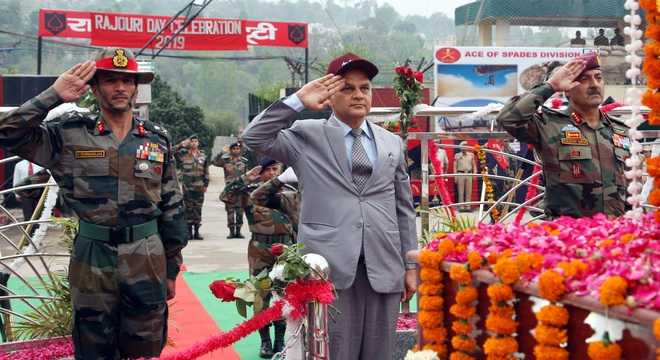
After paying homage to martyrs on the occasion of Rajouri Liberation Day, Lt Gen Paramjit Singh said, “The Army will take strong and effective action against every nefarious activity along the LoC,” the GOC said.

“Whenever Pakistan uses artillery fire on the LoC, it gets the same response. People are safe till the Army is on the border,” he said.

About the “politicisation” of the armed forces, the GOC said, “The Army is working under the Constitution and has its own task and mandate. It does not want to be involved in such disputes.”

He said the Army with the help of people, security forces, civil administration had succeeded in wiping out militancy from Rajouri and Poonch.

“Since the enemy (Pakistan) can revive militancy, the Army has not been withdrawn from Rajouri and Poonch districts,” said the GOC, White Knight Corps.

The Army’s morale was high and it was at the highest alert along the border, the Army officer added.

About the sniping incidents, the GOC said only three such cases had been reported till February 26. He also expressed his concern over the increase in militancy-related incidents in Kishtwar.

Regarding terror camps, he said, “No change has been reported and the figure is the same. After the IAF strikes, top leadership of terrorists has been eliminated in Kashmir.”


From the 2014 OROP promise to the 2019 Balakot air strikes, the armed forces have always been brought into political warfare

With a little under a week remaining for Lok Sabha election, all political parties are searching for ways to keep the atmosphere heated. But even then, one has to admit that the question of national security and the army is milked more frequently in battle 2019, than in any recent electoral exercises.

In the last 24 hours, two cabinet ministers, the prime minister, the head of a ruling party, the head of an Opposition party and a former finance minister have all spoken on the armed forces. If mentions in speeches of politicians could reap real-life dividends then it would not be a leap to say that the nearly 15 lakh people in the armed forces could be looking for huge benefits from whoever would come to power. Yet that is hardly ever the case, so why does the army return to everyday discourse every time there is a particular electoral test?

From the 2014 OROP promise to the 2019 Balakot air strikes, the armed forces have always been brought into political warfare


The year 2019 is particularly amenable to bringing up the security forces. The worst attack on security personnel in decades, on 14 February at Pulwama, ended up not just opening up a fresh soft spot for the army in the minds of the people but also setting the tone of the electoral campaigns in the Lok Sabha election.

The Pulwama attack also ended up in India “exacting revenge” on Pakistan through the controversial Balakot attack. This strike, the toll of which has been questioned as part of the Opposition’s offensive against the BJP, has now become the Bharatiya Janata Party’s favourite refrain in the campaign circuit. Narendra Modi himself has perfected a line from having used it in every speech, “We entered their houses and exacted revenge for our soldiers, and they question our army?”

“We do not question the army,” the Opposition is quick to correct, “but the government’s account.”

The army is apparently unassailable by parties on either end of the political spectrum, so ahead of the 2019 polls, the scurry for each party to establish itself as the custodian of the army’s best interests is a mad one. The Election Commission even had to categorically mention that the armed forces cannot be used as election propaganda.

No surprise then that it has found mention in the Congress’s manifesto, in the backlash to the manifesto and the rebuttals to the backlash to the manifesto.

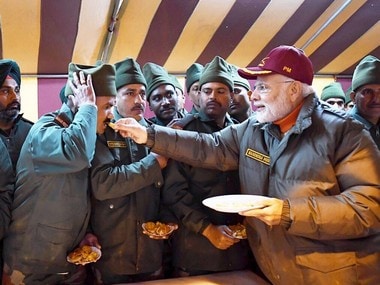
Narendra Modi celebrates Diwali with army, ITBP personnel in Harshil, Uttarakhand. Twitter@narendramodi

The Congress has not only proposed to reduce the presence of the Indian Army and Central Armed Police Forces (CAPFs) in the Kashmir Valley in its manifesto for the 2019 Lok Sabha elections, it has also said that the Armed Forces (Special Powers) Act will be looked into once again. While these have pleased a section of people, the BJP has been quick to slam the entire manifesto in general and the parts pertaining to the armed forces in particular.

While Finance Minister Arun Jaitley has called it “dangerous“, a true mark of how dangerous its suggestions might have been is perhaps in the fact that the Defence Minister herself was compelled to sit in a press conference to address the points of the manifesto pertaining to the army and its personnel. “Something very insidious is going on here,” Nirmala Sitharaman said on Wednesday, referring to the Congress’s decision to take another look at AFSPA. And yet, the government on Wednesday itself withdrew AFSPA from four areas of Arunachal Pradesh, while extending it to three others in the state, proving at least that in some situations a relook is indeed merited.

But it is easy to drive the discourse towards more emotive issues like hypernationalism, when facts on ground about basic lifestyle index throw a worrying picture. It would not be incorrect to state that the more the poverty grows, jobs decrease, economy suffers and education opportunities dry up, the more a nation’s pride hinges on its army.

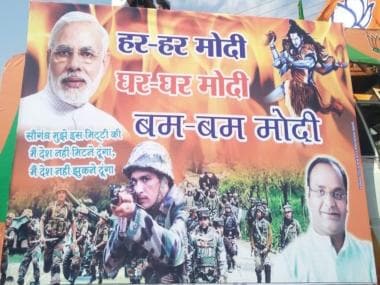
No wonder, then, that Uttar Pradesh chief minister Yogi Adityanath referred to the Indian Army as “Modi ji ki sena” and no wonder that Trinamool Congress leader Mamata Banerjee then went on to scold Adityanath for “such blatant personalisation and usurping of our beloved Indian Army”.

In India especially, the places where the army and paramilitary are active to the point of affecting the daily lives of the people are sufficiently remote. It may fire pellets and injure people in Jammu and Kashmir, subjugate tribals in the name of capturing Maoists and physically and sexually harm people living in the border and remote areas, but so huge and self-important is the Indian hinterland that these human interest issues scarce develop into ones meriting Parliament time, let alone election planks. What makes news is the nationalism plank.

So solid is the army’s reputation that it is now beneficial for any government or political party to allege that questions on the army’s performance are equal to siding with Pakistan. In the warm afterglow that cascaded upon the BJP government in the days following the 2016 surgical strike on Pakistan after the Uri attack, leaders of the party, including those serving in the government, wasted no time in establishing that they were one with the Army.

The Congress may have not ridden an entire poll wave based on the army’s performance like the BJP is doing now, but it has been no better in trying to garner the support of the army’s ranks at a crucial time in its own story — the 2014 polls. In the interim budget before the polls, then finance minister P Chidambaram had allocated Rs 500 crore to the Defence Pension Account for implementation of the One Rank One Pension scheme for the defence forces of the country.

“It is an emotive issue, it has legal implications, and it has to be handled with great sensitivity,” Chidambaram had said in Parliament. Shortly after the session, Congress leaders Rahul Gandhi and Sonia Gandhi held a press conference, notes LiveMint, where they highlighted that this was “a historic and necessary” step. “The armed forces personnel should feel that the country is backing them,” Rahul had said.

OROP found its way into the 2019 budget announcement by acting finance minister Piyush Goyal too. This time, Goyal saw fit to mention that the UPA had only brought the scheme after having stayed in power for 10 years but it was his government that led to scheme coming to fruition.

Your guide to the latest election news, analysis, commentary, live updates and schedule for Lok Sabha Elections 2019 on firstpost.com/elections. Follow us on Twitter and Instagram or like our Facebook page for updates from all 543 constituencies for the upcoming general elections.


2 ex-servicemen set to battle it out in Shimla

Ambika Sharma

Tribune News Service

Solan, April 1

Shimla Lok Sabha seat is all set to witness an interesting contest with a former Army officer taking on an Air Force personnel as both the Congress and BJP have fielded ex-servicemen from this constituency.

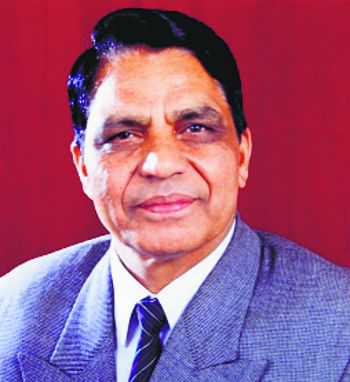
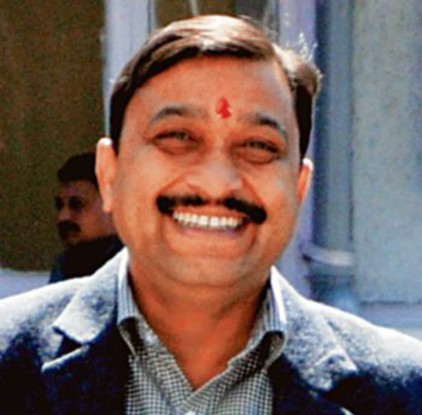
The Congress has chosen a septuagenarian Col DR Shandil (retd), a sitting MLA from Solan. The BJP has fielded former Senior Non-Commissioned Officer from the Indian Air Force, Suresh Kashyap (47), sitting MLA from Pacchad.

Shimla Lok Sabha seat, a known Congress bastion earlier, was wrested by the BJP in the past two occasions.

Shandil is also a two-term MP where he had won the first Lok Sabha election on Himachal Vikas Congress’ ticket in 1999 but went on to join the Congress and won in 2004. However, he suffered defeat in the 2009 Lok Sabha elections. But he went on to win two successive Vidhan Sabha elections from Solan. Armed with adequate experience, Shandil might be the best bet for Congress but he is haunted by a sizeable anti-incumbency.

The BJP on the other hand appears to have done its homework well by choosing a new candidate in the form of Suresh Kashyap as the sitting MP Virender Kashyap had failed to perform as per the party’s survey. Though Kashyap will have the advantage of receiving good support from Sirmaur as this is the first occasion when the party has given ticket to a candidate from this district, but being new he is yet to be introduced to the electorate in Shimla as well as Solan districts.

The fact that polls are slated to take place at the last leg of the polling season on May 19, it will serve as an advantage for this new candidate to tour Shimla and Solan districts extensively.

With the BJP having already begin its campaign with women, youth and SC sammelans taking place in all districts and even Chief Minister Jai Ram Thakur having addressed public meetings in Solan, Shimla as well as Sirmaur to introduce Suresh Kashyap, his campaign has begun well. The Congress was yet to put its house in order as it was yet to even finalise candidates for two of the four seats.


The red tape and delay in procuring specialised firepower from the United States

The elite Special Force units have resorted to stripping de-commissioned battle tanks or using weapons recovered from militants in the absence of the equipment to be procured from the US.

The Indian Army is miffed by delays in Rs 1,000-crore equipment proposal to buy urgently required equipment for its nine Para-Special Forces (Para-SF) battalions from the US. Disagreements within the ministry saw the proposals to acquire new assault rifles, night vision devices and machine guns being dropped from the agenda of a March 20 meeting of the Defence Acquisition Committee.

main_army-para-speci_032519015209.jpgA contingent of Indian Army’s parachute regiment, including special forces, doubles past the saluting dais on Republic Day in Delhi. (Photo: PTI)

Top Ministry of Defence (MoD) officials want the equipment to be purchased through the Foreign Military Sales (FMS) route from the US, to be broken up into smaller procurements of Rs 300 crores and acquired by the Army under its own financial powers. This process, sources say, could further delay acquisitions by another six months.

The shopping list includes 715 Mk 48 Light Machine Guns (LMGs), 1,050 FN Scar (H) 7.62×51 assault rifles, 1,400 FN Scar (L) or HK-416 assault rifles, 110 .50 Cal Browning heavy machine guns (HMG), 400 helmet-mounted night vision systems, 600 combat free fall parachutes, 100 Barret M107 A1 heavy sniping rifles and 20 million rounds of ammunition for all of these small arms. The proposals are part of fast-tracking of Para-SF buys initiated after September 29, 2016, cross-border raids on terrorist launch pads in Pakistan-occupied Kashmir (PoK). It is the most comprehensive re-equipping of the Para-SF in over two decades.

Army Para Special Forces Requirements

Equipment Quantity
Mk 48 light machine guns 715
FN Scar (H) assault rifles 1,050
Scar (L) / HK-416 assault rifles 1,400
FN .50 Cal Browning heavy machine guns 110
Helmet mounted night vision goggles 400
Combat free fall parachutes 600
Barret M107 A1 heavy sniping rifles 100
Ammunition rounds 20 (M)

Indian Army’s SF units drew the list based on evaluations done after joint exercises with the US Special Operations Command (SOCOM). Each acquisition fulfils a critical void. The .50/ 12.7 mm HMGs are meant to be fitted on the Light Strike Vehicle (LSVs) being procured from Pune-based Force Motors over the next three months.

The 7.62 x 51 mm FN Scar, made by a US unit of Belgium’s FN Herstal, is required to upgrade the firepower of SF operators in dense jungles of the Northeast and Myanmar. The case for a new lightweight belt-fed 7.62 x 51 machine gun to replace 50-year old OFBmade ‘1B’ LMGs, has been pending since 2005. The LMGs are critical squad support weapons giving the small six-unit teams of the Para-SF units heavy firepower.

main_assault-rifles-_032519015230.jpgProcurement of arms from the US for the Indian Army SF is still in the pipeline. (Representational image: Reuters)
In their absence, SF units resorted to stripping machine guns from de-commissioned battle tanks or using weapons recovered from militants. This procurement is part of a larger upgrade which includes Finnish Sako sniper rifles, Carl Gustaf Mark-4 rocket launchers and Beretta pistols and LSVs.

The last major acquisitions for the Para-SF a decade ago were also FMS procurements from the US.

(Courtesy of Mail Today)

Also see: To Russia with love: Undeterred by looming threat of US sanctions, why India is going ahead with joint ventures with Russian arms firms


Four Indigenous ‘Dhanush’ Howitzers Inducted Into Indian Army: Here’s What They Can Do

  • Four indigenous ‘Dhanush’ Howitzers have been inducted into the Indian Army
  • Dhanush’ guns are technologically superior to Bofors due to the modifications made to the barrel to help improve its accuracy

In a major fire-power boost for the country, four indigenous ‘Dhanush’ Howitzer guns were inducted to the Indian Army on Tuesday at a ceremony held the Ordnance factory in Jabalpur.

The Dhanush guns have been tested to withstand extreme conditions like rainfall and snow, and have also been built for use in multiple terrains, from plains, to sand and especially in hilly areas

Amit Yadav, a Defence expert, said,” It is not fair to compare the ‘Dhanush’ guns to Bofors as the former are far more technologically superior to Bofors due to the modifications made to the barrel to help improve its accuracy.”

What is the ‘Dhanush’ Howitzer gun?

The Dhanush gun system is based on designs of the Bofors howitzer which was inducted in the Army in 1980s and would be the third type of artillery gun to be inducted into the force after the K-9 Vajra and the M-777 ultra-light howitzers, as per inputs.

The 155mm x 45mm calibre artillery gun is capable of firing projectiles at a relatively higher angle with a steep angle of descent.

Army To Induct Dhanush Artillery Guns, Air Force To Commission Heavy-lift Chinook Choppers In Service Next Week

While the Army had placed an order for 110 guns with the Ordnance Factory, it has been waiting for clearance from the Ordnance Factory Board (OFB) for three decades until 18 February, 2019, when OFB finally got clearance for bulk production of the ‘Dhanush’ artillery Gun System, as per inputs.

PRO, Ordnance Factory Board tweeted:

“The ‘Dhanush’ Howitzers and the Indian Army are ready and fully equipped to protect India from any kind of military threat from its enemies” reports Satavijay Singh.


Afghan stability vital for India by Lt-Gen Sanjiv Langer (retd)

ndia must recalibrate its approach, to enable a firmer and enduring outreach, to the populace, as also the institutions of Afghanistan. The Afghan National Army and National Police, who are in the forefront, despite all odds, need a more robust support. Legitimate Afghan national aspirations must be supported far more energetically.

Afghan stability vital for India

Lt-Gen Sanjiv Langer (retd)
Former Deputy Chief of Armed Forces

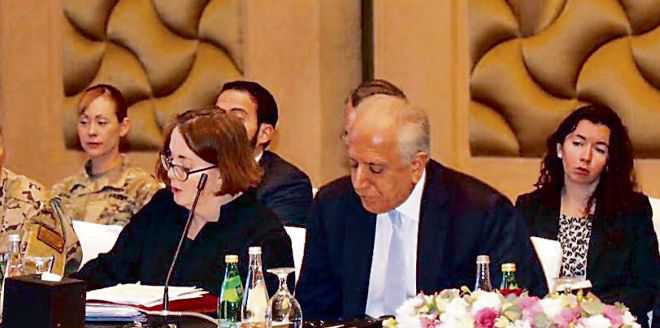
While normalcy continues to elude Afghanistan, a web of initiatives is under way. Negotiations of US envoy Zalmay Khalilzad and the Taliban are reportedly making progress. Stand-alone negotiations with Afghans in Moscow are being conducted. Pakistan is sparing no effort to remain significantly central to the outcomes.  Two aspects, however, in all these are startling.

First, is the absence of the Afghan Government from any of the negotiations, as though there is a negation of the last 18 years of the constitutional process.

Secondly, the statement of the NATO chief that the war cannot be won militarily, but the situation needs a political solution, seems surreal in the light of the security situation in Afghanistan.

Taliban attacks in March 2019 — March 11 on the Army: 16 killed and 40 captured in Herat; March 7 on a presidential candidate in Kabul, leaving three dead; March 6: 17 personnel of a construction company killed; March 1 in Helmand province: 25 Army personnel dead.  The UN has recorded that 2018 was the deadliest year since 2009 for civilian casualties.

After almost 18 years in Afghanistan, the US, confronted with the consequential outcomes of its wavering policies, seeks to change tack and sail away. Moscow, on the other hand, wants to assert that it is back in the game, and as Minister Sergei Lavrov stated, resents US monopoly in the peace talks. The Afghan authorities also want an end to the foreign military presence, but as Minister Abdullah Abdullah says, the military presence is essential to win the war. This is a view that can hardly be faulted. In contrast, Pakistan seeks to nurture an outcome that will give it continued centrality, and fully marginalise India. Notwithstanding the statement of the Pakistan Foreign Minister last year, acknowledging India’s role, it is the Pakistan Army and ISI that are driving the Afghan project.

What is germane in this whirlpool is the strategic outcomes that will impact Afghanistan and India. Historical and socio-cultural linkages apart, for India the air bridge through Kabul, our initiatives in and around Afghanistan, and the considerable Afghani diaspora in India give Afghan issues significant credibility. Indian reconstruction and humanitarian aid is considered by the population to be most effective and has generated goodwill. Stability and normalcy in Afghanistan have importance for India.

Pakistani design in the Af-Pak region, however, is a major consideration. Pakistan has been unable to integrate its North West Frontier (erstwhile NWFP, now Federally Administered Tribal Areas, FATA) since Independence. Fiercely independent and socio-culturally distinct, convergence of population across the infamous Durand Line in the border provinces has remained inviolate.

Afghanistan, for its part, has had such limited opportunities for integration, that the Af-Pak region which was a socio-cultural realism, is today a ‘Geo-Security Actuality’. Pakistan’s windfall came when it became the bridgehead and frontline state for the US campaign against the Soviet occupation, predicated on support to the Afghan Mujahideen. Pakistani ISI had taken proactive steps as far back as 1974.

However, momentum was gained when the US’ covert engagement with the Mujahideen commenced in March, 1979. Afghan refugees and the convergence of Pakistani, US and Mujahedeen priorities gave privileged access and unique significance to Pakistan. Synergised with President Zia’s agenda, terrorist nurseries were awash with recruits, weapons, and sustained finance, all of which facilitate Pakistani design to date. Despite the US vagaries, Pakistan has tenaciously furthered its insidious interests.

It is, therefore, not surprising that Pakistan was indispensable to the Mujahedeen and later Taliban led by the Quetta Shura. It is today a facilitator and exploiter, while simultaneously being subjected to attacks from that region. On the one hand, it released Mulla Barader, co-founder of the Taliban, from a Pakistani jail last October, to participate in the talks with the US, and on the other, at the same time, it is viciously targeted by the Pakistan-centred Taliban.

Consequently, the strategic space that Pakistan seeks is, first, based on control and influence over this turbulent region at any cost, through any stratagem to ensure its own security. Secondly, the Pashtun dependency ensures its influence in Kabul. This also falls in line with its Sunni-centric Islam. Thirdly, this region is ideal for parking Pakistan Army proxies. Fourthly, it gives it the ability to attack Indian-created assets as well as entities in Afghanistan. Fifthly, the Pakistan deep state seeks the control from the opium trade amounting to a massive $4.1 to 6.6 billion. Sixthly, given the ongoing negotiations, Pakistan sees itself well poised to fill in the impending vacuum in the politico security space created by the US and foreign military departure. Caught in the vortex  are the Afghan populace, who are denied peace, ravaged by conflict, and find their futures compromised.

The present negotiations with the Taliban originate from the politico-military developments of 2011-2014. In the five-phase US, NATO, ISAF (International Security Assistance Force), transition support plan, termed ominously INTEQAL, its terminal Phase 4 and 5 (2013-14) targeted the integration of the eastern provinces. This left the most conflict-ridden and difficult region for the end.

Simultaneously, President Obama announced a troop surge, bringing the combined strength of 48 nations to 1,32,500, in June, 2011, while also stating that the final drawdown would commence and terminate (initially) by end-2014. In strategic terms, these were a set of contradictory parameters creating operational dichotomy that would encourage poor outcomes.

So has been proved, by the extant situation. The troops, though downsized, could not withdraw while ISAF claimed it had completed its mission by end-2014. Contrary to plans, however, we find the Taliban capturing legitimacy and occupying unassailable politico-military space. Another fact must not escape our attention: the Afghan National Army and National Police were created. The ANA was, however, only equipped for counter-terrorism and counter-insurgency. It was denied the capability of a conventional Army. It cannot retake the Taliban-dominated areas, or defend its borders.

As events hurtle on, what pre-cognition is possible? The US success in crafting a suitable deal is distant. Outcomes of Moscow’s efforts presently are indeterminate. The Taliban is unlikely to have a long-term commitment to any player except itself. Internally, it is far from monolithic and can diverge or factionalise, based on issues, leadership and tribes. They will, however, continue to expand and firm in on their geographic, security and political spaces. The elements in their shadow, Daish/ISIS, Al Qaida and the new Avatar ISKP (Islamic State Khorasan Province), will reassert in time. Pakistan’s orchestrated strategy rebounded viciously post its assaults on the Lal Masjid, in July, 2007. While its influence and agenda with the Afghan Taliban is likely to endure, it will continue to be targeted by the Pakistan-centred Taliban, whose resilience despite full-scale Pakistan air-land attacks is remarkable.

For India, we need to recalibrate our approach, to enable a firmer and enduring outreach, to the populace, as also the institutions of Afghanistan. The ANA and the ANP, who are in the forefront, despite all odds, need a more robust support. Legitimate Afghan national aspirations must be supported far more energetically. Facing endemic insecurity, with insidious interests across the border, driving and sustaining political duality and Taliban centrality, the plight of the Afghan populace remains challenged.


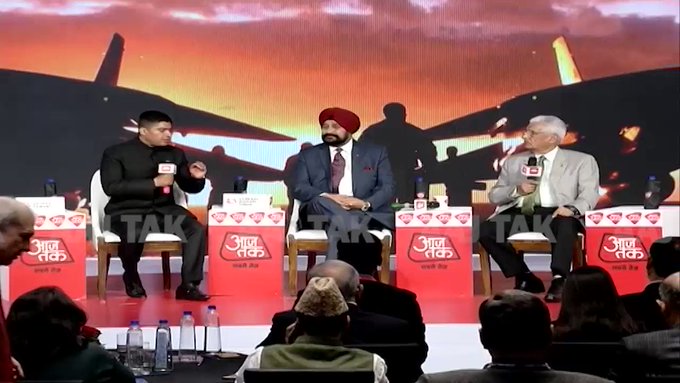
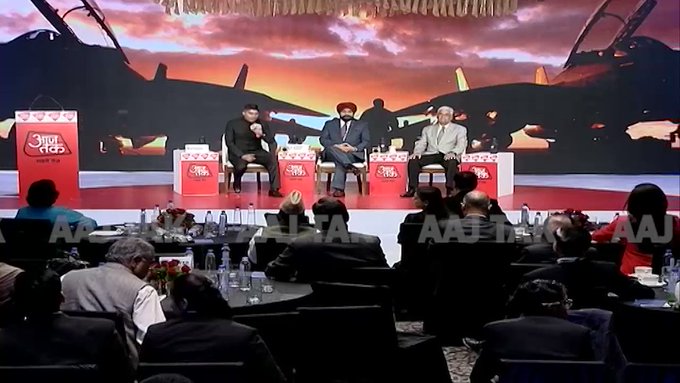
If we stop this now, they will attack with us reinvigorated force’: Former COAS Gen Bikram Singh on Balakot strikes

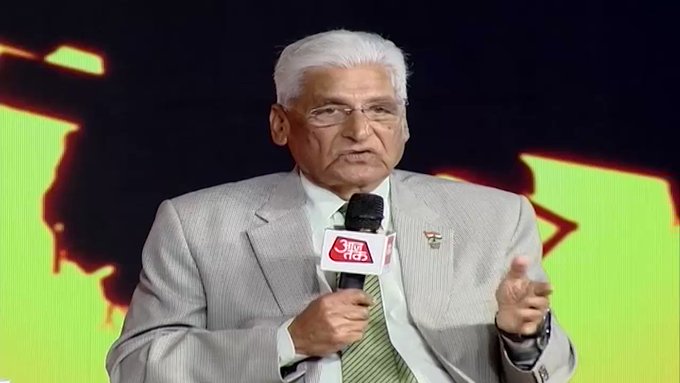
At Aaj Tak’s Suraksha Sabha, former Army Chief General Bikram Singh has emphasized the need to strike Pakistan again and hit them where it hurts. He reiterated that the Pakistani Army uses terrorists to wage a proxy war against India.

Embedded video

General Singh said, “We should remember that terrorism will continue in Jammu & Kashmir. You have seen how the Pakistani Army, their government and their Prime Minister protects terrorists like Hafiz Saeed. Pakistan will keep making claims but will do nothing.”

The General stated further, “The Pakistani Army has sheltered these terrorists. But now, they have become so powerful that they are a law unto themselves. A significant section of the Pakistani population even respects them. Because it is a poor country and they have opened facilities like schools and hospitals and they pay them money for picking up the gun. Terrorism is a form of employment in Pakistan.”

He emphasized that unless we are able to target the root cause of cross-border terrorism, things will not get better. “The Madrassas which are being run and the climate of immunity that has been granted to terrorists by Imran Khan and the Pakistani Army, unless we are able to stop them, things will not change. They will continue attacking us and we will continue to bleed. We have to conduct operations against them in their soil which we have done recently. If we stop this now, they will attack with us reinvigorated force.”

He added, “I think for a while they will not target military installations. They will attack our civilian institutions to show that they still have the capability. Unless we attack their headquarters where they receive their training, this will not stop.”

General Singh further added that we have stepped on the tail of the snake, there’s a need to smash its very skull. He said, “It’s a beehive. Throwing a stone at it and killing some bees will not be enough. We will have to burn the beehive to the ground. For that, we need an enduring strategy. We need to create pressure on the Pakistani Army which is the real villain in this entire scenario.”

Embedded video

Former Chief of Air Staff Air Marshall AY Tipnis also echoes similar sentiments. He said, “People think we are being attacked by terrorists. These are not acts of terrorism, these are acts of War. Pakistan has been waging war against us, not from recent times, but ever since it came into being.”

Embedded video

“In the past 20-30 years, a novel way of waging war they have come up with is terrorism,” he said, “They don’t attack us from the front, they use terrorists and claim that these people are fighting for Azadi. These are all lies. Unless we recognize this, we can’t move forward.”