Sanjha Morcha

What’s New

Click the heading to open detailed news

Current Events :

web counter

Print Media Reproduced Defence Related News

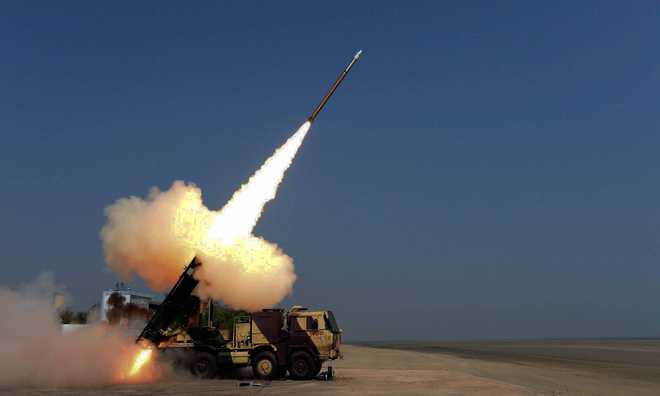
Pinaka guided weapons system successfully test fired: Defence Ministry

Pinaka guided weapons system successfully test fired: Defence Ministry

File photo for representation.

New Delhi, March 11

The indigenously developed Pinaka guided rocket system was successfully test fired on Monday at Pokhran desert in Rajasthan, in a boost to artillery capability of the Army, the defence ministry said.

The weapon system is equipped with state-of-the-art guidance kit comprising an advanced navigation and control system.

“The indigenously developed guided Pinaka, developed by DRDO, will significantly boost the capability of the artillery to make precision hits,” the defence ministry said.

About the tests, it said the weapon systems impacted the intended targets with high precision and achieved desired accuracies.

“Telemetry systems tracked and monitored the vehicle all through the flight path. All the mission objectives have been met,” the ministry said. — PTI


Military option should be the last resort by Bhartendu Kumar Singh

India needs an implementable, sustainable, and above all, affordable non-military war strategy against Pakistan. The push for war goes against India’s painfully constructed image of a pacifist and defensive defence policy. Recent initiatives such as the revocation of the MFN status and the proposal to divert waters indicate that we do have tools to launch a ‘war by other means’ and test Pakistan’s resilience

Military option should be the last resort

Bhartendu Kumar Singh
Indian Defence Accounts Service

AFTER the Pulwama attack, India’s hotchpotch national security discourse has drifted towards talk of war, hitherto a declining trend in international relations. There has been rising demand for waging a ‘war against Pakistan’. Buoyed by the Balakot air strike, many Indians assume that a frontal onslaught on Pakistan would bring it to its knees. They blissfully forget that Pakistan is a middle power having comparable resources and would deny an outright victory to India. India needs an appropriate, implementable, sustainable, and above all, affordable non-military war strategy against its neighbour.

Before 1971, Pakistan had nearly one-third to one-fourth of India’s resources and was a ‘big’ State. Probably, that is why the wars of 1948 and 1965 did not lead to an outright victory for India. While Pakistan’s capabilities to wage wars against India decreased after the 1971 dismemberment, it still has roughly one-fourth to one-fifth of all kinds of resources that India has. According to globalfire.com, a website on comparative military power, while India is four th on the ‘most powerful’ military powers’ list, Pakistan is 17th — ahead of North Korea, Australia, Taiwan and Saudi Arabia. Further, the asymmetry is not well defined (India’s military power index is 0.417, Pakistan’s 0.368). Probably, that explains Pakistan’s capacity to provoke India every now and then.

India also does not have the luxury of 1971-type diplomatic treaties and assurances, despite its rising profile in international relations. On the contrary, Pakistan has a tacit understanding with China, convertible into a military understanding or agreement, leading to a formidable balance of military alliance against India. Chinese investments into Pakistan, best reflected in the China Pakistan Economic Corridor (CPEC), make Beijing very attentive to Pakistan’s security calculus. The nuclear factor also brings a semblance of power parity between India and Pakistan that could make wars mutually damaging.

Finally, despite a seven-decade-old war history with Pakistan, we are yet to institutionalise studies like the Correlates of War (CoW) Project launched in the US to study the factors that lead to war. As such, not only are we indifferent to the probability of war between the two countries, but also clueless about victory in hypothetical wars with Pakistan due to an absence of proliferated lab-based simulation exercises. The Indian armed forces do conduct war exercises, either on their own or in partnership with foreign militaries. However, derivative lessons from such exercises are yet to be studied and tested in the academic sense.

India has a three-fold security dilemma on the Pakistan front. First, Pakistan is waging a proxy war with minimal financial and military investments but causing maximum impact. Islamabad has spent barely a fraction in provoking India compared to the Indian response that has come at a heavy cost. New Delhi is compelled to deploy a significant proportion of its armed forces in J&K to rebut Pakistan-sponsored terror activities. Second, a full-fledged war is ruled out since there would be a stalemate (unless India goes the whole hog), apart from being a costly proposition. Moreover, the push for war goes against India’s painfully constructed image of a pacifist and defensive defence policy. Third, India is also in the midst of building a comprehensive national power (CNP) focusing on developmental aspects of security. At least in the foreseeable future, India may not prefer to be distracted by war-like activities.

It emerges, therefore, that India has to explore non-military and affordable options in dealing with Pakistan. Perhaps the most desirable choice would have been a smaller Pakistan with reduced propensity to wage proxy wars against India. If only Pakistan were of the size of, say Iran, it would have been looking up to India (for security assurances) than indulging in provocative games. A smaller Pakistan would have been no ‘flag-bearer’ for secessionist forces in Jammu and Kashmir. While another division of Pakistan may not happen in the near future, the dominant position of Punjab is being resisted by other smaller provinces, most notably Sindh and Balochistan. This internal contradiction needs to be championed on informal platforms.

Another option could be to expose Pakistan’s ‘fictitious’ identity, mobilised largely on anti-India semantics. Pakistan has failed to progress as a civil society, with insignificant gender and minority rights; the military will reigns supreme and democracy is in name only. Even in Pakistan-occupied Kashmir (PoK), basic civic rights do not exist and the region remains impoverished. Pakistan bartered away a portion of PoK in the Gilgit region to China in 1963. Pakistan is increasingly known as a rogue State promoting terrorist forces within and around it. These representative constructs need to be exposed through the exclusion of Pakistan from all possible forums. For example, in recent years, India has successfully marginalised Pakistan within the South Asian fraternity, best evident in SAARC. It would be prudent to move ahead on a SAARC vision minus Pakistan. That would be a loss of face for Pakistan since it cannot assimilate in the alternative West Asian or Arab imagination.

The military option against Pakistan would be costly and should be exercised as the last resort. Recent initiatives like the revocation of the MFN status, proposal to divert waters etc. indicate that we do have tools to launch a ‘war by other means’ and test Pakistan’s resilience. Historically, great powers have successfully used it. We certainly need to proliferate our non-military options.

Views are personal


Govt ends contract with IL&FS, uncertainty over Zojila project Tunnel completion likely to be delayed after Centre orders rebidding

Govt ends contract with IL&FS, uncertainty over Zojila project

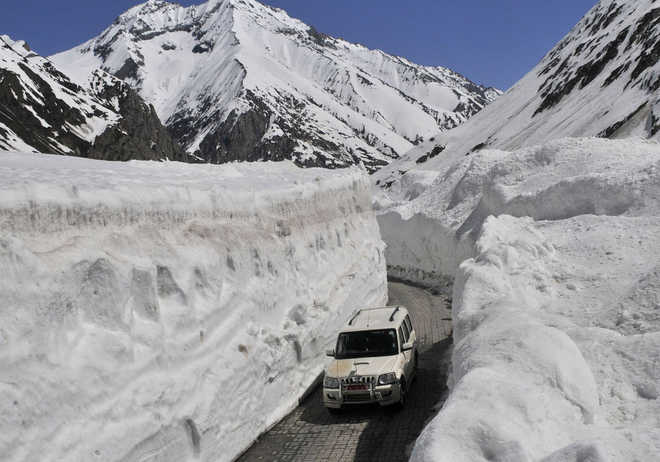
A vehicle passes through Zojila. Tribune file photo

teev Sharma

Tribune News Service

Jammu, March 4

Uncertainty looms over Asia’s longest bidirectional Zojila tunnel, connecting Kashmir’s Sonmarg with Gumri area in Ladakh’s Kargil district, after the Centre terminated contract with the beleaguered executing agency, IL&FS Transportation Networks Ltd.

Though the Union Ministry of Road Transport and Highways has gone for rebidding of the 14.31-km tunnel project, there is every possibility of losing an entire working season in completing the exercise of awarding the project to another company for execution.

“This is the most difficult and challenging contract not only in India but in the entire Asia. We have retendered the project and it will take some time to complete the process of evaluating financial as well as technical bids. The possibility of losing a complete working season in this process can’t be ruled out,” said a senior official of the National Highways and Infrastructure Development Corporation (NHIDCL).

The NHIDCL had sent the letter of contract termination to IL&FS on January 15 and the project was offered for rebidding on February 13. The last day for submission of online bids is March 6. The IL&FS was awarded the contract on January 19 this year.

Prime Minister Narendra Modi had laid the foundation of the project on May 19 last year. The 14.31-km tunnel project holds strategic and socio-economic importance for the Ladakh region. It will help India to keep a check on the growing influence of China and Pakistan in Ladakh. Besides, the project will not only meet the strategic requirements of the nation but also reduce travel time to cross Zojila from 3.5 hours to just 15 minutes.

“Over 30 major avalanches have been reported in the Zojila region in recent months while there is still 3 to 4 metres of snow accumulated. So, it is not an easy job to execute work under such challenging climatic conditions. Yet, IL&FS executed nearly 7 to 10 per cent ground work,” the official said.

He said the government would fix the responsibility of IL&FS for abandoning the project by imposing a penalty on it. “As per the terms of the agreement, if it (contract) is terminated due to defaults on the part of IL&FS, the company will not only forfeit its security deposit but also won’t get any amount from the NHIDCL,” he said.

The construction period of the project was 2,555 days ie seven years, which was to be reckoned from the date of commencement of construction.


Pak won’t hesitate to nuke India if faced with defeat: Amarinder

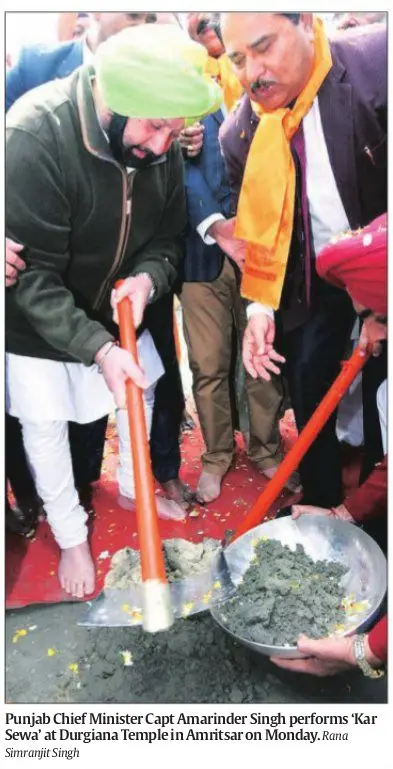
AMRITSAR : Punjab chief minister Amarinder Singh on Monday said a desperate Pakistan would not hesitate from using its nuclear arsenal against India if faced with an imminent defeat in a conventional war.

SAMEER SEHGAL/HTChief minister Amarinder Singh performing kar sewa at the Durgiana Temple sarovar in Amritsar on Monday.Speaking to mediapersons at the Durgiana Temple in Amritsar where he performed kar Sewa, Amarinder said both the two countries are nuclear powers and cannot afford a full-scale war. “It’s not in either country’s interest to use the weapons of destruction. But Islamabad could indulge in such a misadventure if faced with defeat,” he said.

clip

The CM, who was accompanied by school education minister OP Soni, revenue minister Sukhbinder Singh Sarkaria and Amritsar MP Gurjit Singh Aujla, said the Indian Air Force (IAF)’s strikes at a terror launch pad has proven country’s resolve to deal with the problem. Local bodies minister Navjot Singh Sidhu, who represents the Amritsar (East) segment in the Punjab assembly, was conspicuous by his absence.

Refusing to comment on the number of terrorists killed in the strikes, he said, “No matter how many were killed, the message has gone out loud and clear – that India will not let the killing of its soldiers and innocent citizens go unpunished.”

The CM announced ₹1 crore for the development of the Durgiana Temple. Kar sewa at the sacred pool (sarovar) of temple was performed on the occasion of Mahashivratri after 20 years. This is third kar sewa to clean the sarovar, in which lakhs of devotees from around the world are expected to participate. The earlier ones were held in 1999 and 1975.


clip

clip


BATTLE OVER BALAKOT IAF doesn’t count number of dead; casualty figure to be given by govt: Dhanoa Calls MiG-21 ‘capable’ fighter jet

IAF doesn't count number of dead; casualty figure to be given by govt: Dhanoa

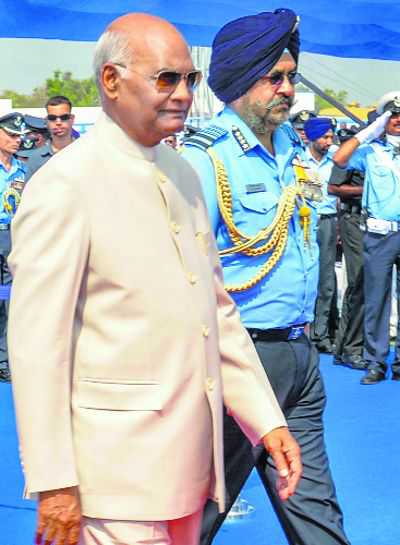
President Ram Nath Kovind with Air Chief Marshal BS Dhanoa during presentation of President’s colours, at Sulur in Tamil Nadu. PTI

Tribune News Service

New Delhi, March 4

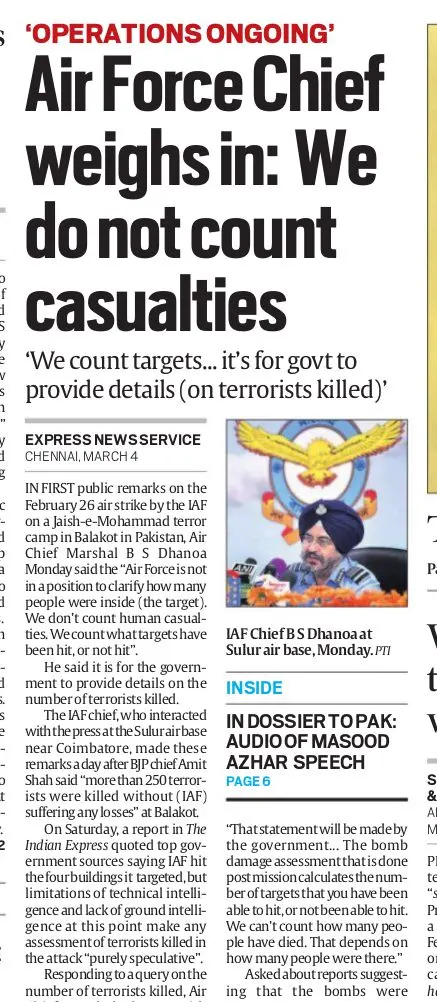
IAF Chief Air Chief Marshal BS Dhanoa today avoided the ongoing political controversy, saying the IAF does not count casualties but the airstrike at Balakot had hit the “target”.

The IAF had struck a terror camp of the Jaish-e-Mohammad (JeM) in Pakistan on February 26 and since then neither the IAF nor the government has listed the number of casualties. However, the media has been saying that nearly 300 terrorists were killed.

EDIT: Going ballistic over Balakot

The IAF Chief was speaking at Coimbatore in Tamil Nadu for the first time since the attack at Balakot in Pakistan’s Khyber Paktunkhwa province. “We don’t count human casualties. We count what targets we have hit or not hit,” the IAF Chief said.

“The bomb damage assessment only calculates the target that has been hit or not hit,” he said, adding: “We can’t count how many people have died. That depends on how many people were there.” He said a statement on the number of terrorists killed would be made by the government.

On reports suggesting the bombs were dropped away from the target, he said: “Had the IAF dropped bombs in a jungle, there would have been no need for Pakistan to respond. If we plan to hit the target, we hit the target.”

On the MiG-21 still being used, the IAF Chief said: “The MiG-21 Bison is in our inventory, why not use it? It has been upgraded. It has got a better weapons system, better radars and better air-to-air missiles.” The IAF Chief refused to be drawn into a commentary on what difference the Rafale could have made, saying: “The Prime Minister has made a statement. I will not comment on that.”


India’s response measured, escalation a challenge by Syed Ata Hasnain

In the wake of these developments, the Indian government needs to ratchet up its diplomatic campaign to an even higher level of engagement.

Imran Khan

 Imran Khan

There is no doubt that it was not an easy decision responding to the Pulwama outrage that had India’s tempers frayed. Losing 40 good men to an outrageous terror attack for which Pakistan had no regret demanded “appropriate” action. The range of options was many, from mass mobilisation of the armed forces at the higher end of the spectrum, to just diplomatic measures to isolate Pakistan on the lower side. However, the Indian government used the diplomatic option as the initiator, gaining sufficient traction in obtaining the support of the international community across the board. Even China was careful in its diplomatic handling of the situation.

Undoubtedly the diplomatic positives helped to take the right decision. India could have chosen the option of launching surface-to-surface precision-guided missiles to take out one of the identified Jaish-e-Mohammed facilities. However, that would have opened it to a similar Pakistani response. A surface-based surgical strike by the Army’s Special Forces a little deeper into Pakistan-occupied Kashmir against terrorist facilities may not have carried any guarantee of assured success, and it was anyway old wine from the September 2016 surgical strikes, which would have kept the Pakistan Army sufficiently alert. There was an option to launch ground operations against a couple of Pakistani posts along and across the Line of Control on the lines contemplated in 2001 when 9/11 finally upset the chain of decision-making. This would have meant a higher level of escalation, which under the circumstances of the diplomatic traction gained may not have paid sufficient dividends. There was also the option of the Indian Air Force striking a couple of military facilities suspected to be supporting terrorist training and launch. However, again the escalation would have been higher at the outset.

Under the circumstances, the most appropriate option no doubt was to go surgical against a Jaish facility and use the aerial route. It met the need for the right optics without going too high in the escalation ladder. Not touching a military or civilian facility meant that the morals involved were intact and remained in India’s favour. That is an important aspect when dealing with the international community, where initial success had already been gained. The Balakot location was large, sufficiently notorious and targeting it carried the basic principle of surprise so essential for success. The amount of importance attached to surprise did get the IAF to select its launch from airfields as far away in central India as Gwalior.

The Indian government had one major factor to contend with, and that was the risk. While being prepared for all options, the situation demanded that India’s action remain within the limits of military escalation. However, what is not being written about yet, and not spoken of either, were the political risks involved for Prime Minister Narendra Modi. With a major national election looming on the horizon, assured success was necessary and yet the mission could not be a damp squib. Any losses would have put back a potential electoral success, and less than desired optics would not have quenched the obvious thirst for retribution being demanded by the Indian public. The final decision appears to have most appropriately met all the needs of the situation.

The moral ascendancy gained by the choice of target places the Pakistani political and military leadership in a quandary. Its response options like in the case of India are many, but all the considerations which went into the selection of India’s options apply almost mirror-like to Pakistan except that there are no terrorist facilities in India to target. It could, however have adopted the option of “no action”, citing India’s alleged failed airstrike which it is claiming vociferously through the Inter-Services Public Relations (ISPR) wing. Yet, it was the boastful rhetoric launched by Prime Minister Imran Khan and followed up passionately by his railway and information ministers that created a degree of compulsion. Although the Indian choice of what is called “proportionality” of decision places a dilemma on the Pakistani leadership, the rhetoric further exacerbates and makes the choice even more difficult. Pakistan is in none too happy a situation in terms of international approval. It is only because of its geo-strategic location that it commands some grudging support. Its involvement in the negotiations for a full and final American withdrawal from Afghanistan as a facilitator of the dialogue with the Taliban has emboldened it. However, it has to also admit that its economic condition is so woeful that, let alone escalate a situation to levels of full military exchanges with India, it can hardly service its debts or meet the needs of essential imports.

Given Pakistan’s propensity to play its military ego to high levels and throw caution to the winds, out of what has come to be known as the principle of “rationalisation of irrationality”, its likely response will remain unpredictable. However, it has felt the compulsion of launching an airstrike against India to quell the inevitable demands of the Pakistani public and ranks within the military. That has led it to launch what it calls its retaliatory action by the Pakstan Air Force (PAF) without intent to escalate, as it claims. Its attempt to target a trans-LoC target has led to intrusion into Indian airspace and a PAF F-16 jet has been shot down. In turn, an Indian MiG-21 aircraft which probably scrambled to respond is confirmed to have also been shot down and crashed into Pakistan-occupied Kashmir, with the pilot bailing out and now in Pakistani custody.

In the wake of these developments, the Indian government needs to ratchet up its diplomatic campaign to an even higher level of engagement. Pakistan’s response has been at a level of a higher rung of escalation, and India could choose to respond in kind, escalating the situation further. In sheer desperation, the Pakistan Army has already virtually abrogated the unwritten ceasefire at the LoC without realising that if India chooses to respond along the entire length of the LoC with its more than abundant artillery and other resources, matching that over a sustained period will be extremely difficult. Prime Minister Imran Khan has once again addressed his nation and offered India talks and an investigation into the Pulwama incident with evidence provided by India. There is nothing new in this. In fact, the assurance India looks towards, that is denying the use of Pakistani territory for terror activity, has not been forthcoming. A suitable conciliatory act could be the immediate and unconditional release of the Indian pilot now held in Pakistani custody.

Will India be willing to de-escalate at this point? The scope to do so appears difficult, but it also is in India’s interest not to escalate beyond a point. The diplomatic traction gained does place some encumbrances on India’s subsequent options. It would be unwilling to lose that advantage. In fact, in that direction lie some of the better options of reining in Pakistan and forcing it to retract from the dangerous path it had chosen to embark upon 30 years ago. Conflict termination, and not conflict exacerbation, must remain India’s preferred option.

DSP, Armyman, 3 Jaish ultras killed in gunfight Officer was awarded for exemplary service only last month

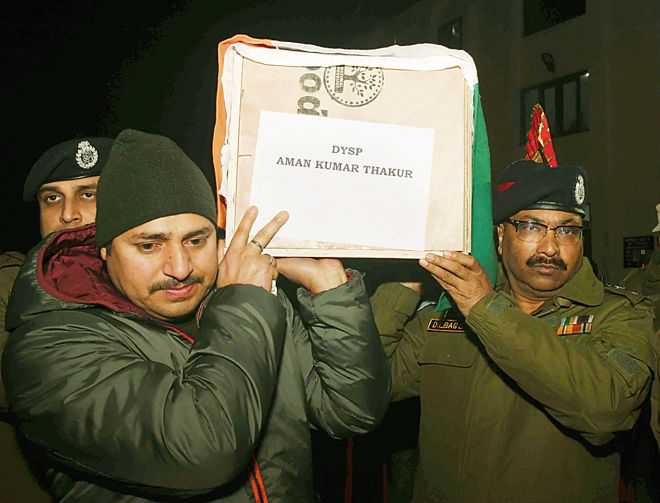
DGP Dilbag Singh and the brother of martyred DSP Aman Thakur carry the coffin. Amin War

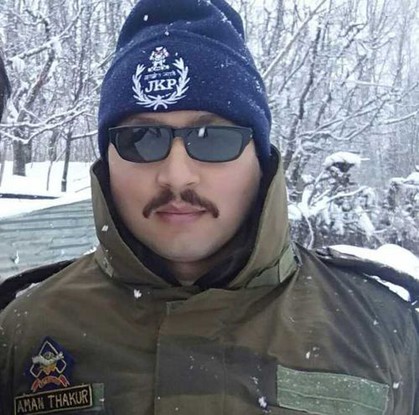
DSP Aman Thakur

Suhail A Shah

Anantnag, February 24

Deputy Superintendent of Police (DSP)  Aman Thakur, posted with the Special Operations Group, non-commissioned officer Havildar Sombir and three Jaish (JeM) militants were killed in a gunfight in Yaripora area of Kulgam district in South Kashmir today. A Major and a soldier were injured.

As men and women gathered at the encounter site, the security forces fired bullets, tear smoke shells and pellets to disperse the surging crowd, leaving at least seven injured. “We have shifted four of the injured to Srinagar — three with bullet wounds and one with a pellet injury in the eye,” a health official said.

The gunfight erupted at 2.15 pm in Tudigam village, minutes after a cordon and search operation was launched by a joint team of the security forces. The militants, hiding in a house, opened fire. A 2011-batch J&K Police Service officer, DSP Thakur was hit in the neck. He died while being flown to the Army hospital in Srinagar.

He hailed from Gogla district of Doda and is survived by his parents, wife and a six-year-old son.

Jammu and Kashmir DGP Dilbag Singh said: “We have lost a brave officer. A fighter, he led Sunday’s operation.”

Thakur was posted as the DSP (Operation) in Kulgam, a terrorist-infested area, two years ago. He was awarded the DGP’s Commendation Medal and Certificate for exemplary service only last month.


Sukhjinder’s pyre lit amid sloganeering

Sukhjinder’s pyre lit amid sloganeering

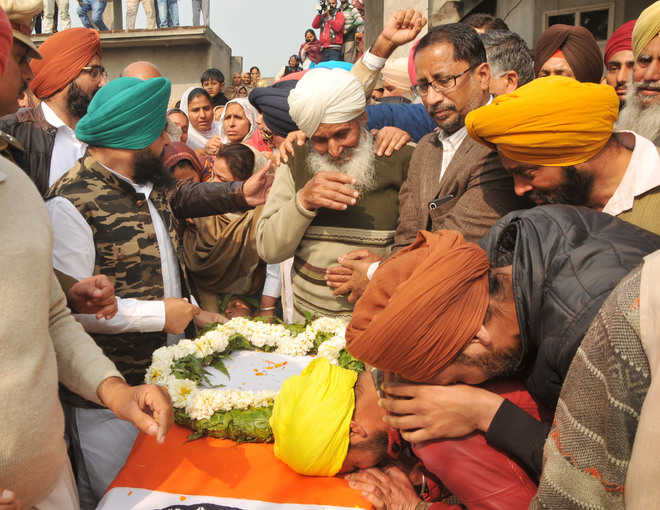
Sukhjinder Singh’s kin at his cremation in Tarn Taran. Photo: Vishal Kumar

Gurbaxpuri
Gandiwind (Tarn Taran), Feb 16

Martyr Sukhjinder Singh (35) was cremated with full state honours at his native village here on Saturday.

Residents of the village gave him a tearful adieu while his father Gurmej Singh lit the pyre. A large number of residents of the area were present on the occasion and paid tributes to the martyr.

The body of the martyr reached the local Civil Hospital late on Saturday evening and was brought to Gandiwind village in a convoy of the officials.

Besides the higher officials of the CRPF, Union minister Vijay Goel and Punjab Cabinet minister Sukhbinder Singh Sarkaria were among those who paid rich tributes to the martyr and laid wreaths on his mortal remains.

People raised slogans against Pakistan at the time of cremation.
Union Minister Vijay Goel said the Centre should look into the matter of releasing compensation to the families of paramilitary personnel at par with the military personnel.


Time for game-changing defence pacts with India: Lockheed official

Time for game-changing defence pacts with India: Lockheed official

Vivek Lall, Lockheed Martin’s vice president of strategy and business development, said the US and India are natural partners with shared interests across numerous political, economic and security issues. Reuters file

Washington, February 16

The time is indeed now to lean into game-changing defence partnerships with India, global aerospace giant Lockheed Martin’s top American executive has said.

Vivek Lall, Lockheed Martin’s vice president of strategy and business development, said the US and India are natural partners with shared interests across numerous political, economic and security issues.

A world-renowned aerospace and defence leader, he has been instrumental in several crucial India-US defence deals in the past one decade.He would be leading the executive delegation of the US-India Business Council (USIBC) to Aero-India show 2019 from February 20-24.

“The time is indeed now to lean into game-changing defence partnerships. India-US ties are growing ever closer and we are very encouraged by the positive trend we’re seeing in US-India relations, particularly on the defence and security front,” Lall told PTI.“Dr Vivek Lall, Vice President of Lockheed Martin Aeronautics service, is our leader this year and we are also pleased to have USIBC’s new Chairman of our Defence and Aerospace Committee Rich Weir of Northrop Grumman in attendance,” USIBC said in a statement.

Aero India is a wonderful opportunity for USIBC members and Lockheed Martin to meet senior US and Indian government officials, participate in business-to-business networking activities and attend seminars that provide insights into the opportunities and challenges associated with doing business in India’s aerospace and defence sector, Lall said.

“Aero India is also an ideal venue to highlight Lockheed Martin’s suite of security solutions and partnerships that support India’s defence needs, Make in India and India-US ties,” Lall said in response to a question.
Officials from the US Department of Defence are also scheduled to attend the annual aero show in Bengaluru. PTI


Russia’s love for Pakistan is back

Russian President Vladimir Putin’s recent overtures to Islamabad go well beyond Tsar Nicholas’ nostalgia for Central Asian affinities

Russia’s love for Pakistan is back

Moscow is keen on reviving Pakistan Steel Mills which has been shut for three years

FS Aijazuddin

Nicholas Romanov II (once Tsar of all Russias and now St. Nicholas) should congratulate Vladimir Putin (once a KGB operative and now Tsar of a truncated Russia) on reviving Russian presence in the areas that are now in Pakistan. In February 1891, Nicholas (then Tsarevitch) visited Punjab during his grand tour of the East. His scribe described Lahore as ‘picturesque in its oriental flavour’, resembling ‘Central Asia’. That cultural affinity may have inspired Putin to reconstruct a modern monument to Pakistan-Russia connections, albeit on uneven foundations.

Since 1947, Pakistan’s relations with Russia have alternated between Siberian winters and Black Sea summers. The first chill occurred when, in the 1950s, Pakistan played the US card to tantalise Soviet Union. In the 1960s, despite the U-2 spy-plane incident, the Soviets collaborated with Pakistan to conduct oil and gas exploration across Pakistan’s geography. (That was the age of pre-satellite espionage).
The Indo-Pak wars of 1965 and 1971, ironically, threw Russia and Pakistan together, first at the Russian-brokered peace conference in Tashkent in 1966 and then with the Trojan horse gift of the Pakistan Steel Mills (PSM). No one in Zulfiqar Ali Bhutto’s government had the temerity to examine PSM’s minutiae: the outdated technology, the onerous terms of finance; and the irreversible dependence on imported iron ore in preference to local ore from Kalabagh. The PSM project (conceived under duress) began in 1973 and took over 10 years to complete. After 30 years of mechanical negligence, it has accumulated losses and debts of almost Rs 500 billion.
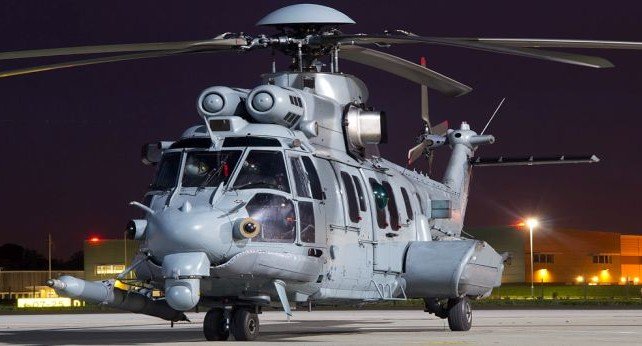
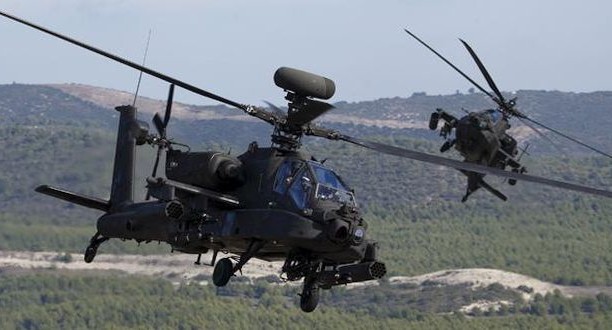
A thaw in the Pakistan-Russia relations came almost without warning. In 2017, Putin decided to sell four Mi-35 — Hind attack helicopters — to Pakistan (could there have been a more provocative name?). If Putin had offered 400 tons of caviar to Pakistan, they would not have caused the same discomfort to India than these four helicopters did. The paradigm of Indo-US-Russian-Pakistani relations suddenly took on a new configuration. Previous alliances (India/Russia; Pakistan/US) were swapped into new partnerships spawned by unabashed self-interest.


Putin’s recent overtures to Pakistan go well beyond Tsar Nicholas’ nostalgia for Central Asian affinities. Maturely, Putin has chosen to forget the abrupt cancellation of his visit to Pakistan (scheduled for October 2012), citing a ‘lack of substance’.  Now seven years later, that substance has begun to solidify.

In January this year, a large Russian energy company, RAO-Engineering, expressed an interest in investing $2 billion in Pakistan’s cash-hungry energy sector. This was capped by an agreement this month between Pakistan’s Inter-State Gas Systems (ISGS) and Russia’s Gazprom. They signed a memorandum of understanding (MoU) to conduct a joint feasibility study regarding gas supplies from the Middle East to South Asian countries.

And this month, a Russian state enterprise, Tyazhpromexport, (undaunted by PSM’s insolvency and closure for the past three years), has proposed to the Pakistan government a plan for balancing and modernisation of the huge PSM complex. The plan envisages financing from a loan and support by Russian expertise to run the refurbished mill. It is the promise of a miracle that would have tempted even Lazarus to resurrect.

Will all these Russian MOUs and proposals reach fruition? Only President Putin knows for sure. He is shrewd. He has calculated that PM Narendra Modi may be re-elected, albeit with a reduced majority; Trump intends to quit Afghanistan but not the White House; President Xi Jinping is secure for life; and PM Imran Khan will wear boots for the next four years. Could there be a better time for the Russian bear to emerge from its hibernation and to give its Pakistani neighbour an ominous hug?