Sanjha Morcha

What’s New

Click the heading to open detailed news

Current Events :

web counter

Print Media Reproduced Defence Related News

No link with murder, claims liquor baron

No link with murder, claims liquor baron
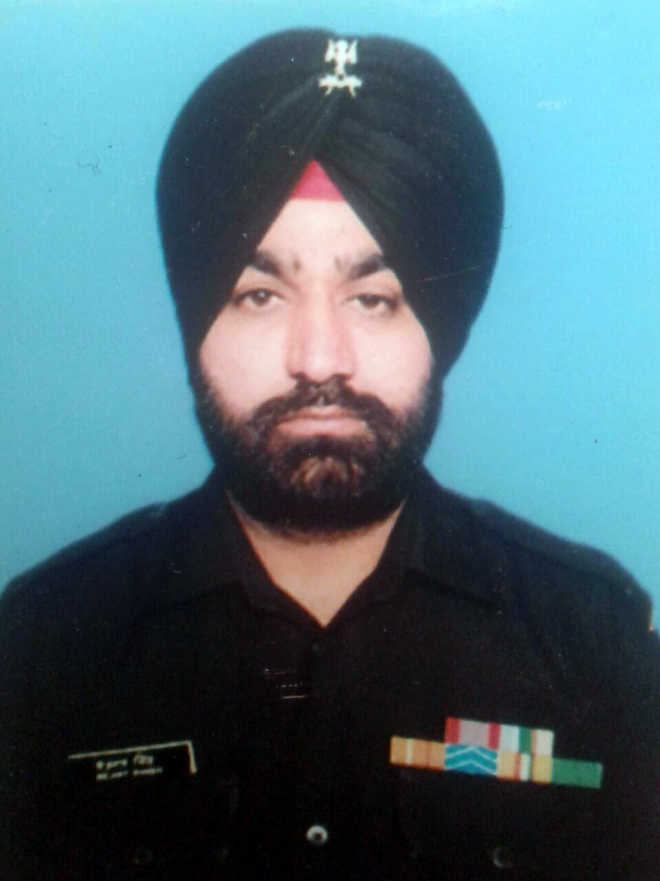
Ex-serviceman Beant Singh, who was murdered in Moga on Thursday. file photo

Tribune News Service

Moga, November 5

Liquor baron Sunny Gill said today that the vend at Thathi Bhai village, where ex-serviceman Beant Singh was murdered on Thursday night, was not allotted to him by the Excise Department.Talking to The Tribune, he said, “The three persons who killed the ex-serviceman were not my employees. I was also not present at the scene of the crime. Then why have I been booked?”An official of the department said the liquor vend was allotted to Star Wines, a company owned by Harjinder Singh. The latter could not be contacted.The official stated that Sanjit Wines, the company owned by Gill and his family members, had signed a partnership deed with Star Wines.Meanwhile, the deceased was cremated today, even as no arrest had been made so far. Beant’s cousin Jaswant Singh, in a statement given to the police, said he was present on the spot when the goons of the liquor mafia killed the ex-serviceman.Besides Gill, those named in the FIR are Harjinder Singh, Sant Ram, Jagdeep Singh Giani and Jeet Singh.


Sharif ’s surgical strike against Pak army: Report

Wants military not to shield terror groups, conclude Pathankot probe’ | PM’s office calls it speculation

Sharif ’s surgical strike against Pak army: Report
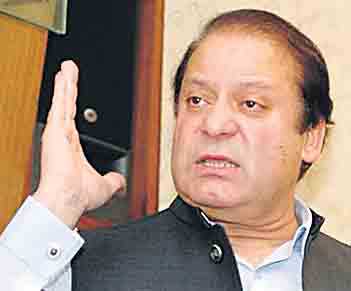
Nawaz Sharif

Islamabad, October 6

Facing international isolation, Prime Minister Nawaz Sharif in an unprecedented move has warned the powerful military not to shield banned militant groups and directed authorities to conclude the Pathankot terror attack probe and the 2008 Mumbai attack trial, a leading Pakistani daily reported today.Sharif’s orders came after a series of meetings between military and civilian leaders, Dawn newspaper said.Edit: Don’t count chickensThe government delivered a “blunt, orchestrated and unprecedented warning” to the military leadership and sought consensus on several key issues, including action against banned militant groups, the paper quoted unnamed individuals involved in the meetings.However, a spokesperson for the Pakistan Prime Minister’s Office rejected the Dawn report. Foreign Office spokesman Nafees Zakaria said: “The story is purely speculative and, as the author himself acknowledged, ‘none of the attributed statements were confirmed by the individuals mentioned’.”The report says at least two sets of actions have been agreed upon. ISI Director General Rizwan Akhtar, accompanied by National Security Adviser Nasser Janjua, will travel to all provinces with a message that military-led Intelligence agencies should not interfere if law enforcement agencies act against banned militant groups.Sharif directed that fresh attempts be made to conclude the Pathankot investigation and restart the stalled Mumbai attack trial in a Rawalpindi anti-terrorism court.Those decisions, taken after an extraordinary verbal confrontation between Punjab Chief Minister Shahbaz Sharif and the ISI DG, appear to indicate a new high-stakes approach by the PML-N government, the paper said.On Monday, Foreign Secretary Aizaz Chaudhry made a presentation in the Prime Minister’s Office to a small group of civil and military officials. It summarised the results of the diplomatic outreach by Pakistan, the crux being that Pakistan faces diplomatic isolation and that the government’s talking points have been met with indifference in major world capitals, the paper said.On the US, Chaudhry said ties could further deteriorate because of its demand that action be taken against the Haqqani network. — PTI

Opposition blames Sharif for Pak isolation

  • Islamabad: A senior Pakistani Opposition leader on Thursday criticised Prime Minister Nawaz Sharif for giving freedom to “non-state actors” that has led to the country’s diplomatic isolation following the Uri terror attack. “Pakistan’s isolation is Nawaz Sharif’s personal failure. Pakistan is isolated because it gives freedom to non-state actors,” Pakistan People’s Party (PPP) leader Aitzaz Ahsan said during a joint session of parliament


Amid standoff with China, IAF’s C-17 makes landing near border

Amid standoff with China, IAF’s C-17 makes landing near border
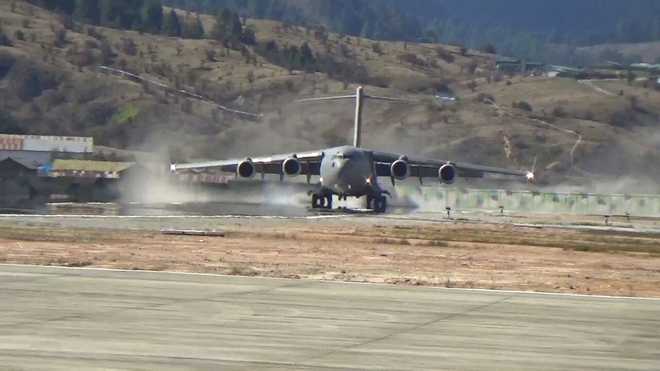
Indian Air Force’s mighty C-17 Globemaster aircraft on Thursday made its first landing at Mechuka, just 29 km from Sino-Indian border in Arunachal Pradesh. ANI

Itanagar/Leh, November 3

Even as Chinese and Indian troops are locked in a stand-off at the icy heights of Ladakh division since Wednesday after People’s Liberation Army personnel stopped the civilian work, Indian Air Force’s mighty C-17 Globemaster aircraft on Thursday made its first landing at Mechuka, just 29 km from Sino-Indian border in Arunachal Pradesh.At an elevation of 6,200 ft with a landing surface only 4,200 ft long, the C-17 landed, validating its short field landing performance at high altitude.(Follow The Tribune on Facebook; and Twitter @thetribunechd)The Advanced Landing Ground at Mechuka in the Yargyap river valley of West Siang district of Arunachal Pradesh had been upgraded recently.Situated along the international border, Mechuka was one of the strategic locations during the India-China war in 1962.The IAF had started its operations with Dakota and Otter in 1962 in the area and subsequently the Antonov-32, popularly known as AN-32, was operated till October 2013 before the upgrade work was started.The road connectivity to the nearest air/rail head at Dibrugarh, about 500 km away, is generally two days of travel, unless the roads get damaged due to frequent landslides.”This is a quantum jump from the existing capability of An-32 and C-130J aircraft. Such airlift capability facilitates speedy transfer of men and material in this rugged terrain, interspersed with valleys and high mountain ranges that inhibit road connectivity,” a statement by the IAF said.In the event of a disaster in the region, C-17 operations to the remote ALG can enhance the speed and quantum of national relief effort.IAF has plans to validate airlift operations to and from various ALGs in the region that would usher in a new dimension in enhanced disaster response.This trial landing is expected to pave the way for operation of civil flights operating to and from the newly upgraded ALGs, which has an enormous potential to boost tourism by improving connectivity to remote locations in the North East.Chinese troops object to civilian workMeanwhile, in Ladakh, the Chinese troops raised objections yesterday when Indian army engineers were constructing an irrigation canal linking ‘hot spring’ waters for the villagers in Demchok, located 250 km east of Leh, under the Mahatma Gandhi National Rural Employment Guarantee Act (MNREGA).Around 55 Chinese troops arrived at the scene and halted the work in an aggressive manner, prompting the army and Indo-Tibetan Border Police (ITBP) personnel to rush to the spot and stop the high-handedness of Chinese troops, official sources said today.The Chinese troops took positions on the perceived Line of Actual Control (LAC) and demanded that work be stopped as either side needs to take permission before undertaking any work, a claim disputed by the Indian side which says that as per the agreement between the two countries, information about construction needs to be shared only if it was meant for defence purposes.Both sides pulled out banners and have been stationed on the ground, the sources said, adding the Army and ITBP was not allowing the Chinese to move an inch ahead despite the PLA claiming that the area belonged to China.The area had witnessed a similar incident in 2014 after it was decided to construct a small irrigation canal at Nilung Nalla under the MNREGA scheme that had been a sore point with the Chinese.The PLA had mobilised villagers from Tashigong to pitch Rebos (tents) at Charding-Ninglung Nallah (CNN) Track Junction to protest Indian action.This time, the sources said, there were 55 personnel from the Chinese PLA whereas nearly 70 personnel from ITBP and army had fortified the area and prevented their march deeper into Indian territory, the sources said.The ‘hot spring’ is different from the one in Chashool where Police Day is observed in memory of 10 CRPF men killed in 1959 by Chinese troops.Meanwhile, senior Army officers insisted that there was no stand-off and the issue is being resolved through established procedures.They added that such objections are not uncommon from either side and situations like these are resolved amicably. — PTI


Avoid creating hysteria over surgical strikes: Modi

Avoid creating hysteria over surgical strikes: Modi
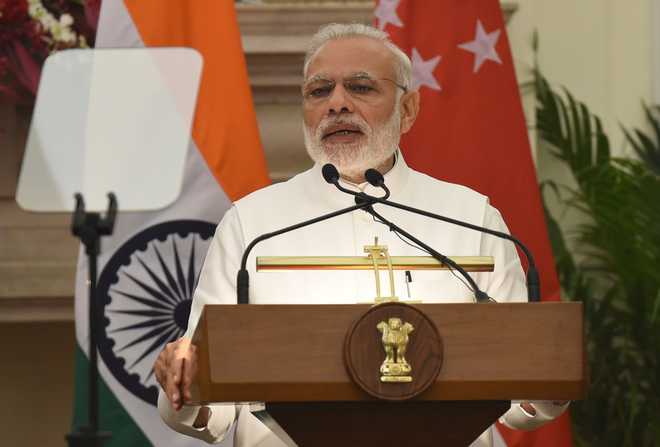
Prime Minister Narendra Modi. — File photo

New Delhi, October 5Amid a raging debate over the surgical strikes, Prime Minister Narendra Modi is understood to have cautioned his Cabinet colleagues against creating hysteria over the military action against terror launch pads across the Line of Control (LoC).During the Cabinet meeting today, Modi is understood to have told his ministerial colleagues that only authorised people should speak on the issue of surgical strikes and one should avoid speaking out-of-turn, sources said.

(Follow The Tribune on Facebook; and Twitter @thetribunechd)

His word of caution came against the backdrop of demands that the government should present proof about the cross-LoC raids to counter the smear campaign by Pakistan, even as the Army handed over the video clips to the government.

The demand has triggered a raging debate on whether the proof should be provided or not.The BJP and experts are against disclosing details of the operation by the Special Forces.Meanwhile, the Parliamentary Standing Committee on Defence which was to meet tomorrow for a briefing by the representatives of the Ministry of Defence on ‘Surgical Strikes across the Line of Control (LoC)’ has decided to postpone the meeting. The panel will now meet on October 14. — PTI


CDA PENSION ALLAHABAD CIRCULAR 570::::IMPLEMENTATION OF GOVT DECISION ON 7 CPC RECOMMENDATIONS : REVISION OF PRE-2016 PENSIONS

CLICK TO OPEN THE CIRCULAR No–570 pdf FILE


animated_arrow_10                                          Circular-570


A tactical shift in policy

India is now keen on isolating Pakistan. It must evaluate the long-term implications

One of the victims of the military exchanges between India and Pakistan along the Line of Control is the civilian political leadership of Islamabad. Pakistani Prime Minister Nawaz Sharif had developed a certain cordiality with his Indian counterpart, Narendra Modi, over the past two years. By all accounts, Mr Modi saw in him a leader who had a pragmatic view of how the two nations should handle their many differences. But Mr Sharif had no authority to pursue this moderate view of India. This is the monopoly of the generals in Rawalpindi and their hostility to India is implacable. When he authorised the military strikes against terrorist camps in Pakistani-occupied Kashmir, Mr Modi concluded that investing in Mr Sharif is a political dead end.

Various Indian prime ministers have faced a similar dilemma. Many have taken heart from Pakistan’s democratically-elected civilian leadership and sought to promote their authority over the men in khaki. Prime ministers Manmohan Singh and Atal Bihari Vajpayee pursued this path. Mr Vajpayee even seeking an accommodation with Pervez Musharraf. At the heart of their view was a belief India should continue to talk with whoever was in power in Pakistan, irrespective of the terrorist attacks and other forms of violence that militants inflicted on India. These attacks were secondary to a larger vision of seeking to engage the civil societies of the two countries and help Pakistan move away from the path of religious fundamentalism and State-sponsored violence that it had taken since the dictatorial rule of Mohammed Zia-ul-Haq. India’s underlying policy was to save Pakistan from itself. This was not an easy policy to sustain. Terrorist attacks of the scale of Mumbai 26/11 or border wars of the Kargil variety would wreak havoc with public support in India for any engagement with Pakistan and strengthen a belief that the only way to handle India’s rogue neighbour was through the barrel of a howitzer.Mr Modi seems to have pursued a version of this enlightened policy for two years, cultivating ties with Mr Sharif even though a diplomatic harvest seemed unlikely. But the prime minister has now concluded that he can no longer afford this policy. The sacrifice of the Saarc summit in Islamabad, humiliating Mr Sharif, is a case in point. In this, he is following the view of PV Narasimha Rao who concluded he was better off reducing his Pakistan contacts to just photo ops. The flip side of this attitude, however, is to give up on civil society engagement and focus more on isolating Pakistan internationally and building the political and military equivalent of a wall between the two neighbours. This has obvious benefits in the short-run but, ultimately, reflects a view that Pakistan is a problem that should be managed rather than solved


IAF to use combat drones in future surgical strikes to prevent risking soldiers’ lives

Highlights
  • IAF is working to upgrade and equip its fleet of Israeli-made Searcher and Heron Unmanned Aerial Vehicles
  • It plans to add combat drones to its fleet which can do the same job without risking soldiers’ lives
  • Air Force is looking to join hands with the Israel defence major Israeli Aircraft Industry

After using Special Forces troops to attack and destroy terrorist launch pads in Pakistan- occupied Kashmir, India is now planning to add combat drones to its fleet which can do the same job without risking soldiers’ lives.

The Indian Air Force is working to upgrade and equip its fleet of Israeli-made Searcher and Heron Unmanned Aerial Vehicles (UAVs) with missiles under a top secret and classified programme code-named ‘Project Cheetah’.

For the ambitious plan, which is expected to cost almost more than Rs 10,000 crores, the Air Force is looking to join hands with the Israel defence major Israeli Aircraft Industry (IAI).

“Under the project, we are planning to equip our Searchers and Herons with advance snooping capabilities and missiles which can target terrorists and their hideouts both within India and if required, across the borders,” a senior IAF source told Mail Today.

Former IAF vice chief air marshal RK Sharma said ideally when the UAVs can see targets with their surveillance and snooping payloads, they should also have the capability to strike rather than having to deploy other aircraft or assets to do that job.

“If you have such a capability in form of drones, you can take down terrorist targets both within and across the borders,” the former vice chief stated.

With such a capability in its fold, in future scenario if the Army units inform about any particular launch pad of terrorists getting active, the IAF can deploy its armed drones to unleash a silent punishment to terrorists from 30,000 feet over the ground.

After silently hovering over PoK over suspected launch pads for some time gathering accurate intelligence the drones can launch an attack and return to the base causing greater damage than what the troops can do.

“The precision guided missiles would also help in specific elimination of desired targets and there would be none or minimum collateral damage in such operations,” the IAF officer explained.

Officers said the drones can also be put to use in case a terrorist hideout is located in higher reaches in Kashmir where missiles can be safely fired to destroy them without any fear of causing any injury to the civilians.

For turning their surveillance drones into killer vehicles, the IAF has taken a cue from the United States.
For the Americans, drones are the weapons of choice for taking out terrorist leaders or destroying their safe houses.

The Americans regularly smoke out terrorists using their MQ-1 Predators and GlobalHawk as it has killed several more than 2,500 terrorist leaders in Afghanistan and Pakistan alone during its war on terror in these countries.

India, so far, has not used air power in anti-terrorist operations in Jammu and Kashmir or North-east to take out terrorists as a policy to not to be seen being too tough within own areas.

India recently used helicopter gunships to eliminate terrorists who had entered the Pathankot air base but that was within a military station and not in civilian locality.

Unlike India, Pakistan uses its American AH1 Cobra gunships extensively against even suspected civilians as can be seen in its Operation Zarb-e-Azb in Taliban and Baloch areas within its own country.

At the moment, the IAF flies the Israeli-made Searcher II and Heron UAVs for reconnaissance and snooping purposes.

“With the upgrade in snooping capabilities, the forces on ground would also be able to get pin-point intelligence about hideouts in areas where men have to be involved in operations,” an IAF source revealed.

The upgrades would also enable the IAF ground station handlers to operate these aircraft from far-off distances and control them through satellite communication system.

The project has been in the works for quite some time and government is also thinking of involving Indian agencies, including the state-owned Hindustan Aeronautics Limited, to use their expertise in the programme.



Army chief visits Western Command to review preparedness

CHANDIGARH: Indian Army chief General Dalbir Singh visited the Western Command, headquartered at Chandimandir near here, on Saturday to review operational preparedness in wake of surgical strikes across the Line of Control in Pakistan-occupied Kashmir recently.

HT PHOTOArmy chief General Dalbir Singh (left) with Western command chief Lt Gen Surinder Singh at Chandimandir on Saturday.

The army chief interacted with senior commanders, including Western Command general officer commandingin-chief (GOC-in-C) Lieutenant General Surinder Singh, and exhorted them to continue to maintain highest vigil and alertness on the western borders.

Earlier, he had visited the Northern Command.

A senior official of the Western Command said: “There is no troop mobilisation or deployment along the border, but routine army exercises are continuing.”

At present, it is the Border Security Force (BSF) that is manning the International Border with Pakistan in Punjab.

But no army official who HT talked to has denied that an alert has been sounded to all forward posts and cantonments.

In the past seven days, Lt Gen Surinder Singh has twice reviewed security arrangements along the border. On September 23 and 24, he had visited forward areas in Jammu, Samba and Pathankot, where he interacted with field commanders and troops, besides meeting the northern army commander.

On September 29 — the day the news of the surgical strikes broke out in the morning — the army commander embarked on a two-day tour to the Vajra Corps headquarters in Jalandhar besides forward locations in Gurdaspur and Amritsar to review the troops’ preparedness.


Dedicate this Diwali to our soldiers, says PM Modi in his ‘Mann ki Baat’ programme

Dedicate this Diwali to our soldiers, says PM Modi in his 'Mann ki Baat' programme
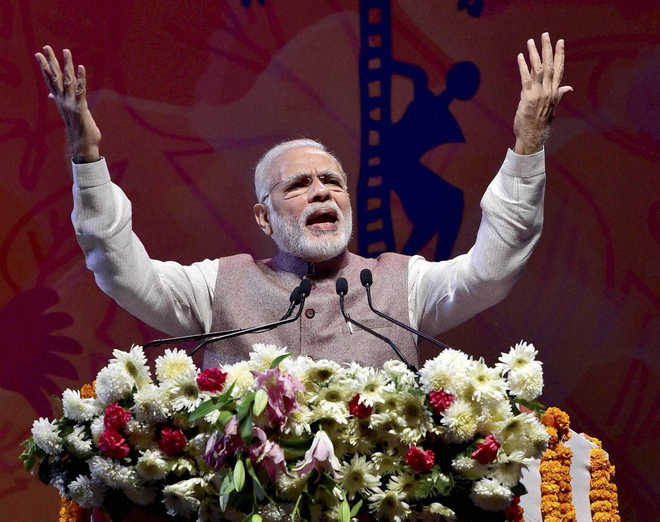
It was the 25th edition of the programme. PTI file

Paying tributes to soldiers, who sacrificed their lives retaliating to Pakistani forces and terrorists at the Line of Control (LoC) in the past few days, Prime Minister Narendra Modi on Sunday dedicated this Diwali to the security personnel.

KV Prasad

Tribune News Service

New Delhi, October 30Amid tension on the border with Pakistan, Prime Minister Narendra Modi on Sunday saluted the valour of the armed forces and lauded their sacrifice while dedicating the festival of Diwali to them.He hailed the people, including celebrities, for sending overwhelming messages to his Sandesh2Soldiers campaign.In his monthly ‘Mann ki Baat’ programme on All India Radio, Modi urged all citizens and state governments to find ways of forging unity across the country and working to defeat separatist tendencies and mentalities.

(Follow The Tribune on Facebook; and Twitter @thetribunechd)

In the wake of the ongoing troubles in the Kashmir Valley, he said, “Unity in diversity is our strength. It is the responsibility of every citizen and all governments to forge unity and curb separatist tendencies to save the country.”In an apparent reference to tension on the Indo-Pak border, Modi credited the soldiers for maintaining peace and security in the country and called upon everyone to remember their gallantry while celebrating Diwali.“In the wake of recent events, our soldiers have been sacrificing their everything for the safety and security of the country. Their dedication has overwhelmed me completely. Let us dedicate this Diwali to our armed forces.“I had invited everyone to participate in the Sandesh2Soldiers campaign and I have been humbled by the response. From students, villagers and traders to political leaders and sportspersons, everyone has sent a Diwali message for our soldiers,” he said while referring to the jawans who are stationed in deserts and on the icy heights of the Himalayas and security personnel who are guarding our industries and airports.“Our forces endure grave hardships for our security. Someone is stationed in a desert, someone on the Himalayas, someone is guarding our industrial installations and someone is protecting our airports. Everyone is fulfilling a mighty responsibility. If we remember them while being in a festive mood, our remembrance will give them strength and renewed energy. I thank everyone for responding to Sandesh2Soldiers,” Modi said in over half-an-hour address on the occasion of Diwali.In a veiled reference to the unrest in Kashmir Valley, the PM also called for forces of unity to be strengthened and those of separatism to be defeated.“Unity in diversity is the strength of our country. Every citizen and every government must work to find ways of forging unity and defeating separatist mindset and tendencies,” he said as he remembered Sardar Patel who strove hard to forge unity in the country and bind it together.As Modi paid tributes to Sardar Patel whose birth anniversary falls on Monday, he also remembered Indira Gandhi whose death anniversary also falls on the same day. He, however, lamented that on a day we celebrate the birth anniversary of Patel, thousands of Sikhs were killed in 1984 in the wake of the assassination of Gandhi.Reiterating his message of cleanliness on Diwali, Modi said the festival is a marker of “swachhta” with every family taking it upon themselves to clean their house.The PM, however, said, “The call of time is to extend this campaign of cleanliness out of one’s house to one’s surroundings.”The PM also took the occasion to note how the Indian festivals are environment friendly and urged parents to stand with their children as the latter burnt crackers.The Prime Minister also remembered Guru Nanak, the first Sikh Guru, who fought against social evils and discrimination and called for making society free from any kind of discrimination.



The Prime Minister also lauded the role played by jawans in natural calamities and said they kept working with patriotic spirit and national interest in mind, be it showing courage in fighting the enemy or in bringing the misguided youth back on track or maintaining law and order.

He lauded the efforts taken by Himachal Pradesh in becoming open defecation free and said it is the second state after Sikkim to be so.Modi said Kerala would become open defecation free on November 1 and Gujarat and Haryana were also making efforts in this direction and many districts in these states had already achieved the goal.In making these states defecation free, Modi highlighted the efforts and contribution of many individuals in helping construct toilets.These included those of an ITBP jawan in Himachal’s Sirmour district who donated Rs 57,000 out of his salary to construct toilets in his village and make it open defecation free, besides those of engineering students in Kerala who helped construct a toilet in Edamalakul of the state.He also praised Haryana, which is celebrating the golden jubilee of its formation on November 1, for taking upon itself to declare the state kerosene-free by linking all LPG beneficiaries with Aadhar card.“Some seven or eight districts have already become kerosene-free in Haryana.“The way they have taken upon them, I am sure they will succeed and help stop pilferage, save environment and conserve foreign exchange, besides helping the people of the state and putting an end to corruption that middlemen indulged in,” he said.Invoking Mahatma Gandhi, whom he described as a guide, Modi said policies should be evolved in such a manner that the poorest of the poor should be kept in mind as the Father of the Nation envisioned.“It is the need of the time to address the problems of the poor.“We must come out of our orthodox thinking and make society free from any kind of discrimination,” he said, while also calling for ending any kind of discrimination towards girls and sought construction of toilets for the girl child too.Wishing countrymen on Diwali, the Prime Minister said India is a country of festivals and today these festivals are celebrated across the world.He highlighted that the US Postal department brought out a postal stamp on this Diwali.Modi said Deepawali gave the message of ‘darkness to light’ and this darkness included the darkness of superstition, illiteracy, poverty and social evils which should end too.He also recalled that people would celebrate Chhat puja in a few days and the festival carried the message of worshipping the Sun. With PTI


Soldier beheaded by ultras under Pak cover along LoC

srinagar, October 28

A soldier was beheaded by militants as Pakistan army engaged in cross-border firing along the Line of Control in Machil sector of Kupwara district, Army sources said on Friday.The slain soldier, rifleman Manjeet Singh of 17 Sikh Light Infantry, belonged to Haryana. “This act will invite an appropriate response,” said an Army spokesman.(Follow The Tribune on Facebook; and Twitter @thetribunechd)He said the soldier was killed during an encounter late on Friday. A militant was also gunned down. An official statement initially said: “In a despicable act, the terrorists mutilated the body of the soldier before fleeing into PoK,” adding they were provided cover by Pakistan troops. — TNS