









Sanjha Morcha

What’s New

Click the heading to open detailed news

Current Events :

web counter

Print Media Reproduced Defence Related News

The Indian Army Strikes Back: Keeps It Within Escalation Control

The Indian Army Strikes Back: Keeps It Within Escalation Control

Syed Ata Hasnain – 

September 30, 2016, 8:06 am

The Indian Army Strikes Back: Keeps It Within Escalation Control

SNAPSHOT

What gladdens the heart is that, after long, the Indian establishment employed information, alongside its operations, as a prime tool most appropriately.

The Indian Army has struck back and handed out appropriate retribution for the attack by Pakistan-sponsored and led terrorists at Uri military base on 18 September 2016. The window for the retribution, just 11 days, is a credible one. The DGMO’s earlier statement regarding the response – “time and place of our choosing” was correctly made to elongate and afford a reasonable window even as public pressure mounted. To ensure full success in military operations of such nature, the degree of preparation and intelligence sharing is mandatory. The window was, therefore, apt and warranted.

Briefly, before any analysis, the known facts need to be stated. In as transparent a way that could be revealed, the Army has conveyed the fact that its troops struck terror bases in Pakistan-occupied Kashmir during the preceding night of 29 September and caused large-scale casualties. The operations were carried out across multiple sectors of the LoC, north and south of the Pir Panjal, all well known to harbour terrorist facilities under control of the deep state. There is no need for the Army to reveal anything more and it needs a pat on the back for having regained the slight loss of moral ascendancy which it may have perceived. It’s for us to analyse the suitability of the timing, the selection of the nature of operations and the implications.

What gladdens the heart is that, after long, the Indian establishment employed information, alongside its operations, as a prime tool most appropriately. Through information control and management, it parried the public pressure for immediate and knee-jerk operations. The Prime Minister’s meetings with the three service chiefs were evidently for coordination of the political, diplomatic, economic, and military response.

Someone obviously correctly advised that when subjected to hybrid conflict you cannot alone respond in the conventional domain. It is in the hybrid domain that retribution lies. Modi changed tack at Kozhikode and lulled the environment with his address to the people of Pakistan. He spoke of economic and social issues challenging them to look inwards to see why they were fighting India. Foreign Minister Sushma Swaraj put up a great show in her speech at the UN General Assembly emphasising the diplomatic dimension. As Indus Waters Treaty (IWT) was introduced into the equation for the first time in years, it was evident that mind games were being most effectively played by India. Anyone knows that the waters can only be controlled by an upper riparian state if it has created the infrastructure to do so. In the case of India, we do not even utilise the full quota of waters authorised to us. Thus mentioning the IWT was a smart thing to convey the seriousness of intent and the commitment to go beyond routine response of the past. This must continue to be mentioned as a potential long-term response with a short-term mind effect.

The Indian establishment also projected itself to be in a tizzy while examining everything but the military option. As the DGMO’s statement receded from memory, the presence of the Prime Minister in every high-level meeting to take decisions on IWT, SAARC and MFN status confirmed India’s obsession with everything non-military. The Prime Minister’s fresh approach met the approval of intellectual circles and commentaries focused on the non-military dimension. While it is correct to surmise that total surprise was achieved in the strikes, a high degree of lulling did take place across the LoC.

Coming to the operations; the hybrid domain offered India a wide spectrum of choice. The diplomatic domain itself had sub choices. Much has been achieved in sensitising the international community. The winning of confidence of the SAARC countries is no mean feat in the process of isolating, naming and shaming Pakistan. However, students of conflict and strategic analysts will agree on one thing; the credibility of a hybrid response is always questionable if there is no military action involved, especially when loss of lives of the quantum at Uri has occurred. At whatever stage the diplomatic and economic campaigns may have been, it is the message from the LoC which takes primacy and energises other responses. The public is enthused; the Army itself regains ego and pride. For the people of India, a serious loss incurred by the Indian Army goes down badly in terms of national morale. A retribution rightly regains that loss.

The long haul is something that India must now be prepared for. There is no peace process to go back to; it’s far from the mind and that helps in being focused on the response. Pakistan has denied the surgical strike thus far. Its unstated response appears in the mould of the Indian DGMO’s first statement – “time and place of own choosing”. That is what Pakistan is hoping to do as a counter response; it is giving itself an elongated window. The counter response will come at the LoC with a mix of regulars and terrorists, as it always has ostensibly under the garb of an action purely by non-state actors. Deniability will be built into it, as far as the role of the Pakistan Army is concerned. We have not seen the last of the LoC actions but the Indian Army has ample experience in ensuring the sanctity of the LoC and the variety of threats which manifest there.

Is India’s military response appropriate? From the list of options in the military domain did we select the right one? Consider the fact that an air strike would have definitely brought about greater escalation. A helicopter-borne Special Forces strike deeper inside PoK or Pakistan would also have led to escalation. Artillery duels on the LoC infringing the 13-year-old unofficial ceasefire would not have met our national self-esteem. Thus surgical strikes by ground troops using foot borne infiltration to distances of 2 to 3 km, or thereabout, offered the greatest chance of success in one night operations. It would also allow for successful evacuation of any casualties if sustained. The Indian Army’s honour code ensures that no casualties are ever left behind and sure enough, the demarche issued to the troops was that no bodies or no buddies would be left behind. None were.

Lastly, the reported selective video graphing of the operations is in the spirit of transparency which will ensure that Pakistan’s denial has little meaning. Thirty-eight terrorists killed is no mean figure and for the moment squarely puts India in the victor’s corner.


India braces for retaliation after strikes, western states put on high alert

Fearing tit-for-tat retaliation from Pakistan-based terrorist groups post Indian cross-LoC strike, home minister Rajnath Singh on Friday reviewed country-wide security measures, particularly in Kashmir, with reports of an eight-strong fidayeen (suicide) squad sneaking into Srinagar.

All western states bordering Pakistan have been placed on alert with state chief secretaries instructed not to go on leave.

Authoritative sources said that the government was expecting a retaliation from Pakistan with the target being Indian Army establishments in Jammu and Kashmir and Delhi.

On Thursday, the security agencies issued an alert about a possible suicide attack by Pakistani jihadists in Srinagar, with security forces as target.

Singh discussed all possible measures with senior officials, including National Security Advisor Ajit Doval and intelligence chiefs.

The home ministry assessment is that after the Indian Army inflicted serious and large scale casualties by attacking the terrorist launch pads in Jammu and Kashmir, terror groups such as the Lashkar-e-Taiba (LeT) and Jaish-e-Mohammed may activate their border action team for retaliation.

Security agencies expect Pakistani border action along the LoC in Machhil, Nowgam, Mendhar and Rajouri sectors — where the Indian Army destroyed seven terrorist forward staging locations.

There was firing by unknown militants on a CRPF-J&K police check post on Shopian-Kulgam road on Friday evening with no casualties.

While the security forces have gone on high alert in Jammu and Kashmir, Singh also reviewed security arrangements in the Indian hinterland, particularly in New Delhi and Mumbai.

Senior officials of the home ministry have issued instructions to Delhi and Mumbai police to ensure that any terrorist action in the form of indiscriminate firing or bombs is either prevented or foiled.

The Indian Army and defence establishments in the Capital have been particularly secured so that they are not targeted by terrorists to avenge the cross-LoC strike.


MoD denies downgrade, armed forces don’t agree

New Delhi: The Ministry of Defence on Thursday said there has been no “downgrading” of service officers in rank parity vis-a-vis civilian staff, this even as serving and retired officers said it was reiterating previous orders.The MoD said: “The reiteration of rank equivalence is only for matters of assigning duties and functional responsibilities as is existing in different offices of the service headquarters of the Army, Navy and IAF having component of service personnel as well as civilian officers”. This has no bearing on civilian staff outside these offices.(Follow The Tribune on Facebook; and Twitter @thetribunechd)The forces opine there cannot be multiple parameters for ‘equivalence’ of ranks. With the MoD letter there will be a separate equivalence, one for ‘functionality’, another on ‘Warrant of Precedence’ (WoP). There has to be only one regime of equivalence, they say,  based on WoP and aligned with relative pay-scales. — TNS


TV bends to winds of war S Nihal Singh Need to rein in chauvinism

TV bends to winds of war
HOLD SWAY: Media can’t be the mouthpiece of the government of the day.

IN these difficult times in Indo-Pakistan relations, the biggest casualty on the Indian side has been the credibility of privately-owned Indian electronic media. Many of us have experienced how quickly the printed press folded up during Indira Gandhi’s Emergency. The wonder is that under the Modi dispensation electronic media have lined up behind the government on its own. Many channels have become super patriots joining the most jingoist voices, but most channels have succumbed to the use of adjectives that give the game away. There is no fairness in presenting facts and it is a toss-up whether Indian channels are copying their Pakistani counterparts or chasing TRP ratings or both. We all honour soldiers who die in the line of duty and pay them due respect, apart from compensation to their families. But for our television channels to describe every such death as that of a martyr is stretching the use of the English language. And covering Pakistan, TV scrolls describe Prime Minister Nawaz Shatif’s presentation at the UN as a “rant”. Where is the dividing line between the duties of media as opposed to acting as a propaganda megaphone for the government?It is true that our private electronic media live in different ages. One channel has adopted what was in vogue 25 years ago, if not longer, in the West by de-sexing genders. Thus their cameramen and women are always “persons”. Another channel continues to beat its drums over the non-interview it had with Prime Minister Modi in how dramatically it has affected its TRPs.Are we then in the game of TRPs without any responsibility to be fair in our reporting? There is not a squeak from the concerned broadcasting organisations on the merits of unbiased reporting. In relations with Pakistan, anything goes, the harder the punch, the better. One channel seems to have opened a direct line to India’s RAW to get the lowdown on the inner recesses of the Pakistani state.What our electronic media do not realise in their cheerleading for chauvinist forces is that this phase will pass, as all phases do, but restoring their credibility with their audiences will be a long-haul problem. As their print colleagues will tell them, even after wearing sackcloth and ashes it took a long time to convince readers that newspapermen were trying to tell the truth.There are, of course, exceptional times such as during the Bangladesh war when media went with the swing. But mercifully, we are not at war with Pakistan and can attempt to present a fairer picture of what is happening. For instance, there was not one commentator to make the point that but for Ms Sushma Swaraj’s inability or unwillingness to make her presentation in English, half of its impact was lost. Except for South Asia, the world is not familiar with Hindi and listening to a translation can never have the impact of an original presentation.How then can we get electronic media to do a fairer job of reporting? One would have expected broadcasting organisations to take the call and seek answers. But they seem to be strangely tongue-tied leaving it to each channel to win its spurs in the propaganda war against Pakistan. The golden arches of TRPs are inviting them — and who cares about credibility?The record of press commissions in India is hardly inspiring. Rather, we must make a new foray in getting the combined weight of serious citizens to lobby against a pernicious trend that threatens to destroy the freedom of media. The forms can vary from small seminars to larger meetings and neighbourhood conclaves focused on one problem: how to keep media from becoming cheerleaders of chauvinist forces?Until the Emergency came, print media were patting themselves on the back that having fought for the country’s freedom, they were the great upholders of the freedom of the press. And yet more than 99 per cent of the press crumbled overnight. The moral of the story is that press freedom should be fought each day because it is the authority’s effort to exploit weaknesses. It would be unfair to paint all television channels with the same brush and the demands of TV as a medium are very different from those of print. But this is certainly a time for introspection if even a man of the calibre of Rajdeep Sardesai can fall a victim to chauvinist trends. The atmosphere is simply too corrosive. There is no substitute for self-policing and it is time for veterans of Indian TV to get together to frame a set of working rules that distinguishes between fair reporting and propaganda. It is not the task of private TV channels to beat the drums of chauvinism. Such an assertion will present two kinds of problems: pressure from the owners and the commercial wings in charge of TRP ratings.But this is a battle journalists have fought all the time everywhere. The question for TV journalists is that time has arrived in India and it is up to them to show their mettle. I am not disparaging the commendable efforts of many channels for their pioneering investigative reporting of trends and controversies and enlarging the Indian viewers’ ken by demonstrating to them the wonders of nature and animals. And some channels make room for serious discussions although the highly accented Indian English of one anchor takes away part of the charm. What I have described above relates to English language channels; channels in Hindi and regional languages are often even more extravagant in presenting news and views. They would of course need separate treatment.As a nation, where do we go from here? First, we must separate fact from fiction and draw clear lines between responsibilities of media and the task of governance. It is not the task of media to become cheerleaders of the government of the day. Second, broadcasting organisations responsible for overseeing TV channels must come out in the open and take charge.


US envoy’s visit to Arunachal riles Beijing

US envoy’s visit to Arunachal riles Beijing
US Ambassador to India Richard Verma (L) with CMs of Assam Sarbananda Sonowal and Arunachal Pema Khandu during a recent visit to Tawang. — PTI

Beijing/New Delhi, October 24

China today warned the US that any interference by it in the Sino-India boundary dispute will make it “more complicated” and “disturb” hard-won peace at the border, days after the US envoy in India Richard Verma visited Arunachal Pradesh, which Beijing claims as southern Tibet. India reacted saying there was “nothing unusual” about the trip to a state which is an integral part of the country.Asking the US to desist from interfering in the India-China border dispute, Chinese Foreign Ministry spokesman Lu Kang said China was firmly opposed to the visit. Referring to Verma’s October 22 tour to Tawang at the invitation of Arunachal Pradesh Chief Minister Pema Khandu, Lu said the US envoy visited a “disputed region”. “We have also noted that the place visited by senior US diplomatic official is a disputed region between China and India. We are firmly opposed to his visit,” he said.China claims Arunachal Pradesh as part of southern Tibet and routinely protests visits by Indian leaders, foreign officials as well as the Dalai Lama to the area.External Affairs Ministry spokesperson Vikas Swarup said: “The US Ambassador visited Arunachal Pradesh, a state which is an integral part of the country to which he is accredited. There is nothing unusual in it.” — PTI

Will complicate dispute: China to Washington

  • The place visited by US envoy is a disputed region between China and India. We are firmly opposed to it… It will only make the dispute more complicated —Lu Kang, Chinese foreign ministry spokesman

Nothing unusual about it, says India

  • The US Ambassador visited Arunachal Pradesh, a state which is an integral part of the country to which he is accredited. There is nothing unusual in it —Vikas Swarup, MEA spokesperson

Jalandhar’s Lt Gen Ranbir Singh is man of the moment

CHANDIGARH: Brilliant soldier, thorough professional and gentleman to the core are how course mates and colleagues describe Lt Gen Ranbir Singh, 57.

PTIDirector General Military Operations Ranbir Singh addressing a press conference in New Delhi on Thursday.

In a break from tradition, the director general of military operations (DGMO), who planned the Indian Army’s surgical strikes against terrorists and their handlers in Pakistanoccupied Kashmir on Thursday, briefed the media himself. In doing so, he became the face of the army and the man of the moment.

“Unlike the briefings during the Kargil war when the army spokesperson addressed the media, this time we heard it straight from the DGMO,” says Chandigarh-based Col Avnish Sharma (retd), a course mate of Lt Gen Ranbir Singh at IMA. “He is the first infantry officer after former army chief General K Sundarji to command an armoured division. It is a huge feather in his cap. It speaks volumes about his competence and versatility,” he adds.

Lt Gen Ranbir Singh commanded 33 Armoured Division at Hisar in 2012. He has served as a colonel and brigadier in the directorate general of military operations, the nerve centre of military policy, planning and conduct of operations.

PUNJAB CONNECT The general belongs to Jalandhar and is an alumnus of Sainik School, Kapurthala. He passed out of the Indian Military Academy, Dehradun, on December 13, 1980, and was commissioned in 9 Dogra, which he went on to command.

Brought up by his uncle, Colonel Manmohan Singh (retd), after his father’s death at an early age, he excelled in academics throughout. “Ranbir was always a topper be it at school or in military courses. He faithfully followed my advice and remained a teetotaller,” says Col Manmohan Singh, who is the deputy director of sainik welfare in Jalandhar.

The family belongs to Ambala Jattan village near Garhdiwala in Hoshiarpur district but is now settled in Jalandhar.

APPROVED TO BE CORPS COMMANDER Though his juniors have taken over command of corps, Lt Gen Ranbir Singh, who is also approved to command one in a month or two, has been retained in his present post because of the competence and professionalism he brings to the job at this critical juncture.

Lt Gen Ranbir Singh, who served with UN missions in Angola and Rwanda, graduated from the Defence Services Staff College at Wellington before taking command of his battalion, 9 Dogra. After commanding a brigade, he did a year-long course at the Royal College of Defence Studies in the UK.

He has also served on the Faculty of Studies at the Army War College, Mhow, after doing the higher command course.

The ever-smiling general is fond of reading and a good golfer.


VICTORIA CROSS WINNERS Chawla questions their inclusion among martyrs

Chawla questions their inclusion among martyrs
Prof Laxmi Kanta Chawla

Tribune News Service

Amritsar, October 22

A day before the inauguration of the Punjab State War Heroes Memorial and Museum in the city, former Punjab Minister Laxmi Kanta Chawla today stirred up a controversy by raising a question mark over the inclusion of Victoria Cross winners of the First and the Second World Wars who fought off Britishers in the list of martyrs.While appreciating the government’s initiative for setting up the war memorial, she said the main aim of it was to apprise the coming generations about those martyrs who had laid down their lives for the country in the line of duty.It was because of their sacrifices that the people of the country feel safe and secure besides enjoying freedom.However, she said the government has also listed the names of 46 Victoria Cross winners who fought the First and the Second World Wars for the British Government, which ruled the country for centuries and committed atrocities on those who fought for the freedom of the nation.She pointed out that it was unfair to give them space along with the martyrs of the country.She also raised an objection over the missing Hindi language from the war memorial while descriptions were written in the Punjabi and English languages only.


Afghanistan defends India’s surgical strikes in Pak-occupied Kashmir

Afghanistan defends India’s surgical strikes in Pak-occupied Kashmir
Afghanistan was among the countries that pulled out of the SAARC summit. AFP

New Delhi, September 30Afghanistan on Friday backed India’s surgical strikes on terror launch pads in PoK, terming it an act of “self-defence” and in a strong message to Pakistan asserted that the time had come to take “tough” and “risky” decisions to deal with the menace of terrorism.Afghanistan’s Ambassador to India Shaida Abdali said his country did not make distinction between terrorist groups and was against all such organisations that pose a danger and threat to any country in the world.(Follow The Tribune on Facebook; and Twitter @thetribunechd)When asked about Afghanistan’s stand on the surgical strikes undertaken by India in PoK, Abdali said, “We hope that no one will allow its territory as a safe haven for terrorists to be used against neighbouring countries.”      “If terrorist groups continue to exist without action, no wonder self-defence against such terrorist groups will be in the form of action that we saw,” he said.Abdali said it was “high time we take tough decisions” and they may be “risky” but are needed to be taken to end terrorism.After India, Afghanistan was among three other countries which pulled out of the SAARC summit to be hosted by Pakistan.The Afghan envoy said he could see Prime Minister Narendra Modi taking “bold decisions” and emphasised that there was a need for the leaderships in the region and the governments to take bold decisions and “risks in order to free ourselves (from terrorism) for good”.Asked about the situation in Balochistan and the human rights violations there, Abdali said, “We have a problem of terrorism and Balochistan is our neighbour. We are being affected from our neighbourhood. Terrorism exists and at the same time people suffer there.”“We want to fight terrorism for the sake of all of us. For the sake of the common people of Pakistan, for the Balochis there and for all others living there, especially the Pashtuns. So we would like to end the atrocity, the wars in whatever forms there may be in order for the people to live freely,” the Afghan envoy said. — PTI


Forces have carried out ‘strikes’ across LoC in past: Foreign Secretary

Forces have carried out ‘strikes’ across LoC in past: Foreign Secretary
The bureaucrat told the Parliamentary Committee on External Affairs that the Indian Army has previously carried out such ‘professionally done, target-specific, limited calibre counter-terrorist operations’ strikes across the LoC, sources present at the meeting said. File photo

New Delhi, October 18Foreign Secretary S Jaishankar told a Parliamentary panel on Tuesday that although the Army had carried out counter-terrorist military strikes in the past, this was the first time the central government made such a military exercise public.The bureaucrat told the Parliamentary Committee on External Affairs that the Indian Army has previously carried out such “professionally done, target-specific, limited calibre counter-terrorist operations” strikes across the LoC, sources present at the meeting said.The statement appears to contradict claims of “never-before” strikes made by Defence Minister Manohar Parrikar.Last week, the minister had rejected Congress’s claims of having conducted similar military exercises under the UPA regime, calling the previous operations “locally executed” by commanders without involving the government.Jaishankar also told the committee that although India had been in touch with Pakistan even after the September 29 surgical strikes, they had no “calendar” drawn up for future talks with Pakistan, sources said.Soon after the operations had ended, the Director General Military Operations of the Pakistan Army was informed about the strikes, the sources claimed.During the two-and-a-half-hour meeting, Vice-Chief of Army Staff Lt Gen Bipin Rawat also gave details of the strikes targeting terrorist launch pads across the LoC.Government representatives are believed to have told the panel that the strikes have fulfilled their purpose and they would always make Pakistan wary of them.Jaishankar however parried a question on UN Military Observer Group in India and Pakistan’s statements that it witnessed no such strike, instead saying that he would not say anything since the panel’s chairman Shashi Tharoor had been associated with the body. — PTI


Cross-LoC raid was ordered around Wednesday noon —–Target was shoot to kill

Cross-LoC raid was ordered around Wednesday noon
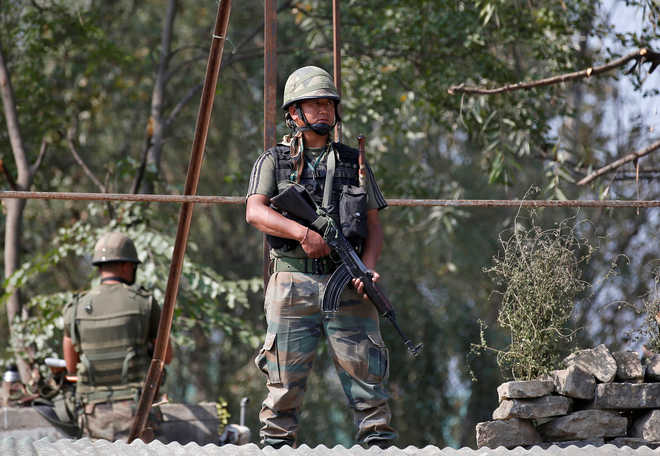
Indian army soldiers keep guard on top of a shop along a highway on the outskirts of Srinagar, September 29, 2016. Reuters

Ajay Banerjee

Tribune News Service

New Delhi, September 29

It was around noon on Wednesday that Prime Minister Narendra Modi sanctioned the military strike across the Line of Control (LoC) to destroy terrorist camps located in Pakistan Occupied Kashmir (PoK).

Troops from the 4 and 9 para special forces were used in the operations.

Over the next 16-17 hours, the dynamics kept changing and ended when the Indian Army team reported back successful around 4.30 am on Thursday. The top brass of the political establishment was informed that the operation was a success.

(Follow The Tribune on Facebook; and Twitter @thetribunechd)

Though cross-LoC military action has been done in the past, the first public announcement of such move came on Thursday morning when Director General of Military Operations (DGMO) Lt Gen Ranbir Singh announced this at a press conference.Top sources explained to The Tribune that a military move was ordered in two parts that would be spread across an arc of 250 km. The targets were seven terrorist launch pads at five locations across the LoC that included the Lepa valley, Tatta Pani and Bimber.  The first was to fire artillery guns across the LoC, including from a location near Uri–close to the same place where terrorists had killed 18 Army soldiers on September 18. The second was to use the confusion caused by the artillery fire to sneak in troops from pre-decided spots across the LoC by using the several ingress routes.As the artillery opened up, three separate teams of heavily armed soldiers of the Indian Army crossed over to the PoK, they were backed by UAV’s providing live footage to the Northern command in Udhampur, the tactical headquarters of the three Army divisions at Baramulla, Kupwara and Poonch.The orders were clear “just shoot to kill…don’t leave behind any injured soldier…be quick and destroy everything”. The troops needed to surprise the terrorists in these camps.The actual operation lasted four hours that is it commenced around 12.30 am on Thursday and ended at 4.30 am on Thursday. Around 2 pm on Wednesday, the special teams had been asked to move forward. Helicopters dropped teams at advanced pre-decided locations.  From afternoon till nightfall on Wednesday, briefings were conducted, and troop leaders given clear instructions. The go-ahead to cross the LoC was for midnight; in the meantime, the artillery fire had distracted the Pakistani troops.The Indian Army troops were carrying heavy firing capability that included shoulder-fired weapons.Around 5 am on Thursday, the Pakistan Army retaliated with artillery fire and around 7.30 am US National Security Adviser Susan Rice called up Indian NSA Ajit Doval