








Sanjha Morcha

What’s New

Click the heading to open detailed news

Current Events :

web counter

Print Media Reproduced Defence Related News

What happens at the Line of Control?—- Lt Gen (retd) Syed Ata Hasnain

The LoC provides scope to send different messages to stakeholders. Whenever Pakistan finds it difficult to sufficiently activate the Valley hinterland, either due to low strength of terrorists or insufficient energy among the separatist cadres, it resorts to activating the LoC.

What happens at the Line of Control?
CROSSING THE LINE? While for India a quiet LoC is advantageous, the same is not true for Pakistan. The body of head constable Rai Singh of the BSF, who lost his life in a ceasefire violation along the LoC by Pakistan, being brought to Rajouri. Tribune photo

EVEN at the best of times the Indian public remains blissfully ignorant of what happens at the Line of Control (LoC) on a daily basis. Now when the worry is about changing old currency notes for new or catering for the next meal because of lack of new currency, the LoC is far from the mind. It’s at times like these that reminders need to be given in the public space on the situation at the LoC in Jammu and Kashmir, where a virtual state of war exists. Public knowledge of this is essential if the correct perception about the state of national security has to be held and not simply taken for granted. The situation at the LoC can dangerously spiral out of control.Firstly, it is important to know just what  the LoC is. It is the imaginary line demarcated on maps and ground where the two armies of India and Pakistan were located when the ceasefire of 1948 came into being after the first India-Pakistan Conflict, in 1947-48. Then called the Ceasefire Line (CFL), it got demarcated under the Suchetgarh Agreement of 1972, which followed the Shimla Agreement. It differs from the international border (IB), which is the legal uncontentious boundary between two states. The IB is manned by police forces on a non-tactical basis to prevent unauthorised trans-border movement, smuggling and other such illegal activity. The LoC is, however, different. For one, it is manned by the armies on both sides in eye-ball contact. Although demarcated and signed on maps, there are contentious disputes about the alignment and many an attempt is made to wrest tactically important ground in own favour by eviction of the adversary, by intimidation  or simply occupation if not strongly held. The well-known notion which exists  is, “Grabbers Keepers”. It manifests in identification of vulnerabilities, a much higher state of alert at these and constant monitoring. In between the LoC and the IB is an awkward phenomenon called the Jammu IB; an alignment which India considers final and uncontentious but Pakistan perceives it as not finalised. It terms it the “Working Boundary”, a term we do not share in vocabulary. It remains manned by the Central Armed Police Forces, the BSF in this case and the Rangers a paramilitary force of Pakistan.The LoC may still have been a relatively safe place to operate in the 1980s of the 20th Century. The 1990s brought with them the havoc of infiltration which had to be countered all the time, night and day. The task of the Army then became twofold; first maintaining the sanctity of the LoC (no negative change) in alignment and state and second, preventing infiltration. When translated, the first meant holding posts strongly and dominating the gaps by fire and observation; the second meant physical prevention of any unauthorised movement across the nooks and crannies of the broken and extremely dangerous terrain. As Pakistan ratcheted up the infiltration of terrorists and warlike material, the strength of terrorists on the Indian side increased manifold as did the number of tiers of such manned alignments, ably supported by technology and physical obstacles. However, the public needs to know a couple of things about this deployment and the inherent threats that are prevalent at almost all times.The LoC/Jammu IB provide the scope for sending messages to different stakeholders. When activated, they keep the international community concerned about potentially destabilising exchanges between nuclear armed  neighbours. Whenever Pakistan finds it difficult to sufficiently activate the Valley hinterland either due to low strength of terrorists or insufficient energy among the separatist cadres, it resorts to activating the LoC due to all the above reasons.The actions on the LoC and Jammu IB currently underway involve major breaches of ceasefire, which means regular fire assaults, using lethal weapons. These also affect the local population, thus drawing more attention. The LoC in the Kupwara sector, which is densely backed with troops in depth, has lesser density along the LoC itself. This is because it is most prone to infiltration through Keran, Machil and the Northern Gallis. The terrain forces larger gaps and isolation of posts. In the desire to cover maximum ground to prevent infiltration and ensure sanctity of the LoC, units here maintain smaller strength in a larger number of posts. This is what the Pakistan army and the terror groups are targeting. Patrolling by the Indian Army is essential. Thus patrols and smaller posts along the LoC become vulnerable when Pakistan’s Border Action Teams (BAT) concentrate  to create a local superiority. Intelligence on the broad presence of BATs is usually available, it is the pegging to a narrow location which remains the challenge. The recent casualties inflicted on our troops by BATs is a result of this. The Pakistan army does not have to deploy with a large number of posts as it does not have to execute counter-infiltration nor cater for raids by the Indian Army since India is not infiltrating terrorists to Pakistani territory. However, the Indian Army has struck back quite often in the past and after the recent surgical strikes that fear exists in the Pakistan Army. The devious game has been boldly played by the Indian Army too, giving away some and gaining more. For us, the LoC being quiet is advantageous, quite the opposite of what Pakistan desires.The machismo on the part of the Pakistan Army is a slow and inevitable way of admitting that the surgical strikes in end September 2016 did take place and they hurt. The Pakistani actions at the LoC now underway are obviously with a view to regain face. This will continue for some time, until the new Pakistan Army Chief settles down. The Indian Army’s surgical strikes have given hopes to the Indian public that each time it will be the same; that is impossible and imprudent. Yet, a LoC-experienced commander will tell you that the options are limitless; from planned fire assaults to trans-LoC strikes dispersed over time and space. That is what the Indian Army will do as an appropriate farewell for Raheel Sharif. 
8


The writer, a former General Officer Commanding of the Srinagar-based 15 Corps, is now a Fellow with the Delhi Policy Group.


One lakh people yet to benefit from OROP; govt working on it: Parrikar

One lakh people yet to benefit from OROP; govt working on it: Parrikar
Parrikar said the delay in sanctioning money under the scheme was being caused due to a technical error. ANI

Majid Jahangir

Tribune News Service

Srinagar, November 3

After the suicide by ex-serviceman Ram Kishan Grewal plunged the capital into chaos on Wednesday, Union Defence Minister Manohar Parrikar on Thursday asserted that one lakh people were yet to benefit under the One Rank, One Pension (OROP) scheme and would be assisted soon after the rectification of the error causing the delay.Parrikar elucidated that the delay in sanctioning money under the scheme was being caused due to some technical error and said, “One lakh people are yet to get full benefit of the OROP. There is some technical issue. We will soon sort out the paperwork.”Parrikar was addressing ex-servicemen in central Kashmir’s Budgam district.(Follow The Tribune on Facebook; and Twitter @thetribunechd)Grewal had consumed poison on Wednesday. The 69-year-old former jawan was protesting over the OROP issue at Jantar Mantar in Delhi when he committed suicide. Earlier in the day, the mortal remains of Grewal were consigned to flames at his native village in Bhiwani. With ANI


Rs 2,000 notes found on two Pakistani militants gunned down in J&K

Rs 2,000 notes found on two Pakistani militants gunned down in J&K
New Indian currency was recovered from the slain militants. ANI

Majid Jahangir

Tribune News Service
Srinagar, November 22

Two suspected Pakistani militants were killed in gunfight in north Kashmir’s Bandipora district on Tuesday.Two weapons and ammunition were recovered from the slain militants. The security forces also recovered two new currency notes of Rs 2,000 from the slain militants.
The gunfight erupted early in the morning, when police and army cordoned Bonikhan Mohalla in Hajin, around 30 km from here, after an input about militants’ presence in the area.
“As the searches were being carried out, militants opened fire and it was retaliated triggering an encounter. In the gunfight two militants were killed,” a police officer said.

(Follow The Tribune on Facebook; and Twitter @thetribunechd)

He said both the slain militants were Pakistanis and were associated with Lashkar-e-Toiba.
Security forces have stepped up anti-militancy operations across Kashmir which had remained halted during the unrest triggered by the killing of militant commander Burhan Wani.


Shelling-hit look for safe lodging on their own

Shelling-hit look for safe lodging on their own
Heavy shelling in Ramgarh has forced residents to migrate to safer places. Tribune Photo

Dinesh Mahotra & Amir Karim Tantray

Tribune News Service

Jammu, November 1

Girdhari Lal, a resident of Treva border village, is in Bishnah town in search of rented accommodation because his family members are not safe because of the shelling from across the border.It is not easy for Lal, a Class-IV government employee, to afford rented accommodation at Bishnah in Jammu district but he has decided to withdraw his fixed deposit as his family’s security is his priority. He has decided to shift his family to Bishan because death is looming large at his shelling-hit village.Girdhari Lal’s is not an isolated case. There are scores of families in forward areas who have shifted to nearby towns or villages without waiting for the authorities to set up camps. Tilak Raj of Allah village, which is situated on the International Border, was fortunate to get rented accommodation in Bishnah but there are many others who are still searching for a safe place to reside in. “Politicians and officers are repeatedly making big announcements about providing shelter to us at safer places but on the ground nothing has been done,” Raj alleged, adding that hundreds of families from the border belt of the Jammu region have taken accommodation on rent on their own at safer areas.Referring to today’s shelling casualties at Ramgarh, Tilak Raj said the killings had debunked the tall claims of the authorities.Sources told The Tribune the administration had decided to evacuate around 50 villages, displacing nearly 37,000 people, on the 198-km-long International Border. This decision has been taken after the Pakistan Rangers resorted to unprovoked shelling on the International Border since morning. Already a few hundred people are staying in migrant camps set up by the administration but mostly people have arranged their own accommodation. “The intense shelling from Pakistan today made panic-stricken people leave their homes and head for safer areas. This forced the administration to officially evacuate villages to avoid collateral damage,” said a source in the administration. On the Line of Control too, people have been asked to move to safer places.

No ambulance to transport firing victims in Balakot sector

Dinesh Manhotra

Tribune News Service

Jammu, November 1

No ambulance to transport firing victims in Balakot sector

While killing of civilians due to unprovoked firing from across the border is going on unabated on the Line of Control (LoC) and International Border, the health sector in Jammu province is virtually paralysed. The situation is worst in the border areas where even ambulances are not available to take injured to the hospitals.Today shelling started on the LoC in the Mendhar sub-division of Poonch district. Some border residents received severe injuries in the firing but no ambulance was available to take the injured to the nearby hospital. The helpless residents took the injured in their own vehicles to the hospitals.According to reports, this morning Pakistan started heavy shelling in the Balakot sector of the Mendhar sub-division, resulting into injuries to some civilians. Locals immediately called for the ambulance from the nearby primary health centre (PHC) of Dhargloon but there was no fuel in it.“We have already sought an explanation from the authorities to fix responsibility for this negligence,” Sher Singh, Sub-Divisional Magistrate (SDM), Mendhar told The Tribune.He said there was another primary health centre at Bharotee which was situated across the fencing but it was not well-equipped. So a huge chunk of the population living near the LoC was dependent on the Dhargloon PHC for shifting the injured to nearby hospitals in case of shelling from across the border, he added.In fact, Dhargloon PHC is not an isolated case. In most of the health centres in the border areas, ambulances are not available. There is strong anger among people against Health Department for not taking the issue seriously.Sources said six ambulances were available in the Mendhar sub-division but most of these vehicles were not fully functional. The sub-division needs 10 ambulances but only six are available that too in a bad condition.


Re-employed defence officers to protest disparity in status

Vijay Mohan

Tribune News Service

Chandigarh, November 20

Retired armed forces officers re-employed with the Department of Defence Services Welfare, Punjab, have decided to go on a strike from tomorrow to protest against the state government’s failure to promote them to the level of Additional Director despite directives issued by the Centre five years ago.The affected officers, who are of the rank of Lieutenant Colonel and Colonel, are instead continuing at the level of Deputy Director which is below their corresponding level in the armed forces. Under the Sixth Pay Commission, a Lieutenant Colonel and Colonel drew a grade pay of Rs8,000 and Rs8,400, respectively, whereas the grade pay being paid to them post-retirement at the level of Deputy Director was Rs5,400.“From tomorrow, officers posted in headquarters and in the districts will be present in the office, but can’t process files, take decisions or sign documents till the matter is resolved,” an officer said.“Though the grade pay has been abolished by the Seventh Pay Commission, wide disparity in the status remains. We are being paid salaries equivalent to our last pay drawn from the armed forces. Meeting our demand will not entail any financial burden on the state government,” he added.In March 2011, the Ministry of Defence had notified that all officers who retired of the rank of Lieutenant Colonel and Colonel are to be given Additional Director posts in the Department of Defence Services Welfare, Punjab, to maintain parity of their rank vis-à-vis civilian officers.According to officers, they had taken up their case with the government and urged CM Parkash Singh Badal. Recently, they received a communication the Finance Department had rejected the case without assigning any reason. The issue figured in the meetings of the Kendriya Sainik Board chaired by Defence Minister Manohar Parrikar.


Mutilating soldier barbaric, India should tell the world: Former Army chief

New Delhi, October 29As tributes were paid to a soldier whose body was mutilated by “terrorists” in Machil sector, former Army chief General JJ Singh (retd) said it reflected the ‘barbarism’ of the Pakistan Army, and added that India should inform the international community of the act.The soldier, Sep Mandeep Singh, who was from Kurukshetra in Haryana, was beheaded by “terrorists” who fled back to Pakistan-Occupied Kashmir under cover fire from Pakistan Army on Friday.The Indian Army in an official statement said the soldier’s body was mutilated and added that it would retaliate with an “appropriate response”.Retired General Singh pointed out it was not the first time Pakistan had done something like this, and termed the act “barbaric and medieval”.”It is definitely an act of frustration. Having been hit very hard by India, this is an expression of frustration. They have done this in past as well, like during the Kargil war when they mutilated some of our soldier’s bodies,” the former Army chief said.”Mutilating a soldier and beheading him shows they have a medieval mentality… They must be investigated by the world,” he said.The former Army chief also recalled how during interrogation of Pakistani Prisoners of War after the 1971 war, he was told by a Pakistani soldier that Indians did not know how to “beat up someone”.”I do remember when we were interrogating some prisoners of war in 1971, I had gone to one of the Prisoners of War camps and one of them told me — ‘Sir aap Hindustaniyon ko to marna bhi nahi aata hai theek se (You Indians do not know how to even beat up someone properly),” General Singh recalled.”I did not understand as a concept of what was the meaning of that until when I was the ADGMO (Additional Director General of Military Operations) when we received the mutilated bodies of our soldiers,” he said.General Singh added that India should tell the world about Pakistan’s barbaric act.”India should tell the whole world what Pakistan is doing. Particularly with India, we honoured their fallen soldiers who they had abandoned. They should be grateful to us forever. How uncivilised they are…” he said.Retired Colonel Anil Kaul meanwhile said it was time for India to take “firm action”, and added that it was not terrorists but the Pakistan Army that was doing it.”Let’s stop calling it a terrorist act… Pakistan army is doing it,” Kaul said. “It is time we stop just speaking and act against them. We must respond. Pakistan has the habit of back stabbing.”This is not the first time Pakistan has mutilated the bodies of Indian soldiers.During the Kargil war in 1999, Captain Saurabh Kalia, Sepoys Arjunram Baswana, Mula Ram Bidiasar, Naresh Singh Sinsinwar, Bhanwar Lal Bagaria and Bhika Ram Mudh of 4 Jat Regiment were captured by Pakistani troops and brutally tortured.The soldiers had their eardrums pierced with hot iron rods, eyes punctured and genitals cut off. The autopsy of the bodies also revealed that they were burned with cigarettes butts. Their limbs were also chopped off, teeth broken and skull fractured during the torture. Even their nose and lips were sliced off.In another incident, on January 8, 2013, Pakistani soldiers entered Indian territory in Krishna Ghati sector of the border and killed two Indian soldiers — Lance Naik Hemraj and Lance Naik Sudhakar Singh. Indian officials said both the bodies were mutilated, and Hemraj’s body was decapitated.Just before retiring, former army chief General Bikram Singh, who headed the Indian Army when the incident happened, had said India gave a “befitting reply”.General Dalbir Singh, just after taking over as the Army chief, had then said if a similar incident occurred the Indian Army’s response “will be more than adequate in future”.Article 4 of the Third Geneva Convention protects captured military personnel, some guerrilla fighters, and certain civilians. It applies from the moment a prisoner is captured until he or she is released or repatriated. One of the main provisions of the convention makes it illegal to torture prisoners, and states that a prisoner can only be required to give his name, date of birth, rank and service number if applicable. — IANS


Three jawans killed in Assam Militants ambush two Army vehicles in Tinsukia

Three jawans killed in Assam
The Army vehicle that was damaged in an ambush by militants at Pengeri in Assam’s Tinsukia district on Saturday. PTI

Tribune News Service

Guwahati, November 19

Three Army personnel were killed and four injured when a group of 15-20  suspected militants belonging to the banned United Liberation Front of Assam (Independent) and the NSCN-K ambushed  two Army vehicles  around 5.30 am inside the Buri Dihing reserve forest  near Pengeri  in Tinsukia district of eastern Assam,  about 510 km away from here.The slain jawans belonged to 15 Kumaon Regiment based in Pengeri and were engaged in counter-insurgency operations, sources said. The deceased were identified as Havildar Multan Singh, Havildar Rishipal Singh and Naik Narpat Singh.Union Home Minister Rajnath Singh called up  Chief Minister Sarbananda Sonowal  this morning and took stock of the situation after the attack. State Director  General of Police (DGP) Mukesh Sahay, who rushed to the spot, said he suspected the hand of ULFA(I) and its allies  and vowed to apprehend the culprits.  The two Army vehicles – a Gypsy and a truck – were on  way to the refinery town of Digboi when ambushed, with the militants triggering an IED blast under the Gypsy and opening fire. The blast created a crater on the road. Security personnel later recovered grenade launchers at the spot. The police and Army have cordoned off the area and launched a combing operation in the area, including the reserve forest. Helicopters have been pressed into service.The police said the attack was carried out by militants who used sophisticated weapons, including rocket- propelled grenades (RPG), AK-47 assault rifles and mortars.This is the first major attack on the security forces by the banned ULFA (I)   since the BJP-led government  headed by Sonowal  came to power in Assam in May this year. It is the second attack by ULFA(I) in Pengeri in three days. On November 16, a civilian was killed and two Assam Industrial Security Force (AISF) personnel were seriously injured when a tea garden vehicle, on its way to collect cash from Doom Dooma to pay workers, was waylaid near Pengeri.

Five Naxals gunned down in Chhattisgarh

  • Raipur: Five Naxals have been shot in the jungles of Chhattisgarh’s Narayanpur district in the Maoist hotbed Bastar, the police said on Saturday. “The skirmish took place on Friday night between a joint team of the District Reserve Group (DRG) and ultras in the jungles of Tuspal and Becha Kilam villages,” IGP (Bastar Range), SRP Kalluri said. This is the second biggest encounter in Bastar this month after bodies of six Naxals, including three women, were recovered after a gunbattle in Dantewadaon November 16.

Militant shot; soldier hurt in border fire

Anantnag, November 19

Local militant Rayees Ahmad Dar of Kakapora village, Pulwama, was killed in an encounter in Pulwama district today while soldier Kala Singh  of 8 Sikh Light Infantry was seriously injured in cross-border firing.  An ambush was laid for militants in Begum Bagh. Personnel of 50 RR  and the Special Operations Group (SOG) were part of the operation,” a senior police official said. He said the two militants were riding a bike when they were intercepted by security personnel. “The pillion rider got down and opened fire. He was killed after a brief encounter. His accomplice managed to flee,” the official said. An AK-47 rifle and ammunition was found at the encounter site.Dar had joined the Hizb-ul-Mujahideen recently. In his mid-twenties, he had attended the ITI  before being appointed trainer at the institute on a contractual basis, the officer said.Meanwhile, the police have appealed to young recruits to lay down arms. DIG (South Kashmir range) Niteish Kumar said rehabilitation cells had been formed at the district level to try integrate “these boys with the mainstream”.Reports said Pakistani troops continued to pound forward posts and villages near the LoC in Rajouri and Poonch districts. After a two-day lull, the Pakistan army today resorted to unprovoked heavy mortar shelling on forward posts and civilian areas in Kalsian, Jhanhar and Bhawani villages in Nowshera sector, using small and automatic arms and 120 mm mortars. Due to the heavy shelling, the movement of civil/police officials has been restricted. A house each at Makri and Kalisan villages was damaged in the shelling. “Shanti Devi, 80, of Makri village received splinter injuries. Her condition is stable,” said the SDM.


clip


Martyrs remembered on Infantry Day

Martyrs remembered on Infantry Day
Lt Gen Surinder Singh, GOC-in-C, Western Command, lays a wreath at the Veer Smriti to mark the 69th Infantry Day in Chandimandir on Thursday. A Tribune photograph

Chandigarh, October 27

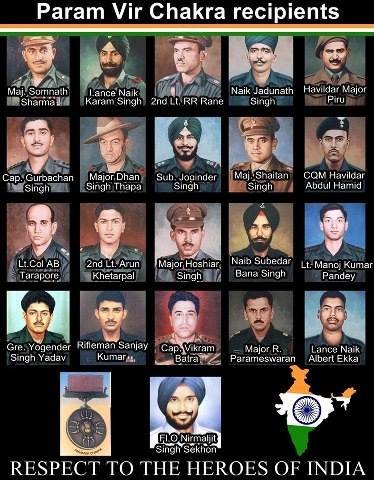
A solemn wreath-laying ceremony was held at the Veer Smriti war memorial to commemorate the 69th Infantry Day at Chandimandir military station today. Lt Gen Surinder Singh, General Officer Commanding-in-Chief, Western Command, along with senior veterans, paid tributes to martyrs.Infantry Day is customarily observed on October 27 every year as it was on this day in 1947 that the first Indian soldier, from the 1st Battalion of the Sikh Regiment, landed at the Srinagar airport to defend the Kashmir Valley against the onslaught of Pakistani raiders.Maj Somnath Sharma of the Kumaon Regiment won the first Param Vir Chakra (posthumously) during these operations in the Battle of Badgam. Ever since, the Infantry has stood tall against all adversities and played a stellar role in all operations post-Independence, including counter-insurgency and internal-security duties. — TNS


Varun Gandhi under attack over defence deals

Varun Gandhi under attack over defence deals
Varun Gandhi. — File photo

New Delhi, October 20

BJP MP Varun Gandhi was at the centre of a controversy over allegations that he had leaked defence secrets to middleman Abhishek Verma and arms manufacturers after being “honey trapped”, a charge he stoutly denied.At a press conference here, Swaraj Abhiyan leaders Prashant Bhushan and Yogendra Yadav released a letter written by Edmonds Allen, a New York-based lawyer, to the PMO last month that Varun was honey trapped and compromised by Verma.He alleged that Verma “blackmailed” Varun, a member of the Defence Consultative Committee, into sharing sensitive information on crucial arms matters.Varun rejected these charges, saying he has not met Verma since 2004 and threatened to file a defamation suit against Bhushan and Yadav over the charges.”The entire information presented does not contain an iota of proof that either I had access or shared any communication regarding sensitive information to Verma,” Varun said.Allen, who was a partner of Verma, fell out with him in 2012. Verma is facing trial in the 2006 Naval War Room leak case.Bhushan alleged that despite having all the details, the BJP government did not blacklist Thales, the company that sold scam-tainted Scorpene submarines, as Dassault acquired it.India recently signed a deal with Dassault for 36 Rafale aircraft.”Any action against Thales may have jeopardised the Rafale deal. Moreover, contrary to previous announcements of getting 126 aircrafts, the government bought 36 aircrafts, paying double the price for individual units. It certainly appears to be the case that something is fishy,” Bhushan said.However, Bhushan and Yadav did not take Varun’s name during the press conference and instead asked journalists to refer to the letter. They claimed to have withheld photographic evidences pertaining to the matter.Allen wrote to the PM, Defence Minister, CBI and the NSA with all the details on August and September this year.Varun said he last met Verma when he was a post graduate student in London at the age of 22.”I am going to turn 37 now. I have never met him since I entered public life in 2004. The only reason why I even know of him is because his parents were members of parliament and was a respected family. I knew them as many other leaders knew them,” he said.Asked if he had come across any sensitive information during his tenure on the consultative committee on defence, he said, “Any MP who has been on that committee knows that not even 0.1 percentage of any confidential information is shared with the committee.” — PTI