


























Sanjha Morcha

What’s New

Click the heading to open detailed news

Current Events :

web counter

Print Media Reproduced Defence Related News

PUNJBA NEWS –15 MAY 2017

Bajwas play host to Capt, bypoll in mind?
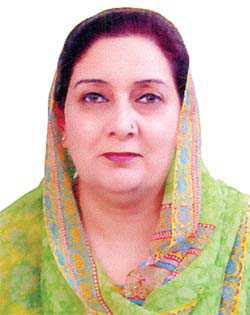
Bajwas play host to Capt, bypoll in mind?
Keen on Charanjit Kaur as Gurdaspur candidate

Ruchika M. Khanna

Tribune News Service

Chandigarh, May 13

With Capt Amarinder Singh now the undisputed “maharaja” of Punjab Congress, his bete noir and former Punjab Pradesh Congress Committee president Partap Singh Bajwa seems keen on a truce.No wonder that Bajwa’s younger brother and Qadian MLA Fateh Jung Singh Bajwa hosted a dinner for Capt Amarinder here last night. Partap Singh Bajwa was also present, while his wife and former Qadian MLA Charanjit Kaur, had withdrawn from the contest in favour of her brother-in-law, was not present.With the election to the Gurdaspur Lok Sabha byelection round the corner following the demise of actor-turned-politician Vinod Khanna, Bajwa is reportedly keen on his wife contesting the bypoll.Capt Amarinder Singh, when contacted, said he did attend the dinner, but there was no political talk. There were around 30 people at the dinner, but it was a social gathering, he added, while insisting that a decision on the party candidate would be taken by the Congress high command.Sources said the Bajwas would not have lost sight of the free hand given to Capt Amarinder by the Congress high command after the party’s emphatic victory in Punjab — whether having his way on the choice of Cabinet, or appointment of confidant Sunil Jakhar as PPCC chief.Sources say that Partap Singh Bajwa being a strong Congress leader of Majha, barring a few, most MLAs are likely to help Charanjit Kaur in case the party zeroes in on her. But he would still need the “blessings” of Capt Amarinder Singh to not just secure a ticket for his wife, but also manage a win at the hustings.

Dharamsot exhorts youths to loans under govt’s welfare schemes
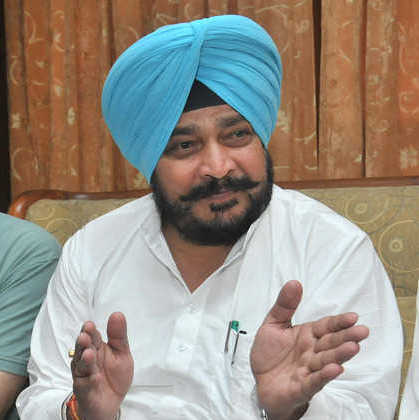
Dharamsot exhorts youths to loans under govt's welfare schemes
SC Welfare Minister Sadhu Singh Dharamsot

Chandigarh, May 14

Punjab minister Sadhu Singh Dharamsot today exhorted youths to avail loans under the state government’s welfare schemes to be able to find avenues of self-employment.He said Punjab Backward Classes Land Development and Finance Corporation (BACKFINCO) was running several schemes aimed at providing loans to the youth at low interest rates.Scheduled Castes and Backward Classes Welfare Minister Dharamsot said these schemes would act as a catalyst for the skilled and enterprising youths to be well-off financially by initiating their own ventures.He said BACKFINCO also provides loans for pursuing higher education.In a statement, the minister said as per the direct loan scheme, BACKFINCO provides loan ranging from Rs 50,000 to Rs 1 lakh at an interest rate of 6 per cent. Loans can be availed to start ventures such as dairy farming and poultry.Apart from this, under the schemes run with assistance from other corporations, students hailing from backward classes and minorities are provided loans at an annual interest rate of 3 per cent and 4.5 per cent respectively, he said. — PTI

Pranab: Indira was convinced of Op Bluestar
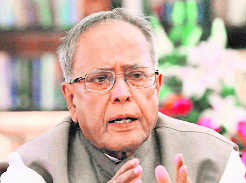
Pranab: Indira was convinced of Op Bluestar
Pranab Mukherjee

Aditi Tandon

Tribune News Service

New Delhi, May 13

Thirty-three years after Operation Bluestar, President Pranab Mukherjee today recalled how late Prime Minister Indira Gandhi was convinced of the unavoidability of her decision to send the Army to clear the Golden Temple of militants in 1984.Speaking at the launch of a centennial commemorative volume on Indira Gandhi, Mukherjee said he had told the late PM that it was the most dangerous decision. “As a student of history, I was afraid to do anything with the Golden Temple… I recalled  (at Cabinet committee meeting) how Ahmed Shah Abdali had to face serious consequences after the Third Battle of Panipat when he did something wrong with the Golden Temple,” the President said.

He then narrated what Indira Gandhi told him: “Sometimes history demands some action to be taken which may not prove correct later on but perhaps is most relevant at that time. This decision cannot be avoided.”

SAD-BJP govt siphoned off ₹1,400 crore, says Sidhu

BATALA: The previous SAD-BJP government siphoned off more than ₹1,400 crore sanctioned by the Centre to promote tourism in the state, said local government, tourism and cultural affairs minister Navjot Singh Sidhu.

HT PHOTOLocal bodies and tourism minister Navjot Singh Sidhu with chairperson of the Punjab Arts Council Satinder Satti at a function to pay tribute to Shiv Kumar Batalvi in Batala on Saturday.

SAYS THE PREVIOUS GOVERNMENT FAILED TO UTILISE ₹400 CRORE FOR PROVIDING DRINKING WATER TO AMRITSAR RESIDENTS

“I have documents to prove that former chief minister Parkash Singh Badal and his son Sukhbir Badal misused crores of rupees sanctioned by the Union government under the centrallysponsored schemes,” said Sidhu at a press conference here on Saturday.

The minister was here to participate in a cultural programme in the memory of noted poet Shiv Kumar Batalvi.

He said during its last term, the SAD-BJP government also siphoned off ₹400 crore released by the Centre under smart city project. “Not only the Badals, some other ministers were also involved in this scam and I will soon make a disclosure in this regard,” he added.

“Besides this, the previous government failed to utilise ₹400 crore it released for providing clean drinking water to residents of Amritsar through the Upper Bari Doab Canal,” the minister alleged.

“I have already ordered audit of all records of the local bodies department and once it is completed, we are going to issue a white paper on all frauds committed by the Badals and their ministers in the past 10 years,” said Sidhu.

Sidhu announced that the department would mark an international event to celebrate the marriage anniversary of Guru Nanak and birth anniversary of Shiv Kumar Batalvi. He also promised to hold an international literary festival in November in the memory of the poet.

After govt’s anti-drug drive, ‘chitta’ rates double in state

HANDIGARH: The drive launched against drugs by Punjab’s Congress government has had visible effect at least on one count — the black economy of chitta (white powder/heroin). Bulk market rates of the deadly intoxicant have nearly doubled from Rs 10 lakh a kg to Rs 19 lakh, say ground reports from the Special Task Force (STF) of the police formed by chief minister Capt Amarinder Singh to curb the menace. And that’s not all.

Addicts in Amritsar — where the rates are usually the lowest due to proximity to smuggling routes from the border — are getting the dose for up to ₹3,600 a gram, which is also double the earlier rate. In Ludhiana, too, the retail rates have doubled since February, to ₹4,500-5,500 a gram. In other places such as Ferozepur, Mansa, Bathinda and Barnala, rates range from ₹2,000 to ₹5,000 a gram.

A usual addict consumes about half a gram in a day, generally divided into in three doses, say de-addiction experts. But chronic addicts consume up to a gram a day.

Information with the Border Security Force (BSF) says rates in Pakistan, from where much of it is smuggled into the Indian Punjab, remain at ₹8-10 lakh per kg. But, because the suppliers here are reluctant to receive the consignments now, big suppliers are now selling their current lot at higher prices.

“Drug dealers active in the border area have, for the time being, only kept their fingers crossed. That’s why they are not hyperactive on the borders as they were earlier,” added a senior BSF official posted at Punjab Frontier headquarters in Jalandhar, who did not want to be named for not being authorised to speak to the media on the matter.

HT talked to various other sources too in the know of the trade, in Bathinda, Mansa, Patiala and Kapurthala, who underlined the rate hike.

A superintendent of police (SP) posted in the counter-intelligence wing in a border region said, “In many cases, older customers are being given the dose on a comparatively lower rate, but the newer ones are charged the current retail rate.”

The STF in-charge, additional director general of police (ADGP) Harpreet Singh Sidhu, sees this as the first positive sign in the fight against drugs. “In coming days, the drive will be given more momentum, and we are sure the prices will further soar, making drug availability more difficult for addicts,” he said.

But is it all that simple? Dr Sandeep Bhola, a psychiatrist and de-addiction expert at the civil hospital in Kapurthala, said the price hike could be a good sign “only if the family or someone else motivates the addict to now quit the habit by joining a de-addiction centre”. “Otherwise, if addicts are unable to afford their dose, they might start using cheaper injections or even indulge in criminal activities to get quick money,” he said.

The STF head acknowledged this: “The strategy of the government is aimed at de-addiction as well as prevention of more people becoming addicts. Reduction in availability, coupled with the steps that the government is taking in the near future, will encourage addicts to go for de-addiction.”

Change of guard, Badals’ man has change of heart?
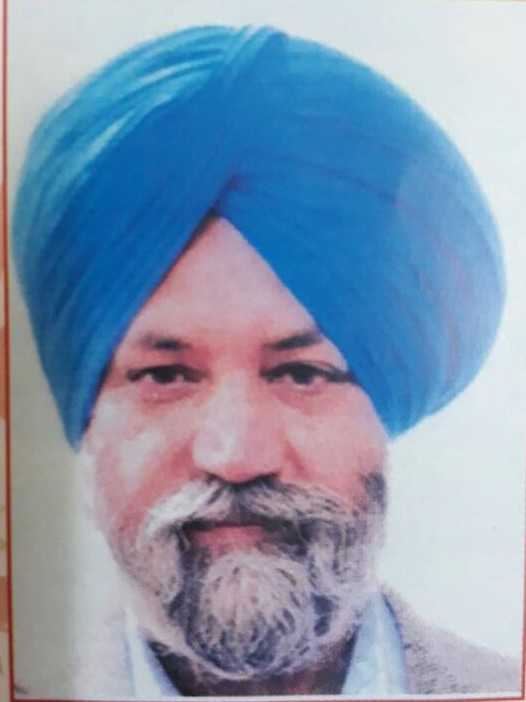
Change of guard, Badals’ man has change of heart?
Harmel Singh Sra

Rajmeet Singh

Tribune News Service

Chandigarh, May 14

The Congress government’s attempt to rid departments of the “Akali influence” seems to have no bearing on the office of the Chief Executive Officer (CEO) of the cash-rich Punjab State Transport Society.A loyalist of the Badal family, Harmel Singh Sra continues to enjoy the “patronage” of the government as the CEO of the society.Private transporters have accused him of watching over the business interests of the Badal family in the transport sector during the previous SAD-BJP government.Several outfits of transporters have demanded his removal in vain. Now, two senior Congress leaders have sought his ouster and a probe into his alleged role in deciding and awarding route permits and finalising previous transport policies.State Congress chief Sunil Jakhar said, “Officials in the previous Akali government, who colluded with their political masters at the cost of the state exchequer, have no place in a government that is committed to fair and transparent administration.”Dera Baba Nanak MLA Sukhjinder Randhawa said there was a need to probe Sra’s role in causing loss to transport undertakings. “The government should fix responsibility for the grant of illegal permits, wrong extension of routes and other anomalies that have been struck down by the Supreme Court and the High Court,” he added.Sra is neither an IAS nor a PCS officer. After serving two extensions post-retirement, he remained the acting State Transport Commissioner — a cadre post reserved for IAS officers — during the SAD-BJP rule. Before the Assembly elections, he was “rewarded” with the post of CEO. The post was created to adjust him.At a time when political appointees of the previous government are either putting in their papers or are being asked to resign, Sra continues to work as the CEO.With the change of guard, the official is reported to have changed loyalties as a senior political appointee has interests in the operations of private buses, raising question marks on the intention of the government.

Finding ‘favours’

  • Harmel Singh Sra remained the acting State Transport Commissioner — a post reserved for IAS officers — during the Akali rule
  • Before the Assembly elections, he was ‘rewarded’ with the post of CEO of the Punjab State Transport Society. The post was created to adjust him

Dalit who raised voice against fund misuse now fears for life
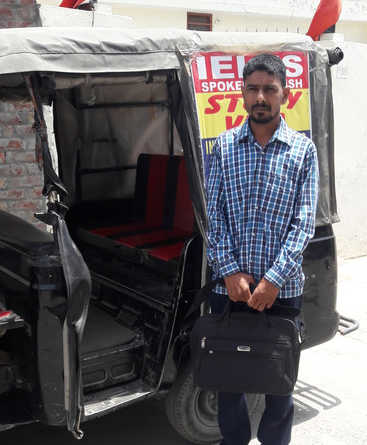
Dalit who raised voice against fund misuse now fears for life
Dalit labourer Sarbjit Singh was sacked four years ago. Tribune photo

He was fired from job four years ago

Parvesh Sharma

Tribune News Service

Sangrur, May 14

Justice comes at a cost and 42-year-old Dalit labourer Sarbjit Singh knows it well. His temporary service as helper under the incharge of the Persons-with-Disabilities scheme at Sant Longowal Institute of Engineering and Technology (SLIET), Longowal, was terminated in 2013.He lost his job after he raised his voice against the alleged misuse of funds meant for persons with disabilities. Then, he procured information through the RTI Act and wrote to many authorities, but justice continues to elude him.Fearing that their “wrongs” would be exposed, SLIET authorities are allegedly threatening Sarbjit with dire consequences. But he has refused to compromise.With a bag of documents that Sarbjit has procured under the RTI Act, he has been visiting various villages of the district to trace the students whose money has been misused.“Despite having grants, SLIET authorities did not give financial aid to enrolled persons-with-disabilities students for vocational courses under the scheme from 2007 to 2015. The authorities should pay Rs 5,700 to each student. I have detailed information that lakhs have been misappropriated by the authorities concerned. My services were terminated in 2013 after I raised my voice against it,” said Sarbjit. He has written to SSP Sangrur for action against SLIET employees.He alleged that on his complaint to the Prime Minister’s Office (PMO) in August 2016, SLIET authorities – despite having the grant — gave wrong information to the PMO that a large number of students were waiting for the grant as funds were not available.“First, they offered me money. When I refused, they started threatening me. These days, I am being pressured to withdraw my complaints. I fear that I may be killed and SLIET authorities will be responsible for it,” he said.Today, he was in Sangrur to board a bus to New Delhi to meet authorities of the Ministry of Human Resource Development.The scheme for integrating persons with disabilities in the mainstream of technical and vocational education was launched in 1999-2000 with an objective to upgrade the skills of physically challenged persons.Mahesh Arora, incharge of PWD scheme, SLIET, has denied the allegations. “No one is issuing threats from our side. It is a baseless allegation,” said Arora.SHO Longowal Jugraj Singh confirmed that Sarbjit has lodged a complaint and said that he would look into it.

Absent for over a year? Employees to lose job

State govt to crack down on unauthorised leave

Tribune News Service

Faridkot, May 14

Cracking the whip on absentee employees, the Finance Department has conveyed to all departments on Friday to treat employees on unauthorised leave for more than one year as “deemed to have resigned.” In a letter to the heads of all departments, divisional commissioners, deputy commissioners, High Court and district and session judges, the department said that a member of the service shall be deemed to have resigned if he is absent from duty for a continuous period exceeding one year.Such employees would not be allowed to join duty if and when they report back. The competent authority will be responsible to start the process to relieve such employees from government service. In case there is any delay or negligence in initiating this process, the officer concerned will be responsible, read the instructions sent by the department.At the time of getting the salary budget, every department will give a certificate about the steps being taken to relieve such employees who were not only affecting the delivery of services to the people, but also creating indiscipline.Such absenteeism shows irresponsible attitude among the errant staff and was against the spirit of state service, reads the letter.Sources said the move was aimed at reining in the absent-for-long and foreign-crazy employees in various departments, particularly teachers, who are settled in foreign countries without resigning from posts in Punjab.Earlier the School Education Department had directed all employees to submit details of their permanent residence (PR) visa, green cards and immigration status in their annual confidential report (ACR)/annual performance assessment report (APAR). Initially, most of these employees take six-month no-pay leave to go abroad. But they don’t return. They just keep extending their leave on one pretext or the other citing “poor health,” the sources added.

Will not be allowed to join back

  • Employees absent from duty for a continuous period exceeding one year will not be allowed to join duty if and when they report back, says the letter
  • The competent authority will be responsible to start the process to relieve such employees from govt service
  • In case there is any delay or negligence in initiating this process, the officer concerned will be responsible, read the instructions sent by the Finance Department

Sidhu plans revamp of several city projects
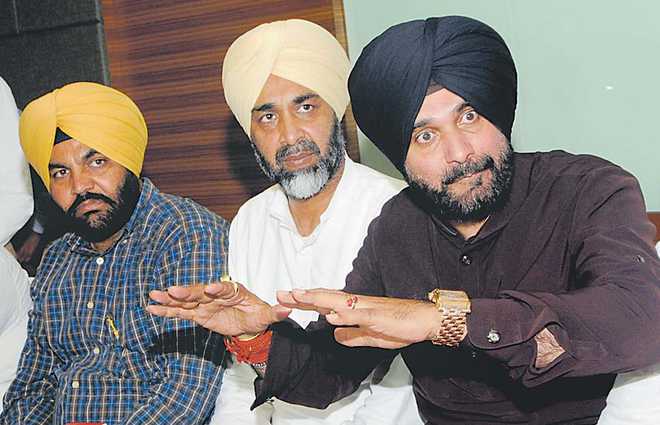
Sidhu plans revamp of several city projects
Local Bodies Minister Navjot Sidhu (right) and Finance Minister Manpreet Badal (second from left) address mediapersons in Amritsar on Sunday while MP Gurjeet Singh Aujla (left) looks on. Photo: Vishal Kumar

GS Paul

Tribune News Service

Amritsar, May 14

With a view to revamp the BRTS (Bus Rapid Transit System) and other stalled projects in the city, a review meeting was held under the tutelage of Local Bodies Minister Navjot Singh Sidhu and Finance Minister Manpreet Badal and in the presence of local Congress MLAs and concerned officials at the MC office here today.As the BRTS project, worth Rs 580 crore, could not be implemented on all the routes for want of infrastructure, the common commuters use its dedicated lanes to reach their destinations. Some even do not refrain from using these lanes as a parking lot. Now, this project would be redesigned to make it viable.Since the BRTS project had resulted in a major loss of the green belt, MP Gurjeet Singh Aujla, in collaboration with the local MLAs, has announced to spare funds to the tune of Rs 50 lakh to plant trees on key routes of the holy city. The aim is to plant at least 1 million trees. A special panel will be constituted for the same which will be headed by Deputy Commissioner.It was collectively decided in the meeting to shift the existing Inter-State Bus Terminus (ISBT) to the outskirts of the city. The present one would only cater to the city buses. All long-route buses would be operated from the new bus stand.Various tracks were identified where infrastructure would be raised to address the traffic snarls. An underbridge has been proposed at Gurdwara Shaheedan Sahib and Jorah Phatak and Hall Gate to Khazana gate. Similarly, modalities would be worked out to ease the traffic flow from Hall Gate to Khazana Gate and extension of Chabaal Road to Vallah road.Sidhu said under the new policy, it would be mandatory to set up a rainwater harvesting plant in new constructions. Before getting the map sanctioned, the applicant would commit to plant at least two trees in the surrounding.For healthy environment, solid waste management would also be implemented. The project had been in limbo for long. “We aim to set up this project in Amritsar, Bhatinda and Jalandhar in the first phase. The state government will identify 100 to 200 acres of land for the project to address the problem of garbage disposal for the next 50 years,” the minister said.He assured that along with the implementation of BRTS and City Bus Service projects, the plying of auto rickshaws would continue but with a new policy under which environment-friendly autos would be introduced.A new advertisement policy was also underway which would fetch at least Rs 200 crore to Amritsar, Sidhu added.Graft charges against BRTS project officialsDuring the review meeting, a social activist, Suresh Kumar Sharma, alleged that crores of public money had been siphoned off by officials, in connivance with the then SAD-BJP leaders, in the BRTS project. Showing supporting documents which he had procured through the Right to Information (RTI) Act, Sharma said he could only get documents that speak about misappropriation of funds to the tune of Rs 15 crore. He would submit the documents with the offices of Chief Vigilance Bureau and the Local Bodies Minister Navjot Singh Sidhu. Sharma said, “From the documents I got, it is clear that four inches (100 mm) of bituminous macadam was supposed to be spread on the BRTS track but only a 2-3 inches bed was laid. At many places, it was done just by placing a fresh track over the old dilapidated track,” he claimed. Gross misappropriation was done while engaging underweight grills which resulted in draining of around Rs 1.04 crore. Further, fixing 150 mm PCC below grill divider on the road on the same tracks constituted of misappropriation of another Rs 1.44 crore. By fixing flexi sheets in place of acrylic sheets, an amount of Rs 43 lakh was embezzled, Sharma added.


HEADLINES ::13 MAY 2017

CANDLE LIGHT VIGIL FOR MARTYRS ON 13 MAY 2017 AT  INDIA GATE AND AT THE PALAZA SECTOR 17 , CHANDIGARH*.

THREAT IN J&K IS BEYOND STREET TURBULENCE BY LT GENJ SYED ATA HASNAIN

UMMER KILLING: HUNT ON FOR 3 HIZB MEN, POLICE RELEASE PHOTOS AND ANNOUNCED BOUNTY

LT. UMAR FAYAZ’S DEATH MAY BE A TURNING POINT IN KASHMIR BY LT GEN SYED ATA HUSNAIN

PAK ARMY’S JOURNEY INTO UNSOLDIERLY DEBASEMENT BY LT GEN BHOPINDER SINGH (RETIRED)

TRUTH BEHIND KASHMIR’S TERROR IS RATHER MUNDANE

SRINAGAR-LEH HIGHWAY REOPENS

WILL CHOP OFF YOUR HEADS, HIZBUL WARNS HURRIYAT LEADERS

PAK RANGERS TARGET BSF TEAM IN ARNIA

US SLAPS SANCTIONS ON PAK TERROR UNITS MOVE FORWARD ON PATHANKOT PROBE, PAK TOLD

ARMY: NO WORD FROM CHINA ON EXERCISE

PUNJAB HEADLINES__13 MAY 2017

  THREE DOMESTIC AIRPORTS FAIL TO TAKE WING

Capt seeks fresh analysis of Punjab river waters

Cong MLAs express displeasure over police functioning in state

KK Sharma is new PRTC chief

Contractual workers to boycott 300 new buses under kilometre scheme

Capt for 60:40 ratio in govt posts of UT

Drugs: CM seeks help from other states

Capt orders recruitment of 4,000 cops

PUNJAB SEEKS CENTRE’S HELP TO CHECK CROSS-BORDER DRUG


Army foils infiltration in Baramulla

Srinagar, May 10

The Army foiled an infiltration bid by a group of militants along the Line of Control (LoC) in Kashmir, an official said today.The infiltration attempt took place on Tuesday night when a group of three to four militants tried to sneak into this side of the LoC in the Rampur sector in Baramulla.“An infiltration bid was foiled after our alert troops opened fire on a group of militants attempting to sneak into our territory on Tuesday night in the Rampur sector in Baramulla,” said the Srinagar-based Army spokesperson, Col Rajesh Kalia.The Army later cordoned off the area and launched a search operation, he said.However, no one was found dead at the encounter site, he said. “The intruders were forced back into Pakistan-occupied Kashmir,” he said.He said the Indian Army did not suffer any casualty or damage in the firing. “The operation is in progress and our troops are on alert in the area,” he said. — TNS


Cop, militant among 4 dead in J&K attack

Cop, militant among 4 dead in J&K attack
Army personnel near the encounter site in Kulgam District. Tribune file

Anantnag, May 6

Three persons, including a policeman, were killed and three injured when militants attacked a police party in Mirbazar area of South Kashmir’s Kulgam district late this evening. The injured were shifted to Srinagar. A militant too died in the incident. (Follow The Tribune on Facebook; and Twitter @thetribunechd)SP Vaid, DGP, said the militants opened fire on a police party inspecting an accident site along the Srinagar-Jammu highway where civilians had gathered too. A policeman, two civilians and a militant were killed. Another militant was injured. — TNS



HEADLINES ::06 MAY 2017

breakl line

DEFENCE NOT GETTING DUE SHARE; INDIA MUST LEARN FROM ISRAEL, CHINA: GENERAL BIPIN RAWAT

IT HAS NEVER BEEN SO HARD TO HAVE AN HONEST CONVERSATION ABOUT KASHMIR

KASHMIR CRISIS: DEADLY COMBINATION OF UNREST AND SURGE IN LOCAL MILITANCY WILL PUSH VALLEY INTO SECURITY ABYSS

SHOPIAN OPS ANOTHER LOW FOR GOVT: NC

KASHMIR NOT GOING AWAY: NARENDRA MODI, MEHBOOBA MUFTI MUST MOVE FAST TO RESTORE WRIT OF THE INDIAN STATE

TROOPS ON ALERT AS TENSION SIMMERS AT INDO-PAK BORDER

HIMACHAL IAS-IPS COUPLE OFFERS TO LOOK AFTER SLAIN SOLDIER’S DAUGHTER

PAKISTAN INTERNATIONAL AIRLINES LIKELY TO SUSPEND KARACHI-MUMBAI FLIGHT

INDIAN ARMY SIACHEN GLACIER – सियाचिन में भारतीय सेना FULL HINDI DOCUMENTARY

HYPER-NATIONALISM DOES NOTHING TO HELP THE ARMY

MUSLIMS FLAY PAK FOR KILLING INDIAN SOLDIERS

PUNJAB HEADLINES:::–06 MAY 2017

Need law for organised crime: DGP
Capt orders survey to oust fake pensioners
Punjab to weed out ineligible pension beneficiaries
Capt-Jakhar team will deliver: Rahul
Govt teachers submit memo on syllabus
Food & Civil Supplies doing it for namesake only
Capt opts for ‘compassion’ to rehabilitate drug addicts

breakl line


Kashmir not going away: Narendra Modi, Mehbooba Mufti must move fast to restore writ of the Indian State

Clarity and perspective are early casualties during turmoil. Yet now more than ever before we are in need of clarity and perspective to deal with the mess in Kashmir. Instead of being swayed by the noise, blood and emotion, decision-makers must be guided by calm, rational judgement. Kashmir is not lost. Nor will it ever be. However, there is no space for complacency and denial. The Valley is suffering from one of the worst periods of crisis in its history and we must acknowledge it, prepare and implement a plan of action.

Kashmir has witnessed a fresh bout of violent protests since last few days. AFP


It may sound preposterous, but ‘Kashmir problem’ might be simpler than it appears. Simpler, not easier. Is it monolithic? No. It is a problem with multifarious dimensions. However, trying to solve everything at the same time is a sure recipe for failure. Therefore, the Indian state must narrow down its focus.

Is the unrest being fuelled by Pakistan? Doubtless. How do we tackle it? Is there increasing Islamist radicalism in the insurgency movement? Yes. How do we tackle it? Is there more support for secession among ordinary Kashmiris now than it was during the turn of the millennium? Possibly. How to rescind the mood? There will be time for these issues to be effectively addressed.

This is not to suggest that these aren’t big enough. Each of these issues is complex, interconnected and resists easy solutions. They pertain to political fallibilities, geostrategic worries and threats to nation’s territorial integrity. These cannot get any bigger.

However, we cannot even begin to tackle these bigger issues plaguing Kashmir if there is no conducive atmosphere for it. How do you, for instance, persuade stone-pelting youths that their future lie in picking up the laptop, not stones, as the prime minister had recently pointed out? Why will the sermon from an authority he doesn’t recognise work when he is led by bigger, if elusive, motivations?

Therefore, the first and foremost responsibility of government stakeholders (and that includes the Centre, state and the entire security establishment) is to restore the writ of the Indian state in Kashmir. Unless there is fear of authority, rule of law and a semblance of order, any hopes of “normalcy” returning to Valley is a pipe dream. And unless there is even a semblance of normalcy, there can be no hope for “peace”.

This opium-fuelled dream of “peace in Valley” cannot become a reality amid flash mobs resisting counter-insurgency operations, youth heckling jawans, raising cries of secession, pelting stones, terrorists spraying Kalashnikov bullets and strewing bodies of jawans and Kashmiris alike.

Which brings us to the painful truth. For all our blaming of Pakistan, the Indian state cannot shirk its role. If Pakistan is guilty of fuelling insurgency, funding cross-border terrorism and using Hurriyat puppets to keep Kashmir on the boil, the BJP-PDP coalition and the Narendra Modi government have been guilty of incompetence. The insurgency movement has gained in strength because it has been allowed to gain in strength.

Since the neutralisation of Hizbul Mujaheedin commander Burhan Wani, a series of tactical and policy errors have been committed. The government has appeared all too eager to cede control and have appeared more interested in short-term placatory gestures rather than displaying an iron will in arresting the deterioration of law and order.

The terrorists and insurgents have used this chance to destabilise the Valley by further challenging the writ of India’s democracy. Politicians have been targeted, threatened and killed. Residences of Jammu and Kashmir Police officers and constables have been attacked. Rule of fear has replaced rule of law. Whereas the Indian state has appeared increasingly clueless, the insurgents and their handlers have moved with great control and coordination. One death at the hands of security forces has given rise to a hundred mutinies as the state has receded deeper and deeper into insignificance.

Nothing exemplifies the government’s ineptitude more than news which emerged on Friday that Saudi, Pakistani and even banned channels like Zakir Naik’s Peace TV are being beamed right into the homes of thousands and thousands of Kashmiri residents, thickening further the witches’ brew of azaadi and Islamism as government officials appear clueless, even complicit.

As Aarti Tikoo reports in Times of India, “over 50 Saudi and Pakistani channels”, including Naik’s Salafist Islam-preaching network and a host of other channels dripping daily venom against the Indian state “are running without necessary clearances via private cable networks in Kashmir. All this is happening under the nose of the PDP-BJP government, which even subscribes to these cable services in some of its offices and buildings.”

The report says there are over “50,000 private cable connections in Srinagar alone” and these are preferred over regular Indian digital platforms such as Airtel or Tata Sky only because they broadcast these banned, anti-India channels.

What’s more, when the issue was brought to the attention of Amit Katoch, director of broadcasting, Information and Broadcasting ministry, “he asked TOI to send a written complaint so that the ministry could verify and take appropriate action”, according to the report.

If this isn’t an indictment of the government’s staggering incompetence, what is?

This must be seen in conjunction with the recent worrying spate of bank loots. There is little doubt that due to demonetisation, many of the terrorist outfits operating in and out of Kashmir and Pakistan-occupied-Kashmir have been hit by cash crunch. The prime minister’s move to declassify the high value notes hit their cash flow, pace of recruitment and arms procurement.

Which is why we find armed terrorists from outfits such as Hizbul Mujaheedin have been targeting several bank branches in the Valley. They have looted, according to a report in The Indian Express, “nearly Rs 92 lakh in 13 separate attacks. There have been four incidents in four days this month, beginning with the bloody attack on a cash van on 1 May during which militants shot dead 5 policemen and 2 bank security guards, and including 2 attacks in 2 hours in adjacent villages in Pulwama on Wednesday.”

Only one out of 13 robberies were committed before 8 November, 2016, the day demonetisation was announced. The government has never ceased to tom-tom its “achievement” that militancy in the Valley was hit due to notebandi. If that was known, what stopped the government from deploying more security at the banks? Didn’t it dawn on administrative functionaries that terrorists will now target banks in desperation?

Chief Minister Mehbooba Mufti has “appealed to the youth to help restore normalcy in the Valley so that peace returns,” and news agency IANS quoted a police officer as saying that “securing each bank in the remote areas by providing guards to every branch in these areas needs manpower which is difficult to arrange at present.”

If we add the recent cancellation of Anantnag bypoll to this mix, the depth of the problem seems clear. It is one of lack of will and the administration, which has gone for a walk at the first sign of volatility, must take the blame for it.

To restore its writ, there is need for a comprehensive military action to flush out the terrorists and if possible, catch or neutralise some of the top commanders to render the outfit headless. The ‘cordon and combing’ operation in south Kashmir launched jointly by the Army and Jammu and Kashmir Police on Thursday, is a good first step. It is telling, however, that the “biggest operation in 15 years” have so far failed to nab a single terrorist. Instead the forces came under attack in which the civilian driver of one of the vehicles was killed. This points to something deeper, that the local intelligence is now favouring the terrorists over Indian security agencies.

But we must not allow any laxity in this regard.

As Arun Sahni, former GOC-in-C, South Western Command, points out in his column for Indian Express, “counter-terrorist operations follow the simple strategy of “an iron fist in a velvet glove”. The pressure of military action — initially by eliminating hardcore leaders and subsequently, as a “threat-in-being” — is the catalyst that forces unlawful elements to talk with the government. Once you dilute the fear of authority of the uniformed forces, there is bound to be resistance to dialogue.”

Restore the authority of Army and the writ of Indian state. The next steps shall follow. Kashmir isn’t going anywhere.


raud: Charges framed against retired Col

Chandigarh, May 3

Charges were framed against retired Colonel Amandeep Singh in a cheating case by the Chief Judicial Magistrate (CJM) today.Charges were framed under Sections 420 ( cheating and dishonestly inducing delivery of property) and other sections of the IPC. Complainant Anupamdeep Kaur alleged she was cheated by Singh who fraudulently lodged a fake DDR at the Sector 3 police station regarding original passbooks missing with regards to deposits in the MIS scheme in three different accounts and withdrew money.  TNS


Hope of peace talks dealt another blow

Hope of peace talks dealt another blow
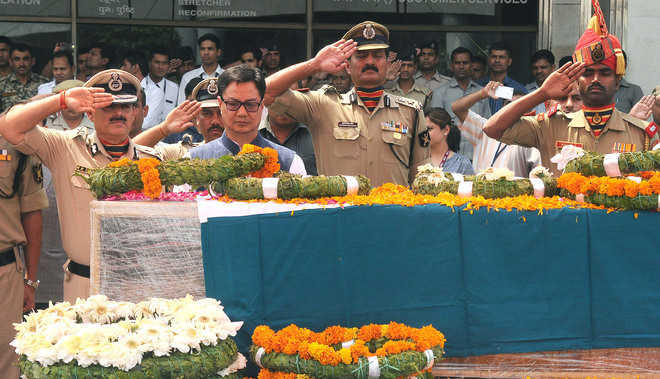
Minister of State for Home Kiren Rijiju pays tribute to BSF Head Constable Prem Sagar. Mukesh Aggarwal

Simran Sodhi

Tribune News Service

New Delhi, May 2The India-Pakistan narrative that has seen its fair share of highs and lows over the past year-and-a-half seems to have hit a dead end following the mutilation of bodies of two Indian soldiers by the Pakistan Army. Not only that, the incident has pushed the neighbours to the brink of limited war.Since the January 2016 Pathankot attacks, both nations have refused talking to each other. But the refusal has only aggravated problems as both countries share a long border.The Kashmir crisis continues to hog the limelight with New Delhi sticking to its stand that it is a bilateral issue while Islamabad is trying its best to raise it at various international fora. The statement of the Turkish President, who visited India only yesterday, and today’s message from the state-run Chinese media appear to be a warning enough that Kashmir is getting an international audience. While Turkey pitched for a multi-lateral dialogue, China has pitched itself as a mediator.Industrialist Sajjan Jindal’s recent visit was seen by many as a positive sign and a possibility that the India-Pakistan ties might see a thaw via back-channel diplomacy. But the mutilation incident has brought things back to square one. These events also highlight the ongoing conflict in Pakistan between the Rawalpindi barracks and the government of Nawaz Sharif.PM Narendra Modi, in the wake of a thumping victory in Uttar Pradesh, is in a stronger position to dictate India’s Pakistan policy. The Opposition parties, however, have dubbed this government having a “no Pak policy” or a “confused Pak policy”.At present, all eyes are on a possible meeting between Modi and Sharif on the sidelines of the Shanghai Cooperation Organisation meet in Astana in June. But if tensions continue to simmer, the possibility will continue to diminish.


Trump’s shadow over India, China Baisali Mohanty

As the United States under Trump unpacks its cards gradually pertaining to Asia, Sino-Indian relations could be considerably reshaped. In this scenario, India has a larger scope to emerge as a facilitator of conflict resolution. It can cater to the interests of multiple stakeholders in the region

Trump’s shadow  over India, China
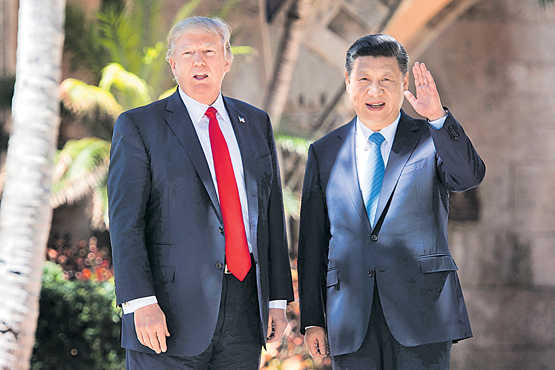
CHINA-US BHAI BHAI?: Chinese President Xi Jinping (R) waves to the press as he walks with US President Donald Trump at the Mar-a-Lago estate in West Palm Beach, Florida. AFP

IN just four months of the establishment of US President Donald Trump’s doctrine on foreign policy, a spate of purportedly “infallible” yet “incoherent” policy stances have impacted Asia. This has markedly influenced the key regional actors — India and China. In the present scenario, it is highly plausible to comprehend an evolving consistency in Trump’s otherwise infamous unpredictability vis-à-vis his bilateral interaction. Previously, from recording a heightening tension between US-China, with Trump’s abrogation of the “One-China” Policy, to the subtle accommodation of Xi’s governance in the region to confront galloping North Korea — Trump has certainly recognised the urgency of “accommodating” the dragon in this region.  In a similar vein, Trump viewing India as a natural partner, from Modi’s congratulatory call to Trump, to the recent visit of McMaster, NSA of the US to  New Delhi is perceived not just as a strategic partner but as a “hedge” in Washington’s effort to strike a balance in the regional milieu. In this scenario, accommodation of India also garners equal concern from the policy makers in Washington. Accommodation, as understood in the common parlance of international relations, involves mutual adaptation, influence or strategic manoeuvering to curtail the rise of a potential contender —rising power — by a great power, in this scenario the United States. Taking notice of the unfolding Indo-Sino interaction with the United States, partial accommodation and issue-based accommodation fits in adequately. The leitmotif for United States is to secure stronger grounds in the region, while figuring distinctively in the affairs of both India and China. 

Trump-Xi bonhomie

Commencing on a rather off-note, the Xi-Trump balance  has struck an unexpectable high note, not to mention the welcoming tweets from President Trump to Xi recently. In an effort to “develop friendship” with Xi Jinping, Trump extended trade and commerce ties with the former in their last meeting in Mar-A-Lago. In addition, he also consciously signalled US strength or rather Trump’s insistence on hard power and escalating presence of United States across conflict-ridden region, by bombing Syria at an opportune moment. More than anything, what is remarkable is US’s burgeoning concern in North Korea that is also echoed in China. Over the purported nuclear strike by North Korea, Trump has repeatedly held talks with China and even confirmed to support the latter in their actions over North Korea’s nuclear adventurism. To this end, the NSA Lt Gen HR McMaster confirmed that US-China have reached a consensus over a solution to the North Korean issue. On the other hand, China has found it beneficial to shake hands with the United States over aggressive Kim-Jong Un’s activities. This stands as an instance showing US’s effort to accommodate China on specific issues within its folds — taking cognisance of the evolving trade opportunities in China. On India, Trump’s motif has been to procure strategic leverage as well as to maintain cordial relation as a natural partner, perhaps not visioning a drastic reversal of Obama’s strategy for India. Prime Minister Modi has been pro-actively pursuing greater collaboration and cooperation with the Trump administration spanning sectors like trade, security, counter-terrorism as well as people-to-people links, which have lately been under grave threat. In addition, Trump also envisions India as a pertinent “hedge” to the rising power of China. While opening up its doors to China, US is equally concerned of its aggressive hegemonic presence in the region as well as an attempt to emerge as a global power.  Under these conditions, India can be the hedge that not just intercepts China’s undue provocations but also has a cordial relation with United States. However, Trump’s policies pertaining to H-1B visa re-evaluation adds few hiccups to bolstering the Indo-US bilateral relations. Unlikely though the bilateral ties will be considerably less impacted by these changes, keeping in mind India’s larger interest in Afghanistan and Pakistan running in tandem with US’s strategy. Earlier, Nikki Haley in a statement reckoned of Trump’s administration interest to engage in resolving Indo-Pak rivalry as a peacemaker. This adds up to the US’s recent strike in Afghanistan, bombing the Taliban safe havens which signals the US intention to oust extremism in the region and inch closer towards a solution over the Afghan conflict. Furthermore, putting aside speculation, Trump has also claimed to support India’s candidature for the Nuclear Suppliers Group, suffusing fresh air into the entangled NSG negotiations over this issue. Importantly, by confirming US support Trump accedes to back India not just in the NSG but also against China’s opposition — as it surges as a foremost opponent against India in the group.  Considering the US-India interaction so far, since the arrival of Trump, it is quite apparent that the US is forthcoming in its engagements towards India. To an extent, it views India as a stronger hedge when the need arises to curtail China’s overwhelming presence. In this regard, Trump has engaged in a partial accommodation of India, while opting for an issue-based accommodation of China. As the United States under Trump, unpacks its cards gradually pertaining to Asia, Sino-Indian relations could be considerably reshaped. In opting for partial accommodation of India, the US confirms to not view India as a possible contender. However, at the same time, the US recognises India’s rising status and material strength globally. In a similar vein, an issue-based accommodation of China by the US implies that the latter is open to accommodating the interests of the Dragon whenever any worse situation befalls, such as North Korea, or even to promote its own interest. However, such issue-based accommodation comes with its baggage of contradictions. While China has earlier sided with North Korea and much of Kim-Jong Un’s artillery has been acquiesced either through China’s aid or Chinese material as its core constituents, Xi’s hegemonic ambitions will not allow US to take it for granted. Also, Trump’s obsession to expand his own interest over national interest, or rather overtly display the strength of America might supersede an opportunity for delivering upon grave situations with a plausible outcome. In this scenario, India has a larger scope to emerge as a bandwagon of conflict resolution — taking up peaceful negotiations and initiating peacemaking to adequately cater to the interests of multiple stakeholders in the region. India will gain significantly by this effort. It will also consolidate India’s “distinctive” status in the global realm as “non-violent”and  well deserving of status of a great power.The writer, a researcher at the Observer Research Foundation, has a postgraduate degree in International Relations from the University of Oxford.


The Colonel who dares the hills SMA Kazmi in Dehradun

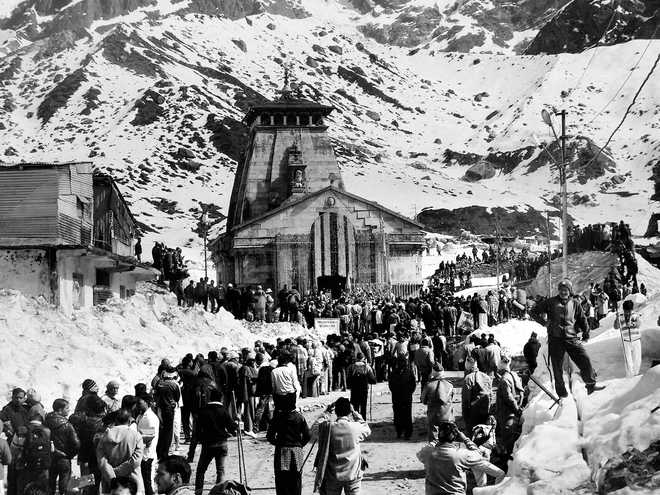
When the PM marks the annual reopening of Kedarnath shrine on May 3, thousands of pilgrims wouldn’t perhaps know the men who brought it all back – from destruction of 2013 to reconstruction

NATURAL disasters of the scale of 2013 Uttarkashi deluge are unforgiving, unforgettable: nearly 5,000 people were killed as dozens of small villages, bridges and narrow passages simply disappeared. In government records many people continue to remain untraceable, presumed dead. Nearly four years later, it all looks as if everything is back to normal: 3 lakh pilgrims visited Kedarnath in 2016. Or is there someone not letting the faith slip away?Ask Col. Ajay Kothiyal, Principal of the Nehru Institute of Mountaineering (Uttarkashi), you’d know how a soldier can steel his will to achieve the impossible. Today, when pilgrims on Char Dham Yatra feel safe around the arduous, serpentine route to the Kedarnath shrine, they wouldn’t perhaps know who Col Kothiyal and his men are. Or, how in just three years, the same treacherous routes have turned safe, inviting no-worry smiles from those who pass. June 16-17, 2013, were most dreadful: rivers and streams were overflowing fast and furious, devouring everything that came their way. Thousands were stranded, many had already died. The Colonel acted on his instincts, gathered his men and helped in rescuing more than 6,000 pilgrims, including 46 foreigners, in one day, June 16. The 15-km original Rambara-Kedarnath pedestrian route had vanished. No agency was willing to undertake reconstruction of roads at those heights. Months later, the ace mountaineer from 4th Garhwal Regiment of the Army, Col Kothiyal, got his mission: rebuild the collapsed road infrastructure — at more than 11,000 feet — at Kedarnath. “I had a dozen-member team. We had to jump from our helicopter in March 2014 to access the ground reality at Kedarnath. We stayed there for two days and trekked down the damaged route. A couple of weeks later, we started the reconstruction work. We are still involved in the work in flood-hit Kedarnath valley,” says Col Kothiyal. This unleashed the massive reconstruction effort. Col Ajay Kothiyal organized around 1,200 Nepalese labourers who were provided with basic equipment and clothing to brave the snow which in March was over 10-ft deep. The officer then chalked out a new alignment on way to Kedarnath, starting from Rambara. They worked round-the-clock in rain, snow and sleet. The team managed to build a landing strip for IAF’s MI-26 helicopters to land. The Col and his team soon realized they needed heavy equipment. So, heavy earth-moving machinery were taken in parts by helicopters and reassembled at those heights. “More than 130-ton machinery was brought to Kedarnath by M1-26 helicopters in a span of a few days,” said the Colonel.Starting from Sonprayag, his team set up camps for labourers and storing equipment. They rebuilt the pedestrian path involving construction of washed away culverts and bridges. The work continued even in winters when the temperature dips several degrees below zero and snow accumulates up to 15-ft high. The Col. has stayed at Kedarnath for the past three years, removing debris at Kedarpuri and rebuilding 113 houses and guest houses of the “pandas” (the priest community). He and his team have already finished constructing 100 modern huts for pilgrims and a subsidized canteen for them. “We involve local residents and buy their vegetables and crops. This way we win their confidence,” says Col. Kothiyal, recipient of Kirti Chakra, Shaurya Chakra and Vishisht Sewa Medal (VSM). “I am proud of my team and our accomplishment,” says the Colonel. 


Training the youth

Col. Ajay Kothiyal is also instrumental in training more than 4,000 youths for recruitment in the Army, paramilitary forces and the police — free of cost. “When we rescued the stranded pilgrims and tourists on way to Gangotri in 2013, we saw many unemployed youth requesting to be enrolled in the Army. I decided to train them,” he says. “I started off with 30 boys at Uttarkashi and trained them for written and physical tests. In the next Army recruitment, 28 of them were selected.”