Sanjha Morcha

What’s New

Click the heading to open detailed news

Current Events :

web counter

Print Media Reproduced Defence Related News

Guv congratulates Lt Gen Hooda for LoC op

Guv congratulates Lt Gen Hooda for LoC op
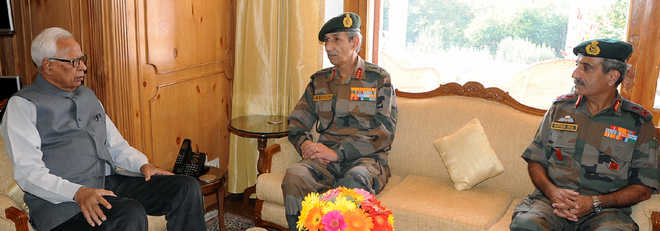
Northern Command chief Lt Gen DS Hooda and 15 Corps GOC Lt Gen SK Dua with Governor NN Vohra in Srinagar. Tribune photo

Tribune News Service

Srinagar, October 1

Lt Gen DS Hooda, Northern Command chief, accompanied by Lt Gen SK Dua, GOC, 15 Corps, met Governor NN Vohra here today.The Governor congratulated the Northern Command chief and all his officers and men concerned for their outstanding success in executing a crucial counter-terrorism operation across the Line of Control (LoC) in the “areas of responsibility” of the 15 and 16 Corps. The Governor particularly complimented Lt Gen Hooda for the brilliant efficiency with which he had planned and carried through this milestone initiative.Later, the Governor held a meeting with the Northern Command chief and the senior-most civil, police, Central Police, Army and Intelligence officers to discuss important issues relating to the obtaining external security situation and matters relating to effective internal security management.The meeting identified important issues which require urgent attention, especially the need for enhanced surveillance and the implementation of counter-terrorism operations in the hinterland.


Uri martyr cremated in Bihar

Uri martyr cremated in Bihar
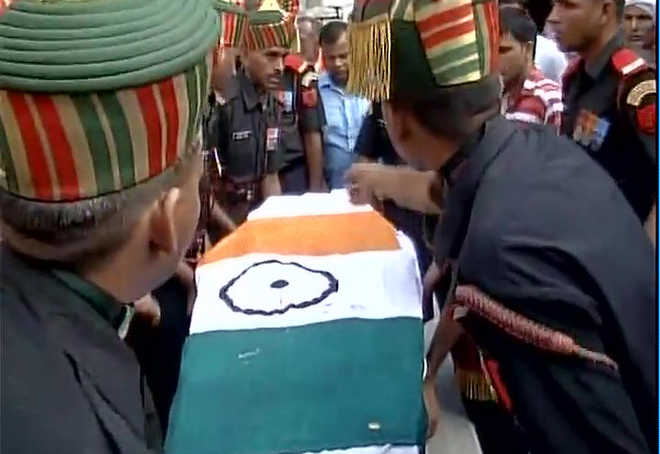
With his death, the toll in the attack rose to 19. ANI photo

Patna, October 1

Raj Kishore Singh, one of the soldiers injured in the September 18 Uri terror attack, was cremated on Saturday with full state honours in Bihar’s Bhojpur district, a police official said.Relatives and hundreds of people gathered at the soldier’s native village Piprapati to witness the last rites.“After his body was brought to Piprapati on Saturday morning, he was cremated,” a district police official said. His body was first brought to Patna from Delhi on Friday.Raj Kishore, 35, left behind his wife Kanchan Devi and two children, 12-year-old daughter, Sushani Kumari and 10-year-old son, Hemant Singh.He was the son of a farmer and the youngest of three brothers.Raj Kishore of the Bihar Regiment succumbed to his injuries on Friday at the Army Research and Referral Hospital in New Delhi, where he was undergoing treatment after being injured in the attack.With his death, the toll in the attack rose to 19.Bihar Chief Minister Nitish Kumar has announced a compensation of Rs 11 lakh to the family. — IANS


What are surgical strikes? How are they carried out?

Lt. Gen. Ranbir Singh, Director General of Military Operations, on Thursday said that the Indian Army conducted surgical strikes on seven terrorist launch pads across the Line of Control at around midnight on Wednesday, and destroyed five of them.

The army struck terrorist units that were ready to carry out attacks in Jammu and Kashmir and various other metros in India.

He said the surgical strikes had caused significant casualties to terrorists and those who were shielding them.

So how are surgical strikes carried out, who engages in these strikes and, more importantly, just what are these strikes?

What is a surgical strike?

A surgical strike is a swift, covert military attack designed to destroy specific targets. Such an assault results in damage only to the intended military target and does causes minimal or no collateral damage to surrounding structures, vehicles, buildings, or public infrastructure and utilities.

Total neutralisation of targets with surgical strikes also ensures the prevention of an assault being escalated to a full-blown war.

As a part of India’s Cold Start Doctrine, surgical strikes are a very effective way of foiling infiltration bids by terrorists across the Line of Control.

The details of the current strike have not been revealed to the public for obvious reasons.

Surgical strikes are a very potent weapon in India’s hand against a hostile nation that has time and again threatened to use nuclear weapons against Indian forces and people.

How is a surgical strike carried out?

Special operations forces or commando units, who are airdropped into the enemy territory, carry out surgical strikes. These elite forces then inflict maximum damage on the targets and are safely extracted from the conflict zone. Some special forces also carry out such strikes in a ground operation.

Air raids too can be a part of a precise surgical strike. The Indian Army, Indian Air Force and the Indian Navy all have special operations forces to carry out surgical strikes if required.

What are the major requirements before carrying out a surgical strike?

Accurate and credible intelligence is the most important element required while planning and executing a surgical strike. The military’s special operations units work very closely with the Intelligence Bureau, the Research & Analysis Wing, military intelligence services and deep assets that the country has within the enemy nation to get all the information related to the targets, etc.

Such Special Operations are very complex and are very carefully planned and coordinated.

India Army’s Parachute Regiments are highly trained para-commandos specially equipped to carry out such audacious strikes. The Indian Navy has marine commandos or MARCOS and the Indian Air Force has Garudas for asset protection and containment.

All about India’s surgical strike across LoC:

  • The surgical operation that Indian Army conducted covered eight locations up to two km across the LOC.
  • It started around 2.30 am (IST) on Thursday and continued till 8 am (IST) on Thursday.
  • The operation focused to ensure that terrorist do not succeed in infiltrating the nation or endangering the life of Indian citizens.
  • Lieutenant General Ranbir Singh said that the terrorists captured have confessed to their training and arming in Pakistan or territories under the control of Pakistan.
  • Lieutenant General Singh also claimed that the teams have found items, including GPS, with Pakistani markings.
  • Pakistan Prime Minister Nawaz Sharif has condemned the attacks and warned India that the country’s “desire for peace should not be interpreted as our weakness.” Pakistan calls the attacks cross-border firing.
  • Lieutenant General Singh said that abiding by the protocol, India had informed Pakistan about the attacks. A week-long surveillance by Indian Army confirmed that terrorists were stationed in the areas ready to infiltrate into India.
  • According to Pakistan Defence Minister Khawaja Asif, two Pakistani soldiers died and nine others were injured in the operation. (From Agencies & IBT)


India, China hold 1st high-level dialogue to combat terror

Beijing, September 27

India and China today discussed ways to enhance security and cooperation to combat terror as officials from the two sides exchanged information on policies and legislation to deal with terrorism at the first high-level dialogue where they reached “important consensus”.

(Follow The Tribune on Facebook; and Twitter @thetribunechd)

The two sides exchanged views on the international and regional security situation at the first meeting of the India-China High Level Dialogue on Counter-terrorism and Security held here.

The meeting was co-chaired by R N Ravi, Chairman of Joint Intelligence Committee and Wang Yongqing, Secretary General of Central Political and Legal Affairs Commission of China.

They exchanged information on respective policies, systems and legislation to deal with terrorism, and further enhance their understanding on issues of major concerns to both sides, according to a press release issued by the Indian embassy here.

“The two sides had in-depth discussions on enhancing cooperation in counter-terrorism and security and on measures to jointly deal with security threats and reached important consensus in this regard,” the release said without elaborating. —PTI


WHAT IS THE INDUS WATERS TREATY ABOUT?

Indian PM Jawaharlal Nehru with Pakistan President Ayub Khan in Karachi before signing the treaty in 1960

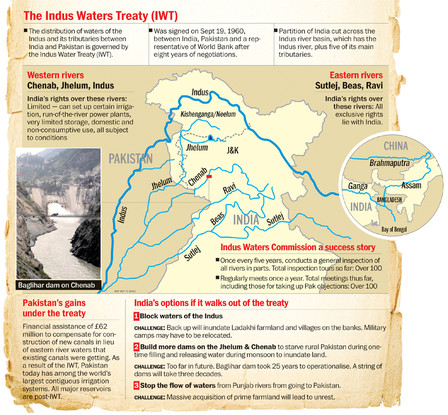
On September 19, 1960, Prime Minister Jawaharlal Nehru and Pakistan president Ayub Khan signed an agreement to share water of Beas, Ravi, Sutlej, Indus, Chenab and Jhelum. As Indus was the biggest of them, the treaty was named the ‘Indus Waters Treaty’. WHAT LED TO IT? After Partition, Pakistan and India locked horns over the share of water in the Indus Basin as its source remained in India. In the early years after Partition, an Inter-Dominion Accord of 1948 apportioned the share. Pakistan was keen on a permanent solution. As both sides could not compromise, the World Bank negotiated a deal between them.

WHAT ROLE DID THE WORLD BANK PLAY?

In 1954, the World Bank offered a proposal to the two nations under which India retains control over the three eastern tributaries while Pakistan controls the three rivers in the west. While India was eager to seal this deal, Pakistan turned hostile, even threatening to walk out. After deliberations, talks gained momentum again in 1954. The Bank also helped to fund the construction of canals for Pakistan.

Scrapping the treaty will not help

NEW DELHI: Four days after India hinted at abrogating the 1960 Indus Waters Treaty with Pakistan, a meeting of top officials chaired by Prime Minister Narendra Modi decided on greater internal use of three rivers — Indus, Chenab and Jhelum — that were allocated to Pakistan by the accord. The government also decided to review its position on the Tulbul/ Wular project on Chenab. After prolonged arbitration in international courts, India got a favourable ruling to build the reservoir but held back implementation to generate goodwill.

However, experts are not sure that the barrage would be a good idea. “The decision on the Tulbul/ Wular project on Chenab should be seen in seen in light of the 2014 floods in Kashmir. The main reason why so much flooding happenedin the city was the siltation in the Wular Lake. Now if a barrage comes up, it will increase the threat of floods in Srinagar. The government’s Monday decision should be technically evaluated,” Prof Shakil Ahmad Romshoo, professor and head, department of earth sciences, University of Kashmir, told HT.

“The government should pursue energy generation from the western rivers (Indus, the Jhelum and Chenab). This is because water utilisation for agriculture in Kashmir is not very high since the topography is undulating (irrigation is difficult) and farmers have moved to water-intensive paddy to rainfed horticulture,” he said.

Dr Medha Bisht, assistant professor, department of international relations, South Asia University, agrees with Prof Romshoo: “It is true that India has not used the capacity of the western river sand the government’s Monday decision to ma xi mi se usage should be seen as a long-term strategy”.

On India’s threat to scrap the treaty, Dr Bisht said the scrapping of the pact cannot be a “credible deterrent” due to several reasons.

First, India has no infrastructure to hold/divert the excess water. Probably what India can do is control the timing of the release of water. Either way — building infrastructure to hold excess water and controlling the timing — are long term strategies. Second, if India walks out of an institutional mechanism such as the Indus Treaty, the country will lose credibility in international community and have long-term consequences. Second, we must not forget that even though there is no treaty between China and India on Brahmaputra, China does have a long term strategic plan to divert the river Brahmaputra. Tampering with the Indus Waters Treaty will send a bad regional signal for upper riparians such as China and will aggravate fears of lower riparians such as Bangladesh.


Why Indus Waters Treaty is good to keep Sandeep Dikshit

Geography and present damming structures ensure India has limited ability to flood or choke water flow to Pakistan. Scrapping the treaty will needlessly pit India against the people of Pakistan by playing on an insecurity that has a deeper psychological effect than the threat of a war.

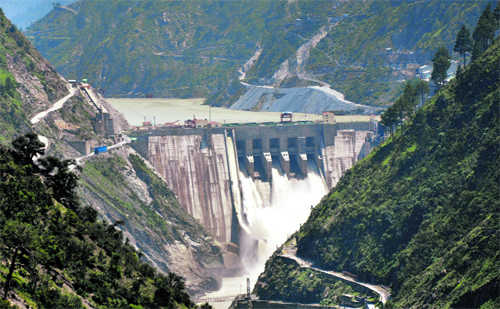
When Prime Minister Narendra Modi sat down for a Power Point presentation on the Indus Waters Treaty (IWT) on Monday, he must have seen two crucial slides on earlier Indian attempts to squeeze Pakistan’s jugular on water. Both came unstuck because of frenzied international mediation as well as the fear of self-damage to India’s reputation in the world.View full imageThe first incident took place shortly after Independence. Angered by Pakistan’s attempts to settle the Kashmir dispute by force, India had shut down sluices on canals carrying water into West Punjab. As the blocked water began backing up into Indian agricultural land and the world community started getting the jitters, the government was forced to backtrack. This episode played havoc on Pakistan’s sense of insecurity about river waters from India. A couple of years later, when the IWT was finalised, the neutral mediator made India cough up over Rs 15,000 crore (in today’s value) to help Pakistan build an independent canal network.The second incident happened barely six years back. India had at long last completed the Baglihar hydropower project over the Chenab. As is the case today, bilateral relations were going through a rough patch. The time chosen by India for one-time filling of the dam’s pondage coincided with the sowing season in Pakistan and low water flows in the river. Pakistan agriculture in a few districts was affected during the one month it took to fill Baglihar.Today, the options for punishing Pakistan through a water war essentially remain the same as they were half a century ago. But there is an added complication. In the absence of trust, India undergoes the same insecurities as Pakistan when it comes to sharing the river waters of the Brahmaputra with China in the east. If the Pakistani media periodically raises the bogey of water terrorism by India, the media at home is not far behind in raising a similar flag against China.But before this logic runs away with the ball, here is a reality check. Any Indian attempt to put a squeeze over water flowing to Pakistan suffers from two infirmities. First, there is no way to control the fast flowing waters of the Indus, at least in India. Unless, India builds dams and forces the India-friendly population of Ladakh to undergo the trauma of massive displacement. Not only will this move punish a region that has never associated itself with the unrest in Kashmir’s streets, Indian military camps located on the banks of the Indus will also have to be shifted. It is not without reason that Indian planners have never even toyed with the idea of setting up a hydel project on the Indus.Having scared Pakistan once by filling up Baglihar during a period of lean flow, India can be tempted to try this option again. It also has plans ready with a virtual procession of dams planned on the Jhelum and the Chenab with names like Sawalkot, Dul Hasti, Pakuldul, Gyspa and Bursar. If Baglihar is an example, Pakistan is bound to approach an international tribunal to contest India’s construction parameters – the height, pondage, etc – for each dam. The possibility of litigation slowing down the pace of work coupled with the extremely difficult terrain will mean it will take an enormous amount of the nation’s resources to build a single dam. The minimum period will be at least a decade. The Prime Minister cannot hope to scare Pakistan into submission with such a long range plan filled with several ifs. India has squeezed the maximum out of the three eastern rivers – the Beas, Ravi and the Satluj. Any effort to control the residual flow will mean a large-scale appropriation of prime agriculture. This strategy is unlikely to resonate well with the people of Punjab.Skeptics may ask if China may pay back India in the same coin to take the pressure off Pakistan? Theoretically, China can do so. In Pakistan, China is racing to complete a dam where the Jhelum and the Neelum (called the Kishanganga in India) converge. In case India build its dams and decides to release the water in one go to trouble Pakistan, the pondage (water storage of a hydel dam) of this Chinese project would absorb most of the excess flow. In China, the upper reaches of the Brahmaputra are now dotted with dams under construction. And India is copying the China/Pakistan’s Jhelum-Neelum hydel project strategy by building dams in Arunachal that are close to the border. So in the unlikely eventuality of China releasing copious amounts of water sometime in the distant future, the pondage in Indian dams should stop the overflow from inundating agricultural land.A closer examination shows the fears of both lower riparian states (India vis-à-vis Brahmaputra and Pakistan about the three Western Rivers) may be misplaced. This is because bulk of the catchment area of the Brahmaputra falls in India. A great scare was raised when China was constructing the Zangmu dam. Today, the dam is operational but no new element has been added in the India-China discourse on common rivers.The same is true for the Indus, the mightiest and most consequential of the common rivers to Pakistan’s agriculture. Over 70 per cent of its catchment area is in Pakistan and it increases after the Kabul river joins the Indus.Therefore, whether it is Brahmaputra or the IWT rivers, one-time filling of pondage may give rise to a temporary shortage, especially if it is done between December and July, when the flows are lean. This was tested while filling up Baglihar, but the impact was limited to a few Pakistani districts. To keep Pakistan in perpetual anxiety, several more dams will have to be built. But if Pakistan also readies a few dams on its side, as it is doing with the Neelum-Jhelum project, the excess water released by India will have no impact.The other option is to deny Pakistan water during the sowing season by undertaking the one-time filling of a dam around the same time. As Baglihar has shown, it is only a one-time tactic.Even China realises that it cannot blackmail India by water terrorism.However, India has more to fear from China’s tactics than Pakistan with respect to India. This is because the IWT has a large number of in-built confidence and trust building measures. These were the product of a neutral expert and India’s willingness to be generous in sharing the waters. But China has played hard ball with India (as well as other countries such as Kazakhstan and Vietnam) in parting with data on water flows of common rivers. Should India then play the same game of obfuscating exchange of data and building projects on the sly with Pakistan when it vigorously protests China trying the same trick with India?Idealists would want to widen the discourse and suggest that all countries sharing the waters of a common river should sit together and formulate plans to jointly develop the entire basin. The idea is altruistic and worthy of consideration. But it is impractical in a situation where states don’t want to share water with their neighbours. It would be too much to expect countries to indulge in a bit of give and take to settle their water disputes. This possibility can only happen if there are statesmen like former Brazil President Luis Inacio Lula da Silva. When Bolivia and Paraguay objected to a massive hydel project in Brazil on a common river, Lula was reported to have told his countrymen: “Look we are within our legal rights to be harsh with them. But these are poor countries and we have to show generosity to them.” With these words and the country behind him, Lula doubled the compensation to Paraguay and tripled it to Uruguay.The threat over choking off water to Pakistan is not just vacuous. It needlessly pits India against the people of Pakistan by playing on an insecurity that has a deeper psychological effect than the threat of a war. The IWT has never been a bone of contention between India and Pakistan. In the case of Baglihar and Tulbul (navigation project), both sides have shown the willingness to listen to a referee. It would be best to allow sleeping dogs lie than open up a time-tested settlement on an emotive issue like water.

sandeep4731@gmail.com

The good in IWT

  • Long-drawn negotiations led to closure on all possible issues.
  • Simple-to-implement formula: eastern rivers to India, most waters of western rivers to Pakistan.
  • Exchange of river flow data keeps away Pakistani fears and insecurities.
  • Neutral experts competently dispose of prickly disputes: Baglihar, Tulbul
  • Can be an example for India-China water-sharing pact for the Brahmaputra.

The bad

  • India appears too generous in letting Pakistan have most of the water in western rivers.
  • Constant Pak meddling despite clear non-consumptive rights to India on western rivers.
  • Pak raises the ante over poor flows in eastern rivers despite full rights to India.
  • Treaty unable to advance despite 56 years of existence – no joint monitoring or joint projects.
  • Pak unappreciative of India not asserting its upper riparian status.


Hand over all Scorpene data to DCNS: Aussie court to paper

Hand over all Scorpene data to DCNS: Aussie court to paper
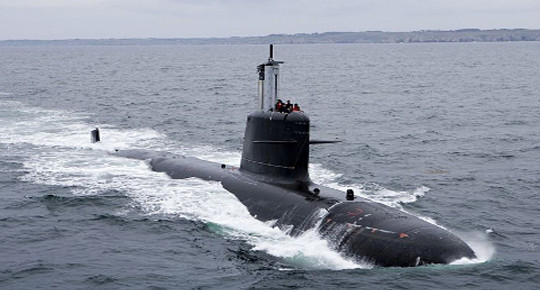
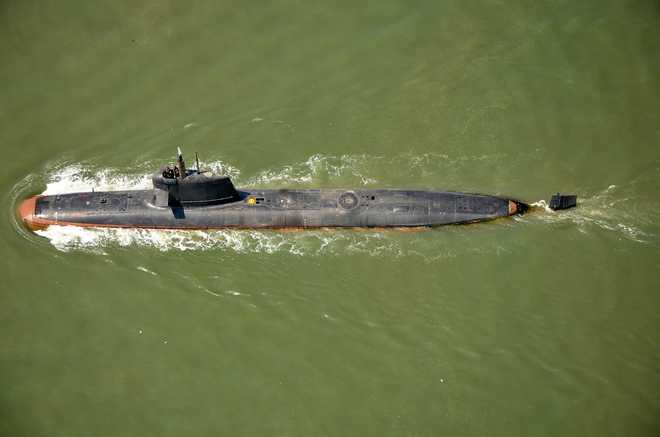
India”s Scorpene Class submarine INS Kalvari taking part in its maiden sea trials off the coast of Mumbai. — AFP file

New Delhi, September 1

An Australian court on Thursday confirmed its preliminary decision made earlier this week asking ‘The Australian’ newspaper to provide all leaked data of India’s Scorpene submarine to French shipbuilder DCNS and to stop publishing any more detail.The paper, which has already withdrawn after the first decision on Monday information published on its website, will provide DCNS with all the documents in its possession and is prohibited from publishing any additional document.”The Supreme Court of the State of New South Wales (Australia) confirmed today the preliminary decision it had rendered on Monday, August 29 against The Australian,” DCNS said in a statement.Underlining that confidentiality of information and communication is a matter of utmost importance, DCNS said it welcomes this decision of the court.In parallel to this action, DCNS filed a complaint against unknown persons for breach of trust, receiving the proceeds of an offence and aiding and abetting before the Paris Public Prosecutor, it added.Over 22,000 pages of top secret data on the capabilities of six highly-advanced submarines being built for the Indian Navy in Mumbai in collaboration with the French company, have been leaked. — PTI


All sound and fury Nawaz incites and instigates

NO one in India is surprised that Pakistan’s Prime Minister Nawaz Sharif should have made extensive references to Kashmir during his speech at the 71st session of the United Nations General Assembly on Wednesday. Expectedly, he accused India of unleashing “state terrorism” on the hapless Kashmiris and demanded plebiscite for them. He allowed himself to hail young terrorist leader Burhan Wani. Neither his belligerence  nor  his  distorted narrative has surprised anyone. Never mind Nawaz Sharif’s historical, geographical and diplomatic contradictions. But he is way off the mark about Kashmir. The dominant narrative in the streets of Kashmir is for “azadi”, which implies that no India, no Pakistan, but independence. He projected himself to be speaking for the people of Kashmir, but none of them has given him the power of attorney to speak or propose a Kashmir resolution on their behalf. “Azadi” is an anathema to Pakistan  because then it will have to vacate all territories of this Himalayan state under its illegal occupation. “Azadi” is an occasional dream for many Kashmiris, but it is a recurring nightmare for Pakistan. Nawaz was eloquent in his support for “peaceful” protests in the Kashmir Valley. He maintained a deafening silence as to how these peaceful protesters get stone and petrol bombs. And when he praised “young” Wani, he clearly painted himself in the terrorist corner. His each word on Kashmir was an unequivocal support for violence; and the speech was a long invitation and an incitement to unrest in Kashmir. Even his “Srinagar to Sopore” definition of the Valley was reflective of ill-information on the Valley’s geography, demography and history.Pakistan premier’s speech was all sound and fury, signifying nothing. The Pakistani leader’s lament that his country itself was a victim of terrorism would find very few takers; his government’s inability or unwillingness to clamp down on assorted  jehadi outfits is too well known and too well documented. His focus on Kashmir was meant to distract the emerging diplomatic consensus on declaring Pakistan a terror state. India should continue its diplomatic offensive to isolate Pakistan in every single international forum.


Indian-origin Major in UK returns honour in protest

Indian-origin Major in UK returns honour in protest
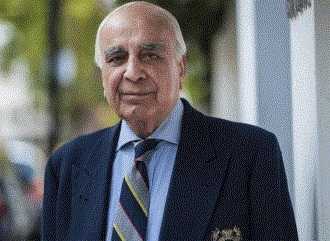
Major (Retd) Narindar Saroop has been protesting alleged misuse of honours system by former UK PM David Cameron

London, August 30

A former Indian-origin soldier-turned-politician in the UK has returned his Commander of the Most Excellent Order of the British Empire (CBE) to protest what he feels is the misuse of the honours system by former PM David Cameron.Major (Retd) Narindar Saroop, who was born in India and went on to serve in the British Indian Army before moving to the UK, was awarded the CBE in 1982 by Queen Elizabeth II on the recommendation of then Prime Minister Margaret Thatcher.(Follow The Tribune on Facebook; and Twitter @thetribunechd)The 87-year-old has the distinction of being the very first South Asian-origin Conservative party candidate to contest a general election back in 1979. However, the Tory party member and former London councillor now feels Cameron had shown “demeaning contempt” for the honours system by recommending less deserving people as part of his so-called resignation list, when he left Downing Street following Britain’s vote in favour of Brexit on June 23.“Cameron’s list, in my view, included a lot of people who were undeserving of what they were given. Prime Ministers like Harold Wilson and James Callaghan gave honours to their advisers, but many were very hard-working individuals. But in Cameron’s list, some of the names were only there a couple of years,” Saroop told a newspaper today. — PTI