Sanjha Morcha

What’s New

Click the heading to open detailed news

Current Events :

web counter

Print Media Reproduced Defence Related News

MILITARY LITERATURE FESTIVAL The salience of military history

War books are not only a prominent source for understanding the world’s conflicts — past, present and future — but also a useful base material for sociologists and political scientists to forecast future societal trajectories

The salience of military history
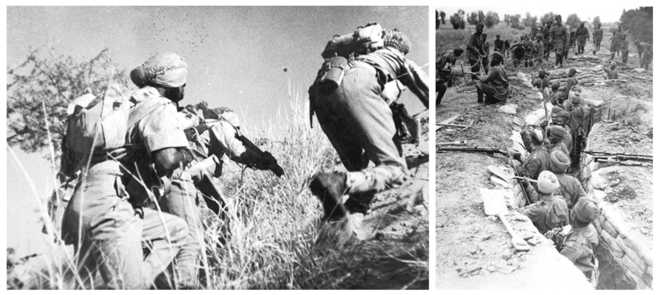
Wars we fought, but didn’t forget: (Left) Indian soldiers during the Battle of Longewala in the Western Sector during the 1971 War; in the trenches in World War I

Sandeep Dikshit

The written history of the world is largely a history of warfare — John KeeganHumans have always engaged in warfare. The earliest known evidence of intra-state conflict is a 3,500-year-old ivory knife handle that must have figured in one of the battles between the Egyptians and the Mesopotamians. Only 283 years since then have seen no recorded wars.The Westphalia concept of nation states in the West is also an outcome of a 30-year-long war in the seventeenth century.(Follow The Tribune on Facebook; and Twitter @thetribunechd)In the twentieth century, India’s impulses towards sovereignty and nationhood gathered steam after it contributed generously to the British effort in World War I. Among its neighbours, Russia became a Communist country after the same war while China turned one following wars between the Communists and the Nationalists, which were a result of the space provided by World War II. It may disappoint the creeping incursion theorists that 60 years later China’s borders have remained nearly the same. In fact, during its settlement with 12 countries, it actually gave away a lot of land it had claimed.This makes military history not only a prominent source for understanding the world’s conflicts — past, present and future — but also a useful base material for sociologists and political scientists to forecast future societal trajectories.It also gives a clue about the present militaristically aggressive behaviour of some nations such as the US, whose early leaders like Theodore Roosevelt and Abraham Lincoln were raised in the crucible of wars and actually led battles.From a tangible perspective, history’s usefulness is more difficult to identify than applied sciences such as medicine or engineering. However, there is no such confusion regarding military history. Cynics may point out the futility of researching centuries-old muscle-and brawn-dependent warfare in an era of armed drones, nuclear submarines and inter-continental missiles. But technology and military history need not be irreconcilable; neither is technology a Silver Bullet. Military history, at the end, is also about technological change and how well or badly military forces adapted themselves to the changes, especially in the kinetics of tactics and strategy; the preparedness in logistics and administration, finessing of military doctrine military and theory, the degree of military professionalism and the mental agility of its leadership.It is also about normative application of the lessons learnt from past wars even if a copy-paste approach will likely bring grief.Military history need not be about mega clashes of armour and men. It could also be about learning from previous anti-terrorism campaigns for instance and applying them in the present instances.There is a caveat though: for soldiers, a mastery over military history does not translate into professionalism and competence; it can add to, but, is not a substitute for practical experience. A simplistic and distorted understanding can have adverse implications as the Americans recently experienced twice: Military professionals had cited the blowback against the British and Soviets to argue against a military intervention in Afghanistan, but then National Security Advisor Condoleeza Rice had drawn a different conclusion: “The Soviets had never taken Kabul whereas the US will,” she said. The war is still on.It is true that military history alone is terribly inadequate in providing all the answers to all the issues confronting the politico-military policy makers of today. This is why an interdisciplinary approach is very important. At the same time, none can deny the lessons in capability of the political leadership, its synergy with the military brass and the military response and counter-response that come from studying past wars: the wars of 1962 and 1971 are studies in contrast while the 1965 battle would fall somewhere in between the two.In the end, every war ought to be a deliberate use of force to achieve political goals. In other words, in most cases, politicians flag off wars and the buck stops with them: win or lose. It is they who are answerable for a large number of critical components of a war: logistics infrastructure, expenditure on the military and the extent of indigenisation.The distilled lessons from military history thus become an integral part of a serving politician’s statecraft as also for tomorrow’s leaders, who are students today. For winning and avoiding wars, it becomes important to study military history in universities and schools as much as in military training institutes.


Valley shuts over Shopian civilian killings Authorities impose restrictions; attempts by Geelani, Mirwaiz to take out a march foiled

Valley shuts over Shopian civilian killings
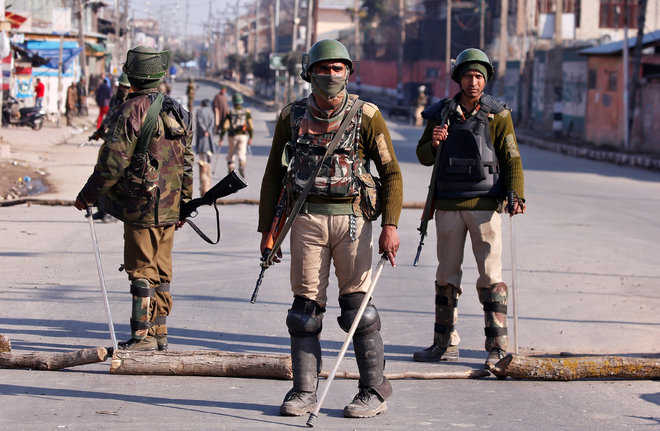
Security personnel stand guard on a road during a shutdown in Srinagar on Wednesday. REUTERS

Ishfaq Tantry

Tribune News Service

Srinagar, March 7

The authorities in Kashmir today foiled attempts by senior separatist leaders Syed Ali Geelani and Mirwaiz Umar Farooq to lead protest marches to Shopian by imposing restrictions in parts of Srinagar and south Kashmir areas.While Mirwaiz Umar Farooq was detained outside his Nigeen residence by a contingent of the police after he attempted to take out a protest march this morning, Syed Ali Geelani was not able to move beyond a point outside his residence this afternoon as the police had barricaded the area around his Hyderpora residence besides placing concertina wires in the alleys leading to his residence.Before being detained outside his residence, Mirwaiz told the media that the “killing of innocent civilians is unacceptable” while also holding the state government “directly responsible” for the killings. He said “till the time black laws like AFSPA are not revoked and forces are not made accountable, the blood of innocent Kashmiri will continue to be spilled”.A spokesman of the hardline Hurriyat said Geelani came out of his residence-cum-office at 12:15 pm, but the police and CRPF didn’t allow him to visit Shopian as the whole area had been barricaded.The joint resistance leadership (JRL) comprising Geelani, Mirwaiz Farooq and Yasin Malik had called for ‘Shopian Chalo’ march today to “express solidarity” with the families of the youth who were killed in Army firing in Shopian on March 4 evening.A majority of the shops and business establishments in Srinagar city and other major towns were closed while public transport on major city roads and inter-district highways also remained suspended today.Fearing law and order problem, the authorities as a “precautionary measure” had also suspended the railways services between Banihal and Baramulla today. The schools and colleges are already closed in the region after the government on Monday extended the winter vacation by three days as tension spiralled over the Shopian shootout in which six persons, including four civilians and two militants, were killed.


Schools to remain shut till March 9  Srinagar: The government has ordered closure of schools and degree colleges on March 8 and 9. The decision has been taken as a “precautionary measure to avoid law and order situation in Valley”. “The classwork will remain suspended on Thursday and Friday in all schools and colleges across Kashmir,” an official said. He said the classwork would resume on Saturday. “In south Kashmir, the classwork will resume from Monday,” the official said. TNSSeveral injured as clashes continueAnantnag: Several people were injured as clashes continued in Shopian district for the second consecutive day on Wednesday following the killing of two militants and four civilians in Army firing on Sunday evening. A complete shutdown was observed across south Kashmir for the third day on Wednesday as the separatist amalgam joint resistance leadership had called for a “Shopian chalo” march. Local sources said vehicles remained off road completely and commercial establishments were closed for the day. In Shopian, violent clashes between locals and security forces erupted at four places, including Bonne Bazar, Meemandar, mini secretariat area and Sofan Aman. Security forces used tearsmoke shells and pellet guns to disperse local stone-throwers. Sources said over a dozen people were injured in the clashes, which continued throughout the day. Protesting youth also assembled in Pahnoo  and threw stones at the nearby Army camp. Army personnel, however, chose not to respond. oc


POWs in Pakistan

Amritsar: On the anniversary of the 1971 India-Pakistan war, veteran BJP leader Laxmi Kanta Chawla has asked the Narendra Modi government to make public the exact number of Indian Prisoners of War (POWs) in Pakistan and reveal their identity. She said the Indian forces had won a historic battle by capturing about 1,00,000 soldiers of Pakistan in the 1971 war. The then Indian Government had released all those soldiers and sent them back to their native country.  She said all Indian leaders, including Prime Minister Narendra Modi and Defence Minister Nirmala Sitharaman, celebrated Vijay Divas with pride.  However, the country had failed to bring back the Indian POWs till date, she remarked. She called upon the government to make public the exact number of POWs in Pakistani jails. TNS

THE FORGOTTEN 54 –

As we celebrate the 45th anniversary of a landmark event in modern history,  there are 54 families for whom the war and the waiting never ended. The agonizing wait goes on to this day. These are the families of the 54 Indian prisoners of war (PoW) who were never released by Pakistan after the war. Their names are as follows:
Indian Army
1.       Major SPS Waraich IC-12712 15 Punjab
2.       Major Kanwaljit Singh Sandhu IC-14590 15 Punjab
3.       2/Lt Sudhir Mohan Sabharwal SS-23957 87 Lt Regiment
4.       Capt Ravinder Kaura SS-20095 39 Med Regiment
5.       Capt Giri Raj Singh IC-23283 5 Assam
6.       Capt Om Prakash Dalal SS-22536 Grenadiers
7.       Maj AK Ghosh IC-18790 15 Rajput
8.       Maj AK Suri SS-19807 5 Assam
9.       Capt Kalyan Singh Rathod IC-28148 5 Assam
10.   Major Jaskiran Singh Malik IC-14457 8 Raj. Rifles
11.   Major SC Guleri IC-20230 9 Jat
12.   Lt Vijay Kumar Azad IC-58589 1/9 G R
13.   Capt Kamal Bakshi IC-19294 5 Sikh
14.   2/ Lt Paras Ram Sharma SS-22490 5/8 G R
15.   Capt Vashisht Nath
16.   L/Hv. Krishna Lal Sharma 13719585 1 JAK RIF
17.   Subedar Assa Singh JC-41339 5 Sikh
18.   Subedar Kalidas JC-59 8 JAKLI
19.   L/Nk Jagdish Raj 9208735 Mahar Regiment
20.   L/Nk Hazoora Singh 682211303
21.   Gunner Sujan Singh 1146819 14 Fd Regiment
22.   Sepoy Daler Singh 2461830 15 Punjab
23.   Gnr Pal Singh 1239603 181 Lt Regiment
24.   Sepoy Jagir Singh 2459087 16 Punjab
25.   Gnr Madan Mohan 1157419 94 Mountain Regiment
26.   Gnr Gyan Chand Gnr Shyam Singh
27.   L/Nk Balbir Singh S B S Chauhan
28.   Capt DS Jamwal 81 Field Regiment
29.   Capt Washisht Nath Attock
Indian Air Force
 30.   Sq Ldr Mohinder Kumar Jain 5327-F(P) 27 Sqn
31.   Flt Lt Sudhir Kumar Goswami 8956-F(P) 5 Sqn
32.   Flying Officer Sudhir Tyagi 10871-F(P) 27 Sqn
33.   Flt Lt Vijay Vasant Tambay 7662 –F(P) 32 Sqn
34.   Flt Lt Nagaswami Shanker 9773-F(P) 32 Sqn
35.   Flt Lt Ram Metharam Advani 7812-F(P) JBCU
36.   Flt Lt Manohar Purohit 10249(N) 5 Sqn
37.   Flt Lt Tanmaya Singh Dandoss 8160-F(P) 26 Sqn
38.   Wg Cdr Hersern Singh Gill 4657-F(P) 47 Sqn
39.   Flt Lt Babul Guha 5105-F(P)
40.   Flt Lt Suresh Chander Sandal 8659-F(P) 35 Sqn
41.   Sqn. Ldr. Jal Manikshaw Mistry 5006-F(P)
42.   Flt Lt Harvinder Singh 9441-F(P) 222 Sqn
43.   Sqn Ldr Jatinder Das Kumar 4896-F(P) 3 Sqn
44.   Flt Lt LM Sassoon 7419-F(P) JBCU
45.   Flt Lt Kushalpal Singh Nanda 7819-F(N) 35 Sqn
46.   Flg Offr. Krishan L Malkani 10576-F(P) 27 Sqn
47.   Flt Lt Ashok Balwant Dhavale 9030-F(P) 1 Sqn
48.   Flt Lt Shrikant C Mahajan 10239-F(P) 5 Sqn
49.   Flt Lt Gurdev Singh Rai 9015-F(P) 27 Sqn
50.   Flt Lt Ramesh G Kadam 8404-F(P) TACDE
51.   Flg Offr. KP Murlidharan 10575-F(P) 20 Sqn
52.   Sqn Ldr Devaprasad Chatterjee
53.   Plt Offr Tejinder Singh Sethi
 Indian Navy
54.   Lt. Cdr Ashok Roy
Every single name that you read here is a soldier who fought for India. They were captured in action and spent the rest of their lives rotting in Pakistani jails. Can you imagine the type of mental agony that they must have undergone there? They must have lived in hope that one day they will be released and slowly the hope faded away. It has been 45 years. How many of them will be alive and in what condition? What kind of miserable existence they must have endured over there? What kind of physical and mental torture they must have endured there?
Imagine a loved one from your family in that position. What do you feel? Multiply that feeling a thousand times over. That is what these 54 families have felt every day for the last 45 years.

The evidence

There is ample evidence for the existence of these 54 prisoners in the Pakistani jails. Consider some of the evidence:-
·         Then on December 26, 1974, R.S. Suri received a hand-written note dated December 7, 1974 from his son. The letter contained a slip in which his son had written, “I am okay here.” The covering note read, “Sahib, valaikumsalam, I cannot meet you in person. Your son is alive and he is in Pakistan. I could only bring his slip, which I am sending you. Now going back to Pak.” Signed M. Abdul Hamid. In August, 1975, he received another missive postmark dated ‘June 14/15/16, 1975, Karachi.’ The letter said, “Dear Daddy, Ashok touches thy feet to get your benediction. I am quite ok here. Please try to contact the Indian Army or Government of India about us. We are 20 officers here. Don’t worry about me. Pay my regards to everybody at home, specially to mummy, grandfather – Indian government can contact Pakistan government for our freedom.” The then Defence Secretary had the handwriting confirmed as Ashok’s and changed the official statement from “killed in action” to “missing in action”!
·         Maj AK Ghosh’s photograph was published in Time Magazine dated 27-12-1971 The photograph is proof that Maj AK Ghosh was in Pakistani custody when the war ended on 17 December 1971. He did not return with the POWs in 1972 at the time of the Simla agreement. He may have died in the interim period in a Pakistani jail. Surely there must be some record of that. The Indian and Pakistan governments can work together to find out what happened to such men. Why were some names not included in the POW list is again a moot point.
·         Mohanlal Bhaskar repatriated on 09.12.1974 writes “Main Bharat ka jasoos tha” or “ I spied for India” Mohanlal Bhaskar, who was in a jail between 1968 and 1974 and repatriated on 09.12.1974 wrote a book in Hindi ( I was a spy for India) and gave a signed affidavit stating that he met a Col Asif Shafi of Second Punjab regt of Pakistan and a Maj Ayaaz Ahmed Sipra in Fort of Attock imprisoned for conspiring against Bhutto in the infamous “Attock conspiracy” . The Pakistani Major Ayaaz Ahmed Sipra spoke of his befriending a Gill of the Indian Air Force and a Captain Singh of the Indian Army as well as mentioning that there were around 40 Pows of the 1965 and 1971 wars in that jail who had no chances of release
·         In the Attock Conspiracy, several officers of Pakistan’s army and air force were arrested on March 30, 1973, on charges of conspiring to overthrow the government of Zulfiqar Ali Bhutto. The detainees included Major Farooq Adam, Major Nadir Pervez (who later became a federal minister in the Nawaz Sharif government), Brigadier Wajid Ali Shah, Colonel Hamdani, and Major Ayaz Sipra, and a total of 59 officers were declared conspirators. The case is well known as the Attock conspiracy. Fifteen army and four air-force officers were found guilty of conspiracy and were handed jail terms ranging from three months to life. In this conspiracy, 15 officers were sentenced to terms in prison – among them Maj Ayaaz Ahmed Sipra and Col Asif Shafi. Others such as Farooq Adam (a Gallian, i.e. from Lawrence school, Ghoraghali) were also sentenced in the Attock conspiracy. Ayaaz Ahmed and Shafi later apparently moved to the US where Shafi was again traced by Manish Jain (son in law of Sqn Ldr Jain, another Indian officer missing and believed to be in Pakistani jails since the 1971 war) and Shafi confirmed to Jain unofficially that he had met Wg Cdr Gill in Attock in 2000 in a telephonic conversation.
·         A Pakistani General, General Riaz, Governor NWFP who subsequently died in an accident informed Mr Ashwini Kumar, then IG of the Border Security Force as a personal favour to him at the Munich Olympics in 1972 that Major Waraich was being held in Dargai jail, NWFP.
·         In her biography of Benazir Bhutto, British historian Victoria Schoffield reported that a Pakistani lawyer had been told that Kot Lakhpat prison in Lahore was housing Indian prisoners of war from the 1971 war. They could be heard screaming from behind a wall, according to an eyewitness within the prison.
·         Pakistani media outlets have also alluded to the men’s existence. The shooting down of Wing Commander Heresen Gill’s Mig 21 on 3 December 1971 was followed that day by a radio broadcast in which military spokesperson claimed that an ‘ace Indian pilot’ had been captured.
·         An American general Chuck Yeager also claimed in his autobiography that during the 1971 war, he personally interviewed Indian pilots captured by Pakistan. The airmen were of particular inertest to Americans because at the height of the cold war the men had attended training in Russia and were flying Russian designed and manufactured aircraft.
·         The families also claimed that on the two occasions when they were allowed to visit the Pakistani jails, the jail guards privately attested to the men being alive – before being ushered away by the prison authorities.
Why?
The question is – Why were these men not released by Pakistan? Was it because Pakistan wanted to extract some sort of revenge for the loss in the 1971 war? Was it because these men had come to know of some secrets that Pakistan did not want the world to know? Did Pakistan want to use them as a bargaining chip of some sort for the future?
Maybe it is all of the above reasons. But the biggest reason is that India forgot them. These men are the forgotten 54 of India. The ruling elite and the bureaucracy of the nation did not find it fit or suitable to keep these men and their release on their agenda. It was because this was not an issue strong enough to dictate the political, professional or financial fate of any politician or bureaucrat. Nobody in the decision making echelons had time for them.
Who is responsible?
What sort a nation are we that forgets it’s soldiers after the war is over? Was it not the collective responsibility of the nation to pressurize the governments to take this issue more seriously? After all, these PoW are somebody’s sons, brothers, husbands and fathers. Every nation and society is morally obliged to ensure that those fighting for it’s independence are looked after well in their hour of need. There can be no need more urgent than being released from the inhuman captivity of an enemy like Pakistan.
After the war the ruling class and he elite got busy trying to ‘improve relations’, they very conveniently swept this issue under the carpet. Over the years the self appointed elite that has dictated the agenda of the nation has all but deleted this issue from the collective consciousness of the nation. We are too busy trying to prove that ‘art has no borders’ ‘sports has no borders’ and such nonsense that will never find any reciprocity from across the border. To uphold such thrash, issues like the prisoners of war had to be forgotten and they were forgotten.
The military top brass too should have followed up more aggressively on this issue with the government. They were and are in a position to exert pressure on the government for this. Agreed, there were other pressing issues but this issue too is equally pressing and urgent.
All in all, the entire nation is responsible for this and this is an unforgivable fault. Nothing can be done for these 54 now except making Pakistan acknowledge that such a thing has happened. But we can and must ensure that such a thing never happens again.
Please do this
Share this as much as you can till the entire nation knows about it. Share it till the 54 are no longer forgotten. It’s probably already too late.


Major not named in FIR, SC stays probe for now

Major not named in FIR, SC stays probe for now
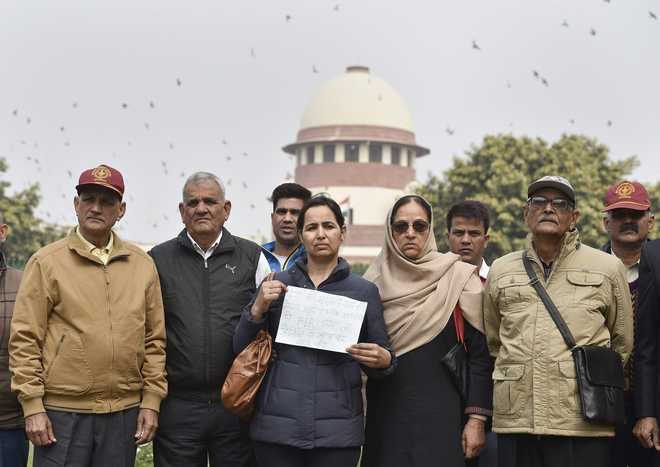
Ex-servicemen stand in support of Major Aditya Kumar at Supreme Court. File photo

Satya Prakash

Tribune News Service

New Delhi, March 5

In a dramatic turn of events, the Jammu and Kashmir Government on Monday told the Supreme Court that Major Aditya Kumar was not named in the FIR in connection with the Shopian firing on January 27 in which three civilians were killed.During hearing of a petition filed by Major Kumar’s father Lt Col Karamveer Singh seeking quashing of the FIR, senior counsel Shekhar Naphade told a Bench headed by Chief Justice of India Dipak Misra that the column in the FIR meant for mentioning the names of  “accused”  was blank.(Follow The Tribune on Facebook; and Twitter @thetribunechd)Naphade’s statement came after the CJI sought to know the allegations against the officer.  “He is an Army officer and not an ordinary criminal,” the Bench, also comprising Justice AM Khanwilkar and Justice DY Chandrachud, observed.The Bench, which had on February 12 stayed criminal proceedings against the Major, fixed April 24 to finally dispose of the matter. It said the investigation shall remain stayed till the next date of hearing. On behalf of the Centre, Attorney General KK Venugopal supported the petitioner and criticised the state for registering a criminal case against a serving Army officer without sanction from the Centre. Naphade opposed the stay on investigation, saying: “Nobody has the licence to kill… Let the probe continue. The court has already protected the officer by saying that no coercive steps shall be taken against the officer.”“Everyday soldiers are being killed. Mobs gather outside police stations to pelt stones. Do they have a licence?” the Attorney General countered. He quoted Section 7 of Armed Forces Special Powers Act, 1990, under which no prosecution can be launched against a serving Army officer without prior permission from the Centre. However, Naphade said the Centre’s permission was not required to file an FIR and it would be required only at the time of filing of charge-sheet.  Three civilians were killed on January 27 when the Army fired at a stone-pelting mob in Shopian village.





Understanding Pervez Musharraf’s newfound love for India’s most wanted Hafiz Saeed by LT GEN SYED ATA HASNAIN (RETD)

Former Pakistani president, Pervez Musharraf

General Pervez Musharraf has expressed fondness for the Lashkar-e-Taiba, and said he was the ‘biggest supporter’ of the group and its founder Hafiz Saeed.

Strategic circles in India and perhaps around the world appear to have been shocked by a recent interview given by former Pakistan President General Pervez Musharraf. He said that there was much mutual fondness between him and the Lashkar-e-Taiba (LeT), the internationally-branded terrorist organisation based in Pakistan.

General Musharraf went on to say that he was the “biggest supporter” of the LeT and its founder, Hafiz Saeed, and asserted that he backs the terror group’s role in “suppressing” the Indian Army in Kashmir. That a former President of Pakistan is admitting to this, and the fact he exploited the LeT to contest the Army of a neighboring country, is tantamount to a full admission of state-sponsored terror by Pakistan in J&K. Not that this needed any confirmation; it’s the timing that is interesting, as is the personality stating this.

There was a time, between 2003 and 2007, when India was negotiating with Musharraf, perceiving a change of heart in Pakistan. Backroom channels were abuzz for over four years after he declared a unilateral ceasefire along the LoC in November 2003. There was even talk of a mutual withdrawal from the Siachen Glacier, which mercifully was never accepted by the Indian Army brass. All this was on the basis of what appeared as a transformed General Musharraf looking for true peace, under the shadow of India’s outstanding leader, then-Prime Minister Atal Bihari Vajpayee.

What gives? Why is Musharraf cozying up to Hafiz Saeed now? The answer lies in the wide open spaces in Pakistan’s political scenario, where the Pakistan People’s Party (PPP) remains a shadow of its past, the Pakistan Muslim League (Nawaz)  is in serious internal disruption mode after the ouster of Nawaz Sharif as Prime Minister, and Imran Khan’s Pakistan Tehreek-e-Insaf (PTI) hardly has the capability to go it alone.

This tempted Hafiz Saeed to launch his own political party, the Milli Muslim League (MML), to politically mainstream his rogue terrorist organisation, the Jamaat-ud-Dawa (JuD). The Pakistan Election Commission has yet to officially register the MML, but Yaqoob Sheikh and Liaqat Ali Khan of the MML contested by-elections in NA-120 (Lahore) and NA-4 (Peshawar) respectively as independent candidates; in fact, Yaqoob Sheikh even secured 5,822 votes.

A new organisation, Tehreek Labaik Ya Rasool Allah, which recently swamped the capital Islamabad demanding death sentences for PML-N ministers and the complete dismissal of parliament, has led the latest emergence of ideologically radical parties that have simultaneously surfaced in recent months. The waning political weight of centrist parties is going to be a major challenge going forward.

Musharraf is looking at this challenge as an opportunity. There have been reports of him attempting to patch together a combine of 23 parties of different hues, including the Muttahida Qaumi Movement (MQM) and the Pak Sarzameen Party. He has called this conglomerate ‘Pakistan Awami Ittehad’, but there can be no certainty that partners here will flock together when it comes to the elections next year. Besides, these are strange bedfellows, and the inclusion of parties such as MQM is a shot in the dark. With nothing having crystallised, Musharraf is seizing the moment of Hafiz Saeed’s release from detention in the fond hope that MML will probably fall in line to join his combine.

At the age of 74, Musharraf’s ambitions, the taste of power (with his background of having led Pakistan for over nine years, 1999-2008) and the relatively open space in Pakistan’s political labyrinth are all creating new complexities. It is hard to say which direction all this will take Pakistan in, even as the nation wrestles with issues concerning extremist violence on its streets.

While all this is pre-election machinations, Musharraf’s admission of employing and backing the LeT to fight the Indian Army appears to be opening potential links for future alliance. Does this have the backing of the Pakistani Army? It is quite certain that an admission by its former chief and President of Pakistan of supporting an Islamist organisation to achieve Pakistan’s strategic ambitions is not causing any embarrassment to it.

The Pakistani Army is a past master in handling this through its policy of denial and deft information handling. With supposedly moderate elements, former leaders, political opportunists and the army all in the fray for exploiting political Islam, how the cookie crumbles in Pakistan is anybody’s guess.


289 killed in border firing in two years

289 killed in border firing in two years
As many as 126 persons were killed and 332 injured in 2017 in militancy-related incidents. File Photo

Vikram Sharma

Tribune News Service

Jammu, February 9

As many as 289 civilians, security forces and police personnel have been killed in state due to militancy/law and order and border firing incidents from 2015-17, besides 110 civilians and two police personnel were killed in 4,376 incidents of stone-throwing in the Valley in the same period.This was stated by Minister-in-Charge, Home, in a written reply to a question by Congress MLC Naresh Gupta who sought figures of civilians, security forces and police persons killed/injured in militancy, border firing and law and order incidents.Gupta said a total number of 61 persons were killed and 173 injured in 2015, 102 killed and 285 injured in 2016 and 126 killed and 332 injured in 2017 in militancy related incidents in the past three years.Regarding killings and injuries to security force personnel and civilians due to border firing, the minister-in-charge said 56 security forces personnel and 41 civilians were killed in 834 ceasefire violations in the past three years, while a total number of 383 persons were injured during the period.Detailing about civilians, police and security forces killed and injured in the state due to law and order incidents, Gupta said a total 4,376 incidents of stone-throwing were recorded in the past three years, out of which 2,808 were recorded in 2016. A maximum number of civilian deaths, 86, were recorded, besides two police personnel killed in the same year. However, no security force personnel were killed in these three years.The highest number of injuries to 1,459 security forces personnel and 7,776 police personnel was also recorded in 2016. The security forces personnel injured in these three years are 1,896, while 9,600 police personnel were injured in 2015-17. However the details with regard to civilians injured during 2015-17 are being compiled /reconciled in consultation with the Health and Medical Education Department.Replying to a query about the measures being taken for the security and safety of people, the Minister-in-charge said as per the Standard Operating Procedures (SOPs), all safety measures were in place.“The security grid has been sufficiently strengthened, steps are being taken to check activities of anti-national elements,” he replied.


CSIO develops indigenous avionics test rigs for IAF

CSIO develops indigenous avionics test rigs for IAF
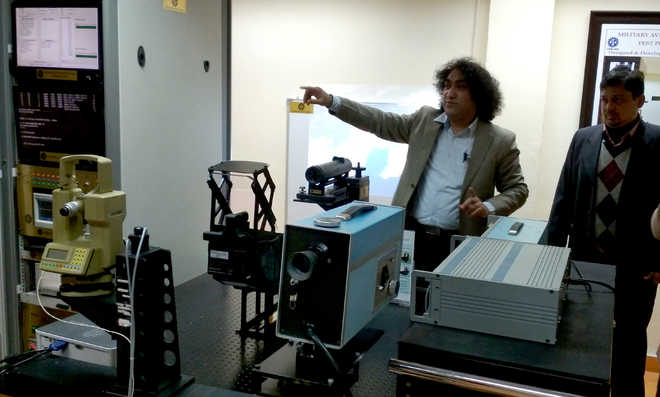
High-tech: Scientists demonstrate the use of the test platform at the CSIO in Chandigarh on Saturday. Tribune photo

Tribune News Service

Chandigarh, December 16

All fighter squadrons of the Indian Air Force as well as the Navy will have indigenous test rigs for the calibration and post-flight analytics of head-up display (HUD) units installed in the cockpit of combat aircraft. This will reduce the costs significantly and save the time involved in getting the same work done from foreign vendors.The technology for the test rig, christened Military Aviation Head-Up Display Test Platform (MAHTP), has been developed by the Central Scientific Instruments Organisation (CSIO) here. It was transferred today to defence public sector undertaking Bharat Electronics Limited (BEL) for its commercial production at its Panchkula unit.The system has been certified by the DRDO’s Regional Centre for Military Airworthiness, Chandigarh, and will also be installed at repair and overhaul depots as well as aircraft manufacturing centres. The comprehensive aviation test platform provides visual inspection, system health monitoring, automated testing, fault debugging and repair and maintenance besides calibration and semi-automated evaluation of optical parameters like parallax error, binocular disparity, photometric characteristics, field of view and camera focus.According to CSIO scientists, each operational fighter squadron would require one set of MAHTP and Bore Sighting System (BSS), also developed by CSIO earlier. The estimated foreign exchange saving is about Rs 50 crore per aircraft. The production of these two systems will also provide revenue generating opportunities to smaller industries.


Will continue giving befitting reply: Army vice chief on ceasefire violation by Pak

Will continue giving befitting reply: Army vice chief on ceasefire violation by Pak
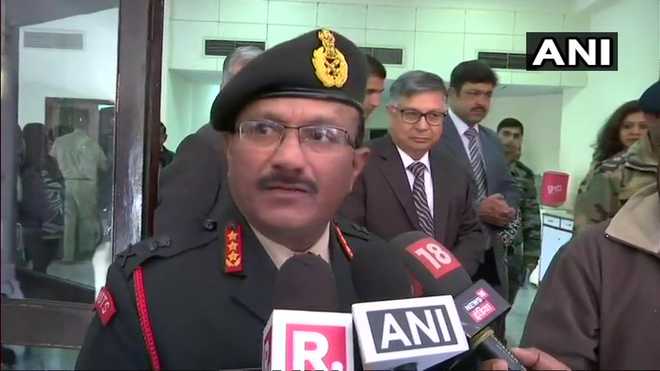
Army Vice Chief Sarath Chand,. ANI

New Delhi, February 5

India will continue to give a “befitting reply” and its action will speak for itself, the Army’s vice chief said on Monday, a day after four of its personnel were killed in heavy shelling by Pakistan along the LoC in Jammu and Kashmir.

Follow The Tribune on Facebook; and Twitter @thetribunechd)

The Pakistani Army has been supporting infiltration by terrorists along the border, Army Vice Chief Sarath Chand said.

“We will continue with our process of giving a befitting reply,” he told reporters.“(Our) action will speak for itself,” Chand added in response to a question on yesterday’s incident.

Four Army personnel, including a 22-year-old captain, were killed yesterday in the Pakistani shelling along the Line of Control in Poonch and Rajouri districts. PTI


Manali-Keylong highway shut due to harsh weather

Manali-Keylong highway shut due to harsh weather

Bhanu P Lohumi

Tribune News Service

Shimla, November 26

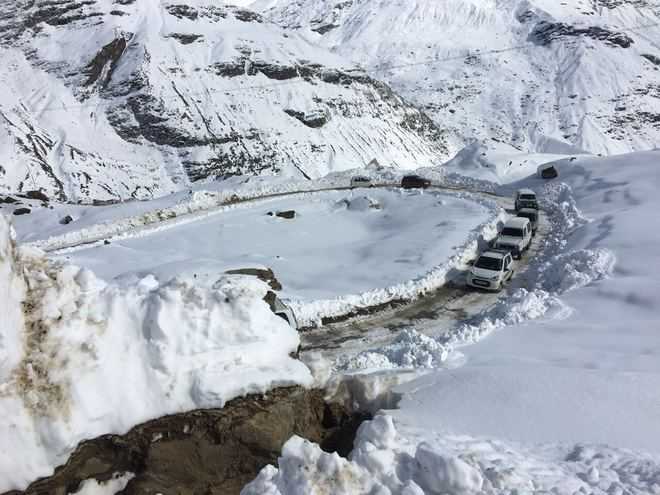
The Manali-Keylong National Highway has been closed to traffic due to inclement weather. The Border Roads Organisation (BRO) has told the state administration that it would not open the Rohtang Pass in the event of fresh snowfall.The Rohtang Pass was closed twice during November due to snowfall. It was cleared by the BRO to enable the stranded vehicles and the people to reach their destination, but now the BRO will open it only after the winter is over. The road was opened for a day today to enable tribals to return to Lahaul from Kullu.Despite the weather being dry, the mercury stayed 10 to 15 degrees Celsius below the freezing point in the high-altitude tribal areas and mountain passes, resulting in the freezing of water and making driving hazardous.Residents of Lahaul-Spiti are annoyed over the closure of the Rohtang Pass. They said barring a few spots like Rahni Nullah and Byas Nullah, there was no risk and the Pass could remain open until the place witnessed heavy snowfall.Kundan Lal Sharma, a resident of Keylong, said SUVs were made for bad roads and harsh weather and that these should be allowed to ply in the area.Sources said the district administration and the BRO were busy passing the buck, while the Lahaul-Spiti district administration maintained that the road was closed after heavy machinery was removed from Rohtang. The BRO stated that in case, the administration decided to allow vehicles to pass Rohtang, they would help.Meanwhile, the minimum temperature has slightly increased in the tribal areas. Keylong was the coldest minus 2.9 degree Celsius followed by Kalpa 0.4 degree Celsius, Manali 1 degree Celsius, Bhuntar 2 degree Celsius, Shimla 7.1 degree Celsius and Dharamsala 7.2 degree Celsius. The Met office has predicted rain and thunderstorm in the mid hills and rain and snow in the higher hills on November 28.


Closure of Rohtang Pass annoys tribals 

  • The Rohtang Pass was closed twice during November due to snowfall. It was cleared by the BRO to enable the stranded people to reach their destination.
  • Now, it will be opened only after the winter is over.
  • The road was opened for a day on Sunday to enable tribals to return to Lahaul from Kullu.
  • Residents of Lahaul-Spiti are annoyed over the closure of the Rohtang Pass.
  • They said barring a few spots like Rahni Nullah and Byas Nullah, all other roads were fine and that the Pass could remain open until the place witnessed heavy snowfall.


Lesson in humility from MIAF himself by Wg cdr DP Sabharwal (retd)

Lesson in humility from MIAF himself

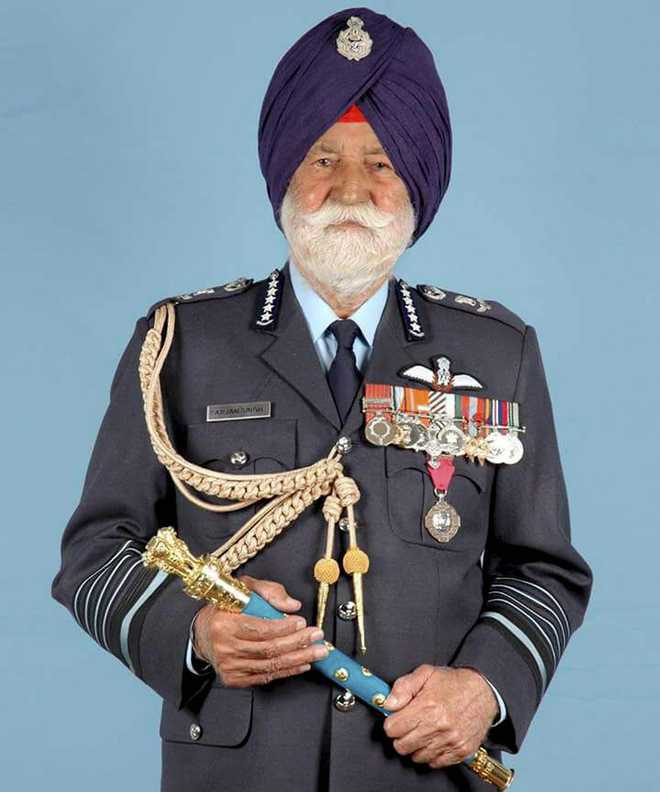
Wg cdr DP Sabharwal (retd)      THERE was a call for you from Delhi,’ said my wife as I entered home. When I enquired who it was, she said she would recollect and let me know later. I did not say anything since dementia was setting in her.‘It was some Arjan Singh,’ she said casually, while clearing the table after lunch. ‘Oh my God!’ was my instant reaction as I rushed to the telephone to retrieve the number from the recording machine. I waited for some hours and called him up in the evening. He was on the line and after the greetings, said: ‘Wing Commander, may I have your permission to change the draft foreword of your book?’ I literally froze. Stumped by his modesty, I managed to mumble: ‘Yes, Sir, my pleasure.’ The few words that, as per military training, should have come out instantly and boldly.He rewrote the foreword: ‘My association with aviation started in 1938 when I joined the Indian Air Force but my curiosity about flying started much earlier when I was a schoolboy and used to see aircraft flying over my village. During my flying training, I flew all fabric and wood aircraft with an uncovered piston engine. In fact, one could see the plugs sparking right in front of you.’ In the covering letter he wrote: ‘You may delete or modify any portion you think does not harmonise with what is given in the book.’ A copybook case of modesty at its best!When I went to present him a copy of the book, 100 years of Aviation, in 2003, he received me, and as I bent down to touch his feet, he appeared to step back a little, but hugged me warmly, and said: ‘I appreciate that you give preference to what you learnt from your parents than what the Air Force would have taught you.’During the next half an hour, over a cup of tea, he enquired about my family and the work I was doing post-retirement. He then went down memory lane to relive the years he had spent in, what he described as,  the glorious Air Force. When I presented him my copy of the book and a pen with a request to sign, he got up, walked to his study table, got a nib-pen, and while writing said: ‘Books should be autographed with ink-pen.’ ‘Yes, Sir’is all that I said. I did not have the courage, or the audacity, to tell him that I was offering him an ink-pen.Before taking his leave, I requested him to allow me to touch his feet again. With a smile, he said: ‘Laylo khushi.’ He then placed his hand on my head and said: ‘Waheguru bless you.’He insisted on seeing me off, saying that guests were to be sent off properly. Out of the porch, he came on to the road where the car was parked. He stood erect while I sat down; the driver started the car. Looking back, I saw him moving only when the car was taking the turn out of the lane. It was then I saluted the Marshal of the Indian Air Force (MIAF), who, without saying much, had taught me an important lesson in decency, humility and graciousness.