An Indian Air Force Wing Commander, who was posted along the western front, has been arrested on the charges of sharing sensitive military Defence information with a Pakistani woman.
The IAF official and the woman had allegedly been in touch on social media.
An IAF spokesperson in New Delhi said: “The officer was under active surveillance and was handed over to the suitable law enforcement agencies.”
Sources said the officer was not posted in the national capital but was posted in the field air base of the Western Air Command that is headquartered in New Delhi. The western command has a vast area of responsibility, including air bases in Punjab, Haryana, Jammu and Kashmir, Western Uttar Pradesh and north-western parts of Rajasthan.
The sources said the IAF Intelligence unit had noticed unusual activity and had proactively placed the Wing Commander under surveillance.
Due to these proactive measures, he was caught, official sources told the Tribune.
The IAF had handed the officer to the Special Cell of the Delhi Police more than two months ago on May 31 and was booked under the Official Secrets Act. After the arrest, he was first questioned in police custody, and later was sent to judicial custody. The Wing Commander is currently lodged in Tihar Jail and it is suspected to be a case of ‘honey trapping’.
It was being ascertained if the Pakistani woman, who ‘honey- trapped’ the Wing Commander, was in touch with anyone else from the IAF.
The Wing Commander reportedly had begun chatting with a woman on social media while going through a “tough phase” in his personal life. The conversations had gradually turned into regular video calls, and that was when the IAF unit picked up the trail.
The woman first gained his trust and then began asking for information related to military activities. The officer is alleged to have shared details about the movement and deployment of military units with the woman.
Sources explained that in military espionage, even ‘bits’ of information are like a ‘gold mine’. Even an innocuous thing like addition of a fuel bouser, or a visit by an operational commander, or even a power failure can be collated to understand the changes, if any. These small things don’t show-up on enemy surveillance satellites hence ground-based information is collected.
The woman reportedly asked the officer to share photos, videos and other details related to the movement and deployment of military units. It is also alleged that the officer sent some important documents and data to the woman through digital medium.
The scope of the leak was being studied and what could be its intended use is being analysed by the IAF.
Another aspect being probed is that the Wing Commander had allegedly asked a colleague to install a specific ‘communication app’ on his mobile phone.
That app was also part of the probe, if it had a spyware or remote-access malware. This software can be used to steal mobile data, track locations or gain access to conversations. As matter of precaution, mobile phones are not permitted inside any IAF operational area, or the commands headquarters, or the IAF headquarters. However, officers and airmen are allowed to use mobile phones in their homes with very strict policy on social media usage.
India eyes partnership with France on sixth-generation fighter aircraft programme
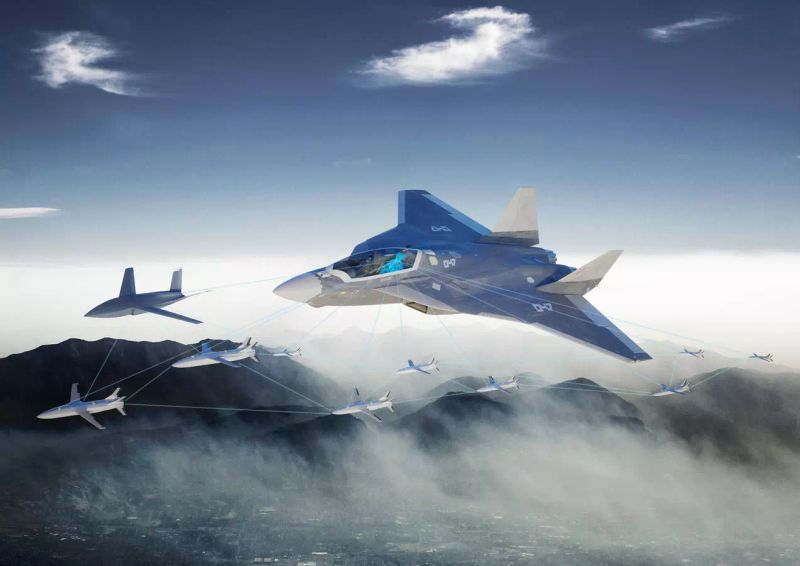
The Ministry of Defence has informed the Parliamentary Standing Committee on Defence that it has “initiated efforts in a concerted manner” to partner with France in the upcoming sixth-generation fighter aircraft development programme, which in military terminology is known as the Future Combat Air System (FCAS).
The French Government is spearheading the programme
The Committee, in its report tabled in Parliament on Friday, said that the “Ministry of Defence has initiated efforts in a concerted manner to co-join the sixth-generation fighter aircraft development programme, spearheaded by the French Government.”
Advertisement
The Committee’s report was on the ‘Action Taken by the Government on the Observations and Recommendations contained in the Twentieth Report of the Standing Committee on Defence’.
The Committee was informed by the MoD that two consortia are working on sixth-generation aircraft. One is a consortium comprising the UK, Italy and Japan, while the other comprises France and Germany, with both developing next-generation fighter aircraft.
The Committee was also informed that the Indian Air Force will try to join forces with one of the consortia and begin considering a sixth-generation fighter at the earliest, with a view to ensuring that India does not lag behind.
The 31-member committee, headed by BJP MP Radha Mohan Singh, has asked the Ministry of Defence to provide a detailed status report on the development and acquisition of sixth-generation aircraft, along with a roadmap, if any, and a tentative timeline for acquisition.
The Standing Committee, in its report, said it had asked the MoD to chalk out a trajectory for the technical upgradation of aircraft on top priority to enhance their combat capability, while expediting the planning process for the development and acquisition of sixth-generation aircraft. This, it said, would eventually enhance India’s air-domain capabilities in today’s highly air-centric modern warfare.
The Committee has also sought a status update on the indigenous fifth-generation aircraft, the Advanced Medium Combat Aircraft (AMCA). The MoD has asked three consortia to submit proposals for manufacturing five AMCA prototypes.
The Advanced Medium Combat Aircraft (AMCA) has been designed, and discussions on its production are currently underway. The Committee also said that, in view of technological advancements in fighter aircraft and to meet the present security scenario, technical upgradation of aircraft is required on top priority to enhance their combat capability.
A ‘generation’ of aircraft is defined by the capabilities that allow a pilot to maintain decision superiority over an adversary. Onboard sensors and technologies make it difficult for enemy radars to track a fifth-generation aircraft, which is backed by millions of lines of software code.
The classification of a generational shift occurs when a technological innovation cannot be incorporated into an existing aircraft through upgrades and retrospective fit-outs.
First-generation subsonic jet fighters emerged from the mid-1940s to the mid-1950s; second-generation jets from the mid-1950s to the early 1960s; third-generation jets from the early 1960s to 1970; and fourth-generation jet fighters from 1970 to the late 1980s. Fourth-and-a-half-generation jet fighters followed, while fifth-generation fighters emerged in the 2000s, with the US F-22 Raptor entering service in 2005.
Record sail: Nine Indian women military officers set new benchmarks with their historic circumnavigation
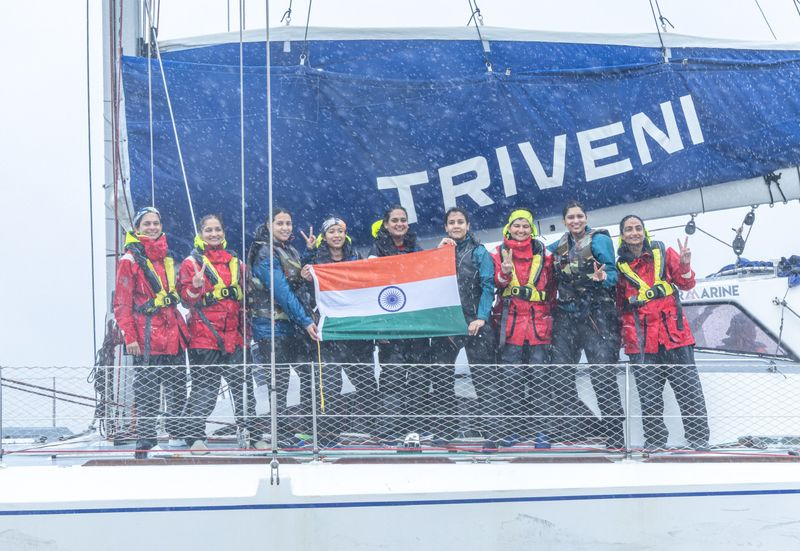
L-R) Sqn Ldr Shraddha P Raju (Deputy Skipper), Lt Col Anuja Varudkar (Skipper), Sqn Ldr Vaishali Bhandari, Lt Cdr Priyanka Gusain, Maj Prajakta Nikam, Sqn Ldr Aruvi Jayadev, Wg Cdr Vibha Singh, Maj Omita Dalvi and Maj Karamjeet Kaur. The photograph was clicked after the successful circumnavigation mission aboard IASV Triveni. Photos courtesy: Ministry of Defence
Women officers of the Indian Army, Navy and Air Force aboard IASV Triveni returned home following 314 days at sea, having sailed 25,500 nautical miles around the globe and conquered four oceans, extreme weather, isolation and technical challenges
When nine women officers of the Indian Army, Navy and Air Force stepped ashore from the Indian Army Sailing Vessel (IASV) Triveni after successfully circumnavigating the globe, the historic 314-day voyage sparked jubilation. Led by Lieutenant Colonel Anuja Varudkar, the world’s first all-women tri-services Samudra Pradakshina expedition was back in Mumbai after sailing nearly 25,500 nautical miles across four major oceans.
The feat has added another feather in the cap of women officers of the Indian armed forces. In May last year, Naval officers Lieutenant Commander Dilna K and Lieutenant Commander Roopa A became the first Indian women to sail the earth in a double-handed, wind-powered voyage spanning 239 days and more than 25,400 nautical miles in INSV Tarini. The same vessel had been witness to another achievement in 2017 when the Navy’s first all-women crew of six sailed around the world for eight months under Lieutenant Commander Vartika Joshi.
ArmyAboard the indigenously built 50-foot yacht IASV Triveni — named after the confluence of the three services — the crew also included Squadron Leader Shraddha P Raju (Deputy Expedition Leader), Wing Commander Vibha Singh, Squadron Leader Aruvi Jayadev, Squadron Leader Vaishali Bhandari, Lieutenant Commander Priyanka Gusain, Major Karamjeet Kaur, Major Omita Sanjiv Dalvi and Major Prajakta P Nikam.
At any given point, six officers sailed actively on the vessel, with the rest relaying from the control room. They crossed the Equator twice, all 360 degrees of longitude and rounded the Three Great Capes — Cape Leeuwin (Australia), Cape Horn (South America) and the Cape of Good Hope (South Africa). By sailing around Cape Horn, they earned entry into the elite Cape Horners fraternity. The team also made four international diplomatic port calls at Australia, New Zealand, Argentina, and South Africa.
In collaboration with the National Institute of Oceanography, the crew carried out scientific research and studied micro-plastics, besides documenting ocean life and raising awareness about marine health.
The journey was a culmination of years of rigorous training, beginning with smaller offshore expeditions on Class B vessels and advancing to IASV Triveni, a Class A yacht with modern communication and navigation gear. The preparatory voyages along India’s western coast were followed by an international expedition from Mumbai to Seychelles and back, gradually building the crew’s endurance, seamanship and confidence.
Experience of a lifetime
Sharing her experience of rounding Cape Horn, often described as the ‘Mount Everest’ of sailing, Lt Col Varudkar says, “It was the greatest feat of our lives. To round Cape Horn is not merely to pass a point on a chart — it is to earn the respect of the sea”.
Military
Recalling the sail through the notorious Drake Passage, where the Atlantic and Pacific Oceans collide, she says, “The day is etched in my memory. We were facing towering waves, screaming winds and unforgiving weather. And suddenly, the ocean surprised us. For a fleeting moment, the winds softened. The waves settled. The sky opened just enough to let sunlight spill across the water. It was a pause so brief and so unexpected that it felt almost sacred. At that moment, we saw Cape Horn. Within seconds, we gathered on the deck to absorb the sight. Even today, whenever I look up at the night sky or hear the sound of the wind, a part of me returns to that moment — to the sailors, the Indian flag and the end of the world.”
Sqn Ldr Shraddha P Raju remembers another defining test near Tasmania. “In heavy winds, our foresail had been torn, forcing us to head towards Hobart. At the same time, our engine failed due to water ingress, leaving us in a dangerous situation. The strengths of all three services came together at that critical juncture. While some Army officers worked to secure the damaged sail, the Air Force officers focused on restoring the engine. The Naval officer analysed the weather, sea conditions and tidal currents, and advised that we should drop all sails and drift with the ebbing current to avoid being pushed towards a mountain barely 2 nautical miles away. Together, we safely navigated the crisis.”
For Lt Cdr Priyanka Gusain, the most frightening phase came midway to Cape Town. “It had been raining continuously and our wind instruments failed due to water ingress. For a considerable stretch, we were fighting poor visibility, sailing just by the feel of the wind. That’s when doubt hit me. No wind data, bad weather, middle of the ocean… there’s no turning back now. But then I reminded myself that we had trained for this. The boat was handling, the crew was together, and we had already crossed the Drake Passage. I focused on what we could control — sail trim, watch-keeping and trusting the feel of the boat. The moment taught me that when instruments fail, you fall back on training and faith”.
Military Nursing Service officer Maj Karamjeet Kaur, who belongs to Sirsa in Haryana, shares how everyone in the team contributed in a disciplined manner, “No one had to be detailed for the task — each crew member had a sense of belongingness. An unspoken rule which we all followed was the judicious use of scarce resources like water, ration and satellite phone units. We always helped each other in waste disposal, routine maintenance, cooking and cleanliness.”
Sqn Ldr Shraddha P Raju, Maj Karamjeet Kaur and Maj Prajakta Nikam lowering the jib sail.
“We are all from the uniformed services, so teamwork and discipline come naturally. Living on a small yacht for months, the mission always came first. We shared responsibilities, talked things through, and found joy in simple moments like watching the beautiful sunrise, dolphins, seabirds, or a great catch. Those little moments kept our spirits high,” shares Sqn Ldr Aruvi Jayadev.
On the yacht what they craved the most for, besides family, shares Wg Cdr Vibha Singh, was a comfortable bed that didn’t move. “Sleeping without the constant vibration, engine noise, or rolling of Triveni is a luxury many don’t appreciate until they’re at sea,” she says. To this list, Sqn Ldr Vaishali Bhandari adds spontaneity: being able to decide “I’ll grab a coffee”, “Let’s watch a movie”, or “I’ll go for a drive”, without being confined to a limited space. “There was no scope for privacy on a small yacht with six women, their luggage and spares. If someone wanted privacy, they’d head to the bow of the boat… only to be drenched by heavy swells,” she adds.
Breaking barriers
“It’s incredible how women officers from the three services came together to complete this historic feat. It will encourage more women to take on different roles in the defence services and challenge perceptions that women don’t have enough endurance for tough roles,” says seasoned sailor, artist and filmmaker Dhanya Pilo, who mentored the crew for a couple of months.
Daughter of a Naval officer, Pilo has been sailing since 1997. She was a crew member of the all-women sailing team Maiden, which won the Ocean Globe Race 2023-24.
Sailing a boat requires physical endurance as well as mental strength, more so if you are a woman. “You’re dealing with your periods, body fatigue due to heavy lifting, etc, but then it also gives you a lot of confidence. Sailing teaches you that while strength matters, it is mental resilience that ultimately carries you through. The Triveni crew was a mix of different branches of armed forces like nursing, engineering, communications, etc. The confidence they have gained will influence how they approach their careers over the next decade,” adds Pilo.
Lt Cdr Priyanka Gusain carrying out daily engine checks.
A distinction cannot be made when women are on the boat because everybody has to be equally capable, says Kirti Chakra awardee Commander Abhilash Tomy (retd), who was the first Indian to complete a solo, non-stop, unassisted circumnavigation of the globe during his historic 2012-13 voyage aboard the Indian Navy sailboat INSV Mhadei. His mentor, Captain Dilip Donde (retd), was the first Indian to sail solo around the world, but with four stops.
“Circumnavigating the earth is a huge challenge. The women officers accepted it and completed it, which is remarkable. Going around the globe in a boat requires years of serious training. Life at sea is uncomfortable but deeply rewarding. You experience a kind of freedom that you can never find on land.” Those who want to attempt circumnavigation, advises Commander Tomy, should have the willingness to learn, patience, physical and moral courage, emotional stability, and the ability to be comfortable with themselves.
Among the expedition’s biggest cheerleaders was a WhatsApp group of 183 defence veterans, mostly from the Navy Foundation, Mumbai. Says 90-year-old Vice Admiral IC Rao (retd), “We started following their journey when IASV Triveni sailed from the Gateway of India on September 11, 2025. Our WhatsApp group included many experts, and we had our own navigation and satellite apps to monitor their journey. We had a good sense of what they were facing each day, and everyone would share their observations in the group. We were not in touch with the crew, but they knew they had a huge group cheering for them.”
Maj Omita Dalvi navigates the sea.
Sharing how the group came about, Admiral Rao says, “In 2022, Commander Abhilash Tomy was competing in the Golden Globe Race for the second time. During his first attempt, he met with a serious accident in the Southern Ocean and had undergone a spinal surgery. After relearning to walk, he returned to race again and we were all eager to follow his journey. People wanted to know what was going on, so I started explaining and soon our group evolved. Tomy finished second. We realised how much we enjoyed ourselves. As armchair sailors, we analysed every development. Our group has grown manifold and we follow every major sail”.
The cheer group was also among the first to felicitate the IASV Triveni crew back in Mumbai. As the women officers rested both their feet on the table at the United Services Club, Colaba — a privilege reserved for those who have rounded both Cape of Good Hope and Cape Horn — they knew they had broken more than just records.
Army
“Life aboard IASV Triveni gave us memories that we will cherish forever. On a good sailing day, we would wake up to see the rising sun. On one of these beautiful mornings, a school of 100 dolphins swam by our side. I was mesmerised,” shares Maj Omita Sanjiv Dalvi.
When the team stepped onto solid ground at the Gateway of India on July 22, they were overwhelmed. Maj Prajakta P Nikam recalls the day, “We were home… and Triveni had brought every one of us back. Our boat had sailed out carrying hope and returned with stories, scars and an unbreakable sisterhood forged by salt water and shared
Tax exemption on disability pension for Armed Forces still in force, MoD tells Parliamentary panel
Finance Bill had proposed taxing disability pension except for personnel invalided out due to service-related disabilities
The exemption from paying income tax on disability pension granted to Armed Forces personnel continues to be in forces, the Ministry of Defence had told the Parliament’s Standing Committee on Defence.
The Finance Bill, 2026 had proposed to bring disability pension under the tax ambit except in cases where an individual has been invalided out of service due to a physical disability attributable to or aggravated by military service. This had drawn an adverse reaction from the service community.
“Although, the matter of taxation comes under jurisdiction of Ministry of Finance, however, the Committee would like to recommend that since the Ministry of Defence is one of the stake-holder in the matter, the Ministry may take this important issue up to an appropriate level to examine the proposal of bringing disability pension under the ambit of Income Tax,” the Committee had recommended in an earlier report.
In its report of August 8, the Committee, however, expressed concern over the amendments involving exemption of income tax on disability pension and asked the Defence Ministry to take up this matter with the Ministry of Finance at the appropriate level so that financial concerns of the ex-servicemen, particularly the disabled personnel, are duly addressed in an upright manner.
Disability pension is paid to members of the Armed Forces who suffer medical or physical impairment that is attributable to or aggravated by military service. It consists of service element, that is, pension for the length of service rendered and the disability element, that is, compensation for injury or disease. Income Tax exemption on disability pension was first introduced in 1922.
Indian Navy joins search for three fishermen missing after boat mishaps in Kerala
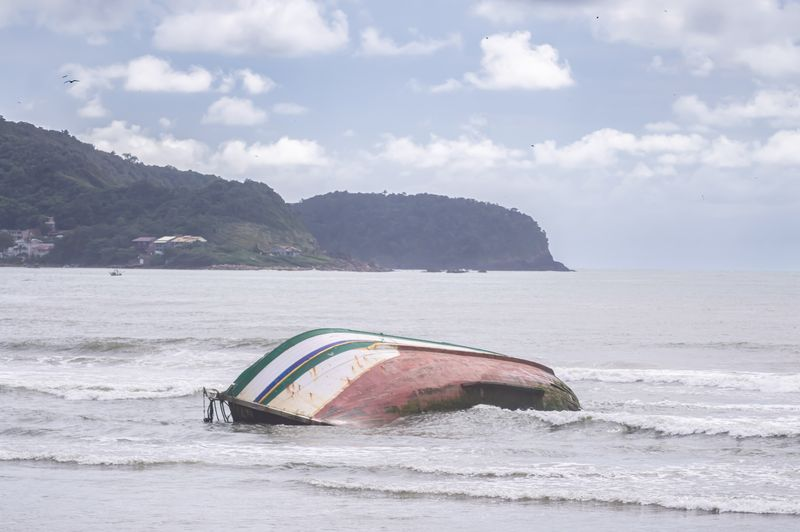
The Indian Navy on Sunday joined the search operations for three fishermen who went missing following separate boat mishaps in Kollam and Thiruvananthapuram districts, officials said.
INS Kalpeni sailed out from Kochi on Saturday night for the search operation, a defence spokesperson said in a statement. The vessel was anchored one nautical mile off Neendakara on Sunday morning, the statement said.
“A specialised Indian Navy diving team is onboard the ship. Marine Enforcement Wing was contacted for localising the diving position further. A Marine Enforcement boat is maintaining its presence in the vicinity of the ship,” the statement said.
The search involving Indian Navy divers commenced around 10 am off INS Kalpeni, officials said.
“The divers are also utilising portable SONAR. The SONAR increases the capability of the divers for underwater surveillance and diving operations,” the Defence Spokesperson said.
Coastal Police officials said that the Navy will first focus on the search for Gautam Krishna, who went missing after a fishing boat capsized off the Neendakara coast. Later, their service would be utilised for searching other missing fishermen in Muthalappozhi and Vizhinjam, officials said.
The search operation by the Coastal Police, Marine Enforcement Wing of the Fisheries Department, and Coast Guard entered its 10th day on Sunday for Gautam Krishna, John, and Shijin, who went missing in separate fishing boat mishaps at Neendakara, Vizhinjam and Muthalappozhi on July 31.
Family members of the missing persons had earlier protested, alleging lapses in the search operation, prompting the state government to seek the assistance of the Indian Navy.
Opposition parties also attacked the state government, alleging a slow response from the authorities in tracing the missing persons.
Meanwhile, Union Minister Suresh Gopi on Sunday said he would continue efforts to trace Gautam Krishna, a fisherman who went missing after a fishing boat capsized off Neendakara.
In a Facebook post, Gopi said Krishna’s mother had appealed to him to consider her as his own sister and stand with her in the search for her son.
Recalling her emotional appeal, Gopi said, “A representative of the people, more than that as a brother, this is the promise I gave that mother. This brother considers you his own sister and will be with you. I will go to any extent to bring that son back.”
Gopi said the fishing boat capsized after being caught in strong waves and the family was yet to recover from the shock of the tragedy.
He said he had been in constant contact with senior officials concerned and would not allow the search operation to slow down for any reason.
“All resources have now been mobilised to intensify the search in the sea,” he said.
Gopi said a vessel carrying Navy divers had resumed an emergency search operation at sea and Coast Guard helicopters had intensified aerial surveillance. He also said Indian Oil is extending full support to the operation by ensuring uninterrupted availability of fuel and other facilities.
An emergency helipad was also being urgently prepared at Amritapuri with the cooperation of college authorities to speed up rescue operations, he said.
Gopi said he had complete faith that Gautam would return when the strength of the administration and collective prayers came together.
“I will stand by that mother until my last breath to wipe away her tears. I will not give up hope… We will fight,” he said.
Air India turbulence case: Pilot’s drug screening needs confirmatory test; both pilots taken off roster
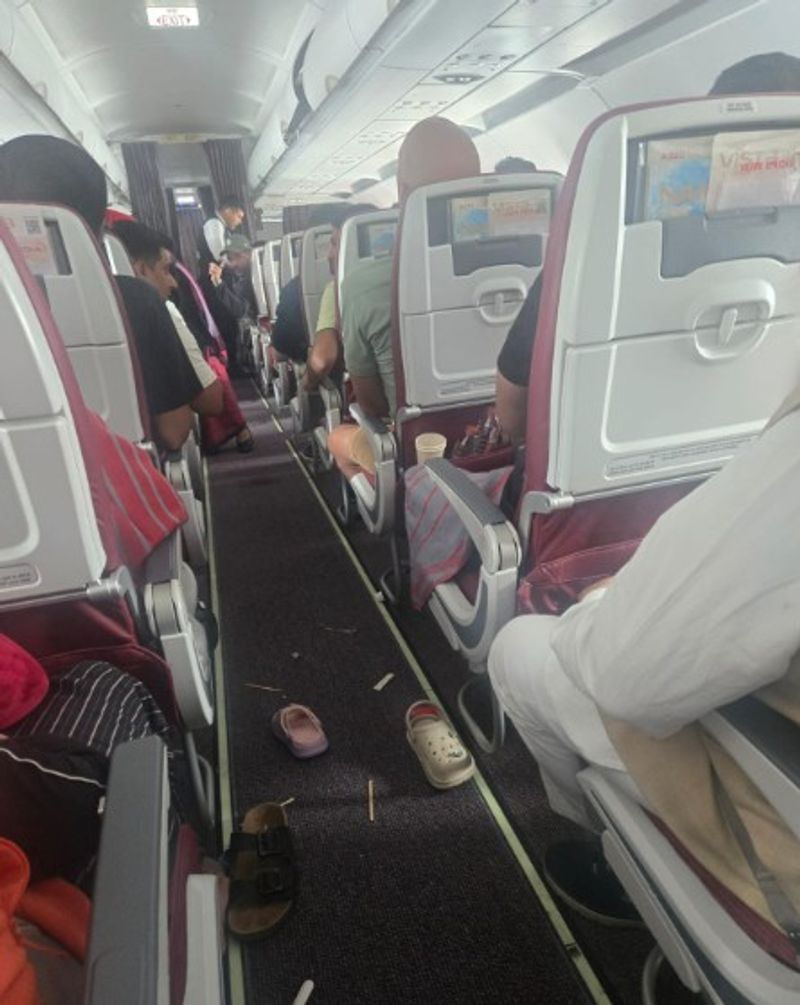
A drug screening of the pilot-in-command of an Air India Phuket-Delhi flight that suddenly lost around 300 feet in altitude during cruise on August 4 has returned a result requiring confirmatory testing, with the sample sent to a designated laboratory even as the DGCA has taken both pilots off roster pending the outcome.
The Ministry of Civil Aviation said on Sunday that the screening was conducted as part of the prescribed procedure after the incident involving Air India’s A320 aircraft VT-EXO, operating flight AI2379 from Phuket to Delhi. The aircraft, carrying 137 passengers, including three infants, and eight crew members — two pilots and six cabin crew — subsequently stabilised and landed safely in Delhi.
The development comes amid reports that the pilot had failed a post-flight drug test. However, the Ministry said the initial screening of the Pilot-in-Command (PIC) had produced a result requiring confirmatory testing and that the final report was awaited.
Air India, too, said it had not received the test results and was, therefore, not in a position to comment on any findings.
“We are aware that a post-flight screening test was conducted on the pilots in accordance with applicable protocols. However, the results of the test have not been shared with Air India, and we are, therefore, not in a position to comment on any findings,” an airline spokesperson said.
The Ministry said samples had been sent to the designated laboratory for confirmatory analysis.
Pending completion of the prescribed process, both flight crew members have been taken off roster by the DGCA, while further action will depend on the outcome of the investigation and the confirmatory test results.
The incident has also been formally classified as a Serious Incident and is under investigation by the Aircraft Accident Investigation Bureau (AAIB).
The Federation of Indian Pilots said the final report should be awaited before drawing any conclusion. FIP president Captain CS Randhawa said that if the pilot is eventually found to have tested positive, cancellation of his flying licence could be among the consequences, apart from penalties and other regulatory action.
“If the test seems positive, then the licence cancellation of the pilot can also take place because of this,” Randhawa said, adding that other consequences could also affect the pilot’s future.
He, however, stressed that the pilots’ body would wait for the official report before commenting on the reported result.
“We have to wait for the report about the doping test, and then only we can comment on it,” he said.
The Air India flight encountered the sudden loss of altitude at around 9.30 am on August 4 during cruise. The aircraft lost approximately 300 feet before stabilising and continuing its flight to Delhi.
Several passengers and crew members were injured during the turbulence. A passenger later filed a complaint with the Directorate General of Civil Aviation through the AirSewa portal, alleging that the sudden plunge threw passengers against the cabin ceiling.
The complaint said a family of six was travelling on the flight when the aircraft suddenly dropped. Renu Raniwala, 62, suffered a rib injury and suspected spinal injury, while Mukul Raniwala, 64, sustained bruises.
Visuals from the Delhi airport terminal showed ambulances and emergency responders attending to passengers, with several being assisted in wheelchairs and some seen with head bandages before being taken for medical evaluation.
Civil Aviation Minister Ram Mohan Naidu Kinjarapu said on Saturday that 24 passengers had experienced some form of medical discomfort and were taken to hospital for thorough medical checks.
“Most of the passengers were discharged from the hospital in the first few hours only,” Naidu said.
Air India said it conducts regular drug testing of crew members in compliance with civil aviation regulations, independent of any particular flight or operational incident.
The Ministry said the Civil Aviation Ministry and the DGCA remained committed to maintaining the highest standards of aviation safety and ensuring that such occurrences were thoroughly investigated and appropriate action taken in accordance with prescribed regulations and procedures.
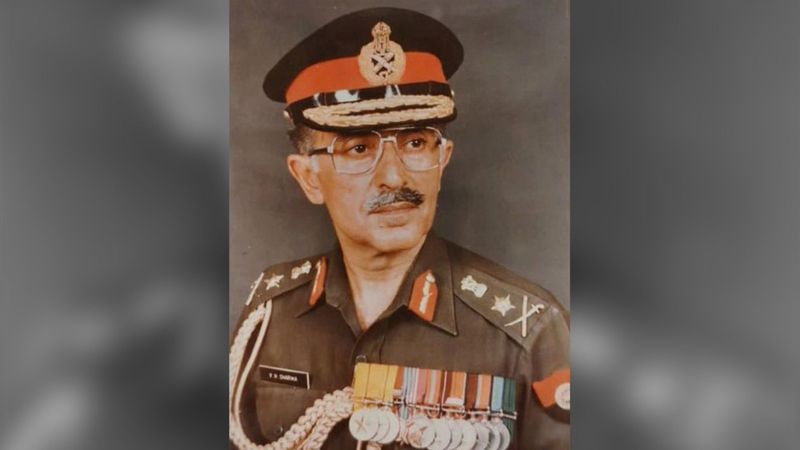
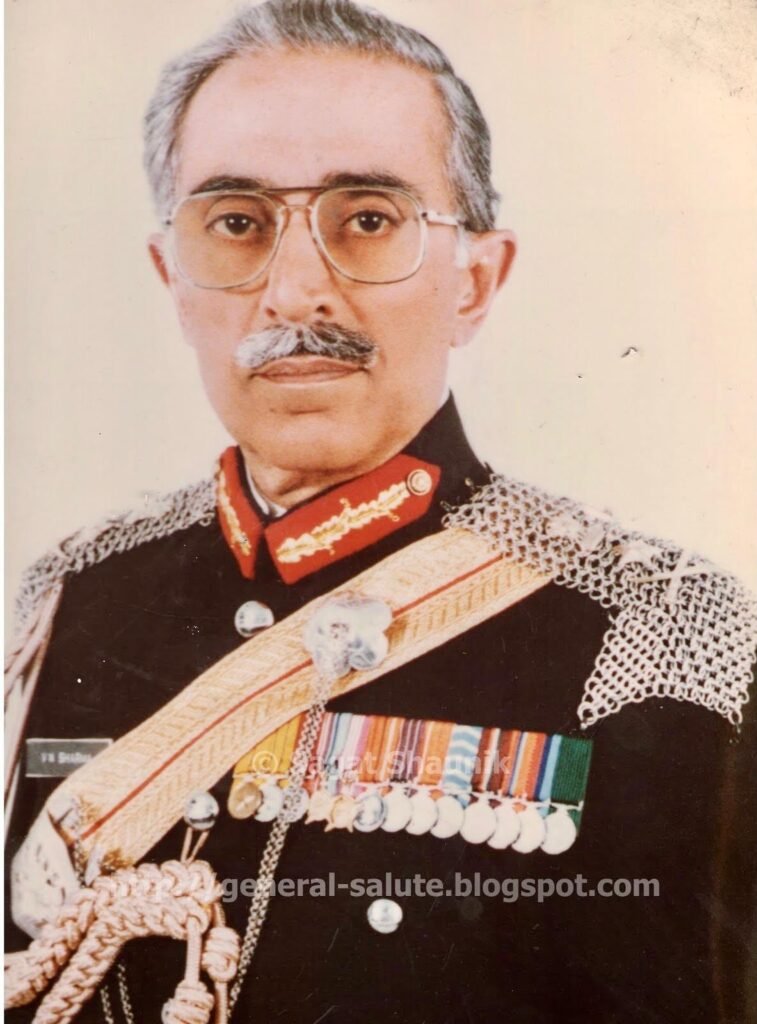
Former Indian Army Chief General Vishwa Nath Sharma, who played a major role in 1987 stand-off with China, passed away of natural causes around 4 am on Friday in the National capital. He was 96. The cremation is will take place on Saturday at 10:30 am at the Brar Square at Delhi Cantonment.
General Sharma’s earlier tenure (June 1987 to May 1988)
As the Eastern Army Commander, the term was eventful and coincided with the military standoff against China at Sumdorong Chu along the Line of Actual control in Arunachal Pradesh.The incident is known among military historians as the “Wangdung incident” and it began in June 1986 when a Chinese attempt was discovered to alter the un-demarcated LAC near the of village Sumdorong Chu in Tawang district of Arunachal Pradesh.
The then Indian Army Chief General K Sundarji had responded and launched operation ‘chequerboard’ in summer of 1987. This involved a massive mobilisation of 10 army divisionsalongside multiple squadrons of the Indian Air Force. It ranged across the entire northeast Himalayan region.
The military stand-off is considered the third Sino-Indian military conflict — the earlier ones being in 1962 and the 1967 near Natu La in Sikkim.
Sad to inform the passing away of ex COAS Gen VN Sharma, PVSM, AVSM, ADC (Retd) at 0410 hr today at Delhi.
Cremation is planned tomorrow at 1030 hr at Brar Square. Om Shan
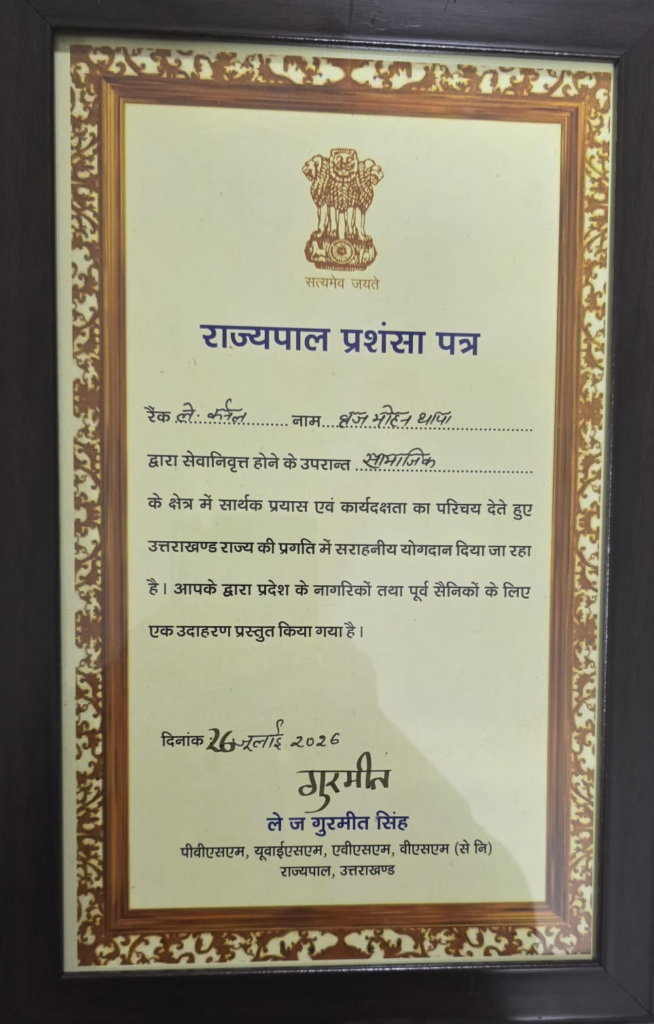
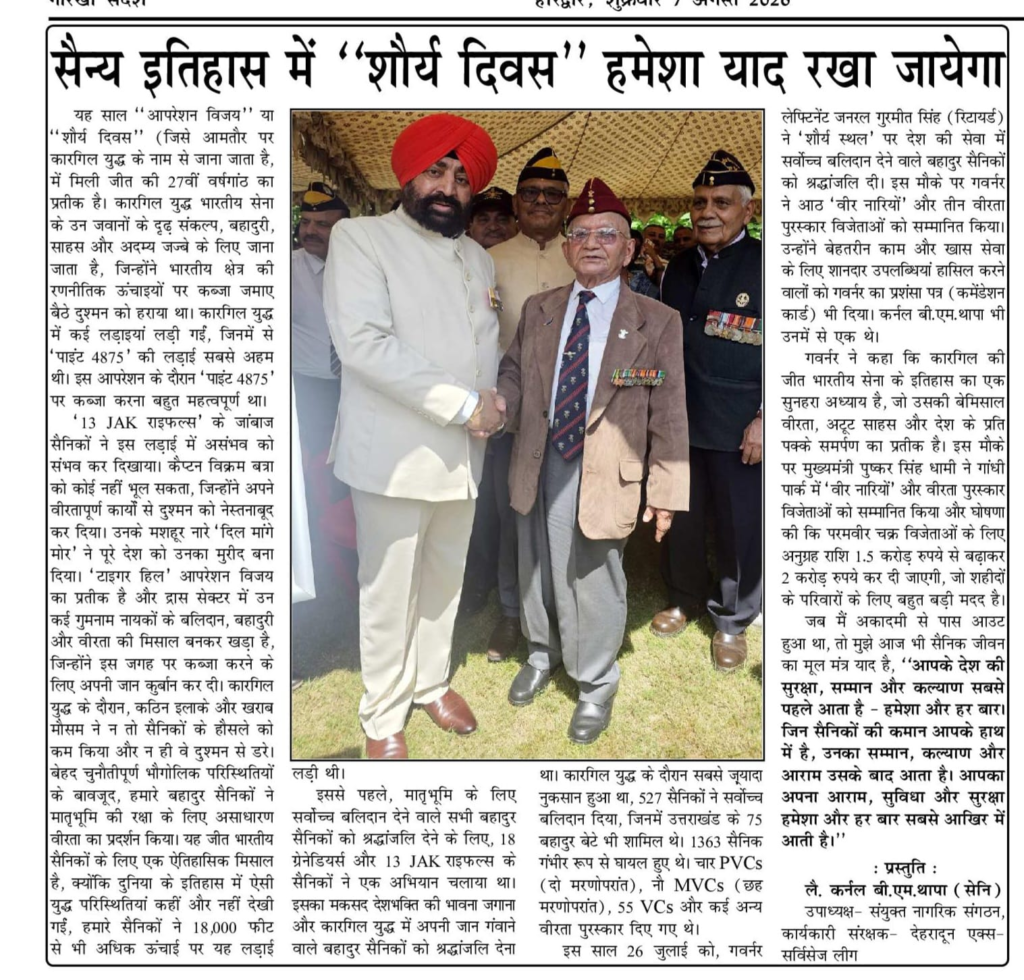
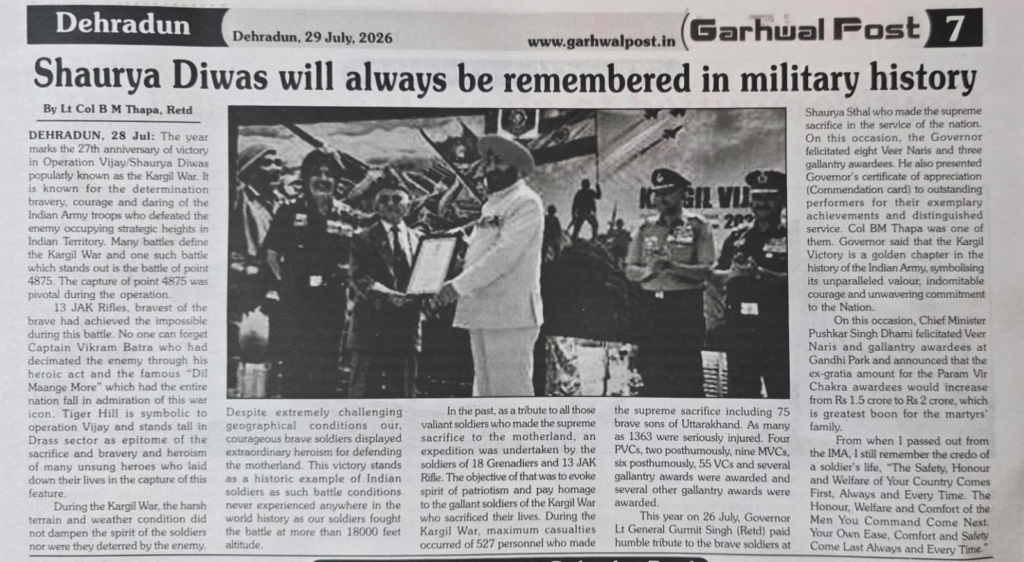
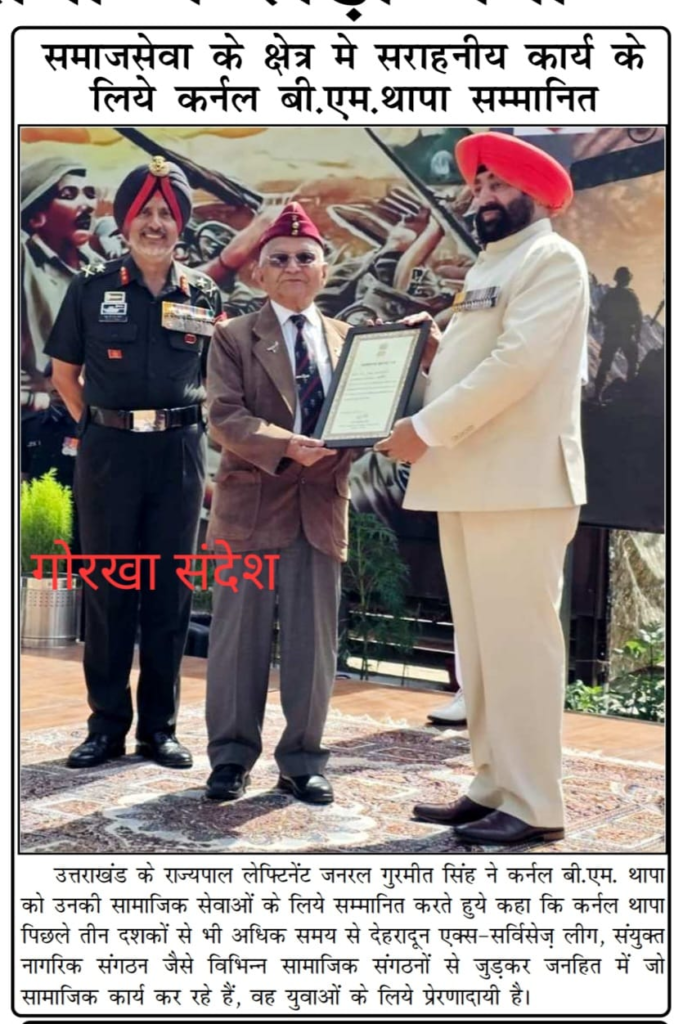
Lt Col BM Thapa :President Uttarakhand: Sanjha Morcha appreciated by the Governor on shauryia Diwas
Air Force Station Amritsar Cantt successfully concluded a 1,600-kilometre motorcycle expedition commemorating the 27th Kargil Vijay Diwas.
The expedition, led by the Station Commander, was undertaken by 17 Air Warriors. It commenced on July 24 and concluded on July 30, covering major cities including Chandigarh, New Delhi, Jaipur, Hisar and Bathinda.
During the journey, the team paid homage at various war memorials, honouring the unparalleled courage and supreme sacrifice of the Kargil martyrs. The Air Warriors also interacted with veterans and expressed gratitude for their invaluable service to the nation.
The primary objective of the expedition was to commemorate India’s historic victory in the Kargil War and inspire the younger generation with the values of patriotism, courage, sacrifice and national pride. The initiative also served as a tribute to the brave soldiers who laid down their lives while safeguarding the unity and integrity of the nation.
Speaking on the occasion, the Station Commander of Air Force Station Amritsar Cantt said the expedition was a fitting tribute to the indomitable spirit and supreme sacrifice of the Kargil heroes.
State Stalwarts
DEFENCE MINISTER
Minister Rajnath Singh
ALL HUMANS ARE ONE CREATED BY GOD
HINDUS,MUSLIMS,SIKHS.ISAI SAB HAI BHAI BHAI
CHIEF PATRON ALL INDIA SANJHA MORCHA
LT GEN JASBIR SINGH DHALIWAL, DOGRA
SENIOR PATRON ALL INDIA SANJHA MORCHA
MAJOR GEN HARVIJAY SINGH, SENA MEDAL ,corps of signals
.
.
PATRON ALL INDIA SANJHA MORCHA
MAJ GEN RAMINDER GURAYA ,MADRAS REGIMENT
sanjhamorcha303@gmail.com
PRESIDENT SOUTH ALL INDIA SANJHA MORCHA
COL SS RAJAN BOMBAY SAPPERS,
PRESIDENT UTTARAKHAND ALL INDIA SANJHA MORCHA
COL B M THAPA ,BENGAL SAPPERSS
PRESIDENT HARAYANA STATE CUM COORDINATOR ESM
BRIG DALJIT THUKRAL ,BENGAL SAPPERS
PRESIDENT TRICITY
COL B S BRAR (BHUPI BRAR)
PRESIDENT CHANDIGARH ZONE
COL SHANJIT SINGH BHULLAR
.
.
PRESIDENT PANCHKULA ZONE AND ZIRAKPUR
COL SWARAN SINGH
INDIAN DEFENCE FORCES
DEFENCE FORCES INTEGRATED LOGO
INDIAN AIR FORCE
Air Officer C-in-C WESTERN AIR COMMAND
AIR MSHL S PRABHAKARAN AVSM VM
AOC-IN-C, EASTERN AIR COMMAND
Air Marshal Inderpal Singh Walia
AOC-in-C SOUTH WESTERN AIR COMMAND
Air Marshal Vikram Singh
AOC-IN-C, SOUTHERN AIR COMMAND
Air Marshal J.Chalapati
AOC-IN-C TRAINING COMMAND
AIR MARSHAL SK GHOTIA VSM
AOC-IN-C MAINTENANCE COMMAND
Air Marshal Jagdish Chandra
Flag Officer Commanding in Chief, Western Naval Command
ice Admiral R Hari Kumar, PVSM, AVSM, VSM
Flag Officer Commanding in Chief, Eastern Naval Command
Vice Admiral Sanjay Bhalla, AVSM, NM
Flag Officer Commanding in Chief, Southern Naval Command