Pakistan has claimed that it has conducted a fresh training launch of its Fatah‑4 ground‑launched cruise missile, organised by the Army Rocket Force Command. The missile, equipped with modern avionics and navigational systems, demonstrated long‑range precision targeting and validated multiple technical parameters, defence experts believe that the missile has Chinese origins.
The Pakistan Army confirmed that the Fatah‑4 cruise missile was test‑fired on Thursday under the supervision of the Rocket Force Command. According to the statement issued by the Inter‑Services Public Relations (ISPR), the missile is fitted with advanced avionics and state‑of‑the‑art navigational aids, enabling it to engage long‑range targets with high precision.
The test was conducted to enhance the operational efficiency of troops and to validate the technical parameters of various sub‑systems integrated into the weapon system. These sub‑systems were designed to improve accuracy and survivability, ensuring the missile’s reliability in operational conditions.
Senior officers of the Army Rocket Force Command, along with scientists and engineers from the missile’s development agency, were present during the launch.
The Fatah‑4 missile has a reported range of approximately 750 kilometres, as demonstrated in earlier training launches conducted in September 2025. The latest test builds upon a series of missile trials under the Fatah program. In May 2025, Pakistan tested a surface‑to‑surface missile with a range of 120 kilometres during heightened tensions with India.
India Strategic Analysis
More recently, in April 2026, the Army Rocket Force Command carried out a training launch of the Fateh‑2 missile system, while the Pakistan Navy successfully fired another Chinese sourced Taimoor air‑launched cruise missile, an indigenous anti‑ship weapon system. These sequential trials reflect a pattern of continuous testing and validation across Pakistan’s missile development initiatives.
The ISPR noted that the Fatah‑4 trial was part of ongoing efforts to enhance operational readiness and ensure the credibility of Pakistan’s strategic forces.
The exercise was described as a crucial step in validating the missile’s survivability features and ensuring its effectiveness in real operational scenarios. The leadership’s collective endorsement underscored the importance of the test in the broader context of Pakistan’s defence posture.
India Condemns Attack On Indian‑Flagged Vessel Off Oman, Crew Rescued Safely
India has strongly condemned the recent attack on an Indian‑flagged commercial vessel off the coast of Oman, describing the incident as unacceptable and reiterating its firm stance on safeguarding freedom of navigation and civilian maritime activity amid the ongoing conflict in West Asia.
The Ministry of External Affairs spokesperson Randhir Jaiswal issued a statement deploring the continued targeting of commercial shipping and civilian mariners in regional waters, stressing that such actions undermine international maritime security and stability.
The Ministry confirmed that all Indian crew members aboard the vessel are safe following rescue efforts carried out by Omani authorities. India expressed gratitude to Oman for its swift intervention, noting that the safety of Indian seafarers remains a paramount concern.
The statement emphasised that targeting commercial shipping and endangering innocent civilian crew members, or otherwise impeding freedom of navigation and commerce, must be avoided, as such acts threaten global trade and energy supply chains.
The incident comes against the backdrop of rising tensions in the Gulf region, where maritime security has become increasingly fragile near key international shipping lanes. Earlier in the day, the United Kingdom Maritime Trade Operations (UKMTO) reported a separate maritime security incident in the Gulf, involving the reported seizure of a vessel near the coast of the United Arab Emirates.
According to UKMTO, the incident occurred approximately 38 nautical miles northeast of Fujairah, where the Company Security Officer of the vessel reported that unauthorised personnel had boarded the ship while it was at anchor. The vessel was subsequently taken over and directed towards Iranian territorial waters.
UKMTO stated that investigations into the incident are ongoing and advised vessels operating in the region to remain vigilant and report any suspicious activity.
This advisory underscores the heightened risks faced by commercial shipping in the Gulf, where multiple incidents in recent weeks have raised concerns about the safety of maritime trade routes and the potential for escalation.
India’s condemnation of the attack reflects its broader diplomatic engagement in ensuring maritime security, particularly given its dependence on energy imports and the large number of Indian nationals working in the Gulf region.
India has consistently called for restraint, dialogue, and respect for international law in addressing maritime disputes and incidents. The latest attack highlights the vulnerability of civilian shipping in contested waters and reinforces India’s position that freedom of navigation must be upheld to protect global commerce and the lives of seafarers.
Geopolitical Analysis India
The Ministry’s statement aligns with India’s wider diplomatic efforts to safeguard maritime trade and ensure the safety of its citizens abroad, while also signalling concern over the broader instability in the Gulf region.
ANI
IAF veteran, who took up voluntary teaching, feted:awarded with Dr BM Munjal Social Impact Award-2026 i
Wing Commander JS Bhalla (retd), a voluntary teacher of Government Model Senior Secondary School, Sector 44, Chandigarh, was awarded with Dr BM Munjal Social Impact Award-2026 in New Delhi.
He was felicitated with a trophy and a cash award of Rs 1 lakh for his contribution towards teaching excellence and nation-building through education.
At the age of 88, Wg Cdr Bhalla continues to serve society with remarkable dedication by teaching Class XII students and inspiring them through discipline, patriotism and moral values. His efforts over the past decade helped hundreds of students, achieve outstanding results in board examinations.
Pakistan’s Activates Multiple Restricted Air Corridors After India Successfully Tests Agni MIRV ICBM
Pakistan’s sudden activation of multiple restricted air corridors just days after India’s successful test of an advanced Agni-series ballistic missile equipped with Multiple Independently Targeted Re-entry Vehicle capability has sharply intensified strategic signalling between the two nuclear-armed neighbours.
The restrictions, issued through a sweeping NOTAM covering major low-altitude aviation corridors over Khyber Pakhtunkhwa and Punjab between 12 and 14 May, coincided with the simultaneous activation of the Gadani and Somiani firing ranges along the Balochistan coastline.
This pattern strongly resembled previous Pakistani live-fire missile validation procedures linked to the Army Rocket Force Command, fuelling speculation of significant military activity.
Open-source intelligence accounts monitoring regional aviation activity circulated polygonal NOTAM maps showing large restricted zones across central and northern Pakistan. Subsequent restrictions expanded the operational footprint into Punjab, Sindh, and Balochistan, covering tactical corridors between ground level and 10,000 feet.
The geographic spread of these restrictions mirrored Pakistan’s dispersed deployment philosophy, designed to improve survivability against pre-emptive conventional strikes. Regional observers noted that the synchronised activation of inland exclusion zones and coastal ranges suggested rehearsals of integrated multi-domain strike coordination involving tactical missile units, drones, and low-altitude penetration platforms under a unified command structure.
India’s Ministry of Defence and the Defence Research and Development Organisation had confirmed days earlier that New Delhi successfully completed a major Agni-series missile flight from Dr APJ Abdul Kalam Island in Odisha.
This marked India’s second publicly acknowledged MIRV validation after the Divyastra mission. The test involved multiple payload deployments across separate impact points in the Indian Ocean Region, significantly strengthening India’s deterrence posture by demonstrating the ability to overwhelm missile defence systems with independently manoeuvrable re-entry vehicles.
Defence Policy Briefs
India’s Agni missile series showcases its evolution from regional deterrence to extended-range strategic capabilities, bolstering a robust nuclear triad. Agni-I, a short-range ballistic missile with 700-900 km reach, primarily targets Pakistan for deterrence. Agni-II extends coverage to western China via a solid-fueled design spanning 2,000-3,000 km. Agni-III boosts payload and range to 3,000-5,000 km with a heavier intermediate-range setup, varying by trajectory and load.
Agni-IV advances with lighter composites, enhanced guidance precision, and greater mobility, bridging to the cannisterised Agni-5. The latter delivers near-ICBM reach, road-mobile canister launch, and MIRV compatibility, covering much of Asia. Complementing this, sea-based options like the K-15 (around 750 km) and K-4 (about 3,500 km) SLBMs form the underwater leg, while BrahMos, Shaurya, and Pralay handle conventional and theatre strikes.
Defence planners in India increasingly view MIRV capability as essential for maintaining credible deterrence against both Pakistan and China, particularly as evolving missile-defence architectures threaten the effectiveness of traditional single-warhead ballistic systems.
Pakistan’s Inter-Services Public Relations directorate has not officially linked its current military activity to India’s MIRV demonstration, but the compressed timeline between both events has amplified perceptions of retaliatory signalling.
Geopolitical Analysis India
The developments unfold amid intensifying Indo-Pacific concerns that South Asia’s accelerating missile modernisation race—driven by MIRV technology, precision-guided tactical strike systems, and survivable conventional strike capabilities—is steadily compressing escalation timelines during future crises.
Analysts caution that such dynamics increase pressure on command-and-control systems and reduce warning periods, thereby heightening risks of miscalculation.
The activation of Somiani and Gadani firing ranges carried major strategic significance. Somiani, located along the Balochistan coast near Karachi, has historically functioned as one of Pakistan’s most critical military testing zones for ballistic missiles, cruise missiles, artillery systems, naval strike weapons, and air-launched munitions.
Its location facing the Arabian Sea allows safe long-range live-fire exercises while supporting maritime strike experimentation. Gadani, situated near Pakistan’s ship-breaking facilities, frequently appears in conjunction with Somiani during intensified military activity involving artillery, drones, coastal defence systems, and tactical missile exercises. The simultaneous activation of both ranges indicated rehearsals of multi-domain strike coordination involving land, air, and maritime components, reflecting Pakistan’s doctrinal emphasis on rapid dispersed strike capability and survivable tactical response networks.
Supersonic Missile Tech
India’s MIRV breakthrough has fundamentally altered the strategic environment. By enabling a single missile to deploy several manoeuvrable warheads against separate targets, India has dramatically complicated interception calculations for opposing missile-defence systems.
The successful test reinforced India’s pursuit of survivable second-strike capability, improving its ability to penetrate layered interception environments during high-intensity conflict scenarios. Pakistan’s military signalling therefore emerges within a broader context where Islamabad faces mounting pressure to demonstrate operational readiness against India’s rapidly modernising missile and aerospace capabilities.
Although Pakistan has not officially characterised its activities as retaliatory, regional observers interpret the timing as deliberate strategic messaging intended to reassure domestic audiences while signalling preparedness to Indian planners.
Pakistan’s extension of restrictions beyond the immediate activity window reflects a persistent pattern of prolonged operational caution shaping regional aviation and military planning since early 2025. Islamabad recently extended its airspace ban on all Indian-registered, Indian-operated, and Indian military aircraft until at least 24 May 2026.
These restrictions, repeatedly extended since March 2025, highlight continuing bilateral tensions and the deterioration of normalised civil aviation engagement. The economic and logistical consequences are significant, as rerouted commercial traffic increases fuel consumption, operational complexity, and scheduling disruptions across South Asian corridors. Military planners closely monitor such restrictions because they often indicate elevated alertness, readiness cycles, or contingency preparations.
Pakistan’s military has simultaneously increased visibility surrounding the Army Rocket Force Command, signalling growing institutional emphasis upon tactical precision-strike systems capable of rapid response during crises.
Military equipment sales
India, meanwhile, continues advancing its integrated strike architecture involving BrahMos cruise missiles, MIRV-capable ballistic systems, long-range airpower modernisation, and layered missile-defence infrastructure. This accelerating competition is steadily compressing decision timelines because both sides increasingly field fast-moving, precision-guided systems capable of producing significant escalation risks.
No mainstream Pakistani or international media organisation has yet confirmed a specific missile launch tied directly to the 12–14 May operational window, leaving assessments dependent upon open-source intelligence and aviation tracking data. Pakistan traditionally announces successful missile tests only after completion, preserving operational secrecy while maximising strategic messaging impact.
The absence of immediate confirmation does not reduce the probability of a launch, as similar communication patterns were observed during earlier training demonstrations. Analysts caution against interpreting the activity as evidence of imminent nuclear escalation, noting that NOTAM procedures remain standard safety mechanisms during tactical drills, live-fire exercises, drone operations, or missile validation events.
Nevertheless, the convergence of India’s MIRV breakthrough, Pakistan’s activation of widespread low-altitude restrictions, and overlapping exclusion zones across multiple provinces has intensified global scrutiny of South Asia’s missile environment.
Geopolitical Analysis India
The current posture demonstrates how rapidly evolving aerospace and missile technologies are reshaping deterrence calculations by compressing warning timelines and increasing pressure upon command systems. India’s emphasis upon MIRV-enabled strategic missiles underscores its determination to maintain deterrence credibility against both Pakistan and China, while Pakistan’s operational signalling reflects its focus on survivable precision-strike systems and tactical readiness.
Until official confirmation emerges, the activity remains best understood as a highly visible demonstration of military readiness, strategic ambiguity, and calibrated deterrence signalling within one of the world’s most heavily militarised rivalries.
THERE is a simple inscription at the Kohima War Cemetery, etched after one of the fiercest battles fought on Indian soil.
“When you go home, tell them of us and say, for your tomorrow, we gave our today.”
It is not a slogan. It is a statement of fact.
Many recall the Indian soldier’s contribution in the First and Second World Wars, fought across three continents. Few remember that the Second World War was also fought on Indian soil. The Battle of Kohima, once described as the “Forgotten War”, is today recognised by military historians across the world as among the finest military campaigns of that war.
In 1944, on a ridge that became synonymous with the Battle of Kohima, soldiers fought at such proximity that the tennis court between opposing trenches became part of the battlefield. Years later, that inscription came to mark not victory alone, but something deeper: the nature of military service itself.
It did not create something new. It recognised something ancient. The civilisational legacy of the Indian soldier.
Historically, he has always been a volunteer for the ultimate sacrifice. That distinction matters. It matters more today than it ever has.
Unlike others, the soldier cannot quit on a whim, cannot unionise, cannot litigate against a transfer and cannot refuse an order that may lead to his death. This is not a lifestyle choice. It is a legal surrender of rights every other citizen retains.
It is the only profession in the Republic where the Constitution is not something you merely live under, but something you may be ordered to die for.
To subject that covenant to the same framework as defined liability service is not merely administratively untidy. It is a category error.
But the soldier’s liability does not end with the body. It extends to the self.
He sets aside everything that marks him in civilian life. Language, caste, religion, region, political preference and personal ambition all remain part of him as a human being, but none may override the larger compact he has entered. The transformation is not ceremonial. It is operational. Trust in combat cannot wait for sociological negotiation. Cohesion under fire cannot pause for identity management.
The regiment functions because the uniform has replaced the self with something larger. Identity is subordinated because survival, command and trust require it.
That is why the soldier eventually becomes, in the fullest sense, everyone’s soldier.
When he arrives at the citizen’s door in flood, in fire, in the aftermath of violence, the citizen does not ask his caste. The soldier does not offer it. Everything that fractures Indian public life dissolves at that threshold.
He surrendered those fragments long before he arrived there. At the SSB (Services Selection Board). At the passing-out parade. At the first moment he wore the uniform and understood what it demanded of him.
That surrender is not incidental to service. It is the deepest form of it.
The soldier who stands at that door has not merely shown up. He has arrived as the nation. Undivided. Unreserved. Unconditional.
At that door, the Republic is not debated. It is delivered.
The military in India is one of the very few institutions where unity in diversity is not aspirational rhetoric but operational necessity.
That achievement is among the Republic’s greatest institutional successes.
Generation Z understands this instinctively, and perhaps more clearly than the debate itself yet does.
This generation does not romanticise institutions. It joins, when it does, after conscious calculation about how to spend the one life it has. It has grown up in an identity-saturated world where every platform asks it to perform, market and continuously explain itself.
The self has become performance. And the performance is exhausting.
Then they encounter the uniform.
The uniform says: here, none of that matters.
For many of them, that is not sacrifice. It is relief.
The military offers what no startup, no salary package and no influencer economy can provide: a purpose that absorbs the self completely and returns something larger in its place.
The soldier at the citizen’s door is not diminished by having no caste in that moment. He is elevated by it. He is perhaps the only person in that doorway who has genuinely transcended the fractures others are still negotiating.
This generation is not running from self-erasure. It is searching for a place where the self can finally rest.
The uniform is that place.
The young volunteer who steps forward today is not an accident of recruitment statistics or nostalgia for another era. Generation Z is shaped not only by its own choices, but by the values it inherits from family, peers and the moral climate around it. Somewhere within that continuum, the legacy of the soldier still survives in the bloodstream of the Republic.
That is why the calling endures.
Each generation, in its own language and under its own pressures, chooses the covenant again.
From 1948, 1971, Kargil to Operation Sindoor, generation after generation has answered that covenant without renegotiation. In mountains, deserts, jungles, counter-insurgency grids and humanitarian crises, the Indian soldier has repeatedly demonstrated something increasingly rare in the modern world: disciplined force under constitutional restraint.
At a time when conflict elsewhere often struggles even to define its own exit, India’s military tradition has remained tied not merely to victory, but to proportion, control and return.
The covenant, however, must run both ways.
The Republic often measures military service only in moments of visible sacrifice. But the deeper cost is quieter, slower and cumulative.
The officer who retires early has given the nation the very decades other professions use to consolidate careers, wealth, networks and security.
He does not merely risk his life.
He surrenders his earning arc.
That sacrifice is not incidental to military service. It is embedded into its design. The nation requires youth in combat leadership. It requires a force capable of movement, endurance and decision under pressure. The compressed military career is therefore not an administrative flaw. It is part of the operational logic of the institution itself.
And when a young person understands that clearly, steps forward with open eyes and accepts that covenant anyway, the Republic owes that person an answer written not merely in ceremony, but in structure. In policy. In design.
The author led a tank squadron to Dhaka during the Liberation War in 1971 Tomorrow: The covenant complete
Not a story of a murder. It was a story of love, betrayal, anger, honor, media, and the clash with the law…
Kawas Manekshaw Nanavati… a name that didn’t just commit one murder, but changed the entire legal history of India.
Born in 1925 into a Parsi family, Nanavati was a Commander in the Indian Navy. A high post, a respectable life, and a beautiful family. In 1949, he married a British woman named Sylvia. They had three children, and everything seemed to be running like a happy family.
Then in 1956, the family settled in Bombay. There, Nanavati met Prem Ahuja, a wealthy businessman. Friendship grew, and visits to each other’s homes became frequent. But Nanavati’s duty often kept him at sea for months at a time.
During this time, closeness grew between Sylvia and Prem Ahuja. That closeness slowly turned into an affair. Nanavati had no idea about it.
On 27th April 1959, Nanavati returned home from duty. He felt his wife’s behavior had changed. After much questioning, Sylvia broke down and told him the whole truth. She said she was having an affair with Prem Ahuja, and when she spoke of marriage, Ahuja had refused.
For a husband, this moment was devastating from within.
Nanavati dropped his wife and children at the cinema to watch a film. Then he went to the naval base. There, giving a false reason, he took his service revolver and six bullets.
He went straight to Prem Ahuja’s flat.
It is said that Nanavati asked Ahuja if he would marry Sylvia and take responsibility for the children. To this, Ahuja replied sarcastically…
“Will I marry every woman I sleep with?”
Hearing this, Nanavati fired three shots in anger. Ahuja fell in the bathroom and died there.
After the murder, Nanavati didn’t flee. He went straight to the police and surrendered.
Then began India’s most talked-about case.
Thousands gathered outside the court. Every day, Nanavati came to court in his Navy uniform and medals. People started seeing him as a hero betrayed. The newspapers also portrayed him as “a man fighting for honor.”
In the trial, the jury declared Nanavati not guilty by an 8-1 vote.
But the Sessions Judge called this verdict “biased and wrong” and sent the case to the Bombay High Court. The High Court found Nanavati guilty of murder. In 1961, the Supreme Court upheld the sentence and sentenced him to life imprisonment.
This case had another major impact.
The court held that media and public influence on the jury was so strong that a fair verdict was impossible. Because of this, the practice of jury trials in criminal cases was abolished in India.
In 1964, the Governor of Maharashtra pardoned Nanavati. He moved to Canada with his wife Sylvia. Surprisingly, despite everything, the two stayed together till the end.
Nanavati passed away in 2003.
This wasn’t just a story of a murder. It was a story of love, betrayal, anger, honor, media, and the clash with the law… which forever changed India’s justice system.
Hav Sawan Barwal of 501 FSEG: breaks 48 year old National record in Marathon at Rotterdam , Netherlands
Hav Sawan Barwal of 501 FSEG and Bengal Sappers for his outstanding achievement in breaking the 48 year old National record in Marathon at Rotterdam , Netherlands this Apr. On behalf of BEG & centre , Roorkee and our fraternity, felicitated Sawan today and wish him all the very best for the forthcoming 20th Asian games to be held at Aichi – Nagoya,Japan in Sep this year.
His dedication, discipline, endurance and spirit of excellence truly reflect the values we hold dear as soldiers and as members of the Bengal Sappers family.
Lt Gen SS Dhayia ,col commndt Bengal Sappers facilitates Hav Sawan Barwal
Balochistan: Armed groups kill 14 Pakistani soldiers in coordinated attacks
At least 14 Pakistani mili tary personnel were killed in separate attacks carried out by Baloch armed groups across Balochistan target ing the security forces, local media reported on Thursday. The Baloch Liberation Army (BLA) claimed re sponsibility for the attack in the Chamalang region that resulted in the death of eight Pakistani army personnel, including an army officer identified as Tauseef Bhatti. Located in a mineral-rich part of Balochistan, Chama lang has witnessed repeated attacks on Pakistani forces and mineral extraction companies by “pro-indepen dence” Baloch armed groups. In a statement, BLA spokesperson Jeeyand Baloch said the group’s fight ers launched a “coordinated attack” on a Pakistani army convoy after receiving “pre cise intelligence” from Zi rab, the group’s intelligence wing, The Balochistan Post reported. “During the operation, one vehicle was first blown up using a remote-controlled explosive device, followed by a heavy armed assault on the second vehicle,” the statement added. In a sepa rate incident in the province, a group of armed fighters targeted 20 trailers carrying minerals from the Saindak area in the Chagai district, along with the security con voy escorting them, near the Noshki region using rockets and other weapons, The Balo chistan Post reported citing local sources.
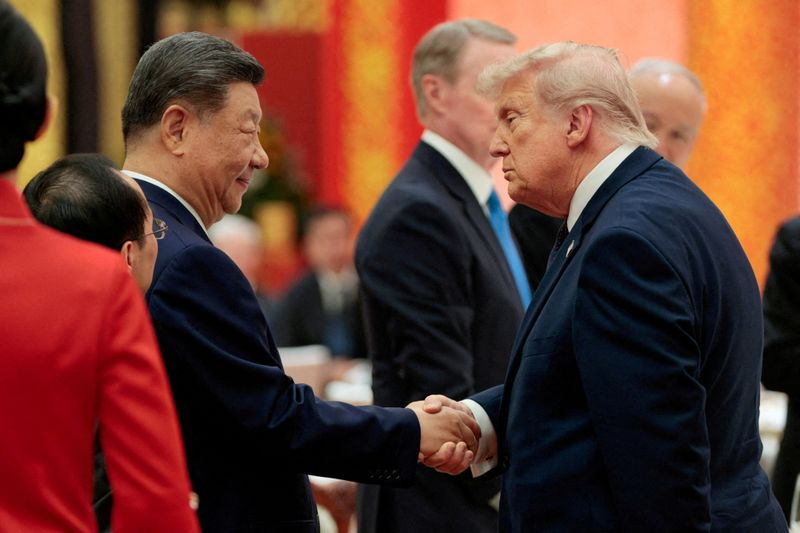
Iran is finished, should make deal to end war: Trump after talks with Xi Jinping
When pressed about China’s support for Iran, Trump stated that the topic was discussed with Xi, who assured him that China “is not going to give military equipment” to Iran
US President Donald Trump said Iran is “finished” and must either negotiate a deal to end the ongoing conflict or face destruction.
“Deal or annihilation for Iran,” Trump stated during an interview with Fox News on the final day of his three-day trip to China. He emphasised that the US cannot “let Iran have a nuclear weapon.”
“They’re finished now; they can make a deal, or they will be annihilated,” Trump said after in-depth discussions with Chinese President Xi Jinping on various issues, including Iran.
Trump was scheduled for one more meeting with Xi on Friday, followed by lunch before returning home, concluding his visit to China.
During the interview, Trump noted, “President Xi would like to see a deal between the US and Iran.”
He added that Xi offered assistance, saying, ‘If I could be of any help whatsoever, I would like to help.’ Trump expressed his belief that China also does not want Iran to possess nuclear weapons.
Additionally, Trump mentioned that General Dan Caine, Chairman of the Joint Chiefs of Staff, informed him that the US could decisively neutralise Kharg Island in Iran in just “four or five minutes.”
When pressed about China’s support for Iran, Trump stated that the topic was discussed with Xi, who assured him that China “is not going to give military equipment” to Iran. China currently purchases 90 per cent of Iranian oil and maintains a strategic partnership with Tehran, including close military ties.
Trump described Xi as a “warm person” who is “all business.” He expressed his appreciation for this, saying, “I like that – that’s a good thing. No games.”
He defended his positive remarks about his relationship with Xi, stating that he often faces criticism for praising certain leaders, but he respects Xi as a leader for China, a nation with nearly 1.5 billion people.
He called the military honour guard ceremony welcoming him “incredible,” adding, “If you went to Hollywood, you wouldn’t find that.”
Trump reiterated that his approach to relations with China has been successful, saying, “We do great with China,” and noted the strength of his friendship with Xi. “He’s a tremendous leader. He’s been here a long time, very powerful, very strong. There’s no doubt about it. We just have a good relationship,” he said.
Defending the military operations against Iran once again, Trump said they are much shorter than previous US conflicts, such as those in Vietnam and Iraq.
He stated that Iran’s navy has been taken out and that they currently lack air force and anti-aircraft capabilities. “They built it up a little bit. We’ll take it out in one day,” he declared.
Trump, who brought top CEOs of US firms, including Tesla Chief, Elon Musk and head of Apple Tim Cook, said the business leaders did fantastically well.
He described the meeting with American executives as a “good idea” but noted it was different from the original schedule.
Trump also mentioned that he encouraged Xi to “buy oil” from the US, to which Xi responded that he “likes the idea.
“They’re going to go to Texas. We’re going to start sending Chinese ships to Texas, to Louisiana and to Alaska. And I think that was another thing that was agreed to. That’s a big thing,” he said.
He expressed a desire to see China open up its markets, stating, “It would be unbelievable for our companies if they open it, and I think it would be good for China too.”
Trump mentioned that Xi agreed to order 200 Boeing jets during their “very good meeting,” stressing, “Big ones. That’s a lot.”
Additionally, he requested that China use Visa for trade and indicated that China is set to purchase a substantial amount of American agricultural products, which he described as “great.”