All posts by webadmin

Capt demands free hand for Indian Army to tackle barbaric acts of Pak Defends Army’s ‘human shield’ act in J&K

Capt demands free hand for Indian Army to tackle barbaric acts of Pak
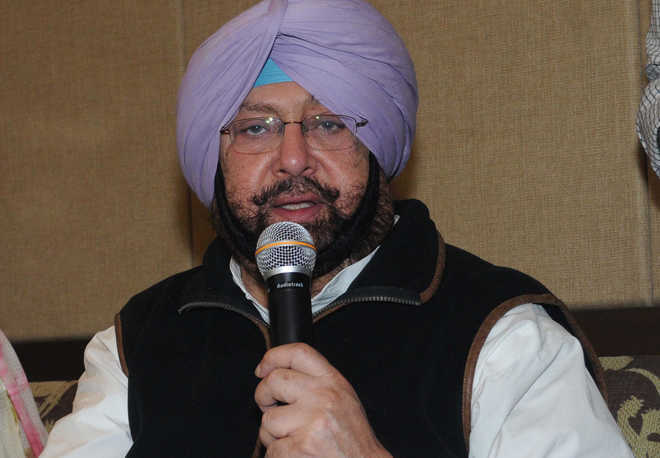
Punjab Chief Minister Capt Amarinder Singh. File photo

Tribune News Service

Chandigarh, May 1

Reacting strongly to the reported mutilation of two soldiers by Pakistan Army following a ceasefire violation in Poonch area of Jammu and Kashmir, Punjab Chief Minister Capt Amarinder Singh on Monday urged the Central Government to give a free hand to the Army to deal with such atrocities and barbaric acts.He also backed the Indian Army’s warning of “appropriate response” for the “despicable act.”In a similar vein, Amarinder also came down heavily on those criticising the Indian Army’s action of tying a man to a jeep to protect its soldiers from stone-pelters during the recent elections in Kashmir.Coming out in defence of Major Gagoi, under criticism from various quarters over his ‘human shield’ action, Capt Amarinder said the officer was simply doing his duty.In a Facebook post, the Chief Minister further said, “Had I been in the same situation I would have carried out the same action.”


Pak providing ‘safe haven’ to terrorists: Washington

Pak providing ‘safe haven’ to terrorists: Washington
Lashkar chief Hafiz Saeed continued to address large rallies in Pakistan, says report. — AFP file

Washington, July 19

The US on Wednesday listed Pakistan among the nations and regions providing “safe havens” to terrorists, saying terror groups like the LeT and JeM continue to operate, train, organise and fundraise inside the country in 2016.In its annual ‘Country Report on Terrorism’, as mandated by the Congress, the State Department said Pakistani military and security forces undertook operations against groups that conducted attacks within Pakistan such as Tehrik-e Taliban Pakistan.(Follow The Tribune on Facebook; and Twitter @thetribunechd)“Pakistan did not take substantial action against the Afghan Taliban or Haqqani, or substantially limit their ability to threaten US interests in Afghanistan, although Pakistan supported efforts to bring both groups into an Afghan-led peace process,” the State Department said.”Pakistan did not take sufficient action against other externally focused groups, such as Lashkar-e-Toiba (LeT) and Jaish-e-Mohammad (JeM) in 2016, which continued to operate, train, organise, and fundraise in Pakistan,” the report said.India, it said, continued to experience attacks, “including by Maoist insurgents and Pakistan-based terrorists”.Indian authorities continued to blame Pakistan for cross-border attacks in Jammu and Kashmir, it said.”In January, India experienced a terrorist attack against an Indian military facility in Pathankot, Punjab, which was blamed by authorities on JeM. Over the course of 2016, the Government of India sought to deepen counterterrorism cooperation and information sharing with the United States,” the State Department said.The Indian government continued to closely monitor the domestic threat from transnational terrorist groups like ISIS and Al-Qaeda in the Indian Subcontinent (AQIS), which made threats against India in their terrorist propaganda. A number of individuals were arrested for ISIS-affiliated recruitment and attack plotting within India, the report said.In a separate chapter, the State Department listed Pakistan as one of the safe havens of terrorism.The State Department said numerous terrorist groups, including the Haqqani Network (HQN), the LeT and JeM, continued to operate from Pakistani soil in 2016.‘Lashkar wings openly engaged in fundraising’“Although LeT is banned in Pakistan, LeT’s wings Jamaat-ud-Dawa (JuD) and Falah-i-Insaniat Foundation (FiF) were able to openly engage in fundraising, including in the capital,” it said.”LeT’s chief Hafiz Saeed (a UN-designated terrorist) continued to address large rallies, although in February 2017, Pakistan proscribed him under relevant provisions of Schedule Four of the Anti-Terrorism Act, thus severely restricting his freedom of movement,” it noted.The 2015 ban on media coverage of Saeed, JuD, and FiF continued and was generally followed by broadcast and print media, it said.According to the State Department, the Pakistani government did not publicly reverse its December 2015 declaration that neither JuD nor FiF is banned in Pakistan, despite their listing under UN sanctions regimes, although in January 2017, Pakistan placed both organisations “under observation” pursuant to Schedule Two of the Anti-Terrorism Act.While not a ban, keeping the outfits under observation allows the government to closely scrutinise the activities of both organisations.On November 11, Pakistan’s National Counterterrorism Authority published its own list of banned organisations that placed JuD in a separate section for groups that are “under observation” but not banned.Pakistan continued military operations to eradicate terrorist safe havens in the Federally Administered Tribal Areas, although their impact on all terrorist groups was uneven, it said.In its report to the Congress, the State Department said in 2016, India and the United States pledged to strengthen cooperation against terrorist threats from groups, including al-Qaeda, the ISIS, JeM, LeT and D-Company (Dawood Ibrahim’s group), including through greater collaboration on designations at the UN.Indian and US leaders directed officials to identify new areas of collaboration through the July US-India Counterterrorism Joint Working Group, applauded finalisation of a bilateral arrangement to facilitate the sharing of terrorism screening information, and called upon Pakistan to bring the perpetrators of terrorist attacks against India to justice, the report said.The United States and India worked together to designate JeM leader Maulana Masood Azhar, although the listing was blocked in the UN 1267 Committee, the State Department said.Other areas mentioned in the report as safe havens are Afghanistan, Somalia, the Trans-Sahara, Sulu/Sulawesi Seas Littoral, Southern Philippines, Egypt, Iraq, Lebanon, Libya, Yemen, Columbia and Venezuela. — PTI

Pak sends back J&K cop who had crossed over 3 years back

Jammu, June 22

A policeman of Jammu and Kashmir, who had inadvertently crossed over to Pakistan three years back, was on Friday sent back home.Constable Sohan Lal was handed over to the BSF by the Pakistan Rangers at the Wagah border in Punjab, BSF DIG Dharminder Pareek said here.“Following the persistent efforts by Jammu Frontier of BSF with Pakistan Rangers, the Rangers handed over Constable of J&K Police Sohan Lal to the BSF at Wagah border in Punjab today,” Pareek said.Lal had inadvertently crossed over to Pakistan in R S Pura sector in 2014, he said. — PTI


Army bids adieu to slain soldier

Army bids adieu to slain soldier
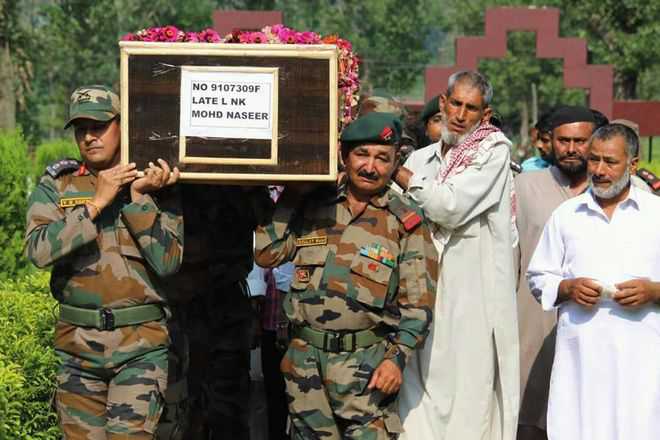
Army personnel and local villagers carry the coffin of slain soldier Lance Naik Mohammed Naseer to his village in Ajout, Poonch district, 260 km from Jammu, on Sunday. PTI

Tribune News Service

Jammu, July 16

The Army today paid bid adieu to Lance Naik Muhammad Naseer, who was martyred on the Line of Control (LoC) in the Rajouri sector yesterday while responding valiantly to unprovoked firing by Pakistan at the Line of Control (LoC).Wreath-laying ceremonies were organised at Rajouri and Poonch where wreaths were laid on behalf of the GOC-in-C, Northern Command, GOC, 16 Corps, GOC, 25 Division and the Commander, 93 Brigade.The mortal remains of the soldier were then sent to his native village for performing the last rites. Lance Naik Naseer, a native of Poonch district, is survived by his wife and three children.


Tensions rise in Pak

Tensions rise in Pak

All is apparently not well between the Pakistani military and the civilian administration once again. Reports indicate that tensions rose on Saturday following a public rejection of the civilian government’s findings of Dawn newspaper report probe by the military. Pakistan Prime Minister Nawaz Sharif on Saturday sacked his Special Assistant on Foreign Affairs Syed Tariq Fatemi and sought action against Principal information officer Rao Tehsin of the Ministry of Information following the Inquiry Committee’s recommendations. In a story published last year, Dawn claimed that the government had told the military to act against militants or face international isolation. The report caused a friction between the civilian administration and the military prompting the government to set up a probe committee. Islamabad had also decided to bar senior journalist Cyril Almeida from leaving his country after writing that exclusive report. Speculation suggests that Islamabad had wanted the story to go public. The aim was to tell the world that Islamabad is doing its part to defang home-grown militancy and embarrass the military establishment. But the use of “non-state” by the Pakistani military establishment has been institutionalised. Some commentators in India have even suggested that the report was part of Islamabad’s strategy to regain some control over national security. But the civilian leadership was seemingly unable to follow through on its gambit. There is speculation that Sharif administration has thrown senior officials and the newspaper under the bus to save itself from the military’s wrath. One can only conclude that the civilian leadership exercises little power, especially in matters of foreign policy and national security. The Panama Papers leak has already rendered Sharif vulnerable. In the past, he has offered little resistance to the military as it has steadily encroached on his authority. How will Sharif react to the military’s latest rebuff? We don’t have the answers yet.

Read more at: http://www.millenniumpost.in/editorial/tensions-rise-in-pak-239309


India developing nuclear arsenal with an eye on China: US experts

Washington, July 13

India continues to modernise its atomic arsenal with an eye on China and the country’s nuclear strategy which traditionally focused on Pakistan now appears to place increased emphasis on the Communist giant, two top American nuclear experts have said.An article published in the July-August issue of the digital journal- After Midnight has also claimed that India is now developing a missile which can target all of China from its bases in South India.India is estimated to have produced enough plutonium for 150–200 nuclear warheads but has likely produced only 120–130, wrote Hans M Kristensen and Robert S Norris in the article — “Indian nuclear forces 2017”.India’s nuclear strategy, which has traditionally focused on Pakistan, now appears to place increased emphasis on China, the two experts claimed. — PTI


Top LeT commander, aide ‘killed’ in Kulgam encounter 2 civilian protesters shot by security men at the site in Arwini area

Top LeT commander, aide ‘killed’ in Kulgam encounter
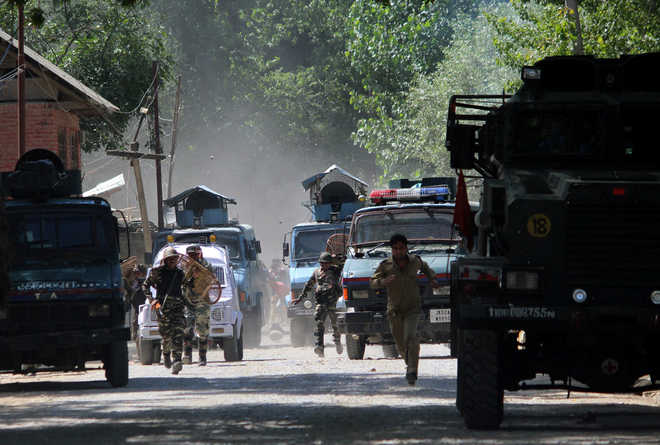
Security personnel chase away stone-throwers from the encounter site at Arwini village in Kulgam district on Friday. Tribune photo: Amin War

Suhail A Shah

Anantnag, June 16

A top Lashkar-e-Toiba (LeT) commander is among two militants believed to be killed in an ongoing encounter in the Arwini area of south Kashmir’s Kulgam district, 42 km south of Srinagar.Two civilians have also been shot dead, allegedly by security forces, during clashes that erupted around the site of the encounter.Though the firing has stopped at the encounter site, the bodies of militants are yet to be retrieved and the operation is still not over, officially.According to reports, security forces cordoned off the Malik Mohalla locality in Arwini early Friday morning on a tip-off regarding presence of militants in the area.“There has been intermittent exchange of fire throughout the day and we believe two militants have been gunned down. The exchange of fire has halted since around 4 pm now,” a senior police official said.Though the bodies are yet to be retrieved, the police believe that one among the slain militants might be a most wanted Lashkar commander, Junaid Mattoo.Mattoo’s name was in the 12 most wanted militants list issued recently by the Army in Kashmir. He carried a bounty of Rs 10 lakh on his head.“Efforts are on to retrieve the bodies from the rubble of the house they were hiding in,” police sources said.Local sources said at least three houses had been razed to ground by the bombardment carried out by security forces.Meanwhile, as the encounter was on hundreds of local youth assembled and in a bid to give trapped militants an escape route engaged security forces by stone-throwing. Security forces fired live ammunition, pellets and tear-smoke shells to disperse the protesters leaving two civilians dead and more than 30 injured, at least 10 of them with bullet wounds.The slain civilians have been identified as 22-year-old Muhammad Ashraf Khar of Khar Mohalla in Arwini and 14-year-old Ahsan Dar of Shamsipora village in neighboring Anantnag district.Both of them have been shot in the chest as confirmed by the health officials at District Hospital, Anantnag, and Sub-District Hospital, Qaimoh, Kulgam district.Chief Medical Officer (CMO), Kulgam, Dr Muhammad Shafi confirmed the killing of Ahsan Dar at Qaimoh Sub-District Hospital and said different hospitals in Kulgam treated around 10 other injured youth. “Five of them had firearm injuries,” he said.In Bijbehara Sub-District Hospital 10 more injured were treated, four of them with bullet injuries.“Two with bullet injuries and three others with pellet injuries in their eyes have been shifted to Srinagar for specialised treatment,” Block Medical Officer (BMO), Bijbehara, Dr Showket, said. In Anantnag district Hospital nine injured, two of them with bullet injuries, were treated.“They were all stable while one of the injured, Muhammad Ashraf, succumbed to his injuries here,” Medical Superintendent (MS) of the hospital Dr Majid Mirab said. A combing operation of the encounter site was on while this report was filed.

Bodies yet to be retrieved

  • Though the bodies are yet to be retrieved, the police believe that one among the slain militants might be a most wanted Lashkar commander, Junaid Mattoo
  • Mattoo’s name was in the 12 most wanted militants list issued recently by the Army in Kashmir. He carried a bounty of Rs 10 lakh on his head

GORKHA STIR Violence, arson back in Darjeeling GTA office, rly station set on fire; several government vehicles damaged

Violence, arson back in Darjeeling
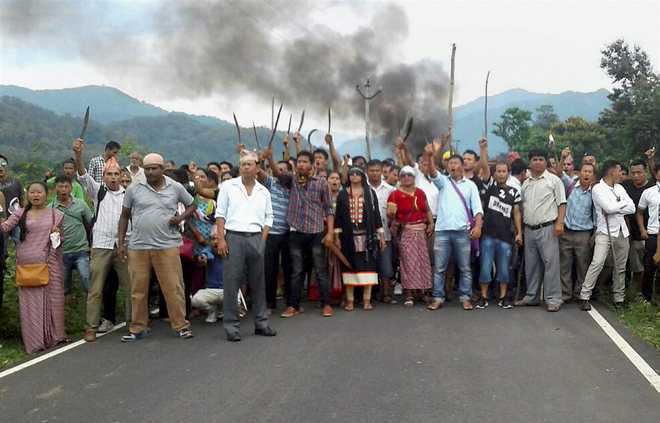
Gorkha Janmukti Morcha activists block a road at Panighata in Siliguri on Thursday. PTI

Darjeeling, July 13

A GTA office was set on fire and several vehicles were damaged in Darjeeling today as the indefinite shutdown in the hills entered the 29th day.The Gorkhaland Territorial Administration (GTA) office for travel and tourism in Chowrastha of Mall Road in Darjeeling was set ablaze by pro-Gorkhaland supporters early morning. Several government vehicles were also damaged near the Darjeeling station by unidentified men last night.A railway station in Gayabari area of Kurseong was set on fire by pro-Gorkhaland supporters this morning. A forest bungalow near Teesta river was also set on fire today.The convoy of state tourism minister Gautam Deb was also attacked on the way to Darjeeling’s Panighatta where the minister was going to attend a programme on the occasion of poet Bhanubhakta Acharya’s birth anniversary.Meanwhile, responding to the call of the Gorkhaland Movement Coordination Committee (GMCC), a writer and a singer returned the awards given to them by the state government.The GJM and pro-Gorkhaland supporters today celebrated the birth anniversary of noted Nepali poet Bhanubhakta Acharaya. Hundreds of Pro-Gorkhaland supporters today took out colourful rallies reciting poems written by Bhanubhakta Acharya and carrying placards in favour of separate state of Gorkhaland. Internet services remained suspended for the 26th day.Except medicine shops, all the shops, restaurants, schools, colleges, hotels and private offices remained closed. The police and the security forces maintained a tight vigil at all entry and exit points.

‘Hold tripartite meet’

CPM general secretary Sitraram Yechury on Thursday said Union Home Minister Rajnath Sigh must convene a tripartite meeting of representatives of the Centre, state government and GJM leaders to restore peace in the region. — TNS & PTI

Gorkhas return awards

  • Expressing support for a separate Gorkhaland state, Gorkha public figures gave up their awards on the birth anniversary of Nepali poet Bhanubhakta Acharya
  • Those who gave up their awards are Nepali writer and translator Krishna Singh Moktan, musician Karma Younzon and Principal of Kurseong College Prakash Pradhan
  • “More than any award, it is Gorkhaland which is important for us. Once it is formed,I will receive many awards from it,” said Younzon,who received the ‘Sangeet Samman’ last year

117 kg nilgai meat, 40 guns seized during raid on ex-Army officer’s house

117 kg nilgai meat, 40 guns seized during raid on ex-Army officer's house
These deer heads were among the things seized from the retired Colonel’s house. ANI photo

Meerut, April 30

At least 117 kg nilgai meat, animal skin, ivory and 40 guns have been seized from the house of a retired Army officer here during a 17-hour-long joint raid conducted by the Directorate of Revenue Intelligence and the forest department.

(Follow The Tribune on Facebook; and Twitter @thetribunechd)

A team of DRI officials reached the Civil Lines residence of Colonel (retd) Devindra Kumar yesterday in the afternoon and the raid continued till 3:30 am.

Kumar’s son Prashant Bishnoi is a national-level shooter.

A DRI official said the raid was conducted in connection with a disproportionate assets case. Five skulls of deer, horns of sambar deer, antlers of antelopes and black bucks, animal skin and ivory were seized from a makeshift warehouse in Kumar’s residence.

Chief Conservator of Forests Mukesh Kumar said: “The meat of blue bull was seized from a refrigerator. A sample was taken and it will be sent to laboratory for testing”. Action will be taken against the retired army officer and Bishnoi under relevant provisions of the Wildlife Protection Act, 1972, though no case has been registered against them yet, he said. — PTI


Pakistan’s back in the Great Game

Washington’s disinterest and Beijing’s ascent are helping Islamabad gain ground in Afghanistan

The horrific suicide bomb attack in Kabul on May 31 that left 150 dead, and subsequent similar attacks at a funeral a few days later briefly brought Afghanistan back into the news. But only briefly since the British elections, the string of terrorists’ attacks in that country and general consternation with Trump’s antics and shenanigans meant that Afghanistan soon receded from public attention. This has meant that Pakistan’s game of gaining ‘strategic depth’ has gained substantial traction and the constitutional framework set in motion with the ouster of the Taliban in 2001 is in real danger of unravelling.

America’s failure to stabilise Afghanistan has led to a sense of fatigue about that country as reflected in the minuscule coverage of the terrible acts of terrorists’ violence that has grown unabated in recent years. America has also been distracted by its domestic political wrangling that marked the presidential election campaign, and has worsened with the coming into office of Donald Trump. This has allowed Pakistan to rearrange regional power equations quite dramatically, ably supported by China who brought in the Russians onto the same side. While the Islamic State Khorasan Province (ISKP) has made its appearance in the eastern Afghan province of Nangrahar, its influence and ability to launch terrorist strikes has been exaggerated to achieve this. American missteps and the Iranian tendency to adventurism has meant that over the past decade, Iran and the Taliban have become close tactical allies. The result is that despite stepped up terrorists attacks aimed at civilians, the Taliban is being presented by these countries as a moderate player that should have a key role in any peace process.

Russia has admitted to opening up lines of communications to the Taliban and even initiated a dialogue process along with China and Pakistan. The Afghan government strongly objected and had to be brought in along with regional stakeholders, India and Iran. Neither the US, the main military and economic player in Afghanistan, nor NATO were part of these talks. Russia took the stand that while violence was unacceptable, the Taliban were very much relevant players. Expectedly, the talks went nowhere; but helped build the case that it was the Taliban alone who held the veto over any attempted peace process.

The disputed elections of 2014 led to the US-backed uneasy coalition between President Ashraf Ghani and his challenger Dr. Abdullah Abdullah, who was given a new title, chief executive; but if anything, dissonance in governance has only enlarged. Initially Ghani made bold moves to placate Pakistan in the belief that it would lead to peace. What Afghanistan saw was increased violence, especially suicide attacks on civilians in crowded places leading to hundreds of causalities. The aim of damaging the credibility of the Afghan government by showing up its inability to protect its citizens was achieved very substantially. This has allowed Pakistan to emerge as the key interlocutor on behalf of the Taliban even as it continued to deny that it had anything to do with them. Exhaustion and distraction meant that the US and other western countries were happy to buy this fiction if it allowed them to quietly exit Afghanistan.

President Ghani’s failure to build a cohesive and inclusive government, or to establish working relations with parliament, whose term has incidentally expired, has meant that the Afghan government is internally hobbled and unable to deliver on good governance. The agreement that set up the National Unity Government with Abdullah in 2014 required that within two years the constitution would be amended to provide for a prime minister, has not happened. The largely non-Pashtun Jamiat from whose ranks Abdullah, foreign minister Rabbani and many more joined the government, has started speaking up as an opposition party. They led a big anti-government demonstration two days after the May 31 terrorist attacks leading to police firing with six dead including the son of the deputy speaker of the upper house of parliament. The next day, at his funeral, attended by Abdullah, Rabbani and others, three bombs went off killing nine persons. Jamiat leaders like Governor Atta of Balkh blamed persons within the government for the complicity in the May 31 bomb blast. And for the same reason, Rabbani boycotted his own government’s Kabul Peace Process presided over by President Ghani.

Trump’s effectively ceding leadership to China on many fronts has meant that Pakistan is emboldened enough to try and push the Afghan government hard enough for them to acknowledge that Pakistan would have de facto control over Afghan affairs, something it tried to do after 1989 Russian withdrawal. At present, the momentum seems to be favouring them as neither is the Afghan government united nor are the security forces in a condition to take the initiative back from the Taliban. If these trends are not reversed, Afghanistan could see increased violence that could potentially spill over its borders.