All posts by webadmin

Five developments that impacted India’s security situation in 2016

A worsening of the security situation in Jammu and Kashmir (J-K), the signing of a $8.9-billion (Rs 60,520 crore) deal for French Rafale fighter jets, and new deals for artillery were among the top five determinants of India’s uncertain security situation in 2016. India made many high-profile defence purchases in 2016 and carried out a much-publicised “surgical strike” against Pakistan-based terrorists, but an IndiaSpend examination of defence data revealed gaping security holes.

India became the world’s fourth-largest defence spender in 2016 with a military budget of $50.7 billion (Rs 3.4 lakh crore)-nine times the health budget for the same year-an increase of 8% over 2015 ($46.6 billion or Rs 3.2 lakh crore), according to the 2016 Jane’s Defence Budgets Report, released by the UK-based research firm IHS Markit.

India’s 2016 military budget was around a quarter of China’s $191 billion or Rs 13 lakh crore.

Here are the five top reasons that made India feel more (and less) secure in 2016:

1. J&K security situation deteriorates after ‘surgical strikes’

The Indian Army conducted “surgical strikes”-as the government called them-against terrorists within Pakistan-occupied Kashmir (PoK) on September 30, 2016. Since then, at least 33 Indian security-personnel have been killed in J&K, according to data collated by IndiaSpend from various news sources.

As many as 71 Indian security forces personnel were killed this year by terrorists in J&K, as of November 27, 2016, up 82% since 2015, when 39 soldiers were killed, according to data tabled by the home ministry in the Lok Sabha (lower house of Parliament).

Injuries among security personnel doubled since last year to 208. Incidents of terrorist violence in J&K increased 47% to 305 in 2016, from 208 in 2015.

The data indicate that terrorist activities increased over 2016 in J&K compared to 2015, IndiaSpend reported on November 25, 2016.

2. 36 new Rafale, 120 Tejas jets cleared; Air Force currently short of 200 aircraft

India signed a $8.9 billion (Rs 60,520 crore) deal with France to purchase 36 Rafale fighter planes, forming two squadrons of the Indian Air Force (IAF).

The IAF is down to 32 fighter squadrons, the lowest in a decade, NDTV reported on February 26, 2016. It should have 42 squadrons or around 670 to 750 aircraft.

The IAF also inducted two indigenously developed Tejas Light Combat Aircraft (LCA) and hopes to add on six squadrons (120 aircraft) of the Tejas by 2022.

The government is reportedly looking to buy up to an additional 200 single-engined fighter aircraft (10 to 11 squadrons) of foreign origin to be produced in India. The 200 foreign fighter aircraft to be built in India are unlikely to be ready by then, since new factories will have to be built after a deal-not an immediate prospect-is signed.

3. India buys 250+ artillery guns, needs at least 3,000

The defence ministry approved the production of 114 dhanush (bow) howitzers in June 2016, the first artillery system purchased by India since the Swedish Bofors gun in the 1980s. India also signed a deal to purchase 145 ultra-light M777 howitzers from the US for $737 million (Rs 5,000 crore).

The Indian Army requires 3,000-3,200 howitzers of various calibres, as envisaged first under a 17-year-old plan.

4. Missiles: A major hit and a major miss

India successfully tested the 5,000-km range Agni V (Fire) on December 26, 2016, bringing it one step closer towards being formally deployed by the strategic forces command.

The nuclear-capable Agni V is an intercontinental ballistic missile, capable of reaching all parts of Pakistan and China, IndiaSpend reported in May, 2015.

However, on December 21, 2016, a test of the 1,000-km ranged subsonic nuclear-capable Nirbhay (fearless) land-attack cruise missile failed. Out of four Nirbhay tests, three failed.

India’s entry into the Missile Technology Control Regime-an international agreement which will allow New Delhi to trade in high technology-in June helped pave way for India and Russia to extend the range of the jointly developed supersonic Brahmos missile beyond 300 km.

5. Submarine modernisation inches forward, Navy requires 20 more

The much delayed INS Kalvari, the first of the six French Scorpene-class submarines being manufactured in India, is undergoing sea trials and might be commissioned early in 2017. But India now has 14 operational submarines, according to Indian Navy data, and requires 20 more, as IndiaSpend reported in July 20, 2015.

The Scorpene project suffered a setback after nearly 22,000 classified pages explaining the submarines’ combat and performance capabilities were leaked by an Australian newspaper in August. The Navy said the leak was not critical.

India reportedly attained a nuclear triad-the capability to launch nuclear weapons from land, air and sea-by quietly commissioning the nuclear-powered ballistic missile submarine INS Arihant in October.

The Indian Navy commissioned INS Chennai, the third and last of the Kolkata class destroyers. India also signed a deal with Russia to purchase four guided-missile stealth frigates.

(Sethi is a Mumbai-based freelance writer and defence analyst.)

This story first appeared on Indiaspend. Indiaspend.org is a data-driven, public-interest journalism non-profit


Pak media notes Modi-Aziz handshake in Amritsar

Pak media notes Modi-Aziz handshake in Amritsar
Aziz reached Amritsar last evening to attend the Heart of Asia conference. File photo

Islamabad, December 4

Pakistan’s media on Sunday took note of the handshake and exchange of niceties between Prime Minister Narendra Modi and Pakistan prime minister’s advisor on foreign affairs Sartaj Aziz at Amritsar amid deadly border skirmishes and rhetoric.Aziz reached Amritsar last evening to attend the Heart of Asia conference, instead of this morning apparently to dodge early morning fog.The change of schedule provided a subtle opportunity for a handshake and exchange of pleasantries with Modi who hosted a banquet for the delegates.The Express Tribune’s front-page headline said, “Aziz-Modi handshake sets off media frenzy”, and wrote under it: “After months of war rhetoric and deadly border skirmishes, Indian and Pakistani officials exchanged niceties and set the media abuzz on Saturday”.”With a broad smile on his face, Indian Prime Minister Narendra Modi shook hands with Pakistan’s Foreign Affairs Adviser Sartaj Aziz at a banquet he had hosted for the participants of the Heart of Asia conference in Amritsar,” the article said.The paper reported that Modi also asked about the health of his Pakistani counterpart Nawaz Sharif who had recently undergone open-heart surgery in a London hospital.Aziz conveyed “good wishes” to the Indian leader on behalf of Sharif.The Dawn reported that Aziz was received by Pakistan High Commissioner to India Abdul Basit and the joint secretary of Indian Ministry of External Affairs.”Sartaj Aziz also sent a bouquet to Indian External Affairs Minister Sushma Swaraj at her residence, extending his sincere good wishes for her full and speedy recovery,” it said.The News International reported that Modi shook hands with Aziz and inquired after the well being of Prime Minister Nawaz Sharif from him.”Aziz said Nawaz Sharif is well and he has also expressed good wishes for him,” it further reported.It also reported that Aziz sent a bouquet to Swaraj at her residence extending good wishes for her speedy recovery. Pakistan was unanimous that no meeting between Pakistani and Indian officials on the sidelines was expected due to the ongoing bilateral tension.”Contrary to Indian media reports, no actual talks took place during the banquet. Nonetheless, the customary handshake after months of belligerence and hostilities set off media frenzy in both countries,” according to the Express Tribune.Relations between India and Pakistan have been strained following the Uri terror attack in September that killed 19 Indian soldiers. — PTI


Agni-V’s 4th test a success, India in elite missile club

Agni-V’s 4th test a success, India in elite missile club

Ajay Banerjee

Tribune News Service

New Delhi, December 26

In a major leap for India’s defence scientists, the country has moved closer to an exclusive club of countries having abilities to deliver a nuclear warhead at a distance of more than 5,550 km.The fourth consecutive test of the long-range ballistic missile Agni-V was successful this morning. The version fired today is road-mobile-on-truck, and is the one that is ‘final delivery version’ for deployment by the Army. The 50-tonne missile is in its final stage of tests before it can be inducted. No dates have been given for induction and this being a nuclear-tipped missile, there seems little possibility of a formal announcement. The missile can be moved on specialised trucks, allowing greater scope of rapid deployment. Today, the Agni-V’s re-entry system worked perfectly. The nose-cone that encases the warhead is made of composites, which can withstand a searing temperature of 3,000 degrees Celsius when the missile re-enters the earth’s atmosphere.The Agni series are nuclear-warhead capable with Agni-I being the lowest end of the spectrum having a range of 700 km. The Ministry of Defence said, “Agni-V, the long range surface-to-surface ballistic missile, was successfully flight-tested by DRDO from Abdul Kalam Island (new name for Wheeler Island), Odisha.”President Pranab Mukherjee, Prime Minister Narendra Modi and Defence Minister Manohar Parrikar congratulated the DRDO for the successful test-firing. The previous successful missions were executed on April 19, 2012, September 15, 2013, and January 31, 2015. 

clip

clip


THE FORGOTTEN 54

On 16th of December 2016 India will celebrate the 45th anniversary of a landmark event in its modern history. It will celebrate the day on which during the 1971 India Pakistan war, the Pakistani forces in the east agreed to a complete and unconditional surrender. It is the day on which the 1971 war ended.
Well, it ended for most of the nation. But there are 54 families for whom the war and the waiting never ended. The agonizing wait goes on to this day. These are the families of the 54 Indian prisoners of war PoW who were never released by Pakistan after the war. Their names are as follows:-
Indian Army
1. Major SPS Waraich IC-12712 15 Punjab
2. Major Kanwaljit Singh Sandhu IC-14590 15 Punjab
3. 2/Lt Sudhir Mohan Sabharwal SS-23957 87 Lt Regiment
4. Capt Ravinder Kaura SS-20095 39 Med Regiment
5. Capt Giri Raj Singh IC-23283 5 Assam
6. Capt Om Prakash Dalal SS-22536 Grenadiers
7. Maj AK Ghosh IC-18790 15 Rajput
8. Maj AK Suri SS-19807 5 Assam
9. Capt Kalyan Singh Rathod IC-28148 5 Assam
10. Major Jaskiran Singh Malik IC-14457 8 Raj. Rifles
11. Major SC Guleri IC-20230 9 Jat
12. Lt Vijay Kumar Azad IC-58589 1/9 G R
13. Capt Kamal Bakshi IC-19294 5 Sikh
14. 2/ Lt Paras Ram Sharma SS-22490 5/8 G R
15. Capt Vashisht Nath
16. L/Hv. Krishna Lal Sharma 13719585 1 JAK RIF
17. Subedar Assa Singh JC-41339 5 Sikh
18. Subedar Kalidas JC-59 8 JAKLI
19. L/Nk Jagdish Raj 9208735 Mahar Regiment
20. L/Nk Hazoora Singh 682211303
21. Gunner Sujan Singh 1146819 14 Fd Regiment
22. Sepoy Daler Singh 2461830 15 Punjab
23. Gnr Pal Singh 1239603 181 Lt Regiment
24. Sepoy Jagir Singh 2459087 16 Punjab
25. Gnr Madan Mohan 1157419 94 Mountain Regiment
26. Gnr Gyan Chand Gnr Shyam Singh
27. L/Nk Balbir Singh S B S Chauhan
28. Capt DS Jamwal 81 Field Regiment
29. Capt Washisht Nath Attock
Indian Air Force
30. Sq Ldr Mohinder Kumar Jain 5327-F(P) 27 Sqn
31. Flt Lt Sudhir Kumar Goswami 8956-F(P) 5 Sqn
32. Flying Officer Sudhir Tyagi 10871-F(P) 27 Sqn
33. Flt Lt Vijay Vasant Tambay 7662 –F(P) 32 Sqn
34. Flt Lt Nagaswami Shanker 9773-F(P) 32 Sqn
35. Flt Lt Ram Metharam Advani 7812-F(P) JBCU
36. Flt Lt Manohar Purohit 10249(N) 5 Sqn
37. Flt Lt Tanmaya Singh Dandoss 8160-F(P) 26 Sqn
38. Wg Cdr Hersern Singh Gill 4657-F(P) 47 Sqn
39. Flt Lt Babul Guha 5105-F(P)
40. Flt Lt Suresh Chander Sandal 8659-F(P) 35 Sqn
41. Sqn. Ldr. Jal Manikshaw Mistry 5006-F(P)
42. Flt Lt Harvinder Singh 9441-F(P) 222 Sqn
43. Sqn Ldr Jatinder Das Kumar 4896-F(P) 3 Sqn
44. Flt Lt LM Sassoon 7419-F(P) JBCU
45. Flt Lt Kushalpal Singh Nanda 7819-F(N) 35 Sqn
46. Flg Offr. Krishan L Malkani 10576-F(P) 27 Sqn
47. Flt Lt Ashok Balwant Dhavale 9030-F(P) 1 Sqn
48. Flt Lt Shrikant C Mahajan 10239-F(P) 5 Sqn
49. Flt Lt Gurdev Singh Rai 9015-F(P) 27 Sqn
50. Flt Lt Ramesh G Kadam 8404-F(P) TACDE
51. Flg Offr. KP Murlidharan 10575-F(P) 20 Sqn
52. Sqn Ldr Devaprasad Chatterjee
53. Plt Offr Tejinder Singh Sethi
Indian Navy
54. Lt. Cdr Ashok Roy
Every single name that you read here is a soldier who fought for India. They were captured in action and spent the rest of their lives rotting in Pakistani jails. Can you imagine the type of mental agony that they must have undergone there? They must have lived in hope that one day they will be released and slowly the hope faded away. It has been 45 years. How many of them will be alive and in what condition? What kind of miserable existence they must have endured over there? What kind of physical and mental torture they must have endured there? 
Imagine a loved one from your family in that position. What do you feel? Multiply that feeling a thousand times over. That is what these 54 families have felt every day for the last 45 years.   
The evidence
There is ample evidence for the existence of these 54 prisoners in the Pakistani jails. Consider some of the evidence:-
• Then on December 26, 1974, R.S. Suri received a hand-written note dated December 7, 1974 from his son. The letter contained a slip in which his son had written, “I am okay here.” The covering note read, “Sahib, valaikumsalam, I cannot meet you in person. Your son is alive and he is in Pakistan. I could only bring his slip, which I am sending you. Now going back to Pak.” Signed M. Abdul Hamid. In August, 1975, he received another missive postmark dated ‘June 14/15/16, 1975, Karachi.’ The letter said, “Dear Daddy, Ashok touches thy feet to get your benediction. I am quite ok here. Please try to contact the Indian Army or Government of India about us. We are 20 officers here. Don’t worry about me. Pay my regards to everybody at home, specially to mummy, grandfather – Indian government can contact Pakistan government for our freedom.” The then Defence Secretary had the handwriting confirmed as Ashok’s and changed the official statement from “killed in action” to “missing in action”!
• Maj AK Ghosh’s photograph was published in Time Magazine dated 27-12-1971 The photograph is proof that Maj AK Ghosh was in Pakistani custody when the war ended on 17 December 1971. He did not return with the POWs in 1972 at the time of the Simla agreement. He may have died in the interim period in a Pakistani jail. Surely there must be some record of that. The Indian and Pakistan governments can work together to find out what happened to such men. Why were some names not included in the POW list is again a moot point.
• Mohanlal Bhaskar repatriated on 09.12.1974 writes “Main Bharat ka jasoos tha” or “ I spied for India” Mohanlal Bhaskar, who was in a jail between 1968 and 1974 and repatriated on 09.12.1974 wrote a book in Hindi ( I was a spy for India) and gave a signed affidavit stating that he met a Col Asif Shafi of Second Punjab regt of Pakistan and a Maj Ayaaz Ahmed Sipra in Fort of Attock imprisoned for conspiring against Bhutto in the infamous “Attock conspiracy” . The Pakistani Major Ayaaz Ahmed Sipra spoke of his befriending a Gill of the Indian Air Force and a Captain Singh of the Indian Army as well as mentioning that there were around 40 Pows of the 1965 and 1971 wars in that jail who had no chances of release
• In the Attock Conspiracy, several officers of Pakistan’s army and air force were arrested on March 30, 1973, on charges of conspiring to overthrow the government of Zulfiqar Ali Bhutto. The detainees included Major Farooq Adam, Major Nadir Pervez (who later became a federal minister in the Nawaz Sharif government), Brigadier Wajid Ali Shah, Colonel Hamdani, and Major Ayaz Sipra, and a total of 59 officers were declared conspirators. The case is well known as the Attock conspiracy. Fifteen army and four air-force officers were found guilty of conspiracy and were handed jail terms ranging from three months to life. In this conspiracy, 15 officers were sentenced to terms in prison – among them Maj Ayaaz Ahmed Sipra and Col Asif Shafi. Others such as Farooq Adam (a Gallian, i.e. from Lawrence school, Ghoraghali) were also sentenced in the Attock conspiracy. Ayaaz Ahmed and Shafi later apparently moved to the US where Shafi was again traced by Manish Jain (son in law of Sqn Ldr Jain, another Indian officer missing and believed to be in Pakistani jails since the 1971 war) and Shafi confirmed to Jain unofficially that he had met Wg Cdr Gill in Attock in 2000 in a telephonic conversation.
• A Pakistani General, General Riaz, Governor NWFP who subsequently died in an accident informed Mr Ashwini Kumar, then IG of the Border Security Force as a personal favour to him at the Munich Olympics in 1972 that Major Waraich was being held in Dargai jail, NWFP.
• In her biography of Benazir Bhutto, British historian Victoria Schoffield reported that a Pakistani lawyer had been told that Kot Lakhpat prison in Lahore was housing Indian prisoners of war from the 1971 war. They could be heard screaming from behind a wall, according to an eyewitness within the prison.
• Pakistani media outlets have also alluded to the men’s existence. The shooting down of Wing Commander Heresen Gill’s Mig 21 on 3 December 1971 was followed that day by a radio broadcast in which military spokesperson claimed that an ‘ace Indian pilot’ had been captured.
• An American general Chuck Yeager also claimed in his autobiography that during the 1971 war, he personally interviewed Indian pilots captured by Pakistan. The airmen were of particular inertest to Americans because at the height of the cold war the men had attended training in Russia and were flying Russian designed and manufactured aircraft.
• The families also claimed that on the two occasions when they were allowed to visit the Pakistani jails, the jail guards privately attested to the men being alive – before being ushered away by the prison authorities.   
Why?
The question is – Why were these men not released by Pakistan? Was it because Pakistan wanted to extract some sort of revenge for the loss in the 1971 war? Was it because these men had come to know of some secrets that Pakistan did not want the world to know? Did Pakistan want to use them as a bargaining chip of some sort for the future? 
Maybe it is all of the above reasons. But the biggest reason is that India forgot them. These men are the forgotten 54 of India. The ruling elite and the bureaucracy of the nation did not find it fit or suitable to keep these men and their release on their agenda. It was because this was not an issue strong enough to dictate the political, professional or financial fate of any politician or bureaucrat. Nobody in the decision making echelons had time for them. 
Who is responsible?
What sort a nation are we that forgets it’s soldiers after the war is over? Was it not the collective responsibility of the nation to pressurize the governments to take this issue more seriously? After all, these PoW are somebody’s sons, brothers, husbands and fathers. Every nation and society is morally obliged to ensure that those fighting for it’s independence are looked after well in their hour of need. There can be no need more urgent than being released from the inhuman captivity of an enemy like Pakistan. 
After the war the ruling class and he elite got busy trying to ‘improve relations’, they very conveniently swept this issue under the carpet. Over the years the self appointed elite that has dictated the agenda of the nation has all but deleted this issue from the collective consciousness of the nation. We are too busy trying to prove that ‘art has no borders’ ‘sports has no borders’ and such nonsense that will never find any reciprocity from across the border. To uphold such thrash, issues like the prisoners of war had to be forgotten and they were forgotten. 
The military top brass too should have followed up more aggressively on this issue with the government. They were and are in a position to exert pressure on the government for this. Agreed, there were other pressing issues but this issue too is equally pressing and urgent.    
All in all, the entire nation is responsible for this and this is an unforgivable fault. Nothing can be done for these 54 now except making Pakistan acknowledge that such a thing has happened. But we can and must ensure that such a thing never happens again.
Please do this
Share this as much as you can till the entire nation knows about it. Share it till the 54 are no longer forgotten.
f76b8769-af83-45b4-9575-67bc3c000c45

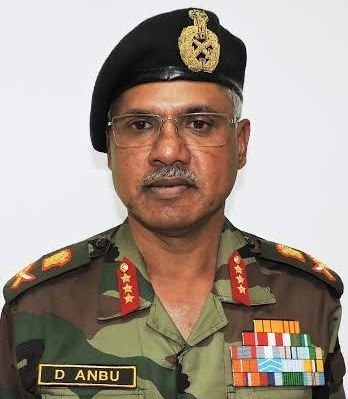
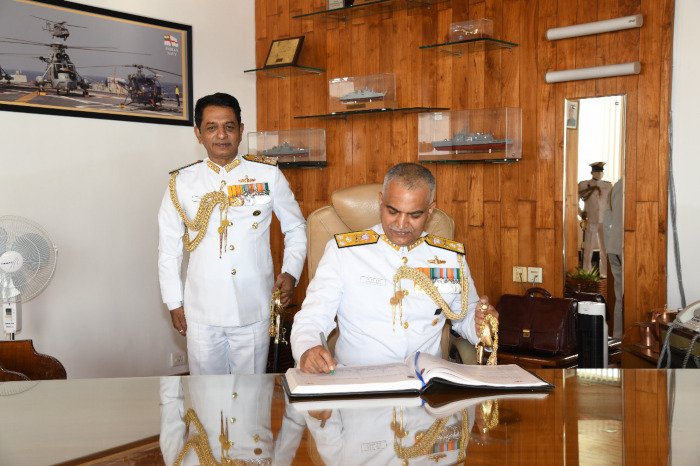
Lieutenant General Devraj Anbu new chief of Northern Command

He has participated in Indian Peace Keeping Operations (IPKF) in Sri Lanka, United Nations Peace Keeping in Namibia, Counter Insurgency and Counter Terrorist operations in Manipur and Jammu and Kashmir.

348

Lieutenant General Devraj Anbu, AVSM, YSM, SM

GOC-in-C, Northern Command

 on Wednesday was appointed as the new chief of strategically important Northern Command in place of Lt Gen D S Hooda, who retires at the end of this month. The Appointments Committee of Cabinet headed by Prime Minister Narendra Modi cleared the name of Anbu for the post of General Officer-in-Commanding-in-Chief (GOC-in-C) with effect from December 1. Udhampur-based Northern Command is a strategically important army formation that overlooks the functioning of Srinagar-based 15 Corps, Jammu-based 16-corps and Leh-based 14-Corps. Anbu was posted as the Corps Commander of Tezpur-based 4 Corps. His last posting in Jammu and Kashmir was as a Brigadier in 2008-09.

He takes over at a time when exchange of fire along the Line of Control has been happening quite frequently especially after the Indian army carried out surgical strikes on September 29 this year, killing at least 19 Lashker-e-Taiba militants inside the territory in Pakistan-occupied-Kashmir. Lt Gen Anbu Commissioned in the Sikh Light Infantry Regiment in June 1980 has had a distinguished military career in which he has executed important Command and Staff appointments in India and abroad. He has participated in Indian Peace Keeping Operations (IPKF) in Sri Lanka, United Nations Peace Keeping in Namibia, Counter Insurgency and Counter Terrorist operations in Manipur and Jammu and Kashmir.

He was awarded the Sena Medal Gallantry for operation in Siachen Glacier. The General has also been awarded Ati Vishisht Seva Medal and Yudh Seva Medal for his distinguished service.


Northern Command (India)

North Western Army” redirects here. For the Chinese revolutionary army, see Guominjun.
Northern Command
IA Northern Command.jpg

Northern Command’s insignia today
Active 1908-1947
1972 – Present
Country  India
Branch India Indian Army
Type Command
Garrison/HQ Udhampur
Commanders
Current
commander
Lt Gen Devraj Anbu

The Northern Command is a Command of the Indian Army. It was originally formed as a formation of the British Indian Army in 1895, scrapped upon India‘s independence in 1947 and later reformed in 1972. Its present commander is Lt Gen Devraj Anbu.[1]
History

The Presidency armies were abolished with effect from 1 April 1895 when the three Presidency armies became the Indian Army.[2] The Indian Army was divided into four Commands (Bengal Command, Bombay Command, Madras Command and Punjab Command) each under a lieutenant general.[2]

In 1908, the four commands were merged into two Armies (Northern Army and Southern Army): this system persisted until 1920 when the arrangement reverted to four commands again (Eastern Command, Northern Command, Southern Command and Western Command).[2] Northern Command was re-formed again as North Western Army in April 1942 to guard the North West Frontier. It controlled the Kohat, Peshawar, Rawalpindi, Baluchistan and Waziristan Districts.[3] The former Western Command, was absorbed by the new North Western Army at that time.[4] The formation reverted to the title Northern Command in November 1945.[5]

In 1947 Headquarters Northern Command became the new headquarters of the Pakistan Army. General Sir Frank Messervy continued to serve as Chief of Staff of the Pakistan Army from 1947 to 1948.[6]

Composition 1942-45

The composition was:

Commanders prior to Independence

Commanders included:[7]
General Officer Commanding-in-Chief Punjab Command

General Officer Commanding-in-Chief Northern Army

General Officer Commanding-in-Chief Northern Command

General Officer Commanding-in-Chief North Western Army

General Officer Commanding-in-Chief Northern Command

Re-raising

The government of India decided to raise a separate command to oversee operations in the northern borders with Pakistan and China. Lt Gen Premindra Singh Bhagat, VC was appointed as the first Army Commander in June 1972. Bhagat’s main activities as Army Commander were the improvement of defences and the living and working condition of his troops.

[8]Headquarters for the command was established at Udhampur, J&K.[9]

The XIV Corps (Leh), XV Corps (Srinagar) and XVI Corps (Nagrota) control the operational units in Northern Command.

71 Independent Sub Area is part of the Command. III Corps and its 57th Mountain Division were shifted into the command as a reserve for Operation Parakram in 2001-2002.[9]


IAF to relax medical norms

IAF to relax medical norms

New Delhi, November 7

A number of abnormalities or ailments which earlier rendered people unfit to gain entry into the Air Force or fly aircraft are soon set to go.With no scientific evidence to back notions such as spinal deformities affect flying, the Air Force will soon modify its medical norms for pilots and new applicants declared unfit due to this reason.Also, with new medical technologies and better drugs available for treatment, several ailments such as asthma, diabetes, coronary heart diseases and hypertension may also go off the list. The Medical Board of the Air Force has also removed 19 drugs like anti-diabetics off the list, which were earlier considered as a “taboo” for flying.“After going through several national and international literature and various research we have done in our Institute of Aerospace Medicine, we are trying to get some of the pilots, who are declared unfit for flying…We are looking into those issues and taking out a new order for commissioning, selection and flying purposes and they will be declared fit (for flying),” Air Marshal Pawan Kapoor, Director General Medical Services (Air), said referring to spinal deformities. “There are 10-12 ailments which have already been taken off. Rest are in the pipeline and decision is likely in 7-10 days,” he said. He said while medical approval has been taken, an administrative approval is awaited and the process will be done without compromising with flight safety.Kapoor was speaking on the sidelines of 64th International Congress of Aviation and Space Medicine here, attended by experts across the world from the field of aerospace medicine from both civil and military aviation.The IAF had formed a panel comprising spinal surgeons, neurosurgeons, physicians, radiologists and it was concluded that there is no evidence to show spinal deformities can affect flight safety and physical capability and conditioning of the pilots. — PTI


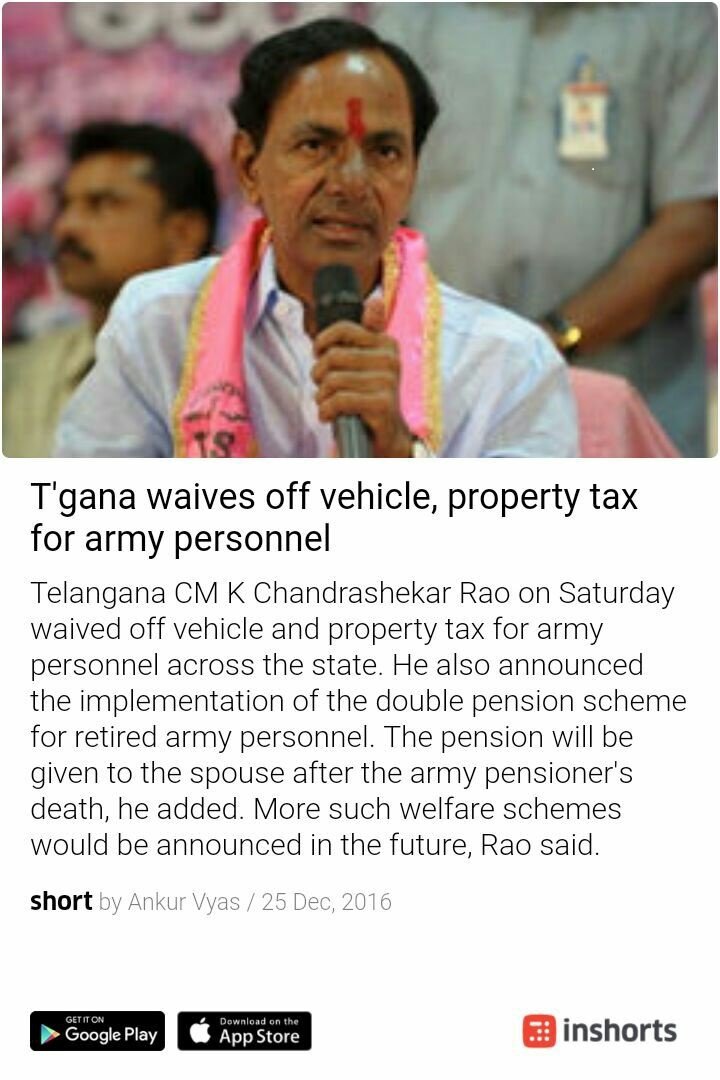
Telangana govt. waives off vehicle, property tax for army

Hyderabad (Telangana) [India]: Telangana Chief Minister K Chandrashekhar Rao on Saturday reiterated that his government is committed to the welfare of the retired army personnel and added that his government has taken several measures for the welfare of the military personnel and some more are in the offing.

The Chief Minister held a high-level review meeting on the welfare of the retired military personnel at Pragathi Bhavan here.

During the meeting the Chief Minister decided to implement double pension scheme for the retired military personnel.

The double pension benefit will also be given to the spouse incase of death of the army pensioner. This pension will also be paid along with pensions of other employees every month.

He has also decided to extend benefits given to the army personnel martyred while serving to those lost their lives due to ill health and accidents too.

He has instructed the officials not to show any discrimination in this regard and said that retired army personnel working as Special Police Officers will be paid salaries along with other employees every month.

Rao said there is a need to strengthen the Army Welfare Boards. There are only 10 Sainik Welfare Boards in the districts, which will be extended to all the newly formed districts in the State.

He said steps will be taken to set up two Army Welfare Offices in Medak and Adilabad districts.

The compensation money given for those getting the gallantry awards would be more in the Telangana State compared to other states.

He also said that reservation should be given to the children of serving and retired army personnel in the Government residential Schools.

“The State government should accord recognition to the schools run by the army. Students joining NCC, Scouts and Guides should be encouraged and those pursing courses in National Defence Academy from the State should be given fellowships,” Rao said.

Since the Centre has agreed to set up an Army School in Warangal, Rao said, a Memorandum of Understadning in this regard will be signed as early as possible.

He also waived off vehicle tax for the the army personnel and will be exempted from paying tax in the state.

Meanwhile, the retired army personnel representatives have thanked the Chief Minister for enhancing the pension of war widows, giving two per cent reservation while allotting the two bed room houses, thereby exempting the military personnel from paying tax on their property.

Ministers Naini Narasimha Reddy, State Government’s Principal Advisor Rajeev Sharma, MPs Capt. Laxmikanth Rao, Vinod Kumar, Principal Secretaries Rajiv Trivedi and S Narsing Rao, Home Secretary Ms Anitha Rajendra, Southern India Army Commandant General Maj Gen S Pachauri, Secunderabad Station Brigadier Ajay Singh Negi, Colonel Tarun Kumar, Colonel Atul Rajput, Lieutenant General Jaswinder Singh, Captain Navneeth Singh, Army Welfare Committee Members Sri Suresh Reddy, Jagan Reddy, Pochaiah, Prabhakar Reddy, Manohar Reddy and others participated in the meeting.

IMG-20161225-WA0063


Pak shelling triggers migration in Hiranagar sector

Pak shelling triggers migration in Hiranagar sector
Border residents moving to a safer place at Kunthal village in Kathua district. Tribune photo

Sanjay Pathak

Kathua, October 21

Continuous shelling on border Bobiya and Pati villages on the Zero Line along the international border in the Hiranagar sector has triggered migration of locals.The shelling started around 9.35 am today and has been going on intermittently, reports said.Official sources said the district administration had launched an operation for the safety and rescue of the border residents. Due to the intermittent firing and shelling, the administration has decided to fully vacate Bobiya and Pati villages which fall in the firing range.“The administration has sent its bullet-proof vehicle to Bobiya and Pati villages and shifted residents of the villages to a temple at Kunthal village in Hiranagar and Higher Secondary School, Hiranagar,” a source said.Deputy Commissioner, Kathua, Romesh Kumar and MLA, Hiranagar, Kuldeep Kumar along with civil and police officers visited Bobiya village today to assess the situation.“We are fed up with repeated migration and suffering. India should take a one-time hard step to end our miseries,” said Surjeet Singh, a resident of Bobiya, who has taken shelter at the migrant camp in Kunthal village.“Just after 20 days, we have again been forced to migrate from our homes,” he added.Rani Devi, another Bobiya resident, said: “Due to the migration, our children are suffering. Their studies have been badly affected and their future seems bleak.”Meanwhile, the Kathua Deputy Commissioner and the Hiranagar MLA held a meeting with the villagers and promised them all help.


14 yrs on, Kaluchak memories haunt again

14 yrs on, Kaluchak memories haunt again
Security personnel keep vigil during Army Chief Dalbir Singh Suhag’s visit to the Army camp in Nagrota on Wednesday. Tribune Photo: Inderjeet Singh

Dinesh Manhotra

Tribune News Service

Jammu, November 30

Tuesday’s terror attack at Nagrota, which claimed lives of seven Army men, including two Majors, has once again brought back memories of devastating terror attack of May 14, 2002, at the cantonment town of Kaluchak on the Jammu-Pathankot national highway. The worst-ever terror strike in J&K had left over 35 soldiers, their wives and children dead.Fourteen years after the incident, terrorists managed to reach near the family quarters at Nagrota. Their aim was to repeat another Kaluchak by targeting family members of the soldiers but they could not.Fortunately, it was bravery and presence of mind of the wives of two Army officers that terrorists’ nefarious design to repeat Kaluchak at Nagrota was frustrated.“The brutality of terrorists, which we witnessed on May 14, 2002, was revived after Tuesday’s incident at Nagrota,” said Ravinder Singh, who runs a shop near Kaluchak.Even after passing of 14 years, signs of terror’s cruelty have still not been erased from the block of family quarters which the terrorists had managed to enter after storming the Army formation. “The block, which witnessed bloodshed and destruction 14 years back, still wears a deserted look,” Brij Nath, a local of Kaluchak said while recounting how three terrorists, who were dressed in Army uniforms, had lobbed grenades and fired on the soldiers, their family members, including small kids.Sources in the intelligence agencies said the initial investigation had established that the terrorists, who attacked the Army formation at Nagrota, had conducted a thorough recce before executing their plan. “It appears that terrorists were well aware about the location of the family quarters which was their target,” the sources said.As reported earlier, soon after the terrorists entered the Army unit located at Nagrota they were desperate to enter the family quarters where they could take the families of the soldiers and officers hostage.However, due to the bravery of two women, who were staying in the family quarters along with their newborns, the nefarious designs of the terrorists were frustrated.The wives of the two Army officers displayed exemplary courage as they blocked the entry of their quarters with all household items, making it difficult for the terrorists to break into the houses.

Fidayeen aimed for families

  • The terror strike in Nagrota brought back memories of devastating terror attack of May 14, 2002, at the cantonment town of Kaluchak on the Jammu-Pathankot national highway which left over 35 soldiers, their wives and children dead.
  • On Tuesday, the three fidayeen terrorists managed to reach near the family quarters at Nagrota and their aim was to repeat another Kaluchak by targeting family members of the soldiers.
  • Fortunately, the presence of mind of the wives of two Army officers nixed the nefarious designs of the terrorists.