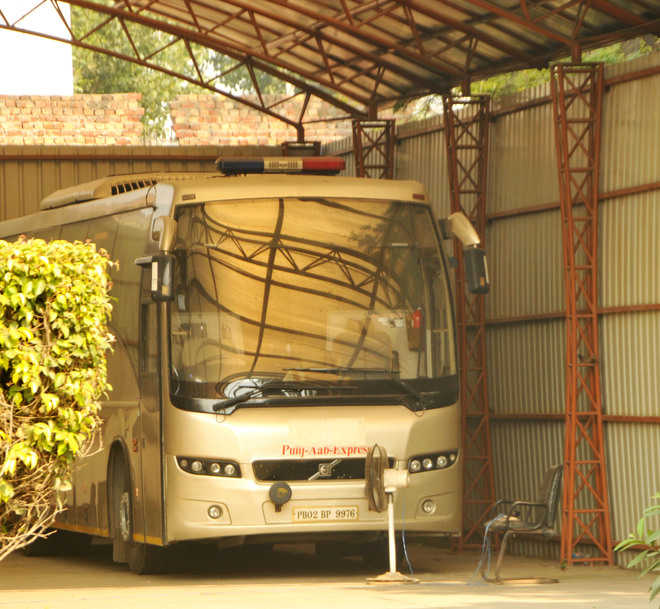
A Punj-Aab bus at the international bus terminus in Amritsar.
GS Paul
Tribune News Service
Amritsar, November 10
The Kartarpur corridor opening has infused a ray of hope among the Sikhs for the revival of “Punj-Aab” bus service between Amritsar-Lahore-Nankana Sahib, the birth place of Guru Nanak.
The SGPC has offered to act as a conduit to facilitate the pilgrims for furnishing the travel documentation formalities and obtaining visa. At present, it is being furnished at the New Delhi embassy.
However, political experts believe that the India-Pakistan bus or rail services are unlikely to resume in near future till political will on either side of the border was there. SGPC chief secretary Roop Singh said, “This service was the most convenient to connect the two holy cities — Amritsar and Nankana Sahib. If the SGPC is entrusted with the responsibility of furnishing the visa formalities of the devotees, we will do the service. Devotees can deposit their passports, bus fare and visa fee with us and we can depute our staff to get their travel formalities endorsed from the embassies concerned in New Delhi.”
As a fall out of India’s move to revoke Article 370 in J&K, Pakistan had snapped all cross-border rail and road links besides downgrading diplomatic relations.
On August 10, the bus service on the Amritsar-Lahore-Nankana Sahib route was suspended. Since then, the bus has been stationed at the International Bus Terminus, Amritsar. Consequently, the incharge, two drivers and administrative staff have been sitting idle. Interestingly, around 14-15 police officers have been performing their duty to safeguard the stationary bus on rotational basis. They all earnestly desire that this bus, which has the exclusive permit of Amritsar-Nankana Sahib via Lahore, should run as it provided the passengers of both the nations an opportunity to meet their relatives who have been separated since Partition.
Harpal Singh Bhullar of Bhai Mardana Society, which organises pilgrimage to Pakistan on Gurpurbs, said the visa formalities should also be made locally in Amritsar. “It is a pity that the clause of the police verification of passengers is implemented on this route only, whereas there was no such binding for those who travelled on the New Delhi-Lahore route,” he added.
Notably, the Amritsar-Nankana Sahib bus service, started on March 24, 2006, was flagged off by the then PM Manmohan Singh. Earlier, 25-30 passengers used to travel in the bus, but the count dipped in the last few months.
Big moment, ties to improve enormously: Ex-PM Manmohan Singh, Capt Amarinder, Sukhbir part of first jatha to visit Kartarpur
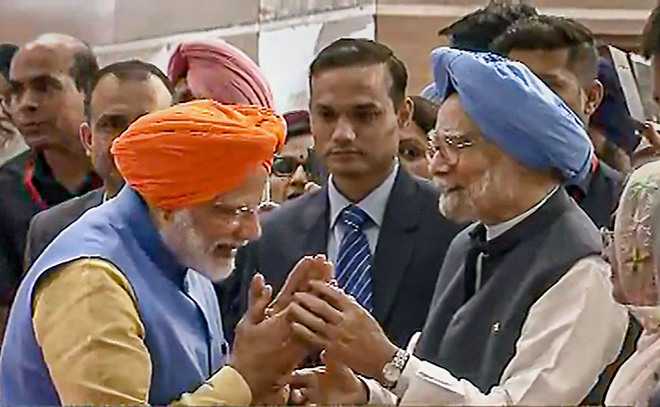
Prime Minister Narendra Modi greets former PM Manmohan Singh at Dera Baba Nanak on Saturday. PTI
Kartarpur (Pak), November 9
The opening of the Kartarpur corridor will “enormously improve” relations between India and Pakistan, former Prime Minister Manmohan Singh said on Saturday after he arrived here as part of the first batch of the Indian pilgrims through the cross-border pathway.
Speaking to reporters, the former PM termed the opening of the corridor a “big moment”. “India and Pakistan relations will improve enormously as a result of this beginning,” he said.
The 87-year-old two-time Prime Minister and his wife paid obeisance at Gurdwara Darbar Sahib. Pakistan PM Imran Khan formally inaugurated the historic corridor to facilitate the visa-free entry of Indian Sikh pilgrims.
He welcomed the first batch of the Indian Sikh pilgrims who entered Pakistan through the corridor which links Gurdwara Darbar Sahib in Pakistan, the final resting place of Guru Nanak Dev, to Dera Baba Nanak shrine in Punjab’s Gurdaspur. Manmohan Singh arrived here as part of the first batch, which also included Akal Takht Jathedar Harpreet Singh, Punjab Chief Minister Capt Amarinder Singh, former CM Parkash Singh Badal, Sukhbir Singh Badal, Harsimrat Kaur Badal, cricketer-turned-politician Navjot Singh Sidhu and BJP MP Sunny Deol.
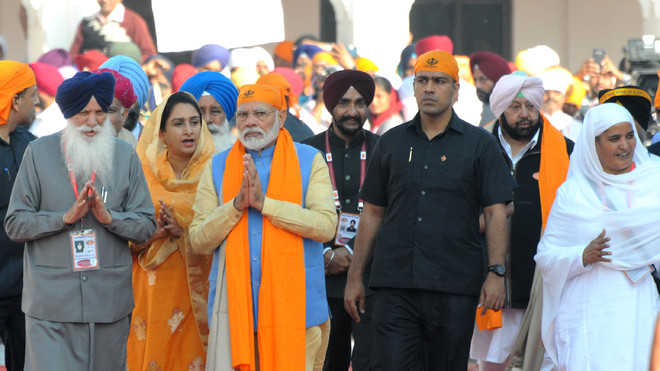
Prime Minister Narendra Modi along with Punjab Chief Minister Capt Amarinder Singh and Union Minister Harsimrat Kaur Badal at Gurdwara Ber Sahib in Sultanpur Lodhi on Saturday. Photo Malkiat Singh
Capt Amarinder said the Sikh community had been waiting for a free passage for 70 years and maintained that it was a good beginning.
SGPC members and all MLAs and MPs from Punjab, including ministers, were also part of the first jatha. Earlier, Prime Minister Narendra Modi flagged off the first batch of over 500 pilgrims, saying it would be easy to pay obeisance at Gurdwara Darbar Sahib after the opening of the corridor.
Asserting that he was fortunate to be able to dedicate the corridor to the country, Modi said the opening of the corridor and the integrated check post would bring double happiness to the people.
According to the agreement between Pakistan and India, 5,000 pilgrims from India can visit the shrine daily and the number can be increased in future.
The requirement of passport and the $20 service fee have been waived for Saturday and for November 12 by Pakistan. Separate events have been organised on both sides of the border to launch the much-awaited corridor ahead of Guru Nanak’s 550th birth anniversary on November 12. Guru Nanak spent last 18 years of his life at Kartarpur Sahib, which has now become the world’s largest gurdwara. — PTI
t was a spiritual and emotional moment. There was an atmosphere of spirituality and religiosity. —Manish Tewari, Anandpur Sahib MP
Dipender Manta
Tribune News Service
Mandi, November 7
Rohtang Pass and its nearby places at Gulaba and Solang valley in Kullu district received fresh snowfall on Thursday morning, something that delighted the tourists and the locals who thronged Solang in large numbers.
The entire area has been covered with white blanket of snow, plummeting the temperature drastically in the region.
The traffic movement has been suspended between Manali and Keylong on the Manali-Leh highway via Rohtang Pass, which received 15 cm snow.
The snowfall was still continuing, said some residents of Manali. The lower parts of Kullu and Mandi districts received rain. In Lahaul and Spiti too, fresh snowfall was reported in higher reaches.
From midnight, J-K will cease to be a state; 2 new UTs to come into being
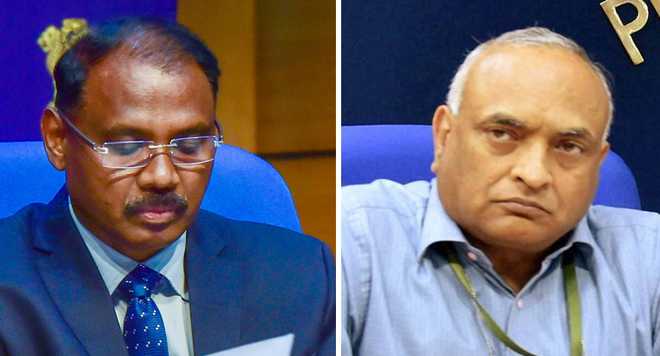
GC Murmu (left) and RK Mathur will be sworn in as new LGs for UTs of Jammu and Kashmir, and Ladakh, respectively. — File photos
New Delhi, October 30
History will be created on Thursday when Jammu and Kashmir, which has been part of the Union of India since 1947, will cease to be a state and will be bifurcated into two Union Territories.
IAS officers Girish Chandra Murmu and R K Mathur, who have been appointed the new Lieutenant-Governors (LG) for the Union territories (UTs) of Jammu and Kashmir, and Ladakh, respectively, will be sworn-in at separate functions to be held in Srinagar and Leh on Thursday.
Both Murmu and Mathur will be sworn in by Chief Justice of J&K High Court Gita Mittal.
According to the Jammu and Kashmir Reorganisation Act, 2019, the appointed day for the two UTs is October 31 and these will come into existence in the midnight (Wednesday-Thursday), nearly three months after the announcement in Rajya Sabha.
This is for the first time that a state is converted into two UTs even though there are numerous example of a UT becoming a full state or a state bifurcating into two states.
The total number of states in the country will be now 28 while the total UTs will go up to seven.
The Narendra Modi government’s decision and subsequent approval of Parliament to abrogate the special status given to Jammu and Kashmir under Article 370 and its bifurcation into two UTs was taken to redraw the map and future of a region at the centre of a protracted militancy movement.
The electoral promise of the BJP to end the special status of Jammu and Kashmir came less than 90 days after the Modi 2.0 government assumed power in May end.
The August 5 decision was taken 72 years after the then ruler of the princely state, Maharaja Hari Singh, executed the Instrument of Accession on October 26, 1947, making it part of the Union of India.
The two UTs will come into existence on the day of the birth anniversary country’s first Home Minister Sardar Vallabhbhai Patel, who is credited for merger of over 560 states into the Union of India.
October 31 is observed as the National Unity Day and both Modi and Home Minister Amit Shah on Thursday will attend separate functions—in Kevadia (Gujarat) and New Delhi, respectively.
According to the Act, the UT of Jammu and Kashmir will have a legislature like Puducherry while Ladakh will be a UT without legislature like Chandigarh and both the UTs will be headed by two separate Lieutenant-Governors (LG).
The Centre will be in direct control of the police and the law and order in Jammu and Kashmir from Thursday when it becomes a UT, while the land will be under the elected government there.
The UT of Ladakh will be under the direct control of the central government which will administer the high altitude region through the LG.
While moving the resolution in the Rajya Sabha that Article 370 — which allowed Jammu and Kashmir to have its own Constitution and prohibited outsiders from buying land and property in the state, Shah had said these provisions will no longer be applicable and the central government will restore its statehood at “appropriate time” and after “normalcy” returns.
“The government will not allow the situation to turn into another battle torn Kosovo… It was heaven on earth and will remain so,” Shah had said, referring to the decades-old militancy in Jammu and Kashmir.
Soon after the abrogation of the Article 370, several hundred political leaders and separatists were put under detention by the Jammu and Kashmir administration while restrictions were also imposed on movement of people, vehicles, telephone, mobile phones and internet.
While most of the restrictions were removed since then, curb on internet is still continuing and situation in the Kashmir Valley is yet to be termed as complete normal.
Among those put under detention include three former chief ministers—Farooq Abdullah, Omar Abdullah and Mehbooba Mufti.
The Jammu and Kashmir Reorganisation Act, 2019 says the all India Services like the Indian Administrative Service (IAS) and the Indian Police Service (IPS), of J-K cadre will continue to serve in the two succeeding UTs while new recruits of these services will be allocated in the Arunachal, Goa, Mizoram Union Territory (AGMUT) cadre.
The provincial service officers will continue serving in their current positions till a new order is issued by the Lt Governors for the two new UTs of Jammu and Kashmir and Ladakh.
The IAS, IPS and other central service officers and the Anti-Corruption Bureau (ACB) will be under the control of the LG and not the elected government of the UT of Jammu and Kashmir.
Mehbooba was the last chief minister of undivided Jammu and Kashmir whose tenure ended in June 2017 when central rule was imposed there after her coalition partner BJP withdrew support. Satya Pal Malik is the last governor whose tenure comes to an end on Wednesday. He has been transferred and appointed as Governor of Goa.
Just a day before Jammu and Kashmir is divided into two UTs, the National Conference on Wednesday made a fervent last minute appeal to the Centre to shelve the plan and maintain the statehood of the “200-year-old state” dubbed as “crown of India”. — PTI
Only a retreat can save face for Pakistani establishment
The political turmoil in Pakistan is getting deeper and deeper with every passing day. The current regime of Pakistan Tehreek-e-Insaf (PTI) is busy trying to stop Maulana Fazal-ur-Rehman’s long march from reaching Islamabad, planning to seize all the routes from where the protesters can enter the federal capital. But perhaps even more than Prime Minister Imran Khan, a faction within the military establishment is feeling the heat.
On Monday night, former prime minister Nawaz Sharif was moved to a hospital after his personal physician Dr Adnan Khan tweeted that Sharif’s platelet count was extremely low. After the news appeared, Pakistan Muslim League-Nawaz (PML-N) workers gathered in front of the National Accountability Bureau (NAB) office and chanted slogans against the government and its backers. This must be an alarming situation for the ruling elite, as the anger against Imran Khan and the establishment is reaching a boiling point.
Sharif was always going to prove more dangerous from behind bars, as if anything were to happen to him, the backlash from the province of Punjab would be beyond the control of even the mightiest security establishment. While the media attention was focused on Sharif, the government arrested his son-in-law, retired Captain Muhammad Safdar Awan, while he was coming to see Sharif in the hospital.
Now with each and every step of crushing opposition, the PTI regime is only moving faster toward the end. The co-chairman of the Pakistan Peoples Party (PPP), Asif Zardari, is also being denied the fundamental right of access to medical treatment despite being a heart patient with diabetes. This shows the lack of political acumen of Khan and his party, as a government with just a little understanding of the nature of politics would know that it takes only one event to trigger a mass movement against any regime, and the throne given by the invisible forces can be taken back at any time.
Imran Khan’s weak government is surviving only on the ventilator provided by the establishment, and it remains to be seen whether the latter will use Khan’s ouster as a bargaining chip to make sure the current top military brass remains at the helm of affairs or it will go to any extent to preserve the status quo. On the other hand, there are questions over the political strategy adopted by the current PML-N leadership, which somehow is roaming freely despite the massive crackdown against the party.
As long as Maryam Nawaz was at the helm of party affairs it was evident that the PML-N was giving a tough time to the establishment and the PTI government, but after her arrest the lackluster party leadership is only conducting traditional status quo politics and seems ready to replace Khan with another puppet.
So the question remains, who will bail out the establishment at a time when it is written on the wall that sooner or later it will suffer its first-ever defeat in the political history of the country?
Sharif has risked everything to turn the tables and so has his daughter Maryam, who is being kept in solitary confinement for a crime that has not yet been proved in any court of law. So the question remains, who will bail out the establishment at a time when it is written on the wall that sooner or later it will suffer its first-ever defeat in the political history of the country? Sharif may be suffering from health problems, but his resolve is commendable, and with massive support from the province of Punjab, it is impossible for him to bail the establishment out of the current situation.
Meanwhile the PPP, after being cheated on many occasions by the powers that be, also seems less interested in providing any relief to the establishment. Perhaps this is the reason many of the leaders of the PPP are also behind bars.
So both the PML-N and PPP seem ready to pay the price of their resistance against the PTI and its backers. The religious card, which once was used by the establishment to weaken elected governments, is now going to be used against the establishment and the current government by the Jamiat Ulema-e Islam (F) of Fazal-ur-Rehman.
As well, the sword of the Financial Action Task Force is still hanging over Pakistan’s neck as the country is being kept on the gray list, and the FATF will again review Pakistan’s performance in February. The Kashmir fiasco and the regular fights with India at the Line of Control are also problems, as with the economy in shambles the country cannot afford to have tension on the borders with India. So it is a dead-end street from which the establishment can only escape if it is ready to make a retreat on the power chessboard.
Sharif’s narrative of “respect the vote” has snatched the sacred-cow status away from the establishment in Punjab, which once was a traditional pro-establishment province. Little did the invisible forces know that while rigging the political discourse they actually were not ousting Sharif from Punjab but were ousting themselves from the power chessboard.
It is in the best interests of the country that the establishment take a back seat and let the Election Commission of Pakistan hold fair and free fresh elections. A face-saving exit is what the establishment should look for. It needs to understand that it is not the state itself but only an organ of the state, and neither is it invincible nor is it above the constitution of the country. It also needs to get out of the illusion that it is the sole institution that is vital for the survival of the country.
A teacher who is providing education in a far-flung village in Balochistan, a doctor working around the clock to save lives, a policeman dying while trying to stop terrorists or an electrician trying to fix the electricity for the cities; a judge upholding the constitutions, a lawyer fighting to get justice for a fellow citizen – every one in his or her own capacity is making sacrifices for the betterment of the country, while journalists or politicians are accused of treason for criticizing the flaws in government services.
It is the constitution that is supreme, and it clearly states that the military establishment has no right to intervene in politics or in shaping the ideological narratives of the country. Even the short history of the country testifies that the establishment’s interventions have only weakened democracy and brought self-inflicted economic and political turmoil to the country. It is the time that the invisible forces make a face-saving exit and let the elected representatives run the affairs of the state. Otherwise, the damage to the economy and the political and social fabrics will become beyond repair.
If Pak doesn’t mend its ways, we’ll go inside to destroy terror camps: Malik
Srinagar : A day after two soldiers and a civilian were killed in cross border shelling in Tanghdar sector of Kupwara district and the Indian Army claimed to have destroyed terror camps in Pakistan occupied Kashmir (PoK) in retaliation, Jammu and Kashmir governor Satya Pal Malik on Monday said if Pakistan does not end terror activities directed against India, the army will go deep inside and destroy terrorist camps.
On the sidelines of a function in Srinagar to celebrate National Police Day, Malik said,“Pakistan will have to behave and stop these terror camps. If it does not behave, we will go deep inside and destroy these camps,’’ he said.
Malik also urged the youth in Kashmir to desist from causing unrest and play a constructive role in building the state.
“From 1 November, there will be a new Kashmir. I want to ask these boys who are roaming around—what have you achieved? Contribute to taking the state forward,” he said.
On Sunday, Army chief General Bipin Rawat announced that four launch pads across the LoC were destroyed by the Indian Army and six to ten Pakistan soldiers were killed. He said an equal number of terrorists were also killed.
Damaged structures after the Indian Army targeted terror camps across the Line of Control on Sunday. Reuters
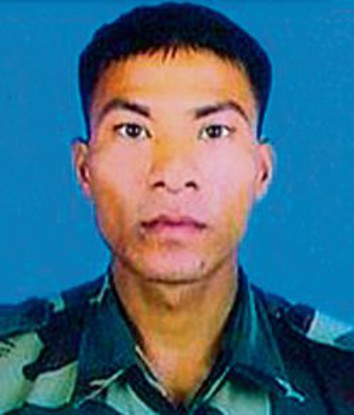
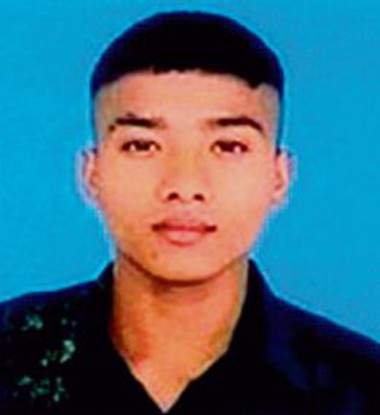
Havildar Padam Bahadur Shreshta and Rifleman Gamil Kumar Shreshta
TNS & Agencies
New Delhi, October 20
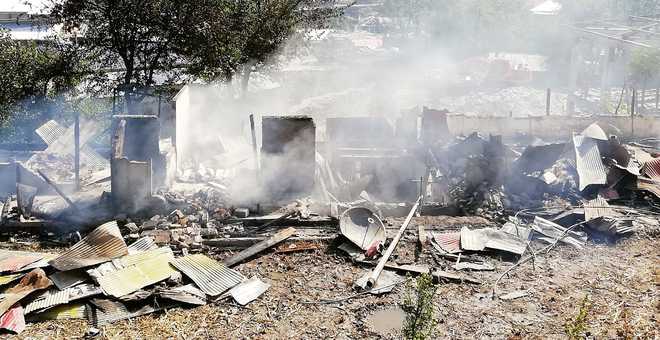
Six to 10 Pakistan Army personnel were killed and three terror camps destroyed in retaliatory action by the Indian Army opposite the Tangdhar and Keran sectors in J&K, Army Chief General Bipin Rawat said on Sunday.
Talking to the media here, he said another terror camp was severely damaged and the retaliation had caused substantial damage to terror infrastructure across LoC.
Defence Minister Rajnath Singh, he said, was briefed about the retaliatory action.
Pakistan accused the Indian Army of targeting civilians using artillery guns. Its Foreign Office summoned the Indian Acting High Commissioner in Pakistan, Gauruv Ahluwalia, and condemned the incident.
The Indian Army carried out heavy artillery strikes, targeting four terror camps and several Pakistani military posts in Neelam Valley in Pakistan-occupied Kashmir (PoK).
“As per the information available with us, 6-10 Pakistani soldiers have been killed and nearly as many terrorists,” General Rawat said. “Three terror camps have been destroyed and on the fourth one also, we have caused severe damage,” he said, adding that according to unconfirmed reports, the number of terrorists killed could be higher. To a question, he said the terror camps destroyed were located in Athmuqam, Kundal Shahi and Jura, and the Army had information about a camp in Leepa Valley too.
“These are the camps we have targeted. And people who were supporting them, also the Pakistani posts, bore the brunt of our action,” he said. General Rawat said of late, the Army had received information that terrorists were coming closer to the camps in forward areas. In the past one month, repeated infiltration attempts were made from the Gurez, Keran, Machil, Uri sectors and south of Pir Panjal, he said, adding that Pakistani soldiers were resorting to ceasefire violation to provide support to the infiltration bids.
“We had picked up a definitive signal that some of the terror camps north of Pir Panjal were active. Terrorists had arrived at these camps and that they were likely to infiltrate. Last evening, an attempt was made in Tangdhar to infiltrate…where we retaliated… Pakistan, at the same time, carried out firing on the post, in which we did suffer. Two of our soldiers were killed and one civilian died too. All this (firing) was done to ensure that they could push in the terrorists,” he said.
The terror camps opposite the Tangdhar and Keran sectors were destroyed, he added. “They do not want to highlight or project this damage as the world will know that no action has been taken (by them) to curtail acts of terrorism from across the border. They are trying to keep it under the wraps. But, definitely, as and when we get it, we will provide you with more evidence.”
Mohammad Sidiq, 50, of Gundishot village was killed and Mohd Maqbool, Yasir and Shafi injured as Pak troops resorted to heavy artillery shelling along the LoC.
Major attack after balakot
On Feb 26, India carried out an aerial strike on a Jaish camp in Pak’s Balakot, in response to Pulwama attack
Pakistan air force retaliated the next day by trying to target military installations but was repulsed
Infiltration bid foiled, says rawat
We had picked up a definitive signal that some of the terror camps north of Pir Panjal were active. Terrorists had arrived at these camps and that they were likely to infiltrate. —Bipin Rawat, Army chief
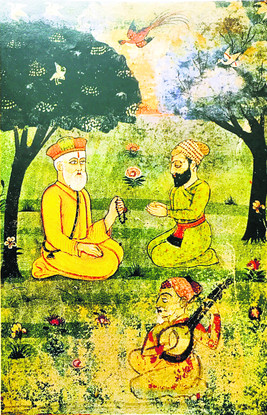
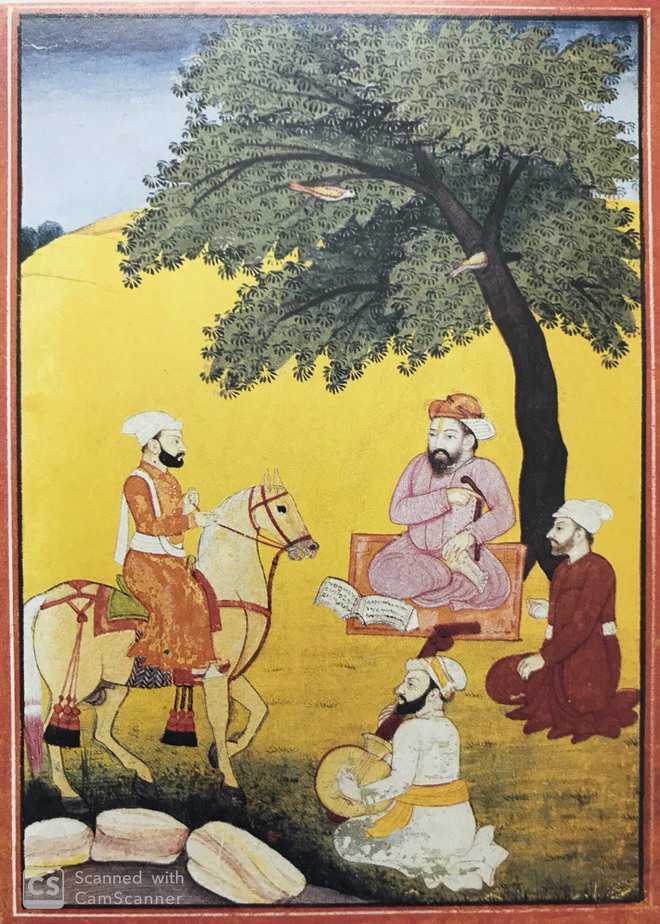
Guru Nanak’s bani enables us to know the spiritual and moral reformation he brought about in his lifetime
Guru Nanak addresses jogis at Achal Batala — from the Asian Art Museum in San Francisco (ca. 1800-1850)
Baba Nanak, Guru Angad and Mardana — B-40 Janamsakhi (1733)
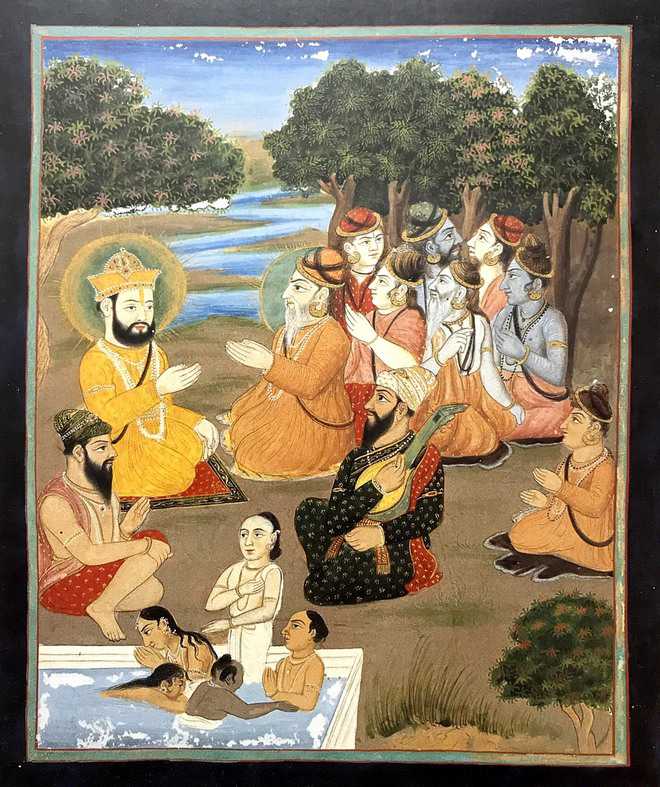
A king pays homage to Guru Nanak — from Government Museum and Art Gallery, Chandigarh (ca. last quarter of the 18th century)
J.S. Grewal
In a well-known 20th-century portrait, Guru Nanak is sitting in meditation with his eyes closed. In his compositions (bani) though, Guru Nanak keeps his eyes wide open. He says in fact that he had seen all nine regions (nav-khand) of the earth, and seen sacred places, markets and cities, walking, as it were, on his eyes. The range of his comments is exceptionally wide, covering the social, political, and religious aspects of the life of his contemporaries. His bani enables us to know the kind of socio-cultural regeneration he brought about in his lifetime.
Guru Nanak was thoroughly familiar with the social order of his time. The royalty, the nobility, the officials of the government, its intermediaries at lower rungs, and common people figure frequently in his compositions. Apart from the mulla and the qazi, the shaikh and the pir, several professions and occupations are noticed. Guru Nanak underscores the life of luxury of the ruling class and the grinding misery and ignorance of the rai’yat, the subject people. He takes notice of the ideal of the four varnas, and the outcastes. High caste has no merit in his eyes. The people who forget God have no caste.
The Sikh of the Guru is expected to rise above the distinctions of caste. Equality between men and women is emphasised in many verses of Guru Nanak. The spiritual and ethical message for women is exactly the same as for men. There is no doubt that this liberation (state of union with God) was made accessible to women. The sada-suhagan enjoys the love of her spouse (God) throughout her life. However, she is placed in the patriarchal family which was inegalitarian. The tension between equality in the spiritual realm and inequality in the social domain was not easy to resolve.
Guru Nanak saw no merit in ritualistic practices. The sacred thread in his eyes has no spiritual or moral efficacy. The thread of the Brahmin does not restrain him from scandalous conduct. There is no restraint on his feet, his hands, his tongue, and his eyes. The sacred thread of the Khatris did not stop them from pandering to the rulers whom they regarded as unclean (mlechh). They wielded the butcher’s knife against the people on behalf of the rulers.
Similarly, the meticulously observed chauka was useless. They told others to keep away but the line drawn around did not keep out their own ignorance and hardness of heart. The notion of purity and impurity (sutak) was merely an illusion. It had nothing to do with ethical living. To regard women as impure during childbirth or menstruation was sheer ignorance. There can be no reproduction without women, and there would be no humanity without reproduction.
Guru Nanak ridiculed the popular practice of floating lighted lamps in water for the dead as an obituary rite. Another such rite was the performing of shradhs in which food was offered to Brahmins to eat on behalf of the dead ancestors of the patron. The dead received nothing. Guru Nanak’s social comment extends to the rites of passage. They who mourn the death of a dear one forget that they themselves would die. Formal mourning served no good purpose. The debate about the mode of the disposal of the dead was futile. Only God knows what would happen to anyone after death.
On the whole, the social order at the time of Guru Nanak was marked by discrimination on the basis of caste and gender, and by ritualistic practices.
Polity and politics
There is explicit reference to the rule of Muslim Pathans (Turk-Pathani ’aml). The name of God now is Allah and the favourite colour is blue. An assessment is built into the association of Muslim rule with the Kaliyuga, the worst of the cosmic ages. Human beings had turned into goblins. Greed was now the Raja; and lust was the Sikdar (shiqdar), local administrator. The seed was crushed, and it could not sprout.
The wielders of power come in for severe criticism. Millions may stand up to salute the masters of vast armies, and millions may obey them, but all this is futile without honour in God’s court. Unlike the ordinary people, the rulers collect wealth with the levers of power, and their thirst for power is never quenched. Indeed, the rulers are butchers; they suck human blood. Justice is administered not in the name of God (as the primary duty of the rulers) but only when the palm is greased. There is discrimination on the basis of religious affiliation. ‘Now that the turn of the shaikhs has come, Ad Purkh is called Allah; it has become customary to tax gods and their temples.’
The verses of Guru Nanak, known as Babur-bani, refer to Babur’s invasions. The army of Babur is called the marriage party of sin; brides are demanded by force; the rite of marriage is performed by Satan. The reference here is to rape. The Mughals descended as the agency of death; the people cried in suffering. If the mighty strike the mighty, the fight is equal. But if a lion falls upon a herd of cattle, God is accountable. Actually, Guru Nanak is questioning God. Many unarmed civilians were killed, and the rulers of the land failed to protect them. Thus, both the Mughals and the Afghans stand indicted.
The Afghans suffered for their political and moral failure. Gone were their sports and stables, and their sword-belts and red tunics. Their tall mansions were razed to the ground and the princes cut into pieces. God takes away the goodness from those whom he wishes to mislead. The women of the ruling classes were dishonoured. Had they thought beforehand, they would not have suffered. There is a moral dimension to a political situation in which men and women suffer because of their misdeeds.
With all their power, wealth and pride, the rulers remained subject to the power of God. His service was far preferable to the service of earthly rulers. He who has access to the divine court does not have to bow to anyone else. This statement carries the implication of potential defiance. Indeed, Guru Nanak talks of the possibility of the white cloth being dyed and of the split seed becoming whole to sprout again. In other words, spiritual and moral regeneration could become the means of social regeneration.
Primacy of liberation
It is important to note that Guru Nanak gives primacy to liberation, the supreme purpose. Earthly pursuits have no meaning if God is forgotten or ignored. The foremost duty of a human being is to dedicate his or her life to God in order to become one with Him and to be released from the cycle of death and rebirth. The path of liberation is hard to follow, like walking on the sharp edge of a sword. It is important to point out that worldly life is not to be renounced but transformed.
Guru Nanak talks of maya, mamta and haumai as the great obstacles on the path of liberation. The thirst for maya is never slaked. Affection for kith and kin (mamta) is more difficult to overcome. Above all, human beings remain preoccupied with themselves, suffering from the disease of self-centredness (haumai). Guru Nanak offers loving devotion to God as the antidote for maya, mamta, and haumai. Loving devotion to God was not divorced from bhay or bhau (reverential fear due to the realisation of God’s power and grace). This way of bhagti was found through the Guru and with God’s grace.
Guru Nanak lays great emphasis on action (karni), rather than verbal profession (kathni). The familiar proverb ‘you reap as you sow’ occurs at many places in Gurbani. Everything is lower than the realisation of truth but truthful living is higher. The world is the stage where merit is earned through altruistic action (seva). To help others is to serve God. Parupkar is a part of God’s raza. The Guru, too, is Parupkari. The Sikh who lives in accordance with God’s raza is the king of kings.
The state of liberation is also called nirban-pad or pad-nirbani, the state of detachment. This state is everlasting (amrapad). There is no haumai in the state of liberation, and there is no fear. It is a state of bliss and peace. The liberated-in-life remains committed to social obligations with a spirit of detachment with a larger concern for the welfare of others.
Contemporary religious traditions
Guru Nanak makes a good deal of comment on the religious beliefs and practices of his contemporaries. He talks of the representatives of three traditions: the Brahmanical, the ascetical, and the Islamic. His comments on the Brahmanical traditions (Shaiva, Vaishnava, and Shakta) include scriptures, gods and goddesses, worship of idols, rituals, charity, pilgrimage to sacred places, and dance and dramatic performances. Guru Nanak looks upon Brahma, Vishnu and Mahesh as God’s creatures. They are not everlasting.
Contrary to the general impression, Guru Nanak is also critical of worship of Rama and Krishna. In the first place, there is no room for incarnation in Guru Nanak’s conception of God. There is no spiritual or moral merit in dramatic representations of Rama and Krishna. Guru Nanak tells the Vaishnavas that the adoration of God is the real dance; all else is sensual pleasure. Guru Nanak has little appreciation for the Gorakhnathi Jogis. He tells them to have contentment as their earrings, productive work as their begging bowl, meditation of God as the ash on their body, the fear of death as their cloak, trust in God as their staff, and keeping their body free from evil as their skill. To regard all human beings as equal is to belong to the highest order of the jogis. There is no ethical merit in possessing supernatural power. Only he can be called a real jogi who regards all human beings as equal. The real avadhut remains hopeless-in-hope (asa mahi niras). The gulf between the Jain monks and Guru Nanak was the widest. Apart from their asceticism, renunciation, and mendicancy, they are denounced for their atheism.
The Muslim claim to an exclusive possession of true faith had no justification. God does not consult anyone when He creates or destroys, when He gives or takes away. There is a suggestion in a verse that Guru Nanak appreciates the way of the Sufis. ‘It is not easy to be a Mussalman; one should be called so if one is a real Mussalman’. First of all he should adopt the path of the auliya. However, Guru Nanak did not appreciate certain practices of the Sufis. They accepted patronage from the state in the form of revenue-free land, going against their own ideal of complete trust in God. Guru Nanak denounced the practice of the Sufi shaikhs to bestow caps (kulhan) upon their disciples and to authorise them to guide others. This appeared to be presumptuous on the part of the Sufi shaikhs.
God, Guru and shabad
Guru Nanak’s religious thought is uncompromisingly monotheistic. There is one God, and no other. He is self-existent; He never dies and He is never born. He alone is active (karta). He is devoid of fear and enmity. As the only eternal entity, God is equated with Truth. In Guru Nanak’s conception of God, the attributes of power and grace are two sides of the same coin.
The concepts of hukam and nadar flow from these attributes. His command (hukam) keeps the physical universe and the moral world in order. His grace enables human beings to do what He likes; they act in accordance with his hukam, and become acceptable to God.
The Guru, in the first place, is God himself. He has revealed Himself in his creation. He who appropriates the Guru’s Word is liberated and he can liberate others. The Guru is found in the sant sabha. The true Guru is found in sat-sangat where God’s praises are sung through the shabad. The mind is turned to God only by praising Him through the Guru’s shabad. The true Guru enables one to meet God. With the true Guru as a friend, one receives truth and honour in the divine court.
The term shabad occurs frequently in the compositions of Guru Nanak. It refers to the self-revelation of God. But more frequently it refers to the bani of Guru Nanak. There is no understanding without the shabad. God is praised through the Guru’s shabad. The woman who gets rid of self and adorns herself with the Guru’s shabad finds the spouse in the home. All illusion is removed by the pure bani. The shabad leads to recognition of the true creator. The Gurmukh is attached to the truth through the shabad and sees God everywhere. The one without any sign, colour or shadow is recognised through the shabad. True is the Guru’s shabad that leads to liberation. There is only one shabad, and it is recognised through the perfect Guru. All nads and Vedas are in Gurbani.
The compositions of Guru Nanak are an integral part of divine revelation. He was called, as he says, by God to his court and given the robe of true adoration with the nectar of the true Name. They who taste it through the Guru’s instruction attain peace. The minstrel (dhadi) of God spreads the message of the shabad. He utters the divine bani as commanded by the Lord. This claim carries the implication that Guru Nanak’s message was more authoritative than any known scripture.
The Sikh Panth
Critical of the socially privileged in society, Guru Nanak aligned himself with the lowest of the low. Critical of the rulers and the ruling class, he sympathised with the subject people. Marked by moral degradation, ritualistic practices, discrimination, oppression and injustice, the social order needed regeneration. The means of social regeneration for Guru Nanak was his own ideology. At the centre of the universe is God. He created the universe through his hukam and keeps it in order. God’s hukam and nadar transcend the law of karma. God Himself is the guide to liberation. His creation is His Word (shabad). As the source of guidance, shabad is the Guru. The divinely inspired bani of Guru Nanak is a part of revelation. Shabad and bani stand equated.
Social action is necessary for liberation, and it becomes all the more important for the liberated-in-life. He remains active in society, not in his own interest so much as in the interest of others. The most important function of the liberated-in-life is par-upkar, that is, all kinds of service for others as human beings. No distinction, whatsoever, is made between one human being and another for the purpose of redemption. The path chosen by Guru Nanak was open to all.
The panth founded by Guru Nanak was based on egalitarian ideology. The Sikh of the Guru had a distinct place of worship, called dharamsal (later gurdwara). They worshipped God in congregation regardless of caste or religious background of the participant. The bani of Guru Nanak was used for kirtan and katha. Ardas (supplication) was an essential part of worship. All the Sikhs ate together from a common kitchen (langar). This was the legacy Guru Nanak left for a successor to carry forward, installing him as the Guru in his lifetime. Guru Nanak discovered a new path and founded a new panth, as an instrument of universal redemption.
— The writer is a historian and former Vice-Chancellor of Guru Nanak Dev University, Amritsar
Rajnath Singh-led DAC to consider procurement of 10 P8i long-range aircraft for Indian Navy
On the eve of the visit by Admiral John Aquilino, the US Pacific Command chief, the Defence Acquisition Council (DAC) headed by Defence Minister Rajnath Singh and including the three armed forces chiefs, will look at, once again, at a three billion dollar mega-deal — the purchase of 10 P8i maritime reconnaissance aircraft for the Indian Navy. This is the second time the issue comes up in a DAC meeting even though this is a repeat order — the Indian Navy has purchased the plane earlier — as it comes in the wake of the COMCASA or Communications Compatibility and Security Agreement. “As a result, the equipment on the plane and the cost will change,” high-level government sources said. The P8i is a long-range (more than 1,200 nautical miles) aircraft for surveillance and also, anti-submarine operations. The USA has been pushing this deal which comes up before the DAC towards the end of this month. Admiral Aquilino arrives for meetings with the Navy chief Admiral Karambir Singh, and other officials, on October 27 for a three-day visit. Discussions are likely to be about closer defence cooperation and the situation in the South China Sea. The USA is concerned about the growing power of China and its recent differences with ASEAN countries, some of whom are close to the USA. There is also some talk of Admiral Aquilino going to the Andamans, where the armed forces have a unified command, but that is yet to be decided. There could be discussions on the region, including help to smaller countries.
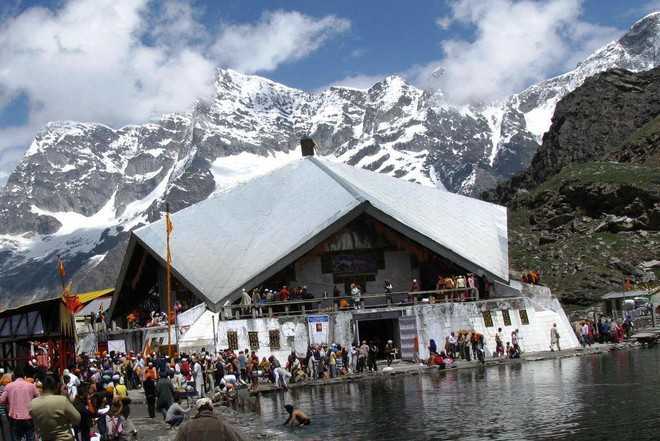
Gurdwara management committee officials said over 2.5 lakh people visited Hemkund Sahib this year. File photo
Gopeshwar, October 10
The portals of Hemkund Sahib, a high-altitude Sikh shrine in Garhwal Himalayas, were closed on Thursday for the winter season.
Over 3,000 Sikh devotees braved the chill to pay obeisance at the temple located at a height of 14202 feet before its ceremonial closure in the afternoon after recital of prayers.
Gurdwara management committee officials said over 2.5 lakh people visited Hemkund Sahib this year.
Doors of the temple will be reopened in May, they said. — PTI
State Stalwarts
DEFENCE MINISTER
Minister Rajnath Singh
ALL HUMANS ARE ONE CREATED BY GOD
HINDUS,MUSLIMS,SIKHS.ISAI SAB HAI BHAI BHAI
CHIEF PATRON ALL INDIA SANJHA MORCHA
LT GEN JASBIR SINGH DHALIWAL, DOGRA
SENIOR PATRON ALL INDIA SANJHA MORCHA
MAJOR GEN HARVIJAY SINGH, SENA MEDAL ,corps of signals
.
.
PATRON ALL INDIA SANJHA MORCHA
MAJ GEN RAMINDER GURAYA ,MADRAS REGIMENT
sanjhamorcha303@gmail.com
PRESIDENT SOUTH ALL INDIA SANJHA MORCHA
COL SS RAJAN BOMBAY SAPPERS,
PRESIDENT UTTARAKHAND ALL INDIA SANJHA MORCHA
COL B M THAPA ,BENGAL SAPPERSS
PRESIDENT HARAYANA STATE CUM COORDINATOR ESM
BRIG DALJIT THUKRAL ,BENGAL SAPPERS
PRESIDENT TRICITY
COL B S BRAR (BHUPI BRAR)
PRESIDENT CHANDIGARH ZONE
COL SHANJIT SINGH BHULLAR
.
.
PRESIDENT PANCHKULA ZONE AND ZIRAKPUR
COL SWARAN SINGH
INDIAN DEFENCE FORCES
DEFENCE FORCES INTEGRATED LOGO
INDIAN AIR FORCE
Air Officer C-in-C WESTERN AIR COMMAND
AIR MSHL S PRABHAKARAN AVSM VM
AOC-IN-C, EASTERN AIR COMMAND
Air Marshal Inderpal Singh Walia
AOC-in-C SOUTH WESTERN AIR COMMAND
Air Marshal Vikram Singh
AOC-IN-C, SOUTHERN AIR COMMAND
Air Marshal J.Chalapati
AOC-IN-C TRAINING COMMAND
AIR MARSHAL SK GHOTIA VSM
AOC-IN-C MAINTENANCE COMMAND
Air Marshal Jagdish Chandra
Flag Officer Commanding in Chief, Western Naval Command
ice Admiral R Hari Kumar, PVSM, AVSM, VSM
Flag Officer Commanding in Chief, Eastern Naval Command
Vice Admiral Sanjay Bhalla, AVSM, NM
Flag Officer Commanding in Chief, Southern Naval Command