All posts by webadmin

Mishaps not new for IAF with Russian-origin AN-32

NEW DELHI: Reliable workhorse — that’s how experts describe Antonov-32, the military aircraft that went missing over the Bay of Bengal on Friday.

COURTESY: IAFThe Antonov-32 is a Russian-origin aircraft that has been in service with the Indian Air Force since 1984. About 250 AN-32s are in service around the world.

The Antonov-32 is a Russianorigin aircraft that has been in service with the Indian Air Force since 1984.

Its design is based on the older AN-26, which first flew in 1969. About 250 AN-32s are in service around the world.

The IAF was the first foreign customer to buy the AN-32 because of the strong defence relations between India and the erstwhile Soviet Union.

India has, over the years, bought 125 of the turboprop military transport aircraft and a little more than 105 are still in service.

India’s AN-32 fleet is currently being upgraded and modernised with advanced avionics, communications systems, landing aids, new oxygen systems and better seats. The upgrade was aimed at extending the aircraft’s service life by 15 years to 40 years.

A contract was signed with Ukraine’s state-owned arms trading agency to refurbish India’s AN-32s by 2017, but the project has run into problems because of the conflict in that country.

The fighting in Ukraine also affected the supply of spares that were to be used to upgrade some 65 aircraft in India.

The AN-32, which can carry 40 to 50 passengers or 7.5 tonnes of cargo, is usually considered a reliable aircraft despite the absence of creature comforts.

The IAF has lost a handful of AN-32s in accidents, the most serious being the crash of one of the aircraft near Delhi’s Indira Gandhi International Airport in March 1999 that killed all 18 people on board and four more on the ground.

In March 1986, one of the first AN-32s being delivered to the IAF from the Soviet Union, disappeared over the Indian Ocean and no trace was found of the aircraft or the seven people on board.

In June 2009, an AN-32 aircraft with 13 people on board crashed while flying from Mechukha in Arunachal Pradesh to Jorhat in Assam. The IAF decided to upgrade the aircraft soon after this crash


Stop inciting violence in India, vacate PoK, Pak told

Stop inciting violence in India, vacate PoK, Pak told
India has accused Pakistan of fanning discontent in the Valley. — Reuters file

New Delhi, July 21

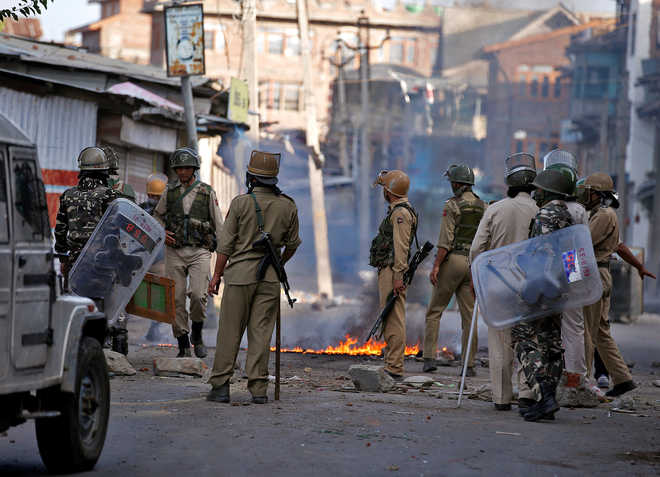
India on Thursday lashed out at Pakistan for “inciting and supporting” terrorism in Jammu and Kashmir and instead asked it to vacate its illegal occupation of Pakistan-occupied-Kashmir (PoK).In a sharp reaction over anti-India rallies being held in Pakistan and other statements emanating from there over the situation in Kashmir, Ministry of External Affairs (MEA) said India strongly condemns encouragement and support to UN-designated terrorists and their activities from Pakistan.Read: Pakistan spreading terrorism in India, says Rajnath
Ministry spokesperson Vikas Swarup also said in view of the threats of marches and protests at the High Commission of India in Islamabad, Pakistan should ensure full safety and security of Indian officials and their families there.

(Follow The Tribune on Facebook; and Twitter @thetribunechd)

“We have seen reports about rallies, events and statements related to J&K in Pakistan and PoK over the last two days. We have also noted that the events were led by UN-designated terrorists, who had in the past protested the elimination of dreaded terrorists including Osama bin Laden and Taliban leader Akhtar Mansour in Pakistan.“India strongly condemns the encouragement and support which such terrorists and their activities receive from Pakistan’s state.”We once again ask Pakistan to stop inciting and supporting violence and terrorism in any part of our country and refrain from its deplorable meddling in our internal affairs in any manner,” the spokesperson said.Asserting that the observance of ‘Kashmir’s Accession to Pakistan Day’ exposes Pakistan’s longing for the territory of J&K, Swarup said, “India demands that Pakistan must fulfil the obligation to vacate its illegal occupation of POK.”   India also asked Pakistan to stop “misleading the international community and Kashmiris through meaningless exercises such as the so-called elections today in PoK which Pakistan ironically calls ‘Azad’ (free).At least 43 people have died and more than 3,000 have been injured in the violence that erupted in Kashmir after the killing of 22-year-old terrorist Burhan Wani by security forces on July 8.India has accused Pakistan of not only pushing in terrorists but also fanning discontent within the Valley by providing support to terrorist outfits in fomenting the recent trouble in Kashmir.Pakistan used Wani’s killing to needle India at the United Nations and issued statements where it accused India of atrocities in Kashmir. Pakistan also observed ‘Black Day’ on July 19 to express solidarity with the people of the Valley over the killing of Wani. — PTI


Rajnath blames Pakistan for stoking violence in Kashmir

Rajnath blames Pakistan for stoking violence in Kashmir
Squarely blames Pakistan for the mess in Kashmir. ANI

Vibha Sharma

Tribune News Service

New Delhi, July 18

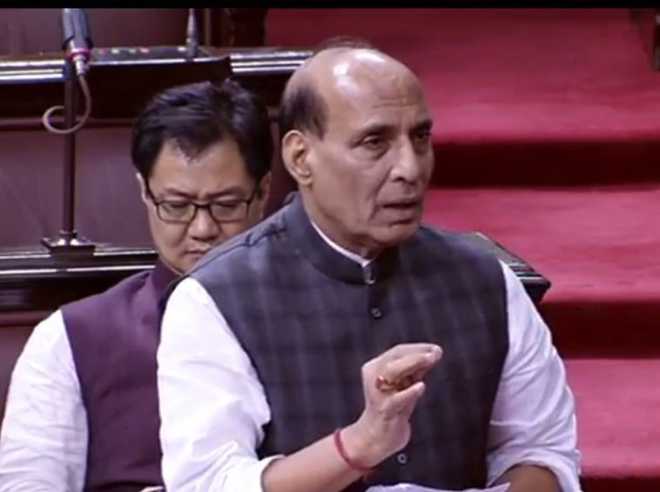
Union Home Minister Rajnath Singh on Monday blamed Pakistan for stoking violence in Kashmir.He was replying to a discussion in the Rajya Sabha on the recent violence in the Valley.Whatever happened in Kashmir has pained me and PM Narendra Modi. He was in constant touch on the issue even while abroad, he said.Replying to the charge that excessive force was used to quell the violence, Rajnath said he and Jammu and Kashmir Chief Minister Mehbooba Mufti had instructed security forces to use maximum restraint.He said a team of eye specialists had been sent to Kashmir. He said as many as 1,671 security personnel had been injured.Rajnath said an extremist had been killed and Pakistan is celebrating Black Day, which is unacceptable. Whatever is happening in Kashmir is sponsored by Pakistan, he added.“I agree there should be a dialogue. I told Mehbooba Mufti that I wanted to come to Srinagar and begin a dialogue process with the locals.” He said the CM had asked him to wait till the situation returned to normal.“Some vested forces are trying to misguide Kashmiri youth. We promise that we will bring them to the right path,” he said.He condemned Pakistan for trying to interfere in matters related to Indian Muslims. “We, and not Pakistan, will look after Indian Muslims. Pakistan, which itself is divided over religious issues, is playing a dirty game. We are not indulging in divisive politics. We will carry everyone along on the issue,” he said.Earlier, Leader of Opposition in Rajya Sabha Ghulam Nabi Azad hit out at the Centre over “brutalities” inflicted on civilians in Jammu and Kashmir, asking if civilians should be “treated in the same manner as militants”.Starting the discussion on the Kashmir situation in the Upper House, Azad said he did not want to blame anyone–either the Centre or the state government. However, it was a matter of concern why the situation had deteriorated so much, he added.People had died in all 10 districts in the Valley, which is unprecedented, he said. The way guns were used, the sheer brutality with which pellets were used and the police controlled the situation is unacceptable, he said.Azad said no party, including the Congress, supported militancy. But there should be a difference between how a militant and the old, women and children are treated. “We support your call against militancy,” Azad told the government. “However, we cannot support you in the way you are treating ordinary citizens,” he added.“As many as 1,800 people are lying injured in hospitals. This type of violence was not used even in Haryana despite a huge agitation there,” he said.The way Kashmiri students are “treated” in educational institutes is adding to the “lack of trust” that people have in the current government at the Centre, Azad alleged.“The BJP does not have acceptability in Kashmir Valley, we had warned,” Azad said, adding, “The BJP’s “mismatch” with the PDP had resulted in the “bursting of the simmering lava”.He said there should be a healing touch and not the use of “disproportionate force” in the Valley. Why such a disproportionate force was not used elsewhere in the country, he wondered.Azad said he is all for the freedom of Press but the media should also act responsibly. The way TV channels compete with one another in inciting sentiments, they should be taken to task.Azad asked the government to call an all-party meeting and fix responsibility of those who used “excessive force” in the Valley.Leader of the House Arun Jaitley thanked Azad for highlighting the issue. He said many a time one needed to get out of one’s political limitations and show a level of statesmanship.


An old new militancy ::Written by Syed Ata Hasnain

In the absence of political engagement, a wide space has opened up for radicalisation in the Valley.

kashmir protests, kashmir violence, burhan wani death, burhan wani killing, Mehbooba Mufti, Burhan Wani, hizbul mujahideen, hizbul, hizbul commander, hizbul militant, Afzal Guru, kashmir violence, kashmir valley, jammu kashmir news, kashmir news, india news

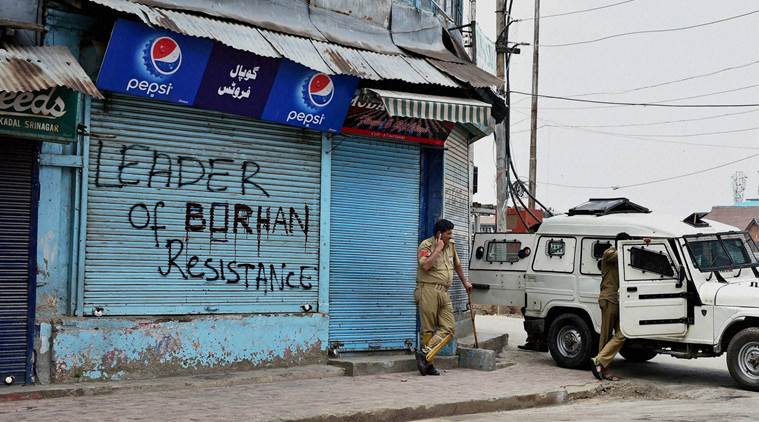
A terrorist’s days are always numbered and so were Burhan Wani’s. Leading the new militancy in South Kashmir, the 22-year-old angry young man from the passionately anti-India town of Tral brought an aura of romance to terror in South Kashmir. Induced into leading a renegade life because of the allegedly undignified treatment by a few errant policemen, Burhan swore retribution. Rather than follow the path of extreme violence, he acquired a Robin Hood image through social media, which catapulted him to iconic fame in the eyes of those favouring a fracture from India. This enabled him to attract 60-70 young local Kashmiris to a similar cause, and empowered them to take the path of violence. In reality, his new militancy was all about indigenous struggle, with “azadi” as the aspiration; hence the attraction.

Burhan met his end at Kokernag in an encounter which was in the offing for some time once the focus of intelligence had him in the spotlight. His death expectedly sparked widespread violence in the streets. The situation throws up many questions which need to be answered here, in as much black and white and least through shades of grey. Was it necessary to neutralise Burhan at a time when all triggers attempted by the separatists had failed to instigate a return to the situation in 2008-10? Could it have awaited the termination of the Amarnath Yatra, the implications being obvious?

WATCH VIDEO: Kashmir Protests: Visuals Of Curfew In the State

Intelligence generated opportunities to neutralise an important terrorist who has acquired inspirational status, do not come easily. Terrorist leaders of the past have survived over 10 years in the same area in South Kashmir and Burhan was becoming larger than life, an embarrassment to the army and police. The decision to target him was correct. The decision to hand over his body for burial with full knowledge of the implications, was a bold one and no doubt considered by all stakeholders. This decision too was correct because it diluted the angst to some degree. Without the body, prayers “in absentia” would still have taken place all over South Kashmir and Srinagar; what the tempers would have been like could not be ascertained.

The more important thing to examine is the continued linkage between the directors sitting across the LoC and the speed with which the stone-throwing mobs mobilised, as if the contingency was well thought out. The focus with which 17 police stations were targeted on the first day appeared almost like a military plan. Remote places like D.H. Pora near Shopian, otherwise low in terror activity and with mainstream political influence, erupted unpredictably. Mobs were bold enough even to target the air force station at Awantipura and the BSF camp nearby, a far cry from 2010.

WATCH VIDEO: Kashmir Protests Victim: 5-Year Old Zohra On How She Got Hit


The deduction is clear. With the improvement in Pakistan’s internal security situation, focus has returned to Kashmir to arrest the situation perceived as slipping from Pakistan’s control. Pathankot was the first attempt; it upset the peace process. Handwara and Sainik Colonies were the second and third attempted triggers; both failed. Contingency planning probably focused on the potential neutralisation of a terrorist leader perceived as charismatic by the public. That a terrorist leader’s days are numbered has already been stated and in today’s environment the average life span in militancy is a mere six months. Burhan was pushing his luck for five years.

The officials admit that the violence was expected, as is the norm in Kashmir, but the speed, scale and spread were not. A return to 2008-10 spelt advantage for the deep state in Pakistan, and for the separatists and ideologues, who had been vainly attempting a revival of the mass upsurge and not finding the trigger to achieve the desired effect. And that really is the story behind the sordid drama being played out all over again.

The Central and state governments are being accused of being in denial of the problem and barking up the wrong tree, with the former engaging Pakistan in a peace process which will apparently go nowhere. That may be a trifle unfair; I do believe that the issues are mutually exclusive. What is, however, wholly true is the dearth of a strategy. Anyone who has worked in and experienced Kashmir’s turbulence will tell you that the angst and the alienation come from the sheer lack of communication, the inability of the political community to shed the fears of 26 years of proxy conflict and engage deeply with their constituencies; the lack of grassroot politics and the mistaken belief that polls make up for all that. In the absence of this engagement, a wide space has been opened to the religious ideologues. Can anyone deny that the so-called radicalisation of society and power at the hands of the rabblerousing clergy happened right under our noses? Reports were frequently made but the buck was passed through chains of bureaucracy without application of mind on how to tackle it.

The inevitable question is: What next? There is no option but to cast aside all political differences and come on to the same page. Leaving ego aside, all-party delegations must get to the ground and engage those willing to be engaged even as no nonsense is broached on the law and order front. They can even meet the clergy, if necessary, to stop impassioning the street with sermons and negativity. Let the Unified Command burn the midnight oil to come up with options for reducing strife at the tactical level. In 2010, it was the brigade commanders and officers below that rank who proved tenacious and subtle in dealing with elders and youth alike. There is no guarantee it will work this time — but try we must.

Whenever this phase passes, let Delhi’s think tanks focus on Kashmir instead of giving priority to issues of faraway West Asia and South China Sea. That, too, is important but not as much as the home turf which needs more ideas on how to communicate better with a population awaiting just that. All is not lost, but it will be, if the message does not sink in this time.

images
The writer is former GOC of the Srinagar-based 15 Corps and fellow, Delhi Policy Group and Vivekananda International Foundation.

Misuse of AFSPA Extra-judicial killings have no place in a civilised society

The Supreme Court has come out strongly in favour of the human rights of Indian citizens, including those living in the “disturbed” areas. The court’s direction on a PIL petition on the 1,528 alleged killings by security forces and the police in Manipur shows that it was not satisfied with the submissions made in defence by the government and the Army. After a long time the controversial Armed Forces Special Powers Act (AFSPA) has come under a critical review. The court has asserted that there is no absolute immunity under the Act.
While the Army maintains that it needs AFSPA’s protection, allegations of misuse of power have surfaced frequently and bred resentment against the state and its armed forces in Manipur and Jammu and Kashmir. Ideally, the Army should not deal with terrorism. Punjab was able to contain militancy without Army help. Whenever the Army is deployed, it has to be ensured that excessive or retaliatory force is not allowed to be used. A prolonged Army deployment with unlimited powers under AFSPA can prove counter-productive as has happened in Manipur. For many years now Manipur has lived with internal disturbances, fake encounters and protests against AFSPA. The Centre and the state government are to blame for the excessive reliance on the Army to contain insurgency.
The Supreme Court has called for an inquiry by an independent agency into all Manipur encounters that have happened in the last two decades. This will hopefully make the powers-that-be realise that no matter how difficult and challenging a situation, violations of the rule of law cannot be overlooked or sanctioned. The Army, at best, can supplement the civil administration’s efforts to control a volatile situation in the short term. If allowed to carry on beyond a point for whatever reason — political convenience or inadequacies of the state/Central forces — the arrangement is bound to backfire. When AFSPA is allowed to stay for six long decades, instances of abuse of power are bound to crop up. As and when excesses happen, these must be investigated thoroughly and swiftly so that the guilty don’t go unpunished.


Finally, Tejas flies into IAF fleet LCA’s first squadron ‘Flying Daggers’ gets two jets, six more to join by December

Ajay Banerjee

Tribune News Service

New Delhi, July 1
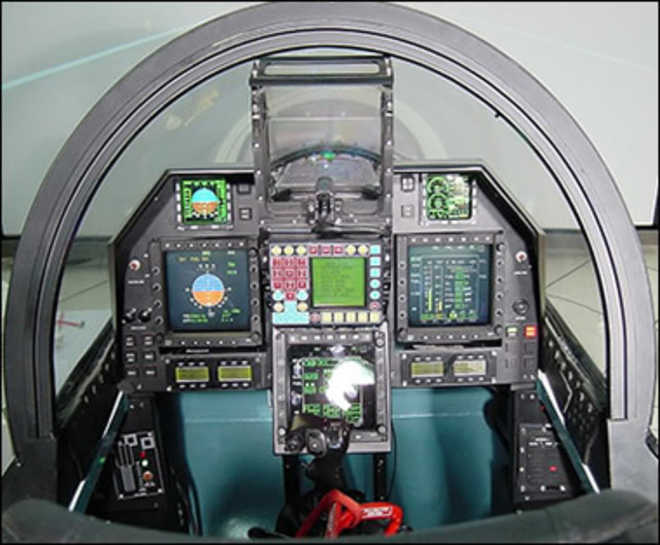
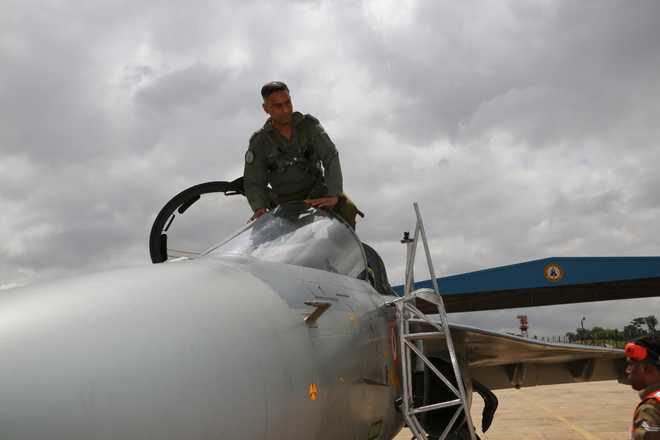
The country’s first indigenously built Light Combat Aircraft (LCA), the Tejas, was today inducted into Indian Air Force (IAF), making it an important day in the history of India’s defence manufacturing efforts.Group Captain Madhav Rangachari will command ‘Flying Daggers’ — the first squadron of Tejas. He flew the inaugural flight of the plane in Bengaluru today.(Follow The Tribune on Facebook and Twitter @thetribunechd)Only two planes have been inducted so far and the entire squadron of 18 planes will be built over the next two years. Six more planes will join in by December-end. The euphoria of history apart, the real test of maker Hindustan Aeronautics Limited (HAL), a public sector undertaking of the Ministry of Defence, starts now. The HAL has been asked to deliver two successive improved versions of Tejas with the second version called “Tejas Mark 1-A” to start production in 2019.These will include new generation active electronically scanned array (AESA) radar which simultaneously tracks and aims at targets in the air and ground, an advanced electronic warfare suite, addition of latest beyond visual range (BVR) of missiles, mid-air refuelling facility and greater war fighting abilities. In all, 43 improvements will be made in the existing plane.”These additions will make the plane truly world class. Today is a historic day and signals ours growth,” said Air Marshal Kapil Kak (retd).In all, 120-125 planes are to be produced and with HAL’s existing capacity of making eight planes annually. This may take up to 15-17 years. The HAL has been asked to produce 16 jets annually and a Rs 1,252-crore modernisation plan has been approved to ramp up capacities.Tejas will fill in the void created by MiG-21s and MiG-27s that will be phased out by 2022. The IAF needs 400 jets over the next 10 years. The gap is slated to be filled by 36 Rafale jets, 80-100 fifth generation fighter aircraft to be co-produced with Russia and another 80-100 Rafale-type medium combat jets. 


Of national pride and happiness!Induction of indigenously made Tejas fighter jet into the Air Force fills our hearts with unparalleled pride and happiness…I laud HAL and ADA on the induction of Tejas fighter jet. This illustrates our skills and strengths to enhance indigenous defence manufacturing. Narendra Modi, Prime MinisterCongratulations to Hindustan Aeronautics Limited and Aeronautical Development Agency for successful induction of the indigenously developed Tejas fighter jet…Moment of National pride…Tejas will take our air strength to new heights. Manohar Parrikar, Defence Minister


33 years in makingRs 10,397.11 cr Spent so far

1983Conception year

Makers Hindustan Aeronautics Limited & Aeronautical Development Agency


Made up of

42%carbon fibre composites

43%aluminium alloy

15%titanium alloy


Two delivered2 Aircraft in new ‘Flying Daggers’ squadron18 Planes to be ready by 2018MiG-21 To be replaced by Tejas


Supersonic LCA

1,300 km/hr(1.6 Mach) Speed

4 tonnesPayload capacity

2,000 hours Test flying


‘I felt on top of the world’Flying the indigenous Tejas LCA after its induction into the IAF was like being on top of the world, said Group Captain Madhav Rangachari on Friday. “I felt like being on top of the world when flying the Tejas fighter. It’s an honour and a privilege to pilot the inaugural flight of the LCA soon after its induction,” Rangachari told reporters after a 10-minute solo sortie under a cloudy sky and windy conditions. The 40-year-old test pilot is the commanding officer of the IAF’s 45 squadron nicknamed “Flying Daggers”. With 3,000 flying hours’ experience, Rangachari was part of the Mirage 2000 squadron before flying the multirole Tejas since a year. “I could do only horizontal profile and not vertical due to the cloudy sky. It’s an excellent aircraft and generation ahead of other fighters in the world,” Rangachari said. — IANS

clip

IAF adds muscle power with Tejas

A milestone in country’s military aviation, officials say aircraft will be used for air-to-air and air-to-ground strikes

THE REAL CHALLENGE IS HOW FAST THE TEJAS CAN MATURE INTO A FULL-FLEDGED FIGHTER JET

From page 01 NEW DELHI: The Indian government officially announced the induction of the Tejas Light Combat Aircraft (LCA) into the air force on Friday. This is a landmark development in Indian aeronautical technology. Yet it has to be seen if the aircraft, for both technical and production reasons, can cover a dangerous gap in India’s airpower. TECHNICAL TEST The purpose of the LCA was to replace the lightweight component of the IAF, largely composed of its obsolete Mig-21s and ageing Mirage 2000s. It is technologically far superior to the various types of Mig-21s, aircraft that were designed in the 1960s and put away in museums everywhere else. But the Tejas real test is whether it can better its equivalents in the Pakistani and Chinese air forces: respectively, the JF-17 and J-10.

Former Air Vice-Marshal Kapil Kak, based on conversation with pilots who have flown both the JF-17 and the Tejas, says, “The Tejas is far superior to the JF-17.” However, it is questionable if the Tejas is upto scratch when it comes to the Chinese J-10. The latter has received good reviews even in the US. Ashley Tellis of the Carnegie Endowment, in a report on the IAF, notes the J-10 has “turned out to be an impressive lightweight fourth-generation combatant.” And it is far ahead on the development curve than Tejas. The LCA was initially envisaged to allow India to leapfrog ahead of its principal military rivals in the region, with claims it would be a 1000 kgs lighter and so on. According to those who have flown it, the LCA is remarkably manoeuvrable and agile, especially in turning.

But it is on par rather than decisively superior to comparable airplanes. The Tejas empty weight, for example, of 6560 kgs and a fully-loaded weight of 13,500 kgs, no real improvement on the much older Mirage 200C’s figures of 7,500 kgs and 17,000 kgs. Executives of major international defence companies say the Tejas has poor thrust-to-weight ratio and a limited top speed given how new it is. It also uses an Israeli EL/M-2052 radar that is inferior to the US counterparts used by Pakistan. The Israeli Air Force prefers the US radar over the EL/M-2052. PRODUCTION TEST The real challenge is how fast the Tejas can mature into a fully mature fighter and how fast it can be churned out. The Indian Air Force is already suffering a crisis in numbers and, in the coming decade, will be forced to retire many of its old fighters. The evidence is that Tejas fighters will trundle off the assembly lines too slowly to matter.

The first problem is that what is being inducted in the air force right now is not the finished fighter. This is the Initial Operational Clearance model, a functional early variety that will be used to help detect teething problems in the aircraft. This will then be followed by a Final Operational Clearance model and then, in theory, a final battle space-ready product, the Tejas 1A. What is being rolled out now, says Kak, cannot be deployed in sensitive combat theatres in the east and west “for at least 10 years.” And the Tejas 1A may not make an appearance until 2030 or so.

The second problem is how fast Hindustan Aeronautics can actually produce the Tejas. At present, HAL can only churn out eight aircraft a year against an IAF minimum requirement of 18 aircraft a year. “Half a squadron a year is the rate of induction we can hope for, in the best of circumstances,” says Kak.

In the meantime, IAF is facing a steady attrition in its numbers from crashes and simple age.


India’s domestically-developed light combat aircraft formally joined the IAF and flew on its first sortie in Bengaluru on Friday


Review of security needed for AFSPA revocation: Govt

Tribune News Service

Srinagar, June 30

The J&K Government today said a critical review of the security situation is needed for revocation of the Armed Forces Special Powers Act (AFSPA) in the state.“The AFSPA is in operation in various districts. The need and desirability of revocation of the AFSPA in various areas of the state requires critical review of the security situation and other relevant factors,” said Chief Minister Mehbooba Mufti, who holds charge of the home portfolio. She said this in a written reply to clubbed questions of National Conference legislators Shehnaz Ganai, Showkat Hussain Ganai and Bashir Ahmad Veeri in the Legislative Council here.The lawmakers had asked the government as to what steps were being taken to revoke the disturbed areas Act from the state in a phased manner.Mehbooba said that the Jammu and Kashmir Disturbed Areas Act, 1997, ceased to be in force with effect from October 7, 1998.Later, giving details about the Public Safety Act, Mehbooba said that 240 persons had been booked under the Act in the state since 2014.“Those booked under the PSA have been detained under the provisions of the Jammu and Kashmir Public Safety Act, 1978, and the Jammu and Kashmir Prevention of Illicit Traffic in Narcotic and Drugs Act, 1998,” Mehbooba said.


NSG push ‘ill-advised, unwarranted’, says noted scientist

NSG push ‘ill-advised, unwarranted’, says noted scientist

Hyderabad, June 25

Noted scientist and Atomic Energy Commission (AEC) member M.R. Srinivasan on Saturday said the Centre’s push to gain Nuclear Suppliers Group membership was “unnecessary, unwarranted and ill-advised”, a day after India failed in its bid to clinch membership of the 48-member club.

The AEC, a body under the Department of Atomic Energy (DAE), would have advised the government to desist from such a move had it been consulted, he said.

(Follow The Tribune on Facebook and Twitter @thetribunechd)

Srinivasan, a former Chairman of the AEC, which looks after atomic energy activities in the country, argued that NSG membership does not make a difference to India’s nuclear commerce as New Delhi has signed agreements with other countries for supply of reactors and uranium.

“Unnecessarily, India made a big hype about this admission into the NSG. It was completely unnecessary because the 2008 waiver was already enabling us to have nuclear commerce with nuclear advanced countries and we already have agreements with Russia, France and the United States for reactor projects…,” he said in an interview to PTI today.

India also has uranium-buying agreement with multiple countries, including Kazakhstan, Canada and Australia, Srinivasan noted, adding that it was an “unwarranted and ill-advised initiative” to seek entry into the group of nuclear-supplier countries set up in 1974.

The Padma Bhushan awardee said failure to get in the NSG would not have adverse impact on India’s nuclear programme as New Delhi has its own capability “for designing and building reactors and fuel manufacturing, reprocessing and so on.”

“On the ground, it won’t make any difference (on failure to get NSG membership). We already have a waiver. We are already having cooperation with important countries and countries who are able to supply uranium. There was no need for us to subject ourselves to embarrassment. Unfortunately, our (India’s) self-esteem has been dented (with this failure),” the well-known 86-year-old nuclear scientist said.

“(Had) the matter been initially brought to the Atomic Energy Commission, (of) which I am still a member, and if they (the Government) had asked if we (the Government) should proceed with this issue (seeking NSG entry), I would have said the same thing—‘don’t raise the issue’,” he said.

“But it was not brought to the Atomic Energy Commission. It’s unfortunate. It was thought to be the preserve of Foreign Office… Ministry of External Affairs… I do not know. Needless drama (India’s diplomatic push on NSG membership) has gone on for a number of days,” he said.

Srinivasan, who played a key role in the development of India’s nuclear power programme and Pressurised Heavy Water Reactor (PHWR), said that no evaluation was made about the perceived benefits of NSG membership.

“…whether we should have put so much efforts… the Prime Minister going to so many countries, canvassing (for NSG entry). Somebody from Foreign Office who has done evaluation, either they did evaluation and their assumptions were not borne out or evaluation was not properly carried out. I am unhappy that we should put so much importance to this thing (NSG membership),” he said.

Needless expectations were raised on becoming part of the group and so much political capital at the highest level of the Government of India and Prime Minister was deployed for the purpose, the noted scientist said.

“It was a quest we could have well avoided and an embarrassment we could well have avoided,” he said, pointing out that India should have sensed the mood with China and some other countries raising objections to India’s membership.

He also found fault with the media’s description of the NSG as an “elite group”.

“How can a 48-member NSG be an elite group? It got members like New Zealand, Ireland… all these people who have no nuclear programme of any kind,” he said. — PTI


India singles out China for crushing NSG dream

NEW DELHI: The Nuclear Suppliers Group (NSG) kept on hold India’s request for membership on Friday after several countries led by China refused to adjust rules that require New Delhi to first sign a global arms control pact.

A disappointed India said, in an unusual ly sharp but veiled reference to China, that one country persistently created “procedural hurdles”, a byword for Beijing’s insistence New Delhi sign the nuclear Non-Proliferation Treaty (NPT).

New Delhi had gone to Seoul without any certainty of victory. It had hoped intense lobbying, which included cross-continent diplomatic campaigns by Prime Minister Narendra Modi and a last-minute meeting with Chinese President Xi Jinping, would help deal with the procedural necessities for a non-NPT member’s entry into the NSG.

But it was clear on Friday that the Chinese opposition had encouraged six others to also raise procedural points about India’s entry into the grouping that controls access to nuclear materials and technology. “We understand that despite procedural hurdles persistently raised by one country, a threehour-long discussion took place last night on the issue of future participation in the NSG,” external affairs ministry spokesperson Vikas Swarup said.

“The NSG plenary in Seoul earlier in the day decided against granting India membership of the grouping immediately and said it will continue to have discussions on participation of countries which have not signed the Nuclear non-Proliferation Treaty.”

China is leading opposition to a push by the United States to bring India into the NSG. Beijing’s all-weather ally, Pakistan, which hasn’t signed the NPT either, is also seeking membership.


Britain’s disruptive vote…

THE United Kingdom has, by a narrow margin of 1,219,501, decided to leave the European Union. This is a deeply unsettling and disruptive vote and its consequences are already being felt across the world. It will be weeks of uncertainty and confusion before the British political establishment itself would be able to figure out how to proceed on the divorce. Details of the vote revealed a nation fractured and divided down the middle. The kind of anchored equilibrium that characterised the English society, politics and economics for a century appears to have dissolved within a fortnight. Prime Minister David Cameron, who led the ‘stay’ campaign, had taken a gamble in calling for the referendum — and, has, now, lost it. This man was voted back to power only a year ago and handed a sturdy mandate. He now stands rejected.  He has been left with no choice but to step down. Till the Conservative Party finds a new leader, Cameron would remain a wounded and crippled Prime Minister. The formal leadership of the Labour Party, too, stands diminished. The Labour Party also favoured a continuation in the European Union but it never demonstrated sufficient energy or verve in its advocacy. Its internal divisions and factionalism would get further aggravated. The two established parties should feel soundly rebuked by the voter. Thursday’s ‘out’ vote is deeply troubling because it represents a symbolically potent victory for politics of anger, hate and xenophobia. The ‘out’ campaign was openly nasty and ugly; it was directed at the average British voter’s fear of the immigrant. The ‘out’ success will give a decided fillip to all the right-wing political leaders and outfits in Europe and beyond. It would be noted that the British voter also spurned President Obama’s advice to ‘stay’, whereas the Republican presumptive nominee, Donald Trump, had championed an ‘out’ vote. The British voter had unwittingly bestowed some kind of respectability on all kinds of demagogues around the world, who would now feel emboldened enough to invoke narrow nationalism and isolationism to crank up a sectarian agenda in their respective domestic politics. The voices of openness, pluralism and tolerance have suffered a definite setback. It is a defining moment — and, not just in England.

India must brace for change

WITH Britain’s ‘Leave’ European Union vote, global financial markets got a nasty jolt, reviving bad memories of the Lehman moment. Its ramifications could be more complicated and even worse. The impact on India will be relatively limited largely because of our domestic-focused economy. The Britain and EU-centric export-led economies will feel the real heat. The reassuring words from Finance Minister Jaitley and RBI Governor Raghuram Rajan about India’s good fundamentals, low short-term external debt, and sizeable foreign reserves did soften the initial blow but long-term concerns remain. Remember after the Lehman collapse, capital outflows continued for five long years. The business sentiment here was just beginning to improve, economic growth was picking up and the government too opened up various sectors of the economy to woo foreign investment. All this would be in danger until stability returns. India’s exports, already shrinking, will suffer further. The $8.83 billion trade with Britain will be in jeopardy as also the auto and pharmaceutical exports to Europe. Foreign funding expected to pour in infrastructure, defence, civil aviation, real estate and other areas may get delayed or shelved.In turbulent times fund managers look for safe havens like the dollar and gold, which appreciated significantly on the very day the news of divorce came. But the other infected assets — stocks, currencies, commodities — could fall further, impacting the performance of economies and companies. A cheaper pound will make trips, holidays and education in Britain cheaper for Indians. A fall in oil prices is expected and it will benefit India. Low commodity prices, however, can also hit corporate performance and poor corporate earnings would derail the plans on managing bad loans of public sector banks and trigger capital outflows, weakening the rupee. How effectively the RBI handles the situation, how monetary policy is shaped and whether the new RBI Governor generates Rajan-like confidence in investors will decide the fate of India’s financial markets, businesses and economy.


Britain leaves EU

S Nihal Singh
Time to fix a broken institution

Britain leaves EU
happy hour: The ‘greatness’ of Britain weighed heavy.

BRITAIN’s decision to leave the EU after a bitter and divisive campaign symbolised by the murder of the British MP Jo Cox has roiled world markets and posed the most serious crisis for the 28-nation group since its inception. The post-World War II idealism that brought warring nations together has undergone a dramatic change. Britain must now begin the process of formalising the divorce over two years and sort out the ramifications of separating from the EU, most notably in its relation to the common market, and possible domestic fallout in terms of Scotland that largely voted to remain in the EU seeking another referendum to seek independence from the UK. It is indicative of the joy of supporters of Brexit that the leader of the UK Independence Party, Mr Nigel Farage, should declare the referendum result as independence day. And far right leaders in France and the Netherlands, Ms Marine Le Pen, and Mr Geert Wilders, have been quick to call for votes in their countries to leave the EU.The major European members, Germany and France, must now act quickly to steady the EU ship by calling an early summit to reassure members that the British act is not contagious. There are good reasons for the rest to stay together, despite dissension.   The EU is facing three kinds of crisis: a large dose of Euroscepticism, inability to act together in the face of a major crisis such as the flood of refugees and the still shaky foundations of the common currency, the euro, with its members in an unequal relationship.Beyond these crises looms the central question that was not resolved through two world wars: how to tame the power of Germany? Britain, together with such countries as France, was a balancer, but since the UK has opted out, it will disturb this balance.Ironically, the very evils of nationalism the EU and its earlier avatars were meant to banish are raising their heads again. In the case of Hungary and Poland in particular, nationalistic and nativist tendencies are being blatantly promoted and the rise of the right and anti-EU rhetoric in major member states are ominous signs. It is ironic that Germany, which dominates EU policy-making, should host an Alternative for Germany party which has gained strength in the face of the unique welcome Chancellor Angela Merkel gave Syrian refugees.Ms Le Pen’s National Front has never been shy in proclaiming its Euroscepticism and is now considered a likely run-off candidate in next year’s French presidential election. Italy, Greece and Spain have their own anti-establishment parties, with anti-establishment candidate winning Rome and Turin mayoral contests against a once anti-establishment party candidates, now ruling dispensation.Where does the task of fixing a broken EU begin? The idealism that built the EU vanished in the 2008 recession and the feeble growth of most member states. The young, of course, take for granted the great benefits of visa-free travel and the ability to work anywhere in the EU. There are other tangible benefits of a common market in boosting trade. Yet the deep shoots of nationalism are negating the very rationale of a group like the EU.The most shameful aspect of the EU in recent times has been the refusal of many members to share the burden of hundreds of thousands of refugees from war-torn Middle East, some signifying their Muslim faith in refusing to give them asylum. Ms Merkel was left holding the baby. She paid a political price at home and completed a shady deal with Turkey for stemming the flow of refugees.Many critics of the EU decry the bureaucracy of Brussels, the group’s headquarters. Like all large organisations, the EU has its share of bureaucrats who guard their turf and take rigid positions. It is the task of the leadership to undertake spring cleaning. But the more immediate problem is of fixing the major fault lines that have emerged.Germany must take the lead because it is the largest aid-giver while Greece is at the other end of the scale. Apart from Athens’ continuing economic woes, there is widespread dissatisfaction with the traditional Berlin cure of following austerity policies for debt-ridden economies. Perhaps it is time to loosen the purse strings, although German hesitation is understandable, given that it is the main banker in doling out money, which comes from the country’s taxpayers.The present state of the EU highlighted by Britain’s own problem of reconciling itself to the fall from a once Great Britain to its present more humble status, poses a broader question: how to make the group useful and beneficial as it is in so many ways, more attractive and sexy to the young?The turn to the far right and nationalist jingoism are expressions of the citizens’ search for something they are missing in the EU. Tawdry deal-making at interminable summits are no substitute for enthusing EU citizens.Besides, the virtual common membership of the EU and the North Atlantic Treaty Organisation (NATO) has given a new twist to a problem familiar to all in the days of the Cold War. We are not quite in a new Cold War but Russia’s understandable resentment over the West’s attempt to swing Ukraine to its side has raised knotty questions.Despite Russia’s reduced status, Ukraine is the cradle of Russian roots in the Orthodox faith, with eastern parts of the country, largely Russian speaking, still attached to what many view as their motherland. The events on the Maidan in Kiev that led to regime change and an aggressive swing to the EU encouraged by Washington resulted in Moscow’s backing for pro-Russian rebels in the east, leading to two Minsk agreements with Western powers with an imperfect peace in place. It did not make sense for the EU to assume that Moscow would accept a country with a vast population so intimately connected with Mother Russia and sharing borders with it to be hived off.In any event, Moscow’s relations with the West have entered a turbulent phase with NATO gearing for reinforcing troops and equipment on states bordering Russia to reassure nervous neighbours such as Poland and the Baltic states. These moves detract from the central purpose of the EU.Britain’s exit gives an opportunity to EU members to revisit their organisation to correct its deficiencies in order to return it to the outlook of its founders in a vastly changed Europe and world. It would be a pity if the opportunity were lost.